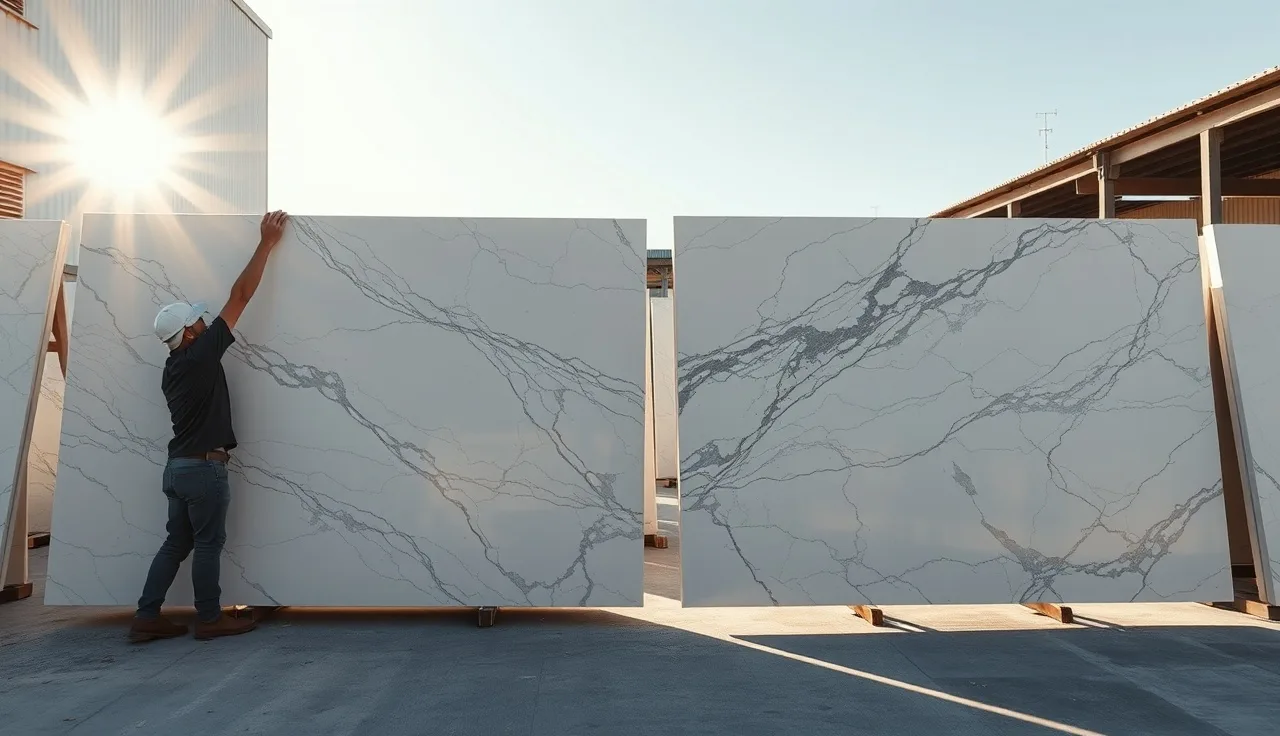
TL;DR
- No two natural stone slabs are identical.
- Color shifts, veining, pits, fissures, and movement are geological facts, not defects.
- Fabricators who set this expectation clearly before templating avoid the most common post-installation complaints.
- This guide covers the science behind variation, how to frame it in a sales conversation, and what homeowners should actually look at when approving a slab.
Why does natural stone look different from slab to slab?
The short answer: stone forms over millions of years under pressure, heat, and mineral-rich groundwater, and no two pockets of the earth share identical chemistry. What you see on a slab surface is a snapshot of that geology.
Granite, for example, forms when magma cools slowly underground. The crystal size, color, and pattern depend on the cooling rate and which minerals were present. Feldspar, quartz, mica, and hornblende each contribute different colors. Shift the mineral ratios a few percentage points and the stone looks like a completely different product, even if it came from the same quarry [1].
Marble starts as limestone and gets recrystallized by heat and pressure. The veining that makes marble countertops so distinctive comes from clay, silt, or iron oxide that was trapped in the original limestone and then deformed during metamorphism. A vein running through one block may pinch out entirely in the block cut right next to it.
Quartzite and soapstone have their own formation stories, but the principle is the same. The earth did not manufacture these materials to a spec sheet. The variation is the product.
What specific things about stone actually vary from slab to slab?
Homeowners often expect variation in color, but they're frequently surprised by everything else. Here's what actually changes:
Background color. The base tone of a slab can shift from creamy white to warm gold to cool gray even within a single quarry block run. This is especially common in quartzites and marbles where iron content varies by layer [2].
Veining density and direction. A marble variety like Calacatta can come in slabs with sparse, delicate veins and also in slabs with heavy, bold movement. Both are authentic Calacatta. Neither is wrong. The display slab at the showroom may represent the thinner end of that range.
Crystal size. In granite, crystal clusters can range from fine-grained (almost sandy looking) to coarse-grained (large, blocky feldspar patches). This changes how busy or calm the surface feels at kitchen distance.
Pitting. Some granites, particularly darker ones, have natural voids left by softer minerals that weathered or fell out during quarrying and finishing. The Marble Institute of America notes that pitting is a naturally occurring characteristic of many granite varieties, not a fabrication defect [3].
Fissures. These are linear separations along grain boundaries. They are not cracks. A fissure is pre-existing geology; a crack happens after the stone is installed, usually from impact or thermal shock. Running a fingernail across them helps homeowners feel the difference: a fissure is flush, a crack has a raised edge.
Background movement. Some slabs are still and uniform; others have swirling clouds of lighter or darker material. Two slabs labeled the same trade name can sit at opposite ends of this spectrum.
| Feature | What homeowners expect | What actually happens |
|---|---|---|
| Color | Matches the showroom sample | Can shift one or two shades across a bundle |
| Veining | Consistent with display slab | May be heavier, lighter, or differently placed |
| Pitting | Smooth surface | Natural voids present in many granite types |
| Fissures | No visible lines | Hairline separations are normal geology |
| Background movement | Uniform | Can vary from calm to dramatic within one stone name |
Is there a standard that defines what counts as a defect versus normal variation?
Yes, and fabricators should know it. The Natural Stone Institute (formerly the Marble Institute of America) publishes technical standards that separate natural characteristics from true defects. Their guidance treats pitting, fissures, and color variation as inherent characteristics of natural stone, not grounds for rejection under normal trade standards [3].
The key legal concept is merchantability. Under the Uniform Commercial Code (UCC) Section 2-314, goods must be fit for their ordinary purpose [4]. A granite countertop with a fissure that does not affect structural integrity or function is still merchantable. Homeowners sometimes try to reject fabricated tops by pointing to fissures as cracks; knowing the UCC language helps fabricators respond clearly. The statute puts it plainly: goods are merchantable only if they are "fit for the ordinary purposes for which such goods are used."
For slabs with actual fabrication defects (a saw cut that chips an edge, a seam that opens up because of improper adhesive), the standards are different. Those are workmanship issues. But the stone's geology is not the fabricator's responsibility to control.
The practical takeaway for shop owners: document the slab condition at templating with photos, note any fissures or pitting on the work order, and have the homeowner sign that they viewed and accepted the specific slabs to be used. That paper trail is the fastest way to resolve a post-installation complaint.
How should fabricators explain stone variation to homeowners without losing the sale?
Framing matters more than the facts. Homeowners who hear "the stone might look different" feel anxiety. Homeowners who hear "you're getting something nobody else in the world has" feel excited. Both sentences describe the same reality.
Here's a conversation structure that works:
Start with geology, briefly. Tell them the stone formed millions of years ago and the pattern on their slab is a record of that process. One sentence is enough. Most homeowners find this genuinely interesting.
Then anchor on what they're actually selecting. When a homeowner chooses a 2-cm Calacatta marble display slab from the showroom, they are choosing a material category and a general aesthetic range, not a reproduction of that exact slab. Walk them to the actual slabs in inventory (or to a supplier's yard) and let them pick the specific pieces [5]. This is the single most effective step. Homeowners who personally choose their slabs almost never complain about variation afterward.
Address fissures directly and early. Show them a fissure on a display sample, explain that it's geology not damage, and run their fingernail across it so they feel that it's flush. Tactile experience lands better than explanation.
Set the lighting expectation. A slab looks different under showroom fluorescent light than under kitchen pendant lighting. If possible, let them see the slab in natural light or take a photo with their phone to review at home.
Finally, explain the seam conversation separately. Seams are where variation becomes most visible, because two slabs of the same material rarely have identical flow at their edges. That deserves its own dedicated discussion before layout approval, not a note buried in the contract.
What should homeowners look at when they approve a slab at the yard?
Most homeowners have never bought stone before. Telling them to "go pick a slab" without guidance produces either paralysis or a choice they'll regret. Give them a short checklist.
First, look at the slab wet and dry. Yards sometimes wet slabs to show the finished color. Ask them to show you the dry appearance too, because daily life is dry.
Second, look at the full slab from kitchen distance (about 3 to 4 feet) and from 12 inches. The overall movement matters more at kitchen distance; pitting and fissures are only visible up close and won't register from across the room.
Third, check the slab's back half and edges. The face material runs all the way through the slab; checking edges shows you what the cut edges and sink cutouts will reveal.
Fourth, if they're ordering more than one slab, look at the bundle slabs together. Quarries cut sequential slabs from the same block; these "book-matched" or "sequential" slabs tend to have the most similar patterns. Pulling slabs from different bundles introduces more risk of mismatch.
Fifth, photograph the slabs with the homeowner's phone so they have a reference for the actual material being ordered. This protects both parties.
For reference on what finished stone countertops look like in real installations, checking resources on granite countertops or kitchen countertops gives homeowners realistic installed-look context before they commit.
How do seams show stone variation, and how should you explain seam appearance?
Seams are where the variation conversation gets hardest. A seam joins two separate slabs, and those slabs will never be identical. Even sequentially cut slabs from the same block have a mirrored relationship, not a matched one.
Here's the honest line to give homeowners. A seam in natural stone is always visible if you look for it. Good fabrication makes a seam that doesn't draw the eye from normal viewing distance and doesn't catch crumbs or moisture. It is not invisible.
Veining direction across a seam is the most common complaint. If both slabs have strong directional veining and the layout doesn't account for that, the seams look like a hard stop. Good layout work, sometimes done with digital templating software, lets a fabricator plan where seams fall relative to the veining before any cuts are made. SlabWise's quoting and nesting tools, for example, let fabricators show homeowners a digital layout so the seam placement conversation happens before the first cut, not after.
Color matching at seams is a function of slab-to-slab consistency, which fabricators can influence by choosing slabs from the same bundle but cannot fully control. Explain this honestly. A homeowner who understands the constraint accepts reasonable variation; a homeowner who expected a perfect color match feels deceived.
One practical rule: place seams where they're least visible and least touched. Under the cooktop (where a seam won't be cleaned repeatedly or catch the eye of someone sitting at the island) beats the center of an island where every guest leans on it.
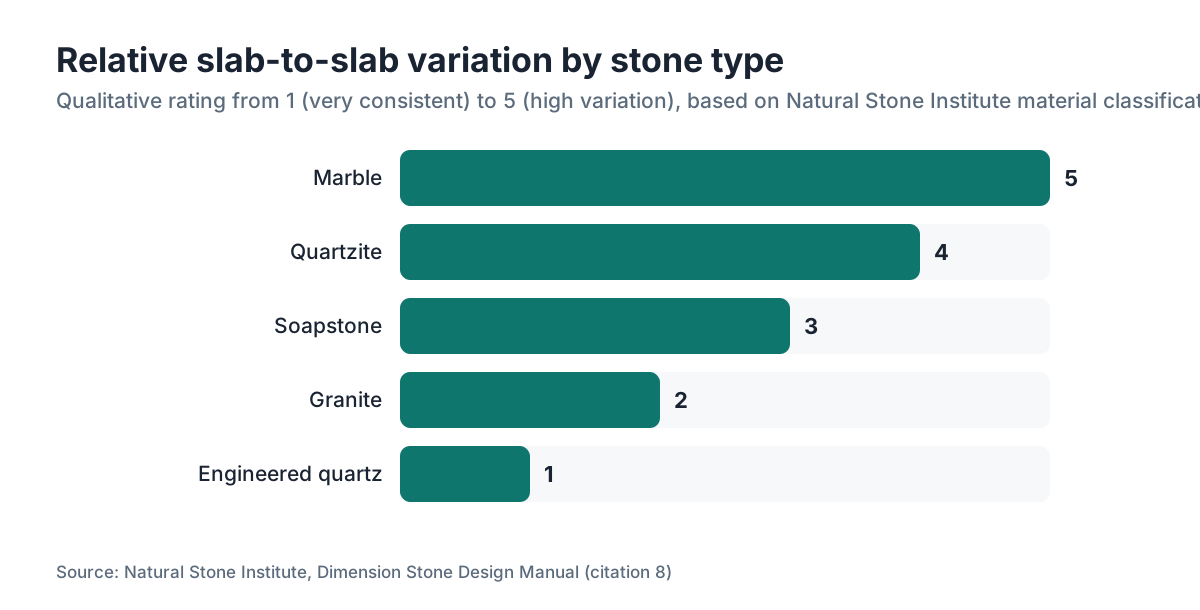
How is natural stone variation different for granite, marble, quartzite, and soapstone?
Each material has its own variation personality. Knowing which to expect helps you have the right conversation upfront.
Granite tends to be the most predictable of the four. Its crystalline structure means variation shows up as shifts in crystal size and density rather than dramatic pattern changes. The biggest surprises in granite are pitting (common in darker varieties like Absolute Black and some Blue Pearls) and occasional color shifts from slab to slab within a single quarry lot. Granite countertops are a popular choice partly because the variation is approachable.
Marble has the most dramatic and least predictable variation. The veining is the entire aesthetic of the material, and it can be wildly different slab to slab. Statuario marble, for instance, ranges from slabs with almost no veining to slabs with bold gray movement. Anyone who fell in love with a marble photo online should be prepared for the real slab to look quite different [2].
Quartzite confuses homeowners because the name sounds engineered (like quartz). It's fully natural. Variation in quartzite tends to run in bands, with color shifting from one layer to the next. White quartzites like White Macaubas can have soft creamy movement in one slab and stronger purple-gray veining in the next. If you're cleaning quartzite surfaces, the how to clean quartzite countertops guide is useful context.
Soapstone has less dramatic surface variation than marble but has a strong color evolution over time. It naturally oxidizes from gray-green to a darker charcoal, and oiling speeds that process. Different parts of the same slab may oxidize at slightly different rates, creating a patchy look early on that evens out over months. This is geology in action, not a defect. For care specifics, the how to clean soapstone countertops article covers the oiling process in detail.
Why does the same stone name look completely different at different suppliers?
Trade names for stone are not standardized across the industry. "Calacatta" is not a protected designation of origin for countertop slabs in the United States. A slab marketed as Calacatta Gold at one supplier may come from a different quarry in Italy (or even a different country entirely) than one sold under the same name at another distributor [5].
The same applies to granite trade names. "Uba Tuba" granite, for instance, is quarried in several regions of Brazil, and the stone from different quarries varies noticeably in crystal size and background color.
For homeowners, the practical implication is this: the stone you fell in love with on Pinterest or Houzz may have been photographed from a premium bookmatched bundle in a European showroom and will look meaningfully different from the slab available at your local yard under the same trade name. That's not fraud. It's an unregulated naming convention.
Fabricators can help homeowners by qualifying what they actually want aesthetically (white background, minimal veining, specific vein color) rather than locking in on a trade name. That approach opens up more slab options and reduces the risk of a disappointed client who got technically the right material but not the right look.
Can fabricators reduce variation-related complaints with better documentation?
Yes, and this is the operational piece that matters most for shop owners.
The highest-risk moment in the process is the gap between the homeowner choosing a material at the showroom and seeing the finished countertop installed. Anything that closes that gap reduces complaints.
Photographing the actual slabs at point of sale is step one. Attach those photos to the work order with a note that these specific slabs were viewed and accepted by the client on a specific date.
A slab approval form, signed before fabrication begins, is the clearest protection. It should note the slab number or bundle number, any visible fissures or pitting observed, and the client's acknowledgment that natural stone characteristics are not grounds for rejection. This isn't adversarial. Presented well, it reads as professionalism.
For countertop installation, doing a final layout check before the top goes in gives the homeowner one more chance to see the actual stone in their space before it's permanently set. Many shops do this for large or complex jobs. The homeowner walks the room while the fabricator holds pieces in place, confirming seam placement and checking that the variation is acceptable in context.
Digital nesting and layout tools (the kind that let you map specific slab sections to specific kitchen zones) make the documentation even cleaner because you can produce a graphic showing exactly what came from where. That visual record answers the "this doesn't match" question before it becomes a dispute.
For fabricators tracking jobs across multiple slabs and clients, software like SlabWise lets you attach slab photos and layout diagrams to each job file, which means you have the documentation automatically rather than as an afterthought.
How does natural stone variation compare to engineered stone and other countertop surfaces?
This question comes up constantly, and fabricators should answer it honestly rather than defensively.
Engineered quartz (brands like Cambria, Silestone, and Caesarstone) is manufactured with consistent pigment and aggregate, so slab-to-slab variation is minimal. Color and pattern match reliably across a production run. That is a genuine advantage for homeowners who want predictability. Cambria countertops are worth pointing homeowners toward if consistency is their primary concern.
Laminate and surfaces like Formica and Corian are fully consistent because they're manufactured products. Laminate countertops, Formica countertops, and Corian countertops don't have variation problems because they're not geological materials.
The tradeoff is feel and authenticity. Natural stone has depth, thermal mass, and a visual complexity that manufactured surfaces approximate but don't replicate. The variation is part of that authenticity. A homeowner who wants a completely reproducible look is probably not the right fit for natural stone, and telling them so early saves everyone a difficult conversation later.
Here's the honest comparison for a fabricator to make: "If you want to know exactly what you're getting before it arrives, engineered stone is probably a better fit for you. If you want something that's genuinely one of a kind and you're okay with some uncertainty in the process, natural stone delivers that." That's not a sales pitch for either product. It's a fair description of the tradeoff.
| Surface type | Slab-to-slab consistency | Source |
|---|---|---|
| Natural granite | Low to moderate | Geology [1] |
| Natural marble | Low (high variation) | Geology [2] |
| Natural quartzite | Low to moderate | Geology [2] |
| Engineered quartz | High | Manufacturing process |
| Laminate / Formica | Very high | Manufacturing process |
| Solid surface (Corian) | Very high | Manufacturing process |
What are the most common homeowner complaints about stone variation, and how do you respond?
Knowing the most common complaints before they happen is the best preparation.
"The stone doesn't look like the sample." This is almost always a slab-versus-small-sample problem. A 4x4-inch sample shows one small section; the full slab includes everything. Fix: show full slabs at point of sale, more than samples.
"There's a crack in my countertop." Half the time this is a fissure. Do the fingernail test (flush = fissure, raised edge = crack) and show them the slab photo from before fabrication, where the same line is visible. Documenting pre-existing fissures protects you here.
"The two slabs don't match at the seam." Color variation between slabs is geology. Show them the pre-install layout approval if you have it. If the seam is visible in a place the homeowner didn't approve, that's a layout conversation, not a variation conversation.
"The pits are filling with food and it looks dirty." Pitting is a natural characteristic of some granites [3], but it does create maintenance questions. Proper sealing helps. Point them toward resources on how to clean stone countertops and make sure they understand the sealing maintenance schedule.
"My neighbor's countertops look completely different and they ordered the same stone." Trade names aren't standardized, and two distributors' "Calacatta" may come from different quarries [5]. Explain the naming system. This isn't a defect. It's how the industry works.
Frequently asked questions
Can I order the same stone as my neighbor and expect it to look the same?
Not reliably. Stone trade names like "Calacatta" or "Uba Tuba" are not standardized designations in the United States. Two distributors selling slabs under the same name may source from different quarries, producing stone that looks noticeably different. Even slabs from the same quarry vary. The safest approach is to describe what you want aesthetically (background color, vein density, vein color) and then select the specific slabs yourself at the yard.
Is a fissure in my granite countertop a defect I should reject?
No. A fissure is a naturally occurring separation along a grain boundary in the stone, formed during the geological process that created it. The Natural Stone Institute's technical standards classify fissures as inherent characteristics, not fabrication defects. The practical test: run a fingernail across the line. If it's flush with the surface, it's a fissure. If there's a raised edge, it may be a crack that warrants closer inspection.
Why does stone look different in the showroom versus my kitchen?
Lighting is the biggest factor. Showroom fluorescent lighting tends to flatten and cool stone tones. Kitchen pendant lights, under-cabinet LED strips, and natural window light all shift how a stone reads. Yellower light warms beige stones and makes white backgrounds look cream. If possible, photograph your candidate slab in natural light at the yard or ask for a sample large enough to hold in your actual kitchen before committing.
What is book-matching and does it reduce slab variation at seams?
Book-matching opens two sequential slabs like the pages of a book, creating a mirrored veining pattern across the seam. It reduces the contrast at the seam and is often used on large kitchen islands or fireplace surrounds. It doesn't eliminate variation because the two slabs are mirror images, not identical copies, and color can still shift slightly. Sequential slabs from the same bundle tend to match better than slabs pulled from different bundles.
How much variation is normal for marble countertops?
Marble has the highest slab-to-slab variation of common countertop stones. A marble variety like Statuario can range from slabs with almost no veining to slabs with heavy bold movement, both correctly labeled Statuario. The veining that makes marble desirable is also what makes predicting the exact look impossible. Homeowners should always select marble from the actual slabs available in the yard rather than from catalog images or small samples.
Does sealing natural stone reduce variation in appearance?
Sealing doesn't change the visible variation in a slab, but it does affect how the stone performs and how consistently the surface looks over time. An unsealed stone can absorb oils and liquids that darken certain sections differently, which creates uneven appearance. A properly sealed stone maintains a more consistent baseline color. The sealing schedule depends on the stone type; denser stones like granite need sealing less often than porous stones like some marbles.
Can a fabricator guarantee that my installed countertop will look like the display slab?
No, and any fabricator who says otherwise is overpromising. A display slab represents the material's general aesthetic range, not a specific reproducible look. The only way to get close to what you saw in the showroom is to locate and select the actual slabs you want before signing a contract. Most good fabricators will either take you to their yard or arrange a visit to a stone supplier so you can approve the specific pieces.
Are pits in granite a sign of poor quality stone?
No. Pitting is a natural characteristic of many granite types, particularly darker varieties. It forms when softer mineral inclusions fall out during quarrying or finishing, leaving small surface voids. The Natural Stone Institute classifies pitting as an inherent material characteristic. From a quality standpoint, a pit-prone granite isn't inferior stone. From a practical standpoint, pitted surfaces can trap food debris, so thorough sealing and cleaning habits matter more with these materials.
What should I do if my countertop looks very different from what I expected?
Start by comparing the installed stone to the slab photos taken at point of approval, not to showroom samples or website images. If you approved specific slabs and those slabs were used, the variation is a natural stone characteristic rather than a fabrication error. If slabs different from the ones you approved were substituted without your knowledge, that's a valid dispute. Document everything with photos and review your contract and slab approval paperwork before escalating.
How do I explain stone variation to a homeowner who is used to engineered quartz?
Lead with the honest tradeoff. Engineered quartz is manufactured to be consistent; natural stone is not. Both are valid choices for different priorities. If a homeowner's primary concern is predictability, quartz may actually be the better fit for them. If they want authenticity and are willing to engage in the slab selection process, natural stone delivers something quartz can't replicate. Forcing natural stone on a homeowner who wants consistency sets up a difficult post-install relationship.
Should homeowners visit the stone yard before buying, or can they choose from photos?
They should visit the yard whenever possible. Photos of stone, even high-quality ones, cannot capture the depth, crystal sparkle, or true color of a slab under real light. More importantly, photos represent a single moment and angle; a slab looks different as light moves across it. For an investment that averages $40 to $100 per square foot installed depending on the material and region, spending two hours at a stone yard is time well spent.
What documentation should a fabricator collect before cutting natural stone?
At minimum: photos of the slabs with bundle or slab numbers visible, a signed slab approval form acknowledging the specific pieces to be used, notes on any pre-existing fissures or pitting observed, and a layout diagram showing which slab sections map to which kitchen zones. This documentation protects both parties. Homeowners who approved slabs in writing rarely dispute natural characteristics after installation.
Does natural stone variation affect resale value of a home?
There's no published research that isolates stone variation as a resale value factor. What appraisers and buyers respond to is material quality and condition. Unique, dramatic stone movement can be a selling point to one buyer and unappealing to another. The practical takeaway: variation is rarely a resale liability as long as the installation is clean, the stone is properly maintained, and any true defects (actual cracks, failing seams) are addressed before listing.
Sources
- U.S. Geological Survey, Minerals Information: Stone, Dimension: Granite forms from slowly cooled magma; mineral composition (feldspar, quartz, mica) varies by geological conditions, producing slab-to-slab color and pattern differences.
- Natural Stone Institute, Technical Bulletin: Understanding Natural Stone: Marble veining and quartzite banding result from mineral impurities (clay, silt, iron oxide) deformed during metamorphism, causing variation from block to block and slab to slab.
- Natural Stone Institute, Technical Bulletin: Granite Pitting: Pitting is a naturally occurring characteristic of many granite varieties and is not a fabrication defect under standard trade definitions.
- Uniform Commercial Code Section 2-314, Cornell Legal Information Institute: Under UCC 2-314, goods must be fit for their ordinary purpose to meet the implied warranty of merchantability; natural stone characteristics that don't impair function do not breach this warranty.
- Federal Trade Commission, Business Guidance Resources: Stone trade names like 'Calacatta' are not standardized or protected designations in U.S. commerce; the same name may refer to stone from different quarries or countries.
- U.S. Geological Survey, National Minerals Information Center: Dimension stone is quarried from geological formations with inherent variability; sequential slabs from the same block show the most consistent patterns.
- National Institute of Standards and Technology: Physical properties of dimension stone (porosity, absorption, density) vary by quarry lot, which affects both appearance and maintenance requirements.
- Natural Stone Institute, Dimension Stone Design Manual: Fissures are linear separations along grain boundaries and are distinguished from cracks by their pre-existing geological origin and flush surface profile.
- Marble Institute of America (now Natural Stone Institute), Care and Cleaning for Natural Stone: Proper sealing maintains consistent stone appearance over time by preventing differential absorption of oils and liquids.
- U.S. Geological Survey, National Minerals Information Center: Granite, marble, quartzite, and soapstone are all classified as dimension stone with distinct geological formation processes that produce differing levels of visual variation.
Last updated 2026-07-10