TL;DR
- Natural stone countertops in New England run $60 to $200 per square foot installed.
- Material, fabrication complexity, and shipping distance drive the number.
- Vermont and New Hampshire quarries still produce granite and soapstone, but most exotic slabs travel from Brazil, Italy, or India.
- Lead times run 2 to 6 weeks at busy shops, longer in the spring and fall remodeling rush.
What does fabricated natural stone actually mean?
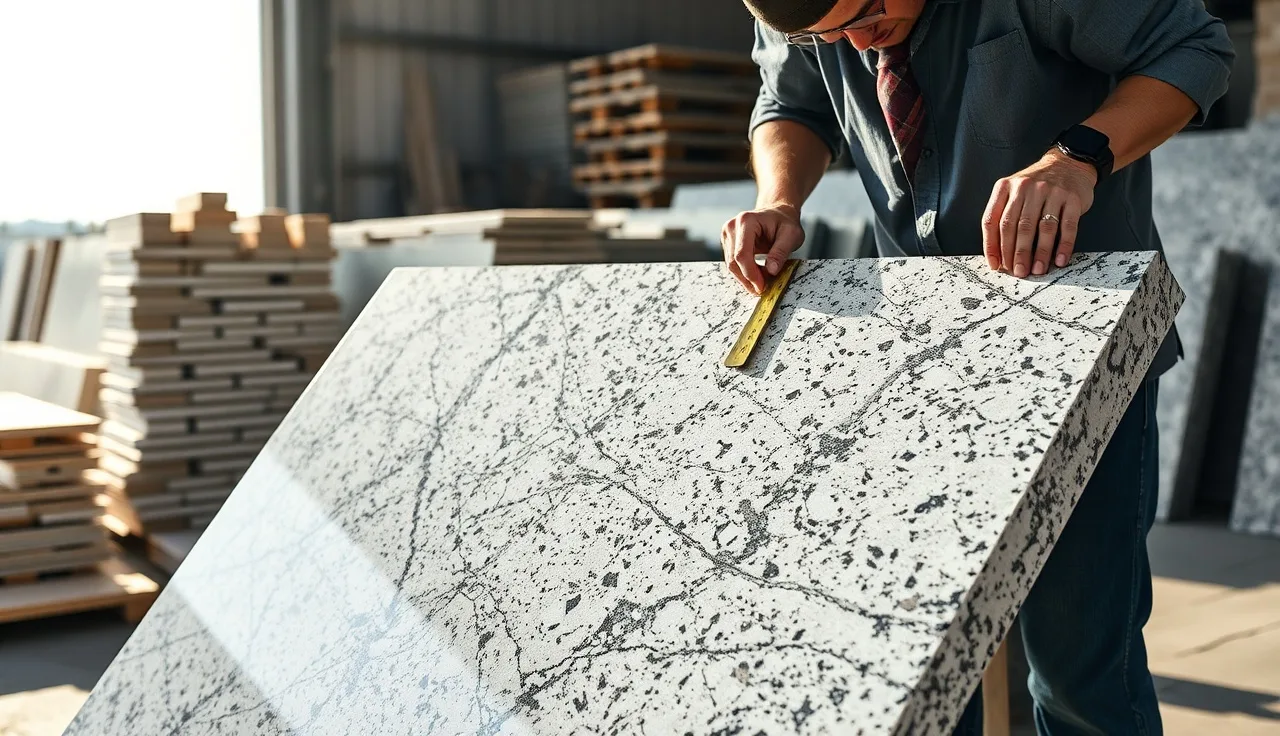
Fabrication is everything that happens between a raw slab leaving a quarry and a finished countertop sitting on your cabinets. Cutting the slab to your template. Shaping the edge profile. Cutting sink and cooktop openings. Polishing the surface to the finish you picked. When a shop says it fabricates stone, it owns the machines and the labor to do all of that in-house instead of shipping the cutting to a third party.
Natural stone is any material quarried directly from the earth. Granite, marble, quartzite, soapstone, limestone, slate, and travertine all qualify. That sets them apart from engineered quartz, which is mostly ground quartz powder mixed with resin and pigment. The difference matters for fabrication because natural stone behaves differently under a CNC router, varies more slab to slab, and needs sealing that engineered products usually skip.
Shops in New England run the full spread. Some are two-man operations with a bridge saw and hand tools. Others are full CNC facilities running multiple shifts. Shop size doesn't always predict quality, but it does predict capacity and lead time.
Which natural stones are actually quarried in New England?
New England has real stone heritage. Vermont granite has been quarried commercially since the early 1800s, and the Barre, Vermont area is still one of the most productive granite districts in North America [9]. Vermont marble came out of Proctor and the surrounding towns in huge volume, though most of that operation has shrunk badly since its peak in the early 20th century.
New Hampshire granite, especially from Conway and the Grafton County towns nearby, is also available. The Chelmsford quarry in Massachusetts produced a well-regarded gray granite for decades, though residential countertop material from that source is hard to find in current retail channels.
Soapstone comes from quarries in Vermont and Virginia. Vermont Soapstone in Perkinsville has been operating since 1965 and supplies slabs to fabricators across the region [2]. If you want how to clean soapstone countertops guidance, the material's softness relative to granite is the thing that shapes that maintenance routine.
Local production doesn't cover the exotic stuff. Most highly figured stone in New England shops still comes from Brazil (quartzite, exotic granites), Italy (Carrara and Calacatta marble), or India (many black and multicolor granites). Local quarry material tends to be more subdued in color. Some homeowners love that. Others don't.
| Material | Common New England Sources | Typical Origin for Exotic Versions |
|---|---|---|
| Granite | Barre VT, Conway NH | Brazil, India, China |
| Marble | Proctor VT (limited) | Italy, Turkey, Greece |
| Soapstone | Perkinsville VT | Brazil, Virginia |
| Quartzite | Rare locally | Brazil, India |
| Slate | Monson MA, Granville NY border | Brazil, India |
What does natural stone fabrication cost in New England?
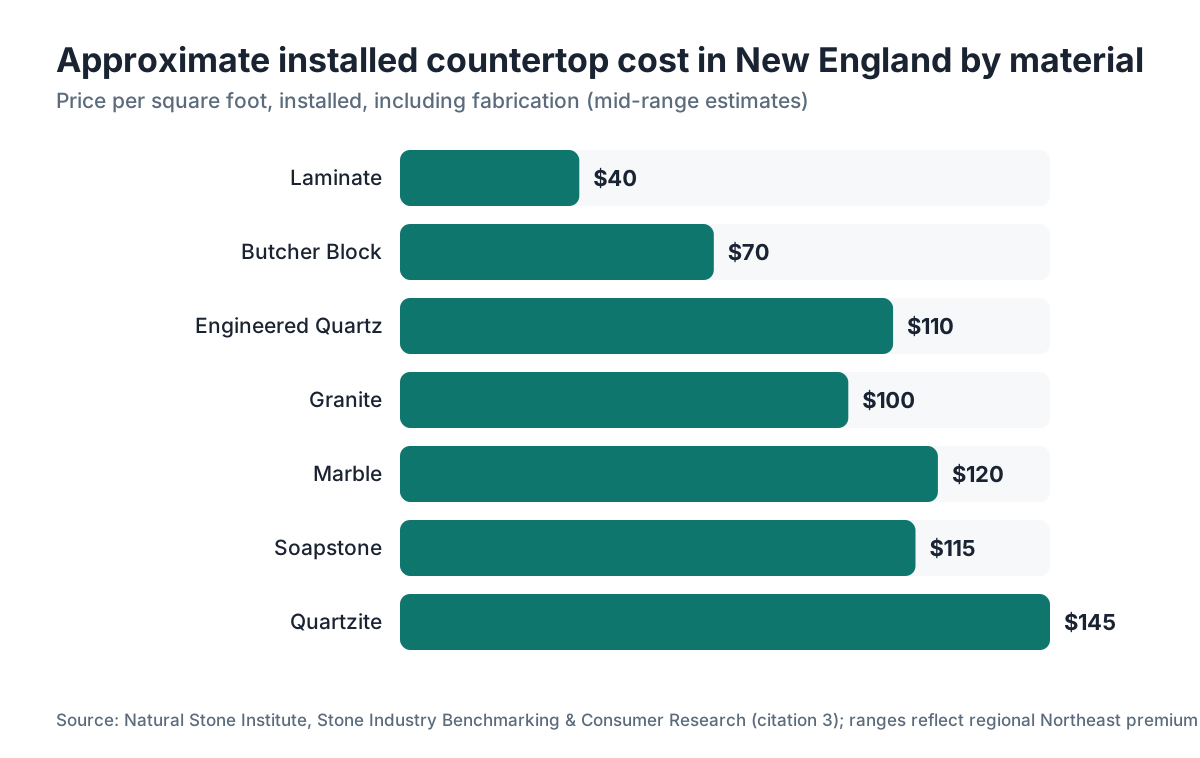
Natural stone runs $60 to $200 per square foot installed in New England, and any single number below that ceiling is misleading without knowing the material. Here's an honest breakdown based on what fabricators in the region have publicly listed or discussed in trade forums as of 2024 to 2025.
Entry-level granite (colonial gold, Santa Cecilia, nothing exotic) installed runs $60 to $90 per square foot. Mid-range materials like leathered blue quartzite or standard Carrara marble land between $90 and $140 installed. High-end Brazilian quartzites, rare marbles, and premium soapstone hit $150 to $200 or more [3].
That installed number includes material, fabrication labor, and basic installation. It leaves out removal of your old countertop (often $150 to $300 extra), plumbing disconnect and reconnect (varies by plumber and whether you hire that out separately), and specialty edge profiles that add $10 to $30 per linear foot.
New England pricing sits above national averages. The Northeast has higher shop labor rates, higher fuel costs for delivery, and a thinner network of wholesale distributors than markets like Atlanta, Dallas, or Phoenix. The Natural Stone Institute's benchmarking research found regional price variation of up to 35% between the lowest-cost markets (parts of the South and Midwest) and the highest-cost ones (Northeast, California) [3].
Here's the biggest price driver most homeowners never see coming: slab yield. A kitchen with an odd L-shape or a lot of cutouts can force the fabricator to pull from a second slab just to finish the job. You pay for that second slab even if most of it goes to remnants. Ask your fabricator to show you the nesting layout before you sign.
For fabricators trying to tighten their own job costing, SlabWise offers quoting and nesting software that shows customers exactly how their job lays out on each slab. That one screen kills most of the surprised-by-the-second-slab conversations.
How long does stone fabrication take in New England?
Plan on 2 to 4 weeks from signed contract to installation at a busy New England shop in slower months. That stretches to 4 to 6 weeks in the spring remodeling push (March through June) and the fall rush (September and October). A few large shops with full CNC automation turn simpler jobs in 7 to 10 business days.
The critical path usually goes: template day, then CNC programming and cutting, then polishing and QC, then delivery and install. Templating itself takes 30 to 90 minutes for a typical kitchen. If you order a less common material that no distributor stocks locally, add 1 to 2 weeks for the slab to travel from the regional warehouse (most sit in Connecticut, Massachusetts, or Rhode Island for this region), or longer if it ships direct from overseas.
One thing reliably blows up timelines: cabinet delays. Fabricators won't template until cabinets are fully installed and level. If your cabinet delivery slips three weeks, your stone slot slips too, and at a busy shop you may not climb right back onto the schedule.
What edge profiles and finishes do New England fabricators typically offer?
Edge profiles get carved by CNC router or shaped by hand, depending on the shop. Standard options at nearly every New England shop include eased (a square edge with the sharp corner softened), beveled, bullnose (fully rounded), and ogee (an S-curve). More elaborate work like waterfall edges, chiseled or rock-face edges, and double ogee is available but costs more and takes longer.
Finish options depend on the stone. Granite is most often polished to a high gloss, but honed (matte) and leathered (textured, low-sheen) finishes show up at most shops. Marble is commonly polished or honed. Honed marble hides etch marks visually, though it still etches chemically from acids. Soapstone gets hand-rubbed with mineral oil, which darkens it and evens out the color.
Leathered finishes on quartzite have taken off in New England over the past five years or so. The texture hides small scratches and fingerprints better than polished, and it reads more organic, which fits the farmhouse and transitional styles common in the region's older homes. The catch: that texture is harder to keep clean in cooking areas.
If you're researching how to clean quartzite countertops, the finish is the first variable. Leathered quartzite traps debris in its texture differently than polished does.
How do New England building codes and regulations affect stone installations?
A countertop swap in New England is generally not permitted work, so you don't need a building permit just to change your counters. The exception is when the countertop replacement is part of a larger kitchen renovation that moves plumbing or electrical, which does require permits in every New England state.
Massachusetts, Connecticut, Rhode Island, Vermont, New Hampshire, and Maine all follow some version of the International Residential Code [10]. Permit thresholds and fee schedules are set at the town or city level, not the state level [4]. A kitchen remodel in Boston follows different administrative rules than the same project in Framingham, even though both sit under Massachusetts state building law.
For countertops, the practical regulatory issue is silica dust during fabrication. OSHA's silica standards (29 CFR 1910.1053 for general industry, 29 CFR 1926.1153 for construction) require engineering controls for workers exposed to respirable crystalline silica above the Action Level of 25 micrograms per cubic meter as an 8-hour average [5]. Any shop cutting granite or engineered quartz falls under these rules. This doesn't touch you directly as a homeowner, but know this: a shop running dry-cutting operations without dust controls is both a worker safety problem and a signal about how seriously the place runs.
Connecticut and Massachusetts have both seen more OSHA enforcement at stone fabrication shops in recent years, in line with the federal silica push that followed the 2016 rule update [5].
What should you look for when choosing a stone fabricator in New England?
Start with one question: do they have CNC equipment, or do they cut everything by hand? Hand cutting isn't inferior for custom shapes, but consistency on production jobs is better with CNC. Ask to see the shop.
Second, ask who does the installation. Some shops subcontract installs to crews who never saw the stone until they show up at your door. A shop that uses its own templaters and installers catches measurement errors before they become your problem.
Third, ask to see finished jobs. Most reputable fabricators keep a portfolio or can point you to references nearby. Installed work beats any brochure.
Fourth, read the contract. Know what happens if a slab breaks during fabrication (rare, but it happens), what the payment schedule is, and whether there's a warranty on fabrication workmanship. Good shops stand behind their cuts and joints.
Price is a bad primary filter. The cheapest quote in New England is usually cheap because the shop skips steps, runs thin on labor, or sources lower-grade slabs. Get two or three quotes, then compare them line by line: same material grade, same edge profile, same sink cut, same thickness.
How does natural stone compare to other countertop materials for New England homes?
New England homes, especially pre-1950 construction, carry quirks that shape countertop choices. Out-of-level cabinets. Odd room proportions. Older plumbing that makes undermount sinks a headache. Natural stone handles these conditions about as well as anything, but it's unforgiving of cabinets that aren't level. Install a stone top on a cabinet run with real slope and it will look crooked. Shimming only helps so much.
Engineered quartz (like Cambria) is a strong alternative if you want a stone look with less maintenance. Cambria countertops come with consistent thickness and no porosity, which simplifies installation on slightly imperfect cabinets and skips sealing entirely. The tradeoff: engineered quartz can't be refinished if it gets deeply scratched or damaged, where natural granite or marble can sometimes be honed to pull out surface damage.
Granite countertops stay the volume leader in the region. They're harder than most other natural stones, take heat well, and sealed properly, they hold up to a normal New England kitchen for decades.
Marble countertops show up in high-end renovations and baking kitchens, but they etch and scratch more readily than granite or quartzite. Anyone who tells you marble is maintenance-free in a cooking kitchen is lying to you.
Butcher block countertops and laminate countertops are honest, practical picks for parts of the kitchen where stone prices make no sense, like a laundry counter or a secondary work surface.
| Material | Approx. NE Installed Price ($/sq ft) | Sealing Needed? | Scratch Resistance | Heat Resistance |
|---|---|---|---|---|
| Granite | $60-$140 | Yes, every 1-3 years | High | High |
| Quartzite | $90-$200 | Yes, every 1-2 years | High | High |
| Marble | $80-$160 | Yes, every 6-12 months | Medium | High |
| Soapstone | $80-$150 | No (oil periodically) | Low-Medium | Very High |
| Engineered Quartz | $70-$150 | No | High | Medium (avoid direct heat) |
| Butcher Block | $40-$100 | Oil regularly | Low | Low |
| Laminate | $20-$60 | No | Low-Medium | Low |
What is the process for getting a stone countertop installed, start to finish?
The process has seven steps, and each one hangs on the step before it.
First, you select your material. That means visiting a stone yard or slab warehouse, because photos don't capture veining and color well enough to make a confident call on a $3,000 purchase.
Second, you get a rough quote. The fabricator measures your existing counters or reviews your cabinet drawings and gives you a price range. This is not a final number.
Third, cabinets go in, fully installed and leveled. Do not let a fabricator template before this is done. Any adjustment to cabinet height or position after templating means a remeasure.
Fourth, templating. A physical template (usually 1/4-inch luan) or a digital laser template captures your exact dimensions, including everywhere the walls aren't square.
Fifth, the shop fabricates your top. CNC cuts to template, edges get shaped, cutouts get made, and the pieces get polished and QC'd.
Sixth, installation. The crew delivers and sets the stone, secures it to the cabinets (typically with silicone adhesive, not mechanical fasteners), and caulks the perimeter. Seams join with color-matched epoxy.
Seventh, sealing. Many shops apply a sealer before they leave. Some leave it to you. Ask which before they walk out the door.
The full countertop installation article covers sink compatibility and substrate requirements in more detail.
How do you maintain natural stone countertops in a New England climate?
New England's climate doesn't stress stone countertops the way temperature swings hammer outdoor stone. Humidity swings between humid summers and dry heated winters matter for the wood components in your kitchen, not the stone. The stone itself is stable.
Sealing frequency is the main maintenance question. The Natural Stone Institute recommends testing your sealer once a year by dropping a little water on the surface. If it beads, you're fine. If it soaks in within a few minutes, reseal [6]. Most quality sealers on granite in an average kitchen last 1 to 3 years. Soapstone needs no sealer but takes to mineral oil every few months, especially in the first year.
For daily cleaning, mild dish soap and water handles most natural stone. Keep acidic cleaners (vinegar, lemon-based products) off marble, limestone, and travertine. They etch the surface chemically. The how to clean stone countertops guide covers product-by-product recommendations.
One New England wrinkle: if you have hard water (common on well water in rural Maine, New Hampshire, and Vermont), limescale near the sink gets stubborn. Reach for a pH-neutral stone cleaner, not a descaler.
Are there silica safety concerns homeowners should know about?
Yes, and this topic gets more attention than it used to. The concern is occupational. Fabricators who cut stone without proper dust controls can develop silicosis, a serious and irreversible lung disease caused by inhaled crystalline silica dust [7]. Cases of accelerated silicosis among countertop fabricators have been documented in Australia, Spain, and the United States [7].
For homeowners, the risk during installation is low. A single install generates a fraction of the cumulative exposure that builds a fabricator's risk over years of daily cutting. If your installer needs to dry-cut a small adjustment at your home, ask them to use a vacuum-equipped angle grinder or wet-cut. Any reputable shop carries tools for this.
OSHA's final silica rule for construction (29 CFR 1926.1153, effective June 2017) requires shops and on-site crews to use engineering controls, wet methods, or local exhaust ventilation when cutting stone [5]. Shops operating legally in New England have to comply. NIOSH has published specific guidance on silica dust controls for stone cutting operations [8].
The industry has genuinely improved here over the past decade. Still, ask a shop what its dust controls look like. It's the right thing for the workers and a clean signal about how the place runs.
What are the best questions to ask a New England stone fabricator before signing?
Ask these before you commit.
Do you have your own CNC equipment, and who does the installation? (In-house is usually better.)
Can I see the slab I'm buying before fabrication starts? (You should always get to approve the specific slab.)
What is your lead time right now, not the best-case number? (A shop quoting one week in April is probably underselling.)
How do you handle seams, and where will they fall on my layout? (Seam placement is both looks and structure.)
What is your warranty on fabrication workmanship? (Look for at least one year on joints and cuts.)
What does your price include, exactly? (Nail down removal of the old top, plumbing disconnect, sink cut, edge profile, sealer.)
Do you pull permits if the project needs them? (Relevant if you're doing a broader renovation.)
For fabricators who want the quoting side of these conversations faster and more accurate, the tools at SlabWise generate precise job quotes and nesting plans you can put in front of a customer, which builds trust and cuts the back-and-forth.
Frequently asked questions
What is the average cost of natural stone countertops in New England?
Expect $60 to $200 per square foot installed, depending on material and complexity. Entry-level granite runs $60 to $90. Mid-range quartzite or marble is $90 to $140. Exotic materials with complex edges or multiple seams can pass $200. These numbers include fabrication and installation but not old-top removal or plumbing work, which are priced separately.
Is Vermont granite still quarried commercially?
Yes. The Barre, Vermont area remains one of the most productive granite quarrying districts in North America. Vermont granite is gray and fine-grained, prized for monuments and architectural stone. Residential countertop slabs are available from Vermont sources but are stocked less often at retail distributors than imported Brazilian or Indian granites.
How long does stone fabrication take in New England?
Typical lead time is 2 to 4 weeks in slower seasons (winter, midsummer) and 4 to 6 weeks during the spring and fall remodeling rushes. The clock starts after your cabinets are fully installed and templated. Ordering an uncommon slab that has to come from outside the region adds 1 to 2 weeks.
Do stone countertops need a permit in New England states?
A countertop-only swap generally doesn't require a permit. If the work is part of a larger kitchen renovation involving plumbing or electrical changes, permits are required and are administered at the town or city level in all six New England states. Permit thresholds and fees vary by municipality.
What is the difference between granite and quartzite?
Granite is an igneous rock formed from cooled magma, made of quartz, feldspar, and mica. Quartzite is a metamorphic rock formed when sandstone recrystallizes under heat and pressure, made almost entirely of quartz. Quartzite is generally harder and denser than granite. Both work for countertops, but quartzite needs sealing and gets mislabeled by suppliers more often than you'd like.
Is soapstone a good countertop choice for New England homes?
Soapstone works well in New England kitchens, especially in older or farmhouse-style homes. It's non-porous, needs no sealing, and takes heat exceptionally well. The downside: it's relatively soft and scratches easily, though scratches sand out. Vermont Soapstone in Perkinsville, VT is a major supplier to regional fabricators.
What silica safety rules apply to stone fabricators in New England?
OSHA's silica standards (29 CFR 1926.1153 for construction and 29 CFR 1910.1053 for general industry) require shops to control worker exposure to respirable crystalline silica. The Action Level is 25 micrograms per cubic meter as an 8-hour average. Shops must use wet cutting, vacuum-equipped tools, or local exhaust ventilation. This is a federal requirement in every state.
Can natural stone countertops be repaired if they chip or crack?
Yes, with limits. Edge chips get repaired with color-matched epoxy or acrylic filler, which can look nearly invisible on granite but shows more on marble with tight veining. Cracks through the body of a slab are more serious. A skilled fabricator can inject epoxy into a crack, but a structural crack in a stress area like a sink cutout may need a section replaced.
How do I find a reputable stone fabricator in New England?
Start with the Natural Stone Institute's member directory, which lists fabricators who have agreed to industry standards. Ask for references from completed jobs and ask to see the shop. Verify they carry liability insurance and workers' compensation coverage. Get at least two or three detailed quotes comparing the same specifications before you decide.
What edge profile should I choose for my stone countertop?
For most kitchens, an eased or beveled edge is the practical pick: durable, easy to clean, no price bump. Bullnose softens the look and suits households with young children. Ogee and waterfall profiles are more decorative but add $10 to $30 per linear foot and take longer to fabricate. Match the profile to your cabinet style before you chase a trend.
Does natural stone need to be sealed, and how often?
Granite, quartzite, and marble generally need sealing. Frequency depends on the stone's porosity and how hard the kitchen gets used. Simple test: drop water on the surface. If it soaks in within minutes, reseal. Most quality sealers last 1 to 3 years on granite. Soapstone is naturally non-porous and needs no sealer, just periodic mineral oil.
What is the difference between natural stone and engineered quartz for New England kitchens?
Natural stone is quarried directly and varies naturally. Engineered quartz is manufactured from ground quartz bound with resin. Engineered quartz is non-porous and needs no sealing. Natural stone can be refinished or repaired more flexibly. Price ranges overlap heavily in New England. Engineered quartz is more sensitive to direct heat than natural granite or quartzite.
How are stone countertop seams handled, and can they be made invisible?
Seams join with color-matched two-part epoxy. A good fabricator places them where traffic and eye movement are least likely to land, away from the main work zone and aligned with natural vein breaks where possible. Seams on a highly figured stone always show if you look for them. On a consistent dark granite, a well-done seam can be nearly invisible.
Is marble practical in a New England kitchen?
Marble is practical if you accept that it will etch and may scratch more than granite. Acids from lemon juice, vinegar, or tomatoes etch the surface finish chemically, leaving dull spots no sealer prevents. Honed marble shows this less than polished. Many New England homeowners put marble on baking sections or islands and choose a harder material for the main cooking area.
Sources
- Vermont Soapstone Company, company history: Vermont Soapstone Company in Perkinsville, VT has been operating since 1965 and supplies slabs to fabricators across the Northeast.
- Natural Stone Institute, Stone Industry Benchmarking & Consumer Research: Regional price variation for natural stone countertop installation reaches up to 35% between the lowest-cost markets and the highest-cost markets (Northeast, California).
- Massachusetts State Building Code, 780 CMR (Office of Public Safety and Inspections): Permit thresholds and fee schedules for residential renovation work are set at the town or city level under Massachusetts state building law.
- OSHA, Occupational Exposure to Respirable Crystalline Silica Standards (29 CFR 1910.1053 and 29 CFR 1926.1153): OSHA requires engineering controls for workers exposed to respirable crystalline silica above the Action Level of 25 micrograms per cubic meter as an 8-hour time-weighted average; the construction standard became effective June 2017.
- Natural Stone Institute, Care and Maintenance Guidelines: The Natural Stone Institute recommends testing sealant effectiveness by placing water on the surface; if it absorbs within a few minutes, the stone should be resealed.
- CDC / NIOSH, Silica and Silicosis topic page: Cases of accelerated silicosis among countertop fabricators have been documented in Australia, Spain, and the United States; the disease is serious and irreversible.
- NIOSH, Preventing Silicosis and Deaths in Rock Drillers and Stone Cutters: NIOSH has published specific guidance on silica dust controls for stone fabrication and cutting operations.
- U.S. Geological Survey, National Minerals Information Center (Dimension Stone): Vermont is among the leading states in dimension stone production in the United States, including granite and marble.
- International Residential Code, International Code Council: All six New England states have adopted versions of the International Residential Code as the basis for residential building regulation, with local amendments.
Last updated 2026-07-09