TL;DR
- Natural stone countertops include granite, marble, quartzite, soapstone, travertine, limestone, and slate.
- Installed costs run from roughly $40 per square foot for basic granite to $200-plus for premium marble or rare quartzite.
- Each stone has a specific hardness, porosity, and maintenance need.
- Pick the wrong stone for your lifestyle and you will regret it within a year.
What counts as a natural stone countertop?
Natural stone is rock quarried directly from the earth, cut into slabs, and finished for indoor use. No binders, no resins, no engineered aggregates. That definition matters because the market is full of quartz surfaces and porcelain slabs that look like stone but are manufactured products with very different performance. If you want the real thing, you are buying geology.
The main countertop stones are granite, marble, quartzite, soapstone, travertine, limestone, and slate. Onyx and schist show up occasionally for decorative work but are rare in full kitchen installations. Each stone type is a category, not a single product. "Granite" covers hundreds of distinct minerals from dozens of countries. Two slabs marketed as "white granite" can have almost nothing in common geologically.
The U.S. Geological Survey tracks natural stone as a distinct commodity category in its annual Mineral Commodity Summaries, separate from manufactured stone products [1]. That matters for trade data and import pricing, but for you the practical takeaway is simpler: if the fabricator cannot tell you the country of origin and rough mineral composition, push harder or walk away.
For a broader look at how natural stone fits against other surface options, the kitchen countertops guide covers the full comparison.
What are the main types of natural stone for countertops?
Here is how each stone actually behaves in a kitchen or bath.
Granite is the most installed natural stone countertop material in the U.S. It is an igneous rock, meaning it cooled from magma, which makes it very hard (typically 6-7 on the Mohs scale) and fairly resistant to heat and scratching. Most granite is moderately porous and needs sealing once a year to once every few years depending on the stone. The full breakdown is in the granite countertops guide.
Marble is metamorphic limestone, mostly calcite. It is softer than granite (Mohs 3-4), reacts to acids, and etches when it contacts lemon juice, vinegar, or wine. Those etch marks are chemical, not physical scratches, and they show up as dull spots. Marble is gorgeous, and many designers will tell you the patina is part of the appeal. That is a legitimate aesthetic choice, not a rationalization. But you have to go in with open eyes. See the marble countertops guide for specifics.
Quartzite is metamorphic sandstone that recrystallized under heat and pressure into a very hard stone, often harder than granite (Mohs 7+). The market confusion is real: many stones sold as "quartzite" are actually soft marbles or dolomitic marbles that etch just like marble. Ask for a scratch test with a steel knife and an acid test with a drop of lemon juice before you buy. The how to clean quartzite countertops guide has a field test you can run in the showroom.
Soapstone is a talc-schist, extremely dense and nonporous, with a Mohs hardness of only 1-2. That softness means it scratches easily, but the scratches buff out with mineral oil or fine sandpaper. Soapstone does not need sealing. It resists acids completely. It is the stone to consider if you want zero fuss around etching and staining. Details in how to clean soapstone countertops.
Travertine is sedimentary limestone formed by mineral springs. It has natural voids that are either filled or left open depending on the finish. Honed travertine has a matte look. Polished travertine is uncommon for countertops because the voids become visible. It is porous and acid-sensitive, similar to marble, but usually costs less.
Limestone is a sedimentary carbonate rock. Softer than granite, acid-sensitive, and quite porous. Mostly used for low-traffic areas like bathroom vanities. Not a great choice for a busy kitchen.
Slate is a fine-grained metamorphic rock that cleaves naturally into flat planes. It is dense, nonporous, and heat resistant. The aesthetic is very specific (dark, matte, layered), so it works for some kitchens and looks completely wrong in others.
| Stone | Mohs Hardness | Acid Resistant | Porosity | Sealing Needed |
|---|---|---|---|---|
| Granite | 6-7 | Yes | Low-moderate | 1-3 years |
| Marble | 3-4 | No (etches) | Moderate-high | Annually |
| Quartzite (true) | 7+ | Yes | Low | 1-3 years |
| Soapstone | 1-2 | Yes | Very low | None |
| Travertine | 3-4 | No (etches) | High | Annually |
| Limestone | 3 | No (etches) | High | Annually |
| Slate | 5-6 | Yes | Very low | Rarely |
How much do natural stone countertops cost?
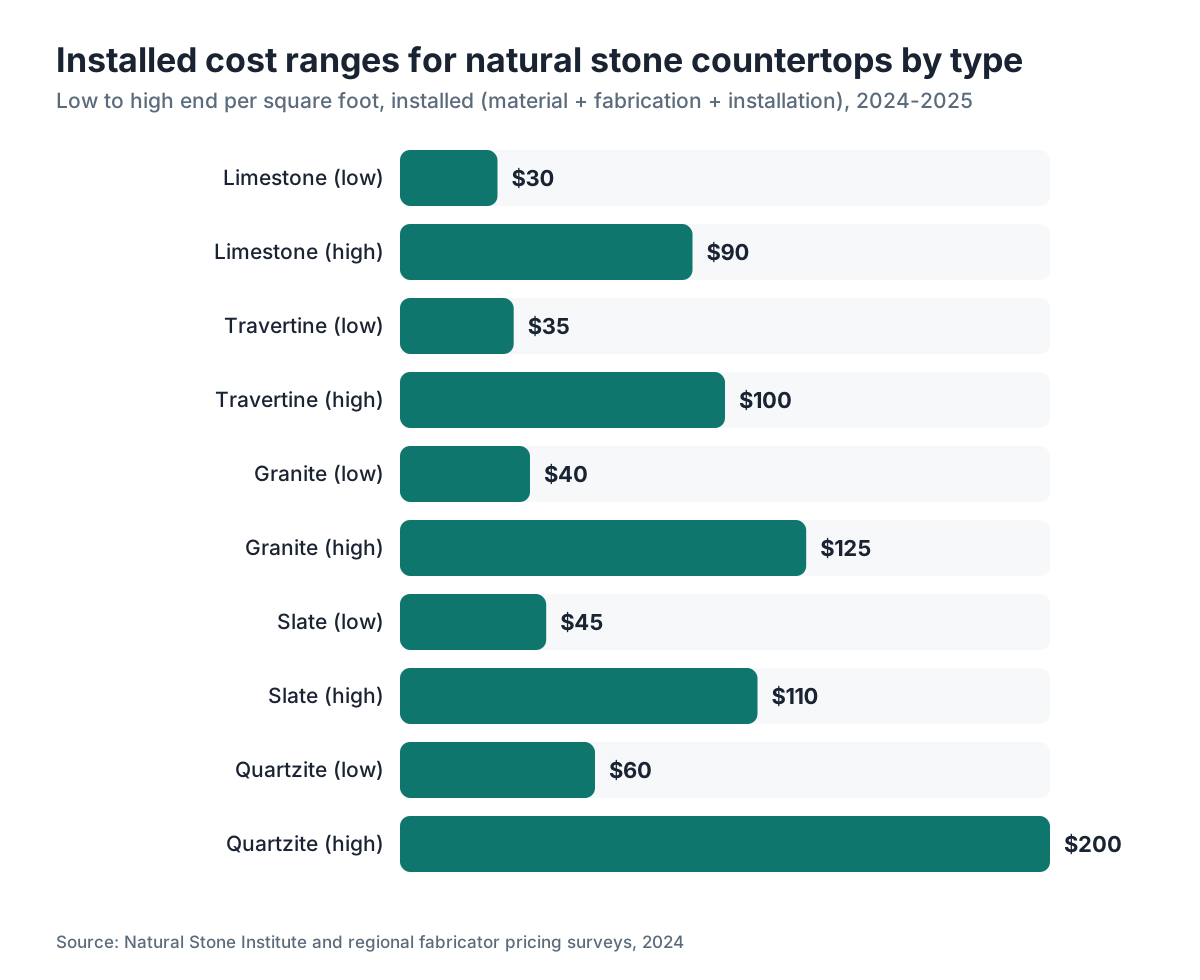
Costs swing hard based on stone type, slab origin, thickness, edge profile, cutouts, and your region. The numbers below are installed prices (material plus fabrication plus standard installation) per square foot as of 2024-2025. They are ranges, not guarantees.
| Stone | Low End ($/sq ft installed) | Mid Range | High End |
|---|---|---|---|
| Granite | $40 | $65 | $125+ |
| Marble | $75 | $110 | $200+ |
| Quartzite | $60 | $100 | $200+ |
| Soapstone | $70 | $100 | $160 |
| Travertine | $35 | $60 | $100 |
| Slate | $45 | $70 | $110 |
| Limestone | $30 | $55 | $90 |
Those ranges come from industry surveys and regional distributor pricing, not from a single federal source, because no federal agency tracks installed countertop costs. The low end for each category usually means domestic stone, a simple edge, and a competitive local market. The high end means rare imported slabs, complex edges, waterfall islands, or tight urban labor markets.
Fabrication alone (cutting, polishing, edge work, cutouts) typically runs $25 to $50 per square foot on top of slab material. A 3cm slab (the standard thickness for countertops today) costs more than a 2cm slab but behaves better structurally. Most fabricators will not install 2cm stone without a plywood substrate, which adds cost and complicates repairs.
One cost variable homeowners consistently underestimate is waste. Natural stone is sold by the square foot but purchased in full slabs. If your layout needs two 55-square-foot slabs to get 80 square feet of usable surface, you pay for 110 square feet. Seam placement, grain matching, and remnant use all change how much stone you actually buy versus how much you use. A fabricator with good nesting software can cut waste significantly, which is where tools like SlabWise help shops quote jobs accurately instead of padding waste estimates.
For comparison to manufactured alternatives, the quartz countertops guide and the laminate countertops guide have current cost ranges.
What affects natural stone countertop prices the most?
Stone origin is the single biggest variable. Domestic granite from quarries in Georgia, South Dakota, or Vermont tends to cost less than imported stone from Brazil, Italy, or India, mostly because of shipping. But many of the most popular stones in the U.S. are imported. The U.S. imported roughly 52 million square feet of finished granite articles in 2022 according to USGS data [1], and Brazil and India are consistently the top sources.
Thickness matters more than most homeowners realize. The industry has largely shifted to 3cm (roughly 1.25 inches) as the standard for kitchen countertops. That is thicker and heavier than the 2cm standard common 20 years ago. Thicker slabs cost more per square foot but usually skip the plywood deck underneath, which simplifies installation and avoids moisture problems.
Edge profiles add cost. A simple eased edge (a slightly softened square corner) is usually included in base pricing. A full bullnose, ogee, waterfall, or mitered edge can add $10 to $30 per linear foot. On an island with 20 linear feet of exposed edge, that is a real number.
Cutouts cost money. A typical sink cutout runs $100 to $200 depending on the sink type. Undermount sinks need more precision than drop-in sinks. A cooktop cutout is similar. Faucet holes, soap dispensers, and side sprayers each add to the bill.
Seams are inevitable on most kitchen layouts because slabs are not infinitely large. Standard slab sizes run roughly 55 to 65 inches wide and 100 to 130 inches long. Any run longer than about 10 feet will likely have a seam. Seam placement and color-matching the epoxy add fabricator time. Matched grain across a seam (bookmatching) is technically demanding and costs more.
How is natural stone countertop installation done?
Natural stone countertop installation follows a fairly consistent sequence regardless of stone type. Here is what actually happens.
The first step is templating. A fabricator or template specialist visits your home and measures the exact layout, including sink openings, cooktop cutouts, wall irregularities, and any corners that are not perfectly square. Templating used to mean cardboard or thin wood strips. Most professional shops now use laser or digital templating tools that create a precise CAD file.
Back at the shop, the fabricator uses that template to lay out cuts on the slab, minimizing waste and placing seams where they will be least visible. Slabs are cut with a CNC machine or manual wet saw using diamond-tipped blades. Edges are profiled with diamond router bits on a CNC or by hand. Cutouts for sinks and cooktops happen at this stage.
Finished pieces travel to your home on padded racks. Natural stone is heavy. A 3cm granite weighs roughly 18 to 20 pounds per square foot, so a 60-square-foot counter is over 1,100 pounds of stone. Expect two to three installers for a typical kitchen job.
Installation means setting the stone on cabinets (which must be level and structurally sound), applying silicone adhesive at contact points, and joining pieces at seams with color-matched epoxy. Stone is never glued down as a solid sheet. It needs to move slightly with the house and with temperature changes.
The sink is attached from below with clips or epoxy, and the plumber reconnects water lines after the stone is set. Most fabricators do not do plumbing. You need a licensed plumber for reconnection in most jurisdictions [2].
After installation, sharp edges get touched up, seams get cleaned, and for porous stones the fabricator or homeowner applies a penetrating sealer. Install day usually takes two to six hours depending on the job size.
For a broader look at stone care after installation, the how to clean stone countertops guide covers the daily and annual routines.
How porous is natural stone and does it really need sealing?
Yes, most natural stone needs sealing. The question is how often, and the answer changes by stone.
Porosity is the percentage of void space in the stone that can absorb liquid. Granite typically has 0.2 to 1% porosity. Marble runs 0.5 to 2%. Travertine can reach 5 to 10% depending on whether the voids are filled. Soapstone has near-zero porosity because its tight talc structure leaves almost no room for liquids to penetrate [3].
A penetrating sealer (also called an impregnating sealer) does not coat the surface. It fills the pore structure below the surface with a water- and oil-repellent compound, usually silane or siloxane-based. The Marble Institute of America recommends testing your stone annually with a water droplet test: if water beads on the surface, the sealer is still working; if it soaks in within a few minutes, reseal [4].
The advice you hear most often is "seal granite once a year," but that is oversimplified. Many dense, dark granites have such low porosity that they rarely need sealing. Some light-colored, coarse-grained granites are quite absorbent and may need sealing twice a year. The water test is the real answer.
Sealing does not make marble or travertine acid resistant. A sealer slows liquid absorption. It does not change the chemical reaction between calcite and acid. Etching happens at the surface the moment acid touches the stone, faster than any sealer can stop. This trips up marble owners who thought they had protected their counters.
For porous stones, a quality penetrating sealer costs $15 to $40 for a consumer-size bottle and takes about 30 minutes to apply. Professional sealing services charge $1 to $3 per square foot, which is rarely worth it unless you are doing a very large project.
What are the pros and cons of natural stone countertops?
Here is the honest version of this comparison, without cheerleading.
Genuine advantages. Each slab is unique. You can walk through a stone yard and pick the exact piece going into your home, which you cannot do with any manufactured surface. High-quality granite and quartzite are genuinely heat resistant, so a hot pan off the stove will not damage them (though thermal shock from an extreme rapid temperature change can, in theory, crack any stone at a seam or thin section). Natural stone typically adds resale value, though the size of that bump is debated and depends on local market taste [5].
Genuine disadvantages. Maintenance is real. Sealing, avoiding acidic cleaners, using cutting boards, wiping spills quickly. If that sounds annoying rather than acceptable, look at quartz countertops or even formica countertops for a lower-maintenance path. Marble will etch with everyday use. That is a fact, not a possibility. Soapstone will scratch. That is also a fact. Weight is a real constraint too. Some older cabinets and floors need a structural check before you install full 3cm stone.
Repairs are complicated. A chip in quartz can be filled invisibly by most fabricators. A chip in granite or marble is harder to match perfectly. A crack usually means a full section replacement. Natural stone does not forgive the way solid surface materials do.
Cost is the other reality. The same kitchen that costs $1,500 in laminate countertops might cost $6,000 to $12,000 in natural stone. That is a real trade-off, not a "you get what you pay for" platitude.
How do you pick the right natural stone for your kitchen or bathroom?
Match the stone to how you actually use your kitchen, not how you wish you used it. That is the whole framework.
If you cook daily, have kids, and clean with whatever spray is under the sink, granite or soapstone are your realistic options. Both handle acid, heat, and casual cleaning. Granite needs occasional sealing; soapstone does not. If you want the white marble look without the etching headache, look at true quartzite (not the fake stuff), or accept that a honed marble finish shows etching less than a polished one.
For bathrooms, the calcite-based stones (marble, travertine, limestone) fit far better than they do in kitchens because acid exposure is lower. A marble bathroom vanity is a reasonable choice. A marble kitchen island with a farmhouse sink is beautiful but will show every lemon squeeze and tomato splash.
Slab thickness matters visually. A 3cm slab with a laminated (stacked) edge looks like a 6cm slab, which reads as substantial and high-end. A 2cm slab without lamination looks thin and cheap no matter the stone species. If budget is tight, 3cm standard beats 2cm laminated.
Always view the actual slab before purchase. Photographs lie. The movement, veining, and color in stone look completely different in a 5x10 foot slab than in a 4x4 inch sample chip. Most fabricators will hold a slab with a deposit while you decide.
For context on how natural stone compares to manufactured alternatives, the concrete countertops and corian countertops guides offer good contrast on different material philosophies.
How do you care for natural stone countertops long-term?
Daily care for most stone is simple. Wipe up spills promptly, use a pH-neutral dish soap and water, dry the surface. Do not use vinegar, lemon juice cleaners, bleach, or abrasive scrubbers. Those rules apply to any calcite-based stone (marble, travertine, limestone) and to most granites and quartzites too.
The pH-neutral rule matters because both acidic cleaners and highly alkaline cleaners can damage stone or its sealer over time. The Marble Institute of America specifically warns against using common bathroom cleaners, tile cleaners, or tub-and-tile sprays on natural stone surfaces [4].
For annual maintenance, the water droplet test (described in the sealing section above) tells you whether to reseal. A full sealing takes about 30 minutes: wipe on the sealer, let it absorb for 5 to 10 minutes per the product instructions, buff off the excess, let it cure. Done.
Oil stains from cooking respond well to a poultice of baking soda and water left on the surface under plastic wrap for 24 to 48 hours. Organic stains (coffee, wine, food coloring) respond to a hydrogen peroxide poultice. Rust stains from cast iron or metal cans are the hardest to remove and sometimes need a commercial stone rust remover. The Marble Institute of America's stain removal guide is the best free resource on this [4].
Cracks and chips need professional attention. Do not try to fill a crack with household epoxy. Color mismatches and texture differences will look worse than the original damage. Most fabricators offer repair services, and the same epoxy used in fabrication gets color-matched to your stone.
For stone-specific cleaning protocols, see how to clean quartzite countertops and how to clean soapstone countertops.
What should fabricators know about quoting and nesting natural stone jobs?
Natural stone jobs carry a few quoting challenges that manufactured-stone jobs do not.
First, slab variability is real. A "Santa Cecilia" granite from one vendor is not the same as Santa Cecilia from another supplier that week. Color batch changes affect matching at seams and change how customers perceive the finished job. Your quote needs to name the specific slab (by name, thickness, finish, and source) so there is no ambiguity when material arrives.
Second, waste calculation on stone with directional veining works completely differently from solid-color material. A slab with strong diagonal veining may require rotating pieces to follow the vein, which increases waste against a theoretically optimal layout. A tool like SlabWise that handles real slab dimensions and vein-aware nesting gives you more accurate waste estimates, which turns straight into more accurate quotes without padding.
Third, natural stone jobs often hide complexity: unlevel cabinet runs, out-of-square walls, and structural concerns with older cabinets show up more often than in new construction. Build templating findings and any shimming or structural notes into your quote process.
Fourth, sealer and edge profile upsells close easier when you present them at quote time with clear pricing instead of springing them at install. Itemized quotes build trust with homeowners who are spending real money.
The Natural Stone Institute publishes business and technical guidance specifically for natural stone fabrication shops that is worth reviewing if you are formalizing your shop processes [6].
Are there health or safety concerns with natural stone countertops?
The main documented concern is radon from granite. Granite is a naturally uranium-bearing rock, and as uranium decays it produces radon gas. The U.S. Environmental Protection Agency has addressed this directly, finding that while granite countertops can emit radon, the levels measured from granite countertops are typically small compared to radon coming into indoor air from other sources like the soil beneath the home [7].
The EPA's guidance is blunt: "EPA does not recommend testing granite countertops, but homeowners concerned about radon in their homes should test the air in their home" [7]. So the practical answer is: test your indoor air, not your countertop. If your home has a radon problem, it is almost certainly coming from soil and foundation, not stone surfaces.
Silica dust during fabrication is a real occupational hazard for stone workers. The Occupational Safety and Health Administration sets a permissible exposure limit of 50 micrograms per cubic meter of air for respirable crystalline silica, as an 8-hour time-weighted average [8]. Fabrication shops must use wet cutting, local exhaust ventilation, and appropriate respirators during cutting and grinding. This is not a concern for homeowners living with installed stone. It is a worker safety issue in the shop.
For homeowners: installed, polished stone surfaces are inert. The stone is not releasing dust or chemicals into your kitchen air under normal use.
How does natural stone compare to quartz and other alternatives?
The three-way comparison between natural stone, engineered quartz, and solid surface materials (Corian and the like) comes up constantly, so here is the direct version.
Engineered quartz (brands like Silestone, Caesarstone, Cambria) is roughly 90 to 93% ground quartz bound with polymer resin. It is not porous, never needs sealing, and resists acids and staining better than most natural stone. Its biggest weakness is heat: the resin binder can discolor or crack under direct pan contact, where granite would not. Cost is comparable to mid-range granite. The quartz countertops guide has the full breakdown.
Solid surface materials like Corian countertops are fully synthetic and repairable by sanding. They cost less, scratch easily, and are not heat resistant. Their advantage is invisible seams and easy repair, which matters in some applications.
Butcher block countertops and natural stone often get considered together in rustic or farmhouse kitchens. Wood is warm, renewable, and workable with home tools. It is also vulnerable to water damage and bacteria if you neglect it. Mixing stone and wood in the same kitchen (stone on the perimeter, wood on the island or prep area) is a legitimate and popular design choice.
The honest verdict: for low-maintenance performance, engineered quartz beats natural stone. For uniqueness, natural feel, and the ability to select your exact slab from the earth, natural stone has no equal. Both last decades in a well-maintained kitchen. The choice is about which trade-offs you can live with.
Frequently asked questions
How long do natural stone countertops last?
With normal care, natural stone countertops last the life of the house. Granite, quartzite, and soapstone installations from the 1980s are still in daily use. The limiting factors are usually not the stone itself but the supporting cabinets, the seam epoxy (which can be redone), or style changes by the homeowner. No material manufacturer warranty covers natural stone the way quartz warranties do, because stone is a natural material.
Can you cut directly on natural stone countertops?
Technically yes on hard stones like granite and quartzite, but it is a bad idea. Cutting directly on stone dulls your knives faster than a cutting board and can eventually scratch or chip the surface at the cutting edge. Use a cutting board. This is practical advice from every fabricator and the Marble Institute of America, and it protects both your knives and your countertop.
What is the most durable natural stone for countertops?
For hardness and scratch resistance, true quartzite (Mohs 7+) and most granites (Mohs 6-7) are the toughest natural stone options. For stain and acid resistance without any sealing, soapstone wins because of its near-zero porosity. The "most durable" answer depends on which durability matters most to you: hardness, stain resistance, or heat tolerance.
Does marble really stain and etch that easily?
Yes. Marble etches almost immediately on contact with acid. Lemon juice, vinegar, tomato sauce, wine, and many cleaning sprays all leave visible dull spots on polished marble within seconds. Etching is a chemical reaction with the calcite in the stone, and sealing does not prevent it. Many marble owners embrace the patina. Others find it maddening. Go in knowing this before you commit.
How many square feet does a typical slab cover?
A standard full slab runs roughly 45 to 60 square feet of usable surface area, though actual dimensions vary by quarry and stone type. Jumbo slabs from some quarries reach 70 to 80 square feet. After accounting for waste, seams, and cutouts, a 50-square-foot counter usually requires buying at least 60 to 70 square feet of stone. Your fabricator should give you a specific yield estimate for your layout.
Can natural stone countertops be repaired if they chip or crack?
Chips can often be filled with color-matched epoxy by a professional fabricator, with results ranging from nearly invisible to obvious depending on the stone's pattern. Cracks are harder. A structural crack through the full slab thickness often means replacing that section. Hairline surface cracks can sometimes be stabilized with epoxy. Never attempt a DIY crack repair on a visible surface. The color matching is very hard without professional tools.
What edge profile should I choose for natural stone?
For most kitchens, an eased edge (slightly softened square) or a bevel edge is practical and durable. Ogee and full bullnose profiles look traditional and elegant but collect debris at the edge detail, which means more cleaning. Mitered waterfall edges are contemporary and expensive, adding $25 to $50 per linear foot or more. A simple edge on a beautiful stone looks better than an elaborate edge on a mediocre stone.
Is 2cm or 3cm stone better for countertops?
3cm (roughly 1.25 inches) is the current industry standard for good reason. It is structurally self-supporting across cabinet spans without a plywood substrate, which simplifies installation and avoids moisture trapping. 2cm stone requires a substrate, adds cost and weight a different way, and looks visibly thinner at the edge. Unless budget or cabinet structure forces 2cm, choose 3cm.
What sealer should I use on granite countertops?
Use a penetrating (impregnating) sealer, not a topical sealer. Topical sealers sit on the surface and wear off unevenly, leaving blotchy protection. Penetrating sealers fill the pore structure below the surface with silane or siloxane chemistry. Brands like Miracle Sealants 511, Aqua Mix Sealer's Choice Gold, and StoneTech BulletProof come up often. Follow the application instructions on the product; they vary by concentration. Retest annually with a water droplet.
Do I need a permit for countertop installation?
In most U.S. jurisdictions, replacing countertops does not require a building permit because it is cosmetic work with no structural, electrical, or gas changes. But if your sink replacement moves drain lines or relocates a gas cooktop, permits and licensed contractors are typically required. Plumbing permits are separate from fabrication work. Check with your local building department if you are unsure, because permit rules vary a lot by city and county [2].
How much does it cost to have natural stone countertops professionally cleaned and resealed?
Professional stone cleaning and resealing typically costs $1 to $3 per square foot from a stone care company, or $150 to $400 for an average kitchen. Most homeowners can do their own annual resealing for the cost of a $20 to $40 bottle of penetrating sealer and 30 minutes of time. Professional service makes more sense after a significant stain or as part of a deep restoration, not as routine annual maintenance.
What is the difference between polished, honed, and leathered stone finishes?
Polished is the high-gloss finish that maximizes color depth and shows every fingerprint and water spot. Honed is matte, softer-looking, and more forgiving of daily marks but slightly more absorbent because the surface pores stay open rather than closed by buffing. Leathered (or brushed) is a textured finish that adds tactile character and hides fingerprints better than polished. Finish affects both maintenance and looks, and it cannot be changed after fabrication without significant work.
Can natural stone countertops be installed outdoors?
Yes, with important caveats. Granite and slate work well outdoors because they are frost-resistant (low porosity means freeze-thaw cycles do not fracture them easily) and UV stable. Marble, travertine, and limestone are more vulnerable to freeze-thaw damage and should be avoided in climates with hard winters unless sealed extremely well and protected. Any outdoor stone countertop needs a drain-friendly overhang design and should be resealed more often than indoor surfaces.
Sources
- U.S. Geological Survey, Mineral Commodity Summaries 2024 (Stone, Crushed and Dimension): The USGS tracks natural stone as a distinct commodity separate from manufactured stone products; the U.S. imported approximately 52 million square feet of finished granite articles in 2022.
- U.S. Department of Housing and Urban Development, Permitting and Licensing Overview: Plumbing reconnection after countertop installation typically requires a licensed plumber and may require permits depending on jurisdiction.
- Indiana Geological and Water Survey, Stone Properties Reference: Soapstone has near-zero porosity due to its talc-schist structure, making it highly resistant to liquid absorption.
- Marble Institute of America (Natural Stone Institute), Care and Maintenance Guidelines: The Marble Institute of America recommends annual water droplet testing to determine if resealing is needed, and warns against using vinegar, bleach, or abrasive cleaners on natural stone.
- National Association of Realtors, Remodeling Impact Report: Kitchen upgrades including stone countertops are consistently cited among remodeling projects that recover value at resale, though the exact percentage varies by market.
- Natural Stone Institute (formerly Stone Fabricators Alliance), Technical and Business Resources: The Natural Stone Institute publishes fabrication standards and business guidance for natural stone fabrication shops.
- U.S. Environmental Protection Agency, Radiation Protection: Granite Countertops and Radon: The EPA states that radon levels from granite countertops are typically small compared to other indoor radon sources and does not recommend testing granite countertops specifically.
- Occupational Safety and Health Administration, Silica Crystalline Overview: OSHA sets a permissible exposure limit of 50 micrograms per cubic meter of air for respirable crystalline silica as an 8-hour time-weighted average, applicable to stone fabrication shops.
- U.S. Geological Survey, Mineral Commodity Summaries: Talc and Pyrophyllite: Soapstone is classified as talc-schist with a Mohs hardness of 1-2, the lowest of common countertop stones.
- National Institute of Standards and Technology, Standard Reference Database for Stone Properties: Granite Mohs hardness typically ranges from 6-7; marble from 3-4, consistent with countertop industry performance differences.
Last updated 2026-07-09