TL;DR
- Entry-level granite countertops cost $40, $60 per square foot installed, which covers the slab, fabrication, and basic installation.
- These are real granite slabs, not composites.
- They come in a short list of high-supply colors like Uba Tuba, Santa Cecilia, and New Venetian Gold.
- You give up exotic looks and thick slabs.
- You get real stone at a real discount.
What exactly is 'entry-level' granite?
The granite industry has no official grading body. No government agency or standards organization certifies stone as Level 1, Level 2, or Level 3. Fabricators invented those tier names, and different shops define them differently. Here is what they mean in practice: entry-level granite (often called Level 1 or builder grade) is real, natural granite, quarried the same way as any other slab. The difference is supply, not quality.
High-supply colors are cheaper because importers bring in large, consistent quantities. A quarry in Brazil that produces Santa Cecilia in enormous volume can sell slabs at a lower price than a quarry producing a rare blue granite in tiny batches. The fabricator passes some of that savings to you. Entry-level slabs also tend to come in standard thicknesses of 3/4 inch (2 cm) rather than 1.25 inch (3 cm), which drops the material cost further.
What you are not getting at the entry level is visual drama. These stones run toward uniform, smaller grain patterns in beiges, blacks, and creamy golds. They are durable, they polish well, and they behave exactly like more expensive granite under a knife or a hot pan. The stone itself is not inferior. The economics are just different.
How much do entry-level granite countertops cost per square foot?
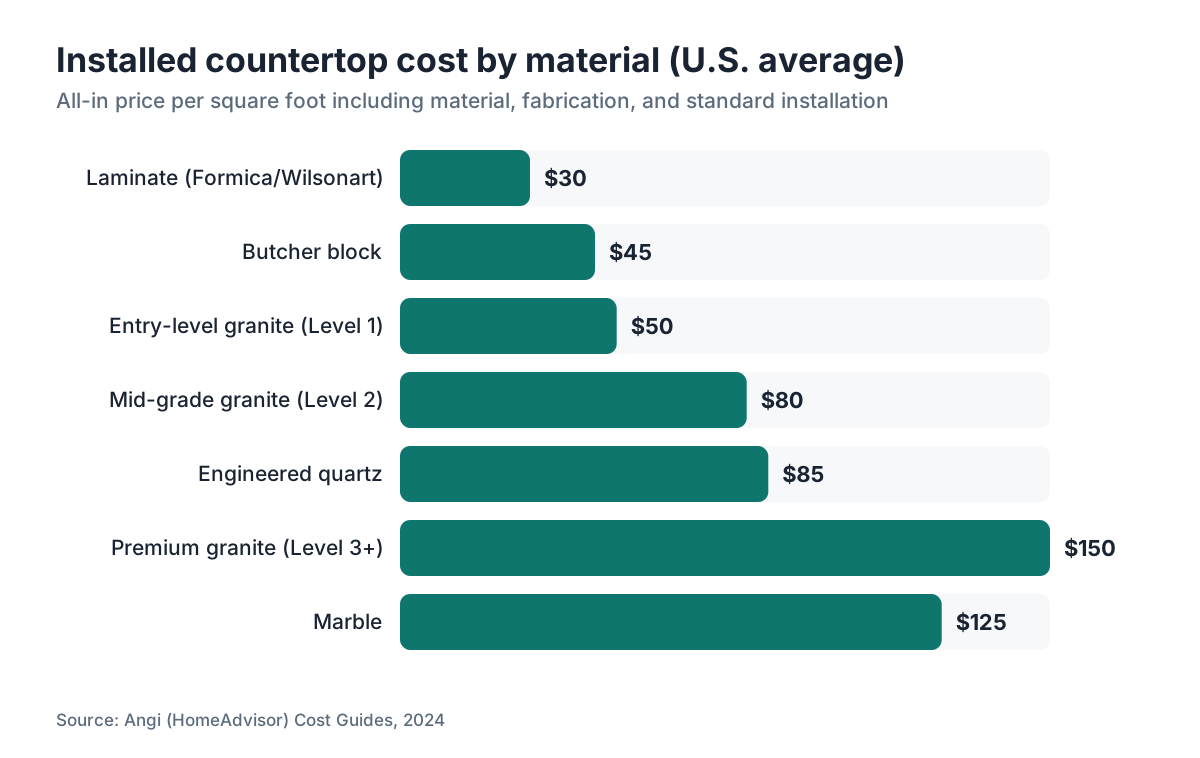
Most U.S. fabricators price entry-level granite at $40, $60 per square foot, all-in. That number includes the slab, fabrication (cutting, edging, polishing), and standard installation. The stone-only cost at the slab yard might be $5, $15 per square foot before any work is done. Fabrication and installation are where the cost piles up, and those prices barely move based on the stone tier.
A typical kitchen with 40 square feet of countertop surface lands between $1,600 and $2,400 at entry-level pricing. Mid-grade granite usually runs $60, $100 per square foot installed, and premium or exotic slabs can push $100, $200 or more [1]. Entry-level saves you real money, not a rounding error.
The numbers above are national averages and ranges collected by home cost research services. Your actual quote will vary by region, by the number of cutouts (sinks, cooktops), by edge profile choice, and by how far the fabricator has to travel. High-labor cities like San Francisco or New York skew higher. Rural Midwest shops often come in at the low end.
Edge upgrades are a common upsell at this tier. A standard eased or bevel edge is usually included. An ogee or waterfall edge adds $10, $20 per linear foot and can quietly blow your budget. Decide on the edge before you get your quote.
| Granite tier | Installed cost per sq ft (U.S. avg) | Common examples |
|---|---|---|
| Entry-level (Level 1) | $40, $60 | Uba Tuba, Santa Cecilia, New Venetian Gold |
| Mid-grade (Level 2) | $60, $100 | Giallo Ornamental, Black Galaxy, Bianco Romano |
| Premium (Level 3+) | $100, $200+ | Blue Bahia, Van Gogh, Taj Mahal quartzite (often mislabeled) |
| Quartz (engineered) | $50, $120 | Silestone, Cambria, MSI Q |
| Laminate | $20, $40 | Formica, Wilsonart |
Which granite colors are typically entry-level?
The colors in the entry-level category shift over time as quarry output changes. A handful of stones have been reliable budget options for decades because their quarries produce at massive scale.
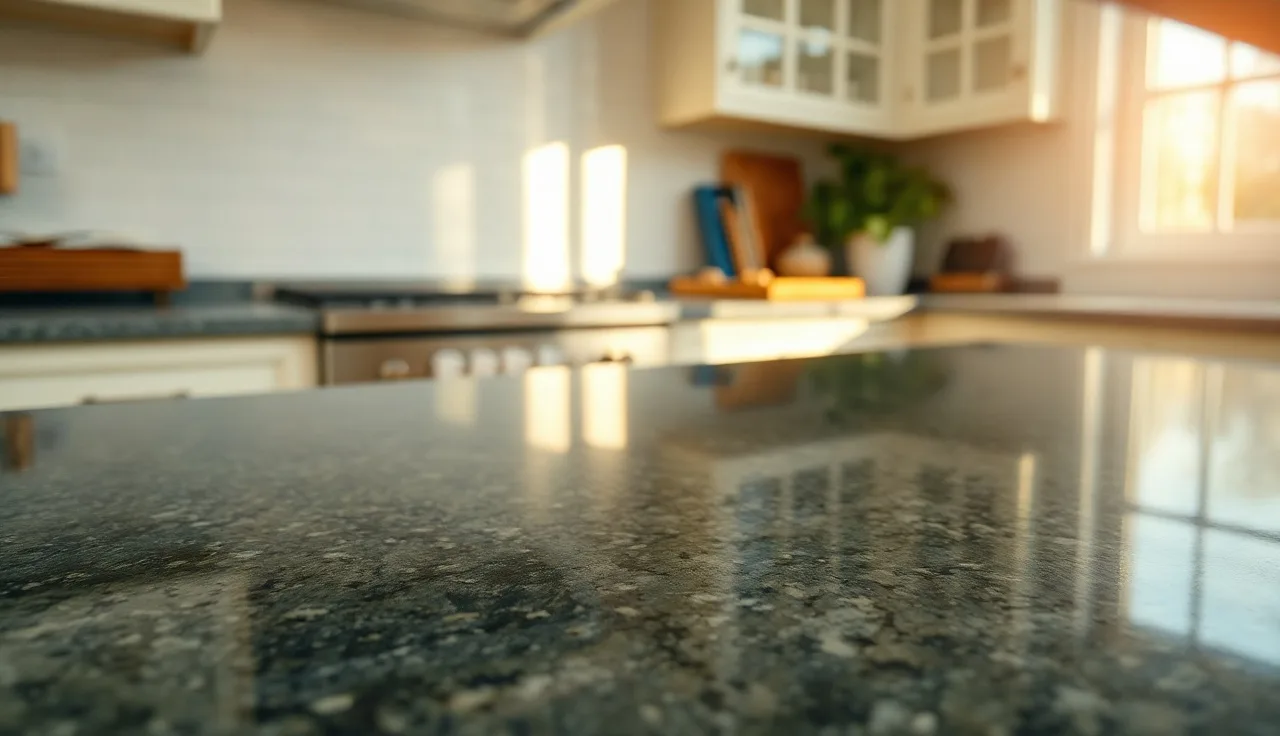
Uba Tuba is one of the most common. It is a dark green-black granite from Brazil with fine gold and silver flecks. It reads as near-black in most kitchens and works well with both light and dark cabinetry. Santa Cecilia is a warm beige and gold stone, also Brazilian, with burgundy and black mineral inclusions. It was the single most popular granite color in American kitchen remodels for stretches of the 2000s and 2010s because it pairs with almost any cabinet color. New Venetian Gold is a similar warm gold family. Giallo Ornamental straddles entry and mid-grade depending on the supplier.
Black stones, especially those labeled Absolute Black or Black Galaxy, often appear at the entry level. Be careful here. True Absolute Black is a fine-grained, nearly featureless black granite from India. Cheaper alternatives labeled 'Absolute Black' are sometimes gabbro or diabase, which are technically different rock types. They look similar but can behave differently with sealers. Ask your fabricator for the full origin name before committing.
If you want a white or light gray stone at the entry-level price, your options narrow fast. White granite tends to be more variable in veining and harder to produce consistently, so it commands higher prices. Colonial White and Bianco Romano sometimes show up at entry-level pricing, but expect to pay $60, $80 installed more often than not.
For readers comparing stone types, marble countertops occupy a separate market with different maintenance demands, and quartzite countertops are frequently confused with quartz but are natural stone. Neither typically enters the entry-level price range.
Is entry-level granite actually good quality?
Yes, with one caveat about slab thickness.
The mineralogy of granite does not change based on the price tier. Granite is an igneous rock made mostly of quartz, feldspar, and mica, and it rates 6 to 7 on the Mohs hardness scale whether the slab cost $8 per square foot or $30 per square foot at the yard [2]. It resists scratches from normal kitchen use, handles heat from pots and pans without cracking under ordinary circumstances (though no stone professional recommends putting a 500-degree pan directly on any countertop regularly), and with proper sealing, it resists staining reasonably well.
The thickness caveat is real. Many entry-level slabs come in 2 cm thickness rather than 3 cm. A 2 cm slab is structurally fine on a solid substrate like plywood, but it looks thinner at the edge, and most homeowners want the visual heft of a 3 cm edge. Fabricators often laminate a strip of stone at the front edge to fake a 3 cm profile. That adds cost and creates a glue joint that can become visible over years, especially if the stone has strong veining. If you care about edge appearance, ask specifically whether you are getting a 2 cm laminated edge or a full 3 cm slab.
Sealing is the other maintenance reality. Granite is porous to varying degrees, and entry-level stones like Santa Cecilia are known to be more porous than denser stones. An impregnating sealer applied every one to three years keeps liquids from penetrating the surface [3]. This is a $20, $30 DIY job and it genuinely works. Skip it for years in a busy kitchen and you get oil stains near the stove that become permanent. For guidance on maintaining any natural stone surface, see our guide on how to clean stone countertops.
What does granite countertop installation actually involve?
Knowing the installation sequence helps you catch problems before they cost you money. The order is: measure, template, fabricate, deliver, install.
After you pick your slab and sign a contract, the fabricator sends someone to template your kitchen. Templating used to mean paper or wood strips. Most shops now use digital laser templating tools that produce a precise CAD file. The file goes back to the shop where CNC saws and polishing equipment cut the slab to shape. This process typically takes one to two weeks from template to install, though busy shops in high season can stretch to three or four weeks.
Installation day runs two to four hours for a typical kitchen. Two installers bring in the cut pieces (granite is heavy, roughly 18 to 20 pounds per square foot for 3 cm stone), set them on the cabinets with construction adhesive or silicone, and caulk the seam where the counter meets the wall. If there is more than one piece, the seam between pieces gets epoxy with a color-matched pigment.
Seam placement matters, and it is something to discuss before fabrication, not after. Fabricators minimize seams but cannot always avoid them on long runs or L-shaped kitchens. Entry-level stones with small, uniform grain patterns like Uba Tuba hide seams much better than stones with large swirling veins. That is one functional advantage of the entry-level palette.
For the full breakdown of what installation involves, the countertop installation guide covers what to expect from template day through final inspection.
How does entry-level granite compare to laminate, butcher block, and quartz?
This is the real question most homeowners are chasing when they research entry-level granite. Here is an honest comparison.
Laminate (Formica, Wilsonart) runs $20, $40 installed and has improved a lot. Modern high-definition laminate can mimic stone convincingly until you touch it. It cannot be repaired if chipped, it is not heat-resistant the way stone is, and it does not add resale value the way natural stone does. If your budget is genuinely tight and you plan to sell in two years, laminate is a defensible choice. See the full comparison in our laminate countertops and Formica countertops guides.
Butcher block runs $30, $60 installed depending on wood species and thickness. It is warm and beautiful and terrible in kitchens where water sits on the surface. You will oil it. You will sand out knife marks. You will think about it more than you want to. If you genuinely cook and want a prep surface, one section of butcher block next to a sink is a great idea. A full kitchen of it is a commitment. Butcher block countertops covers the maintenance reality in detail.
Engineered quartz (Silestone, Cambria, MSI) runs $50, $120 installed and needs no sealing. It is more uniform in color because it is manufactured, which some people love and others find sterile. It is not heat-resistant the way granite is. The resins that bind the quartz particles can discolor or even crack from hot pans. For a busy kitchen where the natural stone story does not matter to you, quartz is genuinely competitive.
Entry-level granite beats laminate on durability, resale value, and heat resistance. It goes head to head with mid-priced quartz on installed cost. It loses to quartz on maintenance-free living. It wins over quartz if you want actual natural stone character.
Corian and solid surface options, covered in the Corian countertops guide, sit in yet another niche. Their main advantages are invisible seams and easy repair.
What should you ask a granite fabricator before signing anything?
Most homeowners get burned not on the stone itself but on surprises in the fine print. Ask these questions before you sign.
First: is the quoted price per square foot inclusive of fabrication and installation, or is it just the material? Some shops quote material only and add $30, $40 per square foot for labor. Others quote all-in. You cannot compare quotes without knowing which you are looking at.
Second: what thickness is the slab? 2 cm or 3 cm? If it is 2 cm, will the edges be laminated to a 3 cm profile, and what does that cost?
Third: how many cutouts are included? A standard undermount sink cutout is typically $100, $200 extra. A cooktop cutout adds similar cost. Faucet holes are usually $20, $40 each.
Fourth: who removes the old countertop, and what does that cost? Some fabricators include demo. Many do not.
Fifth: can you see the actual slab you are buying before fabrication? This is standard practice at reputable shops. Granite varies within a color family, and the display sample is not always representative of what is in the warehouse. Go to the yard, find your slab, mark it with chalk, and photograph it. This step alone prevents more disappointment than anything else in the process.
Fabricators who run efficient shops use software like SlabWise to manage slab inventory and quote jobs precisely, which means the price you are given reflects what is actually in stock. When you call around for quotes, shops with organized inventory can give you a firm number faster and honor it more reliably.
Can you save money by buying a remnant granite slab?
Yes, and this is one of the best ways to get granite at the lowest possible price for smaller surfaces.
A remnant is the piece left over after a fabricator cuts a larger slab for another job. If a customer ordered a kitchen that used two-thirds of a Santa Cecilia slab, the remaining third sits in the shop's remnant rack. Fabricators want to move those pieces. They take up space and represent tied-up inventory. Prices on remnants are negotiable, often 30 to 60% below the cost of buying from a full slab.
Remnants work best for bathroom vanities, laundry rooms, small kitchen islands, or bar tops. A typical remnant is 20 to 40 square feet. A full kitchen usually needs more than that, so you would either piece together multiple remnants (possible, but the seams need to match well) or accept the limitation.
The tradeoff is selection. You buy what is available the day you walk in, not what you ideally want. If you are flexible on color and grain, remnants are a smart move. If you have a specific vision, stick with a full slab purchase.
How do you maintain entry-level granite long-term?
Granite maintenance is simpler than most homeowners expect. For daily cleaning, soap and warm water work fine. Stone-specific pH-neutral cleaners are sold at hardware stores and are not strictly necessary, but they avoid any risk that repeated use of a strongly alkaline cleaner like some dish soaps might slowly degrade a sealer over years.
Avoid vinegar, lemon juice, and ammonia-based cleaners on granite. These are acidic and will etch the surface over time, dulling the polish in the spots you clean most. This is the mistake that damages more granite than anything else in residential kitchens [3].
Sealing: the most common recommendation is to seal entry-level granite once a year in a high-use kitchen. The easy test is to put a tablespoon of water on the surface. If it beads up and holds for a few minutes before a ring appears, the sealer is still working. If it absorbs within a minute, reseal. An impregnating penetrating sealer (Tilelab, StoneTech, Aqua Mix are common brands) takes about 30 minutes to apply and wipe off.
Scratches and chips: granite is hard enough that you will rarely scratch it with normal use. If a chip occurs at an edge (usually from impact, not cutting), a color-matched epoxy repair kit from any tile supply house can fix it invisibly enough for most people. A fabricator can do a professional repair for $50, $150 if the damage is significant.
For broader care guidance across different stone types, how to clean stone countertops covers the do's and don'ts in practical detail.
Does entry-level granite add home resale value?
The honest answer is that it depends on your market and what you are replacing.
Real estate research consistently shows that kitchen upgrades return somewhere between 50% and 80% of their cost at resale, with high variability based on local market conditions [4]. The National Association of Realtors' Remodeling Impact Report found that a complete kitchen renovation recoups roughly 67 cents on the dollar at resale on average [4]. Countertop-only upgrades are harder to isolate in the data.
What most real estate professionals and appraisers will tell you is that buyers in the middle-market segment expect stone countertops. Having laminate when comparable homes have granite or quartz will drag down your competitive position. Replacing laminate with entry-level granite is a genuine differentiator. Going from entry-level granite to premium exotic stone is unlikely to return its cost in a home priced under $400,000.
For a typical home sale, entry-level granite is probably the sweet spot. It checks the box buyers are looking for, it holds up through years of use so it still looks good at sale time, and it does not cost so much that you cannot recoup a fair share of it.
For a full picture of the kitchen countertops decision in a remodel context, the comparison between surface types and their impact on kitchen value is worth reading before you commit.
What are the most common mistakes buyers make with entry-level granite?
Not seeing the actual slab first is the biggest one. The display tile at a showroom is a 4-inch sample cut from one point in one slab. The slab in the warehouse can look quite different in color variation, veining, and overall character. Always view and approve the specific slab before fabrication starts. Most fabricators will allow this. The ones who resist should give you pause.
Choosing the edge profile last is another. Edge profiles are priced differently and are part of fabrication, not an afterthought. Decide during the quoting phase so the price is locked in.
Skipping the plywood substrate check matters more than most homeowners realize. Granite needs a solid, flat surface to sit on. If your cabinet tops are not flat or the plywood is thin or warped, the granite will rock or crack at seams over time. Ask the fabricator whether they inspect the substrate before installation and what they do if it needs shimming or repair.
Expecting entry-level granite to look like the dramatic book-matched veined slabs you see on design websites sets you up for disappointment. The entry-level palette is different by definition. If you want the dramatic look, budget for the dramatic stone. If you want a clean, durable surface at a fair price, entry-level granite delivers that well.
Fabricators and shop owners who want to quote entry-level and premium jobs with the same accuracy, track remnant inventory, and cut waste on the CNC can look at what SlabWise offers on the operations side. A well-run shop gives better prices and fewer surprises to homeowners.
Frequently asked questions
What is Level 1 granite, and is it the same as entry-level granite?
Yes, Level 1 is a trade term for entry-level granite. It refers to high-volume, widely available colors that cost less at the slab yard, not a certified quality grade. There is no industry-standard definition, so Level 1 at one fabricator might be Level 2 at another. Always ask what is included in that tier rather than assuming the label means the same thing everywhere.
What is the cheapest granite countertop color you can buy?
Uba Tuba, Santa Cecilia, and New Venetian Gold are consistently among the least expensive granite colors available in the U.S. because their Brazilian quarries produce at very high volume. Absolute Black from India is another low-cost option. Prices vary by region and current import supply, so check with local fabricators, but these four colors almost always appear in any shop's entry-level tier.
Is 2 cm granite strong enough for kitchen countertops?
On a solid substrate like 3/4-inch plywood, 2 cm granite is structurally adequate for most kitchen use. The risk is more at unsupported spans like an overhang for bar seating, where 2 cm can flex or crack without added support. Many fabricators laminate a 2 cm slab to appear as 3 cm at the edges. Ask about the support plan for any overhang longer than 6 inches.
How long does entry-level granite last?
Granite countertops routinely last the lifetime of the home if they are sealed periodically and not subjected to heavy impact on unsupported edges. The stone itself does not degrade. What ages first is the sealer, the caulk at the backsplash joint, and occasionally the epoxy in seams. All three are maintainable and replaceable for minimal cost. A 1975 granite countertop that has been resealed and re-caulked every few years looks nearly new today.
Does entry-level granite look cheap?
Not if you choose well. Uba Tuba is a clean, sophisticated black-green that reads as upscale in most kitchens. The 'cheap' perception usually comes from two places: a slab with an inconsistent, blotchy pattern that did not photograph well from the start, and the thinner 2 cm edge profile that visually telegraphs cost-cutting. Choosing a uniform, well-matched slab and specifying a 3 cm edge or clean laminated profile eliminates most of the visual tells.
Can you DIY install granite countertops to save money?
The fabrication (cutting and polishing) requires CNC or diamond saws and is not a practical DIY task. The installation (setting the cut pieces) is physically possible for handy homeowners, but granite slabs are extremely heavy, 18 to 20 pounds per square foot for 3 cm stone, and setting them without cracking a slab or damaging cabinets takes experience. Most fabricators will not sell you a cut slab without installing it because liability for breakage during install is theirs if they do the work.
How do I get quotes for granite countertops and compare them fairly?
Ask every shop for an all-in price per square foot that includes slab, fabrication, one undermount sink cutout, a standard eased or bevel edge, and installation. Then add edge upgrade and additional cutout costs as line items. Compare total installed cost for your specific square footage, not the per-square-foot number alone. Also ask about slab thickness, warranty on fabrication, and timeline from template to install.
Is Santa Cecilia granite a good choice?
Santa Cecilia is a strong entry-level choice for most kitchens. It is warm, versatile, and pairs with cream, white, honey, and dark cabinetry. Its one known downside is that it is more porous than denser granites, so regular sealing matters more here than with a stone like Absolute Black. Seal it on install and once a year after, and it holds up well for decades. It has been one of the top-selling granite colors in the U.S. for good reason.
What is the difference between granite and quartz countertops at entry-level prices?
At $40, $60 installed, granite is natural stone with no sealing-required substitute. Entry-level quartz from major brands starts closer to $50, $70 installed. Quartz needs no sealing but cannot handle direct heat from hot pans the way granite can. Granite varies slab to slab; quartz is manufactured to be consistent. Neither is definitively better. The choice comes down to whether you want the natural variation and heat tolerance of stone or the low-maintenance uniformity of engineered material.
How much does it cost to replace only the bathroom vanity with entry-level granite?
A small bathroom vanity of 10 to 15 square feet might cost $400, $900 using a remnant piece, which is far below the threshold where buying from a full slab makes economic sense. Ask fabricators specifically about remnant stock for vanity-sized projects. Many shops have remnants of Santa Cecilia, Uba Tuba, and similar colors sitting in the yard that they would rather sell at a discount than store indefinitely.
Does granite need to be sealed before use?
Most fabricators apply a factory sealer before installation. That is not a reason to skip a second application immediately after install. Entry-level granites, especially Santa Cecilia and similar porous stones, benefit from sealing on day one of use. Apply a penetrating impregnating sealer, let it soak for the time on the label (usually 10 to 20 minutes), then wipe off the excess. The whole job takes under an hour and protects the surface for a year or more in normal kitchen use.
What edge profiles are typically included with entry-level granite?
Standard eased (a slightly softened 90-degree edge) and basic bevel edges are almost always included in entry-level pricing. Ogee, bullnose, dupont, and waterfall profiles are upgrades that typically add $10, $20 per linear foot. A 40-square-foot kitchen has roughly 20 to 25 linear feet of exposed edge, so an ogee upgrade can add $200, $500 to your total. Decide on the profile before you sign the contract so there are no surprises.
Can entry-level granite be used outdoors?
Granite is used outdoors, but entry-level stones with more porosity will absorb water through freeze-thaw cycles in cold climates, which can cause surface spalling over years. In warm or dry climates the risk is minimal. For a heavily used outdoor kitchen counter in a freeze-prone area, a denser stone or a porcelain slab is a better long-term choice. If you want granite outdoors in a moderate climate, seal it with a breathable exterior-rated stone sealer and re-apply annually.
Sources
- HomeAdvisor (Angi), Granite Countertop Cost Guide: Entry-level granite installed ranges $40, $60 per sq ft; mid-grade $60, $100; premium $100, $200+
- University of Florida IFAS Extension, Natural Stone Care and Maintenance: Acidic cleaners (vinegar, lemon juice) etch stone surfaces and degrade sealers; penetrating sealers recommended for porous granite
- National Association of Realtors, 2023 Remodeling Impact Report: Complete kitchen renovation recoups approximately 67% of cost at resale on national average
- U.S. Geological Survey Mineral Resources Program, Stone, Dimension (Granite): Brazil is a primary source of high-volume granite including Santa Cecilia and Uba Tuba exported to the U.S.
- HomeAdvisor (Angi), Countertop Installation Cost Guide: Undermount sink cutout adds $100, $200 to countertop fabrication cost; cooktop cutouts similar
- U.S. Department of Housing and Urban Development, Remodeling and the Housing Market: Kitchen remodels ranked among top value-adding home improvements in resale context
- Tile Council of North America, ANSI A108 Stone Installation Standards: 3/4-inch (2 cm) stone slabs require solid substrate support; unsupported overhangs beyond 6 inches require reinforcement per installation guidelines
- Remodeling Magazine, 2024 Cost vs. Value Report: Kitchen upgrades nationally return 50 to 80% of cost at resale; high variability based on local market
- U.S. Census Bureau, American Housing Survey: Kitchens and Bathrooms: Stone and engineered stone countertops are present in a growing share of owner-occupied homes; laminate remains most common overall surface type
Last updated 2026-07-09