TL;DR
- Engineered stone (quartz) is roughly 93% ground quartz crystals bound with polymer resin, pigments, and sometimes glass or mirror chips.
- Fabricators template the kitchen, cut with wet-blade CNC saws, grind and polish the edges, then install.
- Installed cost runs $75 to $150 per square foot in the U.S.
- The material is hard, non-porous, and consistent.
- It also warps under sustained heat and yellows near UV light.
What exactly is engineered stone made of?
Engineered stone is a manufactured composite, not a quarried block. The standard formula is roughly 93% ground quartz aggregate by weight, bonded with about 7% polymer resin (usually polyester or acrylic), plus pigments and sometimes decorative additives like mirror chips, glass, or metallic flakes. [1] That ratio is not arbitrary. Below roughly 90% quartz, surface hardness drops noticeably. Above 95%, the slab turns brittle and harder to polish without micro-cracking.
Quartz itself sits at 7 on the Mohs hardness scale. The finished composite tests at 6.5 to 7 because the resin matrix between the grains is softer than the quartz. Granite averages around 6 to 7 depending on feldspar content, and marble runs 3 to 5. [2] So engineered stone is genuinely scratch-resistant for daily kitchen use, though a ceramic knife or a tungsten carbide tool will still mark it.
The resin binder is what gives fabricators trouble. Standard polyester resin systems have a heat deflection temperature around 150°F (65°C). Set a cast-iron skillet fresh off the burner on the surface and you can warp the slab or burn a white haze into it permanently. That is not a fabrication defect. It is a material limit every fabricator should explain before the install.
Caesarstone, Cambria, Silestone, and Cosentino's Dekton line each use slightly different formulas. Cambria markets its product as 100% American quartz with no polyester resins in the stone layer, using a different binding approach. [3] Dekton is not engineered stone in the traditional sense. It uses a sintered process with 20-plus minerals compressed under heat and pressure, which puts it closer to ultra-compact surface than quartz composite. Fabricators need to know the difference, because sintered surfaces demand different tooling entirely.
How is engineered stone made at the factory?
Factory process matters to fabricators because it sets slab thickness consistency, internal stress, and how the material behaves under the blade. Get a bad batch and you feel it at the saw and again at the seam.
Most engineered quartz slabs are made using the Bretonstone process, developed by Breton S.p.A. of Italy in the late 1980s and still the dominant system worldwide. [4] Ground quartz of varying particle sizes is mixed with resin and pigments, vibro-compacted under vacuum pressure (around 100 tons or more), and cured in an oven at roughly 90°C (194°F) for 45 to 90 minutes. The vacuum step pulls out air bubbles that would otherwise leave voids and weak spots. Skip it and you get micro-porosity, which is exactly what the material is supposed to eliminate.
The result is a slab typically 120 inches by 55 inches (about 3 meters by 1.4 meters), though jumbo slabs from some manufacturers reach 128 inches by 63 inches. Nominal thickness is 2 cm (0.8 inches) or 3 cm (1.2 inches). Many fabricators prefer 3 cm for counters because it kills the need for substrate buildup and handles edge profiling better. Two-centimeter is lighter and sometimes cheaper. [1]
Thickness tolerance is where quality shows. Reputable manufacturers hold about plus or minus 1 mm across the slab. Cheap or off-brand slabs can drift 2 to 3 mm, which causes trouble at seams and when the polisher tries to make a flat surface out of a slab that isn't. Check incoming slabs with a straightedge before you process anything.
What does the fabrication process actually involve, step by step?
Engineered stone fabrication has five stages: templating, layout, cutting, edge profiling, and finishing. Each has its own way of going wrong.
Templating. Before any stone gets cut, a fabricator measures the kitchen or bath. Digital templating uses a laser device (a Proliner, or a Leica Disto with templating software) to capture the real dimensions of the base cabinets, overhang requirements, sink cutout positions, cooktop locations, and any filler or scribe measurements. [5] Traditional templating uses thin strips of luan or cardboard. Digital is faster and lands within 1 to 2 mm across a full kitchen. Errors here are the most expensive kind, because the stone is already bought and custom cut.
Layout and nesting. With the template in hand, the fabricator lays out cuts on the slab, working around pattern matching, seam placement, and yield. Waste costs real money: engineered stone slabs run $300 to $600 each wholesale, more for premium brands. Nesting software (the kind of tool quoting platforms like SlabWise handle) optimizes cut placement to cut remnant waste and prices jobs on actual yield rather than a rough square-foot guess.
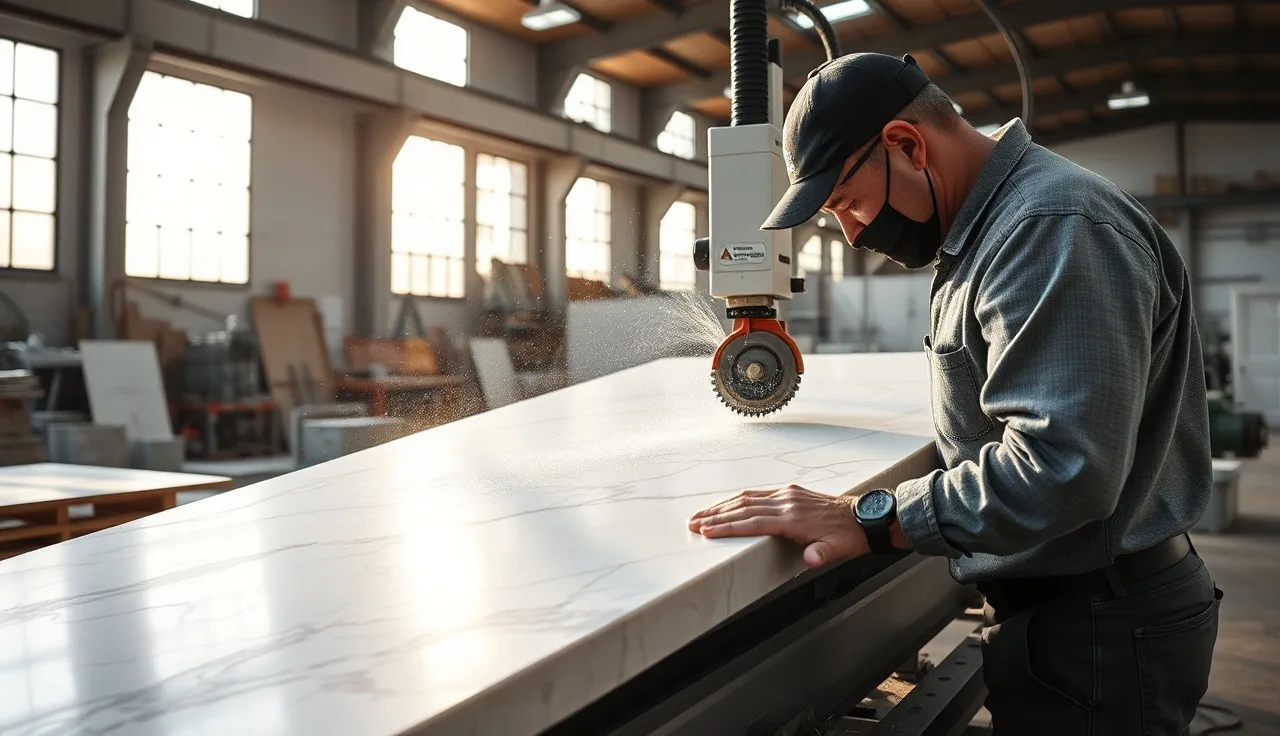
Cutting. CNC bridge saws do the heavy lifting. A diamond-tipped blade (usually a continuous-rim or segmented-rim wet blade for engineered stone) runs at roughly 3,000 to 5,000 RPM with water cooling. [6] Feed rate for a straight cut on 3 cm engineered stone runs around 12 to 20 inches per minute depending on blade age and stone hardness. Rush it and you chip the bottom exit edge. Sink cutouts are almost always done with a CNC router or jigsaw attachment, using plunge cuts at the corners.
Edge profiling. This is where labor time piles up. A standard eased edge takes 15 to 20 minutes per linear foot on an edge polisher. A full bullnose or ogee can take 45 minutes per foot or more. [6] Engineered stone polishes well because of its uniform hardness, but the resin smears if diamond pad grits are sequenced wrong (typically stepping from 50 through 3000 grit before the final buff).
Seaming and installation. Seams get filled with color-matched epoxy. The best seams disappear under a single light source. They are never actually invisible under raking light, and any fabricator who promises otherwise is setting you up for a complaint. Industry standard seam width is 1/16 inch or less. After the top is set, it gets caulked to the backsplash and any adjacent walls.
How much does engineered stone fabrication cost?
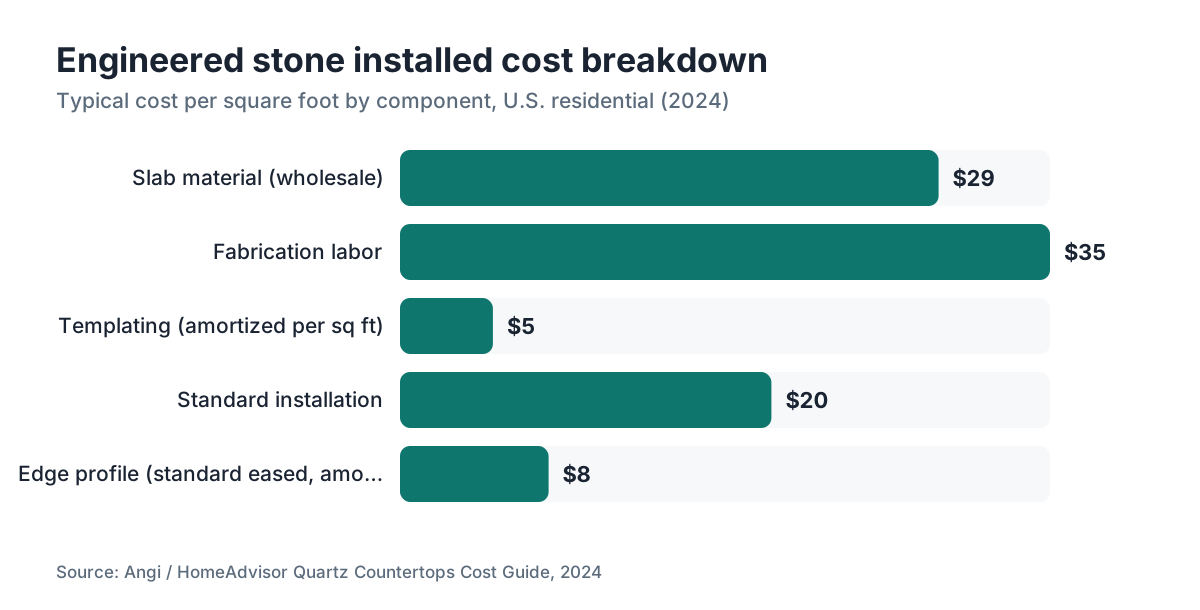
Installed engineered stone countertops run $75 to $150 per square foot in the U.S., with the midrange around $100 to $120. [7] That bundles material, fabrication labor, templating, and basic installation. Edge upgrades, sink and cooktop cutouts, mitered edges, and odd layouts push the base price up.
Here is where the dollars go on a typical job.
| Cost component | Typical range (per sq ft unless noted) |
|---|---|
| Slab material (wholesale) | $18 to $40/sq ft |
| Fabrication labor (cutting, edging) | $25 to $45/sq ft |
| Templating | $100 to $200 flat fee |
| Standard installation | $15 to $25/sq ft |
| Sink cutout (undermount) | $100 to $200 each |
| Upgraded edge profile | $15 to $30/linear ft adder |
| Seam (per seam) | $50 to $150 each |
Premium brands like Cambria or Silestone Eternal cost more at the slab, sometimes $35 to $50 per square foot wholesale, while commodity-grade engineered stone from a distributor might be $15 to $22. [7] Fabrication labor barely moves between brands, because the material fabricates about the same either way.
Homeowners usually stack engineered stone against granite countertops and marble countertops. Granite installed runs $60 to $130 per square foot, so engineered stone is not dramatically more, and its consistency means fewer surprises at the seam. Marble prices out similarly but needs sealing and stains easily, which changes the long-term math.
For fabricators, profit lives in material yield. A 50-square-foot kitchen cut from one slab with smart nesting beats the same job that needs a second partial slab, every time. Once waste climbs past 25%, margin on mid-priced material starts bleeding fast.
What tools and equipment do fabricators need?
Running an engineered stone shop takes real capital. Here is the core equipment list and what it costs.
CNC bridge saw. The workhorse. Entry-level machines (older used Italian saws) start around $30,000. Modern 5-axis CNC bridge saws with automatic tool changers from Intermac, Park Industries, or Donatoni run $150,000 to $400,000 new. [6] The bridge saw is the single most important machine in a stone shop. It sets cut quality, throughput, and which profiles you can run.
Edge polisher. A manual or semi-automatic edge machine runs diamond tooling along the cut edge through a sequence of grits. Automatic machines speed up production a lot on straight runs. Budget $20,000 to $80,000 for a quality automatic line polisher.
CNC router. For sink cutouts, radius corners, and decorative cuts. Often built into the bridge saw on higher-end machines. Standalone routers start around $25,000.
Vacuum lifting systems. Engineered stone at 3 cm weighs roughly 18 to 20 pounds per square foot. [1] A 30-square-foot island top weighs 550 to 600 pounds. Vacuum lifters prevent dropped slabs and back injuries. Non-negotiable for any shop doing volume.
Digital templating device. A Proliner 8 or similar unit runs $8,000 to $15,000. It pays back in accuracy and fewer remakes.
Wet grinder / hand polisher. For field seam work and touch-ups. $500 to $2,000 for the tool, plus a diamond pad inventory.
A two-person shop doing residential work produces roughly 20 to 40 square feet of finished countertop per day per installer pair, depending on complexity. High-volume shops running automated lines push 200 to 400 square feet per shift.
What are the most common fabrication mistakes and how do you avoid them?
Engineered stone is more forgiving than marble or limestone. Fabricators still make expensive mistakes with it, and most trace back to support and heat.
Seam placement. Put a seam directly over a dishwasher or at a high-traffic corner and you invite cracking. Standard practice keeps seams away from inside corners and off unsupported spans. A seam over a dishwasher sees door flex and heat every day. It will open or crack eventually.
Insufficient support. Engineered stone is not self-supporting over long spans. A 3 cm slab spans roughly 24 to 30 inches unsupported, but anything past 36 inches needs a support structure underneath. Islands with overhangs beyond 12 inches for seating need corbels or steel supports. [1] Cheap out here and you get post-install cracking calls.
Heat damage during cutting. Run dry or with weak water flow and you burn the resin, leaving a cloudy line along the cut edge. Sometimes you can grind past it. A deep heat scar means cutting a new piece.
Wrong blade or wrong feed rate. A blade built for natural stone (wider kerf, more aggressive) tends to chip the bottom edge of engineered stone. A continuous-rim or engineered-stone-specific blade at the right feed rate leaves a cleaner exit edge. Blade cost matters less than shops think. A worn blade costs more in chipping and redo labor than a new one.
Ignoring thermal expansion. Engineered stone expands and contracts with temperature. Caulk, not grout, at every perimeter joint lets the slab move without cracking. Rigid grout at the wall is a slow-motion crack waiting to happen.
Sink mounting errors. Undermount sinks on engineered stone need epoxy adhesive, sink clips, or both. A cast-iron undermount sink without proper mechanical support pulls the stone down at the front edge over time.
Is engineered stone safe to fabricate? What about silica dust?
This is the biggest safety question in stone fabrication right now, and the answer has shifted hard in the last few years. Dry cutting engineered stone can kill you. That is not hyperbole.
Engineered stone contains up to 93% crystalline silica by weight. [1] Dry cutting or grinding throws off fine respirable silica dust (particles under 10 microns) that causes silicosis, an irreversible and potentially fatal lung disease. Natural granite runs 20 to 45% silica by weight, so engineered stone generates roughly two to four times more silica dust per cutting operation than granite. [8]
OSHA's permissible exposure limit (PEL) for respirable crystalline silica is 50 micrograms per cubic meter of air as an 8-hour time-weighted average, set in the final rule on respirable crystalline silica (29 CFR 1910.1053 for general industry, 29 CFR 1926.1153 for construction). [9] The action level is 25 µg/m³, and crossing it triggers medical surveillance requirements.
CDC's National Institute for Occupational Safety and Health has documented engineered stone countertop workers in the U.S. and Australia developing accelerated silicosis at younger ages than expected, including cases in workers under 35 with fewer than 10 years of exposure. [8]
Required controls under OSHA's standard include wet methods during cutting (water suppression at the blade), local exhaust ventilation at the grinding station, and respiratory protection when engineering controls alone can't hit the PEL. [9] OSHA's construction standard directs employers to "use one or more of the following: (i) Wet methods; (ii) Vacuum systems with HEPA filter exhaust." Dry cutting engineered stone without controls is not legal in the U.S. and has led to enforcement actions.
California went further. In 2024 the California Occupational Safety and Health Standards Board adopted an emergency temporary standard under Cal/OSHA with stricter requirements aimed at engineered stone fabrication shops. [10] Several countries, including Australia, have moved to ban the product for indoor use over silicosis cases in fabricators.
For shops, the takeaway is short. Wet cutting is mandatory, not optional. Put real wet extraction at grinding and polishing stations. Provide and enforce half-face respirators with P100 or N95 filters whenever dust is generated. Run air monitoring at least annually. This is not box-checking. Fabricators have died from this.
How does engineered stone compare to natural stone for fabricators?
Fabricators who work both materials develop strong opinions fast. Here is an honest comparison across what actually matters in a shop.
Consistency. Engineered stone wins by a mile. Every slab of a given SKU is dimensionally similar, same hardness, same density. Natural granite and quartzite vary from slab to slab and even within one slab. For newer fabricators, engineered stone is far easier to produce consistently good work with.
Edge polish quality. Engineered stone takes a high gloss edge easily thanks to its uniform composition. Natural granite with a large crystal structure can look slightly grainy at the edge at the same grit sequence. Marble polishes brilliantly but scratches easily afterward.
Seam visibility. Engineered stone seams show more than most homeowners expect, especially on heavily veined patterns where matching the design across a seam is nearly impossible. Natural stone seams on consistent materials like absolute black granite can nearly vanish. On exotic patterns, natural stone seams are obvious too.
Behavior under the saw. Engineered stone's resin binder can gum up diamond blades faster than natural stone when water cooling is weak. Natural granite is all mineral and doesn't smear.
Porosity and sealing. Engineered stone is non-porous and needs no sealing. Natural granite gets sealed once a year or every few years. See our guide to how to clean stone countertops for maintenance details.
Weight. About the same. Both run roughly 18 to 20 pounds per square foot at 3 cm. Neither is easy to handle without lifting equipment.
Price to fabricate. Labor cost is similar. Blade wear on engineered stone runs higher because of the silica density, which is a real but modest cost.
How do fabricators quote and price engineered stone jobs accurately?
Accurate quoting needs three inputs: real square footage with real waste factors, edge linear footage by profile type, and cutout count by type. Ballpark estimates off a floor plan are almost always wrong by 10 to 15%, which is enough to erase your margin on a mid-size job.
Waste factor swings with job complexity. A simple galley kitchen with two straight runs might waste only 10 to 15% of the slab. An L-kitchen with an island, a diagonal corner, and pattern-matching can waste 30 to 40%. Price on material square footage without adjusting for actual yield and you underprice complex jobs every time.
Edge profiling is where shops quietly lose money. A full kitchen might have 40 linear feet of exposed edge. At a $20 per linear foot adder for a profile upgrade over a basic eased edge, that is $800 the quote missed. Smart shops price edge work by profile complexity (eased, beveled, bullnose, ogee) rather than a flat uplift, which lands closer to reality.
To tighten this, fabrication quoting software that uses real slab dimensions and nesting logic prices jobs more accurately than spreadsheets. SlabWise is built for exactly this. It handles slab nesting, calculates yield-based material cost, and generates the customer quote in one workflow, so you see actual margin before you commit to a price. Homeowners can use the same tool to get an instant estimate before calling shops.
One more thing pricing has to account for: install complexity. A 10-foot island top set on the first floor of a new build is easy. The same top hauled up a stairwell to the third floor of a brownstone reno is a different job. Flat per-square-foot pricing that ignores access difficulty underprices hard installs, over and over.
Kitchen countertops covers all the material options if you want to compare costs across types before committing to engineered stone.
What warranties and durability can homeowners expect?
Most major engineered stone brands offer a limited lifetime warranty to the original purchaser. [3] Cambria offers a lifetime limited warranty. Caesarstone offers a limited lifetime warranty in the U.S. Silestone by Cosentino offers a 25-year transferable warranty on its HybriQ technology line. [11]
Read the exclusions closely, because most warranties exclude thermal damage (hot pans), mechanical impact damage, flexural stress from improper installation (inadequate substrate support), and damage from the wrong cleaning agents. Set hot pots on it and the resulting discoloration is on you. That is material science, not a warranty failure.
Actual durability in normal kitchen use is genuinely excellent. The surface resists steel cutlery in daily use, though deliberate scraping with a metal tool will mark it. It shrugs off wine, coffee, and common kitchen acids better than marble and about as well as sealed granite. UV exposure is the real limit. Engineered stone near south-facing windows with direct sun can yellow over time as the resin ages. Manufacturers know this, and some newer formulations have better UV stability, but no engineered stone is truly UV-proof for the long haul.
For more, Cambria countertops has brand-specific detail, and laminate countertops and Corian countertops are worth reading if you're deciding between engineered stone and solid-surface or laminate.
What should homeowners ask a fabricator before signing a contract?
Homeowners fixate on pattern and price and skip the questions that actually predict whether the job goes smoothly. Ask these instead.
Ask how they template. Digital templating cuts error hard. If they're still cutting cardboard strips, that's fine for simple layouts, but for a complex kitchen you want digital.
Ask where the seams will go. They should show you on a drawing before cutting. Seam placement is the fabricator's design call with your input, and moving a seam after the stone is cut means new material.
Ask about the support plan for overhangs. Anything past 12 inches of overhang on an island needs mechanical support. Get it in writing.
Ask about their silica dust controls. Legitimate shops wet-cut and ventilate. Shops that skip basic dust controls are usually the same shops cutting corners on fit and finish.
Ask for references from recent jobs. Not website testimonials. Actual contact info for two or three past clients.
Ask about timing. Fabrication and installation for a typical kitchen runs two to four weeks from template to install once the material is in the shop. Rush orders happen, and they cost more.
For install day itself, read our countertop installation guide before the crew shows up, so you know what to check before they leave.
Are there environmental considerations with engineered stone?
Engineered stone manufacturing takes a lot of energy. The Bretonstone process runs on industrial compaction and kiln curing. The quartz aggregate still gets mined, crushed, and processed. The polymer resin is petrochemical-derived. None of this makes engineered stone dramatically worse than other countertop materials, but the footprint isn't zero.
Some manufacturers mix post-industrial recycled quartz and glass into their aggregate, which cuts virgin material use. The percentages vary and don't always show up clearly in marketing. If recycled content matters to you, ask for the manufacturer's environmental product declaration (EPD), a third-party verified document that discloses environmental impact data. [12]
End-of-life disposal is the real problem. Engineered stone doesn't recycle easily because the resin and quartz are bonded permanently. Old countertops go to landfill almost every time. Some fabricators sell remnants or donate them to Habitat for Humanity ReStores, which trims shop waste a little.
For comparison, butcher block countertops carry a different profile (wood, renewable but needs finishing chemicals), and formica countertops use paper and resin over particleboard. Every material trades something. Engineered stone's durability (20-plus years in normal use) is itself an environmental plus against materials swapped out every 10 years.
Frequently asked questions
Can engineered stone be cut on site during installation?
Yes, but it's not ideal. Field cuts with a wet circular saw and diamond blade happen when adjustments are needed, but cut quality is lower than a shop CNC saw, and dust control on site is harder. Experienced installers make clean field cuts for minor tweaks. Cutting a full sink hole or a complex mitered edge on site is a last resort and usually produces worse results than shop fabrication.
How thick should engineered stone countertops be?
Most residential countertops use 3 cm (roughly 1.2 inches). It's self-supporting over standard spans, handles edge profiling better than 2 cm, and needs no buildup board beneath it. Two-centimeter slabs are lighter and sometimes cheaper, but fabricators usually laminate a second piece at the edge to fake a thicker look, which adds labor. For outdoor or very long spans, go 3 cm.
Why do engineered stone seams show more than I expected?
Heavily veined engineered stone patterns are formed during manufacturing, so matching the pattern perfectly across a seam is nearly impossible. Even on solid or lightly patterned surfaces, a seam reflects light differently than the stone around it. A seam is never truly invisible under raking light. Good fabricators minimize it with color-matched epoxy and tight alignment, but setting the expectation upfront avoids disappointment. Visit the shop and look at sample seams first.
Does engineered stone need to be sealed?
No. The polymer resin binder makes engineered stone non-porous, so liquids can't penetrate the surface. Sealing is neither needed nor effective, because a sealer has nothing to bond to. This is one of the main maintenance advantages over natural stone like granite or marble, which typically need resealing every one to three years depending on use and porosity.
What is the difference between engineered stone and Dekton?
Engineered stone (quartz composite) is roughly 93% quartz bound in polymer resin, cured at moderate heat. Dekton by Cosentino is an ultra-compact sintered surface made by fusing 20-plus minerals under very high heat and pressure, which burns off the organic binders entirely. The result is closer to a ceramic-porcelain hybrid with more heat resistance and UV stability, but it's more brittle and needs different diamond tooling. It also tends to cost more than standard engineered quartz.
How long does engineered stone fabrication and installation take?
From the day the fabricator templates your kitchen to install day, expect two to four weeks for a typical residential job. Template takes one to two hours. Material may already be in stock or need ordering (one to two weeks). Shop fabrication takes one to three days. Install day for a full kitchen runs four to eight hours. Complex jobs or back-ordered materials can push timelines to six weeks.
Can engineered stone be repaired if it chips or cracks?
Small chips and hairline cracks can be repaired with color-matched epoxy, and a skilled fabricator can make them nearly invisible on solid-color surfaces. On patterned materials, repairs show more, because matching the pattern in a filled area is hard. Large cracks through the full thickness usually mean replacing the affected section, which involves a new piece and a new seam. Proper support and avoiding impact beats any repair.
Is engineered stone heat resistant enough for a kitchen?
It's more heat-resistant than plastic laminates but less than natural stone or Dekton. The polymer resin starts to deform around 150°F (65°C) in standard formulations. A pot of boiling water set directly on the surface rarely causes immediate damage, but a cast-iron pan at 400°F straight from the oven can leave a permanent white discoloration or warp. Every manufacturer recommends trivets or hot pads. Communicate this limit before installation, not after.
What causes engineered stone to yellow over time?
UV radiation degrades polyester and some acrylic resins, causing yellowing or color shift over years of direct sun. This is a known limit of polymer-bonded composites. Countertops near south-facing windows with direct sun are most vulnerable. Some manufacturers have improved UV stabilizers in newer formulations, but no current engineered stone is fully UV-stable long term. If your kitchen gets heavy direct sun, ask the manufacturer specifically about UV performance for that product.
How serious is the silica dust risk for fabricators working with engineered stone?
Very serious. Engineered stone is up to 93% crystalline silica, far more than natural granite. CDC and OSHA have documented accelerated silicosis in engineered stone fabricators, including workers under 35. OSHA's permissible exposure limit is 50 µg/m³ over an 8-hour average. Wet cutting, local exhaust ventilation, and respiratory protection are legally required controls, not optional. Shops that dry-cut engineered stone are breaking federal law and putting workers at serious risk.
What edge profiles work best on engineered stone?
Engineered stone machines cleanly for almost any profile: eased, beveled, half-bullnose, full bullnose, ogee, and mitered. The uniform hardness keeps edge polish consistent and makes high-gloss finishes achievable with standard diamond pad sequences. The main constraint is machine capability in your shop, not the material. Complex profiles like ogee and dupont take a lot more machine time and carry a labor upcharge, typically $15 to $30 per linear foot over a standard eased edge.
Can you install engineered stone outdoors?
Not recommended for most standard engineered stone. UV degradation of the resin, freeze-thaw cycling in cold climates, and sustained outdoor heat all shorten its life. Some manufacturers void warranties for outdoor use. If you want a stone-look outdoor surface, sintered materials like Dekton or porcelain slabs are better suited and designed for it. Repurposing indoor engineered stone to an outdoor application is a choice many shops will warn you against.
How do fabricators handle very large island tops without seams?
Standard engineered stone slabs are roughly 120 inches by 55 inches. An island longer than about 110 inches, or wider than about 42 inches with overhang, needs a seam somewhere. Jumbo slabs from some manufacturers reach 128 by 63 inches and reduce seam frequency. The other option is mitered corners or waterfall edges designed so the seam, when it exists, falls somewhere less conspicuous. There's no magic way to avoid seams on truly large islands with standard slab sizes.
What's the best way for a homeowner to find a qualified engineered stone fabricator?
Check whether the fabricator is a certified installer or partner for the brand you're buying. Caesarstone, Cambria, and Silestone all maintain authorized fabricator networks, and buying through an authorized shop protects your warranty. Ask to visit the shop and see the equipment. A shop with a wet-process CNC saw and proper dust extraction operates at a different level than one doing hand cuts in a garage. Get at least two quotes, and ask each shop where they'd place your seams.
Sources
- U.S. Geological Survey (USGS), National Minerals Information Center: Quartz hardness is 7 on the Mohs scale; granite mineral composition and hardness range
- Cambria, Cambria Warranty Page: Cambria offers a lifetime limited warranty to the original purchaser and describes their American quartz sourcing and binding approach
- Park Industries, Stone Fabrication Equipment Specifications: CNC bridge saw RPM ranges for engineered stone cutting; edge polishing machine cost ranges; feed rate guidance for 3 cm engineered stone
- Angi (HomeAdvisor), Quartz Countertops Cost Guide: Installed engineered stone countertop cost ranges $75 to $150 per square foot in the U.S., with slab wholesale prices varying by brand
- CDC / NIOSH, National Institute for Occupational Safety and Health: Engineered stone generates roughly 2-4x more respirable silica dust than natural granite per cutting operation; accelerated silicosis cases have been documented in U.S. and Australian engineered stone workers under age 35
- OSHA, Respirable Crystalline Silica Standard (29 CFR 1910.1053 general industry; 29 CFR 1926.1153 construction): OSHA PEL for respirable crystalline silica is 50 µg/m³ as an 8-hour TWA; action level is 25 µg/m³; required controls include wet methods and HEPA vacuum systems
- California Department of Industrial Relations, Cal/OSHA (Division of Occupational Safety and Health): California's Cal/OSHA adopted an emergency temporary standard in 2024 establishing stricter requirements specifically for engineered stone fabrication shops
- Cosentino / Silestone, Silestone Warranty: Silestone by Cosentino offers a 25-year transferable warranty on their HybriQ technology countertop line
- International EPD System, Environmental Product Declaration Program: Environmental product declarations (EPDs) are third-party verified documents disclosing environmental impact data for building products including stone countertops
Last updated 2026-07-10