TL;DR
- Engineered quartz is 90 to 93% crushed natural quartz bound with polymer resin, pigments, and sometimes recycled content.
- Installed cost runs $50 to $150 per square foot depending on brand, edge profile, and region.
- The surface is non-porous, never needs sealing, and holds up to daily kitchen use.
- It can't take prolonged direct heat, and it yellows or warps in full sun.
What exactly is engineered quartz made of?
Engineered quartz is a manufactured slab, not a quarried stone. Manufacturers grind natural quartz crystals (and sometimes mirror chips, glass, or granite particles) into pieces ranging from fine sand to coarse grit, then bind them under vacuum and vibro-compaction with a polymer resin. That resin runs about 7 to 10% of the finished slab by weight. [1] Pigments and stabilizers go in at this stage, which is how manufacturers produce consistent solid colors and uniform veining that natural stone can't match.
The most widely cited composition is roughly 90 to 93% quartz aggregate, 7 to 10% resins and binders, plus small amounts of pigment and sometimes recycled glass. [1] Because that binder is essentially a plastic, the finished slab is non-porous in a way that natural quartzite, marble, and many granites are not. Liquids can't seep in. Bacteria and mold have nowhere to hide.
The process was commercialized by Breton S.p.A. in Italy and is described in patents going back to the 1960s, though mass-market adoption in North American kitchens picked up in the early 2000s. [2] Today the major brands (Caesarstone, Cambria, Silestone, MSI, and dozens of others) run essentially the same Breton-licensed process or a derivative. That's why the core performance profile is similar across brands even when prices and looks vary wildly.
Keep one thing straight: engineered quartz is not quartzite. Quartzite is a metamorphic natural stone that needs sealing and can etch. Engineered quartz is a man-made composite slab. If a showroom rep uses the two names interchangeably, that's a red flag worth calling out on the spot.
How much do engineered quartz countertops cost?
Installed quartz runs $50 to $150 per square foot, and the national midpoint lands around $70 to $90. The number in an ad is almost never the number on your final invoice.
Material-only prices at the slab level run from about $25 to $90 per square foot depending on brand tier and color. Entry-level imported quartz from suppliers like MSI or Vicostone sits toward the low end. Mid-range domestic and European brands (Caesarstone, Silestone) fall in the middle. Cambria, the only major brand that mills in the United States, sits near the top on material cost. [3]
Fabrication and installation add another $25 to $60 per square foot for a typical kitchen. That covers templating, cutting, edge profiling, sink cutouts, and installation labor. Edge upgrades (ogee, waterfall, dupont) and non-standard cutouts push it higher. Demolition and haul-away of old countertops adds $3 to $8 per linear foot on top.
A typical U.S. kitchen has 30 to 40 square feet of countertop surface, so total installed cost usually falls in the $2,100 to $5,000 range before upgrades. Kitchens with islands, elaborate edges, or premium brands can run $6,000 to $10,000 or more. [4]
| Quartz tier | Material per sq ft | Installed per sq ft |
|---|---|---|
| Budget / builder-grade import | $25, $40 | $50, $70 |
| Mid-range domestic/European | $40, $65 | $65, $100 |
| Premium (Cambria, top-tier designs) | $65, $90+ | $90, $150+ |
Region matters a lot. Labor rates in San Francisco or New York City can run 40 to 60% above what a shop in rural Ohio or Texas charges for identical work. In a high-cost metro, budget toward the top of each range.
Want a sanity check before you call fabricators? Tools like the SlabWise instant quote calculator let you plug in square footage, edge choice, and zip code for a ballpark. Knowing a realistic floor helps you push back on inflated quotes in the showroom.
How does engineered quartz compare to granite, marble, and other countertop materials?
No single countertop material wins every category, which is exactly where homeowners get stuck. The tradeoffs are real, so pick the ones that matter for how you actually live.
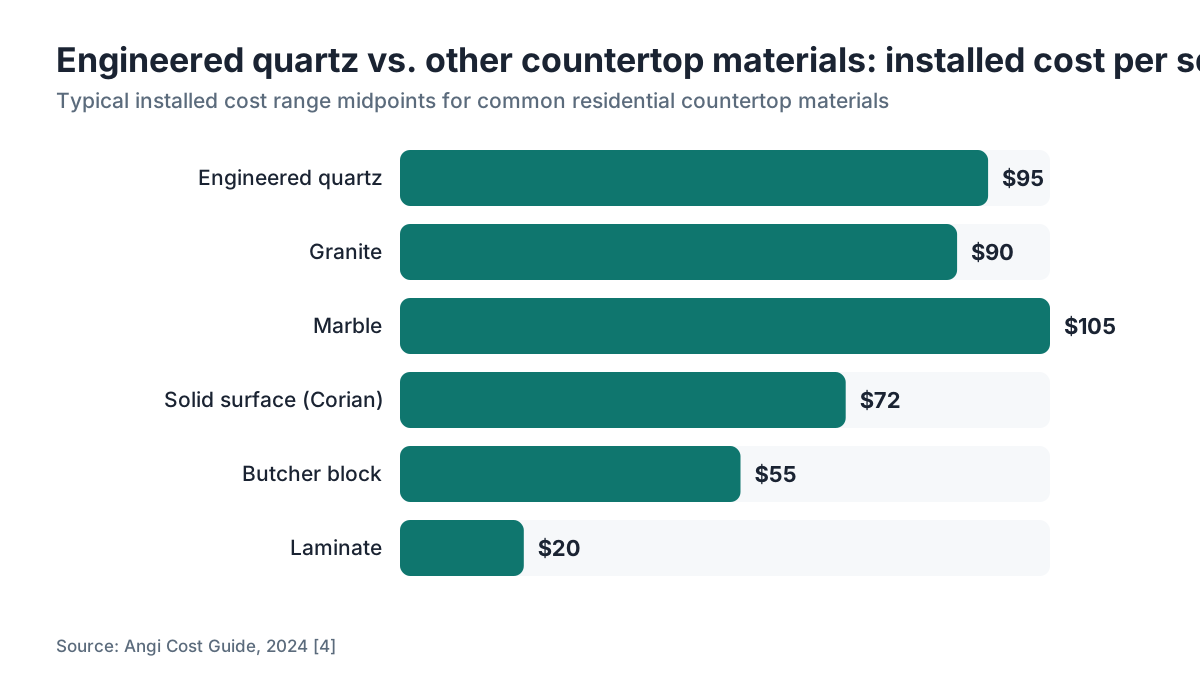
Granite countertops are natural stone, so no two slabs are identical. Granite is slightly harder than quartz on the Mohs scale (7 to 7.5 vs. the composite's effective 6 to 7 once you factor in the resin) and handles heat better because it has no plastic binder. Most granites need sealing every one to three years. Cost is similar to mid-range quartz, though exotic granites with dramatic movement cost more. [4]
Marble countertops are soft (Mohs 3 to 4), etch with acid (lemon juice, vinegar, tomato sauce), and need regular sealing. They look extraordinary and demand commitment. Quartz beats marble outright for a kitchen that actually cooks.
Laminate countertops and Formica countertops cost far less, $10 to $30 per square foot installed, but they scratch, can't be re-polished, and degrade around sinks over time. For a budget kitchen, laminate is a rational call. For a long-term home, quartz is the better buy.
Corian countertops (solid surface) are repairable, joined without visible seams, and priced near entry-level quartz. They scratch more easily, but scratches sand right out. Quartz holds its polish longer without any intervention.
Butcher block countertops are warm, repairable, and cheap, but they need regular oiling and don't belong near a sink that sees standing water.
| Material | Sealing required | Heat resistance | Scratch resistance | Installed cost/sq ft |
|---|---|---|---|---|
| Engineered quartz | No | Moderate (avoid direct heat) | Good | $50, $150 |
| Granite | Yes (periodic) | Excellent | Very good | $50, $130 |
| Marble | Yes (frequent) | Good | Poor (etches) | $60, $160 |
| Laminate | No | Poor | Fair | $10, $30 |
| Solid surface (Corian) | No | Poor | Fair (repairable) | $45, $100 |
| Butcher block | Yes (oil) | Fair | Poor | $30, $80 |
For most households that cook often, quartz and granite are the two real finalists. Quartz wins on zero maintenance. Granite wins on heat resistance and the pull of a one-of-a-kind slab. Neither is a wrong answer.
What are the real downsides of quartz countertops?
Quartz gets sold as nearly perfect, so let's talk about where it actually fails.
Heat is the big one. The polymer resin has a thermal expansion rate different from the quartz aggregate, and sustained heat above about 150C (300F) can make the resin discolor, crack, or pull away from the aggregate. [1] A hot pan straight off the burner set directly on quartz can leave a permanent thermal shock mark. Most manufacturer policies won't honor that as a warranty claim. Use trivets. Always.
Direct UV exposure breaks down the resin over time, causing yellowing or fading. Quartz is a poor pick for outdoor kitchens or spots with long daily sun through unshaded windows. Manufacturers uniformly state that quartz is for interior use only. [5]
Quartz is heavy. Most slabs run 15 to 20 pounds per square foot, similar to granite. Standard base cabinets handle this fine, but older or custom cabinetry may need reinforcement before install.
The look can be too consistent for some buyers. Engineered slabs lack the depth and randomness of natural stone. Under warm showroom lighting, plenty of designs read as convincing stone. Under the cool LED lighting in a lot of modern kitchens, the same slab can look flat or obviously artificial. View samples in the actual light of your space.
Repair is possible but imperfect. Chips and deep scratches get filled with matching resin by a pro, but the color match is never exact, and the fix usually shows under close inspection. Natural stone can sometimes be polished or re-ground. Quartz can't.
Cost creeps up fast once you add waterfall edges, multiple cutouts, or premium brands. Get multiple bids. Fabricator markup on materials swings a lot, and some shops buy cheaper off-brand slabs and charge as if they're installing Cambria.
Does engineered quartz need sealing or special maintenance?
No. This is one of the clearest wins quartz has over natural stone. The surface is non-porous, so there's no pathway for liquids, oils, or bacteria to penetrate. Sealing is unnecessary and actually backfires, because stone sealers can leave a hazy film on quartz. [6]
Day-to-day cleaning is soap and warm water. A soft cloth or sponge does it. For stuck-on food, a plastic scraper and a few minutes of soak time handles most of it without hurting the surface.
Avoid abrasive scrubbers, steel wool, and scouring pads. They won't cut through the resin easily, but over time they'll dull the polish, and a matte-scuffed quartz surface looks bad and can't be brought back to factory finish without professional re-polishing.
Harsh chemicals are the other thing to skip. Bleach at high concentrations can break down resin over repeated exposure. Drain cleaners, paint strippers, and oven cleaners should never touch a quartz countertop. For disinfecting, a diluted isopropyl alcohol solution (70% or less) or a pH-neutral surface disinfectant is fine. [6]
For a broader take on cleaning stone and engineered surfaces, how to clean stone countertops covers principles that apply across material types.
One maintenance item people forget: the caulk joint at the backsplash and sink. Caulk is not quartz. It ages, cracks, and can harbor mold. Re-caulk those joints every few years no matter how perfect the quartz itself looks.
Is quartz a healthy and safe choice for a kitchen?
For most households, yes, with one caveat worth understanding. The finished countertop is safe. The dust created while cutting it is the real hazard, and that risk falls on shop workers, not homeowners.
Because quartz is non-porous, it resists surface bacteria better than porous materials. A 2012 study in the Journal of Applied Microbiology tested multiple countertop materials and found that non-porous surfaces including quartz composites held significantly fewer bacteria after cleaning than porous surfaces like unsealed granite or wood. [7] That's a real benefit in a working kitchen.
The bigger health conversation in the trade is silica dust. Dry-cutting, grinding, and polishing quartz slabs release respirable crystalline silica, a known occupational hazard. OSHA's permissible exposure limit is 50 micrograms per cubic meter as an 8-hour time-weighted average, codified in 29 CFR 1910.1053, effective for general industry in 2018. [8] OSHA describes respirable crystalline silica as "a known human carcinogen," and enforcement inspections of stone fabrication shops have repeatedly found the limit exceeded, which is why wet-cutting and local exhaust ventilation are now standard in the trade.
As a finished, installed countertop, quartz doesn't off-gas or shed silica into your home. The resin binder locks the particles in place. Normal use, including cutting on the surface (not recommended, but it happens), doesn't release meaningful dust.
The resin itself is polymer-based and inert once cured. No credible peer-reviewed study has found a health risk from living with installed quartz countertops.
What quartz brands are worth knowing, and how do they differ?
Brand matters less than the marketing suggests, but it's not meaningless. Here's the honest rundown.
Caesarstone (Israeli company, manufacturing in the U.S. and Israel) was among the first to crack the North American market in the early 2000s. Slabs are consistent and widely available. Mid-to-upper pricing.
Silestone (Cosentino, Spain) has been around since 1990 and is one of the largest producers globally. They introduced N-Boost technology a few years back, claiming improved stain resistance. Mid-tier pricing with regular promotions.
Cambria countertops are made exclusively in Le Sueur, Minnesota, which lets the company make a genuine domestic-manufacturing claim. Cambria has a lifetime transferable warranty and sits at the top of the residential price range. Whether the extra cost is worth it depends on how much you value the warranty terms and domestic origin.
MSI (M S International) runs mainly as a distributor, sourcing from multiple manufacturers worldwide. Pricing is aggressive, typically 20 to 40% below the named brands for comparable specs. Quality is generally solid. You just don't get the brand-name warranty backstop.
Vicostone (Vietnam) and Compac (Spain) are often sold through local distributors rather than showrooms. Fine material at lower price points.
The honest fabricator's view: for most kitchens, the difference between a mid-range Caesarstone slab and a comparable MSI slab is not something a homeowner notices in five years of daily use. Buy the look you want at the best price from a fabricator you trust. The name on the slab matters less than the quality of the fabrication and install.
For fabricators pricing multiple brands and slab sizes in one quote, software like SlabWise handles the material cost variations automatically when you build out your price lists, which saves real time on jobs with material substitutions.
How thick should quartz countertops be?
3 cm (about 1-3/16 inch) is the right choice for almost every kitchen. Standard residential quartz comes in two thicknesses: 2 cm (roughly 3/4 inch) and 3 cm. [9]
3 cm is the default today for good reason. It looks substantial at the edge without a laminated build-up, resists cracking from point loads or uneven cabinet support, and lets fabricators profile most decorative edges directly from a single slab. The added weight is real, roughly 7 more pounds per square foot than 2 cm, but rarely a structural problem for standard cabinetry.
2 cm slabs were common in the early quartz market and still show up in some commercial work, wall cladding, and shower surrounds. For a kitchen counter with a thick mitered or waterfall edge, a fabricator laminates two layers of 2 cm to build a 4 cm face. That can look great, but it adds cost and a visible seam line at the mitered joint.
Some manufacturers also offer 1.2 cm material for furniture tops, backsplashes, and vertical work where weight is a constraint. Don't use it for a countertop that sees any real load.
If a quote specifies 2 cm for a kitchen counter without a clear reason, ask why. It might be a budget move that shaves $3 to $5 per square foot on material and leaves you with a counter that looks thin and chips more easily at the edge.
What should you watch for during the buying and installation process?
A few things go wrong on quartz jobs over and over, and knowing them in advance saves money and grief.
Seam placement is the big one. Quartz slabs come in standard sizes (typically 55 x 120 inches or 63 x 126 inches depending on the manufacturer) [9], and very few kitchens get done with zero seams. A good fabricator places seams away from sinks, at corners rather than mid-run, and talks placement through with you before templating. A bad one drops seams wherever the leftover material dictates. Ask specifically where seams will fall before you sign anything.
Seam visibility in quartz is generally better than in natural stone because the material is uniform, but it's never zero. A seam in a matched-movement veined design shows more than one in a solid color. If a nearly invisible joint matters to you, pick a solid or low-movement design.
Templating accuracy is everything. Modern shops use digital templating (laser or photogrammetry) rather than cardboard, and the dimensional accuracy is much better. [10] If a shop is still using cardboard and hand measurements on a job with complex angles or appliance cutouts, that's a signal to ask more questions.
Check the warranty terms before you buy. Most manufacturer warranties cover defects in the material but explicitly exclude thermal shock damage, misuse, and normal wear. Some transfer to a new homeowner (Cambria's does), which adds resale value. Read the actual document, not the marketing summary.
For a fuller look at install day, countertop installation walks through the process from template to final caulking.
Overhang limits matter too. Most quartz manufacturers recommend no more than 12 inches of unsupported overhang for 3 cm material. Beyond that, you need corbels or brackets. An island built for seating with a 15-inch overhang needs physical support, full stop.
How long do engineered quartz countertops last?
The material itself, maintained well and kept away from sustained heat and direct outdoor sun, lasts decades. I'm not aware of a credible industry-wide lifespan study with longitudinal data, but the oldest North American quartz installations are now over 20 years old and the slabs remain structurally sound.
What degrades first is usually the surface resin, which can pick up micro-scratching from abrasive cleaning over years, and the caulk joints, which need periodic replacement. The quartz aggregate itself doesn't wear, fade, or weaken under normal use.
Manufacturers like Cambria offer lifetime limited warranties, which is a confidence signal, though the fine print matters. [3] Most warranties cover manufacturing defects but not the normal aging of the resin binder under hard use.
For planning, budget a quartz countertop as a 15-to-25-year surface in a busy family kitchen, longer in lower-use spots. That beats laminate (10 to 15 years with heavy use) and approaches the lifespan of well-maintained granite.
The failure modes to watch are edge chips (most common, especially at outside corners and around sink cutouts), thermal shock cracks near the cooktop, and seam separation when the original adhesive was applied poorly. Edge chips on quartz are more common than on granite because the resin binder is slightly softer than the aggregate, so the edge face chips where a granite edge would more often hold.
Are there environmental concerns with engineered quartz?
Honest answer: yes, more than the industry usually admits.
The resin binder is a petrochemical product. Most manufacturers use unsaturated polyester resin, which takes virgin petroleum feedstock and releases styrene during manufacturing, a chemical with known health and environmental concerns for factory workers. Some brands have moved toward methyl methacrylate (MMA) or other options with better emissions profiles, but this isn't consistently disclosed in product literature. [11]
Transportation emissions are meaningful for imported material. A slab made in Vietnam and shipped to a U.S. showroom carries a substantially higher carbon footprint than a domestically made slab. That's not disqualifying, but it's part of the full picture.
On the plus side, quartz manufacturing can use recycled content. Some brands blend recycled glass or reclaimed quartz aggregate into their slabs, and a few publish Environmental Product Declarations (EPDs) verified under ISO 14044 with lifecycle data. [11] If environmental impact matters to you, ask the supplier for an EPD rather than accepting a marketing claim.
Quartz slabs aren't easily recyclable at end of life. The composite can't be cleanly separated back into aggregate and resin, so disposal means landfill. Granite slabs, being natural stone, sometimes get salvaged and repurposed. Quartz rarely does.
None of this makes quartz a uniquely bad environmental choice. Every countertop material has impacts. Laminate has a shorter lifespan and also lands in the trash. Marble quarrying carves up landscapes. But quartz is not the green option it's sometimes sold as.
For fabricators: how does quartz affect shop operations and quoting?
Quartz is good business for a countertop shop, but it comes with operational demands natural stone doesn't.
Silica dust control is the most serious. OSHA's final rule on respirable crystalline silica (29 CFR 1910.1053) set the action level at 25 micrograms per cubic meter and the PEL at 50 micrograms per cubic meter as an 8-hour TWA. [8] Engineered quartz releases more respirable silica when cut than most natural stones because the aggregate is so concentrated. Wet-cutting, vacuum shrouds on angle grinders, and local exhaust ventilation at CNC machines are compliance requirements, not options. OSHA began phased enforcement for general industry in 2018.
Nesting quartz slabs efficiently matters because material cost per square foot is higher than most stone, and slab sizes are standardized (less variability than natural stone). Good nesting software recovers meaningful yardage across a full week of jobs. A 5% gain in material yield on a $150,000/month material spend is real money.
Edge profiles on quartz sometimes want different tooling feeds than granite because the resin load changes the cutting response. Talk to your tooling supplier about feeds and speeds specific to each brand's resin content if you're getting excessive chipping.
Warranty documentation is important for residential clients. Keep records of the manufacturer lot number and slab origin in case a claim comes up two years after installation. Most warranty processes require the original fabrication shop to submit the claim, so you stay in the chain even after the job is done.
For shops tightening up their quartz quoting, kitchen countertops covers how homeowners think about material decisions, which helps calibrate how you present options during a sales conversation.
Frequently asked questions
What is the difference between quartz and quartzite countertops?
Quartz countertops are a man-made composite: crushed quartz aggregate bound with polymer resin. Quartzite is a natural metamorphic stone quarried from the earth. Quartzite is porous, can etch with acids, and requires sealing. Engineered quartz is non-porous and never needs sealing. The names sound similar, but the materials, maintenance, and performance are substantially different.
Can you put hot pans directly on quartz countertops?
No. The polymer resin binder in engineered quartz can discolor, crack, or separate from the aggregate at sustained temperatures above roughly 300F (150C). A hot pan from the oven can cause permanent thermal shock damage. Most manufacturer warranties explicitly exclude thermal damage. Always use a trivet or hot pad. This is the single most common cause of non-defect quartz damage in kitchens.
How much does it cost to install quartz countertops in an average kitchen?
A typical U.S. kitchen with 30 to 40 square feet of countertop surface runs $2,100 to $5,000 for mid-range quartz fully installed. That includes materials, fabrication, and installation labor. Kitchens with islands, waterfall edges, or premium brands like Cambria can reach $6,000 to $10,000 or more. Labor rates vary by region; high-cost metros like San Francisco or New York City add 40 to 60% to the labor portion.
Does engineered quartz stain?
Engineered quartz is highly stain-resistant because its non-porous surface prevents liquid absorption. Most common kitchen stains (coffee, wine, juice) wipe off cleanly. Certain chemicals can leave permanent marks: nail polish remover (acetone), paint strippers, and some permanent inks can damage the resin surface. Prolonged exposure to turmeric or beetroot can also leave faint discoloration on lighter colors. Clean spills promptly regardless of material.
Is quartz harder than granite?
The quartz mineral itself rates 7 on the Mohs scale, the same as granite's typical range of 6 to 7. But engineered quartz slabs contain 7 to 10% polymer resin binder, which softens the composite slightly compared to solid natural granite. In practice, quartz and granite have similar scratch resistance for kitchen use. Quartz edges chip somewhat more easily than granite edges because the resin face is softer than pure mineral.
What colors and styles does engineered quartz come in?
Engineered quartz comes in essentially any color, from pure white to jet black, plus designs that mimic Carrara marble, concrete, and even wood grain. Manufacturers can control color consistency across production runs, which natural stone can't match. The tradeoff is that the look can feel flat or too uniform next to natural stone with genuine movement. View large samples in your actual kitchen lighting before deciding.
Can quartz countertops be used outdoors?
No. Every major quartz manufacturer explicitly designates their products for interior use only. UV exposure degrades the polymer resin binder over time, causing yellowing, fading, and eventual surface breakdown. Temperature swings outdoors also stress the material differently than a controlled interior. For outdoor kitchens, granite, porcelain, or concrete are better choices.
How are quartz countertops installed?
A fabricator templates your cabinets (digitally or by hand), cuts slabs to size at the shop on a CNC or bridge saw, profiles the edges, then delivers and installs the finished pieces on-site. Seams are joined with color-matched epoxy and the perimeter is caulked. The process typically takes 7 to 14 days from template to installation, though lead times vary. See the full process breakdown in our countertop installation guide.
What thickness of quartz should I choose?
3 cm (about 1-3/16 inch) is the standard for kitchen countertops and the right choice for most jobs. It looks substantial at the edge without laminating, resists cracking better than 2 cm, and allows direct edge profiling. 2 cm material is used for some commercial work, wall cladding, and lower-budget projects with a laminated edge build-up. For a kitchen, 3 cm is worth the modest additional cost.
Do quartz countertops add value to a home?
They generally do, particularly in the mid-to-upper resale market where buyers expect stone or engineered-stone surfaces. Remodeling Magazine's Cost vs. Value report has historically tracked kitchen remodel ROI in the 50 to 70% range nationally, though countertops alone are not separately broken out. The bigger benefit may be speed of sale: listings with quartz counters photograph well and appeal to buyers who don't want a near-term renovation.
Is quartz safe for food preparation?
Yes. The non-porous surface resists bacterial colonization better than porous materials and doesn't require chemical sealers that might contact food. A peer-reviewed study in the Journal of Applied Microbiology (2012) found non-porous surfaces like quartz composites harbored fewer bacteria after cleaning than porous surfaces. The finished, cured resin does not off-gas or shed particles into food under normal use.
What should I clean quartz countertops with?
Warm water and dish soap handle almost everything. A diluted 70% isopropyl alcohol solution works for disinfecting. Avoid bleach at full strength, abrasive scrubbers, and any solvent-based cleaners like acetone or paint thinner. Don't use sealers or wax products made for natural stone; they can leave a hazy film. Re-caulk the joints at the backsplash and sink every few years regardless of how the quartz itself looks.
How do I compare quartz brands when getting quotes?
Ask fabricators to quote the same brand and color on each bid, or at minimum the same slab thickness and edge profile. Fabricator markup on materials varies a lot: some shops buy budget imports and charge as if they're selling a premium brand. Request the slab manufacturer and country of origin in writing. For long-term coverage, verify whether the warranty is manufacturer-direct or shop-backed, and whether it transfers to a future homeowner.
Can chips in quartz countertops be repaired?
Yes, by a professional using color-matched epoxy or resin filler. The repair is functional and holds well, but it's rarely invisible under close inspection because the resin fill lacks the aggregate texture of the surrounding surface. Repairs near edges and around sink cutouts are the most common jobs. Prevention is easier than repair: use cutting boards, avoid dropping heavy objects at edges, and protect outside corners during moves or renovations.
Sources
- USPTO, Breton process patents (cited in Engineered Stone industry history): The Breton vibro-compaction process for engineered stone was commercialized in Italy and patented beginning in the 1960s.
- Cambria Company LLC, Warranty and Product Information: Cambria manufactures exclusively in the United States and offers a lifetime limited warranty that is transferable to subsequent homeowners.
- HomeAdvisor / Angi, Quartz Countertop Cost Guide: Installed quartz countertop costs nationally range from approximately $50 to $150 per square foot; typical kitchen projects fall between $2,100 and $5,000.
- Caesarstone, Installation and Care Guidelines: Caesarstone and other major quartz manufacturers explicitly designate their products for interior use only, citing UV degradation of the resin binder as the reason.
- Silestone by Cosentino, Care and Maintenance Guide: Engineered quartz requires no sealing; recommended cleaning is warm water and mild soap; high-concentration bleach and solvent-based cleaners should be avoided.
- Journal of Applied Microbiology, 2012, bacterial contamination study on countertop surfaces: Non-porous surfaces including quartz composites harbored significantly fewer bacteria after standard cleaning compared to porous surfaces such as unsealed granite or wood.
- OSHA, 29 CFR 1910.1053 Respirable Crystalline Silica Standard for General Industry: OSHA's permissible exposure limit for respirable crystalline silica is 50 micrograms per cubic meter as an 8-hour TWA; action level is 25 micrograms per cubic meter; general industry compliance required from 2018. OSHA describes respirable crystalline silica as a known human carcinogen.
- CDC / NIOSH, Silica and Engineered Stone Fabrication Hazard Alert: NIOSH identifies engineered stone as containing a high concentration of crystalline silica and documents severe silicosis cases among stone fabrication workers, recommending wet methods and local exhaust ventilation.
- MSI Stone, Quartz Countertop Product Specifications: Standard engineered quartz slab dimensions are typically 55 x 120 inches or 63 x 126 inches; residential thickness options are 2 cm and 3 cm.
- Stone World, Digital Templating in Stone Fabrication: Digital laser templating systems have substantially improved dimensional accuracy in countertop fabrication compared to traditional cardboard template methods.
- NSF International / ISO 14044, Environmental Product Declaration framework for building materials: Some quartz manufacturers publish Environmental Product Declarations verified under ISO 14044 lifecycle assessment methodology; the resin binder in most quartz uses unsaturated polyester derived from petroleum.
- Remodeling Magazine, Cost vs. Value Report (most recent edition): Major kitchen remodel ROI has historically tracked in the 50 to 70% range nationally according to the annual Cost vs. Value report.
Last updated 2026-07-10