TL;DR
- End grain hickory butcher block countertops cost roughly $40 to $120 per square foot installed, depending on thickness and finish.
- Hickory scores about 1820 lbf on the Janka scale, the hardest common domestic hardwood, so end grain cuts shrug off knife work.
- They need regular oiling and hate standing water at a sink.
- For a hard-working kitchen that wants real wood, this is about as tough as domestic wood gets.
What exactly is an end grain butcher block countertop?
A butcher block countertop is wood pieces glued into a thick panel. The one thing that decides how tough it is: which face of the wood points up.
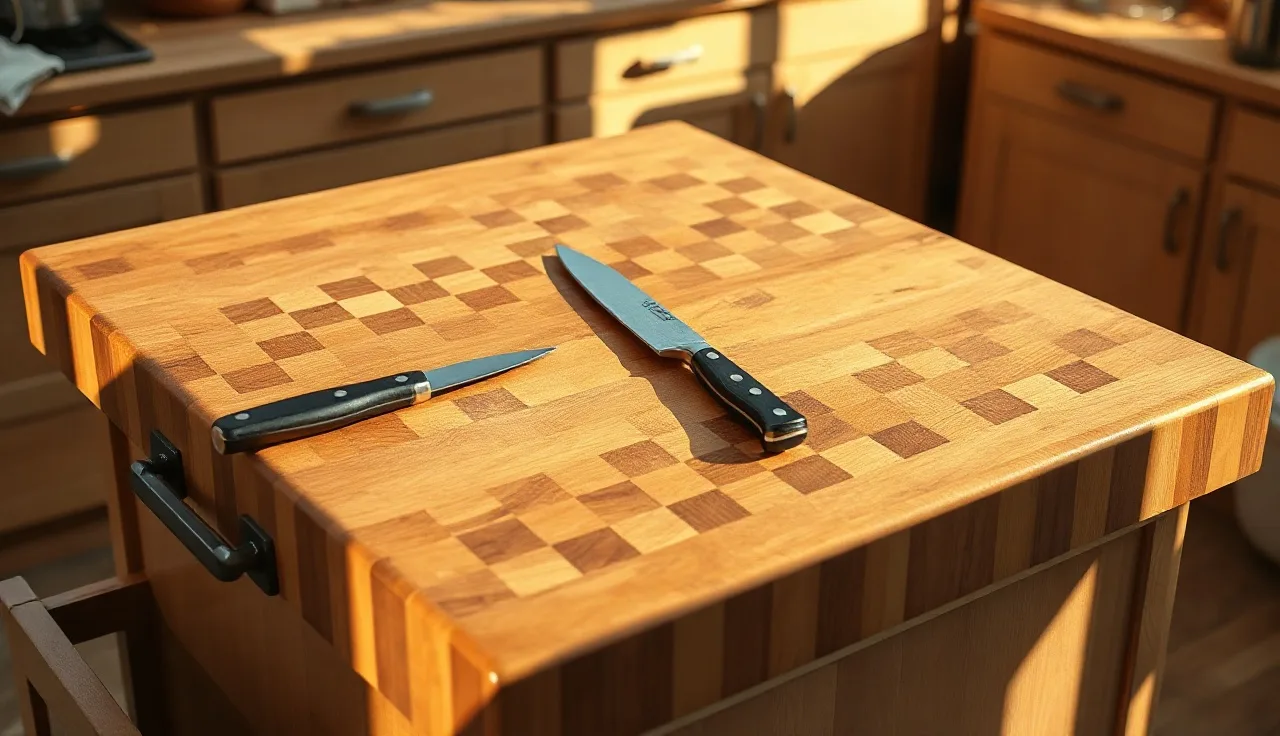
Face grain shows the long, flat side of the board. Edge grain shows the narrow side. End grain shows the cut end of the wood, the same rings you'd see on a stump. End grain butcher block turns all those cut ends upward, then glues the pieces into a slab.
Why does that matter? Wood fibers run the length of a tree. When a knife hits end grain, the blade slips between fibers instead of slicing across them. The fibers spring back. That's why butchers have used end grain blocks for centuries. The surface heals itself far better than face or edge grain does.
End grain also has that checkerboard look. Hickory's tight grain and hard color swing, creamy white sapwood right next to dark reddish-brown heartwood, makes the pattern loud. Want a countertop that reads as a statement piece without going to stone? End grain hickory does that. Compare it with a quieter butcher block countertops run in maple or walnut, where the look calms down.
Here's the trade-off. End grain glue-ups take more labor than face or edge grain, so they cost more and weigh more. A 2-inch end grain panel runs roughly 8 to 12 pounds per square foot, which drives your cabinet and support decisions.
Why hickory specifically? How does it compare to other butcher block woods?
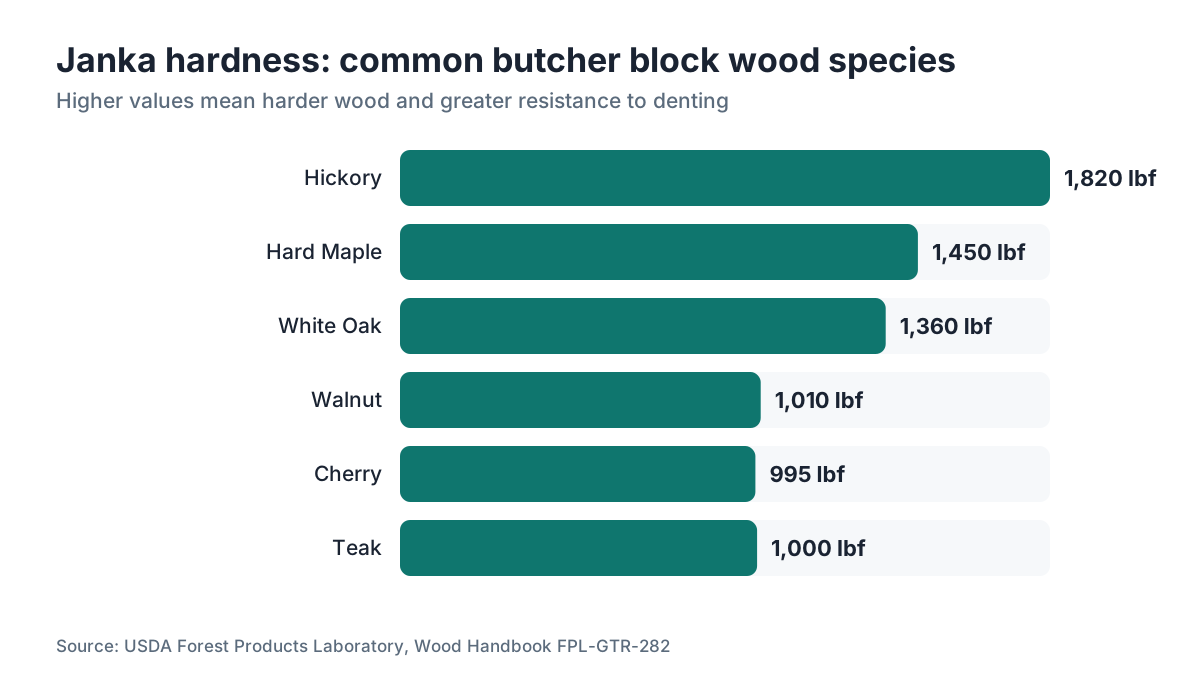
Hickory is the hardest widely available domestic hardwood in North America. The Janka test measures the force needed to push a steel ball halfway into a wood sample. Hickory scores around 1820 lbf [1]. Hard maple, the classic butcher block wood, scores about 1450 lbf. White oak lands near 1360 lbf. Walnut, popular but soft, sits around 1010 lbf.
That hardness gap shows up in daily use. Hickory end grain shrugs off dents from heavy pots and rolling pins better than maple, and much better than walnut. Drop a cast iron skillet on maple butcher block and you'll often leave a dent. Do it on hickory end grain and you probably won't.
Hickory also takes shock well, which is why tool handles and baseball bats get made from it. Same trait helps it absorb the pounding of a busy kitchen.
The downsides are real. Hickory fights the machine. It's harder to mill and sand than maple, so fabrication runs longer and costs more. The strong grain variation also makes a uniform look hard to hit. Some people love the movement in the grain. Others find it busy.
| Wood Species | Janka Hardness (lbf) | Typical Edge/End Grain Cost ($/sq ft, uninstalled) | Notes |
|---|---|---|---|
| Hickory | 1820 | $30, $80 | Hardest domestic option; bold grain contrast |
| Hard Maple | 1450 | $25, $65 | Traditional butcher block choice; uniform look |
| White Oak | 1360 | $28, $70 | Good for kitchens; open grain needs sealing |
| Walnut | 1010 | $40, $100 | Softer but premium look; pricier due to demand |
| Teak | 1000 | $50, $120 | Naturally oily; good moisture resistance |
Sources: Janka values from the USDA Forest Products Laboratory [1]; price ranges are typical retail as of 2024 and swing hard by region and supplier.
Comparing wood to stone? A granite countertops slab handles water and heat on its own. Wood asks for active care. That's not a reason to skip it. It's the honest trade you're signing up for.
How much does end grain hickory butcher block cost?
Plan on $30 to $80 per square foot for the material alone, uninstalled. Add installation, edge profiles, sink cutouts, and finishing, and most projects land between $40 and $120 per square foot installed [2].
Thickness moves the number most. A 1.5-inch end grain panel costs a good bit less than a 3-inch block. Most kitchen counters run 1.5 to 2 inches; islands sometimes go to 3 inches for the drama. Every extra half-inch adds material and weight, which pushes shipping up too.
Custom sizing costs more than standard widths. Many suppliers sell end grain panels in preset widths (usually 24 to 36 inches) and you cut to length. A U-shaped kitchen with an odd island burns more waste material and more shop time, and both show up on the quote.
Installation is usually simple when cabinets are level, but wood mounts differently than stone. Wood expands and contracts with the seasons, so it gets held by clips or elongated slots instead of glue at every point. A fabricator who ignores wood movement can leave you with a cracked or buckled top inside a year.
Shops quoting wood next to stone have to price it as its own animal. The material moves, the tooling is different, and finishing labor usually runs higher than stone polishing. Shops on countertop quoting software (SlabWise, for one, costs wood materials right alongside stone layouts) can compare profit across material types and catch a wood job that's priced too low.
For where this sits on the whole spectrum: kitchen countertops run from about $15 per square foot for laminate countertops up past $200 for premium quartzite. End grain hickory lands in the mid-to-upper-mid tier.
Is end grain hickory butcher block durable enough for a real kitchen?
Yes, with one honest caveat: durable for a wood surface, not durable the way stone is durable. Different categories entirely.
Hickory end grain handles daily knife work better than nearly any other domestic wood. The self-healing fibers mean light cut marks close up or disappear with routine oiling and the occasional sanding. A well-kept end grain hickory top can look better at 20 years than it did at 5, because the wood builds a patina.
Heat is where wood struggles across the board. The USDA Forest Products Laboratory notes wood scorches at sustained temperatures above roughly 200 to 250 degrees Fahrenheit [1]. A pan straight from the oven can scorch end grain hickory in seconds. Use a trivet, always. Not a dealbreaker, just a habit you actually have to keep.
Moisture is the other honest concern. End grain drinks water faster than face or edge grain because it wicks straight into the open fiber ends. Put end grain hickory next to a sink, let water puddle on it, and you'll see warping, cracking, and mold within a year or two. Plenty of designers and fabricators steer homeowners away from end grain within 6 inches of a sink unless they're genuinely committed to quick drying and regular sealing.
Away from the sink, on an island or a dry prep zone, end grain hickory is genuinely tough. Pro kitchens have run end grain maple blocks for decades with good maintenance. Hickory, being harder, arguably holds up better.
Deep gouges from careless knife work are recoverable on end grain. Sand with 80-grit, work up to 220, refinish. You cannot do that on stone. That repairability is one of the real reasons to choose wood.
How do you oil and maintain an end grain hickory butcher block countertop?
Oiling is the core job and it's not optional. Food-safe oil soaks into the fibers and keeps them from drying, cracking, or getting porous enough to soak up water.
Food-safe mineral oil is the standard pick. The FDA cleared food-grade white mineral oil (21 CFR 172.878) for direct food contact [3]. It's cheap, colorless, odorless, and won't go rancid like vegetable oils do. Skip flaxseed oil on end grain specifically; it can polymerize unevenly and leave a sticky, peeling mess.
A fresh end grain hickory top needs saturation. Flood it with mineral oil, let it soak for several hours, wipe the excess, repeat. Do that three to five times over the first week. End grain drinks oil faster than face grain thanks to those open ends, so it wants more oil, more often, at the start.
After that first week, monthly oiling through the first year is reasonable. Once the wood is seasoned, quarterly (or whenever the surface goes dry and pale) usually does it.
Mineral oil alone gives light protection. Butcher block conditioner, mineral oil cut with beeswax or carnauba, adds a surface layer that pushes water off harder. Some people saturate with pure mineral oil, then switch to an oil-wax blend for upkeep.
Cleaning is easy: mild soap and water, wiped up right away. Don't soak it, don't let it air-dry wet, don't ever run it through a dishwasher (that's for boards, not counters, but standing water is the enemy either way). A dilute white vinegar solution works fine as an occasional sanitizer, though the University of California Cooperative Extension notes repeated vinegar use can dry wood over time [4].
Deep stains or scratches? Light sanding with 120 to 220 grit, then re-oil, brings it back. That's a genuine edge over stone and most other counter materials.
Can you use end grain hickory butcher block next to a sink?
Technically yes. In practice it rides entirely on how the sink area gets used and how diligent the household is.
End grain is more porous than face or edge grain. Water pooling around a sink, dripping off hands, splashing off vegetables, all of it soaks into those open fiber ends fast. Wet-dry cycling swells and shrinks the wood, and that cycling is what cracks and warps it over time.
Want wood next to a sink? Edge grain forgives more. It soaks up water slower because less fiber is exposed. If the homeowner insists on end grain, the moves that matter are: (1) put down a penetrating oil-wax finish and keep it fresh, (2) wipe up standing water immediately, every single time, and (3) hit the sink perimeter with butcher block conditioner more often than the rest of the top.
Some fabricators run a film-forming finish, a food-safe polyurethane or hardwax oil, on the sink surround for a tougher water barrier. It changes the look and feel (more plastic, less natural) but it does protect the wet zone better.
An undermount sink with end grain is the riskiest combo. The underside of the cutout is bare end grain, and if the perimeter isn't sealed all the way around, water wicks in from below. If you go undermount, seal every cut edge thoroughly, ideally with epoxy or a full oil soak before the sink drops in.
A farmhouse or drop-in sink does better, because the rim covers more wood at the edge.
For the porosity mindset near water on other surfaces, the same caution runs through how to clean soapstone countertops and how to clean stone countertops, even where the specific steps differ.
What finish options work best on end grain hickory?
Two camps: penetrating finishes and film-forming finishes. Each has real trade-offs.
Penetrating finishes (mineral oil, butcher block oil, Danish oil, tung oil, hardwax oils) soak in and protect from inside. No surface film, so the wood still looks and feels like wood. The catch: no hard barrier, so water still gets in if it sits long enough. These want regular reapplication.
Food-safe tung oil gets cited as better than mineral oil because it polymerizes and hardens inside the wood. Pure tung oil (not tung oil varnish, which carries petroleum distillates) is considered safe for food contact once cured, though it cures slower than mineral oil, per the USDA Forest Products Laboratory's finishing guidance [5].
Film-forming finishes (polyurethane, lacquer, conversion varnish) build a hard surface layer. More water-resistant, less frequent upkeep. The trade-off: scratch through the film and you expose raw wood that soaks up water right there, and the fix means stripping and recoating the whole top instead of a quick re-oil. They also change the feel, less tactile, more plastic.
For a kitchen top that sees real prep and cutting, most woodworkers and fabricators go penetrating, precisely because it's easier to maintain and repair. The surface stays alive and refreshes instead of demanding a full refinish.
Hardwax oils are the middle ground, and they're catching on. They penetrate like oil but carry waxes that build a light protective layer. Rubio Monocoat and Osmo Polyx both make food-safe versions certified under food contact safety standards [6]. Worth the extra money for a kitchen.
Whatever you pick, end grain on hickory wants more product and more cure time than face grain. Don't rush it.
How is end grain hickory butcher block fabricated and installed?
It starts with hickory lumber cut into short billets, usually 1.5 to 4 inches long depending on the target thickness. Those billets get turned end grain up, laid out in a pattern (random or geometric), glued with a waterproof PVA or urea-formaldehyde glue, clamped under pressure, and left to cure fully.
After cure, the slab runs through wide-belt or drum sanders to flatten. This takes more work than face or edge grain because end grain doesn't machine clean and needs more sanding stages. Then it's finished in the shop or shipped raw for the homeowner to oil on site (most suppliers ship it lightly oiled or bare).
Installation needs cabinets that are level and plumb. Wood counters don't forgive out-of-level cabinets the way stone does. Stone sits flat and rides on adhesive. Wood has to move and rides on mechanical clips. A high spot in the cabinets makes a wood top rock instead of flexing to fit.
Attaching it: use L-brackets or dedicated wood countertop clips that let the wood expand and contract across the grain without splitting. Most woodworkers warn against gluing a wood top solid to the cabinet base across its full width. Glue at the front edge only, or not at all, is common practice.
Sink and cooktop cutouts get done with a router or jigsaw. The step that matters most on end grain is sealing every exposed cut edge right away. Those fresh cuts are open end grain, even thirstier than the top surface, and they'll pull in any moisture around.
For how installation works across materials, the countertop installation overview walks the general process.
How thick should an end grain hickory countertop be?
For kitchen counters, the working range is 1.5 to 3 inches. The right pick depends on the job, the cabinet structure, and how hard the top will get used.
1.5 inches is the floor for a kitchen counter, and it's fine for light to moderate use. Heavy enough to feel solid, light enough that standard cabinets carry it without reinforcement.
2 inches is the sweet spot for most kitchens. More material to sand down over the years if you refinish, better proportions on a standard-height island, and enough depth to take an undermount sink cutout without structural worry.
2.5 to 3 inches reads as a pro butcher block, the kind in a restaurant prep line. It's dramatic, especially with hickory's bold grain. The downsides are weight (a 30-square-foot island top at 3 inches can hit 300 pounds or more depending on density) and cost. You may need extra cabinet support.
End grain is stronger across its thickness than face grain, so a 1.5-inch end grain panel holds up better under heavy impact than a 1.5-inch face grain one. But thicker still buys you more material to work with over the top's life.
Using it as a real cutting surface regularly? Go 2 inches or more. You want the depth for the day you sand out a deep mark.
What are the honest drawbacks of end grain hickory butcher block?
Nobody should buy one without knowing these.
Maintenance is real. This is not set-it-and-forget-it. You oil it, wipe it dry after water, sand and re-oil on a schedule. If your household won't do that, it looks bad within a few years. A quartz or engineered stone option like Cambria, or even a solid Corian countertop, asks almost nothing by comparison.
Heat damage doesn't fully undo in the short term. A light scorch sometimes sands out. A deep burn may need enough sanding to change the top's level, or a section repair. Cook a lot and move pots straight from stove to counter? Think hard about this.
Water at the sink is a management job, covered above. Small kids who splash constantly, or a household that won't wipe up, means put the wood somewhere other than the sink perimeter.
Cost runs higher than people expect for wood. Folks assume wood is cheap next to stone. End grain isn't. Building a good end grain panel takes serious labor, and hickory works harder than maple, which adds more. You can fake the look for less in laminate countertops or Formica countertops, but the real material costs real money.
Movement: hickory, like all wood, shifts with humidity. Build it right and install it with room to move, and it handles that fine. Glue it solid, or drop it into a bone-dry room without acclimating first, and it can crack. That's a fabrication and install quality issue as much as a material one, but you should know it's there. The USDA Forest Products Laboratory documents this seasonal movement and why installation needs an expansion allowance [8].
Is end grain hickory butcher block good for an island specifically?
An island is the best home for end grain hickory. Usually no sink. No constant water. The grain shows off from all four sides. Room for overhang where people sit.
Islands also let you go thick, since there's no wall to fight and the proportions carry it. A 2.5 or 3-inch end grain hickory island top looks genuinely impressive and photographs well for anyone renovating with resale in mind.
As a working prep surface, an island in end grain hickory earns its keep. You can cut right on it (though your knife edges wear faster than on a proper board). Pastry work, meat prep, kneading bread, all fine. The surface is big enough to actually help.
The overhang: a typical seating overhang runs 12 to 15 inches for counter-height and 15 to 18 inches for bar-height, per the National Kitchen and Bath Association's design guidelines [10]. End grain butcher block at 3 inches thick has the rigidity for a 12-inch overhang unsupported. Past that, add corbels or legs, or you risk flexing the panel when someone leans on it and stressing the glue joints.
End grain hickory on an island is one of those cases where the material fits the job cleanly. It's hard to build a better argument for the stuff than that one scenario.
How does end grain hickory compare to other countertop materials overall?
Any honest comparison sorts these into categories instead of crowning a winner, because the right pick depends entirely on how the kitchen gets used.
Versus stone (granite, quartzite, marble): Stone wins on heat and moisture. Wood wins on repairability and as a cutting surface. Stone is usually easier day to day. Wood ages in a way that looks intentional; stone ages like damage unless you seal it right. See marble countertops for how stone upkeep compares.
Versus other wood counters: Hickory end grain is harder than maple end grain, which is already the durability standard. Choosing between hickory and maple is mostly a look decision (hickory's bold movement vs maple's calm) plus a modest hardness edge for hickory.
Versus engineered options: Quartz, Corian, Cambria and the like give you consistent looks, low maintenance, and good durability. They don't look or feel like real wood, and they can't be refinished the way wood can. Want zero maintenance? Engineered wins. Want a surface that feels like a living material and don't mind the upkeep? Wood wins.
Versus laminates and Formica: The cost gap is huge. Laminate can copy the look for a fraction of the price, but it can't be refinished, can't take direct cutting, and doesn't have the same thermal or tactile feel. For resale signaling, real wood reads premium where laminate doesn't.
Shops pricing wood next to stone should note that end grain wants different tooling, different layout logic (glue-up panel waste is nothing like slab nesting), and different finishing labor. Getting the quote right matters as much as getting the material right.
Frequently asked questions
How long does an end grain hickory butcher block countertop last?
With proper oiling and care, a well-made end grain hickory countertop lasts 25 to 50 years or more. The surface sands and refinishes multiple times, which effectively resets it. What kills these tops early is usually moisture damage at a sink or neglected maintenance, not the wood itself wearing out.
Can you cut directly on an end grain hickory countertop?
Yes, and it's one of the main reasons people choose it. End grain fibers treat your knife edge gentler than stone or ceramic. That said, cutting straight on the counter (instead of a board) works bacteria into the wood, calls for more frequent sanitizing, and eventually leaves visible marks. Most people use a board for raw meat and cut directly for light prep.
How often do you need to oil an end grain hickory countertop?
Heavily the first week after install: three to five coats of food-grade mineral oil. After that, monthly through the first year, then every three to four months once the wood is seasoned. Watch the color. When the surface goes dry and matte compared to how it looks freshly oiled, it's time to oil again.
Is hickory end grain butcher block food safe?
Yes. Hickory is a non-toxic hardwood with no natural compounds harmful to people. The finish matters too. Food-grade mineral oil (FDA 21 CFR 172.878) is cleared for direct food contact, and hardwax products from Osmo or Rubio Monocoat make food-safe versions. Avoid finishes with solvents or biocides not rated for food contact.
What oil should I use on end grain hickory butcher block?
Food-grade white mineral oil is the standard, cheap, reliable pick. It won't go rancid, it's safe for food contact, and it soaks in well. Butcher block conditioner (mineral oil plus beeswax or carnauba) adds a water-repelling layer and is good for upkeep. Skip vegetable, olive, and coconut oils; they go rancid inside the wood over time.
How much does end grain hickory butcher block weigh per square foot?
Hickory runs a specific gravity of about 0.64 to 0.75, which works out to roughly 6 to 9 pounds per square foot at 1.5 inches thick and 8 to 12 pounds at 2 inches. A 30-square-foot island top at 2 inches could weigh 240 to 360 pounds. Check cabinet load capacity before install, especially on thicker panels.
Can end grain hickory butcher block be installed over existing countertops?
Technically yes, if the existing surface is flat, level, and structurally solid. Wood needs a flat substrate or it flexes, which stresses the glue joints over time. The added height (usually 1.5 to 2 inches) changes counter height, which affects appliance clearances and ergonomics. Most renovators pull the old top first. A licensed installer can judge whether an overlay works for your case.
Does end grain hickory butcher block increase home resale value?
No reliable national data exists on this specific point. High-end kitchen finishes generally help resale in mid-to-upper price ranges, but countertop material rarely moves appraisal value as a standalone line. Buyers who want natural wood kitchens value it; buyers who prefer low maintenance may see it as a liability. In premium markets, a well-kept end grain island is likely a net positive.
What is the difference between end grain and edge grain butcher block?
Edge grain shows the narrow side of each board, grain lines running horizontally across the top. End grain shows the cut end of each board, growth rings in a checkerboard. End grain heals better under knife cuts because the blade slips between fibers instead of across them. It also soaks up more moisture, costs more, and weighs more than edge grain of the same size.
How do you repair a burn or deep scratch on end grain hickory?
Light marks: sand with 80 to 120 grit in the direction that blends with surrounding fibers, step up through 150 and 220, then re-oil the whole surface. Deep burns that charred the wood want a random-orbit sander starting at 60 grit. Very deep damage may mean routing out the section and patching in new hickory, which is doable but shows.
Is end grain hickory butcher block good for a bathroom vanity countertop?
It can work, but moisture management is harder in a bathroom than on a kitchen island. Splashing, toothbrush water, and shower humidity all stress wood. If you want wood in a bathroom, face or edge grain with a film-forming waterproof finish (food safety doesn't apply here) is more practical. End grain is the highest-risk wood setup in a wet room and needs aggressive finishing to survive.
Where can I buy end grain hickory butcher block panels?
Specialty lumber dealers, hardwood suppliers, and woodworking retailers stock or order end grain hickory. Online retailers like Woodcraft, Rockler, and some Amazon sellers carry standard panel sizes. Custom shops build to your exact dimensions. Expect two to six weeks lead time for custom work. Prices swing widely by region, thickness, and source.
How do I keep end grain hickory butcher block from warping?
Acclimate the panel in your kitchen for 48 to 72 hours before install. Attach with clips or slots that allow seasonal movement instead of rigid glue across the full width. Oil the top and the underside equally; uneven moisture top to bottom is a primary cause of cupping. Keep indoor humidity steady. A whole-house humidifier in dry climates helps all wood furniture and counters.
Sources
- USDA Forest Products Laboratory, Wood Handbook: Wood as an Engineering Material (General Technical Report FPL-GTR-282): Hickory Janka hardness approximately 1820 lbf; wood scorches at sustained temperatures above approximately 200 to 250 degrees Fahrenheit; species-specific gravity values for weight calculations
- HomeAdvisor (Angi) Butcher Block Countertop Cost Guide: Typical installed cost range for butcher block countertops $40 to $120 per square foot depending on species, thickness, and region
- U.S. Food and Drug Administration, 21 CFR 172.878: White mineral oil: Food-grade white mineral oil is approved by the FDA for direct food contact surfaces under 21 CFR 172.878
- University of California Cooperative Extension (UC ANR): Dilute white vinegar used as a sanitizer on wood surfaces; repeated vinegar application can dry wood over time
- USDA Forest Products Laboratory, Finishing of Wood (Chapter 16, Wood Handbook FPL-GTR-282): Pure tung oil polymerizes and hardens within wood fibers; longer cure time than mineral oil; distinguished from tung oil varnish blends containing petroleum distillates
- National Hardwood Lumber Association, Hardwood Species Guide: Hickory classification as one of the hardest North American domestic hardwoods; species characteristics including shock resistance
- USDA Forest Products Laboratory, Wood Handbook Chapter 4: Moisture Relations and Physical Properties of Wood: Wood expansion and contraction with humidity changes; seasonal movement behavior requiring expansion allowance in installation
- U.S. Department of Agriculture Forest Service: Hickory specific gravity 0.64 to 0.75 range; traditional use for tool handles due to shock resistance
- National Kitchen and Bath Association, Kitchen Design Guidelines: Standard counter-height seating overhang 12 to 15 inches; bar-height seating overhang 15 to 18 inches
Last updated 2026-07-09