TL;DR
- A countertop edge profile is the shaped finish cut along the exposed front edge of a slab.
- Basic eased or straight edges usually come bundled into the fabrication price.
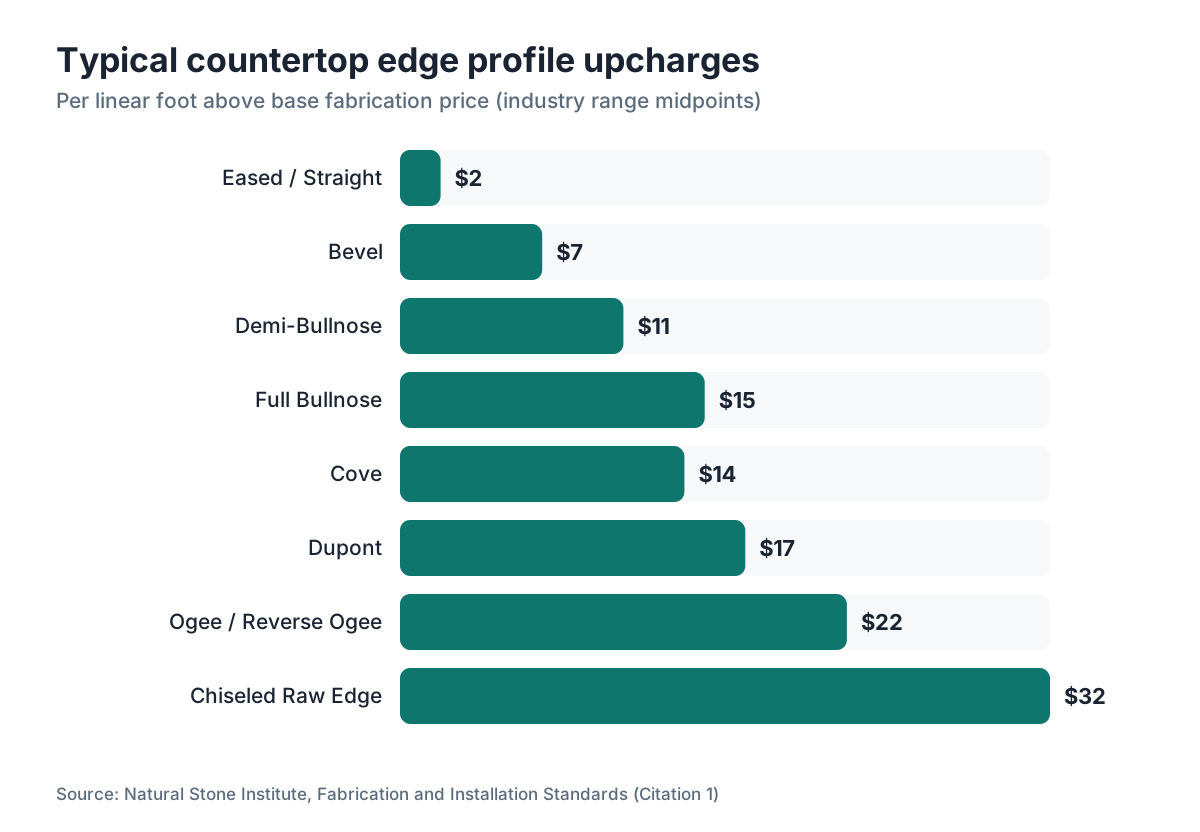
- Decorative profiles like ogee or waterfall add $10 to $30 or more per linear foot.
- Your choice affects safety, cleaning time, material compatibility, and how the whole kitchen reads.
What is an edge profile and why does it matter?
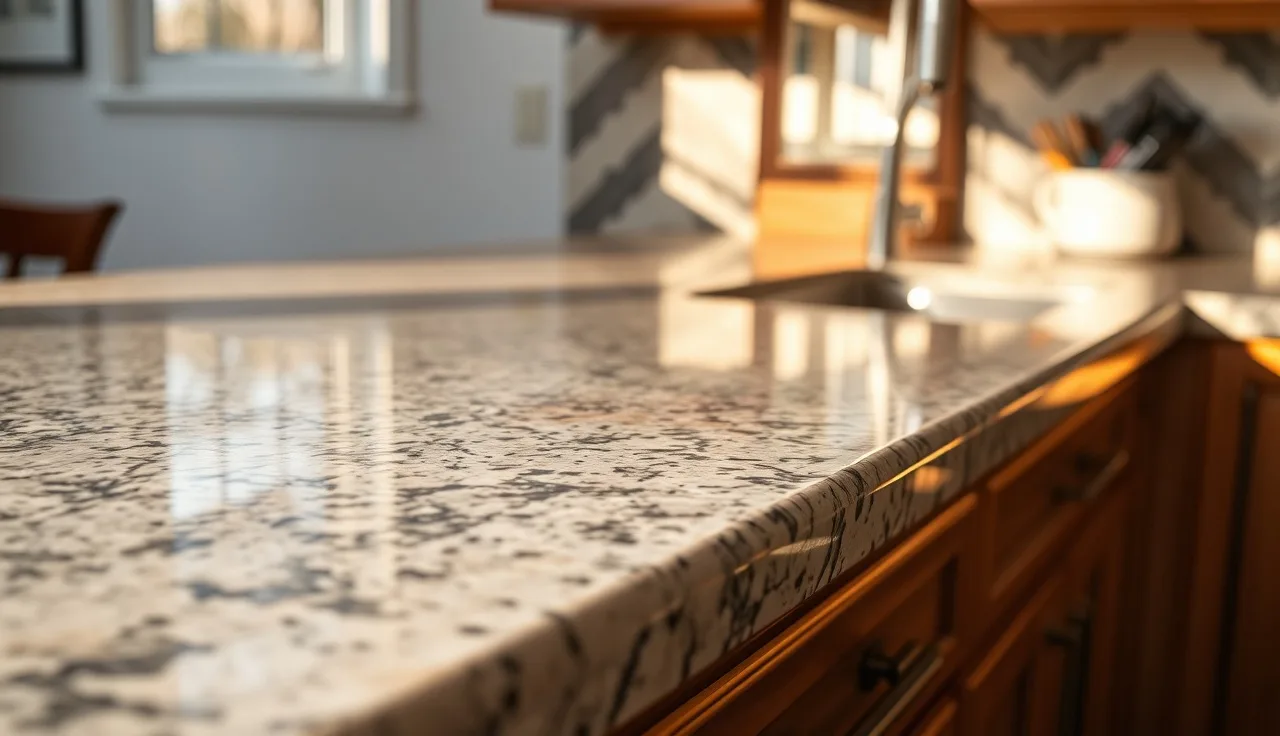
The edge profile is the cross-sectional shape machined into the front face of your countertop where it meets open air, usually along the front of base cabinets, islands, and bar overhangs. It looks like a small design detail. It is not.
The profile decides how water runs off the surface, how much the edge chips if something clips it, how fast you can wipe it down, and how formal or casual the kitchen feels. A sharp square edge on granite can fracture along the corner over time. A too-elaborate ogee on a busy slab pattern looks muddled and collects grease in every groove.
The profile also touches real money. Fabricators charge by the linear foot for edge work. Simple profiles are often bundled into the base price while complex ones show up as a separate line item. Learn the vocabulary before you talk to a fabricator and you stop nodding along to terms you do not understand, then avoid the invoice that surprises you.
For kitchen countertops especially, the edge choice touches daily life: small children bumping hips, bread dough kneaded on the overhang, guests resting their arms on a bar top. Get it right and you never think about it again. Get it wrong and it nags you every single day.
What are all the different countertop edge profiles?
Here is every profile category you will actually meet. Fabricators use slightly different names shop to shop, but these are the standard terms.
Eased (also called slightly eased or 90-degree eased) A square corner with just the very tip broken at roughly 45 degrees, taking off the sharpest point. This is the default on most slabs. Clean, modern, cheap.
Straight (or square) A full 90-degree corner with no rounding at all. Maximally minimal. Used often with ultra-compact surfaces and thick porcelain. More prone to chipping on natural stone because there is no radius to spread impact force.
Beveled A flat angled cut, usually 45 degrees, along the top edge. More visual interest than eased, still easy to clean. Common on laminate countertops because it does not need expensive tooling.
Demi-bullnose (half bullnose) The top edge is fully rounded; the bottom stays square. Softer look than eased. Good for households with children.
Full bullnose Both top and bottom edges roll into a continuous half-circle. The softest possible silhouette. Needs more material removal and more finishing passes, so it costs more. It also shows thickness variations in the slab more clearly.
Ogee A classical S-curve: concave at the bottom turning to convex at the top. Traditional, ornate, high-end look. The cove (the concave section) traps crumbs and water. Budget extra cleaning time.
Reverse ogee The mirror image of a standard ogee. Less common. Looks elegant on thicker slabs (3 cm and up).
Cove (or coved) A concave quarter-round scooped out of the top corner. Softer than a bevel, easier to clean than a full ogee. Often combined with other profiles for double-layer or mitered-and-stacked looks.
Waterfall The countertop wraps vertically down the side of the cabinet all the way to the floor. Technically this is an installation method, not a profile cut, but it comes up alongside edge choices constantly. Common on islands. Needs a full extra slab face and precise mitering, which makes it expensive.
Chiseled (or leathered raw edge) The edge is left rough, as if the stone fractured on its own. Popular on quartzite, marble, and some granites. Labor-intensive to pull off safely. Very specific look.
Dupont (also spelled DuPont) A flat top face with a slight overhang, then a quarter-round step down. Similar feel to ogee but less pronounced. Homeowners confuse it with eased all the time.
Triple pencil or stacked profiles Fabricators can run multiple passes: a cove, then a bead, then another cove. These are specialty builds, mostly for very traditional or period-style kitchens.
The table below sums up typical profile characteristics at a glance.
| Profile | Cleaning Ease | Chip Risk | Typical Upcharge | Best Material Match |
|---|---|---|---|---|
| Eased | Very easy | Low | Usually $0 | Any |
| Straight/Square | Easy | Moderate-High | $0-5/lf | Quartz, porcelain |
| Bevel | Easy | Low | $0-8/lf | Laminate, quartz |
| Demi-bullnose | Easy | Very low | $5-12/lf | Granite, quartz |
| Full bullnose | Easy | Very low | $8-15/lf | Granite, marble |
| Ogee | Hard | Low | $15-25/lf | Granite, marble |
| Reverse ogee | Hard | Low | $15-25/lf | Granite, marble |
| Cove | Moderate | Low | $10-18/lf | Quartz, granite |
| Waterfall | Very easy | Low | $500-2000+ total | Quartz, marble |
| Chiseled raw | Very hard | N/A | $20-40/lf | Quartzite, granite |
| Dupont | Moderate | Low | $12-20/lf | Granite, marble |
How much do different edge profiles cost?
Edge upcharges are priced per linear foot of exposed edge, measured along the front of the countertop run, islands and peninsulas included. The back edge against the wall usually gets a basic eased finish at no extra charge because nobody sees it.
Pricing swings a lot by region and by shop. Based on fabricator price sheets and material supplier data compiled by the Natural Stone Institute [1], rough ranges look like this:
- Eased or straight: $0 (bundled into fab cost) to $5/lf
- Bevel: $5 to $10/lf
- Demi-bullnose: $8 to $15/lf
- Full bullnose: $10 to $20/lf
- Ogee or reverse ogee: $15 to $30/lf
- Dupont: $12 to $22/lf
- Waterfall: usually $500 to $2,000 or more for the whole feature, depending on slab cost
- Chiseled edge: $20 to $45/lf, sometimes more for hard stone
Put it in practical terms. A typical kitchen has around 30 linear feet of exposed front edge. Upgrade from eased to a full bullnose at $15/lf and you add $450 to the job. Upgrade to ogee at $25/lf and you add $750. Whether that matters depends on your total budget, but you should know it before the quote lands.
Thicker slabs cost more to profile. A 3 cm (1.25 inch) slab is the standard for stone today [2]. Some fabricators offer laminated or mitered edges to make a 2 cm slab look thicker, which carries its own cost. The stacked look of a mitered 2 cm edge roughly mimics a 4 cm or 6 cm slab edge, a popular island detail.
For granite countertops, ogee and dupont profiles have been popular for 20 years and most fabricators have well-worn tooling, so pricing tends to stay competitive. For engineered stone like Cambria countertops, some profiles need manufacturer approval to keep the warranty intact, so check before you spec anything non-standard.
Which edge profile should you choose for your kitchen?
There is no single right answer. There are better and worse answers for different situations.
For a modern or contemporary kitchen, eased or straight edges are the honest choice. They keep the slab's natural geometry intact and pair well with flat-front cabinetry. They also photograph well if you ever sell, because they do not date the way an ornate profile does.
For a traditional or transitional kitchen with raised-panel cabinets and detailed millwork, an ogee or dupont edge speaks the language of the room. The ornamentation makes sense there. Put that same ogee on the same granite in a flat, minimalist kitchen and it looks like a costume.
Families with young children should look hard at demi-bullnose or full bullnose. There is no sharp edge to catch a hip or a small head. The rounded profile resists chipping better than a square corner too, which matters on granite and marble countertops.
For a heavy-use prep area on a butcher block countertop, a simple eased or straight edge is easiest to sand back if the wood ever needs refinishing. Elaborate profiles on wood are miserable to re-sand without specialized tooling.
Bar overhangs deserve their own thought. If the overhang runs more than 10 to 12 inches and people rest their forearms on it, a full bullnose or a softened dupont beats a sharp bevel for comfort. A bevel on a bar top can leave a red mark on an arm after 20 minutes. That is a real complaint. Think it through.
Island edges that face a walkway do a different job than edges facing a sink wall. The walkway edge gets brushed by every person who passes. Softer profiles chip less there. The sink side, the one you see head-on from across the room, is where a decorative profile reads best if you want one.
Does the edge profile differ by countertop material?
Yes, and people miss it. Not every profile works on every material, and a few profiles slowly damage certain materials over time.
Natural stone (granite, marble, quartzite) All profiles are possible. Harder stones like granite [3] hold a crisp ogee or square edge well. Softer stones like marble (Mohs hardness around 3 to 4) [4] chip more readily on sharp profiles, so bullnose or demi-bullnose is safer. True quartzite countertops (real quartzite, not soft marble sold under a quartzite label) are hard enough for any profile.
Engineered quartz Holds profiles very well because it is uniform all the way through, with no grain or fissures. Square edges chip less on quartz than on granite because the resin binder locks the particles together. Any profile works.
Laminate The exposed edge is the weak point. The substrate, usually particleboard or MDF, cannot be left showing. Most laminate countertops and Formica countertops use a self-edge (the laminate wraps around the front), a contrasting color edge strip, or wood edge banding. Tight-radius ogee profiles are basically impossible on laminate without a post-form process.
Solid surface (Corian and similar) Very workable. Corian countertops take almost any profile because the material is uniform and can be routed, sanded, and buffed. Scratches on solid surface can be sanded out of the edge profile too, which is a real maintenance advantage.
Porcelain and ultra-compact Hard and brittle. Square or minimally eased edges are typical because the material cracks more easily under the stress of complex profile cuts. Some manufacturers make mitered edge options for thickness, but those are glued assemblies, not single-pass cuts.
Soapstone Softish stone that scratches easily. Simple profiles hold up better long term. If you are eyeing soapstone countertops, eased or bullnose is the smarter call.
Butcher block and wood Any profile a router can cut is possible, but refinishing gets harder as the profile gets fancier. Eased, bevel, or a simple roundover are the practical choices.
How is a countertop edge profile actually installed?
Understanding the process helps you ask better questions and catch mistakes before they turn permanent.
For stone (granite, marble, quartz), the profile gets cut in the shop on a CNC router or by hand with a profile router bit [5]. CNC work is faster, more consistent, and the norm at most modern shops. Hand-routed profiles still show up for repairs and site work. The slab is cut to shape first, then run past the router head that matches the chosen profile bit. Complex shapes like ogee need multiple passes. After routing, the edge runs through a series of polishing pads, usually starting around 50-grit diamond and finishing at 3,000-grit or higher for a mirror polish [6].
For a honed finish, the fabricator stops at a lower grit, usually 400 to 800, leaving a matte surface that does not throw sharp reflections. Leathered finishes use a texturing tool after the basic profile is cut.
For laminate, the edge is usually formed before installation with a laminate trimmer or a post-form press for curved profiles. Some installers add a wood nosing strip at the front edge before wrapping with laminate.
For solid surface, the profile is cut with a router at the shop or on site. Solid surface is the one material where on-site profile corrections make sense, because it can be worked with woodworking tools and the seams can be chemically bonded and sanded invisible.
Thinking about doing it yourself on a new slab? Be realistic. Natural stone edge profiling needs diamond tooling, water cooling, and finishing steps most DIYers do not own. Laminate edge trimming is doable. Solid surface edge work takes practice but stays manageable for a careful person with the right router bits. See our countertop installation guide before you commit.
One thing shops sometimes botch: they profile all four edges of an island slab before templating is done, then the measurement comes back slightly off and the profile has to be reworked or a seam added. This is where accurate digital templating pays for itself. Tools like SlabWise help fabricators lock in measurements and edge callouts before any cutting starts, which kills exactly this kind of rework.
What is the most popular countertop edge profile right now?
The eased edge has run away with new construction and remodels for the past decade, riding the popularity of modern flat-front cabinetry and open-plan kitchens. Houzz's annual kitchen trends surveys keep showing clean, simple profiles leading new installations [7]. Waterfall edges peaked as a luxury statement roughly between 2017 and 2022 and have settled into a niche but still-popular spot.
Ogee profiles, everywhere in granite kitchens through the 1990s and 2000s, have faded without disappearing. In regions where traditional styling still rules, ogee stays a common spec.
Beveled edges are staging a quiet comeback on thicker slabs and on engineered quartz, partly because the bevel catches light differently than a plain eased edge without adding cleaning headaches.
For designers and fabricators, the takeaway is blunt: never push a trend profile on a client without confirming they actually like it. A homeowner who said yes to ogee without understanding it will call you when the kitchen is finished and they see that ornate edge next to their Shaker flat-panel cabinets. Show samples or renders early.
How does edge thickness change what profiles are available?
Standard stone slabs today come in 2 cm (roughly 3/4 inch) and 3 cm (roughly 1-1/4 inch) thicknesses [2]. For countertops, 3 cm is standard across most North American markets because it is rigid enough to span cabinet runs without substrate support in most situations. Many fabricators will not warranty a stone countertop on a 2 cm slab without a plywood substrate underneath.
Profiles that remove a lot of material, like a full bullnose or ogee, need enough thickness to work with. On a 2 cm slab, a full bullnose leaves very little meat at the top surface once the curve is cut. Some profiles are physically impossible at 2 cm without laminating a second strip of stone underneath (called a laminated or mitered edge buildup).
A mitered edge buildup bonds an extra strip of stone to the underside of the front edge, usually 3 to 5 inches deep, to fake the look of a much thicker slab. This is how you get a 6 cm or 8 cm thick counter look from a 2 cm slab. The joint disappears on a well-matched slab if the fabricator aligns the veining. On a busy patterned stone it can jump out.
On islands with a waterfall configuration, the miter joint at the corner where the top meets the vertical panel is the most visually critical detail in the whole kitchen. It should be matched for veining if the stone has movement. Expect to pay more for matched miters. The fabricator has to lay out the slabs carefully and may waste more stone to nail the alignment.
Can you change your countertop edge profile after installation?
Sometimes. It depends on the material and what you want to change.
Got a stone or quartz countertop with a square or eased edge? A fabricator can come on-site with a grinder and diamond router bits and cut a new profile. Going from square to bullnose is feasible. Going from an ogee back to an eased edge is harder, because the ogee already removed material from the edge. You cannot add material back.
Solid surface is the most forgiving material here. A skilled solid surface installer can sand, re-rout, and re-polish the edge on-site with good results.
For laminate, the edge treatment is mostly cosmetic and can sometimes be swapped by pulling the edge banding and applying new material, but the visible joint is almost never perfect.
Changing profiles on installed countertops carries risk. Vibration from grinding near sinks can crack grout or wreck caulk joints. Dust from dry cutting stone is a serious silica hazard. Any on-site stone grinding should run wet or with a HEPA vacuum attachment. The Occupational Safety and Health Administration's silica standard (29 CFR 1926.1153) requires engineering controls for silica-generating operations [8], which matters if you are hiring someone for this work and want to know they operate legally. The EPA also flags the same dust exposure as a health hazard in stone fabrication [11].
In practice, most people who want a different profile just replace the countertops, because the labor cost of a full on-site re-profile often lands near the cost of new templating and installation anyway.
How do edge profiles affect countertop maintenance and durability?
This is where the pretty picture meets daily reality.
Any profile with a cove (a concave channel) collects crumbs, cooking grease, and water. An ogee has two direction changes, which means two trapping zones. You will be working a sponge into that channel every time you wipe the counter. For someone who cooks a lot, that adds up over the years.
A full bullnose has no channel to trap anything. Water sheets off. Crumbs brush away. This is one reason bullnose has stayed popular in high-use kitchens even as it fell out of style in design circles.
Chipping behavior is mostly about corner geometry. A sharp 90-degree corner concentrates impact stress at a single point. Any radius, even a small eased corner, spreads that stress over a larger area. A cast iron pan dropped on a square granite edge does more damage than the same drop on a bullnose. On engineered quartz the polymer binder softens the blow, but the difference is still real.
The finish on the edge surface (polished, honed, or leathered) changes how stains behave. A polished edge on marble is more stain-resistant than a honed edge, because the denser surface closure resists liquid soaking in [9]. If you have a marble countertop and care about the edge shrugging off wine spills, polished profile edges beat honed ones on maintenance. For general stone countertop care, the edge profile follows the same sealing and cleaning rules as the field of the slab.
What do fabricators need to know when specifying edge profiles for a job?
If you run a shop, edge profile callouts on the work order need to be specific enough that nobody has to guess. A callout that just says "bullnose" is ambiguous. Full bullnose or demi? Bottom eased or square? Same profile on the island returns as the perimeter? Every one of those is a potential callback.
Good practice is to spell out the profile name, the finish (polished, honed, or leathered), which edges get the profile (front face only, all exposed edges, island sides), and any thickness or buildup details. Attach a drawing or photo reference to the work order and you save yourself the phone call.
Pricing accuracy matters here too. If you quote "eased edge included" and the client calls after templating wanting ogee, you need a clean change-order process. Shops that use quoting software can attach a profile upcharge to a line item and recalculate the quote in real time. SlabWise's quoting module, for example, lets you define per-linear-foot edge prices by profile and auto-populate them when the edge length is measured from the template, which cuts manual math errors and forgotten line items.
For fabricators pricing countertop installation work, profile complexity drives labor time. A simple eased edge on a standard kitchen might add 30 minutes of shop time. A full ogee with a mitered buildup on a 15-foot island could add 3 to 4 hours. Build that into your labor rate or you will keep undercharging your hardest jobs.
Are there edge profiles that are better for resale value?
Honestly, no single edge profile has documented, measured impact on home resale value in any study I have found. The closest data comes from kitchen remodeling ROI research by the National Association of Realtors [10], which tracks kitchen renovation return on investment broadly but never breaks out edge profiles as a variable.
The practical answer from real estate agents is that anything too trend-specific or too ornate dates a kitchen faster than a simple neutral choice. An ogee edge on dated tile and cherry cabinets will not rescue a 2025 sale. A clean eased or beveled edge on a well-kept quartz counter reads fresh to almost any buyer.
Renovating specifically to sell? The conventional wisdom is to stick with eased or demi-bullnose on a neutral stone. You spend less on the upcharge and the kitchen photographs cleaner. Put the money you save into cabinet hardware or lighting, which buyers notice more than edge profiles in listing photos.
That said, a very nice waterfall island in a contemporary home can be a genuine selling point. It photographs well and buyers remember it. The math depends entirely on the price point and the buyer pool.
Frequently asked questions
Is a countertop edge profile included in the fabrication price?
Basic eased or straight edges usually come bundled into the base fabrication price. Anything more complex (bullnose, bevel, ogee, or waterfall) is typically priced as a per-linear-foot upcharge. Get this in writing on your quote before approving the job. Charges run $5 to $30 or more per linear foot depending on profile complexity and your region.
What is the most durable edge profile for a kitchen countertop?
Full bullnose and demi-bullnose are the most durable because the rounded corner spreads impact stress across a radius instead of concentrating it at a point. Sharp square edges chip more easily, especially on natural stone. For engineered quartz, the polymer binder makes square edges more resilient, but rounded profiles still win on impact resistance.
What is the difference between a bullnose and a demi-bullnose edge?
A full bullnose rounds both the top and bottom of the edge into a continuous half-circle. A demi-bullnose rounds only the top; the bottom stays square. Demi-bullnose is more common because it uses less material and still gives a soft, safe corner. Full bullnose looks softer overall but needs more material removal and costs slightly more per linear foot.
Can you add or change an edge profile on already-installed countertops?
Sometimes. A stone fabricator with the right diamond tooling can re-profile some edges on site, but you cannot add material back once it is gone. You can soften a square edge to a bullnose; you cannot turn a bullnose back into an ogee. Solid surface is more flexible. Most homeowners find on-site re-profiling costs close enough to full replacement that they just replace the countertop.
What edge profile works best for a kitchen island?
For a heavily-used island that people lean against or work at, a full bullnose or demi-bullnose is comfortable and durable. For a statement island, a waterfall edge hits hard visually but costs much more, because it needs a full vertical slab panel and precise mitering. Avoid sharp ogee profiles on island edges that face a walkway, since the concave section chips more easily with repeated contact.
How many linear feet of edge should I expect to pay for in a typical kitchen?
A standard countertop run along one wall might have 10 to 20 linear feet of exposed front edge. An island adds another 10 to 20 feet depending on size. A kitchen with an island and a perimeter run usually has 25 to 45 linear feet of exposed edge that takes a visible profile. The back wall edge is usually eased at no extra charge, since it faces the backsplash and stays out of sight.
Does a waterfall edge require a special profile cut?
A waterfall edge needs a 90-degree miter cut where the horizontal top meets the vertical side panel, not a profile cut in the traditional sense. The mitered faces are polished, glued, and sometimes mechanically fastened. Seam quality depends heavily on the fabricator's skill at aligning the stone's veining across the joint. It is priced as a specialty feature, usually $500 to $2,000 or more for the complete build.
What edge profile is easiest to clean?
Flat profiles with no concave channels are easiest. Full bullnose, demi-bullnose, eased, and straight edges all wipe down in one stroke. Ogee and reverse ogee have concave grooves that collect food debris and grease and need deliberate scrubbing. If you cook often, that adds real maintenance time over years. A beveled edge is a good middle ground: it catches light nicely and still wipes clean fast.
Are there edge profiles I should avoid for granite or marble?
Avoid fully square (90-degree) edges on softer natural stones like marble, travertine, and softer limestones, because the corner becomes a fracture point. A demi-bullnose or full bullnose is a better bet. For granite, square edges are more viable thanks to its hardness, but a small eased radius still helps. Any profile with tight concave sections should be avoided on very soft or fissured stone, since the groove concentrates stress.
What edge profile is best for outdoor kitchen countertops?
Outdoors, drainage and weather resistance matter more than looks. Simple flat profiles with no channels (eased, straight, or demi-bullnose) shed water cleanly and do not collect organic debris. Complex ogee or dupont profiles trap water, which speeds up staining and freeze-thaw cracking in cold climates. Skip honed finishes outdoors if standing water is possible; polished surfaces resist staining better.
Do edge profiles affect the countertop sealing process?
The same penetrating sealers you use on the field of a stone slab should hit the edge too, including every contour of a bullnose or ogee. Complex profiles have more surface area, so they drink slightly more sealer. Honed edge finishes absorb sealer faster than polished edges because honing opens the surface pores. The Natural Stone Institute recommends applying sealer in thin coats and buffing off the excess before it hazes.
What is a laminated edge on a countertop?
A laminated edge (also called a mitered buildup) bonds an extra strip of matching stone to the underside of the front edge to make the slab look thicker. A 2 cm slab with a 3-inch laminated strip reads like a 4 cm or thicker slab from the front. It costs more than a standard profile because it needs extra material and precise adhesive joinery. The visual result depends on how well the grain or veining matches across the joint.
How do I tell a fabricator what edge profile I want?
Be specific: name the profile, name the finish (polished, honed, or leathered), and say which edges get the treatment. Show the fabricator a photo or, better, ask to see their physical edge sample kit, which most shops keep. Confirm in writing on the quote which edges are in the base price and which are upcharged. Precise callouts on the work order prevent miscommunication that is expensive to fix after cutting.
Is a thicker countertop slab required for certain edge profiles?
Yes. Full bullnose, ogee, and dupont profiles need enough material depth to finish the curve or step without eating into the top surface. On 2 cm slabs, these profiles often require a laminated edge buildup to work right. Standard 3 cm slabs handle most profiles without a buildup. Want a dramatically thick edge look? Fabricators can stack two 2 cm strips for a 4 cm appearance, though it adds cost.
Sources
- Natural Stone Institute, Technical Manuals and Industry Standards: Edge upcharge pricing ranges and fabrication standards for stone countertop profiles
- Marble Institute of America (now Natural Stone Institute), Dimensional Stone Design Manual: Standard stone slab thicknesses of 2 cm and 3 cm for countertop applications
- USGS Mineral Resources Program, Granite: Granite hardness and physical properties relevant to edge profiling and chip resistance
- USGS Mineral Resources Program, Marble and Limestone: Marble Mohs hardness approximately 3 to 4, relevant to edge chip risk
- Natural Stone Institute, Fabrication and Installation Standards: CNC and hand-routing processes used for stone edge profile fabrication
- Natural Stone Institute, Finishing and Polishing Guidelines: Diamond polishing grit sequence from 50-grit to 3000-grit or higher for edge finishing
- Houzz, U.S. Houzz Kitchen Trends Study 2023: Simple, clean edge profiles dominate new kitchen installations; waterfall edges popular as a luxury feature
- OSHA, Occupational Exposure to Respirable Crystalline Silica Standard, 29 CFR 1926.1153: Engineering controls required for silica-generating operations including on-site stone grinding
- Natural Stone Institute, Sealing and Maintenance Technical Bulletin: Polished marble surfaces have lower liquid penetration rates than honed surfaces, relevant to edge stain resistance
- National Association of Realtors, 2023 Remodeling Impact Report: Kitchen renovation ROI data; no specific edge profile variable documented in resale value studies
- EPA, Silica Dust Health Hazards in Stone Fabrication: Health hazard context for on-site stone cutting and grinding without wet methods or HEPA controls
- HUD, User Note on Countertop Materials in Residential Construction: Standard countertop thickness specifications in residential construction reference 3 cm stone as typical
Last updated 2026-07-10