TL;DR
- "Cutting edge countertops" is a marketing phrase applied to porcelain slabs, sintered stone, ultracompact surfaces, and advanced quartz with textured finishes.
- Prices run from about $55 to $200 per square foot installed.
- A few of these materials genuinely beat older options on hardness and heat resistance.
- Others are expensive rebrands of technology you can already buy.
- This guide sorts them out.
What does "cutting edge countertops" actually mean?
It means different things depending on who says it. A fabricator usually means porcelain or sintered stone, because cutting those materials takes diamond tooling and different CNC programming than granite or quartz. A showroom salesperson often means whatever launched at the last trade show. A homeowner searching the phrase usually just wants something that looks better and lasts longer than what they have now.
Here's the honest version. The countertop industry sees real material innovation about once a decade, and we're in one of those windows right now. Sintered stone (sold as Dekton and Lapitec), large-format porcelain slabs, and next-generation engineered quartz with low silica content are genuinely different from what you could buy in 2010. Silica-reduced quartz is the biggest change of the bunch, driven by worker safety rules rather than looks, and every fabricator should understand what it does to their shop.
Everything else wearing the "cutting edge" label is mostly finish work: leathered textures, book-matched veining, matte quartz, digital printing on porcelain. Those are real improvements in how a counter looks. The material underneath is not new.
Which countertop materials are genuinely new, and which are rebrands?
Here's a straight breakdown of what actually changed versus what got a new sticker.
Sintered stone (Dekton by Cosentino, Lapitec, Neolith) is genuinely new. It's made by hitting a blend of glass, porcelain, and quartz raw materials with extreme heat and pressure. The result has almost no porosity, a Mohs hardness around 8 (harder than granite at 6-7), and UV stability that natural stone doesn't have [1]. It hit the market commercially around 2013. The fabrication headaches are real: cutting it needs specific diamond blades, and it chips at edges more readily than quartz.
Large-format porcelain slabs are an extension of existing ceramic technology, not a new material. What changed is the size, up to 63 by 126 inches on some formats, and the thickness, as thin as 6mm for overlay work. The material is still sintered clay fired at high heat, which is how tile has been made for centuries. The supply chain shift is a big deal. The chemistry is not.
Low-silica and silica-free engineered quartz is the development fabricators need to watch hardest. Traditional engineered quartz runs 87-93% crystalline silica by weight [2]. Brands including Caesarstone and Hanstone have shipped lines with much less silica. This matters because Australia, the UK, and several U.S. states are tightening silica exposure rules for stone shops, and California's standard already ranks among the strictest anywhere [3].
Dekton Ultra-Compact and similar ultracompact surfaces are basically high-end sintered stone under a proprietary name. The category is real. The sub-brand pile-up is marketing.
Recycled glass and recycled-content countertops have been around since the early 2000s. Not new. They have a real sustainability angle if that matters to you, but "cutting edge" is the wrong frame for a material you could buy 20 years ago.
| Material | Mohs hardness | Porosity | Avg installed cost ($/sq ft) | UV stable? |
|---|---|---|---|---|
| Granite | 6-7 | Low-medium | $60-$150 | Yes |
| Engineered quartz (standard) | 7 | Very low | $55-$140 | No |
| Sintered stone (Dekton, Neolith) | ~8 | Near zero | $80-$200 | Yes |
| Large-format porcelain slab | 6-7 | Near zero | $65-$160 | Yes |
| Marble | 3-5 | Medium-high | $75-$250 | Yes |
| Recycled glass composite | 5-6 | Low | $50-$125 | Varies |
How much do cutting edge countertops cost?
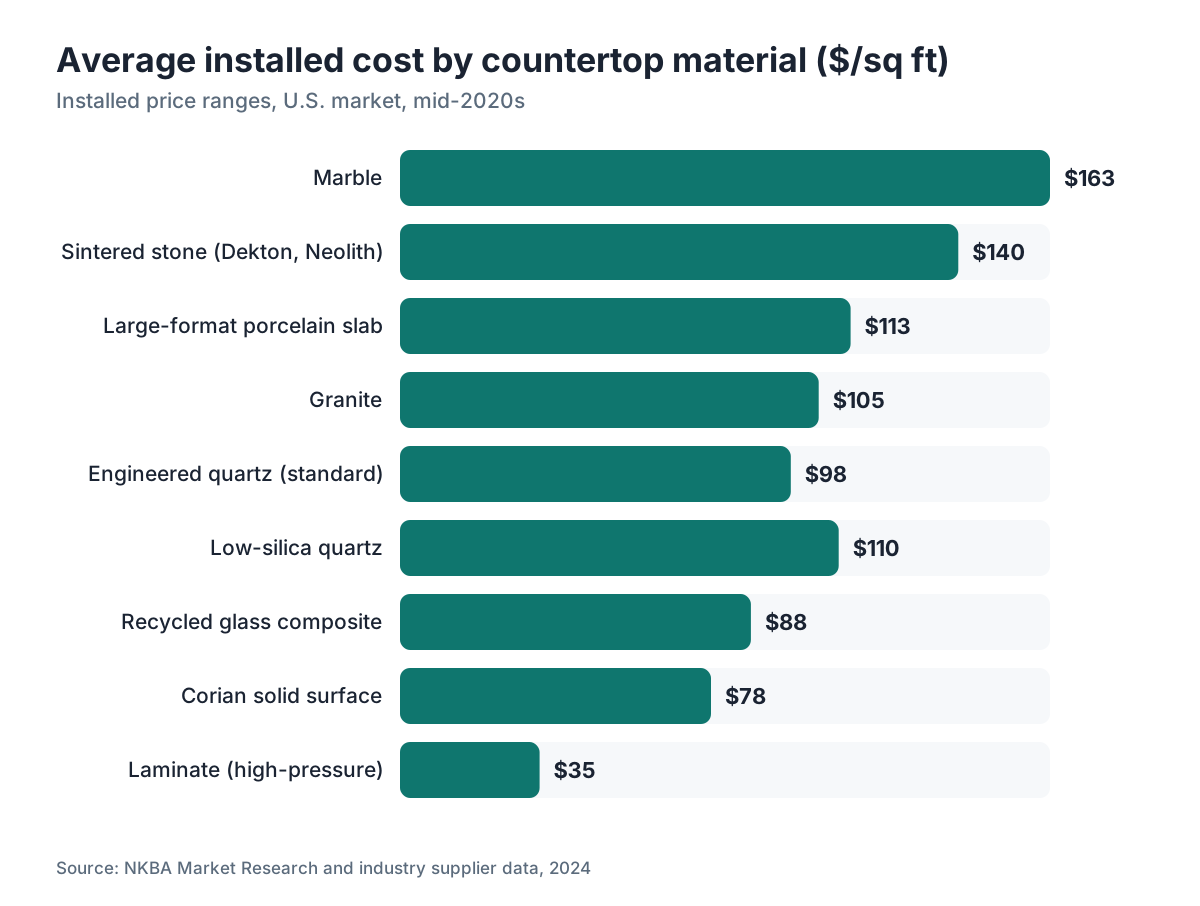
Installed prices for the genuinely newer materials sit above standard granite or quartz, mostly because they're harder to fabricate, not because the raw material costs more.
Sintered stone and ultracompact surfaces typically run $80 to $200 per square foot installed, depending on thickness, edge profiles, and your region. The 12mm thickness used for countertops sits at the low end of that range. The 20mm used for heavy-use surfaces or waterfall islands pushes toward the top. Fabricators charge more for sintered stone because blade wear is higher and the scrap rate for shops still learning the material is real.
Large-format porcelain slabs run $65 to $160 installed. That wide spread reflects how much shop markup swings by region and whether your fabricator has the right handling gear for a 63x126-inch slab, which is not a given.
Low-silica quartz from Caesarstone's newer collections or Hanstone's silica-reduced lines prices close to standard quartz, $55 to $140 installed, with a modest premium of 10-20% for the reduced-silica versions depending on the supplier.
For context, the kitchen countertops market as a whole averages roughly $2,000 to $4,500 for a typical kitchen of 50-70 square feet installed, with premium materials pushing past $6,000 [4].
The honest fabricator's take: most homeowners spending over $150 per square foot are buying looks and brand cachet, not better performance. Sintered stone at $90 to $100 installed performs just as well in a real kitchen as the same material at $200 with a designer label on it.
What is sintered stone and is it worth the price?
Sintered stone earns its price in specific situations and wastes your money in others. Let's be concrete.
Buy sintered stone if you have an outdoor kitchen or any counter that sees direct sun. UV exposure yellows standard engineered quartz over time. Sintered stone doesn't have that problem because its color runs through the whole body of the material [1]. Outdoor kitchens, covered patios, and sunlit breakfast bars are the real use case.
Buy sintered stone if you want near-zero maintenance and never want to think about sealing again. The porosity is essentially zero. Leave wine, coffee, or oil on it for hours and it won't stain. For a vacation home or a house full of kids, that's worth something.
Skip sintered stone if edge damage worries you. The same hardness that resists scratches also makes it brittle at thin edges. It chips. Quartz and granite chip too, but sintered stone chips more easily in most fabricators' experience, and repairs are harder because you can't polish it back the way you can with stone.
Skip it if your fabricator doesn't already work with it. A shop that has never cut Dekton has a learning curve, and you'll see that curve in your seams, edges, and cutout quality. Ask exactly how many sintered stone jobs they've finished in the last 12 months. Fewer than 10 is a yellow flag.
For more on how stone surfaces differ at the maintenance level, the how to clean stone countertops guide covers the trade-offs in detail.
What is the silica dust issue and why does it matter for fabricators?
This is the biggest change happening in the countertop trade right now, and most homeowners have no idea it exists.
Crystalline silica dust from cutting, grinding, and polishing engineered quartz causes silicosis, an irreversible and sometimes fatal lung disease [5]. The U.S. Occupational Safety and Health Administration (OSHA) set a permissible exposure limit for respirable crystalline silica of 50 micrograms per cubic meter of air as an 8-hour time-weighted average, in force for construction and general industry since 2017 [5]. The rule demands engineering controls (wet cutting, local exhaust ventilation), not respirators alone.
OSHA's regulation states: "The employer shall ensure that no employee is exposed to an airborne concentration of respirable crystalline silica in excess of 50 μg/m3 as an 8-hour TWA" [5].
California's Cal/OSHA has moved to go further [3]. Australia has effectively banned engineered quartz fabrication without extraordinary dust controls after deaths among young workers. The UK has issued warnings, and several major Australian retailers stopped selling high-silica engineered quartz entirely [6].
For fabricators, the takeaway is direct: wet-cutting protocols are no longer optional, shop ventilation is now a regulatory matter, and stocking low-silica quartz gives you a compliance cushion and a real sales story. For homeowners, it means asking your fabricator whether they wet-cut and control dust. A shop that does is safer for its people and usually more careful about precision across the board.
Quartz pricing software like SlabWise lets shops flag material-specific cutting protocols right on the job ticket, which helps the right process get used when low-silica and standard quartz move through the same shop.
How do porcelain slab countertops compare to quartz and granite?
Large-format porcelain slabs have the best stain resistance of any countertop material in common use. The through-body porosity is near zero, similar to sintered stone, and the surface hardness shrugs off most scratching. They're UV stable too, which makes them a good outdoor pick alongside sintered stone.
The trade-offs are real. Porcelain is hard and brittle. Undermount sink cutouts take skill and the right tooling, and a rushed cutout can crack the slab. Edges need careful support because thin porcelain at a raw edge chips under impact. Most fabricators steer you toward a mitered or laminated edge on porcelain instead of a standard eased or beveled profile, which adds cost.
Compared to granite countertops, porcelain is lighter per square foot, which matters for older cabinets or mobile homes. Porcelain never needs sealing, while granite benefits from periodic sealing depending on its porosity. Granite can be repaired and re-polished on site. Porcelain generally cannot.
Against engineered quartz, porcelain handles direct heat from pots better (though setting a hot pan on any counter without a trivet is still a bad habit). Quartz has better impact resistance at everyday kitchen use. Porcelain looks more like natural stone in large-format applications because the veining runs continuously across the slab.
For homeowners coming from marble countertops, porcelain slabs printed with marble veining give you a similar look without the etching and staining that calcite-based natural stone is prone to. It's not identical to a trained eye, but it's closer than it was five years ago as printing has improved.
What edge profiles and finishes count as "cutting edge" right now?
Finish and texture is where the market has moved fastest over the last five years, and some of it is genuinely useful instead of just cosmetic.
Leathered and brushed textures on quartzite and granite have been popular for a while and have shifted from premium to standard at most shops. The texture hides fingerprints and minor marks better than a polished finish. If you have kids or cook a lot, a leathered finish on natural stone is closer to a practical choice than a style one.
Calacatta-look quartz with macro-veining has gotten dramatically better. Vein runs now stretch across full slabs and match at book-matched seams in ways that weren't possible five years ago. Brands like Cambria led this in the engineered quartz category. The digital imaging behind porcelain patterns has also improved enough to match two slabs for a continuous look at a waterfall island.
Matte and ultra-matte quartz finishes are practical as well as fashionable. They forgive light scratching better than polished surfaces, though they ask for different cleaning habits because residue shows more on matte in certain light.
Micro-bevel and eased edges have mostly replaced the bulky ogee and dupont profiles that ruled the early 2000s. Cleaner, flatter edges read more contemporary and fabricate faster, so they cost less without looking cheap.
Thicker slabs, 3cm as the default rather than 2cm, are now common enough that 2cm reads as the budget signal at the high end.
Are there genuinely sustainable cutting edge countertop options?
Sustainability claims in this industry deserve a hard squint, but a few hold up.
Recycled glass countertops from Vetrazzo and IceStone use post-consumer and post-industrial glass set in cement or resin binders. IceStone's products contain at least 75% recycled glass and carry third-party environmental certification [7]. The trade-off: cement-binder versions crack under thermal shock more easily than stone or quartz, and they need sealing.
Paperstone and Richlite are solid surfaces made from recycled paper and non-petroleum resins. They're durable, repairable, and have lower embodied energy than sintered stone or quartz. They don't look like stone, which limits their market, but for a shop counter, a craft room, or a modern kitchen where an industrial look fits, they're a real option [8].
Sintered stone makers claim green benefits because the production process is theoretically low-waste, but the energy it takes to sinter at high heat is substantial. The environmental product declarations for products like Dekton exist and can be requested from Cosentino directly. Read those instead of trusting the brochure.
Butcher block countertops from sustainably certified wood (FSC-certified suppliers exist) stay one of the genuinely low-carbon options for a kitchen surface. Not high-tech, but renewable, repairable, and biodegradable in a way no stone or engineered material is.
For homeowners balancing budget with sustainability, laminate countertops have a smaller material footprint than stone and have improved a lot in quality and looks. High-pressure laminate from makers like Formica now includes recycled-content options.
What should fabricators know about machining and fabricating these materials?
If you run a stone shop and you're adding sintered stone or large-format porcelain, here's what actually changes.
Blade selection comes first. Sintered stone and porcelain want continuous rim diamond blades with very fine grit, usually 60-80 grit on the diamond segments, at slower feed rates than you run for granite. The wrong blade chips your cut edges in ways that are hard to fix. Blade cost per linear foot cut is meaningfully higher than for quartz or granite, and that belongs in your material pricing.
Water is mandatory. Dry cutting sintered stone or porcelain throws airborne crystalline silica dust, chews up tooling, and gives you a worse cut. Wet cutting on these materials wins on safety, quality, and tooling life at the same time.
Nesting efficiency matters more as material cost climbs. A sintered stone slab at $800 to $1,200 wholesale means a bad nesting layout is a far pricier mistake than the same error on a $200 granite slab. Shops moving into premium materials keep reporting that better nesting software, whether purpose-built or baked into their quoting workflow, pays for itself fast on high-cost slabs. SlabWise's nesting tool was built for exactly this.
Edge work on sintered stone and porcelain needs sharp tooling and steady water flow. Mitered edges on thin-body porcelain are the most demanding edge job in the shop. If your CNC operator hasn't done it, run test cuts on scrap before you touch a paid slab.
Handling large-format slabs safely takes either a vacuum lifter rated for slab work or a dedicated A-frame cart. A 63x126-inch porcelain slab at 6mm is fragile in a way a 2cm quartz slab just isn't. Drop a full-format porcelain slab and you usually lose the whole thing. Get the right handling gear before the first delivery lands, not after.
For shops new to sintered stone installation, the countertop installation guide covers fit-up, seam placement, and substrate requirements that carry across material types.
How do you pick the right cutting edge material for your specific kitchen?
Honest answer: most kitchens don't need a premium sintered or ultracompact surface. They need something that looks good, resists everyday staining, and gets installed right by a competent fabricator near you.
Start with what your fabricator can actually execute well. The best material on earth installed by a shop that's never touched it beats out to a worse result than a more familiar material installed by experts. Ask for photos of completed jobs in the material you're considering. Look hard at seams, edges, and sink cutouts.
Match the material to how you use a kitchen. If you set pots straight on the counter without trivets, sintered stone or porcelain handles that better than quartz. If your household beats up surfaces, leathered granite hides visible wear better than polished quartz. If you cook with oil constantly, a honed or leathered finish shows it less than polished stone.
Budget honestly. Premium sintered stone at $150-plus per square foot installed is real money. If the alternative is a high-quality Corian solid surface at $65 to $90 installed, which is repairable, joins invisibly at sinks, and has 50 years of residential track record, the sintered stone doesn't always win on practical grounds.
For outdoor kitchens, sintered stone or large-format porcelain is the clear pick over quartz, which fades. For rentals or flips, modern laminate or mid-range granite is smarter economics. For a primary kitchen you'll keep 15 years, the premium materials justify themselves if the look matters to you.
To compare your specific project against regional price ranges before you talk to a fabricator, getting an instant online estimate first helps you walk in knowing what the numbers should look like.
What are the most common myths about cutting edge countertop materials?
Several claims float around showrooms and design blogs that fall apart under scrutiny.
Myth: sintered stone can't be scratched. It can. Mohs 8 means harder than most kitchen tools, not harder than everything. Silicon carbide abrasives, ceramic knife edges, and certain metals will scratch it. The surface is more scratch-resistant than quartz, not scratch-proof.
Myth: porcelain countertops are fragile. Full-body porcelain slab isn't fragile in normal use. It's brittle under point impact, so a dropped cast-iron pan landing on the edge of a cutout can chip it. Properly installed and used normally, porcelain is no more prone to damage than granite.
Myth: all low-silica quartz is just marketing. The silica reduction in some newer formulations is real and measurable. Australian research documented silica content across engineered stone products and found the highest-risk products top 90% crystalline silica by weight [2]. Products formulated to cut that number are a genuine worker-safety improvement.
Myth: digital-printed porcelain looks fake up close. High-end digital printing on porcelain at 20-pixel-per-mm resolution and multiple ink layers has gotten good enough that most people can't tell it from natural stone without touching it. The texture reads different. The look in a finished kitchen does not read artificial.
Myth: cutting edge countertops are always better. Newer materials carry real trade-offs. Quartzite, for one, is a genuinely hard natural stone with gorgeous looks, but how to clean quartzite countertops is a real question because it's more porous and higher-maintenance than quartz. Newer isn't automatically better for every household.
Frequently asked questions
Is sintered stone better than quartz for a kitchen countertop?
For most indoor kitchens, the performance gap is small. Sintered stone handles heat and UV better and has near-zero porosity. Quartz has better impact resistance at edges and is stocked by more fabricators who know it well. If you have an outdoor kitchen or a sun-exposed surface, sintered stone wins clearly. For a standard interior kitchen, either is excellent when properly installed.
What is the most durable countertop material available today?
On hardness alone, sintered stone (Dekton, Neolith) scores highest at around Mohs 8, above granite at 6-7 and standard quartz at 7. For real-world durability that weighs chip resistance and repairability, thick engineered quartz (3cm) is arguably more practical. It depends on how you use it: heat exposure favors sintered stone, impact resistance favors quartz or granite.
How much does sintered stone countertop cost per square foot installed?
Sintered stone countertops typically run $80 to $200 per square foot installed in the U.S. The wide range reflects slab thickness (12mm versus 20mm), edge profile complexity, and regional labor rates. Shops new to sintered stone sometimes charge more to cover higher blade wear and slower feed rates. Get at least two quotes from fabricators who have finished multiple sintered stone jobs.
Can I cut on a sintered stone or porcelain slab countertop?
You physically can, but you'll dull your knives faster than on a cutting board. Neither sintered stone nor porcelain is harmed by knife contact in normal use, but the hardness that protects the surface wrecks blade edges quickly. Use a cutting board. Same advice applies to any hard surface, including granite and quartz.
What is the silica dust risk in countertop fabrication?
Cutting engineered quartz generates respirable crystalline silica dust that causes silicosis, a serious and irreversible lung disease. OSHA set a permissible exposure limit of 50 micrograms per cubic meter (8-hour average) in 2017. Engineered quartz can contain 87-93% crystalline silica by weight. Fabricators must use wet cutting and engineering controls, not respirators alone, to comply. Low-silica quartz formulations reduce but don't eliminate the risk.
Are large-format porcelain slabs hard to install?
Yes, more than standard stone. A 63x126-inch porcelain slab needs a vacuum lifter for safe handling, specialty cutting tooling, and careful support during undermount sink cutouts. The material is brittle under point impact. Shops without large-format experience have higher breakage rates. Ask your fabricator specifically how many large-format porcelain countertop jobs they've completed before you sign a contract.
What is the difference between sintered stone and ultracompact surface?
They're the same category. "Ultracompact" is a marketing term used mainly by Cosentino for its Dekton line. Both describe a countertop made by hitting raw mineral materials with extreme pressure and heat, giving near-zero porosity and very high surface hardness. Neolith, Lapitec, and Dekton are all sintered stone products, sold under different names by their makers.
Do cutting edge countertops add more resale value than granite or quartz?
There's no reliable data showing sintered stone or porcelain slabs return more on resale than well-installed granite or quartz. Remodeling Magazine's Cost vs. Value Report shows kitchen remodels broadly return 50-75 cents on the dollar, but the data doesn't break out countertop material. Premium materials may help a home sell faster in design-conscious markets, but no documented resale premium is tied to sintered stone specifically.
How do I clean sintered stone or porcelain slab countertops?
Both are low-maintenance. Warm water and mild dish soap handle daily cleaning. Neither needs sealing. Skip abrasive pads, which can dull a polished finish over time. For stubborn stains, a diluted bleach solution (1:10 ratio) is safe on fully sintered surfaces. Porcelain and sintered stone shrug off acidic cleaners that would etch marble and some granite, which is a real practical advantage.
Is low-silica quartz available from major brands?
Yes. Several manufacturers have released reduced-silica or silica-alternative engineered quartz lines in response to regulatory pressure and worker-safety concerns, especially in Australia and the UK. Caesarstone, Hanstone, and others have products in this category. U.S. availability varies by distributor. Ask your fabricator or slab supplier directly, since these products aren't always promoted heavily in American showrooms.
What countertop material is best for an outdoor kitchen?
Sintered stone or large-format porcelain are the two best picks. Both are UV stable (no yellowing), have near-zero porosity (no freeze-thaw water absorption damage), and handle grill heat without issue. Standard engineered quartz fades in direct sun and isn't rated for outdoor use by most makers. Granite works outdoors but needs sealing and can absorb moisture in freeze-thaw climates if it isn't sealed right.
Can sintered stone or porcelain countertops be repaired if they chip?
Not easily. Unlike granite or engineered quartz, which repair with color-matched epoxy fillers that blend reasonably well, sintered stone and porcelain chips are hard to fix invisibly because the through-body color and texture resist matching with filler. Small edge chips can be stabilized to stop further cracking, but a noticeable chip at a prominent edge usually stays visible.
How thick should a sintered stone countertop be?
12mm (about 0.5 inches) is the standard thickness for most countertop work and is structurally fine with proper cabinet support. 20mm is the call for heavy-use surfaces, waterfall islands, or applications without continuous cabinet support along the front edge. Some designers use 6mm sintered stone as an overlay on existing counters, but that needs a perfectly flat substrate and expert installation to avoid cracking at unsupported spans.
Sources
- Cosentino, Dekton Technical Data Sheet: Sintered stone (Dekton) has near-zero porosity, Mohs hardness approximately 8, and UV stability suitable for outdoor use
- California Department of Industrial Relations, Cal/OSHA Crystalline Silica Standard for Construction: California OSHA has among the most stringent silica exposure regulations in the United States
- National Kitchen and Bath Association, NKBA Market Research: Typical kitchen countertop installation costs range from approximately $2,000 to $4,500 for a standard 50-70 square foot kitchen
- OSHA, Occupational Exposure to Respirable Crystalline Silica, 29 CFR 1926.1153: OSHA permissible exposure limit for respirable crystalline silica is 50 micrograms per cubic meter as an 8-hour TWA, effective 2017; exact rule text quoted in article
- IceStone, Environmental and Material Certifications: IceStone recycled glass countertops contain at least 75% recycled glass content and have received third-party environmental certification
- Richlite Company, Product Technical Information: Richlite countertop surfaces are made from recycled paper and non-petroleum resin binders with documented lower embodied energy than stone or engineered quartz
- Remodeling Magazine, Cost vs. Value Report 2024: Kitchen remodels broadly return 50-75 cents on the dollar in resale value across U.S. markets
- OSHA, Crystalline Silica page (Stone Countertop Fabrication): OSHA identifies stone countertop fabrication (cutting, grinding, polishing quartz) as a high-exposure silica dust activity requiring engineering controls
Last updated 2026-07-09