TL;DR
- An eased edge on marble is a near-square 90-degree corner with a barely visible softening on the top arris, about 1/16 to 1/8 inch.
- It is the cheapest profile to cut, usually included in the base slab price or adding $0 to $15 per linear foot.
- It suits modern and transitional kitchens.
- Fabricators recommend it for first-time marble buyers because it polishes fastest and repairs easiest.
What exactly is an eased edge on a marble countertop?
An eased edge is as close to a square, 90-degree corner as you can cut in stone without leaving a razor-sharp arris. The fabricator runs the slab through a CNC router or shapes it on a hand grinder, takes off just enough material to knock the raw cut angle down, and polishes the result. The top edge ends up with a barely perceptible softening, somewhere between 1/16 and 1/8 of an inch. Viewed straight on, the counter looks completely square.
That tiny curve is on purpose. A perfectly square corner on marble, or any natural stone, is a chip waiting to happen. Marble scores a 3 to 4 on the Mohs hardness scale, which makes it softer than granite (6 to 7) or quartzite (7) [1]. Take off a little more material at the corner and you cut the stress that causes corners to flake during everyday use.
Some fabricators and designers use 'eased edge' and 'straight edge' interchangeably, which causes confusion. A true straight edge has zero rounding. An eased edge has a micro-bevel. The visual difference in an installed kitchen is nearly invisible, but the structural difference matters on a stone this soft. If a shop quotes you a straight edge on marble, ask flat out whether they are softening the arris at all.
How much does an eased edge profile add to the cost of marble countertops?
The eased edge is the baseline profile for almost every shop. That means it is usually built into the per-square-foot slab price with no upcharge, or it adds a modest $0 to $15 per linear foot if the shop itemizes edge work [2].
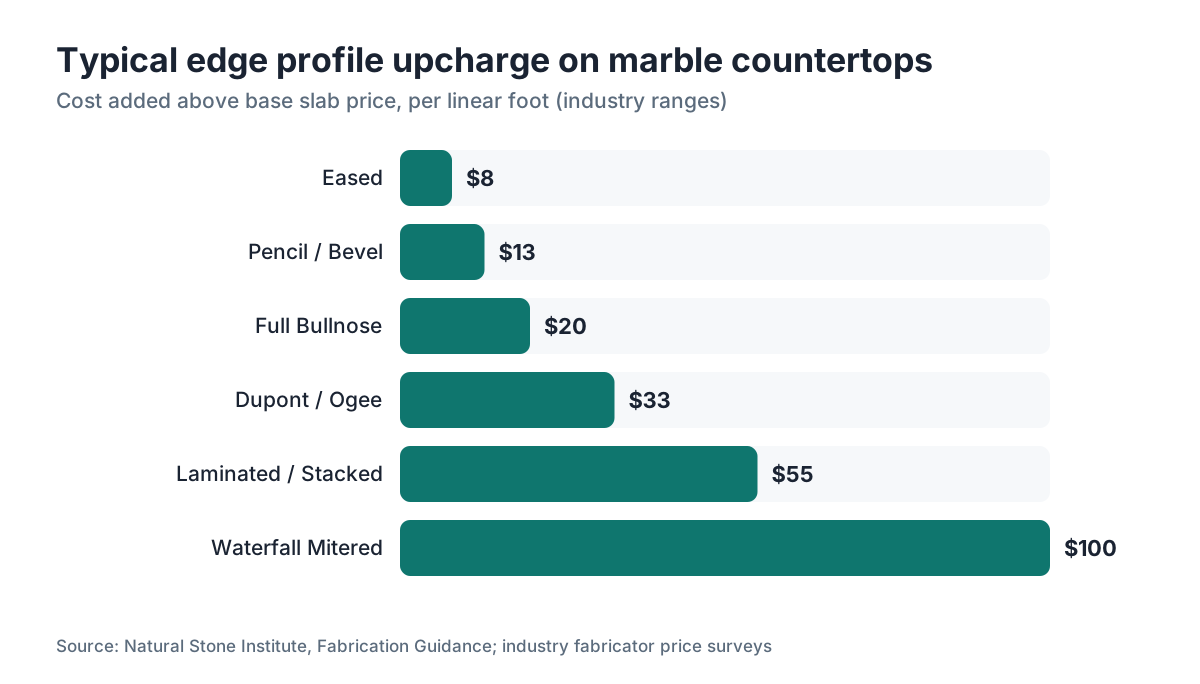
Here is how the eased edge compares in price to other common profiles. These are industry ranges pulled from multiple fabricator price lists and contractor resources. Your local shop may land anywhere within or slightly outside these bands depending on equipment and labor.
| Edge Profile | Typical Upcharge ($/LF above base) | Complexity |
|---|---|---|
| Eased | $0, $15 | 1 pass, minimal polish |
| Beveled | $5, $20 | 1 angled pass |
| Bullnose (full) | $10, $30 | Single radius, full polish |
| Dupont / Ogee | $20, $45 | Multi-radius CNC |
| Waterfall Mitered | $50, $150+ | High waste, multiple pieces |
| Laminated / Stacked | $30, $80 | Two slabs glued, extra polish |
The gap between an eased edge and an ogee on a typical 30-linear-foot kitchen runs $350 to $900. That is real money that could go toward a better marble grade or a stronger sealer. On the other hand, the edge is one of the first things anyone touches in a kitchen, so if you love the waterfall ogee look, it is a defensible splurge.
Getting a quote? Ask your fabricator to break out edge work as its own line item, even when they bundle it by default. It makes comparing shops much cleaner. Shops running modern quoting software, including those on tools like SlabWise, itemize edge profiles automatically, which takes the guesswork out.
If your kitchen has an island with 40 linear feet of edge and you go from eased to ogee at a $30/LF premium, that is $1,200 in edge work alone. Worth knowing before you commit.
What does an eased edge look like compared to other popular marble edge profiles?
The eased edge reads clean and architectural. In a white Carrara or Calacatta kitchen, the profile disappears into the design. The slab and its veining carry the room. The edge does not fight for attention.
The bullnose rounds the top corner all the way over, giving a soft, half-round silhouette. It reads warmer and more traditional, and it forgives chips because there is no corner at all. The tradeoff: water and crumbs collect in the curved seam where the bullnose meets the cabinet, which is a nuisance on porous marble where staining already worries you.
The bevel adds a flat angled cut, usually 45 degrees, along the top corner. It looks more finished than a plain eased edge and catches light differently. It costs a little more, and it has a defined corner where the bevel meets the flat top, which is a minor chip point.
The ogee is the ornate S-curve that shows up in traditional and transitional kitchens. On white marble it can look elegant. On heavily veined marble like Nero Marquina it can look busy. Ogee profiles take multiple CNC passes and more hand polishing, which is why they cost a lot more.
The waterfall or mitered edge is the one profile that makes marble look thicker than the actual slab, because the fabricator miters a strip of matching marble down the front face. On a 3/4-inch slab it can fake a 3-inch counter. Material waste and labor run high, and matching veining across the miter is genuinely hard with natural stone.
For most people putting marble in a contemporary or transitional kitchen, the eased edge is the honest first choice. It protects the budget, it ages well, and it never argues with the stone.
Is an eased edge a good choice for white marble like Carrara or Calacatta?
Yes. The eased edge is the dominant choice for Carrara and Calacatta installations, and the reason is simple: those marbles are already doing the visual work with their gray and gold veining. Pile an elaborate edge on top and the surface starts to look fussy.
Carrara marble comes mostly from the Apuan Alps in Tuscany, Italy, and has been quarried commercially for centuries [3]. Its fine white-to-gray ground with softer linear veining takes to clean, minimal detailing. Calacatta is also Italian, quarried from a smaller area in the same range, and carries a more dramatic, branching vein. On Calacatta especially, the eased edge lets the slab carry the room.
There is a practical side too. Carrara and Calacatta are both calcium carbonate stones, so they etch from acids like lemon juice, vinegar, and wine [4]. Etching leaves dull spots in the polish. An eased edge exposes less polished surface at the corner than a bullnose, and the simple corner makes it relatively easy for a fabricator to re-hone and re-polish a small section if the edge gets badly etched or chipped. A complex ogee with multiple radii is much harder to spot-repair.
If you are running a honed finish instead of a polished one (more popular lately because honed hides etch marks better), the eased edge fits it perfectly. Honed marble with an eased edge is one of the more durable finish-and-profile pairings you can pick for a working kitchen.
How is an eased edge actually cut and polished in a fabrication shop?
Shops cut eased edges one of two ways: CNC router or hand grinding. CNC routing is faster and more consistent, and it is the method for high-volume work. The slab goes on a flat table, the router head makes a single pass along the programmed edge path, and out comes a repeatable micro-bevel.
Hand grinding is still common for site work, repairs, and small shops without CNC. A skilled fabricator uses a series of diamond polishing pads, starting at coarse grits (50 to 100) to shape the edge, then stepping through finer grits (200, 400, 800, 1500, 3000) to build the polish [10]. Hand work on an eased edge takes 20 to 40 minutes per linear foot, against 2 to 5 minutes per foot on a CNC with automated polishing heads.
Marble's softness (Mohs 3 to 4) makes it easier to polish than granite, but it also means the pads load up faster and the risk of burning or scratching the surface climbs if the fabricator rushes. A well-run shop slows feed rates on marble compared to granite and swaps polishing pads more often.
Inspecting finished work? Run your hand along the polished edge and look for flat spots, micro-scratches, or places where the shine dips. Those are the tells that the fabricator skipped a grit step. The polish on a properly finished marble eased edge should look continuous with the face of the slab.
Does the edge profile affect how easy marble countertops are to maintain?
More than most people expect.
The eased edge has two maintenance wins. First, it wipes down fast. A flat vertical face with a barely curved top corner collects almost no debris. Compare that to an ogee, where the S-curve traps grime in its crevice, or a bullnose, where the curve meets the underside of the counter and creates a ledge.
Second, the eased edge is the easiest profile to re-polish when marble etches or scratches. Marble does etch. Acid etching is a chemical attack on the calcium carbonate surface that strips the polish and leaves a dull spot [4]. Re-polishing an eased edge takes a flat polishing pad and a straight stroke. Re-polishing an ogee takes a shaped pad or a hand technique that follows the profile, which is much harder to do evenly.
Sealing is the same across profiles: you seal the face, and you should seal the edge too. An eased edge seals quickly because the surface area is small and the geometry is simple. Use a penetrating impregnator sealer rated for marble, follow the manufacturer's instructions, and test now and then with a water bead. When water stops beading, reseal [5].
Day-to-day care on any marble edge is the same: no harsh cleaners, no acidic solutions, wipe spills fast. See the fuller rundown at how to clean stone countertops.
What thickness of marble slab works best with an eased edge?
The two standard slab thicknesses you will meet are 2 cm (about 3/4 inch) and 3 cm (about 1 1/4 inch). The eased edge works on both, but the look changes.
A 2 cm slab with an eased edge looks slim and light. On a wall-mounted bathroom vanity or a thin island, that slimness can be very elegant. The tradeoff is structural: 2 cm marble needs continuous support across its span, usually a plywood substrate underneath, and it has less weight to steady itself against vibration and impact [6].
A 3 cm slab with an eased edge looks substantial without a decorative profile to fill out the mass. For kitchen counters with standard overhangs (1 to 1.5 inches beyond the cabinet face), a 3 cm slab can usually cantilever up to about 12 inches without extra support, depending on the stone's density and span [7]. Past 12 to 14 inches, ask your fabricator about corbels or brackets.
Want the look of a thick counter (2 to 3 inches) but working with 2 cm marble? The laminated or stacked edge gets you there by gluing a mitered strip of matching marble to the bottom of the visible face. On a 2 cm slab, though, that buildup makes a plain eased corner read like a sharp ledge. If you are laminating for thickness, move to at least a small bevel or a bullnose so the corner looks intentional.
How does an eased edge hold up in a bathroom versus a kitchen?
Bathrooms are gentler on marble than kitchens, and that matters for edge durability.
In a kitchen, the edge takes hits from pots, pans, cutting boards, and small appliances sliding across the counter. An eased edge on marble does chip if you catch it with a cast iron pan. The corner is not bulletproof. But a sharp impact on an eased edge tends to produce a clean small chip that a fabricator can fill with color-matched epoxy and re-polish. An ogee can fracture along its curve in a less predictable way.
On a bathroom vanity, the edge sees cosmetic bottles, soap dispensers, and the occasional elbow. Chipping risk drops way off. The eased edge is almost the default on a vanity, and there is little reason to upgrade unless the design calls for it.
For heavily used family kitchens with kids and constant cooking, some fabricators push a full bullnose on marble precisely because it kills the corner entirely. That is a fair opinion. My read: if you like the eased edge, choose it, but be deliberate about not storing heavy cast iron right at the edge and not sliding appliances along the counter lip.
For marble countertops in general, the edge decision sits well downstream of the bigger calls around sealing, acid management, and finish type. Nail those first.
What should you ask your fabricator before choosing an edge profile?
The edge profile is one spot where specific questions save regret later.
Start by asking to see physical samples of each profile they offer, cut from marble, not granite or engineered stone. The profile reads differently in every material. Some shops keep a sample board; smaller shops may have offcuts from past jobs. A physical sample beats any rendered image.
Ask how they finish the eased edge: CNC or hand polish, and how many grit steps they run. A shop that stops at 800 grit leaves a slightly hazy polish. A proper marble polish goes to 1500 or 3000 grit at minimum. You can see the gap in side-by-side offcuts under a shop light.
Ask whether the edge upcharge covers the entire perimeter or only exposed edges. Usually you pay for the profile only on edges visible to the room. Edges against a wall, under an upper cabinet, or butting a refrigerator stay as raw cuts. Make sure your quote reflects that.
Ask about their repair policy if the edge chips during installation or delivery. Marble edge chips happen. A reputable shop color-fills and re-polishes at no charge when the chip happened on their watch.
Last, if you are sourcing your slab from a different supplier and having this fabricator cut it, ask whether they add a markup on the material. Many do. That is normal and not a red flag by itself, but it changes your total.
Shops on modern quoting platforms (SlabWise is one built for fabricators) list edge profiles as selectable line items, so the quote already shows the breakdown. If your quote is a single lump sum with no itemization, push for a revised version before you sign.
How does the eased edge compare to a pencil edge, bevel edge, or dupont edge on marble?
Four profiles come up constantly alongside the eased edge, and the differences are worth knowing precisely.
A pencil edge adds a small quarter-round radius to just the top corner, usually 1/4 inch. It looks a touch softer than an eased edge but still reads clean and modern. It shows up a lot in bathrooms. Cost usually runs $5 to $15 per linear foot above base.
A bevel edge (also called a chamfer) cuts a flat angled face at 45 degrees across the top corner, usually 1/4 to 1/2 inch wide. It catches light differently than an eased edge and can look sharp in the right kitchen. The bevel creates two defined corners (where it meets the top face and where it meets the vertical face), both slight chip points. Cost is close to a pencil edge: $5 to $20/LF.
A dupont edge is a flat-top profile with a concave radius on the lower front face, then a small return at the bottom. It has an architectural, almost furniture-like look. On marble it takes more CNC passes and a more complex polishing sequence. Cost typically runs $25 to $45/LF.
The full bullnose, again, rounds the entire top corner in a half-circle. On thick 3 cm marble it can look heavy, especially in small kitchens. On 2 cm marble it often looks well-proportioned.
None of these beats the eased edge categorically. They are aesthetic calls. The eased edge wins on cost and maintainability. Everything else trades some of that for a more distinctive look. Comparing materials and want a cleaner cost breakdown across options? The kitchen countertops overview covers how edge choices fit into total countertop budgets across materials.
Can you change the edge profile after marble countertops are already installed?
Yes, but it is a messy job.
A fabricator can re-profile an installed marble edge by grinding down the existing shape and recutting it. Going from an ogee to an eased edge (simpler shape) is straightforward. Going from an eased edge to an ogee (more complex shape) is possible but risks cracking the stone, because it removes more material with the slab already in place.
The real problem is dust and vibration. Dry grinding marble in an installed kitchen throws off enormous amounts of fine white dust that gets into cabinets, appliances, and HVAC returns. Wet grinding cuts the dust but needs careful containment so water does not damage adjacent cabinetry or flooring. Most homeowners who have this done say prep and cleanup take longer than the grinding itself.
Re-profiling also risks micro-cracks if the slab is not well supported. An unsupported span that vibrates during grinding can crack along a vein.
If you genuinely hate your current profile, re-profiling is a real option. It runs $20 to $60 per linear foot in labor, depending on profile complexity and local rates. But it is far easier and cheaper to pick the right profile before installation. Physical samples, as covered above, are the best way to dodge regret.
What are the most common mistakes people make when choosing a marble edge profile?
The biggest one is picking a profile from an online photo shot in a different kitchen. Profiles look different depending on lighting, marble color, counter thickness, and cabinet style. A dramatic ogee in a warm, dark kitchen does not translate to your bright white kitchen with flat-front Shaker cabinets. See physical samples in your actual space if you can.
The second mistake is over-specifying the edge to compensate for a marble grade you are not fully happy with. If you have doubts about your slab's veining or color, an elaborate edge will not fix that. Get the slab right first.
The third mistake is forgetting to budget for edge linear footage. First-time buyers price marble by the square foot and overlook that a 30-linear-foot perimeter at a $30/LF ogee upcharge adds $900 to the bill. That surprise, late in the process, can force a compromise.
Fourth: assuming one profile fits every surface in the project. Your kitchen island and your bathroom vanity might want different profiles. They get different use, different adjacencies, and often different aesthetic goals. Mixing profiles across a project is fine.
Fifth, and this one is subtle: not specifying which edges get profiled and which stay raw. Confirm in writing which edges are included and which are not. Miscommunication here has caused real disputes between homeowners and fabricators.
Frequently asked questions
Is the eased edge the cheapest marble countertop edge profile?
Yes, almost always. The eased edge needs a single pass and minimal polishing, so most fabricators include it in the base slab price or charge $0 to $15 per linear foot. Every other profile (bevel, pencil, bullnose, ogee, dupont) takes more machine time or hand work and costs more. If budget is tight, the eased edge is the correct default.
Does an eased edge make marble countertops look cheap?
No. The eased edge dominates high-end kitchen design precisely because it keeps the focus on the stone. Expensive, heavily veined marble like Calacatta Gold or Statuario Venato looks best with a simple profile. A complex edge on a striking slab competes with the stone. When the marble is quality material, the eased edge reads as intentional and restrained, not low-budget.
What is the difference between an eased edge and a straight edge on marble?
A straight edge is a true 90-degree corner with no softening. An eased edge removes a tiny amount of material from the top arris, creating a micro-bevel of roughly 1/16 to 1/8 inch. On marble, which is softer than granite, a true straight edge chips easily. Most fabricators apply at least a minimal ease even when quoting a 'straight edge.' Ask directly whether they soften the arris at all.
Does the edge profile affect how often I need to seal my marble countertop?
Not significantly. Sealing frequency depends on the marble's porosity and your use pattern, not the edge profile. A penetrating impregnator sealer applied to the face also covers the edge. The eased edge has a small surface area at the edge, which makes it fast to seal. Test by applying water to the edge: if it absorbs rather than beads, reseal. Most marble counters need resealing every one to three years.
Can I get an eased edge on 2 cm marble without a laminated buildup?
Yes. An eased edge works on 2 cm slabs. The counter looks slim, about 3/4 inch thick at the face. That can be elegant on a bathroom or a furniture-style island, but it needs full plywood substrate support beneath the stone. Want the look of a thicker counter? A laminated front strip glued to the bottom adds visual mass, but then you typically want a bevel or bullnose rather than a plain eased edge.
How long does it take a fabricator to cut and polish an eased edge on marble?
On a CNC machine, roughly 2 to 5 minutes per linear foot including polishing passes. By hand, 20 to 40 minutes per linear foot, depending on the polisher's experience and how many grit steps the shop runs. A properly polished marble edge steps through grits from roughly 100 to 3000. Shops that rush and stop at 800 grit leave a noticeably hazier finish that shows next to a polished face.
What edge profile do designers usually recommend for a farmhouse or traditional kitchen with marble?
Traditional and farmhouse kitchens often use an ogee or dupont edge because those profiles have historical precedent in kitchen millwork. The eased edge reads more contemporary. That said, honed white marble with an eased edge works in a farmhouse kitchen because the honed finish reads less formal. The thing that matters most is consistency: match the edge language to the cabinet and hardware style.
Does the eased edge affect the resale value of a home with marble countertops?
There is no credible data showing edge profile measurably changes resale value. Buyers notice the marble, not the edge profile. A poorly finished or chipped edge of any profile can raise questions about overall quality, so the factor that matters is workmanship, not which profile you chose. A clean, well-polished eased edge from a skilled fabricator is worth more than a sloppy ogee.
Is an eased edge safe around children, or should I choose a bullnose?
An eased edge on a standard 36-inch counter is not a meaningful safety hazard for children compared to other kitchen risks. The micro-softened corner is not sharp enough to cut. If you have very young toddlers at counter height and you are worried, a full bullnose removes the corner entirely. But most kitchen safety concerns for children center on access to appliances, drawers, and cabinet contents, not the edge profile of the stone.
Can a fabricator match an eased edge profile exactly if I need to add a marble section later?
Yes, with reasonable accuracy. An eased edge is the easiest profile to match because it has no complex geometry, just a micro-bevel and a polished flat face. The bigger matching challenge is always the marble itself: finding a slab with similar veining and background color from the same quarry batch. Save the original remnants from your slab if you can. They give you a guaranteed material match for future repairs or additions.
What does a marble eased edge look like at a sink cutout?
At a sink cutout, the eased edge goes on the inside radius of the cutout as well as the perimeter. On the inside of an undermount cutout, the fabricator polishes the exposed stone face but typically does not apply a full eased profile to the inner edge because it is largely hidden. The visible front edge, sides, and back edge all get the full eased treatment. Confirm with your fabricator what they include in the sink cutout edge work.
Does an eased edge look different on honed marble versus polished marble?
Yes, noticeably. On polished marble, the eased edge reflects light and the micro-bevel catches a thin line of highlight that makes the counter look crisp. On honed marble, the edge has a matte, soft look with no highlight, which blends the corner quietly into the surface. Neither is better; they suit different aesthetics. Honed with an eased edge is a popular combination for low-maintenance, casual kitchens.
How do I compare edge profile quotes from different fabricators?
Ask each shop for an itemized quote that breaks out slab cost, edge profile cost per linear foot, sink cutout, and installation separately. Compare the linear footage they charge against your actual measurements. Some shops quote the full perimeter, some quote only exposed edges. Make sure you are comparing the same scope. Also ask what grit they polish marble edges to: shops that skip fine grits save time but deliver a lower-quality finish.
Sources
- U.S. Geological Survey, Mohs Hardness Scale: Marble scores 3 to 4 on the Mohs hardness scale; granite scores 6 to 7
- Natural Stone Institute, Natural Stone Reference Manual: Eased edge is the base/standard profile; upcharges for more complex profiles range from modest to significant depending on geometry
- U.S. Geological Survey, Mineral Resources Program: Dimension Stone: Carrara marble is quarried from the Apuan Alps in Tuscany, Italy, and has been a major commercial stone source for centuries
- Natural Stone Institute, Care and Cleaning for Natural Stone Surfaces: Marble is susceptible to etching from acidic substances; etching is a chemical reaction that removes the polish from the calcium carbonate surface
- Natural Stone Institute, Sealing Natural Stone Surfaces Technical Bulletin: Penetrating impregnator sealers should be applied to marble per manufacturer instructions and tested with a water bead test; reapply when water no longer beads
- Tile Council of North America, Handbook for Ceramic, Glass, and Stone Tile Installation: 2 cm stone slabs require continuous substrate support, typically plywood, because of lower span strength compared to 3 cm slabs
- National Kitchen and Bath Association, NKBA Kitchen and Bathroom Planning Guidelines: Standard countertop overhang beyond cabinet face is 1 to 1.5 inches; unsupported overhangs beyond 12 inches may require corbels
- Home Innovation Research Labs, Annual Builder Practices Survey: Natural stone countertops, including marble, account for a significant share of installed kitchen countertop materials in new construction and remodeling
- U.S. Environmental Protection Agency, Granite Countertops and Radiation fact sheet: Natural stone materials including marble and granite are inert mineral products; relevant for context on stone material characteristics
- Natural Stone Institute, Fabrication: Edges and Profiles technical guidance: CNC machines can produce consistent eased and complex edge profiles; hand polishing sequences should proceed through multiple diamond pad grits to achieve proper marble polish
Last updated 2026-07-09