TL;DR
- An eased edge is the simplest countertop edge: a square cut with the sharp 90-degree corners lightly broken (about 1/16 inch) so they won't chip or cut you.
- Most fabricators fold it into the base slab price.
- It suits modern kitchens and works on every material.
- A more decorative profile usually adds $5 to $30 per linear foot.
What exactly is an eased edge on a countertop?
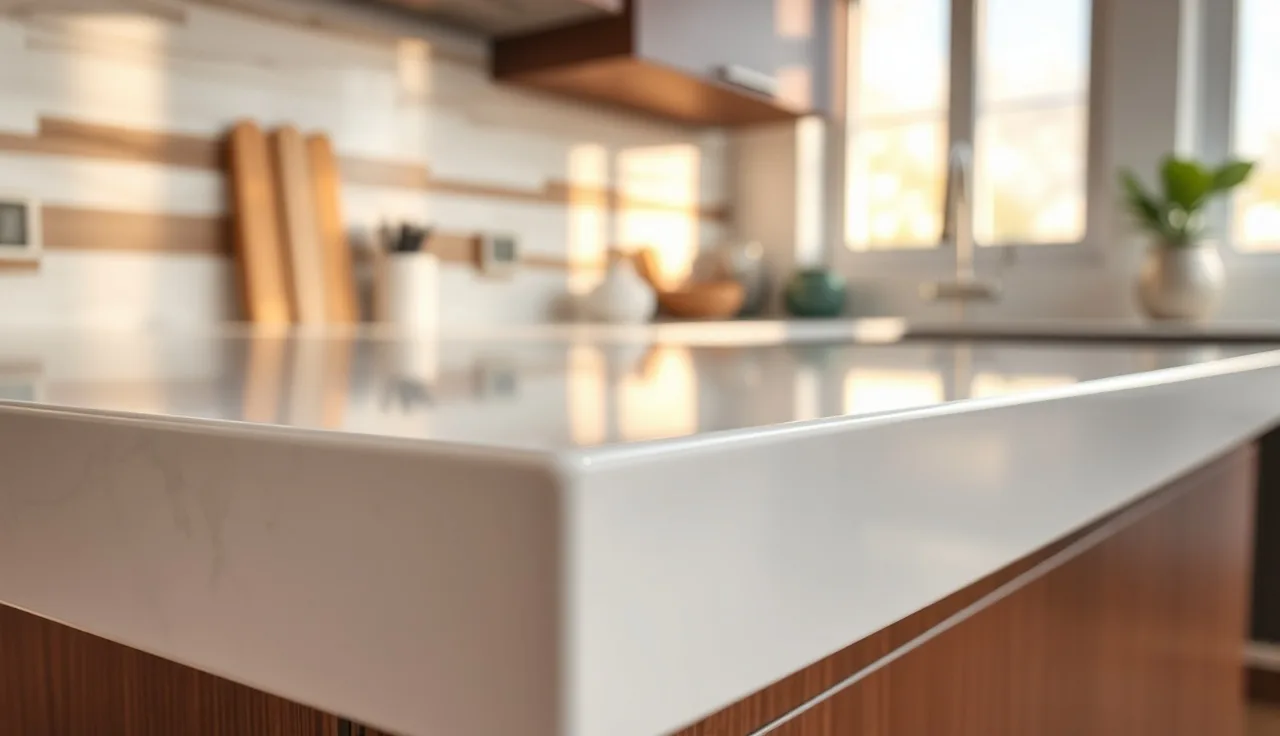
An eased edge keeps the top face and front face of the stone at a right angle to each other, then knocks off the two sharp corners just enough to stop chipping and kill the finger-cutting risk of a raw 90-degree edge. The corner break is small, usually 1/16 to 1/8 of an inch, done with a hand tool or a flat wheel on a CNC router. That's the whole thing.
It does not curve. No bullnose, no bevel, no step. Viewed from the side, the edge looks like a clean straight line. That simplicity is exactly why architects and designers spec it for modern kitchens: it reads as a hard, precise line, not a decorative molding. If you want the slab to feel like a slab instead of furniture, an eased edge gets you there.
People mix up the eased edge with its cousins. A square edge (sometimes called a straight edge) has the same geometry but no corner treatment at all, so the corners stay sharp and chip easily. A bevel grinds the top corner back at 45 degrees to a visible angle. "Broken edge" and "eased edge" get used interchangeably, though some shops mean an even lighter touch by "broken." Ask your fabricator to show you a sample piece instead of trusting the words. The names drift between shops.
How does an eased edge compare to other countertop edge profiles?
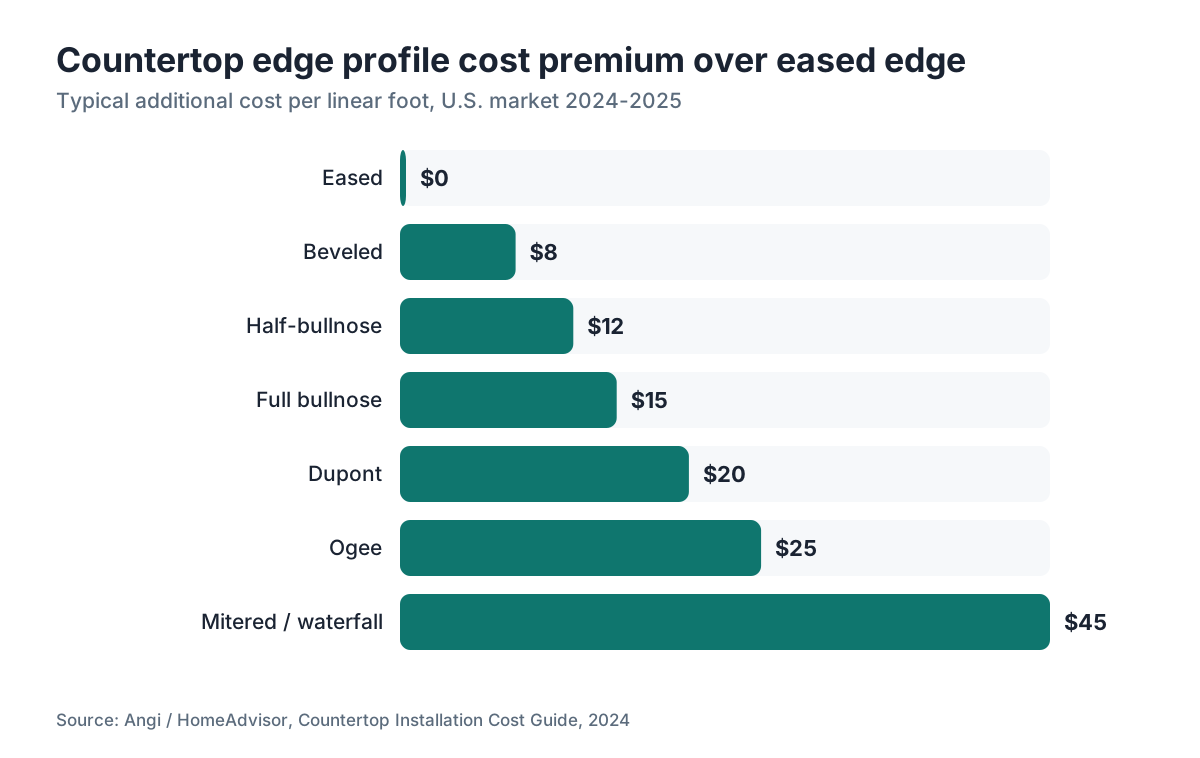
You'll run into roughly eight edge profiles across most fabrication shops. The table below shows how they differ on what homeowners and fabricators actually care about.
| Profile | Corner treatment | Relative cost (vs. eased) | Best material match | Visual weight |
|---|---|---|---|---|
| Eased | 1/16" corner break | Baseline ($0) | All materials | Light, minimal |
| Square / straight | None (sharp corners) | $0 to +$2 | Laminate, wood | Light, minimal |
| Beveled | 45° cut on top corner | +$5 to +$10 | Granite, quartz | Medium |
| Half-bullnose | Top corner fully rounded | +$8 to +$15 | Granite, marble | Medium |
| Full bullnose | Both corners rounded | +$10 to $20 | Granite, marble | Heavy, traditional |
| Ogee | S-curve profile | +$20 to $30 | Granite, marble | Heavy, ornate |
| Dupont | Flat-face with top curve | +$15 to $25 | Granite, quartz | Medium-heavy |
| Mitered | Two slabs joined at 45° | +$30 to $60+ | Quartz, porcelain | Very heavy, dramatic |
Prices above are per linear foot, typical U.S. market rates in 2024 to 2025. Actual quotes swing with material hardness, shop equipment, and local labor [1].
The eased edge sits at the cheap end because it takes the least machine time, not because it's inferior. A CNC router or edge polisher runs it in one pass. An ogee needs multiple passes with different wheels plus hand finishing. You're paying for labor, not for a better-looking kitchen. Whether the ogee actually looks better depends entirely on the style of the kitchen around it.
For quartz countertops, shops often default to an eased edge because the engineered material holds a crisp line and the contemporary kitchens that spec quartz want that clean geometry. Granite countertops see more variety, since traditional kitchens still ask for ogee and bullnose, and granite's natural movement reads well against a softer edge. Marble countertops can go either way, though a minimal eased edge on a Calacatta or Statuario slab usually looks better than a profile that fights the stone's own veining.
How much does an eased edge countertop cost?
Most fabricators include the eased edge in the base slab fabrication price, so you pay nothing extra. When a quote breaks out edge pricing, an eased edge runs $0 to $5 per linear foot depending on the shop and the material [1]. A full bullnose runs $10 to $20 per linear foot; an ogee runs $20 to $30. That gap is why budget projects and spec-home builders default to eased.
On a typical kitchen with 30 linear feet of exposed edge, choosing eased over an ogee saves $450 to $750. That might be trivial against a $6,000 slab job, or it might buy you a better sink. Good to know either way.
The bigger cost lever is the slab, not the edge. A 3 cm quartz slab runs roughly $50 to $120 per square foot installed depending on brand and region [2]. The edge profile is a rounding error next to that. If a fabricator quotes you a real premium for a plain eased edge, ask why before you sign, because that's unusual.
One place edge choice does move cost indirectly: waterfall islands. A waterfall (where the slab runs down the side of the island to the floor) almost always uses a mitered joint, not a standard eased profile. The miter is expensive no matter what edge you run everywhere else.
What materials work best with an eased edge?
An eased edge works on every countertop material, full stop. Some hold it better than others.
Quartz and porcelain are the best matches. Both are engineered or fired to precise dimensions, so the 90-degree geometry stays put. The edge doesn't chip easily on quartz, and the tight particle structure of porcelain gives you a clean, hard line.
Granite and quartzite hold an eased edge well in most cases. Denser, harder stones (Black Galaxy, Absolute Black granite) give the crispest result. More porous or fissured stones like some leathered granites or lower-grade quartzites can show small chips along the edge over years of use. Not a reason to avoid it. Just something to know.
Marble countertops with an eased edge look clean and sophisticated, but marble is soft (Mohs 3 to 4), so the corner break rounds out naturally with use [7]. That patina is either charming or annoying depending on your expectations.
Laminate countertops and Formica countertops almost always ship with a square or eased edge because the post-form manufacturing process defaults to it. You can get other profiles on custom laminate jobs, but the standard product is basically an eased edge.
Butcher block countertops look great with an eased edge. The wood's warmth pairs with the geometric simplicity, and you can sand and re-break the corner yourself if it chips.
Concrete countertops can be cast or ground to any profile, but an eased edge fits the material's industrial look. The edge forms in the mold, so it costs nothing extra.
Corian countertops and other solid surfaces get routed and sanded at the shop, and an eased edge is the baseline option. Any chip can be sanded out and buffed back to factory finish, so chipping matters less over the long haul.
Is an eased edge durable, and will it chip?
The corner break is the whole point of an eased edge from a durability angle. A truly square edge, with no corner treatment, creates a stress concentration right at the 90-degree corner. That's where chips start. The eased break spreads that stress across more surface and removes the thinnest, most fragile material. The result is noticeably more chip-resistant than a square edge.
An eased edge on a 2 cm slab is more vulnerable than the same profile on a 3 cm slab, simply because there's less material at the corner. If you're speccing thin stone (2 cm quartz or porcelain), ask about a laminated edge, where a strip of matching material gets added underneath to bring the visual thickness up to 3 cm or more. You get the thin slab's weight savings and a chunkier, tougher edge.
Daily durability is good. Running a pot against the edge of a 3 cm granite or quartz top with an eased profile won't chip it under normal use. Drop a cast-iron skillet on the corner and that's a different story, but no edge profile saves you there.
Sealing and maintenance don't change with the profile. An eased edge on granite still needs periodic sealing like any other edge. For keeping stone clean and sealed, see how to clean stone countertops.
How do fabricators cut an eased edge profile?
In most modern shops, an eased edge comes off a CNC router or a dedicated edge polisher in one pass with a flat wheel. The operator programs the corner break depth, the machine runs the profile, and the edge goes through a polish sequence (usually 50 grit through 3000 grit for granite or quartz, ending with a buff) [3]. Machine time per linear foot is a few minutes.
In smaller shops or for custom cuts, a fabricator can hand-break the corners with a 400-grit hand pad or a small angle grinder. It takes longer and produces the same result. The variable is consistency. A CNC machine holds a perfectly even corner break across 30 feet of edge; hand work varies slightly. For a minimalist kitchen where that edge is a visual line, CNC consistency matters. For a rustic natural-stone look, slight variation is fine.
The polishing sequence matters more than people think. A flat-polished eased edge on black granite reflects light sharply and looks nothing like the same profile with a honed or leathered finish. Same geometry, different character. If you're speccing an eased edge on a honed slab, make sure the edge gets the same honed finish instead of defaulting to a polish.
A note on the shop side: edge grinding generates respirable crystalline silica, and OSHA regulates exposure limits for every profile you cut [10]. Eased or ogee, the dust control requirement is the same.
Fabricators quoting complex layouts track linear feet of each edge type, because that sets labor time and tooling wear directly. Software like SlabWise calculates edge linear footage automatically from the template, so the quote matches the real job instead of a guess.
For shops on tight margins, the difference between quoting an eased edge and accidentally quoting a beveled edge can mean $150 to $400 in unbilled labor on a mid-size job. Getting the profile confirmed in writing before templating is basic job hygiene.
When should you choose an eased edge vs. a different profile?
Choose an eased edge when the design has clean geometry, flat-front cabinets, and you want the slab to speak for itself. If you spent money on a dramatic stone with bold veining, a busy ogee or bullnose fights the stone. The eased edge steps back and lets the slab be the feature.
Choose it when budget matters. There's no reason to pay $20 per linear foot extra for a profile that doesn't fit your design. That's real money that could go toward a better material or a better sink.
Don't choose it when the kitchen is traditional or transitional and the millwork around it has detail, curve, or period molding. A square eased edge next to heavily routed cabinet doors looks incomplete, not minimal. In those kitchens a half-bullnose or beveled edge reads as intentional. An eased edge reads as unfinished.
Think about thickness and visual weight too. A 3 cm eased edge on a long island looks substantial. A 2 cm eased edge with no laminated buildup can look thin to the point of seeming cheap, especially under tall ceilings with generous proportions. Laminate the edge to 4 or 5 cm if you want drama from a minimal profile.
Outdoor kitchens: an eased edge is fine, but seal the slab more aggressively regardless of profile, and pick a material rated for UV and freeze-thaw cycles. Profile has nothing to do with outdoor performance. Material does.
For kitchen countertops generally, the eased edge is the safe default for 2025 design, which has trended toward flat, minimal geometry for about a decade [6].
Does edge profile affect countertop resale value?
Nobody has good longitudinal data on this exact question. The closest relevant research is the National Association of Realtors 2024 Remodeling Impact Report, which tracks kitchen renovation ROI but doesn't isolate edge profiles [4]. What agents and appraisers say is that material (stone vs. laminate vs. solid surface) moves perceived value, while edge profile stays invisible to buyers unless it's strikingly wrong for the kitchen's style.
A fully ornate ogee edge in a 2025 new-construction kitchen can work against the sale, signaling a dated look to buyers who want contemporary finishes. An eased edge in the same kitchen reads as current. So in this market the eased edge is the safer resale choice, not because it's premium but because it doesn't date the room.
Here's the practical version: don't pick or reject an edge based on resale speculation. Pick it for how you'll live with it for ten years. If you hate cleaning crumbs out of a bullnose seam, don't install one. The eased edge wipes clean easily because there's no crevice at the top corner where debris collects.
One thing that does move resale: fabrication quality, regardless of profile. A chipped eased edge or an uneven line at the backsplash hurts a buyer's read of the kitchen more than any edge style choice.
What does an eased edge look like on an island vs. a perimeter countertop?
On a perimeter countertop against a wall, only the front edge and the short return edges at the ends of a run are visible. The eased edge reads as a clean horizontal line at roughly waist height. It sits quietly against the lower cabinets.
On an island you see all four edges. That's where the eased edge either works or feels underspecified. A large island in 3 cm quartz with an eased edge looks confident and architectural. The same island in 2 cm material with no edge lamination can look flimsy from the side.
Want the eased edge's minimal geometry on an island with more mass? Two moves work well. One: laminate the edge to build up to 4 or 5 cm. Two: run a mitered waterfall on the two island ends only, keeping the eased edge on the front and back runs. The miter costs money but turns the whole piece into a furniture-like object.
Bar overhangs are related. An overhang of 12 inches or more (typical for seating) leaves the underside of the slab visible to seated guests. An eased edge is fine here, but some designers add a small chamfer to the underside corner too, making both the top and bottom corners eased. Ask if that's an option. It's a small extra step and usually costs less than $2 per linear foot.
How do you specify an eased edge correctly when ordering?
When you get your fabrication quote, the edge profile should be written on the quote, more than discussed out loud. The line should read something like "eased edge, all exposed edges, 3 cm material," or spell out which runs get which treatment if you're mixing profiles (common on island overhangs vs. perimeter tops).
Ask to see a physical sample, not a photo. Photos of edge profiles vary wildly with lighting and angle, and what looks eased in a kitchen photo might be a half-bullnose in person. A 4-inch sample of your actual material with the actual profile is the only reliable reference.
Confirm the edge finish matches the face of the slab. Honed quartz top, honed edge. A mismatch between face finish and edge finish looks like a mistake, because it is one.
Note which edges you want treated. On a countertop that runs to a wall on both ends, those wall-abutting ends may need no treatment at all since they're hidden. On an island, all four are exposed. Make sure the quote reflects the actual exposed linear footage so you're not billed for edges that disappear inside cabinets.
If you run a shop, locking edge specs at template instead of at delivery kills the most common source of scope creep and revision requests. Shops that use quoting and templating software like SlabWise can attach the confirmed edge spec to the job file at template, so it flows through to shop drawings and CNC programming without a phone call or a sticky note.
Are there any downsides to an eased edge?
The honest ones:
It reads as basic in the wrong context. Put an eased edge in a kitchen with raised-panel cabinets, crown molding, and antique brass hardware and it looks like you ran out of budget, even if the stone cost a fortune. The profile isn't universally flattering. It needs the surrounding design to match its simplicity.
Second, the corner, even with the break, can still chip on harder impacts than a rounder profile would. A full bullnose has no corner to chip. An eased edge has a very small one. Over 20 years of heavy use you might see minor corner wear that wouldn't show on a bullnose. Irrelevant for most people. Worth knowing for a kitchen that will take real abuse.
Third, some cheaper shops use "eased edge" loosely and deliver something closer to a raw square edge with almost no break. If the material chips within six months, they can argue the profile was correct. The fix is simple: approve a sample before fabrication starts.
Those three aside, the eased edge is a genuinely good default for most kitchens. Inexpensive and simple doesn't mean inferior. It means it fits some kitchens and doesn't fit others.
Frequently asked questions
Is an eased edge the same as a square edge?
Not quite. A square edge has no corner treatment, leaving the full 90-degree corner intact. An eased edge breaks that corner by 1/16 to 1/8 inch, removing the sharpest, most chip-prone material. In practice many fabricators use the terms interchangeably, so ask to see a sample piece. The two look nearly identical up close, but the eased version is measurably more chip-resistant.
How much does an eased edge cost compared to a bullnose?
An eased edge is usually included in the base fabrication price or costs $0 to $5 per linear foot. A full bullnose runs $10 to $20 per linear foot extra. On a kitchen with 30 linear feet of exposed edge, that's a potential savings of $300 to $600 by choosing eased over bullnose. The actual gap depends on your shop's rates and the hardness of your stone.
Does an eased edge look good on quartz?
Yes, and it's probably the most popular profile for quartz in contemporary kitchens right now. Quartz holds the crisp 90-degree geometry cleanly, and its flat engineered look pairs well with the minimal eased edge. Most quartz manufacturers' marketing photos use an eased or similar simple profile because it photographs well and suits the modern kitchens where quartz shows up most.
Can an eased edge chip on granite?
It can chip on any material with enough force, but the corner break makes it more resistant than a true square edge. Dense granites like Absolute Black or Impala Black hold the corner very cleanly. More porous or coarse-grained granites are slightly more prone to edge wear over years. For granite, choosing 3 cm thickness rather than 2 cm reduces chip risk regardless of profile.
What is the difference between an eased edge and a beveled edge?
An eased edge breaks just the sharp corner with a tiny flat or soft relief, keeping the edge face essentially vertical. A beveled edge cuts the top corner back at 45 degrees to a visible angle, often 1/4 to 3/8 inch wide. The bevel is a decorative choice you can see across the room. The eased break is so small it's barely visible up close. Both are cheap, but they read very differently in a finished kitchen.
Does the edge profile affect how easy a countertop is to clean?
Yes, in small ways. An eased edge has minimal geometry, so there's nowhere for crumbs or grime to collect at the top corner. A bullnose has a curved surface that sheds water and debris well. Ogee profiles with their S-curve have a small crevice where the counter meets the edge, and that groove can trap debris. For cleaning, eased and bullnose are roughly equal and both beat an ogee.
Is an eased edge good for a bathroom vanity?
It works well. Bathroom vanities usually have less visual complexity than kitchens, so a minimal eased edge reads as clean and intentional. For a modern bathroom with undermount sinks and frameless mirrors, an eased edge fits naturally. For a traditional bathroom with furniture-style vanities and decorative hardware, a half-bullnose or beveled edge might look more intentional.
What thickness slab should I use with an eased edge?
A 3 cm slab gives the best visual result because the edge face has enough height to read as substantial. A 2 cm slab with a plain eased edge can look thin on an island or large countertop. The fix is to laminate a 3/4-inch strip of matching material underneath the 2 cm slab at the edge, bringing visual thickness up to roughly 4 to 5 cm. Most fabricators offer this as a standard option.
Can you change the edge profile on an existing countertop?
Yes, but it's a job for a professional. A fabricator can bring a portable edge polisher to your home and re-grind an existing eased edge to a bevel, half-bullnose, or similar. Going the other way, from bullnose to eased, removes material permanently and needs careful grinding. Both jobs are possible but involve working in your kitchen, with dust and water. Expect a shop visit fee plus per-linear-foot labor.
Does an eased edge work on laminate countertops?
Most stock laminate countertops come with a square or eased edge already, since post-form manufacturing produces that geometry naturally. On custom laminate work, a fabricator can route the edge to the same profile. The difference from stone: laminate's core is exposed at the edge, so you see the particleboard or MDF substrate unless it's covered with a matching edge band. An eased edge on laminate usually has that band applied.
Is an eased edge safe for households with small children?
It's safer than a truly square edge because the break removes the sharpest point. It's not as forgiving as a full bullnose, which has no corner at all. For households with toddlers at exactly counter-corner height, a bullnose or half-bullnose is the most protective choice. An eased edge isn't dangerous in a normal adult kitchen, but a full bullnose is the better call if children's head height and counter corners will overlap for several years.
How do I describe an eased edge to a fabricator so they know exactly what I want?
Say: 'I want an eased edge, 1/16-inch corner break, polished to match the face finish.' Then ask to approve a 4-inch sample of your actual material before they run the full job. Get the profile written on the quote with those words. If your fabricator uses CNC software, 'eased edge' is a standard named profile in most systems, so there's no ambiguity once it's in writing.
What is the most popular countertop edge profile in the U.S. right now?
The eased edge and the beveled edge are the two most commonly specified profiles in contemporary U.S. kitchen design as of the mid-2020s, with eased likely ahead thanks to the dominance of quartz and the continued pull of minimalist kitchen trends. The full bullnose was the default in the 1990s and early 2000s but has dropped off sharply as flat-front cabinetry took over. No major national survey isolates edge profile data specifically.
Sources
- Angi (formerly Angie's List / HomeAdvisor), Countertop Installation Cost Guide: Edge profile upgrade costs range from $5 to $30 per linear foot depending on profile complexity; eased edge is typically included in base fabrication price.
- Angi (formerly Angie's List / HomeAdvisor), Quartz Countertop Cost Guide: Installed quartz countertop costs range from roughly $50 to $120 per square foot depending on brand and region.
- Natural Stone Institute (formerly Marble Institute of America), Dimension Stone Design Manual and fabrication standards: Standard polishing sequences for stone edges run from coarse abrasives (about 50 grit) through fine (about 3000 grit) to buff, applied by CNC edge polishers or hand tools.
- National Association of Realtors, 2024 Remodeling Impact Report: Kitchen renovation ROI data tracks material upgrades broadly; edge profile is not isolated as an independent variable in resale value studies.
- U.S. Geological Survey, National Minerals Information Center, Dimension Stone statistics and information: Granite and marble are classified as dimension stone; production and import data support pricing context for the stone countertop market.
- National Kitchen and Bath Association (NKBA), Kitchen and Bath Market research: Minimalist and flat-front kitchen design continues to dominate U.S. kitchen specifications, supporting demand for simple edge profiles like eased and beveled.
- Natural Stone Institute, natural stone hardness and Mohs scale reference material: Marble rates Mohs 3 to 4 on the hardness scale, making it softer than granite (Mohs 6 to 7) and more prone to edge wear over time.
- ASTM International, ASTM C503 Standard Specification for Marble Dimension Stone: ASTM standards for dimension stone define physical property thresholds including abrasion resistance relevant to edge durability comparisons.
- U.S. Census Bureau, American Housing Survey: Kitchen remodeling frequency and material upgrade data provide context for countertop market size and consumer decision patterns.
- Occupational Safety and Health Administration (OSHA), Crystalline Silica in Construction: Stone fabrication including edge grinding generates respirable crystalline silica; OSHA regulates exposure limits relevant to shop operations for all edge profiles.
Last updated 2026-07-09