TL;DR
- Quartz engineered stone and granite are the most durable everyday kitchen countertops.
- Both score 6-7 on the Mohs hardness scale, resist scratches and heat reasonably well, and last decades with minimal upkeep.
- Quartzite and soapstone are strong natural-stone alternatives.
- Laminate and butcher block cost less but need more care.
- Material, thickness, and edge profile all affect longevity.
What makes a countertop actually durable?
Durability is not one thing. It breaks into four separate properties: scratch resistance, heat resistance, impact resistance, and resistance to staining or etching. A material can score well on three and fail badly on the fourth. Marble is hard enough to resist most scratches but etches visibly when acidic liquids hit it. Butcher block shrugs off impacts but soaks up water and bacteria if you skip the oil.
The most useful single measure of scratch resistance is the Mohs hardness scale, which ranks minerals from 1 (talc) to 10 (diamond). A standard steel kitchen knife sits around 5.5. Any countertop harder than that will not scratch from normal cutting. Quartz engineered stone and granite both land around 6 to 7 [1]. Marble sits at 3 to 4, which is why a fork dragged across it leaves a mark.
Heat resistance is a different property from hardness. Granite handles a hot pan better than engineered quartz does. The resins binding quartz particles can discolor or crack under sustained high heat, typically above 300 degrees Fahrenheit, though manufacturers' tolerances vary [2]. No countertop is truly pan-proof over time. A trivet is cheap insurance regardless of what you choose.
Impact resistance matters more than people think. Thick slabs (3 cm, or about 1.25 inches) handle corner bumps far better than 2 cm material. The substrate under the slab matters too. A solid, level cabinet box transfers less shock than one with warps or gaps. That detail shows up in countertop installation quality more than in material choice.
Staining and etching are chemical, not mechanical. Porous stones like unsealed marble and limestone absorb oils and wine into the surface. Etching happens when acid (citrus juice, vinegar, tomato sauce) reacts with calcium carbonate in the stone, leaving a dull spot that cannot be buffed out without re-polishing. Quartz, porcelain, and stainless steel do not etch. Soapstone does not etch either, which surprises most people.
How do the most popular countertop materials compare on durability?
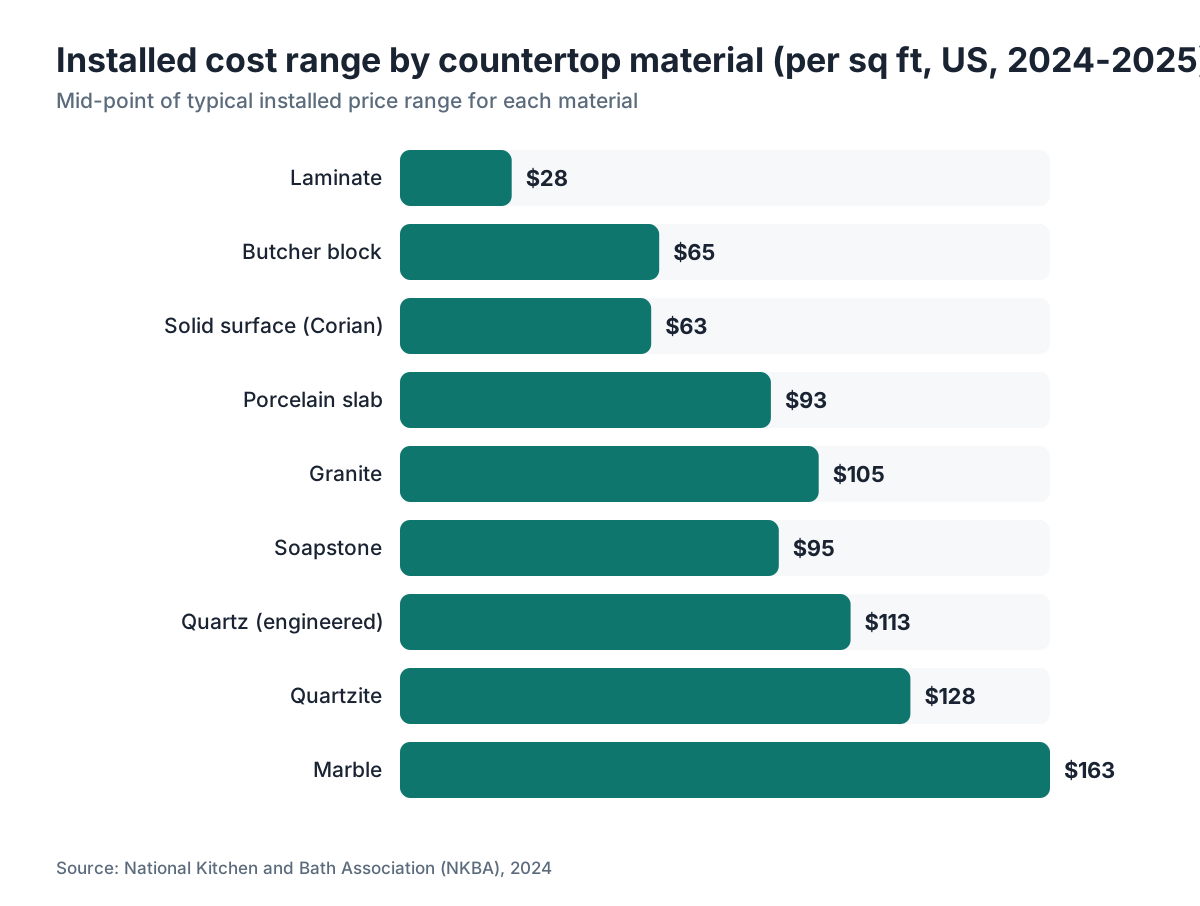
Here is a side-by-side comparison of the ten most common kitchen countertop materials on the factors that decide real-world longevity. Prices are installed averages in the U.S. as of 2024-2025, based on National Kitchen and Bath Association and industry survey data [3].
| Material | Mohs hardness | Scratch resist. | Heat resist. | Stain/etch resist. | Avg installed cost (per sq ft) | Typical lifespan |
|---|---|---|---|---|---|---|
| Quartz (engineered) | 6-7 | Excellent | Moderate | Excellent | $75-$150 | 25-50+ yrs |
| Granite | 6-7 | Excellent | Excellent | Good (sealed) | $60-$150 | Lifetime |
| Quartzite (natural) | 7+ | Excellent | Excellent | Good (sealed) | $80-$175 | Lifetime |
| Soapstone | 1-2 | Poor (soft) | Excellent | Excellent | $70-$120 | Lifetime |
| Marble | 3-4 | Fair | Good | Poor (etches) | $75-$250 | Lifetime (if maintained) |
| Porcelain slab | 7-8 | Excellent | Excellent | Excellent | $65-$120 | 25-50+ yrs |
| Concrete | 3-5 | Fair | Good | Poor (sealed helps) | $65-$135 | 20-30 yrs |
| Butcher block (wood) | 2-3 | Poor | Poor | Poor | $30-$100 | 20-50 yrs (if oiled) |
| Laminate | 3-4 | Fair | Poor | Good | $15-$40 | 10-20 yrs |
| Stainless steel | ~5.5 | Fair (scratches show) | Excellent | Excellent | $75-$150 | 30+ yrs |
A few things jump out. Porcelain slab scores the highest hardness of any countertop material at 7 to 8 Mohs, and it does not etch, stain, or burn. The trade-off is brittleness. Drop a cast-iron pan on a thin porcelain slab and you may crack it. Granite and quartzite are the only materials that are both very hard and very heat resistant without caveats. Soapstone's low hardness surprises people who have read glowing things about it online. It scratches easily, but those scratches sand out and the surface re-oils, which makes them a non-issue for some households.
Laminate gets underestimated. Modern laminate countertops and Formica countertops have improved a lot and can last 15 to 20 years in a kitchen that does not see heavy abuse. At $15 to $40 per square foot installed, that is a reasonable trade. What laminate cannot survive is prolonged water at seams, direct heat, or gouging.
Is quartz or granite more durable for everyday kitchen use?
They are about equal in scratch resistance, granite wins on heat, and quartz wins on stain resistance. That is the honest short answer to the question fabricators hear most.
Granite is a natural igneous rock. Its crystalline structure handles a hot pan straight from the oven without damage, which quartz cannot claim. Unsealed granite absorbs oil and dark liquids over time, but a good penetrating sealer applied once a year (or every two to three years with premium sealers) closes that gap substantially [4]. The granite countertops guide has the details.
Quartz engineered stone is roughly 90 to 95% ground quartz bound with polymer resins and pigments [2]. The resin is what makes it non-porous and stain-proof, and it is also what limits its heat tolerance. The non-porous surface means no sealing, no annual ritual, and no worrying about red wine sitting overnight. For households with kids, busy cooks, or owners who will never remember to seal anything, quartz is lower-maintenance.
Both materials come in 2 cm and 3 cm thicknesses. Go 3 cm if your budget allows. The slab is stiffer, more chip-resistant at edges, and does not need a plywood substrate the way 2 cm does. That alone extends effective lifespan.
One thing fabricators rarely advertise: quartz edge profiles chip more readily than granite because the resin bond at a thin edge is weaker than solid stone. Eased or slightly bullnosed edges chip less than sharp mitered edges on quartz. Granite can handle a sharper profile with less risk.
Which natural stone countertop holds up best over time?
Quartzite is the most durable natural stone in every mechanical sense. It is a metamorphic rock formed when sandstone goes through heat and pressure, and its interlocking grain structure gives it a Mohs hardness above 7. It does not etch from acids the way marble does, though it needs sealing to prevent staining. The how to clean quartzite countertops guide covers the maintenance.
The market confusion is real and worth naming. Many slabs sold as "quartzite" are actually soft marbles or dolomitic marbles that will etch. Ask your fabricator or stone yard for a simple acid test (a drop of muriatic acid on an inconspicuous spot). If it fizzes, it is calcite-based and will etch in your kitchen. True quartzite does not react.
Granite is the workhorse natural stone for kitchens, and for good reason. It has been installed in high-use kitchens for decades with documented longevity. Sealed properly, it handles oils, acids, and heat without visible degradation. Some slabs have more porous microstructure than others depending on the quarry and mineral makeup, so the generic advice to seal annually applies most to denser, darker granites with visible mica or quartz veining.
Soapstone is polarizing. Its softness (Mohs 1 to 2) means knives and rings scratch it freely, and over the years it develops a patina of fine scratches and nicks. Some owners love that look and compare it to a well-worn cast-iron pan. Others hate it. Soapstone does not etch, stain, or absorb bacteria, which makes it genuinely low-maintenance in the chemical sense. The how to clean soapstone countertops guide explains the mineral oil routine.
Marble is the most debated. Marble countertops are beautiful, and many homeowners accept etching and staining as part of the character. On pure durability, marble is a poor choice for a working kitchen unless you are comfortable with the maintenance or you prefer an aged, lived-in look. Honed finishes hide etches better than polished ones.
What is the most durable countertop for a kitchen that gets heavy use?
Heavy use means high cooking volume, frequent cutting near (or on) the surface, lots of liquids, and probably kids. The material that handles all of it without a maintenance regimen is porcelain slab.
Porcelain slab countertops fire at temperatures above 2000 degrees Fahrenheit, producing a surface harder than granite that does not stain, etch, scratch under normal use, or absorb bacteria [5]. It is UV-stable, so it does not yellow or fade. The weakness, as noted above, is that it can crack under a sharp point impact. Fabrication also demands diamond tooling and experienced hands because it is brittle to cut and drill. Costs run $65 to $120 per square foot installed, competitive with mid-grade granite.
Engineered quartz is the practical second choice for high-use kitchens. It is available everywhere, fabricators know exactly how to work it, and the non-porous surface is easy to clean. Use trivets for hot pans, skip cutting directly on the surface, and a quartz countertop will look the same in 20 years as on day one.
Stainless steel is worth a look for cooking-focused households. It is the material in professional kitchens for a reason: sanitary, heat-proof, and close to indestructible. It scratches (a patina develops over time), it shows fingerprints, and it does not look right in every design. But if you cook heavily, it works.
Fabricators who run estimating and job-management software like SlabWise can track which material and thickness combinations produce the fewest callbacks. The pattern in shops that measure this is consistent: callbacks on 2 cm quartz edge chips run meaningfully higher than on 3 cm slabs, which is exactly what the hardness and stiffness data predict.
How long do kitchen countertops actually last?
It depends heavily on material, installation quality, and how you use the surface. Well-installed, well-maintained stone slabs (granite, quartzite, marble) are effectively permanent. Homes with 50-year-old granite countertops exist. The stone itself does not degrade. The failure point is usually the substrate, the caulk, or an owner who wants a new kitchen.
Engineered quartz has a shorter track record simply because it went mainstream in the early 2000s. Most manufacturers' warranties run 10 to 15 years, though the material itself should last far longer under normal use [2]. The resins can yellow from prolonged direct UV exposure, worth thinking about for countertops near large south-facing windows.
Laminate is the honest outlier. It works fine for 10 to 20 years, then the substrate can swell at seams, the surface can chip or delaminate, and it looks dated. That is not a failure. That is appropriate expectation-setting.
Butcher block can last 50 years or longer if you oil it consistently (food-safe mineral oil or a butcher block conditioner, applied every few months when the wood looks dry or dull). Neglect it, and it dries, cracks, and becomes a bacterial harbor within a few years [10]. The butcher block countertops guide has the full picture.
Concrete countertops are beautiful but notoriously variable. Lifespan hangs almost entirely on the sealer and how often you reapply it [11]. A poorly sealed concrete countertop stains within months. With a quality epoxy or penetrating sealer kept up properly, 20 to 30 years is realistic.
The single biggest non-material factor in lifespan is installation quality. A slab that is not fully supported, or that sits over a cabinet box that racks (twists), will crack under localized stress over time. A 30-second visual and level check during countertop installation prevents years of premature failure.
Does countertop thickness affect durability?
Yes, a lot. The industry offers two thicknesses for stone slabs: 2 cm (about 0.75 inches) and 3 cm (about 1.25 inches). For most kitchens, 3 cm is worth the extra cost.
A 3 cm slab is roughly 40% thicker and proportionally stiffer. It resists cracking across the span between cabinet supports, handles impact at overhangs better, and can be cut with a wider range of edge profiles without structural risk. It also does not need a plywood buildup layer the way 2 cm slabs do for structural adequacy, though some fabricators add buildup anyway for the look.
The cost difference is real. 3 cm slabs cost more per square foot at the stone yard, and they weigh more, which adds handling and labor cost. Expect to pay roughly 10 to 20% more for 3 cm over 2 cm in the same material. That is usually money well spent on granite or quartzite. On laminate or engineered surfaces sold in pre-finished sheets, thickness works differently and the 2 cm versus 3 cm comparison does not apply.
Edge profiles affect durability too. Thin, sharp mitered edges (like a pencil edge) are beautiful but chip more easily than a standard eased edge or a full bullnose. On an island corner that sees daily traffic, an eased edge on 3 cm quartz will outlast a mitered pencil edge on 2 cm quartz by years.
What are the most durable countertop options for a tight budget?
Budget does not have to mean fragile. At the lower end of the cost range, laminate and porcelain tile are the two most durable options.
High-pressure laminate (sold under brand names including Formica countertops and others) resists stains and scratches reasonably well, does not etch, and costs $15 to $40 per square foot installed. Its weak point is seams and edges. Water that gets in at a seam swells the particleboard substrate. Keep seams tight and sealed, and laminate goes 15 to 20 years without complaint.
Solid-surface materials like Corian countertops land in the $45 to $80 per square foot range installed. They are repairable: scratches and minor burns sand out. They are non-porous and join without visible seams when fabricated correctly. They are not as hard as stone (Mohs 3 to 4), so cutting directly on them leaves marks, but that is true of laminate too.
Mid-range granite from remnant slabs is a genuine value. Many fabricators sell remnant pieces (leftovers from larger jobs) for $40 to $60 per square foot installed. You get lifetime granite durability at laminate-adjacent pricing if you stay flexible on color. Ask your local stone yard or fabricator directly.
Porcelain tile countertops (not the large-format slab kind) cost $20 to $40 per square foot installed, are extremely hard and stain-proof, and the only durability issue is grout maintenance. Epoxy grout largely removes that concern but costs more upfront.
For a full picture at every price point, the kitchen countertops guide covers the whole spectrum.
How does maintenance affect how long a countertop lasts?
Maintenance is where most countertop durability problems actually start. A granite slab that was never sealed, left wet constantly, and cleaned with bleach-based sprays will look worse at year 10 than a marble countertop that was sealed twice a year and wiped dry after every use.
Here is the maintenance hierarchy, lowest to highest effort:
- Quartz engineered stone: wipe with mild soap and water. Avoid prolonged exposure to harsh chemicals (paint remover, drain cleaner). That is essentially it.
- Porcelain slab: same as quartz. Almost nothing.
- Stainless steel: wipe with the grain using a damp cloth. Avoid steel wool.
- Sealed granite or quartzite: mild daily cleaning plus a sealer check once a year. Drop water on the surface; if it soaks in rather than beading, reseal. Most quality sealers last two to three years [4].
- Soapstone: mineral oil every few months when the surface looks dry or ashy. Optional, but it keeps the look consistent.
- Marble: seal twice a year minimum, use pH-neutral cleaners only, dry spills right away. The how to clean stone countertops guide has the specific protocols.
- Concrete: reseal on the manufacturer's schedule, typically once a year or more depending on sealer type.
- Butcher block: oil every few months with food-safe mineral oil. More often if the wood looks dry [10].
The products matter. Use a penetrating (impregnating) sealer for natural stone, not a topical coating. Topical sealers sit on the surface, peel, and trap moisture underneath. Penetrating sealers fill the pores of the stone and do not interfere with the surface finish [4].
Skip ammonia-based cleaners (Windex, many multi-surface sprays) on natural stone and quartz. They degrade sealer over time and can dull the finish. A few drops of dish soap in warm water is genuinely the best daily cleaner for most countertop surfaces.
Which countertop brands are most durable?
For natural stone, brand matters less than material and fabrication quality. Two slabs from the same quarry, one fabricated and installed well and one not, will perform very differently over a decade.
For engineered quartz, brand does matter because the resin formulation and quality control vary. Cambria countertops are made in the U.S. and carry a lifetime warranty against manufacturing defects, among the strongest in the category [6]. Silestone (made by Cosentino, Spain) and Caesarstone (Israel) have similar long market records. All three sit in the $80 to $150 per square foot installed range.
For solid surface, Corian (DuPont, now Corian Design) has the longest track record in the category, going back to its introduction in 1967. It is a known quantity: repairable, joined without visible seams, and durable enough for commercial use [7].
For laminate, Wilsonart and Formica are the two dominant brands. Both build to similar quality standards. The substrate (particleboard versus moisture-resistant MDF) matters more than the brand of the laminate face.
Here is the honest advice. Pick the right material for your use pattern, then let your fabricator's skill and reputation carry more weight than brand. A well-fabricated granite slab from a mid-tier brand will outperform a poorly installed Cambria quartz over any 20-year period. Get references, and look at jobs the shop did five or more years ago if you can.
What should you ask a fabricator before buying?
Most homeowners negotiate price and pick a color. The questions that actually decide durability are different.
Ask what thickness they recommend for your specific cabinet configuration and overhang. A 12-inch overhang on a thin slab needs a steel support bracket, and a good fabricator includes it without being asked. A mediocre one will not mention it.
Ask how they handle seams. Stone joints should be tight, color-matched with epoxy adhesive, and placed at structurally sound locations (away from sink cutout corners, where stress concentrates). Seam placement is both an aesthetic and a structural decision.
Ask what they use for sink cutout support on undermount sinks. The four corners of a rectangular sink cutout are stress concentration points. Proper clips and silicone bonding between the sink rim and the stone prevent cracking over years of thermal cycling and loading.
Ask about their warranty and callback policy. A shop that stands behind its work for at least one year will handle edge chips, cracking from installation errors, and seam failures. One that will not warranty labor is telling you something.
Shops that run their quoting and production on organized software (such as SlabWise's quoting platform, used by fabricators to track job details and material specs) tend to keep better records on job specifics, which matters if you need warranty service two years later. Still, the most useful thing you can do is talk to past customers directly.
For a full breakdown of what good installation looks like, the countertop installation guide walks through the process step by step.
Frequently asked questions
What is the most scratch-resistant kitchen countertop material?
Porcelain slab tops the list at Mohs 7 to 8, harder than a steel knife. Quartzite (natural, not to be confused with quartz engineered stone) follows at Mohs 7+. Engineered quartz and granite both sit at 6 to 7, hard enough to resist scratching under normal kitchen use. None of these surfaces are immune to diamond or carbide tools, but ordinary utensils will not mark them.
Can you put a hot pan on quartz countertops?
Briefly and occasionally, probably without visible damage. Sustained or repeated high heat, above roughly 300 degrees Fahrenheit, risks discoloring or cracking the polymer resins that bind quartz particles together. Most quartz manufacturers void the warranty for heat damage. Use a trivet or silicone pad. Granite, quartzite, soapstone, stainless steel, and porcelain slab all handle heat better than engineered quartz.
Is granite or quartz better for a kitchen with kids?
Quartz wins for kid-heavy kitchens. It is non-porous by default, so juice, food coloring, and washable marker wipe off cleanly without sealing. Granite is nearly as durable but needs annual sealing to keep its stain resistance. If you will reliably seal it, granite is an excellent choice. If you will not, quartz is more forgiving.
How often do granite countertops need to be sealed?
Most penetrating sealers for granite last one to three years depending on stone porosity and the product used. A simple water test tells you when: drop a tablespoon of water on the surface. If it beads, the sealer is working. If it soaks in and darkens the stone within a minute or two, reseal now. Premium sealers marketed for low-porosity granite can last up to five years.
What is the cheapest durable countertop option?
Granite remnants are the best value if you can find them locally. Fabricators often sell leftover pieces from larger jobs for $40 to $60 per square foot installed, giving you lifetime stone durability at near-laminate pricing. If remnants are not available, high-pressure laminate at $15 to $40 per square foot installed is genuinely durable for 15 to 20 years if seams stay dry. Avoid cutting directly on it and keep it away from standing water.
Does countertop color affect how durable it looks over time?
Lighter surfaces show stains more; darker surfaces show etching and water spots more on polished finishes. A mid-tone or variegated pattern (like most granites) hides both best. Honed or matte finishes on any material hide daily wear better than high-gloss polished finishes, though they can be harder to clean. This is an aesthetic durability question as much as a structural one.
What countertop material is easiest to repair if it chips or cracks?
Solid surface (like Corian) is the easiest. Scratches and chips sand and buff out by any fabricator, returning the surface to near-original condition. Butcher block sands and refinishes similarly. Engineered quartz and granite take color-matched epoxy in chips, which is serviceable but visible on close inspection. Porcelain slab chips are extremely difficult to repair invisibly because of the through-body color variation.
Is porcelain slab a good countertop choice for kitchens?
Yes, with caveats. Porcelain slab is the hardest common countertop material (Mohs 7 to 8), does not stain, etch, or absorb bacteria, and handles heat well. The risks are brittleness under sharp point impact and difficult fabrication, which means you need an experienced shop. Thin porcelain (6 mm) is more vulnerable than 12 to 20 mm. It costs $65 to $120 per square foot installed, comparable to mid-grade granite.
How do I know if a slab being sold as quartzite is really quartzite?
Ask for an acid test at the stone yard. Put a drop of diluted muriatic acid or white vinegar on an inconspicuous spot. True quartzite does not react. Marble and dolomitic marble (often mislabeled as quartzite) will fizz or bubble because they contain calcium carbonate that reacts with acid. The test takes 30 seconds and costs nothing. Many slabs sold under quartzite trade names are actually soft marbles that will etch in your kitchen.
What thickness of countertop slab should I choose?
Choose 3 cm (about 1.25 inches) if your budget allows. It is stiffer, more chip-resistant at edges, and does not need a plywood buildup layer. The extra cost is typically 10 to 20% over 2 cm in the same material. On overhangs longer than about 6 to 8 inches, 3 cm is strongly preferable and some fabricators require it. For laminate and solid-surface materials, the product sets the thickness and the comparison does not apply the same way.
Do white countertops stain more easily than darker ones?
On engineered quartz, no. Quartz is non-porous regardless of color, so white quartz stains exactly as easily as dark quartz (which is to say, barely). On natural stone, white and cream marbles etch visibly and can stain because most light-colored marbles are calcite-based. White granite is generally denser than white marble and stains less. White quartzite is durable but needs sealing. The material matters far more than the color.
What is the longest-lasting countertop overall?
Properly installed granite, quartzite, or soapstone countertops can last the lifetime of the house, measured in centuries in older European homes. Among engineered materials, porcelain slab has no known degradation mechanism under normal use. Engineered quartz is rated to 25 to 50+ years. Laminate and butcher block at 10 to 20 years are not failures; they have defined service lives. Stone is the answer if you want to never replace it.
Are concrete countertops durable enough for a kitchen?
With the right sealer and regular maintenance, yes. Without it, concrete countertops stain easily because the material is inherently porous. The sealer choice matters enormously: penetrating sealers and high-quality epoxy topcoats perform very differently. Concrete also cracks occasionally from thermal movement and substrate flex. Most fabricators mitigate this with steel fiber reinforcement and control joints. Expect to reseal at least annually and accept some hairline cracking as normal.
How does countertop edge profile choice affect durability?
Sharp edges chip more easily than rounded ones. A pencil edge or mitered edge on quartz is more vulnerable than an eased or bullnose edge, especially on islands and corners that see daily contact. On granite the difference is smaller because the material is stiffer, but the principle holds. If you have children, pets, or a high-traffic kitchen layout, specify an eased edge minimum. The cost difference between edge profiles is small next to the cost of an edge repair.
Sources
- U.S. Geological Survey, Mohs Hardness Scale: Granite and quartz rank 6-7 on the Mohs hardness scale; standard steel knives rank approximately 5.5
- Quartz countertop composition and heat tolerance, general industry specification; Marble Institute of America stone care reference: Engineered quartz is approximately 90-95% ground quartz bound with polymer resins; resins can discolor above sustained high heat
- National Kitchen and Bath Association, NKBA Cost vs. Value and Design Trends: Installed countertop cost ranges by material: quartz $75-$150/sq ft, granite $60-$150/sq ft, marble $75-$250/sq ft
- Marble Institute of America, Natural Stone Care and Maintenance Guide: Penetrating sealers should be used rather than topical coatings for natural stone; resealing frequency depends on porosity and product; water bead test indicates sealer effectiveness
- Tile Council of North America, ANSI A137.3 Standard for Gauged Porcelain Tiles and Panels: Porcelain slab is fired above 2000°F producing a surface with Mohs hardness of 7-8 that does not absorb liquids or etch from acids
- Cambria, Warranty Information: Cambria offers a lifetime warranty against manufacturing defects on its engineered quartz countertop products
- Corian Design, Product History and Technical Data: Corian solid surface material was introduced in 1967 and is used in commercial kitchen and healthcare applications
- U.S. Department of Energy, Energy Efficiency in Residential Buildings: Natural stone surfaces including granite conduct and dissipate heat without structural degradation; relevant to heat resistance of countertop materials
- NSF International, Food Equipment Standards (NSF/ANSI 51): Stainless steel and non-porous surfaces like porcelain meet NSF standards for food contact surfaces due to resistance to bacterial absorption
- Forest Products Laboratory, USDA Forest Service, Wood Handbook (Wood as an Engineering Material): Wood surfaces including butcher block require regular oil or finish maintenance to prevent moisture absorption, cracking, and bacterial harboring
- Building and Construction Technology, University of Massachusetts Amherst: Concrete is inherently porous and requires sealing; sealer type and maintenance frequency significantly affect stain resistance and service life
Last updated 2026-07-09