TL;DR
- Butcher block countertops hold up for 20 or more years if you pick a hard species, oil or seal them right, and keep standing water off the surface.
- Maple and oak score 1,000 to 1,450 on the Janka hardness scale.
- Wood dents easier than stone, but you can sand it flat and refinish it, which stone can't do.
- Moisture, heat, and neglect kill these counters, not normal cooking.
What does 'durable' actually mean for a wood countertop?
Durability means different things depending on the material. For granite or quartz, it's mostly about resisting scratches and cracks. For butcher block, it's about taking daily abuse, getting repaired when something goes wrong, and still looking good decades later. No wood countertop is scratch-proof or heat-proof. But the right one, finished correctly, outlasts a cheap laminate by 15 years and can outlive the kitchen itself if you resand and refinish it along the way.
Four variables decide how long a butcher block counter lasts: species hardness, grain orientation, finish type, and moisture management. Get all four right and you have a counter that handles a working kitchen. Miss one and you'll fight warping, staining, or cracking within a few years.
Wood is also repairable in a way that changes the whole math. A deep scratch in quartz means a call to the fabricator and an expensive fix or a full replacement. A deep gouge in butcher block means ten minutes with a belt sander and a fresh coat of oil. That repairability is a real durability advantage, and most buyers undervalue it when they compare materials.
How hard is butcher block compared to other countertop materials?
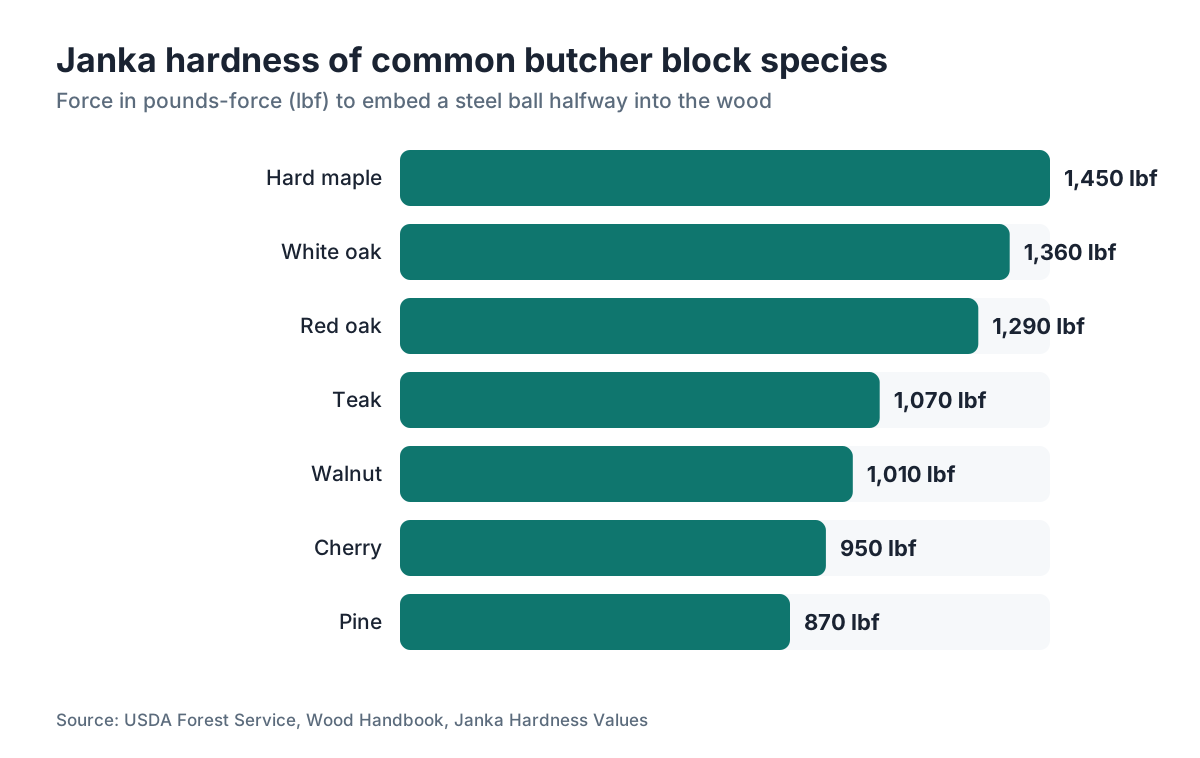
Wood hardness is measured by the Janka test, which records the force in pounds-force (lbf) needed to push a steel ball halfway into the wood. Higher numbers mean harder wood. The common butcher block species land in a useful range for kitchen work [1]:
| Species | Janka Hardness (lbf) | Notes |
|---|---|---|
| Maple (hard) | 1,450 | Industry standard for cutting boards and butcher blocks |
| White oak | 1,360 | Good durability, open grain holds finish well |
| Red oak | 1,290 | Common and affordable, slightly softer |
| Walnut | 1,010 | Softer but prized for appearance |
| Cherry | 950 | Softest of the popular choices; needs more care |
| Pine | 870 | Too soft for heavy countertop use |
| Teak | 1,000 to 1,155 | Oily grain resists moisture naturally |
Cherry butcher block sits near the bottom of that range, around 950 lbf. That doesn't make it fragile. It does mean cherry dents and scratches more visibly than maple. Plenty of homeowners pick cherry anyway, for the warm reddish tone and the way it deepens in color with age, and they accept that it needs a bit more attention than maple.
Stone gets rated on the Mohs scale instead of Janka. Granite typically scores 6 to 7 out of 10, which is extreme scratch resistance. Wood can't touch stone there. But stone can't be sanded flat and refinished, and that's the real tradeoff [2].
Want maximum hardness? Hard maple is the answer. Care more about looks and can commit to maintenance? Cherry and walnut are legitimate choices that have furnished kitchens for generations.
What finish type has the biggest effect on durability?
After species, the finish is the single biggest durability lever you control. There are two camps: film-forming finishes and penetrating oil finishes. They behave nothing alike and demand different maintenance habits.
Film-forming finishes (polyurethane, lacquer, conversion varnish) build a hard shell on top of the wood. That shell shrugs off water, stains, and light scratches beautifully, right up until it fails. When it chips, peels, or cracks, water sneaks under the film and the wood beneath can stain or swell. Fixing a film finish means sanding back to bare wood and starting over, which is more work than most homeowners expect [3].
Penetrating oil finishes (mineral oil, food-safe danish oil, tung oil, linseed oil) soak into the wood instead of sitting on top. They leave almost no surface build-up and they're genuinely food-safe once cured. The wood looks and feels natural. The catch: oils resist water less than a film finish and need reapplying on a schedule, usually every few months the first year, then once or twice a year after that. The USDA Forest Products Laboratory notes that properly finished wood surfaces stay stable for decades when they're kept away from standing water [3].
A third option many pros reach for is hardwax oil, which partly penetrates and leaves a thin protective layer. Rubio Monocoat is popular in the fabrication trade because it gives decent water resistance with easier spot repair than a full film finish.
Here's how I'd choose. For a counter used mostly as prep surface (not an actual cutting board), a film finish is defensible: better stain resistance, less frequent upkeep. Want the warm, tactile feel of real wood and willing to oil it? Go penetrating oil. The worst outcome is picking oil for the looks and then ignoring the maintenance schedule.
How does moisture damage butcher block, and how do you prevent it?
Moisture is the primary threat to any wood countertop. Wood is hygroscopic, which means it drinks in and releases water as humidity shifts. When one part of a counter absorbs water and another part doesn't, you get differential movement, and the wood warps, cracks, or splits along the grain. Standing water around a sink cutout is the most common failure point in butcher block installs [10].
The fix is sealing every exposed surface before installation, including the underside and the end grain. End grain is especially thirsty because the wood's tubular structure runs straight up through cut ends, pulling water in like a bundle of drinking straws. Good fabricators pile extra coats of finish or a dedicated end-grain sealer onto those edges. Skip this and you get a warped counter faster than any other way.
Around the sink, run a silicone bead along the perimeter of any cutout and replace it the moment it starts peeling. Dry the counter after use, especially in the first few months while the finish is still curing. Dishwasher steam is another sneaky moisture source if your butcher block sits close to the appliance.
Forest Products Laboratory research on wood dimensional stability notes that wood changes roughly 1% in width for every 4% change in moisture content across the grain [3]. Do the math on a 24-inch-wide counter and you get about 1/4 inch of seasonal movement in a home without humidity control. Plan for that in how the counter is mounted and where the seams fall.
Can you cut directly on butcher block countertops?
Yes. End-grain butcher block was built for exactly this. The fibers in an end-grain surface separate to let a blade pass, then spring back together, which is gentler on both the knife and the wood than edge-grain or face-grain cutting.
Cutting on the counter does open small gaps where bacteria can settle, though. Research on wood's antibacterial properties is real but often overstated. A study by Dean O. Cliver at UC Davis, published in the Journal of Food Protection, found wood surfaces can harbor and then kill bacteria in ways plastic boards do not, but that finding applies to clean, well-maintained wood, not neglected wood [4]. The USDA Food Safety and Inspection Service says to clean any cutting surface thoroughly after it touches raw meat, no matter the material [5].
Most homeowners with butcher block counters keep a separate portable board for raw meat and use the counter for bread, vegetables, and general prep. That habit keeps the counter looking good longer, because it corrals knife marks to one spot, and a removable board is far easier to sanitize.
One budget note: if you have an oil finish and cut on it often, plan on oiling more. Every knife mark breaks the surface and speeds up how fast the wood dries out.
How do butcher block countertops hold up around sinks?
The sink area is where most butcher block counters fail, and it's almost always moisture, not structure. Undermount sinks carry more risk than drop-in sinks because more cut wood edge sits exposed to splashing water. An undermount in butcher block is doable, but the installer has to seal every millimeter of that cutout edge before the sink goes in.
Many fabricators steer butcher block buyers toward a top-mount (drop-in) sink because the rim overlaps the cut edge and cuts down water exposure. It isn't the sleekest look. It buys you real years.
Some homeowners run butcher block on the island or the non-sink runs and pair it with quartz or granite for the sink section. That combination plays to each material's strengths. You can compare granite countertops or quartz options if you're pricing a mixed-material layout.
A fabricator who does a lot of butcher block should put marine-grade sealant on the underside of the sink cutout, more than on the top surface. If they skip the underside, ask why.
What is the expected lifespan of a butcher block countertop?
Well-maintained butcher block counters commonly last 20 to 30 years. Some survive an entire home renovation and get reinstalled in the new kitchen. What ends them is almost always neglect or a single moisture event (a flooded sink, years without oiling, a dishwasher leak), not normal wear.
Here's a realistic lifespan breakdown by care level:
| Care Level | Likely Lifespan | What Happens |
|---|---|---|
| Excellent (regular oiling, quick spill cleanup, annual inspection) | 25 to 40+ years | Surface stays smooth; refinishing restores it fully |
| Good (oil when it looks dry, normal cleaning) | 15 to 25 years | Some knife marks and staining, fixable by sanding |
| Neglect (rarely oiled, water sits at sink) | 3 to 8 years | Warping, cracking, black staining near sink |
Compare that to laminate countertops, which typically last 10 to 15 years before bubbling, chipping, or delaminating at the seams, and can't be refinished. Or marble countertops, which can last a lifetime but etch and stain in ways that are much harder to fix than wood.
Repairability is the X factor. A 15-year-old counter with surface damage can be belt-sanded, refinished, and look genuinely new. That reset is off the table with stone, laminate, or solid surface.
How much does butcher block countertop installation cost?
Butcher block is one of the cheaper countertop materials, which puts its durability per dollar near the top of the category. Standard edge-grain maple or oak typically runs $40 to $100 per square foot installed [6]. End-grain blocks, the most durable for cutting and the best-looking, cost more, often $80 to $200 per square foot installed because they take more labor to build.
Cherry butcher block lands in the middle to upper part of that range, usually $70 to $120 per square foot installed depending on your region and fabricator. Walnut tends to be the priciest domestic species, sometimes hitting $150 or more per square foot installed for quality end-grain slabs.
Quartz runs $75 to $150 per square foot installed for reference [7], so standard-grade butcher block is a meaningfully cheaper way in. Ongoing maintenance costs almost nothing: a bottle of mineral oil is about $10 at any grocery store.
If you build quotes for butcher block jobs, the costing structure differs enough from stone that it's worth tracking on its own. SlabWise's quoting tools let you set material-specific pricing and waste factors, which matters for end-grain work where offcut rates run higher than edge-grain.
See countertop installation for a fuller breakdown of labor and material cost ranges across countertop types.
How does butcher block compare to other countertop materials on durability?
Straight comparison, no hedging. Butcher block wins on repairability and warmth. It loses on scratch resistance and moisture resistance against stone and engineered surfaces. Here's how it stacks up [2][6][7]:
| Material | Scratch Resistance | Heat Resistance | Moisture Resistance | Repairability | Typical Lifespan |
|---|---|---|---|---|---|
| Hard maple butcher block | Moderate | Low | Moderate (with finish) | Excellent | 20 to 40 years |
| Cherry butcher block | Low-Moderate | Low | Moderate (with finish) | Excellent | 15 to 30 years |
| Granite | Very High | Very High | High (sealed) | Low | 25 to 50+ years |
| Quartz (engineered) | Very High | Moderate | Very High | Low | 20 to 30 years |
| Marble | Low (etches) | High | Low | Low | 20+ years if sealed |
| Laminate | Low | Low | Low | None | 10 to 15 years |
| Solid surface (Corian) | Moderate | Low | Very High | Good | 15 to 25 years |
The honest take: if your kitchen sees heavy use, lots of water, and you don't want a maintenance schedule, butcher block isn't your best pick. Go look at quartz or granite. If you love the look of wood, don't mind oiling it a few times a year, and like that you can fix most damage yourself, butcher block is hard to beat for the price. For broader material context, kitchen countertops covers the full field.
Cherry specifically pulls in buyers who want a warmer, more traditional look than maple and are fine treating the surface more gently. It is not a countertop for someone who slides cast iron around without a thought.
What are the most common mistakes that shorten butcher block lifespan?
A handful of mistakes account for most early failures:
-
Skipping the underside seal. The bottom of a butcher block counter pulls humidity from below, especially over a cabinet with plumbing, and that moisture has nowhere to go if the underside is bare. Seal all six faces, more than the top.
-
Parking a dish rack on the counter. The constant wet mat keeps moisture on the wood for hours. Use a rack with drainage, or better, put it somewhere else.
-
Setting hot pans on the surface. Wood doesn't move heat away the way stone does. A 400-degree cast iron skillet can scorch and discolor the finish in seconds. Always use a trivet.
-
Over-sanding. Homeowners who discover that sanding fixes damage can go overboard, sanding too often or too aggressively, thinning the counter and weakening it around sink cutouts where thickness matters.
-
Putting polyurethane over an oiled surface. Oil and film finishes don't get along. Oil left in the wood keeps polyurethane from bonding, and the finish peels within months. Pick one system and stay with it.
-
A bad seam near water. Any seam is a potential entry point for moisture. Seams near sinks need to be glued, clamped tight, and sealed on all edges before installation.
How do you maintain butcher block countertops to maximize their lifespan?
If you have an oil finish, the schedule looks like this: apply food-grade mineral oil or a dedicated butcher block oil (Howard Products, Boos Block, and similar) once a month for the first three months after installation. After that, oil whenever the surface looks dry or starts drinking water instead of beading it. For most homes, that's two to four times a year.
Apply the oil liberally, let it soak in for 20 to 30 minutes, then wipe off the excess. Leave it overnight before using the counter. If the wood swallows the oil right away and still looks dry, put on a second coat the same day.
For film finishes, upkeep is mostly cleaning with mild soap and water. Skip abrasive cleaners. When the finish shows wear, scuff-sand with 220-grit and lay down a fresh topcoat, or strip to bare wood for a full refinish every several years depending on use.
Daily cleaning on an oiled surface is just warm water and dish soap. Avoid bleach and ammonia cleaners, which dry out the wood and break down the finish. The USDA does recommend a diluted bleach solution (one tablespoon per gallon of water) for sanitizing after meat contact, then rinsing right away and drying thoroughly [5].
For deeper stone care logic you can borrow from, how to clean stone countertops covers what works and what doesn't on porous natural materials, some of which carries over to wood finishing.
Is butcher block a good investment for home resale value?
This is harder to pin down than industry sources sometimes imply. The National Association of Realtors publishes remodeling impact data, but it aggregates kitchen remodels rather than breaking out countertop materials [8]. The honest answer: butcher block reads as either warm and artisanal or dated and high-maintenance, depending on the buyer.
In a high-end kitchen with custom cabinetry, butcher block on an island can read as a premium, intentional choice. In a mid-range home surrounded by quartz-countered neighbors, some buyers see more work rather than more value.
What the data does support: minor kitchen remodels return about 85.7% at resale and major midrange kitchen remodels return about 41.8%, per Remodeling Magazine's 2023 Cost vs. Value report [9]. The cost gap between mid-grade butcher block and quartz is usually small next to the total remodel budget. So the material choice matters less to resale than the overall quality of the kitchen.
Renovating to sell soon? Go with what buyers in your market read as premium, usually quartz or granite. Renovating for yourself and planning to stay 10-plus years? Butcher block's longevity and repairability mean you get full value from it regardless of what it adds at resale.
Frequently asked questions
How long does butcher block last in a kitchen?
With regular oiling and proper sealing around the sink, butcher block countertops commonly last 20 to 40 years. The lifespan drops sharply if the counter is neglected or exposed to standing water. Because you can sand and refinish the surface, minor damage doesn't shorten the life the way it would with stone or laminate.
Is butcher block harder than granite?
No. Granite scores 6 to 7 on the Mohs hardness scale, which is extreme scratch resistance. Hard maple butcher block scores 1,450 on the Janka scale, but that measures compression, not abrasion. In practice, a knife or dropped key scratches wood far more easily than granite. Butcher block trades scratch resistance for repairability.
Can you put hot pans directly on butcher block countertops?
No. Heat is a real threat to butcher block. A hot pan can scorch the finish and discolor the wood in seconds. Always use a trivet or hot pad. Wood doesn't disperse heat the way stone does, and even a moderately warm pan left sitting can leave a ring in an oil-finished surface.
Are cherry butcher block countertops durable enough for a busy kitchen?
Cherry has a Janka hardness around 950 lbf, lower than maple at 1,450 lbf, so it dents and scratches more noticeably under heavy use. In a busy kitchen, cherry needs more attentive oiling and gentler treatment than maple or oak. Many homeowners choose cherry for the warm color and consider the extra care a fair tradeoff.
What type of butcher block is most durable, end-grain or edge-grain?
End-grain is generally more durable for cutting because knife blades slip between the wood fibers rather than cutting across them, and the surface self-heals somewhat. Edge-grain is more common for countertops, costs less, and is durable enough for general kitchen use. Face-grain is the least durable and the most prone to warping.
How often do you need to oil butcher block countertops?
For the first three months, oil monthly. After that, oil whenever the wood looks dry or stops beading water, which is typically two to four times per year for most homes. Film-finished butcher block (polyurethane) doesn't need oiling but needs periodic topcoat renewal. Never apply oil over a film finish; the two systems are incompatible.
Can butcher block countertops be used near a sink?
Yes, but the sink cutout edges must be sealed on every exposed face, including the underside, before installation. An undermount sink exposes more wood to splashing than a drop-in and needs more careful sealing and ongoing upkeep. Many fabricators recommend a drop-in sink for butcher block, or a separate material at the sink run, to reduce moisture risk.
Does butcher block scratch easily?
More easily than stone or engineered quartz, yes. Knives, utensils, and even heavy pots leave marks in wood. The upside: most surface scratches in oil-finished butcher block sand out by hand with 120 to 150-grit paper followed by fresh oil. That repairability is what keeps butcher block competitive on long-term durability despite lower hardness.
Is butcher block safe for food prep?
Yes. Oil-finished butcher block countertops are food-safe. The USDA recommends cleaning surfaces with mild soap and water after food contact and using a diluted bleach solution after raw meat, then rinsing and drying promptly. Research from UC Davis found wood surfaces can kill certain bacteria naturally, though that's no substitute for regular cleaning.
How does butcher block compare to laminate for durability?
Butcher block is meaningfully more durable than laminate over the long run. Laminate typically lasts 10 to 15 years before chipping, peeling, or delaminating, and it can't be repaired or refinished. Butcher block, maintained properly, can last 25 or more years and can be sanded back to like-new condition multiple times. Laminate wins on upfront cost; butcher block wins on long-term value.
Can you refinish butcher block countertops to fix damage?
Yes, and this is one of butcher block's biggest advantages. Surface scratches, stains, and worn finish sand out with a random-orbit or belt sander and refinish. Deep gouges usually come out with 80 to 100-grit paper followed by progressively finer grits. A full refinish restores the counter to essentially new condition, something no stone, engineered quartz, or laminate can match.
How much does butcher block countertop cost compared to quartz?
Standard edge-grain butcher block in maple or oak typically runs $40 to $100 per square foot installed. Quartz runs $75 to $150 per square foot installed. So at entry price points butcher block is cheaper, though premium end-grain slabs in walnut or cherry can reach $150 to $200 per square foot and overlap with quartz pricing.
What wood species is best for butcher block countertops?
Hard maple is the industry standard for maximum hardness at 1,450 lbf on the Janka scale and the most common choice in professional kitchens. White oak at 1,360 lbf is close behind with better moisture resistance thanks to its closed-grain structure. Walnut and cherry trade hardness for visual appeal. Avoid soft woods like pine for countertop use.
Do butcher block countertops add value to a home?
The evidence is mixed and depends on market and buyer preference. Minor kitchen remodels return about 85.7% at resale per Remodeling Magazine's 2023 Cost vs. Value data. Butcher block reads as premium in some markets (especially on islands) and as high-maintenance in others. If you're renovating to sell quickly, quartz or granite may be safer choices with broader buyer appeal.
Sources
- USDA Forest Service, Wood Handbook: Wood as an Engineering Material (Table 5-3, Janka Hardness Values): Janka hardness values for hard maple (1,450 lbf), white oak (1,360 lbf), red oak (1,290 lbf), walnut (1,010 lbf), and cherry (950 lbf)
- Natural Stone Institute (formerly Marble Institute of America), granite properties reference: Granite scores 6 to 7 on the Mohs hardness scale, translating to very high scratch resistance compared to wood surfaces
- USDA Forest Products Laboratory, Wood Handbook, Chapter on Finishing of Wood: Film-forming vs. penetrating oil finishes for wood, wood moisture movement (~1% width change per 4% moisture content change), and long-term stability guidance
- Cliver, D.O. et al., Journal of Food Protection, 1994, cutting board bacteria study, UC Davis: Wood surfaces can harbor and then kill bacteria in ways plastic boards do not; finding applies to clean, well-maintained surfaces
- USDA Food Safety and Inspection Service, safe food handling guidance: USDA recommends cleaning cutting surfaces thoroughly after raw meat contact; diluted bleach (1 tablespoon per gallon) for sanitizing, then rinse and dry promptly
- National Kitchen and Bath Association (NKBA), design and industry data: Butcher block countertops typically cost $40 to $100 per square foot installed for standard edge-grain hardwood; end-grain runs $80 to $200 per square foot installed
- Angi (formerly HomeAdvisor), countertop installation cost guide: Quartz countertops average $75 to $150 per square foot installed; cost varies by region and edge profile
- National Association of Realtors, Remodeling Impact Report: Kitchen remodel data aggregated by full project type; no species-level countertop breakdown available; report covers overall kitchen remodel ROI
- Remodeling Magazine, 2023 Cost vs. Value Report: Minor kitchen remodels return approximately 85.7% and major midrange kitchen remodels return approximately 41.8% on resale
- USDA Forest Products Laboratory, Wood Handbook, Chapter on Structure and Function of Wood: Wood is hygroscopic and absorbs/releases water as humidity changes; differential moisture absorption causes warping and cracking; end grain absorbs water faster than face or edge grain
Last updated 2026-07-09