TL;DR
- Dolomite marble countertops are natural stone slabs high in the mineral dolomite (CaMg(CO3)2), not pure calcite marble.
- They look almost identical to white Carrara or Calacatta but run harder and less reactive to mild acids.
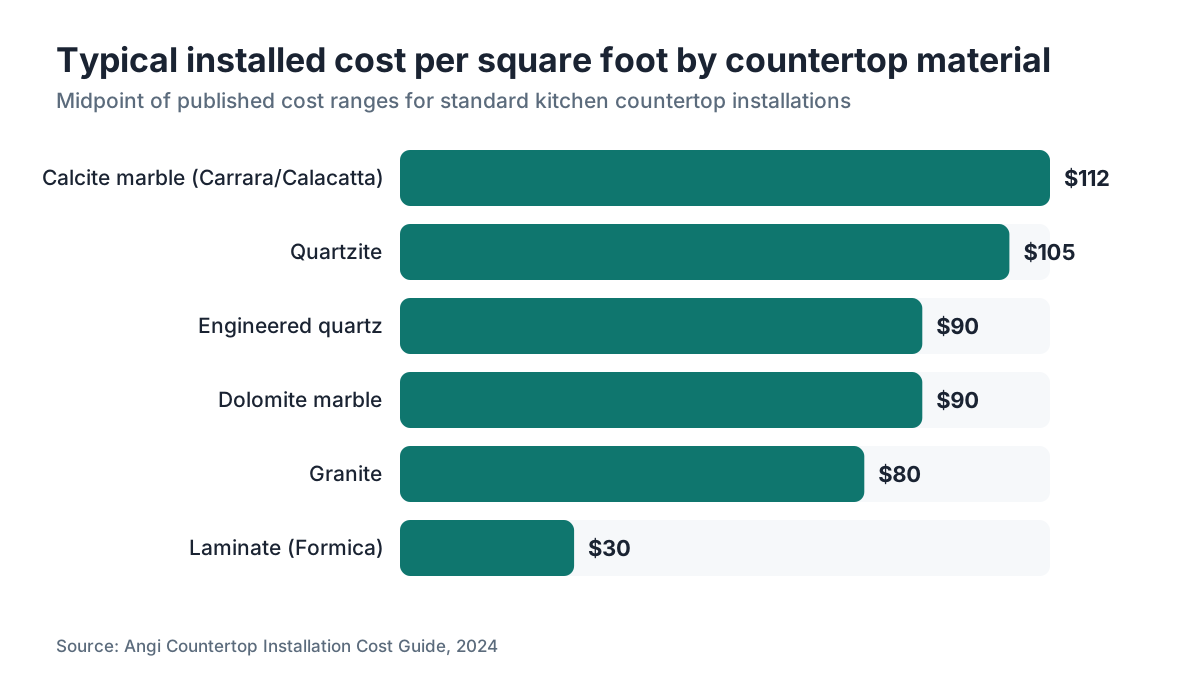
- Installed cost lands around $60 to $120 per square foot depending on slab grade and region.
- They still need sealing and they still etch, so they fit careful cooks better than busy family kitchens.
What exactly is dolomite, and is it really marble?
Dolomite is both a mineral (calcium magnesium carbonate, CaMg(CO3)2) and a sedimentary rock made mostly of that mineral [1]. The word does double duty in the stone trade, and that causes real confusion at the slab yard. What fabricators sell as 'dolomite marble' is usually a dolomitic limestone or dolostone that has gone through some low-to-moderate metamorphism, landing between a true limestone and full crystalline marble on the geologic spectrum.
True marble, by the strict geologic definition, is limestone or dolomite recrystallized under high heat and pressure. The stone sold as dolomite at showrooms often hasn't fully recrystallized, which is why geologists sometimes call it a 'proto-marble' or just dolostone. That distinction drives real behavior. The dolomite mineral has a Mohs hardness of 3.5 to 4, against calcite's 3, so a slab with more dolomite content runs marginally harder and dissolves more slowly in weak acids like lemon juice [1].
Stones sold under names like White Princess, Fantasy Brown, and Super White are often partly or largely dolomitic. Labs have tested 'Super White' slabs and found them ranging from nearly pure dolomite to blended carbonate compositions depending on the quarry lot, which is exactly why two slabs under the same trade name can behave differently on an acid test [2].
Want to know what you're actually buying? Ask the distributor for a petrographic report, or run a quick acid drip test on the back of the slab. A fast fizz with white vinegar means high calcite content. A slow or faint reaction points toward more dolomite.
How does dolomite compare to marble, quartzite, and quartz?
Dolomite sits between calcite marble and true quartzite, and it behaves closer to marble than to quartzite. Knowing where it lands saves you from a bad surprise after installation. It is not a stand-in for quartzite if acid resistance is your main goal.
| Stone | Primary mineral | Mohs hardness | Acid resistance | Scratch resistance | Typical installed cost |
|---|---|---|---|---|---|
| Calcite marble (Carrara) | Calcite | 3 | Poor | Low | $75, $150/sq ft |
| Dolomite marble | Dolomite | 3.5 to 4 | Fair | Low-moderate | $60, $120/sq ft |
| Quartzite | Quartz | 7 | Good | High | $70, $140/sq ft |
| Engineered quartz | Quartz + resin | 7 | Good | High | $55, $125/sq ft |
| Granite | Feldspar + quartz | 6 to 7 | Good | High | $50, $110/sq ft |
Lemon juice, wine, and tomato sauce will still etch an unsealed or lightly sealed dolomite surface. They just do it a bit more slowly than on Carrara [2].
Against engineered quartz like Cambria, dolomite gives you natural variation and a warmer, more three-dimensional look, but it asks for maintenance that quartz never does. Love the white-and-gray veined look and have the patience to seal once a year and wipe spills right away? Dolomite is a reasonable choice. If your household runs hard on countertops, engineered quartz or granite will give you similar neutrals with far less upkeep.
One edge dolomite has over standard calcite marble: it usually costs less per square foot for comparable visual quality. A showroom-grade White Princess dolomite slab often runs $10 to $25 per square foot under a comparable Calacatta marble slab at the same distributor.
What does dolomite marble actually cost?
Material and fabrication together run roughly $40 to $85 per square foot for dolomite slabs. Total installed cost lands between $60 and $120 per square foot once you add edge profiles, sink cutouts, and basic labor [3]. A standard kitchen with 30 square feet of counter area typically comes to $1,800 to $3,600 installed. The range is wide because slab grade, thickness (2 cm vs 3 cm), edge complexity, and local labor rates all pull the number around.
Slab-only cost at a distributor usually runs $15 to $40 per square foot for mid-grade dolomite. Premium book-matched or jumbo slabs can push $50 to $60 per square foot for the raw material alone. Fabrication adds another $25 to $45 per square foot depending on shop overhead, equipment, and region [3].
A few cost drivers worth knowing:
- Thickness: 3 cm slabs are the industry standard for countertops. They cost more than 2 cm but crack less during fabrication and under point loads.
- Edge profiles: a simple eased or beveled edge adds little. A mitered waterfall edge on an island can add $500 to $1,500 to the job.
- Cutouts: each undermount sink cutout typically runs $100 to $200. Cooktop cutouts are similar.
- Backsplash: tile-matching or a full-height stone backsplash adds roughly $20 to $50 per linear foot.
Fabricators running modern quoting and nesting software (SlabWise is one option) can cut material waste on premium slabs, which sometimes shows up as a lower quote on large or oddly shaped layouts.
For a side-by-side on every material, see our full breakdown of kitchen countertops costs.
How hard is dolomite, and will it scratch or chip?
Dolomite's Mohs hardness of 3.5 to 4 beats calcite marble at 3, but it's nowhere near granite's 6 to 7 or quartzite's 7 [1]. A serrated knife dragged across bare dolomite leaves a mark. Ceramic dishes, cast iron set down hard, and abrasive scrubbers all scratch the finish.
So use a cutting board every time. Don't slide pots across the surface. Keep trivets handy for hot cookware, not because dolomite is heat-sensitive (it handles heat better than engineered quartz resins do), but because thermal shock from a very hot pan can crack the surface near edges or thin spots in heavily veined slabs.
Chipping is the other worry. Dolomite's natural cleavage planes, especially along veins, create weak zones. Corners and sink cutouts are the most exposed. A 3 cm slab handles chips better than 2 cm, and a good fabricator orients the slab to keep the heaviest veining away from high-stress spots like the edge of an undermount sink.
Here's the honest summary. Dolomite is tougher than pure calcite marble, softer than granite or quartzite, and needs more care than any engineered surface. That's not a disqualifier. It's just the deal you're making.
Does dolomite etch, and how bad is the acid sensitivity?
Yes, dolomite etches. Etching is a chemical reaction where the carbonate mineral dissolves slightly on contact with acid, leaving a dull, lighter spot in a polished surface. It looks like a water stain but won't wipe off, because it's actual surface damage, not a deposit [7].
Dolomite etches more slowly than calcite marble, because the dolomite mineral is less soluble in dilute acids. White vinegar (acidity around pH 2.4) dripped on polished Carrara shows a visible etch within seconds. The same test on a high-dolomite slab like White Princess usually takes longer and leaves a fainter mark, though the effect swings by quarry lot as noted above [2].
The usual kitchen offenders: lemon juice, vinegar, wine, tomato sauce, citrus cleaners, and anything with citric acid. Coffee is mildly acidic (pH around 5) and can etch over time with heavy exposure. Even carbonated water (pH around 3.5 to 4) will etch if it sits.
The only permanent fix for deep etching is professional re-polishing, which typically costs $3 to $8 per square foot depending on severity and area [3]. Light surface etching sometimes fades with a hand-applied marble polishing powder, but polishing out true etch damage takes diamond-grit refinishing equipment.
Want etching to nearly disappear? Choose a honed finish instead of polished. A honed surface is already matte, so normal kitchen accidents don't read as damage. Plenty of designers spec honed dolomite for exactly this reason: the veining still shows beautifully, but the wear hides itself.
How often does dolomite marble need to be sealed?
Most installers say seal dolomite once a year. The honest answer is that frequency depends on the stone's porosity and how you use it [7]. Some denser dolomite slabs hold up fine on an 18 to 24 month schedule. Others, especially lighter, more porous lots, do better sealed every 8 to 12 months.
The water test is the simplest guide. Pour a tablespoon of water on the surface and wait 10 to 15 minutes. If the stone darkens where the water sat, it's absorbing moisture and needs sealing. If the water beads and the color stays put, the existing sealer is still doing its job.
Use penetrating (impregnating) sealers. They're the standard for natural stone countertops. They soak into the pore structure and repel water and oil without leaving a film on top that can peel or scratch. Topical sealers (wax-based or acrylic) are less durable for countertop use and can trap stains under them [7].
Sealing does not prevent etching. This is the single most misunderstood thing about carbonate stone. A sealed dolomite surface still etches on acid contact. The sealer only slows water and oil staining. Anyone who tells you a sealer makes dolomite etch-proof is wrong.
For technique, our guides on how to clean stone countertops and how to clean quartzite countertops cover products and methods that apply to dolomite too.
What are the best finishes for dolomite countertops?
Polished, honed, and leathered are the three finishes you'll see at most slab yards, and honed is the one I'd pick for a real kitchen.
Polished is the classic mirror-bright finish that shows off the depth and contrast of the veining. It's beautiful, but every etch and scratch stands out against the shine. Polished dolomite in a busy kitchen starts showing wear patterns within a few years unless you're diligent.
Honed is a matte to satin finish, made by stopping the polishing process before the mirror stage. It hides etching and minor scratches far better than polished. The tradeoff: honed surfaces are more porous than polished ones, so they stain from oils a little more readily and need sealing at least as often. Many kitchen designers prefer honed because it looks quietly intentional and ages well.
Leathered finish uses brushes with diamond-tipped bristles to make a slightly textured, low-sheen surface. It's less common on dolomite than on granite, but it suits earthy or warm-toned dolomite slabs. It hides fingerprints and minor damage, though the texture is harder to clean thoroughly.
For most people who love white veined stone and want to actually cook on it, honed keeps the look while hiding the daily evidence of use.
Is dolomite good for kitchen countertops specifically?
It depends entirely on how you cook and how much maintenance you'll really do. Dolomite works well where the counter is more workspace than acid-splashed prep station. It struggles where cooking is heavy and constant.
If your kitchen sees daily cooking with acidic ingredients, water splashing around the sink, and pots moving nonstop, dolomite will etch and wear faster than you'd like. Fabricators who've been at this a long time will tell you the most-regretted material they install is white calcite marble in homes with young kids. Dolomite is better, but it still belongs in that conversation.
On the flip side, dolomite does great in kitchens that get regular use without abuse. Bakers who work mostly with flour and dough (non-acidic) love the cool surface. Homeowners who keep a cutting board down and wipe spills fast often go years without real etching.
The sink area deserves special attention. Water and soap residue around an undermount sink is the zone that deteriorates fastest on any carbonate stone. A stainless or composite sink apron, or a drop-in sink that keeps water from pooling on the stone, helps a lot.
For bathroom vanities, dolomite is a strong pick. Acid exposure is minimal (toothpaste is mildly abrasive but rarely acidic enough to etch), and the visual payoff is high. Dolomite bathroom counters last beautifully with little more than occasional sealing.
For how dolomite stacks against every other option, our kitchen countertops guide covers the full material landscape.
How do you identify real dolomite vs. marble or quartzite at a slab yard?
Trade names in the stone business are unreliable. A slab labeled 'dolomite' at one distributor might be a true dolostone; the same slab at another yard might be a quartzite-carbonate blend. The names 'White Princess,' 'Super White,' and 'Fantasy Brown' have each been confirmed by independent testing to vary in composition from lot to lot [2].
Three practical tests for buyers:
-
Acid drip test: ask permission to put a small drop of white vinegar on the back of the slab. Fizzing (effervescence) means carbonate minerals (calcite or dolomite). No reaction suggests higher quartz or silicate content, pointing toward true quartzite. Slow or faint fizz fits dolomite. Fast, vigorous fizz points to calcite marble.
-
Scratch test: try to scratch the back of the slab with a metal key (Mohs around 5.5). If the stone scratches easily, it's soft enough to sit in the calcite-dolomite range. If it shrugs off the key, it's likely quartzite or another silicate. Not precise, but a quick sanity check.
-
Ask for documentation: reputable distributors can give you a country of origin (most commercial dolomite comes from Brazil, Italy, and Turkey) and sometimes a petrographic or XRF analysis. If the seller can't tell you the quarry, that's a yellow flag.
Why does this matter? You're paying for specific performance. A slab sold as quartzite that turns out to be calcite marble will etch badly, and you'll feel misled. A slab sold as dolomite that's actually quite quartzitic behaves better than expected, which is a pleasant surprise. Either way, knowing what you own beats finding out after installation.
What are the pros and cons of dolomite marble countertops?
The case for dolomite is real. It has natural depth and veining that engineered surfaces can't quite copy, it costs less than comparable calcite marble for the same look, and it's harder and more acid-resistant than Carrara or Calacatta. For homeowners who want natural stone and will actually maintain it, dolomite ranks among the better options in the white stone category.
The case against is real too. It will etch. It will scratch if you treat it carelessly. It needs annual sealing, and you have to actually do it. Composition varies by lot, so the slab you test at the yard doesn't always represent every slab in the bundle. And in a high-traffic household, the maintenance reality diverges hard from the showroom fantasy.
Pros:
- Better acid resistance than calcite marble
- Strong visual match to high-end Italian marble
- Usually cheaper than equivalent-looking calcite marble
- Natural material with unique veining in every slab
- Great for bathroom vanities and lower-acid rooms
- Honed finish ages gracefully
Cons:
- Still etches on acid contact, unlike granite or quartzite
- Needs annual sealing
- Scratches from metal and abrasives
- Composition varies between lots under the same trade name
- Professional re-polishing needed for real etch damage
- Higher long-term maintenance cost than engineered surfaces
If the maintenance feels like too much, the materials that genuinely behave better in demanding kitchens are quartzite (for a similar look), granite (for durability), or engineered quartz. The marble countertops article covers the broader calcite marble landscape if you want to compare dolomite to its closest natural relatives.
For fabricators building quotes on dolomite jobs, the swing in slab composition and the need for careful layout around veins and weak zones make accurate nesting worth the effort. A tool like SlabWise can model usable yield before you commit the material, which matters on a $40 to $60/sq ft slab.
How is dolomite fabricated, and what should you ask your fabricator?
Fabricating dolomite follows the same path as marble: CNC waterjet or bridge saw cutting, edge profiling with diamond tooling, then polishing or honing to the specified finish. The differences in shop handling come from dolomite's variable composition and its cleavage planes along veins.
Vein orientation matters during cutting. Cut heavily veined slabs so no undermount sink cutout or cooktop cutout runs parallel to a prominent vein, since that creates a stress concentration. A good fabricator lays out the cuts on a digital template before touching the slab.
During CNC cutting, the feed rates and water cooling settings that suit calcite marble generally suit dolomite, though harder dolomitic lots may wear diamond tooling faster. Shops that mostly cut granite or quartzite should reset their expectations for how quickly tooling dulls on softer carbonate stones.
For edge profiles, miter joints on waterfall edges need extra care, because carbonate stones don't hold a hairline miter as cleanly as quartzite. Expect a bit more fill and color-matching on carbonate miter joints.
Questions to ask your fabricator before signing:
- Have you worked with this specific trade name before? (composition varies by lot)
- What thickness slab are you specifying, and why?
- How will you orient the layout to protect the sink cutout from vein stress?
- Do you offer post-install sealing, or should I source and apply my own?
- What edge profile do you recommend for this material at this thickness?
For the countertop installation process from template through completion, that guide walks the sequence and what to watch at each stage.
How do you clean and maintain dolomite countertops day to day?
Daily cleaning is simple. Warm water and a few drops of pH-neutral dish soap on a soft cloth. Rinse, then dry. The drying matters, because hard water deposits build up fast on polished stone, look bad, and can trap minerals in micro-scratches.
Avoid these entirely: vinegar-based cleaners (sold as 'natural,' they etch carbonate stone on contact), citrus-based degreasers, bleach, abrasive pads, and anything with ammonia. The National Park Service and stone care industry both document that carbonate stones need acid-free products to avoid surface damage [10].
For spills, the rule is fast and dry. Blot, don't wipe. Wiping smears the acidic liquid over more surface. Blot with a paper towel, then rinse with damp neutral-soap water. That's the sequence.
For deeper cleaning, a stone-specific soap (like those from StoneTech or Miracle Sealants) works for weekly use. These are pH-balanced and won't strip the sealer or etch the stone.
Oil stains (cooking oil, butter, skin oils) are the other common headache. A poultice of baking soda and water left on the stain for 24 to 48 hours draws oil out of the pores on most natural stones [10]. For stubborn staining, commercial stone poultice products are sold by stone care suppliers.
The how to clean stone countertops guide has the full product list and methods. The principles that apply to quartzite and marble apply directly to dolomite.
Frequently asked questions
Is dolomite marble better than Carrara marble for kitchen countertops?
For kitchen use, yes. Dolomite has a real edge over Carrara. The dolomite mineral (Mohs 3.5 to 4) is harder and a little more acid-resistant than the calcite in Carrara (Mohs 3), so it etches more slowly from lemon juice, wine, and tomato sauce. It also usually costs less for comparable looks. Both still need sealing and careful use, so dolomite is better but not problem-free.
Does dolomite scratch easily?
Dolomite scratches more easily than granite or quartzite. At Mohs 3.5 to 4, a metal key, knife blade, or abrasive pad can mark it. Normal use with cutting boards and soft cloths keeps it looking good for years. The catch is that its scratch hardness is low enough that casual contact with metal cookware or dragged ceramics leaves marks.
What is the difference between dolomite and quartzite?
Quartzite is a metamorphic rock made almost entirely of quartz (Mohs 7), so it's very hard and genuinely acid-resistant. Dolomite is a carbonate rock (Mohs 3.5 to 4) that etches on acid contact. The two look similar as white-veined slabs, which is why mislabeling is common. If acid resistance matters to you, confirm composition with an acid drip test before you buy.
How long does dolomite marble last as a countertop?
With proper sealing and care, dolomite countertops can last the lifetime of the kitchen. The stone itself does not degrade. What changes is the surface finish: etching and scratching accumulate over years. Professional re-polishing restores the surface to near-original condition for roughly $3 to $8 per square foot. Honed finishes hide this wear far better than polished.
What sealers work best for dolomite countertops?
Penetrating (impregnating) sealers are the right choice. Products from brands like StoneTech, Miracle Sealants, and Dry-Treat soak into the stone's pore structure to repel water and oil without forming a surface film that can peel. Apply per package directions, let it absorb, buff off the excess. Re-seal when the water bead test shows absorption, typically every 12 to 18 months.
Is White Princess dolomite or quartzite?
White Princess is sold under both labels depending on the distributor, and lab testing confirms it varies in composition between quarry lots. Some slabs are mostly dolomitic carbonate; others lean quartzitic. The only reliable way to know what you're buying is the acid drip test: vigorous fizz means carbonate (dolomite or calcite); no reaction means quartzite or another silicate.
Can dolomite countertops be used in a bathroom?
Dolomite is a great bathroom vanity material. Acid exposure in bathrooms is minimal next to kitchens (toothpaste, soap, and water are low-acid or neutral), and the visual payoff is high. Maintenance drops significantly in a bathroom. Annual sealing and neutral-soap cleaning is all most bathroom dolomite counters need.
How do I remove etch marks from dolomite marble?
Light surface etching sometimes fades with a marble polishing powder applied by hand with a soft cloth in small circular motions. Deeper or wider etches need professional refinishing with diamond-grit equipment, typically $3 to $8 per square foot. Choosing a honed finish makes etches nearly invisible in the first place, which is the simpler long-term strategy.
Does dolomite marble need to be sealed before installation?
Yes, or right after installation before use. Applying the first coat of penetrating sealer while the slab is still on sawhorses gives you easy full-surface access. Some fabricators include post-install sealing; ask when getting quotes. Either way, don't start using the countertop until it's been sealed, especially around the sink cutout.
What countertop material looks like marble but requires less maintenance?
Engineered quartz (like Cambria or Silestone) closely mimics white-veined marble without any etching or sealing needs. True quartzite is another natural option that looks similar but is far harder and acid-resistant. Both are more practical than dolomite for high-traffic kitchens. The tradeoff with engineered quartz is that the look, while very good, lacks the natural depth of real stone.
How much does dolomite marble cost compared to regular marble?
Dolomite typically costs $10 to $25 per square foot less than comparable calcite marble (Calacatta, high-grade Carrara) at the same distributor for similar looks. Total installed cost for dolomite runs $60 to $120 per square foot versus $75 to $150 for premium calcite marble. The savings come partly from sourcing: much dolomite supply comes from Brazil and Turkey, while top Italian marble commands a provenance premium.
Is dolomite heat-resistant enough for kitchen use?
Dolomite handles normal kitchen heat reasonably well. Unlike engineered quartz resins, which can scorch or discolor above roughly 300 degrees F, dolomite mineral itself doesn't melt or discolor from a hot pan. That said, thermal shock from a very hot cast iron pan on cold stone can crack the surface near edges or veins, so trivets remain smart practice for any natural stone.
Where does most commercial dolomite stone come from?
Most commercial dolomite slabs sold in the U.S. come from Brazil, Italy, and Turkey, with Brazilian quarries supplying the largest volume of white dolomitic material under trade names like White Princess and Super White. Italian dolomite from the Dolomite mountain range (which gave the mineral its name) is also available but commands a premium. Turkish quarries supply a good share of mid-range gray-toned dolomitic slabs.
Sources
- USGS Mineral Resources Program, Dolomite mineral data: Dolomite mineral (CaMg(CO3)2) has a Mohs hardness of 3.5 to 4, harder than calcite at Mohs 3; dolomite rock (dolostone) is a sedimentary rock composed primarily of the mineral dolomite
- Natural Stone Institute, Technical Bulletin on Stone Identification: Trade-named slabs including Super White and White Princess have been shown through testing to vary in mineral composition between quarry lots, ranging from predominantly carbonate to mixed quartzite-carbonate assemblages
- Angi, Countertop Installation Cost Guide 2024: Dolomite and natural stone countertop installed costs range from approximately $60, $120 per square foot; fabrication adds roughly $25, $45 per square foot to raw slab cost; re-polishing runs $3, $8 per square foot
- Natural Stone Institute, ANSI/NSI 373 Sustainable Natural Stone Standard: Industry standards for natural stone fabrication and installation including thickness specifications (2 cm and 3 cm) and edge profiling requirements
- Natural Stone Institute (formerly Marble Institute of America), Stone Care and Maintenance Guidelines: Penetrating impregnating sealers are recommended for natural stone countertops; honed finishes reduce the visual impact of etching compared to polished finishes; annual sealing schedule is standard guidance
- USGS Minerals Information, Quartz Mohs Hardness Reference: Quartz has a Mohs hardness of 7; quartzite composed primarily of quartz is significantly harder and more acid-resistant than carbonate stones including calcite marble and dolomite
- Cornell University Cooperative Extension, Cleaning and Maintaining Natural Stone: pH-neutral cleaners are recommended for natural stone surfaces; acidic household cleaners including vinegar-based products cause surface etching on carbonate stones and should be avoided
- National Park Service, Preservation Brief 45: Removing Stains and Cleaning Stone Buildings: Poultice methods using absorbent materials are effective for drawing oil-based stains from porous natural stone; carbonate stones require acid-free cleaning products to avoid surface damage
Last updated 2026-07-09