TL;DR
- Marble countertops run $40 to $200 or more per square foot installed, with most kitchen projects landing between $1,800 and $5,500 total.
- Entry-level tiles and remnants sit at the low end.
- Premium book-matched Calacatta slabs push well past $200 per square foot.
- Material grade, thickness, edge work, and your region move the price more than most homeowners expect.
What does marble cost per square foot in 2025?
Marble runs $40 to $200 or more per square foot installed. Where you land inside that band depends on grade, origin, and what your fabricator charges locally. That spread frustrates people, so here is how to think about it.
Material alone (the slab, not installed) runs roughly $20 to $100+ per square foot at most stone yards [1]. Fabrication and installation add another $20 to $80 per square foot on top of that, covering cutting, edge profiling, polishing, transport, and setting. A basic Carrara with an eased edge in a mid-size market lands around $55 to $75 per square foot installed. A premium Calacatta Oro or Statuario with mitered waterfall edges in a high-cost metro can clear $250 per square foot before you blink.
Nobody has a clean national average pulled from one dataset here. The closest reliable benchmark comes from the National Kitchen and Bath Association, which surveys member designers and fabricators annually and finds natural stone countertops averaging $70 to $100 per square foot installed across reported projects [2]. Marble skews toward the upper half of that band.
For a typical 40-square-foot kitchen (standard island plus perimeter), that puts total project cost at:
| Project scope | Est. installed cost |
|---|---|
| Small kitchen, ~30 sq ft, builder-grade Carrara | $1,500, $2,400 |
| Average kitchen, ~40 sq ft, mid-grade Carrara/Calacatta | $2,400, $4,200 |
| Large kitchen, ~60 sq ft, premium white marble | $5,000, $10,000+ |
| Luxury project, book-matched Calacatta, complex edges | $12,000, $25,000+ |
Those are real-world ranges, not aspirational ones.
How does marble type affect price?
Marble is not one thing. It is a family of metamorphic limestone varieties quarried on several continents, and the stone you pick is the single biggest driver of material cost.
Carrara is the workhorse. It comes from the Apuan Alps in Tuscany, has been quarried for thousands of years, and its gray-white field with soft feathered veining is what most people picture when they hear "marble." Quarry output is high and supply is fairly stable, so Carrara is the most affordable Italian marble, typically $20 to $50 per square foot at the slab yard [1]. That does not make it cheap. It makes it the entry point.
Calacatta comes from the same mountain range but from a smaller set of higher-altitude quarries. The white is brighter, the veining is bolder, and the stone is genuinely scarcer. Slab prices run $80 to $200+ per square foot depending on the lot and how desirable the vein pattern is. Calacatta Gold and Calacatta Borghini sit at the top.
Statuario reads as a middle child between Carrara and Calacatta, but it commands Calacatta-level prices because supply is limited. Its crisp white background with fine gray veining has been prized for sculpture since antiquity.
Crema Marfil comes from Spain, not Italy, and has a warmer beige palette. It is durable for marble, widely available, and typically priced $25 to $60 per square foot at the yard.
Pentelic (Greek), Thassos (Greek white island marble), and Arabescato round out the common imports. Domestic marble from Vermont (Vermont Danby) or Georgia is underrated, often priced $25 to $50 per square foot, and quarry-to-shop lead times are shorter than for imported Italian stone [10].
The table below shows typical slab yard prices (material only, not fabricated or installed):
| Marble type | Origin | Slab material cost (per sq ft) |
|---|---|---|
| Carrara | Italy | $20, $50 |
| Vermont Danby | USA | $25, $55 |
| Crema Marfil | Spain | $25, $60 |
| Arabescato | Italy | $45, $90 |
| Calacatta | Italy | $80, $200+ |
| Statuario | Italy | $90, $200+ |
| Thassos | Greece | $60, $130 |
Prices move with exchange rates, shipping costs, import duties, and lot-to-lot variability. Marble and travertine slabs enter the U.S. under HTS heading 6802 and carry standard import duties that show up in landed cost [11]. Always price the actual slabs you are considering, not a category.
What drives fabrication and installation costs?
Once you pick the stone, fabrication is where the bill gets itemized. Most fabricators quote a base per-square-foot rate that covers templating, cutting, and one standard edge (eased or bevel). Everything past that adds line items.
Edge profiles are the most visible upsell. An eased edge is a barely softened 90-degree corner and costs nothing extra at most shops. A pencil or beveled edge runs $10 to $20 per linear foot. An ogee or dupont profile runs $20 to $40 per linear foot. A full laminated mitered edge (two pieces of stone joined at 45 degrees to fake a thick waterfall look from a standard 3/4-inch slab) can cost $50 to $100 per linear foot in labor alone.
Thickness matters too. The North American standard is 3/4 inch (2 cm). Two-centimeter slabs are lighter, cheaper to ship, and need a plywood substrate for support. Three-centimeter slabs are heavier, self-supporting across most overhangs, and increasingly the default for kitchens. Expect to pay $5 to $15 more per square foot for 3CM over 2CM material.
Cutouts for sinks and cooktops each add $50 to $200 depending on complexity. A farmhouse apron sink cutout in marble takes very precise work to avoid cracking and often runs $150 to $250. Seams add $50 to $150 each. A square kitchen may need none. An L-shape with an island could need two or three.
Removal of old countertops is sometimes bundled, often billed separately at $100 to $400. Delivery and setting fees vary by region. Many shops fold them in above a project minimum. Others charge $150 to $350 flat.
Regional labor rates swing the number hard. The same Carrara slab installed in rural Tennessee might cost $55 per square foot all-in. The same job in San Francisco or New York often clears $90 to $120 per square foot, purely because shop overhead and labor rates run higher.
For a clean comparison of how marble stacks up against other natural and engineered surfaces, see kitchen countertops and the granite countertops guide.
Is marble more expensive than granite or quartz?
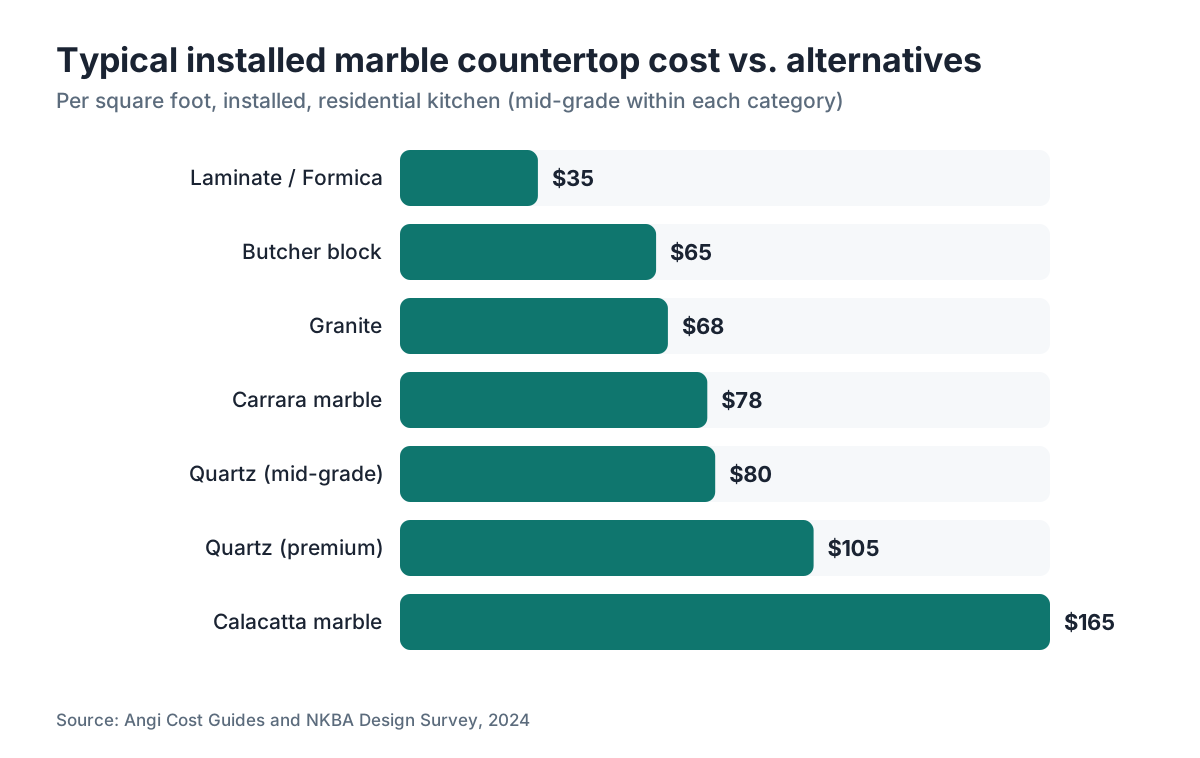
Usually, yes. Marble sits above granite in most cases and above mid-tier quartz, though premium quartz brands overlap with entry marble.
Granite for a standard kitchen typically runs $45 to $90 per square foot installed, depending on color rarity and origin [3]. Mid-grade Carrara overlaps with premium granite. Move up to Calacatta and marble leaves granite behind.
Engineered quartz (Silestone, MSI Q Premium, Cambria) runs $60 to $120 per square foot installed for most residential projects [4]. Cambria countertops, made in the USA and backed by a lifetime warranty, land at the premium end of that quartz band. High-end marble still costs more, but the gap narrows once you count quartz's lower maintenance burden.
Laminate and Formica sit at $20 to $50 installed. Corian and solid surface run $45 to $80. Butcher block lands at $35 to $100 depending on species and thickness.
| Surface | Typical installed cost (per sq ft) |
|---|---|
| Laminate / Formica | $20, $50 |
| Butcher block | $35, $100 |
| Granite | $45, $90 |
| Quartz (mid-grade) | $60, $100 |
| Carrara marble | $55, $100 |
| Quartz (premium) | $90, $120 |
| Calacatta marble | $100, $250+ |
For full surface comparisons, laminate countertops and formica countertops break down the budget end of the market, and corian countertops covers solid surface options.
How much does a marble bathroom vanity top cost compared to a kitchen?
A marble vanity top costs less in total dollars than a kitchen because it is smaller, but the per-square-foot rate is often the same or higher. Fabricators carry fixed costs for templating and delivery that do not shrink with the job. A 24-inch single vanity might use only 6 square feet of stone, but the shop still drives out, templates, cuts, and returns to install.
Expect $400 to $900 for a standard 24-to-36-inch single vanity in Carrara, installed, including one undermount sink cutout. A double vanity at 60 to 72 inches runs $700 to $1,800. Premium stones or vessel sink cutouts add $100 to $300 more.
Many shops set a project minimum, often $500 to $800. If your vanity falls below that threshold, you pay the minimum anyway. That is the moment to look at prefabricated tops from a big-box store. Home Depot and Lowe's carry Carrara cultured-marble and genuine marble vanity tops from $150 to $600 in standard sizes, drop-in only.
Bathroom floors and shower surrounds in marble are priced differently. They go by the square foot as tile, not slab, and floor tile installation labor runs $8 to $20 per square foot on top of material.
What factors make marble countertop quotes vary so much?
You can get two quotes for the same kitchen that differ by 40 percent, and both can be legitimate. Here is what is actually different underneath the number.
Slab selection and yield. A fabricator who pulls your layout from a single slab with good yield has less waste cost to cover. One who has to open a second slab to finish your kitchen charges for that waste. Ask whether the quote assumes a specific slab or a category.
Fabricator overhead. A two-person shop with a used bridge saw carries lower overhead than a full-service shop with CNC equipment, a showroom, and five estimators. The CNC shop may produce cleaner, more consistent cuts. The small shop may be more flexible on timing. Neither is automatically better.
Grade within a type. Carrara Bianco C and Carrara Gioia are both Carrara, but they look different and price differently. Always ask for the commercial name and grade of the exact stone being quoted.
Local competition. A market with six active marble fabricators prices lower than a market with two. Rural areas served by one stone yard leave little room to negotiate.
Season and lead time. Shops in the remodeling busy season (late spring through early fall) often book out four to eight weeks and rarely discount. Off-season projects sometimes get better pricing because keeping the shop busy matters.
Fabricators trying to price jobs consistently can cut variance with software. SlabWise automates nesting and material yield math so you are not guessing on waste factors every time you bid a complex marble layout.
Get three quotes. Make each one itemize material, fabrication (per square foot), edge profile (per linear foot), cutouts (each), delivery and install, and removal of old tops. Comparing them line by line shows where the real difference lives.
Does marble require sealing, and what does that cost?
Yes. Marble is porous enough that sealing is not optional for a kitchen. It is a calcite-based stone that etches on contact with acids (citrus, wine, coffee, vinegar) and absorbs oils and pigmented liquids without a sealer barrier [5].
Professional sealing at installation typically runs $50 to $150 for a kitchen counter. It is sometimes included in the installation quote, sometimes not. Ask directly. Understand what the sealer does and does not do: it blocks staining from absorption, but it does not stop etching. Etching is a physical surface change from acid, and removing it takes honing or polishing, not cleaning.
A quality penetrating impregnating sealer (Tenax, Miracle Sealants, Aqua Mix, and similar shop-standard brands) lasts one to three years depending on use and traffic [6]. Budget $30 to $80 per application if you do it yourself after the first year. High-traffic kitchens may need annual resealing. A lightly used marble bathroom vanity might go two to three years.
Honed marble hides etching better than polished marble because the surface is already matte. That is a real trade-off worth knowing before you choose a finish. Polished Calacatta looks stunning in photos and in low-use spaces. A honed finish is more forgiving in a working kitchen.
For daily care that will not damage the surface, the how to clean stone countertops guide covers the routine.
Are there ways to get the marble look for less money?
Several. They range from genuinely marble to very much not marble.
Remnants are the best move if you want real marble cheaper. Stone yards and fabricators pile up offcuts from larger projects. A remnant slab might be enough for a small kitchen, a bathroom vanity, or an island top. Remnant prices run 30 to 60 percent below full slab pricing for the same stone. Call local fabricators and ask what they have. It costs nothing.
Marble tile. Carrara in 12x24 or 18x18 tile runs $5 to $15 per square foot for material. Set with a tight grout joint, it can read close to a slab. The grout lines are the tradeoff. They need maintenance and they break up the surface visually. It is not the same thing, but it is a real option on a tight budget.
Slab alternatives. Quartzite (not quartz) is a natural stone that looks like marble, runs much harder and less porous, and often prices comparably to mid-grade marble [7]. Dolomite is another metamorphic stone sometimes sold as marble, with similar looks and slightly better acid resistance. Neither is maintenance-free. See how to clean quartzite countertops for what quartzite care actually involves.
Engineered quartz with marble visuals. Many quartz makers produce Calacatta and Carrara lookalikes, and the patterns have gotten much better. Quartz does not etch, needs no sealing, and stays consistent. The tradeoff is repeating veins (it is a printed pattern) and less depth than real stone. Some people care. Many do not.
Laminate with a marble print. Modern laminate reproduces stone photography surprisingly well. At $20 to $40 per square foot installed, it costs a fraction of the real thing. It will never feel or age like stone, and the edges give it away. Worth a look for rentals or tight budgets where the look matters more than the material.
Cultured marble. This is a polyester resin product cast to look like marble, common in prefab vanity tops. It is not marble, cannot be refinished the same way, and has a distinct sheen. Priced $50 to $200 for a standard vanity top, drop-in.
How do you get an accurate quote for marble countertops?
Templating and quoting marble takes more work than most homeowners expect, and the accuracy of your final price depends on a few things you control.
Bring a dimensioned drawing before you call a fabricator, or at least a sketch with real measurements. You do not need a CAD file. A hand-drawn plan with correct dimensions of each counter run, the island, and any offsets is enough for a rough estimate. Without dimensions, the fabricator is guessing, and so is the quote.
Decide on your sink type before templating, not after. Undermount sinks require the stone to be cut to the sink's exact rim, and that cutout happens before installation. Change sink models after the top is cut and you may have a problem. Farmhouse sinks need the front apron to sit against the cabinet before the stone goes down, which changes how the front is cut.
Ask the fabricator to quote using the specific slab you are buying, not a category price. Walk the stone yard if you can, view the actual lots, and pick your slabs. Stone is not uniform within a type. Two Carrara slabs from different quarry runs can look noticeably different.
Pin down what is included. A quote that says "$75 per square foot installed" needs to specify the edge, the cutout count, whether removal of existing tops is in, whether templating is separate, and whether there is a trip fee for your zip code.
Shop owners quote marble faster and more accurately when the software counts material waste from actual nesting instead of a blanket waste percentage. SlabWise's quoting module lets you template and nest digitally, so the waste factor in your price reflects the real layout instead of a guess. That matters most on expensive Calacatta, where a wrong waste assumption can cost the shop hundreds of dollars per job.
Early on, an instant quote tool helps you understand rough price ranges before you walk into a showroom. That puts you in a much better spot to judge whether a formal quote is fair.
What should you budget for a full marble kitchen countertop project?
A realistic budget has more line items than the countertop square footage alone.
Here is a framework for a mid-size kitchen at 45 square feet of countertop:
| Line item | Budget range |
|---|---|
| Marble slab material (Carrara, 3CM) | $1,350, $2,250 |
| Fabrication and edge profile | $900, $1,800 |
| Undermount sink cutout (1) | $150, $250 |
| Cooktop cutout (if applicable) | $100, $200 |
| Delivery and installation | $200, $400 |
| Old countertop removal | $100, $300 |
| Sealing (first application) | $50, $150 |
| Contingency (waste, small adds) | $150, $300 |
| Total estimate | $3,000, $5,650 |
Swap in Calacatta Oro and the material line alone jumps to $3,600 to $9,000, and total project cost can hit $7,000 to $14,000 or beyond.
The contingency line is real and necessary. Marble cracks during fabrication at a higher rate than granite or quartz, and if the crack lands in a structurally compromised part of the stone rather than tracing to a fabrication error, the shop may charge you for replacement material. This is rare, but it happens, and a $150 buffer will not cover it. Budget 10 percent for surprises on any stone project.
For the full picture of what happens beyond buying the slab, countertop installation walks through the steps from template to set.
Does marble add value to a home?
The honest answer: marble adds to perceived quality and can help a home sell faster in certain markets, but the dollar-for-dollar return on premium stone is rarely 100 percent. This question gets a lot of confident answers the data does not support.
Remodeling Magazine's Cost vs. Value report tracks major kitchen and bath renovations each year and consistently shows even a midrange kitchen remodel returning about 75 to 80 percent of its cost at resale nationally. Upscale kitchen remodels return less, around 53 to 60 percent [8]. That report does not break out countertop material specifically, but the principle holds: remodels rarely pay back one for one.
What marble does do is help a home photograph well (listings with marble kitchens tend to draw more interest), signal quality to buyers in certain price brackets, and sometimes close a sale faster in a competitive market. In a high-end home where buyers expect luxury finishes, builder-grade surfaces can hurt the sale. In a mid-range neighborhood, $15,000 of marble may not return more than $5,000 to $7,000 in added value.
Love marble and plan to stay for years? The lifestyle value outweighs the resale math. Renovating purely to sell? Quartz at $70 to $90 per square foot photographs nearly as well, is easier for buyers to maintain, and costs less.
The National Association of Realtors' 2023 Remodeling Impact Report puts cost recovery for a complete kitchen renovation at 67 percent [9]. Marble as a standalone upgrade contributes to that, but not dollar for dollar.
Frequently asked questions
How much does marble cost per square foot for countertops?
Material only runs $20 to $100+ per square foot depending on type. Carrara sits at $20 to $50, Calacatta at $80 to $200+. Fabrication and installation add $20 to $80 per square foot on top. Most installed projects land between $55 and $150 per square foot for common grades, with luxury stones going well beyond that.
What is the average total cost of marble kitchen countertops?
For a typical 40-to-50-square-foot kitchen, expect $2,400 to $5,500 installed in Carrara. Mid-grade Calacatta in the same kitchen runs $4,000 to $10,000. Large kitchens with premium stones and complex edge profiles can reach $15,000 to $25,000 or more. These are real installed costs including fabrication, cutouts, delivery, and sealing.
Is Carrara marble cheaper than Calacatta?
Yes, by a lot. Carrara at the slab yard typically runs $20 to $50 per square foot; Calacatta runs $80 to $200+. Both come from the same Apuan Alps region in Tuscany, but Calacatta quarries are fewer, output is lower, and the bright white field with bold veining is more sought after. The gap can be $60 or more per square foot for the same area.
How much does a marble bathroom vanity countertop cost?
A standard 24-to-36-inch single vanity top in Carrara, installed with one undermount sink cutout, typically costs $400 to $900. A double vanity at 60 to 72 inches runs $700 to $1,800. Many shops set a project minimum of $500 to $800, so very small vanities can cost the same as slightly larger ones.
How often does marble need to be sealed, and what does it cost?
Most kitchens need resealing every one to three years depending on use. A professional application costs $50 to $150; a DIY impregnating sealer costs $30 to $80 per application. Sealing prevents staining from absorption but does not stop acid etching. High-traffic kitchens may need annual attention. Ask your fabricator whether the first seal is included in the install quote.
Does marble countertop thickness affect price?
Yes. Standard 2CM (3/4-inch) slabs cost less than 3CM (1.25-inch) slabs, typically by $5 to $15 per square foot for material alone. Most kitchen installs now use 3CM because it needs no plywood substrate and overhangs are more stable. Bathroom vanities sometimes still use 2CM with substrate support.
How do marble countertop prices compare to quartz?
Mid-grade quartz runs $60 to $100 per square foot installed; premium brands like Cambria reach $90 to $120. Entry Carrara overlaps that at $55 to $100. Above that, marble diverges sharply, with Calacatta hitting $200+ per square foot. Quartz needs no sealing and does not etch from acids, which affects lifetime cost and maintenance beyond the sticker price.
Can I get marble countertops cheaper by using remnants?
Remnants are the best way to cut marble cost without changing the stone. Fabricators pile up offcuts from larger jobs, and remnant pricing runs 30 to 60 percent below full slab pricing for the same material. A remnant suits a small kitchen, island top, or bathroom vanity. Call local stone yards and shops directly and ask what remnants they have in stock.
What edge profiles cost extra on marble countertops?
A standard eased edge is usually included at no extra charge. A beveled or pencil edge adds $10 to $20 per linear foot. Ogee and dupont profiles run $20 to $40 per linear foot. A laminated mitered edge to fake a thick waterfall can add $50 to $100 per linear foot in labor alone. A full kitchen perimeter might run 30 to 50 linear feet, so edge choice adds up fast.
Does marble countertop installation require permits?
Countertop replacement on its own generally does not require a building permit in most U.S. jurisdictions because it counts as like-for-like cosmetic work that does not touch structure, plumbing rough-in, or electrical. If the project includes plumbing relocation (moving the sink drain) or electrical work, those trades usually do require permits. Check with your local building department to confirm for your specific job.
Is a honed or polished marble finish cheaper?
At most fabricators, polished is standard and included in the base price. Honing (a matte, flat finish) sometimes costs a modest premium of $5 to $15 per square foot because it takes an extra processing step. Some shops charge the same for both. Honing is worth considering for kitchens because it hides everyday etching better than polished, though it still needs sealing.
What is the cheapest way to get a marble look in a kitchen?
From cheapest to most realistic: laminate with a marble print runs $20 to $40 per square foot installed. Marble-look quartz from brands like MSI or Silestone runs $60 to $100 and does not etch. Marble tile in a tight-joint format uses real stone at $5 to $15 per square foot material. Carrara remnants give you genuine marble at potentially 40 to 60 percent off full slab prices if your layout is small enough.
How long does marble countertop fabrication and installation take?
After you select stone and sign a contract, most fabricators schedule templating within one to two weeks. Fabrication after templating takes three to seven business days at most shops. Installation follows within a few days of completion. Total time from signed contract to installed countertops is typically two to four weeks in a normal market, longer during busy remodeling season.
Does marble add value when selling a house?
It adds appeal and can help listings photograph well and sell faster in competitive markets, but dollar-for-dollar returns typically fall below 100 percent. Remodeling Magazine's Cost vs. Value data shows upscale kitchen remodels returning around 53 to 60 percent of cost at resale nationally. Marble helps most in high-end homes where buyers expect premium finishes; in mid-range markets, the premium rarely pays back fully at sale.
Sources
- HomeAdvisor (Angi), Marble Countertops Cost Guide: Marble slab material costs approximately $20 to $100+ per square foot at most stone yards before fabrication and installation
- National Kitchen and Bath Association, NKBA Design & Industry Survey: Natural stone countertops average $70 to $100 per square foot installed across member-reported projects
- HomeAdvisor (Angi), Granite Countertops Cost Guide: Granite countertops typically run $45 to $90 per square foot installed for standard residential projects
- Consumer Reports, Countertop Buying Guide: Engineered quartz countertops run approximately $60 to $120 per square foot installed for most residential projects
- Natural Stone Institute, Care and Maintenance of Natural Stone: Marble has a calcite matrix that etches on contact with acids and absorbs liquids without a sealer barrier
- Natural Stone Institute, Sealer Selection and Application: Quality penetrating impregnating sealers typically last one to three years on kitchen countertops depending on use
- U.S. Geological Survey, National Minerals Information Center: Quartzite is a natural stone classified separately from marble and generally has higher hardness due to its silica content
- Remodeling Magazine, 2024 Cost vs. Value Report: Upscale kitchen remodels return approximately 53 to 60 percent of project cost at resale on a national average basis
- National Association of Realtors, 2023 Remodeling Impact Report: Complete kitchen renovations have a 67 percent cost recovery at resale according to NAR's 2023 Remodeling Impact Report
- U.S. Geological Survey, National Minerals Information Center: Vermont and Georgia are primary domestic sources of dimension marble in the United States, offering shorter quarry-to-fabricator lead times than imported Italian stone
- U.S. International Trade Commission, Harmonized Tariff Schedule: Marble and travertine slabs imported into the United States are classified under HTS heading 6802 and are subject to standard import duties that affect landed cost
Last updated 2026-07-10