TL;DR
- Most granite needs sealing, but not all of it and not on a fixed calendar.
- Dense, dark slabs like Absolute Black absorb almost nothing and can go unsealed forever.
- Lighter, more porous granites need a penetrating sealer every one to three years.
- A quarter cup of water and 30 minutes tells you which camp your stone is in before you spend a dime.
What does sealing granite actually do?
A sealer does not coat granite the way paint coats a wall. A penetrating sealer, the only kind worth using on a kitchen counter, soaks into the pore structure and leaves a resin behind that occupies those pores [1]. The point is to slow liquid absorption long enough that you can wipe up a spill before it stains or before bacteria settle into the stone.
Granite is not a sponge. Even the most porous granite pulls in water far slower than unsealed concrete or unsealed butcher block countertops. The sealer buys you time, usually a few seconds up to several minutes depending on how well the stone was sealed and how dense it is.
Surface sealers are a different animal. Topical coatings, acrylics, and waxes sit on top of the stone. They peel and yellow over time, and most fabricators do not recommend them for countertops. If a product promises a "high-gloss shine" or a "protective coating," it is almost certainly topical. Skip it.
Does all granite need to be sealed?
No. Some granites are dense enough that sealing is genuinely optional. The U.S. Geological Survey classifies granite as an igneous rock with interlocking crystals of quartz, feldspar, and mica, and the tightness of that matrix swings enormously from quarry to quarry [2]. Absolute Black from India or Black Pearl from Brazil is so dense that water beads on it forever without soaking in. Sealing those slabs is harmless and pointless.
Lighter granites tell a different story. Sierra White, Venetian Gold, Kashmir White, and most beige or cream granites have more open pores and will drink up liquids within 10 to 30 minutes if left bare. Those slabs earn their sealer.
Here is the color rule of thumb. The closer to white or cream, the more likely the stone needs sealing. The closer to black, the less likely. That is a rough heuristic, not a law of physics, which is exactly why the water test exists.
For contrast, quartz countertops never need sealing. Engineered quartz (brands like Cambria) is roughly 90 to 94% ground quartz bound in polymer resin, which makes it essentially non-porous from the factory [3]. That is one real edge quartz has over natural stone. Marble countertops, on the other hand, are more porous than most granite and almost always need sealing.
How do you test granite to see if it needs sealing?
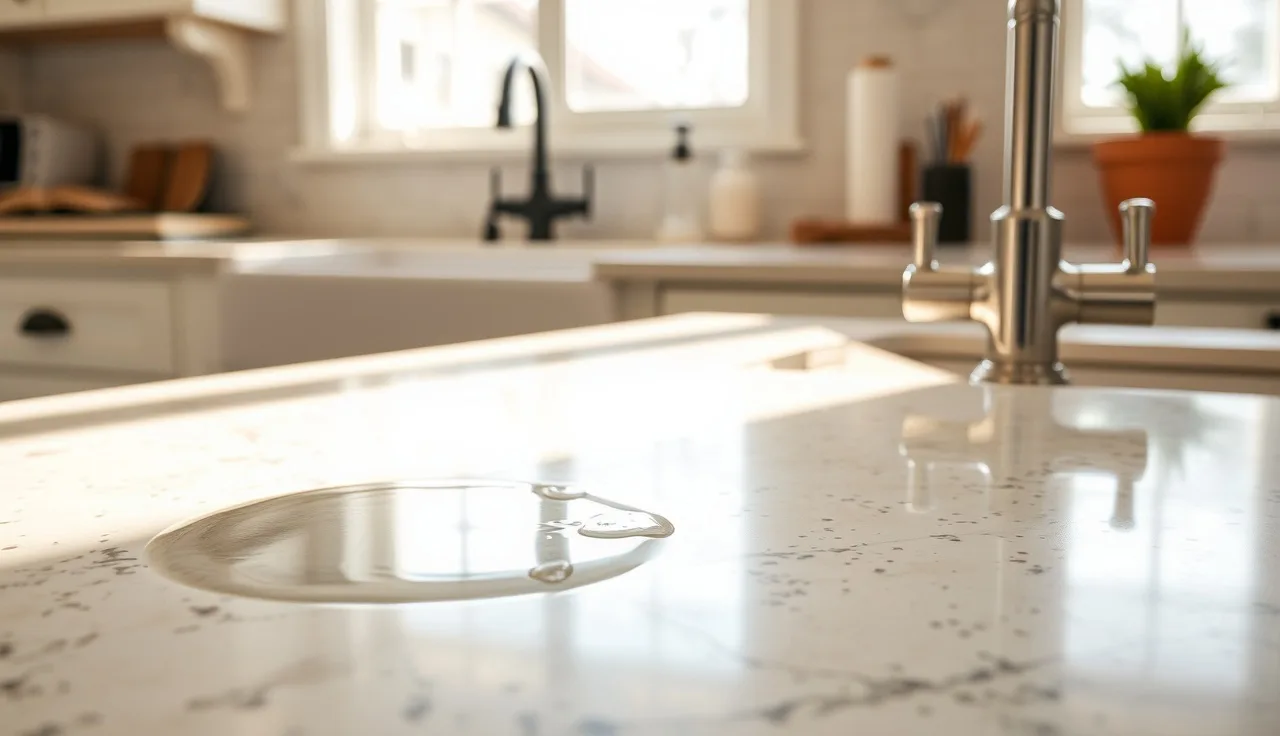
The water test is the field method fabricators use, and it costs nothing. Pour about a quarter cup of water on the counter, ideally in a few spots since one slab can vary in porosity. Wait 15 to 30 minutes without touching it. Then look.
If the granite darkened under the puddle, the stone is drinking moisture. Seal it. The darker and faster the mark shows up, the more the stone needs sealer. If the water just sits and you can slide it off with no darkening, the slab is dense enough that sealing is optional.
Some fabricators run a second pass with a drop of mineral oil or cooking oil left for 30 minutes. Oil stains are harder to remove than water stains and give a more conservative read on porosity. For most homeowners, the water test alone does the job.
A few things skew the result. If the fabricator sealed your granite before delivery (most shops do), it passes the water test no matter how porous the stone underneath is. Wait at least six months after installation, or just watch whether the seal seems to be wearing near the sink.
How often does granite need to be sealed?
Seal it when the water test tells you to, not on a calendar. The advice to reseal every year is mostly a marketing artifact from sealer manufacturers, not a maintenance rule. Some porous granites in busy kitchens want fresh sealer every 12 to 18 months. Some dense granites run three to five years or longer with no measurable change.
A few things drain a sealer faster. Heavy cooking with oils and fats matters, since oil molecules are smaller than water molecules and go deeper. Acidic cleaners like vinegar or citrus sprays chip away at sealer chemistry. So does scrubbing with abrasive pads. The Marble Institute of America notes that harsh cleaners break down sealer chemistry over time [4].
The whole maintenance system fits in one line. Do the water test once a year. If the stone darkens, seal it. If it does not, skip it.
What type of sealer should you use on granite?
Use a penetrating (impregnating) sealer built on a fluoropolymer or silane/siloxane carrier. These are what professionals reach for. They soak in, push air out of the pores, and cure into a barrier that repels both water and oil below the surface [1].
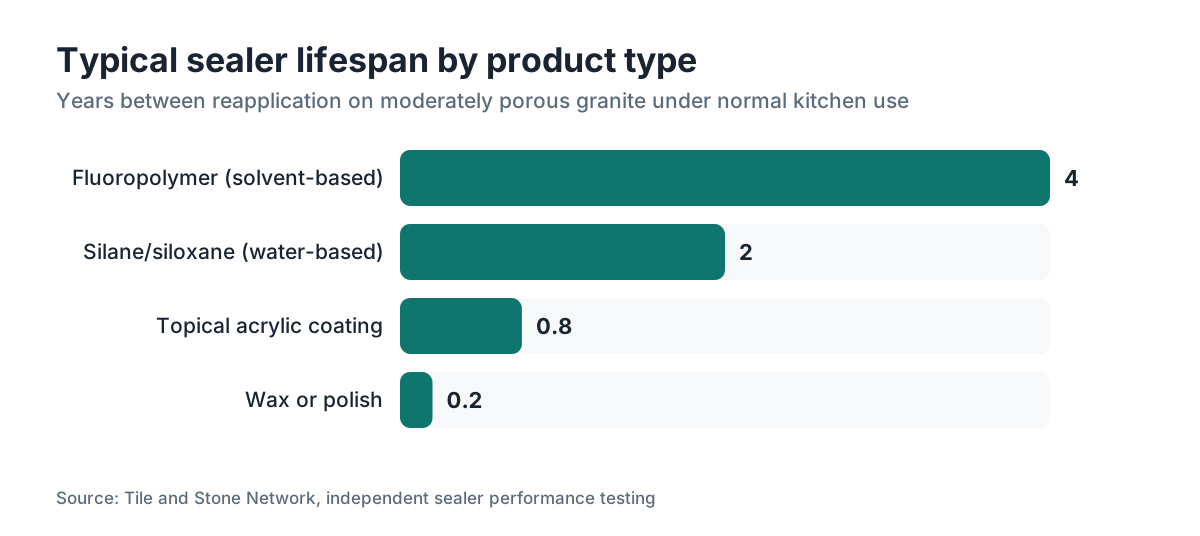
There are two main chemistries. Solvent-based sealers go deeper and usually last longer, sometimes three to five years on moderately porous stone. Water-based formulas run lower on VOC emissions and are easier to use in a closed room. The gap between the two has narrowed as water-based chemistry has improved.
Skip any sealer that does not say "penetrating" or "impregnating" on the label. Skip topical coatings and waxes too. For food prep, look for products labeled safe for food-contact surfaces once cured, which most quality penetrating sealers are after a 24 to 72-hour cure window [5].
Names you will see at the home center include StoneTech BulletProof, Aqua Mix Sealer's Choice Gold, and Miracle Sealants 511. Independent testing by tile and stone publications has found real differences in longevity between products, so a $30 sealer is not always the same as a $15 one.
Here is a quick comparison of common sealer types:
| Sealer Type | Penetrates Stone? | Typical Life | VOC Level | Food Safe When Cured? |
|---|---|---|---|---|
| Fluoropolymer (solvent) | Yes | 3-5 years | Higher | Yes (after 72 hrs) |
| Silane/siloxane (water-based) | Yes | 1-3 years | Lower | Yes (after 24-48 hrs) |
| Topical acrylic coating | No (sits on surface) | 6-12 months | Variable | Often no |
| Wax/polish | No | 1-4 months | Low | No |
If you run a shop with multiple granite jobs going and you want to track which sealer went on which slab, that belongs in your job records. Shops using countertop fabrication software like SlabWise can attach sealer notes to individual quotes and job files, so installers always know what was applied before delivery.
How do you seal granite countertops yourself?
The process is simple. You do not need a contractor for routine resealing, though the first seal after fabrication usually happens in the shop or at install.
Step one: clean the surface with a pH-neutral stone cleaner or dish soap and warm water. Rinse and let the stone dry all the way, ideally 24 hours. Sealer applied over moisture traps that moisture in the pores and cuts penetration.
Step two: apply the sealer in a thin, even coat with a clean cloth or foam applicator. Work in sections of about two square feet. Do not flood the surface.
Step three: let it dwell for the time on the label, usually 5 to 20 minutes. You want the sealer to soak in, not evaporate off the top.
Step four: buff off any leftover sealer with a clean dry cloth before it hazes. Sealer left on the surface cures into a sticky film that is a pain to remove. This is the number one DIY mistake.
Step five: keep the surface dry for 24 to 72 hours. No cooking, no wet dishes, no food prep until the cure window closes.
One coat is usually plenty for dense granite. Porous light-colored granite sometimes wants a second coat after the first has dried (15 to 30 minutes), same process.
Can unsealed granite make you sick?
This question comes up a lot and deserves a straight answer. The research on bacterial retention in granite versus other surfaces is thin and mixed. A 2006 study out of the University of Michigan, funded by the Hospitality Institute of Technology and Management, found that E. coli and Salmonella could survive on several countertop surfaces and transfer to food through cross-contamination, but that cleaning with soap and water cut counts by 99% or more regardless of the surface material [6].
Unsealed granite has open pores where bacteria can linger longer than on a sealed surface, in theory. In a home kitchen, though, the risk is controlled almost entirely by your cleaning habits, not by whether the stone is sealed. Wiping the counter with soap and water after raw meat contact protects you far more than any sealer.
The FDA Food Code covers commercial food service, not home kitchens, but the standard is worth knowing. The code requires surfaces to be "smooth, easily cleanable, and nonabsorbent" [7]. Sealed granite clears that bar easily. Unsealed porous granite is the edge case that might give a health inspector pause in a restaurant.
At home, keep granite clean and you are fine whether it is sealed or not.
What happens if you never seal granite?
For dense granite, nothing bad happens. The stone looks and performs the same unsealed as sealed.
For porous granite, you run three real risks. Oil and wine stains can sink deep and turn permanent or nearly impossible to lift. An olive oil spill on unsealed Kashmir White, left for two hours, can leave a dark mark that needs a poultice and repeated tries to fade, and it may never fully vanish. Acidic liquids like lemon juice, vinegar, and tomato sauce can etch some granites, though granite handles acid better than marble does. And bacteria can persist in the pores longer after a contamination event.
Staining is the one homeowners actually run into. The stains are ugly, not dangerous. If you have porous granite that sat unsealed for years and picked up stains, a poultice (an absorbent powder like kaolin or diatomaceous earth mixed with a solvent matched to the stain) can pull some of the contamination back out [4]. It is slow work, and some old stains will not budge, which is why prevention beats the fix.
For related care, the ideas behind granite sealing carry over to how to clean quartzite countertops and how to clean stone countertops, though every stone has its own chemistry.
How much does it cost to seal granite countertops?
DIY sealing runs $20 to $50 for enough product to seal an average kitchen (roughly 30 to 50 square feet) once, sometimes twice. A standard bottle of StoneTech BulletProof (about $30 at most home centers as of 2025) covers 100 to 200 square feet per coat, so the per-kitchen cost stays low [8].
Professional sealing, done as a standalone service by a stone care company, usually runs $100 to $300 for a full kitchen depending on square footage and region. Most of that is labor. A fabricator sealing at installation either folds it into the job or charges $50 to $150 as an add-on.
Over a decade of ownership, sealing moderately porous granite yourself every two years costs roughly $150 to $250 in materials. That is small money next to the slab and installation, which for granite typically runs $40 to $100 per square foot installed depending on material grade and market [9].
Sealers making big claims (25-year protection, permanent treatment, never seal again) deserve a raised eyebrow. A few commercial-grade fluoropolymer products with genuinely long durability exist, but most residential products in that category have not been independently tested against those numbers.
Do quartz countertops need to be sealed?
No. This one comes up enough to earn its own section. Engineered quartz is made with a polymer resin binder that fills nearly all the pore space in the material. Water absorption is so low it is effectively zero under normal kitchen conditions [3]. There is nothing for a penetrating sealer to penetrate.
Putting stone sealer on quartz does not hurt it, but it does nothing. You are wasting product. The sealer has nowhere to go and just sits on top waiting to be buffed off.
What quartz does need is regular cleaning with a pH-neutral cleaner and protection from long heat exposure. Quartz can warp or discolor from sustained direct heat, unlike granite, which shrugs off heat. Use trivets. That matters far more for quartz than any sealing routine.
Other materials that skip sealing entirely include laminate countertops, Formica countertops, and Corian countertops. All of them are non-porous by nature or by manufacture.
What do fabricators need to know about granite sealing?
If you run a shop, sealing is usually part of finishing before delivery or at installation. A few things matter in practice.
Start with timing. Sealing a freshly polished slab the same day is fine for penetrating sealers. Do not apply over wet stone, and make sure any water left from the polishing line has evaporated first.
Next, document what you applied. When a homeowner calls six months out asking whether their granite needs resealing, your answer depends entirely on which sealer you used and when. Shops that track this in their job records dodge a lot of confusion. If your team runs countertop fabrication software like SlabWise for quoting and job management, that is a natural place to attach a care note or sealer spec to each completed job.
Then there is customer education. Most homeowner anxiety about sealing comes from conflicting internet advice. A one-page handout that explains the water test and your shop's sealer recommendation takes about 20 minutes to write and kills a big share of post-install callbacks.
Last, slab selection talks. When a customer is choosing between granite options and asks about upkeep, accurate porosity info on the specific slabs in front of them is a real service. Telling someone Absolute Black needs no sealing while Bianco Romano wants it every 18 months is specific, useful advice that builds trust. For the wider view on material selection and installation, see countertop installation and our granite countertops reference.
Frequently asked questions
How do I know if my granite has already been sealed?
Do the water test. Pour a quarter cup of water on the surface and wait 15 to 30 minutes. If the granite darkens under the puddle, the sealer has worn through or was never applied. If water beads and you can slide it off with no dark mark, the sealer is intact or the granite is dense enough that it does not need one. Recently sealed stone almost always passes this test.
Can I use cooking oil or olive oil on sealed granite without staining it?
A good penetrating sealer slows oil absorption a lot, but it does not make granite bulletproof. Oil molecules are small and sink deep given enough time. Wipe up cooking oil spills promptly, ideally within a few minutes. If you cook with oils often, expect to reseal the zone around your cooktop more than the rest of the counter, since that area sees the most fat.
Is it safe to prepare food on granite after sealing?
Yes, once the sealer has fully cured. Most penetrating sealers specify a 24 to 72-hour cure window before the surface is safe for food contact. After that, the cured resin is inert. Check your product label for the cure time and any food-contact language. Topical coatings and waxes are a different story and generally should not go on food-prep surfaces.
Why does dark granite not need sealing?
Dark granites like Absolute Black or Black Pearl have an extremely dense crystal structure with almost no pore space between the quartz, feldspar, and mica. There is not enough void for liquids to enter in any meaningful amount. Color is a rough indicator of that density, not a guarantee. The water test stays the most reliable check regardless of color.
How long does granite sealer take to dry?
Most penetrating sealers feel dry to the touch within 1 to 4 hours. Full cure, meaning the resin has cross-linked and is safe for food contact and water exposure, takes 24 to 72 hours depending on product chemistry and room temperature. Do not leave standing water on freshly sealed granite and avoid heavy use until the full cure window passes.
Will sealing granite make it shiny?
A penetrating sealer should not change your granite's look at all, which is the point. It goes below the surface and stays there. If a sealer creates a shine or shifts the color, it is a topical product sitting on top rather than soaking in. If your granite looks hazy or shiny after sealing, you likely left sealer on the surface that needs buffing off.
Can I use vinegar to clean granite?
No. Vinegar is acidic (pH around 2.4) and degrades penetrating sealers with repeated use. On some granites it can also etch the surface minerals. Use a pH-neutral cleaner or plain dish soap diluted in warm water. The same caution applies to lemon juice, citrus sprays, and most bathroom tile cleaners, which are formulated for acid-tolerant ceramic, not natural stone.
What is the best way to remove an old oil stain from granite?
Use a poultice. Mix an absorbent powder (diatomaceous earth, kaolin clay, or baking soda for mild stains) with a degreasing solvent like acetone or a stone degreaser into a peanut-butter paste. Spread it about a quarter inch thick over the stain, cover with plastic wrap, tape the edges, and leave it 24 to 48 hours. The paste pulls the oil out as it dries. Remove, rinse, and repeat if needed. Old deep stains may take several rounds.
Does granite around the sink need to be sealed more often?
Yes. The sink area sees constant moisture, soap, and food contact, and sealer wears faster there than on quiet sections. Many homeowners find the band within six inches of the sink fails the water test before the rest of the counter does. Consider spot-sealing the sink surround every year even when the rest of the counter passes.
Can new granite countertops already have a sealer applied from the factory or fabricator?
Most fabrication shops seal granite before delivery, either at the shop or at installation. Ask your fabricator which product they used and when. That helps you plan your first resealing. If you cannot get an answer, wait six months and do the water test. A factory seal applied at the slab yard in Brazil or India is not the same as a proper countertop sealer applied before install.
Do I need to seal granite in a bathroom versus a kitchen?
The same porosity rules apply, but bathroom granite sees fewer oil and food exposures than kitchen granite. Soap scum and water are the main concerns there. Porous granite on a bathroom vanity still benefits from sealing, especially if you notice darkening around the faucet. Dense bathroom granite can often go unsealed or need less frequent attention than kitchen stone.
Does sealing granite prevent etching from acids?
Mostly no. Penetrating sealers mainly block liquid absorption and staining. They give some limited resistance to mild acid etching, but granite that reacts to acids (some granites carry calcite content, even though pure granite should not) will still show surface damage from prolonged acid contact even over a sealed surface. Wipe up acidic spills immediately no matter your sealing status.
How is sealing granite different from sealing quartzite or marble?
The process is the same, but the stakes differ. Marble is generally more porous than granite and more vulnerable to acid etching, so sealing is more urgent and often more frequent. Quartzite varies wildly in porosity and sometimes gets sold mislabeled as granite. The water test works for all three. See the guides on how to clean quartzite and how to clean stone countertops for material-specific details.
Sources
- Marble Institute of America, Care and Maintenance of Natural Stone: Penetrating sealers soak into the pore structure of stone and leave behind a resin barrier that slows liquid absorption
- U.S. Geological Survey, Minerals Information: Dimension Stone: Granite is classified as an igneous rock with interlocking crystals of quartz, feldspar, and mica; crystal matrix density varies by quarry
- NSF International, NSF/ANSI 51 Food Equipment Materials Standard: Engineered quartz is manufactured with a polymer resin binder that produces a surface with effectively zero water absorption
- Marble Institute of America, Stain Removal Guide for Stone: Harsh cleaners can break down sealer chemistry over time; poultice treatment recommended for deep oil stains in porous stone
- U.S. Environmental Protection Agency, Safer Choice Standard: Most quality penetrating stone sealers are inert and safe for food-contact surfaces after a 24 to 72-hour cure window
- University of Michigan / Hospitality Institute of Technology and Management, Bacterial survival on countertop surfaces study (2006): Bacteria including E. coli and Salmonella were reduced by 99% or more on multiple countertop surfaces with soap and water cleaning regardless of surface material
- U.S. Food and Drug Administration, FDA Food Code 2022: FDA Food Code requires commercial food service surfaces to be smooth, easily cleanable, and nonabsorbent
- StoneTech Professional, BulletProof Sealer product specifications: A standard bottle of penetrating sealer covers 100 to 200 square feet per coat, making per-kitchen DIY sealing cost approximately $20 to $50
- HomeAdvisor / Angi, Granite Countertop Cost Guide 2024: Granite countertop installation typically runs $40 to $100 per square foot installed depending on material grade and regional market
Last updated 2026-07-09