TL;DR
- Modern stone fabrication combines CNC bridge saws, waterjet cutters, digital laser templating, and automated edge profilers to cut granite, quartz, and marble faster and tighter than hand methods.
- A typical job moves from digital template to finished slab in one to three days.
- Equipment runs from roughly $50,000 for an entry-level CNC saw to over $500,000 for a five-axis machining center.
What does 'stone fabrication' actually mean from raw slab to finished countertop?
Stone fabrication is every step between a rough quarried slab and an installed countertop: templating, cutting, edge profiling, polishing, cutouts for sinks and cooktops, and final surface treatment. Nothing about it is simple. A single kitchen island can require a dozen separate machine operations, each with its own tolerance stack.
The slab arrives at the shop typically measuring 9 to 10 feet long and 5 to 6 feet wide, somewhere between 2 and 3 centimeters thick for standard countertops, or 3 centimeters for heavier applications [1]. The fabricator's job is to extract the homeowner's exact shapes from that slab while minimizing waste, keeping the stone structurally sound, and matching veining where the customer paid for book-matched slabs.
For decades that work was done mostly by hand: chalk lines, angle grinders, hand polishers. Skilled fabricators still do some of that. But the shop floor in a competitive fabrication business today looks more like a small machine shop than a stone yard. CNC bridge saws, digital templating systems, waterjet cutters, and robotic polishing arms have replaced or supplemented nearly every manual step.
The shift matters to homeowners because technology drives both price and quality. A shop running modern equipment can hold tighter tolerances (seams under 1/16 inch are realistic), turn jobs faster, and waste less material. It matters to fabricators because capital costs are high and the wrong equipment choice can sink a shop.
How do CNC bridge saws work, and why are they the backbone of most fabrication shops?
A CNC bridge saw is a computer-controlled cutting machine where a motorized bridge carrying a diamond blade travels along rails over a flat cutting table. The operator programs cut lines from a digital drawing, the machine executes them with millimeter-level repeatability, and a water cooling system keeps the blade from overheating the stone.
Most production shops run bridge saws with 5-axis heads. That means the blade tilts and rotates on top of moving in X and Y, so it can cut miters, angled edges, and compound shapes in a single setup. A basic 3-axis bridge saw handles flat cuts only; you need a separate edging machine for profiles. The 5-axis machines cost more but cut labor time by consolidating operations.
Blade diameter is usually 14 to 16 inches for production cutting. Spindle power runs from about 15 HP on entry-level machines to 30 HP or more on heavy-production models. Cut speed depends on the material. Granite typically runs slower than engineered quartz because its hardness wears blades faster. A good operator dials feed rate to stone hardness to protect both the blade and the slab.
Equipment pricing is real and steep. Entry-level bridge saws from brands like Park Industries or Breton start around $50,000 to $80,000 installed [2]. Full 5-axis CNC systems with automatic tool changers run $150,000 to $350,000. A complete high-production line with automated material handling can exceed $500,000. These numbers come from manufacturer published pricing and industry distributor quotes; actual installed cost varies by region and freight.
For a homeowner, the takeaway is simple. Ask your fabricator what equipment they run. A shop with a calibrated CNC bridge saw holds tighter seam tolerances than one doing the same cuts freehand. That matters most on long runs, dark stones, and any job with a waterfall edge.
What is digital templating and how does it replace cardboard or wood templates?
Traditional templating meant sending a crew to the job site with cardboard or thin wood strips, tracing every wall, cutout, and corner by hand, then hauling those physical templates back to the shop to lay out cuts. It worked. It was also slow, prone to cumulative measurement error, and a pain to store.
Digital templating uses a laser measuring device (the common systems are from LT2D3D and Proliner, both established in the stone industry) that captures points around the countertop footprint and records the geometry as a digital file [3]. The whole process takes 20 to 45 minutes on a typical kitchen. Back at the shop, that file drops directly into the CNC programming software. No manual re-drawing, no risk of a cardboard template shifting in transit.
The accuracy gain is measurable. Proliner's published specs claim ±0.5 mm positional accuracy for a standard kitchen measurement [3]. Cardboard templates in skilled hands hold ±2 to 3 mm; in less skilled hands the error compounds with every transfer step.
Digital templating also opens up remote quoting. Some shops send the digital file to their quoting software right after the site visit, generating a cut list and material cost before the crew even drives back. That closes the sales cycle faster.
For homeowners, digital templating means fewer return visits (the shop is less likely to discover a wall-angle error after cutting), faster turnaround, and the ability to verify the final cut file matches what you ordered. Ask to see the template drawing before your slab is cut. A good shop will show you.
How does waterjet cutting work for stone, and when does a fabricator actually use it?
A waterjet cutter forces water mixed with an abrasive (usually garnet) through a small nozzle at pressures around 60,000 PSI. The stream cuts stone, glass, metal, or nearly any hard material without heat, which matters for stone because thermal stress from saws can cause micro-fractures near cut edges.
In a stone shop, waterjet earns its keep on shapes a bridge saw blade can't cleanly produce: curved cutouts, detailed inlays, letters or medallion patterns cut into a slab, radius sink cutouts with tight corners, and mitered corners on thick materials where the angle geometry gets complicated.
Waterjet machines are expensive to run. The abrasive garnet costs money per hour (rough industry figures run $15 to $30 per hour in abrasive alone, depending on flow rate and pressure) [4]. Nozzle wear is constant. So fabricators reserve waterjet for cuts where it's genuinely necessary, not as a substitute for a bridge saw on straight cuts where the saw is faster and cheaper.
The cut edge from a waterjet is slightly rough compared to a diamond blade. For most applications that's fine because the edge gets polished afterward anyway. But on very thin inlay pieces where the cut face shows, a high-quality waterjet with a fine abrasive mix beats a saw.
Not every shop has a waterjet. Smaller regional fabricators often subcontract complex waterjet work to a larger shop or specialty cutter. If your project includes decorative inlays, a custom island shape with tight interior curves, or a medallion pattern in the floor, ask upfront whether your fabricator has in-house waterjet capability or whether they're outsourcing it, because that affects both timeline and quality control.
What edge profiles are actually possible with modern CNC profiling equipment?
Edge profiling is one of the most visible results of fabrication technology. The edge you see on your countertop, whether it's a simple eased edge, a bullnose, an ogee, or a stacked laminate, was shaped by either a hand-held router or a CNC edging machine.
CNC edge profilers use diamond-tipped tooling wheels in a fixed sequence to grind, shape, and polish an edge in one pass through the machine. The stone sits on a conveyor, travels through the tool stations, and exits with a finished edge. This is fast (a 10-foot run might take 5 to 8 minutes through the machine) and consistent, meaning the profile depth and polish level don't drift the way they do with a hand tool over the course of a long run.
Here is a comparison of common edge profiles and their typical relative cost at retail:
| Edge Profile | Machine-friendly? | Typical upcharge vs. eased edge |
|---|---|---|
| Eased (1/8" bevel) | Yes | $0 (base price) |
| Beveled | Yes | $2, $5 per linear foot |
| Bullnose (full) | Yes | $5, $10 per linear foot |
| Ogee | Yes, with correct tooling | $10, $20 per linear foot |
| Dupont | Yes | $10, $18 per linear foot |
| Waterfall / mitered | Requires 5-axis saw + hand finish | $30, $80 per linear foot |
| Custom / compound | Hand work + CNC | Quote only |
These ranges are composite estimates from fabricator price sheets and industry forums; actual pricing varies significantly by region and shop overhead.
The tooling for CNC profilers is not cheap. A single diamond profile wheel can cost $300 to $900 and wears out after a certain linear footage depending on stone hardness [5]. Shops that run a lot of granite burn through tooling faster than those running mostly engineered quartz. That tooling cost feeds into the edge upcharge you see on your quote.
For homeowners choosing an edge profile, the practical advice is this. Pick what you like visually, but know that more complex profiles add real cost and (with waterfall edges in particular) real lead time. If budget is tight, a well-executed eased or beveled edge on quality stone looks better than an ornate profile done poorly.
How do fabricators use nesting software to reduce stone waste and cut costs?
Nesting is the process of arranging all the pieces from a job onto the slab to minimize offcuts and wasted material. In the old days, a skilled layout person did this by eye, sometimes with paper cutouts on a photo of the slab. Now dedicated nesting software does the same job algorithmically, often in minutes.
The software takes the cut list (all the pieces required for a job, with their exact shapes and dimensions) and the slab dimensions, then computes the most efficient arrangement. It accounts for grain direction if the customer wants consistent veining, for problem areas in the slab (a crack, a soft spot), and for kerf width (the material lost to each saw cut). Good nesting software can also flag whether a job needs one slab or two before anyone touches the stone.
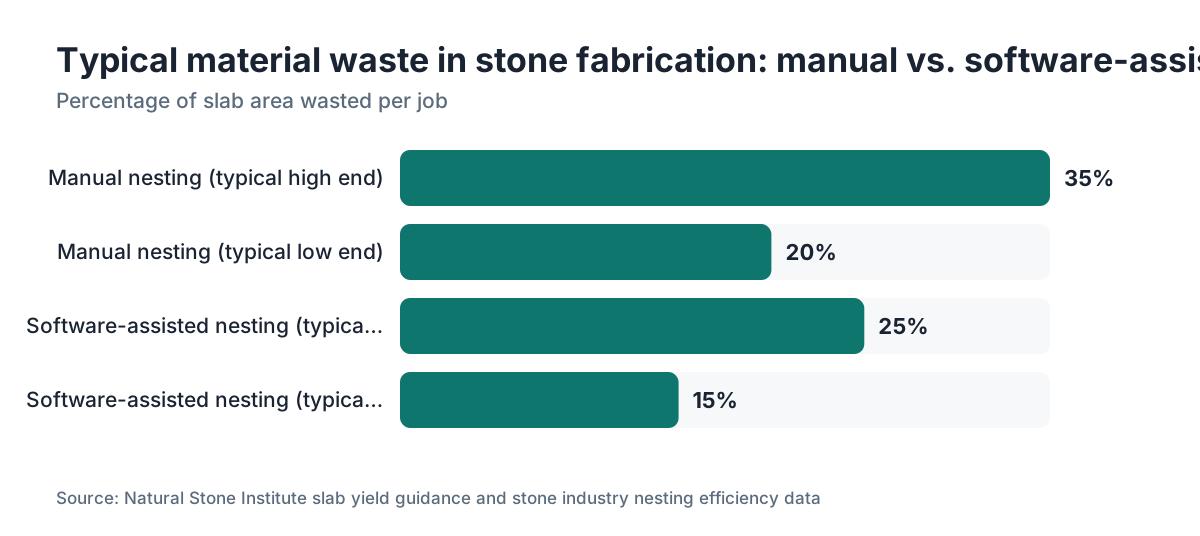
Waste reduction is meaningful financially. In a typical granite job, material waste runs roughly 20 to 35% of the slab area without careful nesting, and skilled nesting (manual or software-assisted) can bring that down to 15 to 25% [6]. On a $400-per-slab remnant, that's real money. For higher-cost materials like exotic quartzites or book-matched marble, the savings are proportionally larger.
Shops running quoting and nesting software together (tools like those offered by SlabWise, which combines digital quoting with cut-list optimization) can generate both the material cost estimate and the cut layout from the same template file, cutting the chance of a piece being missed in the quote and cut differently in the shop. The integration matters because disconnected quoting and production steps are where expensive mistakes happen.
For homeowners, nesting efficiency mostly affects whether you pay for remnant material you'll never use. Ask your fabricator how they handle remnants. Some shops keep them (and might credit you if your job produces a useful remnant), others sell them, and the policy affects your total slab cost.
What materials does modern fabrication equipment handle, and which are the hardest to cut?
Stone fabrication equipment was originally built for natural stone, mostly granite and marble. Modern CNC equipment handles a much wider range: engineered quartz (like Cambria or Silestone), quartzite, soapstone, dolomite, porcelain slabs, sintered surfaces like Dekton, and ultra-compact surfaces.
Hardness, abrasiveness, and brittleness vary dramatically across these materials, and they drive both tooling selection and cut parameters.
Granite sits at 6 to 7 on the Mohs hardness scale, which makes it hard on diamond tooling but manageable with correct blade speed and water cooling [7]. Quartzite is similar in hardness but often more abrasive. Marble and limestone are softer (3 to 5 Mohs) and easier to cut but easier to chip and scratch during fabrication.
Engineered quartz (around 7 on Mohs) cuts cleanly at higher feed rates than natural granite in many cases, but the resin binder in the composite can heat-stress if the water cooling isn't adequate. A blade running dry on quartz will cause delamination or discoloration at the cut edge.
Porcelain slabs and sintered surfaces like Dekton are where many shops struggle. These materials are extremely hard and brittle, and they have very little tolerance for vibration or blade flex during cutting. Chipping at cut edges is the common failure mode. Fabricators who specialize in these materials often run slower feed rates, use blades designed for ultra-compact surfaces, and support the slab very carefully during cutting. Some shops refuse to work with Dekton or similar materials because the scrap rate on inexperienced first runs is high.
For a homeowner choosing a material, the fabricator's experience with that specific material matters as much as the equipment. Ask whether they've worked with it before, how many jobs they've run with it in the last year, and what their policy is if a slab cracks during fabrication.
You can read more about specific materials in our guides to granite countertops, marble countertops, and how to clean quartzite countertops.
How does sink cutout technology work, and what can go wrong?
Sink cutouts are one of the highest-risk operations in stone fabrication. You're removing a large section of material from near the edge of a slab, and if anything goes wrong (cracks or chips), the piece is ruined. A good fabricator takes this seriously.
On a CNC bridge saw with a 5-axis head, the machine can plunge-cut the sink opening, routing the shape in one programmed operation with support blocks placed under the waste piece so it doesn't drop and crack the deck. On machines without plunge-cut capability, the operator pre-drills corner holes by hand (usually with a 2-inch core bit) before running the straight cuts between them.
For undermount sinks, the cutout also typically gets a polished or eased edge that you see from below when looking up through the sink basin opening. That edge work adds time and needs either a hand router or a secondary CNC operation.
Waterjet is sometimes used for sink cutouts, particularly for complex shapes (farmhouse apron openings, unusual sizes) where a straight-cut approach doesn't work well. The advantage is that waterjet removes the risk of blade flex causing a crack in the bridge between the cutout and the countertop front edge.
The most common failure point is the rear corners of a sink cutout on a narrow kitchen countertop. If the stone between the back cutout corner and the backsplash edge is less than 3 to 4 inches, that bridge of stone is fragile. An experienced fabricator will flag this during quoting and may recommend a different sink model or placement to reduce the risk.
What role does polishing technology play in the final surface finish?
Polishing is the last major fabrication step, and it takes the surface from a sawn or ground face to the reflective or matte finish you see in a showroom. The sequence uses progressively finer abrasive grits, typically from around 50 grit up through 3,000 grit or beyond for a high gloss, with each step removing the scratches left by the previous one.
Manual polishing with hand-held polishers and foam or resin pads still happens in shops, particularly for edges and small detail work. But flat surface polishing on a production line runs through a bridge polisher or a multi-head planetary polishing machine, which holds the polishing heads at consistent pressure across the slab while the stone moves through on a conveyor.
Finish options have expanded. A standard high-gloss polish is the most familiar. Honed (matte) finishes require stopping the polishing sequence at a lower grit. Leathered or brushed finishes use a different tooling type (bush hammers or wire brushes) to create texture rather than reflectivity. Some materials take a leathered finish better than others. Granite and quartzite leather well; marble can work but shows more fingerprints in the textured low spots.
For how to clean stone countertops after installation, the finish type matters because it affects both the sealing approach and the cleaning products that work well long-term.
One honest note: the quality of polishing on an edge profile, particularly on complex profiles like an ogee or dupont, is harder to nail by machine than on a flat surface. Check the edge polish quality carefully at the showroom or job site walk-through. It's one of the clearest signs of a shop's overall finishing standards.
What does a typical fabrication timeline look like from measure to install?
Homeowners often ask how long the whole process takes. The honest answer is it varies by shop workload and material availability, but here is a realistic sequence for a standard kitchen project using a well-equipped modern fabricator.
Day 1: Template. Digital measuring takes 30 to 60 minutes on site. The file is ready for programming the same day.
Day 1 to 2: Material selection and slab confirmation. If the homeowner has already chosen their slab, this step is done. If not, add 1 to 5 days for slab selection and purchase from the distributor.
Day 2 to 3: Programming and nesting. The cut file is built from the template, and materials are scheduled on the production calendar.
Day 3 to 5: Fabrication. Cutting, edge profiling, sink cutout, polishing, and quality inspection. A simple kitchen project runs 1 to 2 days in the shop; complex projects with custom edges or inlays can take 3 to 5 days.
Day 5 to 10 from template: Installation. Most shops schedule install 5 to 10 business days after templating if everything goes smoothly [8].
Total from template to installed countertop: 1 to 2 weeks is reasonable for standard projects with an established fabricator running modern equipment. Shops with backlogs, shops using outsourced processes (like sending waterjet work out), or projects with exotic materials can run 3 to 4 weeks.
For a complete picture of what happens on installation day, see our guide to countertop installation.
How should homeowners and fabricators evaluate a stone shop's technology and capabilities?
If you're a homeowner getting quotes, or a fabricator benchmarking your operation against competitors, the equipment list is only part of the picture. Here is what actually matters.
For homeowners: Ask whether the shop uses digital templating or still works from physical templates. Ask what CNC equipment they run and whether they do edge profiling in-house or outsource it. Ask to see examples of seam work on dark stone (seams are most visible on dark materials, and seam quality is the clearest indicator of CNC calibration). Ask about their policy if a slab cracks during fabrication: is it on them, on you, or shared?
For fabricators weighing a shop upgrade: The ROI on a CNC bridge saw versus manual cutting depends on your volume. Industry estimates suggest a CNC bridge saw pays back its cost in labor savings and reduced scrap at production volumes above roughly 40 to 60 jobs per month [2], though that number swings heavily with labor rates and local material costs. Below that volume, a well-maintained used saw or a time-and-material arrangement with a larger shop may be smarter.
Calibration matters as much as equipment age. A five-year-old bridge saw that's been regularly calibrated and maintained holds tighter tolerances than a new one that's been abused. Ask about the shop's maintenance schedule and whether they use an external calibration service.
Software integration is the emerging differentiator. Shops that connect their quoting, templating, nesting, and production scheduling in one system make fewer errors than shops running those steps in separate tools. If you're shopping fabrication software, look for solutions like SlabWise that let the same template file flow from customer quote through to the CNC cut list without re-entry.
You can also see how different countertop material types affect fabrication requirements in our guides to kitchen countertops and Cambria countertops.
What are the real safety and environmental considerations in a stone fabrication shop?
Stone dust is a serious occupational health issue. Cutting and grinding natural stone and engineered quartz produces respirable crystalline silica dust, which causes silicosis, an irreversible and potentially fatal lung disease. OSHA's permissible exposure limit (PEL) for respirable crystalline silica is 50 micrograms per cubic meter of air as an 8-hour time-weighted average, adopted in 2016 and enforceable in fabrication shops under 29 CFR 1910.1053 [9].
OSHA states in its standard that the PEL for respirable crystalline silica is "50 µg/m3, calculated as an 8-hour TWA" and requires employers to use "engineering and work practice controls" to limit exposure [9]. In practice, this means wet cutting (water suppression at the blade), enclosed CNC machines with integrated dust collection, and in some operations, local exhaust ventilation. Dry cutting of stone or engineered quartz is a serious violation and a genuine health hazard.
Engineered quartz has drawn specific regulatory attention. Australia banned the use of engineered stone containing crystalline silica in 2024 [10]. California's OSHA (Cal/OSHA) adopted an emergency temporary standard for engineered stone fabrication that goes beyond federal OSHA requirements. The situation is evolving, and fabricators working with quartz products should track state-level regulatory updates closely.
Water management is the other major environmental consideration. Wet cutting produces slurry (water mixed with stone dust and cutting debris). Many jurisdictions require fabricators to treat or settle slurry before discharge. A recirculating water system with a settling tank is standard in well-equipped shops and helps with both regulatory compliance and water costs.
For homeowners, this is mostly background information, but it matters when choosing a fabricator. A shop that takes dust control seriously is a shop paying attention to quality and process discipline overall.
Frequently asked questions
What is the difference between a CNC bridge saw and a waterjet cutter for stone?
A CNC bridge saw uses a spinning diamond blade to cut stone in straight or angled lines; it's fast and economical for standard cuts. A waterjet uses high-pressure water mixed with abrasive garnet to cut without heat, which makes it better for curved shapes, inlays, and complex interior cutouts. Most shops use both: bridge saw for the bulk of cutting, waterjet for detailed or curved work.
How accurate is digital laser templating compared to traditional cardboard templates?
Digital laser templating systems like Proliner publish positional accuracy of ±0.5 mm for a standard kitchen measurement. Skilled cardboard templating typically holds ±2 to 3 mm, and errors compound with each transfer step. For most kitchens the difference is small, but on long runs with multiple seams or tight wall angles, the tighter tolerance of digital templating reduces the chance of gaps or misaligned seams at installation.
How much does a CNC bridge saw cost for a stone fabrication shop?
Entry-level 3-axis CNC bridge saws from established brands like Park Industries or Breton start around $50,000 to $80,000 installed. Full 5-axis systems with automatic tool changers run $150,000 to $350,000. A complete high-production line with automated material handling can exceed $500,000. Used equipment can cut entry cost significantly, though maintenance history and calibration state matter as much as price.
Which countertop materials are hardest for fabricators to cut and shape?
Porcelain slabs and sintered ultra-compact surfaces like Dekton are the most difficult. They're extremely hard and brittle, with almost no tolerance for blade flex or vibration. Chipping at cut edges is the primary failure mode. Quartzite and hard granites are also demanding on tooling. Marble and limestone are softer and easier to cut but more vulnerable to chipping during edge profiling.
What is stone nesting software and does it actually reduce material waste?
Nesting software arranges all required cut pieces on a slab layout to minimize wasted material. Without careful nesting, granite jobs typically waste 20 to 35% of slab area. Good software-assisted nesting can bring waste down to 15 to 25%. On premium or exotic slabs costing $500 or more, the savings in material alone can justify the software cost for a mid-volume shop.
How long does stone fabrication take from template to installation?
With a well-equipped modern shop and no material delays, a standard kitchen project typically runs 5 to 10 business days from digital template to installation. That includes 1 to 2 days of programming and scheduling, 1 to 2 days in fabrication, and scheduling the install crew. Complex projects, exotic materials, or custom waterfall edges can add another week.
Is silica dust from stone fabrication really that dangerous?
Yes. Respirable crystalline silica from cutting stone and engineered quartz causes silicosis, an irreversible lung disease. OSHA's enforceable permissible exposure limit is 50 micrograms per cubic meter as an 8-hour time-weighted average under 29 CFR 1910.1053. Wet cutting with proper water suppression is the primary engineering control. Dry cutting of stone is a serious regulatory violation and a genuine health hazard.
What edge profiles can CNC edging machines produce, and which ones require hand work?
CNC edge profilers handle most standard profiles including eased, bevel, bullnose, ogee, and dupont in one machine pass. Waterfall and mitered edges require a 5-axis CNC saw for the miter cuts plus hand finishing at the joint. Custom compound profiles often need hand work throughout. Machine-cut edges are more consistent over long runs; hand-finished complex profiles can be beautiful but quality depends heavily on the individual craftsperson.
Why do some fabricators refuse to work with Dekton or engineered stone?
Sintered ultra-compact surfaces like Dekton require slower feed rates, specialized blades, and careful slab support to avoid chipping. Shops without experience with the material see high scrap rates on initial jobs. Some fabricators also avoid engineered quartz due to increasing silica dust regulations, including a 2024 ban on engineered stone in Australia and an emergency standard in California.
How should I compare quotes from different fabricators beyond the price?
Ask each shop whether they use digital templating, what CNC equipment they run, whether edge profiling and sink cutouts are done in-house, and what their policy is if a slab cracks during fabrication. Request photos of previous seam work on dark stone. Seam quality on dark materials is the clearest indicator of CNC calibration and operator skill. Cheap quotes from shops with poor seam control often cost more in the end.
What is a 5-axis CNC machine and do I need a fabricator who has one?
A 5-axis CNC machine can move its cutting head in X, Y, Z, and two rotational directions, allowing mitered cuts, angled edges, and compound shapes in a single setup. For standard countertops with basic edge profiles, a 3-axis machine is fine. If your project includes waterfall edges, angled island details, or complex mitered corners, a fabricator with 5-axis capability will produce better results and likely faster turnaround.
What happens to stone slurry and water waste from fabrication shops?
Wet cutting produces slurry combining water, stone dust, and abrasive debris. Most jurisdictions require shops to settle or treat slurry before discharge into municipal drains. Well-equipped shops run recirculating water systems with settling tanks, which recover much of the water and collect solid waste for disposal. This is both a regulatory requirement and a cost-saving measure since it reduces fresh water consumption.
Can I see my slab's cut layout before fabrication starts?
You can and should ask. Shops using digital templating and nesting software can show you the cut layout on screen before any stone is touched. This lets you verify that piece placement matches what you wanted for veining direction and that no pieces are missing. Most professional fabricators will walk you through the layout on request, and some include it as a standard step in their process.
How does fabrication technology affect the price of my countertop quote?
Shops with modern CNC equipment and digital templating typically quote faster and with fewer surprises, but their overhead is higher than manual shops. That overhead usually shows up in minimum charges and square-footage rates rather than itemized line items. The value is in consistency: tighter seams, more accurate sink cutouts, and lower risk of a cracked slab. On a $3,000 to $8,000 kitchen project, the precision of the fabrication matters more than saving $200 on the quote.
Sources
- Natural Stone Institute, Dimension Stone Design Manual: Standard countertop slab thickness is 2 cm or 3 cm; 3 cm is standard for most countertop applications in North America
- Park Industries, CNC bridge saw product line pricing: Entry-level CNC bridge saws start around $50,000 to $80,000 installed; 5-axis systems with tool changers run $150,000 to $350,000
- OMAX Corporation, waterjet abrasive consumption and operating cost guidance: Waterjet abrasive garnet operating cost runs approximately $15 to $30 per hour depending on flow rate and pressure
- Tenax USA, diamond tooling catalog for stone edge profiling: Single diamond profile wheel for CNC edger costs $300 to $900 and wears with use; harder stones consume tooling faster
- Natural Stone Institute, slab yield and layout best practices: Material waste on granite jobs runs roughly 20 to 35% without careful nesting; skilled nesting brings it to 15 to 25%
- U.S. Geological Survey, Mohs Hardness Scale and mineral data: Granite measures 6 to 7 on the Mohs hardness scale; marble and limestone are softer at 3 to 5
- Natural Stone Institute, countertop installation standards and best practices: Typical fabrication and installation timeline runs 5 to 10 business days from template for standard kitchen projects
- OSHA, 29 CFR 1910.1053 Respirable Crystalline Silica standard: OSHA's permissible exposure limit for respirable crystalline silica is 50 µg/m3 as an 8-hour TWA; employers must use engineering and work practice controls to limit worker exposure
- Breton SpA, CNC stone machinery product specifications: Breton is an established manufacturer of CNC bridge saws and polishing lines for stone fabrication; multi-head systems exceed $500,000 for full production lines
Last updated 2026-07-09