TL;DR
- Granite cuts with a diamond blade rated for hard stone, mounted on an angle grinder (dry) or a wet-feed saw.
- A careful DIYer can trim an installed top or widen a cutout.
- Full slab cuts and sink openings need water feed, real diamond tooling, and practice.
- Most mistakes are permanent, and a cracked slab is a total loss.
What makes granite so hard to cut compared to other countertop materials?
Granite sits at roughly 6 to 7 on the Mohs hardness scale, harder than a steel file and harder than the carbide tooling that breezes through wood or tile [1]. That hardness comes from quartz crystals locked inside the rock, and quartz alone runs 20 to 60 percent of most slabs. Quartz itself is a 7 on Mohs. Any blade or bit that tries to scratch through it has to be harder still.
Steel and carbide saw teeth don't cut granite. They smear against it and dull in seconds. The only practical way to get through stone this hard is to grind it, which is exactly what a diamond blade does. The diamonds aren't a coating. They're industrial diamond particles sintered into a metal bond matrix, and as the matrix wears, fresh diamond comes up to the surface. That self-sharpening action is the whole point.
Then there's heat. Granite is a poor conductor, so cutting friction concentrates right at the blade-stone line and can crack the slab or cook the blade in under a minute with no cooling. Water fixes that. A shop wet saw runs a steady stream straight at the cut, and that's one big reason a jobsite cut looks nothing like a shop cut.
For comparison, laminate countertops and formica countertops cut with a standard fine-tooth circular saw blade. Butcher block countertops cut like the hardwood they are. Granite is a different animal.
What tools can actually cut granite countertops?
Four tools do the job in the real world. They run from barely adequate to purpose-built.
Angle grinder with a dry-cut diamond blade. A 4.5-inch or 5-inch grinder with a continuous-rim or segmented diamond blade rated for granite cuts an edge or a short cutout. A decent blade costs $15 to $50. Control is the catch. Grinders are handheld, so any straight cut longer than a few inches needs a clamped straightedge, and you manage heat by hand, stopping every 20 to 30 seconds to let the blade and stone cool. This is the tool most homeowners already own.
Circular saw or track saw with a diamond blade. A 7.25-inch circular saw with a dry-cut diamond blade ($30 to $80 for a quality one) gives more control than a grinder, especially with a clamped aluminum straightedge. Still no water, so short passes and cooling breaks apply. A track saw is better because the track handles alignment, but the heat problem stays.
Wet tile saw. A contractor-grade wet tile saw (10-inch blade, water tray) is built for ceramic and porcelain, not thick granite. Slabs over about 3/4 inch may pass the depth of cut, and granite outlasts tile blades fast. For a remnant or a granite tile, fine. For a 3cm (1.25-inch) slab, marginal.
Professional bridge saw or CNC waterjet. This is shop gear. A bridge saw is a large-format machine with a water-fed diamond blade that holds tolerances inside 1/16 inch across a 10-foot slab. CNC routers and waterjets cut curves and sink openings no hand tool touches. When you pay a fabricator, this is what you're paying for.
A blade rated for hard stone carries a bond hardness rating: soft bond for hard stone, hard bond for soft stone. The wrong bond burns the blade up. Buy blades labeled for granite or hard stone, never generic masonry or concrete blades [2].
Which diamond blade should you buy for cutting granite?
For granite, buy a continuous-rim (turbo-rim) diamond blade with a soft metal bond. It gives clean, low-chip cuts on hard stone, and the soft bond keeps exposing fresh diamond. Skip generic masonry and concrete blades. They glaze over on granite in minutes. A quality 4.5-inch blade runs $20 to $60; a 7.25-inch runs $40 to $90.
Here's why blade type matters. A continuous-rim blade has an unbroken cutting surface, so it produces cleaner edges with less chipping. On a countertop edge somebody will actually look at, that's worth the slower cut. A segmented rim clears material faster but leaves a rougher edge, so save it for cuts you'll never see.
Diamond concentration and bond hardness decide how long the blade lasts. Granite is hard, so you want a soft bond that wears away and keeps new diamonds in the game. Blades made for ceramic or masonry use a harder bond meant for softer abrasive materials. On granite they polish smooth and stop cutting.
Reputable makers include Husqvarna, Bosch, DEWALT's stone series, Lackmond, and MK Diamond. Cheap no-name blades from a bargain bin often have uneven diamond spacing and will chip or crack your granite instead of cutting it clean [2].
One field trick: run a new blade dry for 30 seconds on scrap concrete or cinder block before your first granite cut. That dresses the blade and exposes the diamonds. Then wet or mist the cut line before each pass if you're dry-cutting.
How do fabricators cut granite slabs in a shop?
A shop starts with a full slab, usually 55 to 65 inches wide and 100 to 130 inches long, weighing 400 to 800 pounds depending on thickness. Nobody moves that by hand. The job gets templated, nested for the least waste, rough-cut on a bridge saw, then routed for cutouts and profiled on the edges.
Templating comes first, either with a digital laser templater or old-school plywood and cardboard patterns. Those measurements feed nesting software that works out how to pull the most countertop from each slab. That step alone can cut material cost by 10 to 15 percent on a complex kitchen [3]. (SlabWise handles this nesting and quoting step for fabricators, if you're running a shop off paper or spreadsheets.)
The bridge saw makes the rough cuts. It's a large gantry with a water-fed blade riding rails above a moving table. The operator programs or guides the cuts, and water floods the blade the whole time. Blade diameters run 14 to 16 inches, and the depth handles a 3cm (about 1.25-inch) slab with room to spare.
Sink and cooktop openings go to a CNC router with a diamond core bit, or on simpler jobs, an operator uses a plunge router attachment on the bridge saw. Edges get profiled on a dedicated edge machine or by hand through a series of diamond pads. Then the shop polishes, cleans, and seals before delivery.
The whole run for a typical kitchen takes 3 to 8 hours of machine and labor time once the slab is on the table. That's why fabrication labor runs $30 to $100+ per square foot depending on edge profile and local market [4].
Can a homeowner cut granite countertops themselves, and is it actually worth it?
A homeowner can cut granite for small adjustments. A homeowner probably should not cut granite for a full kitchen install. That's the honest line.
Here's what's realistic. Say you have an installed top and need to shave a few inches because a wall moved, or widen a sink cutout by half an inch because the sink won't drop in. A careful DIYer with a grinder, a clamped straightedge, a diamond blade, and a helper keeping water flowing can make that cut. It won't be shop-clean, and you'll polish the edge afterward through diamond hand pads (50, 100, 200, 400, 800, 1500, 3000 in sequence), but it's doable.
Templating and cutting a full kitchen from raw slabs is a different story. The reasons pile up. You have to move 400-pound slabs without breaking them, and granite has almost no tensile strength, so it snaps if it's unsupported across a span. You have to hold cuts to 1/16 inch or the seams show. You have to cut inside corners without cracking through. You have to polish 40 linear feet of edge to a matching finish.
Even experienced tile setters and general contractors who've never fabricated granite tend to underprice the difficulty and crack a slab. A cracked slab is basically total loss. Granite doesn't repair invisibly.
Weighing DIY against a fabricator for a full install? Get three quotes first. Fabrication plus installation for a typical kitchen (40 to 50 square feet) runs $1,500 to $5,000+ depending on material and region [4]. Crack one $800 slab, add the wasted blade and consumables, and you've blown past whatever you thought you'd save.
For the bigger picture beyond cutting, see our full guide on countertop installation.
How do you cut a sink hole in an existing granite countertop?
Cutting a sink hole in installed granite is one of the hardest DIY cuts out there. The top is already down, so your tool angles are limited. You're cutting a rectangle (or a curved rectangle for an undermount) in the middle of a slab, which means four plunge cuts meeting at corners, and the corners are where granite almost always chips or cracks. Drill a radius into every corner and support the waste piece, and you dodge the two failures that ruin most jobs.
Here's the shop process scaled down for a jobsite:
- Mark the cutout with a permanent marker off the sink template (most sinks ship with one). Check your measurements three times.
- Drill a starter hole at each corner with a diamond-tipped hole saw (3/4-inch to 1-inch). These holes let you start the blade safely and put a radius at each inside corner, which spreads stress and prevents cracking. A square inside corner with no radius is a crack waiting to happen.
- Get a helper or a set of blocks underneath to support the cutout piece for the last cut. If the waste drops free, the weight and vibration can crack the slab back into your good material.
- Cut each side with a circular saw and diamond blade in short passes (6 to 8 inches) with cooling breaks. Keep water running at the line the whole time.
- Once the cutout drops, clean up the inside edges with a diamond hand pad.
The number one mistake is skipping the corner holes and plunging straight into a sharp inside corner. That's how slabs crack. Number two is not supporting the waste.
If the top is sealed and in use, cover the surrounding surface with cardboard or a drop cloth. Diamond debris scratches a polished finish fast.
What safety gear do you actually need when cutting granite?
Two hazards make granite cutting genuinely dangerous: silica dust and flying fragments. At a minimum wear a P100 respirator, ANSI Z87.1 goggles or a face shield, and hearing protection, and cut outdoors or with dust extraction. That's the floor, not the ceiling.
Silica dust is the serious one. Granite holds crystalline silica from its quartz, and cutting or grinding throws off fine respirable dust. OSHA's permissible exposure limit for respirable crystalline silica is 50 micrograms per cubic meter as an 8-hour time-weighted average, set in the 2016 silica standard [5]. That rule also requires water suppression or local exhaust when cutting stone, and respirators when those controls fall short. NIOSH is blunt about the stakes: silica dust from cutting quartz-bearing stone causes silicosis and lung cancer with repeated exposure [9].
A homeowner doing a one-time outdoor cut with water suppression faces less risk than a shop worker breathing it daily, but the dust is still real. Wear at least an N95, and a P100 half-face respirator is better. A paper dust mask does nothing here. Fine silica slips right through it.
Flying fragments are hazard two. Diamond blades throw chips at high speed, and granite edges flake mid-cut. Safety glasses aren't enough. Wear ANSI Z87.1-rated goggles or a full face shield [6]. Hearing counts too. Grinders and circular saws on granite run 95 to 105 dB, past OSHA's 90 dB limit [7].
Do all of this outdoors or somewhere well ventilated. Cutting inside? Run a shop vac at the cut line and clear everybody else out.
Cut-resistant gloves help against edges but do nothing against a spinning blade. Keep both hands on the tool and out of the blade path. Sounds obvious, but grinders kick when the blade catches.
How do you cut granite without chipping the edge?
Chipping is the most visible way a DIY granite cut goes wrong, and it almost always traces to one of three things: wrong blade type, too fast a feed rate, or cutting from the wrong face.
Blade type. A segmented blade cuts faster but leaves a rough edge. For anything visible (a front edge, a backsplash top, a seam), use a continuous-rim or turbo-rim blade. Slower, much cleaner.
Feed rate. Push the blade faster than it can grind and it deflects and tears at the stone instead of cutting through it. Let the blade set the pace. On a 3cm slab, a circular saw should move about 1 to 2 inches per second, tops. Faster than that invites trouble.
Cutting face. Granite chips where the blade exits. On a circular saw, the blade climbs out through the top face of the slab, so chips land on top when you cut from above. Fix it by cutting from the underside (flip the slab if you can) or by scoring a shallow kerf with a grinder first, so the edge is pre-broken clean before the full cut. Masking tape over the cut line helps too. It backs up the surface as the blade exits.
After any cut, polish the edge through diamond hand pads in order: 50, 100, 200, 400, 800, 1500, 3000, then a buffing pass. Keep the surface wet between grits. Skip a grit and you leave scratches that flash under raking light.
How much does it cost to have granite cut by a fabricator vs. doing it yourself?
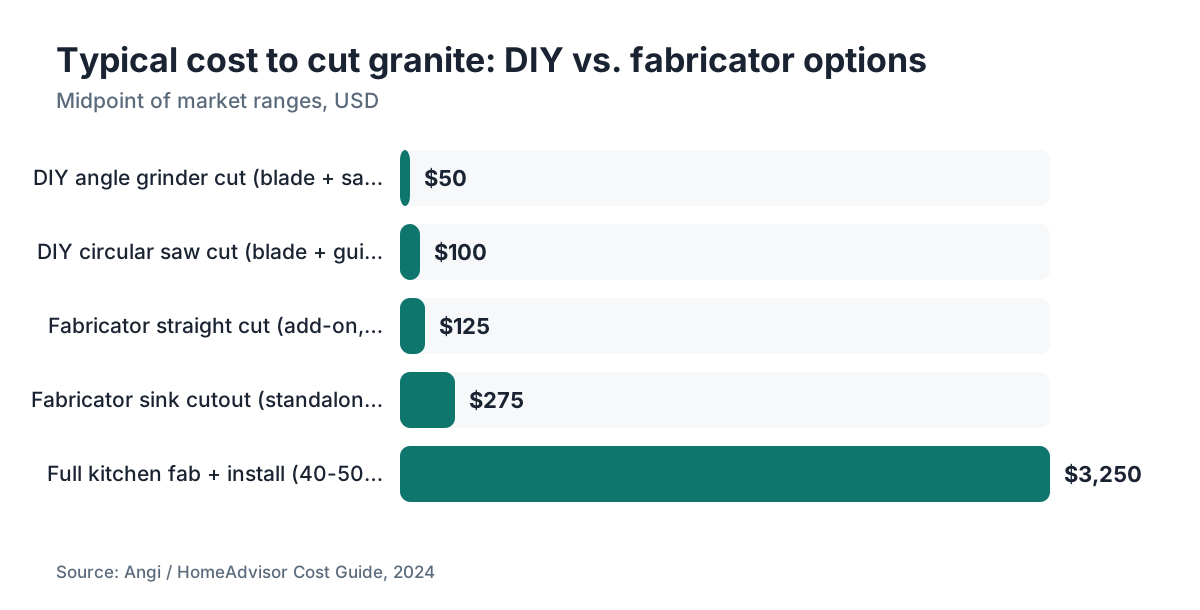
DIY runs $20 to $150 in materials if you own the tools. A fabricator will trim a simple straight edge for $50 to $150 if you bring the piece in, a standalone sink cutout runs $150 to $400, and a full kitchen fabricated, cut, and installed runs $1,500 to $5,000+. The numbers below reflect real 2024 to 2025 market ranges and vary a lot by region, material, and shop.
| Option | Typical Cost | Notes |
|---|---|---|
| DIY angle grinder cut (materials) | $20 to $80 | Diamond blade + safety gear; no labor cost |
| DIY circular saw cut (materials) | $50 to $150 | Saw + blade + guide + safety gear |
| Fabricator straight cut (per linear foot) | $5 to $20 | Add-on cut to existing job; varies widely |
| Fabricator sink cutout (standalone) | $150 to $400 | Includes polishing the cutout edge |
| Full kitchen fabrication + cut + install | $1,500 to $5,000+ | 40-50 sq ft; material separate |
| CNC waterjet complex cutout | $200 to $800 | Curves, tight corners, unusual shapes |
The fabricator numbers come from industry pricing surveys and contractor cost aggregators [4]. The wide ranges track geography (NYC fabrication runs 30 to 50 percent above rural markets) and material (exotic imported granites carry higher cutting fees because the shop eats more breakage risk).
Already own a grinder? Your marginal cost for a simple trim is just a blade, $20 to $60. Have to buy the grinder too and you're at $100 to $200, close enough to a fabricator's add-on fee that it's worth calling your shop first. Plenty of fabricators will cut a simple straight trim for $50 or less if you carry the piece to them.
On full kitchens, hiring out is almost always the rational call once you price in the risk of cracking an $800 slab. The material alone can cost more than the labor to cut it.
What happens after the cut: polishing, sealing, and finishing the edge
A fresh-cut granite edge looks rough and chalky white from the grinding. Turning it into a finished polished edge takes time and the right march through abrasives.
Shops use an automated edge profiler, a machine that runs progressively finer diamond wheels along the edge in one pass. It puts down a consistent finish in 2 to 10 minutes per linear foot depending on the profile. Common profiles: eased (a softened square), beveled, bullnose (fully rounded), and ogee (an S-curve that eats labor and really wants a machine).
For a DIY repair or small cut, hand polishing with wet diamond pads works. The order: 50 grit to knock down saw marks, then 100, 200, 400, 800, 1500, 3000, then a 3000-grit buffing pad. Each grit has to remove the scratches from the one before it. Still see the last grit's pattern? You're not done with that step. Rush the sequence and you get a hazy edge that reads badly under light.
Seal after any cut. A fresh-cut edge is bare stone, and the polishing pads open up any tiny surface pores. Apply a penetrating granite sealer (not a topical coating) once the edge is fully polished and bone dry. Most residential granite wants sealing every 1 to 3 years anyway [8], so a fresh cut is a fine excuse to seal the whole top.
For ongoing stone care, our guides on how to clean stone countertops and how to clean quartzite countertops cover products and intervals.
Still deciding whether granite's cutting complexity is worth it over engineered surfaces? The granite countertops overview lays out the whole picture.
When should you hire a fabricator instead of attempting DIY?
Some cuts aren't just safer with a fabricator. They're the only reasonable path. Long slab cuts, slab-to-slab seams, tight-radius cutouts, and any rare or expensive stone all belong in a shop.
Any cut longer than 24 inches on a full slab needs a guide and ideally a track saw or wet bridge saw. Freehand long cuts on granite almost never come out straight enough to seam.
Seams between two slabs want both pieces cut on the same blade the same day when possible, because blade wear shifts the cut angle over time and a mismatch of even 0.5mm shows as a gap. Invisible seams are hard with professional gear, never mind by hand. A visible seam in a kitchen that cost $3,000 in material is a gut punch.
Curved cuts, cutouts with radii under 1.5 inches, cooktop openings with corners crowded close together, and any cutout within 3 inches of a slab edge all carry high breakage risk and belong on a CNC machine.
Rare, expensive, or irreplaceable remnant? Don't cut it yourself. The math is lopsided: a good DIY cut saves $100 to $300, and a cracked slab costs $500 to $2,000 in material plus whatever the reschedule costs you.
Volume shops track all of this in software. For fabricators building quotes that account for cutout complexity and edge profiles, SlabWise bakes cutout and edge pricing into the quote flow so nothing falls off an estimate.
Know where your skill and tooling run out. Granite doesn't give second chances.
Frequently asked questions
Can you cut granite countertops with a regular circular saw?
A standard circular saw cuts granite only after you swap in a diamond blade rated for hard stone. Steel or carbide wood blades won't work; they dull in seconds. Even with the right blade you get no water cooling, so cut in short passes with breaks. For anything past 12 to 18 inches, heat buildup becomes a real risk of cracking the slab or destroying the blade.
What is the best blade for cutting granite countertops?
A continuous-rim (turbo-rim) diamond blade with a soft metal bond, sized to your saw, is the best pick for clean finished cuts. Blades labeled for granite or hard stone beat generic masonry or concrete blades. Husqvarna, MK Diamond, Lackmond, and Bosch make reliable options in the $25 to $80 range. Skip bargain-bin blades with uneven diamond spacing; they chip granite instead of cutting it clean.
Can you cut granite with a grinder?
Yes. A 4.5-inch or 5-inch angle grinder with a continuous-rim diamond blade rated for stone is probably the most common DIY tool for small granite cuts. It handles trimming edges, opening a sink cutout a little, and short cuts. Control is the limitation: without a guide, long straight cuts are nearly impossible freehand. Always clamp a metal straightedge as a fence and keep the tool moving to hold down heat.
How do you cut granite without cracking it?
Support the slab fully before you start; granite has almost no tensile strength and cracks if it flexes. Use a continuous-rim diamond blade at a slow feed rate. Drill corner holes before sink or cooktop cutouts so inside corners get a radius instead of a sharp angle. Support the waste piece so it doesn't drop and shock the slab. Keep water on the cut line to manage heat. Rushing any of these is where cracks come from.
Do I need water when cutting granite?
You need cooling, and water is the standard way to get it. Pro wet saws run a continuous feed. For DIY dry cutting, manage heat by cutting in short 6 to 8 inch passes and stopping 20 to 30 seconds between them to let the blade and stone cool. With no cooling, the blade glazes, the bond breaks down, and the stone can crack from heat. Misting the line with a spray bottle between passes beats nothing.
How long does it take to cut granite countertops?
In a shop with a bridge saw, a full kitchen's cuts take 1 to 3 hours of machine time, not counting edge profiling and polishing. DIY is much slower thanks to mandatory cooling breaks and slower feed rates. A single 24-inch straight cut done carefully with an angle grinder and cooling breaks takes 20 to 40 minutes. A full sink cutout done safely by a skilled DIYer takes 1 to 2 hours with setup, corner drilling, and cleanup.
Is cutting granite dangerous?
Yes, in two specific ways. Granite holds crystalline silica; grinding or cutting throws off respirable dust that causes silicosis with repeated exposure. OSHA's 2016 silica standard requires water suppression or ventilation plus respirators for stone-cutting work. The second hazard is fragments: diamond blades throw chips at high speed. Wear a P100 respirator, ANSI Z87.1 goggles or a face shield, hearing protection, and cut outdoors or with dust extraction.
Can you cut granite countertops in place (already installed)?
Yes, but it's harder than cutting on a workbench. You can't flip the slab to cut from underneath, your tool angles are limited, and dust and water land on cabinets and floors. Small trim cuts and sink cutout expansions are the usual in-place jobs. Tape off the surrounding surface, have a helper manage water or a shop vac at the line, and expect a slightly rougher finish than a shop cut. Protect the cabinet boxes from water.
How much does it cost to cut a granite countertop?
DIY materials run $20 to $150 depending on whether you already own a grinder or saw and what blade you buy. A fabricator usually cuts a simple straight trim for $50 to $150 if you bring the piece to the shop. A standalone sink cutout runs $150 to $400 including polishing the inside edge. Full kitchen fabrication with all cuts, edge profiles, and installation runs $1,500 to $5,000 or more depending on square footage and region.
What grit sequence do you use to polish a freshly cut granite edge?
Start at 50 grit to remove saw marks, then work through 100, 200, 400, 800, 1500, and 3000 grit diamond hand pads, keeping the surface wet the whole time. Each grit must fully clear the scratches from the previous step before you move on. Finish with a 3000-grit buffing pass. The full sequence on a linear foot of edge takes 30 to 60 minutes by hand. Seal the edge when dry, since polishing opens surface pores.
Can you cut granite tile the same way as a granite slab?
Granite tile (usually 3/8 inch to 1/2 inch thick) is easier than a full 3cm slab because most contractor-grade wet tile saws can handle the depth. Same rules apply: diamond blade rated for hard stone, slow feed rate, continuous water cooling, and a continuous-rim blade for clean edges. Thinner material is less forgiving of chipping on the exit face, so cut finished face down and tape over the cut line.
What should I do if my granite cracks during cutting?
Stop immediately. A crack that's just started may not spread if you relieve stress: remove the blade, support the slab fully, and check whether the crack reaches an edge or runs through the full thickness. Hairline surface cracks on a cut face can sometimes be filled with clear epoxy and disappear after polishing. Full through-cracks, or cracks heading toward a sink cutout, are usually a total loss for that piece. Photograph it before touching anything if a shop is involved.
How do fabricators handle curved cuts in granite?
Fabricators use CNC routers with diamond core bits for curved internal cutouts and CNC waterjets for complex exterior curves. A waterjet cuts by mixing high-pressure water with garnet abrasive and follows any programmed curve to about plus or minus 0.005 inches. For gentle exterior curves, a skilled operator can rough the shape freehand with a grinder, then refine it with diamond hand pads. True inside corners under a 1.5-inch radius are nearly impossible without CNC equipment.
Does cutting granite void a warranty or sealer?
Slab warranties generally cover defects in the stone, not DIY damage, so cutting doesn't void a warranty that wouldn't have applied to your work anyway. Sealer warranties (if a shop applied a professional sealer) often require intact coverage; cutting through a sealed surface exposes raw stone at the new edge. Reseal any freshly cut or polished edge with a penetrating stone sealer once the surface is fully dry and polished.
Sources
- USGS National Minerals Information Center, granite and dimension stone data: Granite hardness of 6 to 7 on the Mohs scale, with quartz content ranging from 20 to 60 percent in most commercial granite
- ANSI B7.1, Safety Code for the Use, Care, and Protection of Abrasive Wheels: Diamond blade bond hardness requirements for hard stone cutting; soft bond required for hard materials like granite
- Natural Stone Institute, Dimensional Stone Design Manual: Nesting and material yield optimization in stone fabrication can reduce slab waste by 10 to 15 percent on complex kitchen layouts
- Angi, Granite Countertop Installation Cost Guide: Fabrication and installation for a typical kitchen (40 to 50 sq ft) runs $1,500 to $5,000 or more; fabrication labor $30 to $100+ per square foot depending on complexity
- OSHA, Occupational Exposure to Respirable Crystalline Silica Standard (29 CFR 1910.1053 and 1926.1153): OSHA permissible exposure limit for respirable crystalline silica is 50 micrograms per cubic meter as an 8-hour TWA; water suppression or LEV required for stone cutting, with respirators as supplemental control
- ANSI/ISEA Z87.1-2020, Occupational and Educational Personal Eye and Face Protection Devices: ANSI Z87.1 is the standard for eye and face protection rated against impact and flying fragments in cutting operations
- OSHA, Occupational Noise Exposure Standard (29 CFR 1910.95): OSHA 90 dB permissible exposure limit over an 8-hour day; hearing protection required above the 85 dB action level
- Natural Stone Institute, Care and Maintenance of Natural Stone: Most residential granite should be sealed with a penetrating sealer every 1 to 3 years depending on use and porosity
- CDC / NIOSH, silica and stone fabrication hazard information: Crystalline silica dust from cutting stone containing quartz causes silicosis, lung cancer, and other diseases with repeated respirable exposure; N95 or P100 respirators required as minimum when engineering controls are insufficient
- OSHA, Table 1 to 29 CFR 1926.1153, Specified Exposure Control Methods for Stone Cutting: OSHA Table 1 lists stationary and handheld masonry saws as requiring integrated water delivery, with a P100 respirator when dry cutting or where controls fall short
Last updated 2026-07-09