TL;DR
- A waterfall countertop runs a slab panel down one or both cabinet sides to the floor.
- Pricing one right means paying for extra square footage, a mitered corner joint, added waste from vein matching, and longer install time.
- Expect to add $400 to $2,000 per waterfall leg on top of the base countertop price, depending on material and whether veins have to line up.
What exactly is a waterfall edge countertop?
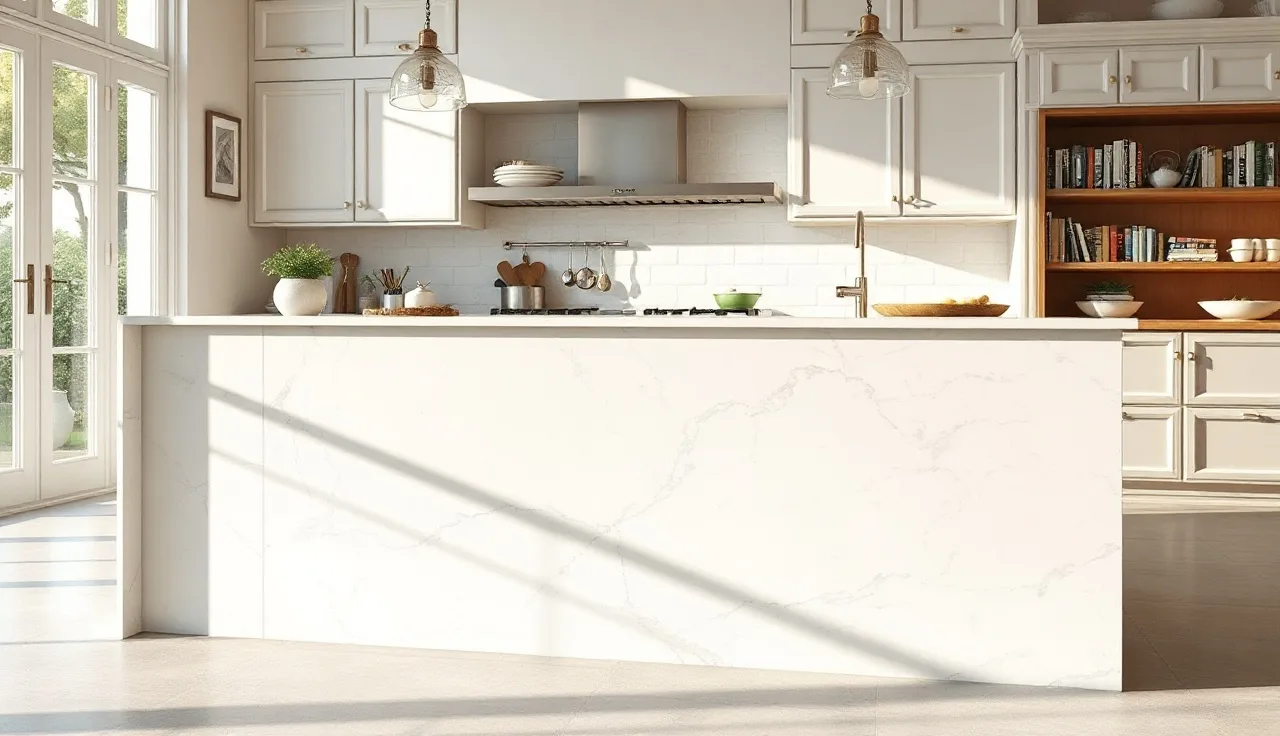
A waterfall countertop runs the field of the counter straight down the side of the island or cabinet to the floor, so the stone looks like it pours over the edge. You get a 90-degree mitered joint where the horizontal top meets the vertical leg, and both faces read as one continuous surface. One leg on one side is the most common setup. Two legs, one on each side, doubles the work.
The point is continuity. The stone pattern keeps moving from the top down the side panel. Sounds simple. The fabrication reality is that you now need a separate slab piece for each leg, you have to match veins across a 90-degree corner, and you have to cut a precise 45-degree miter on two edges that mate perfectly. None of that shows up in a plain square-footage price.
For homeowners reading this: a waterfall is not an edge profile. It is a separate structural element, essentially a side panel cut from the same stone and joined to the top. Price it like a fancy ogee edge and your fabricator loses money, or your quote arrives missing half the job.
What square footage do you actually measure for a waterfall bid?
Start with the horizontal top the way you always do, measuring the full footprint including any overhang, in square feet. Then add each waterfall leg as its own piece.
A waterfall leg is the depth of the counter times the floor-to-top height. Most kitchen islands run 25 to 36 inches deep. Call it 27 inches for a standard 36-inch-deep island with a 9-inch overhang, or measure the full island depth if the stone goes all the way to the cabinet edge. A standard 36-inch-high island means the leg is 36 inches tall. So one leg on a 27-inch-deep island is 27 x 36 inches, which is 972 square inches, or 6.75 square feet. Two legs add 13.5 square feet on top of your measurement.
That math looks clean. Yield is the trap. You almost never get to cut both legs from scrap or from a single slab without giving up the vein match. In practice a lot of shops burn one full slab on the two legs and the top, when the same top without a waterfall would come from half a slab. Price for that.
Measure the exposed bottom edge of each leg too. If the client wants it finished (polished, beveled, or eased), that linear footage adds to your edge pricing like any other exposed edge.
How much does material waste increase on a waterfall job?
This is the part most homeowners never hear and a lot of fabricators undercharge. A vein-matched waterfall needs the slab cuts to line up so the veining continues from the top down the leg. That means you plan every cut before the saw ever touches the stone.
On a standard countertop, a good estimator factors 15 to 25% waste for cuts, sink cutouts, and slab defects. On a vein-matched waterfall, waste runs 35 to 50% depending on the pattern scale and the island dimensions. A large-scale Calacatta marble with veins 12 inches apart forces your cuts into very specific spots, and that usually means sacrificing usable stone between them.
For a bookmatched waterfall, where the leg is a literal mirror of the top made by flipping the adjacent slab section, you often need two slabs from the same lot and block number. Some distributors will not split those. That is a real line item: two full slabs for a job that would otherwise take one.
Quartz and porcelain are kinder. The pattern repeat on engineered stone is short, so waste stays near normal. Natural stone is the opposite. On marble or quartzite with vein matching in scope, budget waste at 40% minimum.
What does the miter joint cost to fabricate?
The miter is the most labor-heavy single operation on a waterfall job. You cut a 45-degree bevel on the front edge of the horizontal top and on the top edge of the vertical leg, then bond those two faces so the seam disappears, or comes close.
In granite or quartzite, a clean miter needs a bridge saw cut followed by hand-polishing or CNC profiling on the cut face. The mitered surface has to match the top surface for polish, because any difference in flatness or sheen telegraphs straight through the joint. Most shops charge a per-joint fee for this rather than hide it in the square-footage rate.
Shop rates vary by region, but fabricators commonly quote miter joints at $150 to $400 each depending on stone hardness and whether CNC profiling is on hand. A two-sided waterfall has two joints. On something hard like quartzite, or a thick 3-centimeter or 2-inch slab, budget toward the top of that range. On softer marble, skilled hands move faster.
Adhesive matters too. Most shops use a two-part epoxy color-matched to the stone, sometimes with pigment mixed in to blend with the veining. Mixing, applying, clamping, and cleaning the joint is real labor. It is not a commodity step, so don't price it like one.
How do you price the labor for waterfall installation?
Setting a waterfall leg is a different animal from setting a standard top. The vertical panel has to sit plumb, flush with the front face of the cabinet, and co-planar with the front edge of the top. It also has to rest flat on the floor with no rocking, which means the floor is level or the bottom edge gets scribed to it.
A two-person crew that installs a standard kitchen in 3 to 4 hours will often spend 5 to 8 hours on a waterfall island. Part of that is wrangling large vertical stone panels, which are awkward and heavy. A 36 x 27-inch piece of 3-centimeter quartzite weighs roughly 90 to 110 pounds, and you are setting it on end. That takes gear: suction cups, a third hand, sometimes a simple jig to hold the panel while the adhesive cures.
Countertop installation labor runs about $40 to $100 per hour per crew member depending on region. At two people and 6 hours, that is $480 to $1,200 in labor for the waterfall portion alone, before you add the standard install labor for the top. If your shop bills a flat install rate, you need a separate line or a multiplier for waterfalls. A 1.5x to 2x bump on install labor is common.
What is the typical price range for a waterfall countertop job?
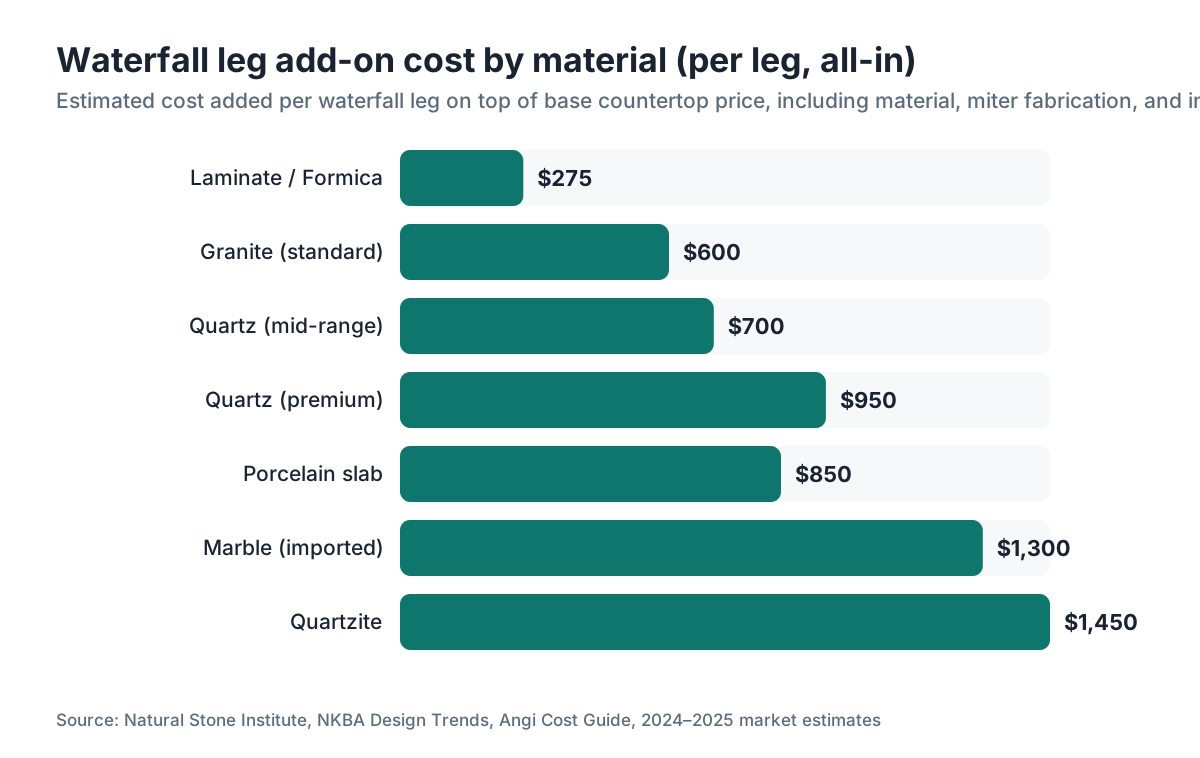
There is no single number, because material choice drives cost more than anything else. The table below gives realistic all-in ranges, material plus fabrication plus installation, per waterfall leg, by common material. These are 2024 to 2025 market estimates pulled from distributor pricing and fabricator trade data. Prices swing by region.
| Material | Base countertop price (per sq ft, installed) | Waterfall leg add-on (per leg, all-in) |
|---|---|---|
| Laminate / Formica | $25 to $45 | $150 to $400 |
| Quartz (mid-range) | $65 to $100 | $500 to $900 |
| Quartz (premium, e.g. Cambria) | $100 to $150 | $700 to $1,200 |
| Granite (standard) | $50 to $85 | $400 to $800 |
| Marble (imported) | $75 to $130 | $800 to $1,800 |
| Quartzite | $80 to $140 | $900 to $2,000 |
| Porcelain slab (thin format) | $70 to $120 | $600 to $1,100 |
For a typical quartz island with one waterfall leg, a homeowner should budget $1,500 to $3,500 total above the base countertop cost. Two legs can push that to $2,500 to $5,000 extra, more on high-end stone.
Fabricators, here is a clean check: if your quote lands below the low end on natural stone, you probably forgot to price miter labor, waste, or install time separately. Those three items together commonly make up 40 to 60% of the waterfall premium.
How should a fabricator structure the line items in a waterfall bid?
A clean waterfall bid has at least these separate lines, each priced on its own so the client sees exactly what they are buying:
- Horizontal top material and fabrication (standard square footage times your per-foot rate).
- Waterfall leg material, one line per leg, showing the square footage of each piece.
- Waste or yield surcharge if the job needs a second slab for vein matching. Be blunt: "Second slab required for vein match, net usable 18 sq ft, priced at cost plus 15% handling."
- Miter joint fabrication, per joint.
- Edge finishing on the bottom of each leg, linear feet times your edge rate.
- Installation labor, broken out from standard counter install, with estimated extra hours shown.
- Structural backing if the vertical panel needs substrate support. Some thin porcelain waterfall panels need a plywood or aluminum honeycomb backer, and that is real cost.
Clients who see one lump-sum number for a waterfall push back, because they cannot tell what changed. Itemized bids close faster and cut down on change-order fights. They also protect you if the scope shifts mid-job.
For shops running quoting software, this is where a tool like SlabWise pays for itself. You set up waterfall legs as a configurable add-on with waste multipliers and miter fees built in, so your estimator is not doing mental math under pressure on a sales call.
Does slab thickness change the waterfall price?
Yes, and more than most people expect. Countertops come in two common thicknesses: 2 centimeter (roughly 3/4 inch) and 3 centimeter (roughly 1-1/4 inch). Some shops also build 4-centimeter mitered tops or laminated edges to fake a 2-inch-thick slab.
3-centimeter material weighs more (a square foot of 3 cm granite runs about 18 to 19 pounds), handles worse as a vertical panel, and costs more per slab. But it makes a structurally sound waterfall leg without substrate backing. 2-centimeter material is lighter and cheaper per square foot, and a 36-inch-tall vertical panel in 2 cm stone has real flex risk unless it is bonded to a backer. Add backer material and adhesive to the price if you are spec'ing thin stone.
Laminated edges (two layers of 2 cm glued at the perimeter to look like 4 cm) show up on the top but rarely on the waterfall leg face, because the lamination seam would be visible along the leg's top edge. Keep that in mind when a client asks for a laminated-look top paired with a waterfall.
What can go wrong on a waterfall job, and how do you price for risk?
Three failure modes show up most in the field.
First: a bad miter joint. If the two faces are not perfectly co-planar when glued, you get a visible ridge or gap at the corner. Fixing it after the adhesive sets usually means grinding, which risks the polished surface. Price in time for a dry-fit before final bonding. Some shops charge a dry-fit labor fee outright, others fold it into the miter rate.
Second: slab breakage during handling. A 36 x 27-inch panel standing on end is fragile at the corners and along any natural fissure. Marble fissures more than granite or quartzite. Put a breakage clause in your contract, or carry a spare cut piece if the slab run allows. This risk should shape your margin, not become a line the client sees.
Third: an out-of-level floor. If the finished floor is off by more than 1/8 inch across the width of the waterfall leg, the panel will not sit flat. Scribing the bottom edge fixes it but adds labor and leaves a thin feathered edge that chips easily. Price in a site-check visit, or put language in the contract making floor leveling the GC's job before stone goes in.
A general risk contingency of 10 to 15% on top of direct costs is fair for one-off jobs like bookmatched waterfall islands. That is not padding. It is honest accounting for work where one mistake can eat the whole margin.
How do homeowners get a fair price and avoid being overcharged?
Get three itemized quotes. Not three lump sums. Three quotes that show the square footage of each piece, the waste assumption, and the miter and install fees as separate lines. If a fabricator won't itemize, that tells you something.
Know the material tier you are buying. A Calacatta marble waterfall and a mid-grade quartz waterfall don't compete on price, and a suspiciously cheap marble quote usually means the shop never priced the vein-matching work. Ask straight: "Is vein matching across the joint included?" and "Will you need a second slab?"
For a standard quartz island with one waterfall leg, a fair market price in most U.S. metros in 2024 to 2025 runs $3,500 to $6,000 total including installation. Below $2,500 on quartz should prompt questions. Above $8,000 on a single quartz island is probably over-market unless the material is very high-end or the island is huge.
Countertop pricing varies by material and region. See the guides on kitchen countertops, marble countertops, and granite countertops. For a Cambria countertops waterfall specifically, Cambria's engineered stone has consistent patterning that makes vein matching easier than natural stone, which should show up as slightly lower waste costs.
Ask about the seam location. Some fabricators try to put the miter seam on the top surface instead of at the corner. That is almost always the wrong call. The joint belongs at the corner or on the underside of the top's overhang.
Are there material types that are easier or harder to waterfall than others?
Easier: engineered quartz and porcelain slab. Both have repeating patterns with a short pitch, so matching across a joint works without buying two full slabs. Porcelain is also light (about 7 to 9 pounds per square foot in 6 mm thickness), which helps when you are handling a vertical panel.
Moderate: granite. Most granite has fairly random crystalline patterning, so a vein-match requirement is unusual. The joint just needs to be clean and color-consistent. Granite's hardness makes the miter slower to polish, but the material risk is lower than marble.
Harder: marble, quartzite, and any bookmatched slab. Large-scale veining demands careful layout, a possible second-slab purchase, and precise cutting. Quartzite is very hard, often harder than granite, so saw blades wear faster and miter polishing drags on.
Laminate is a different beast: the material is thin, bendable, and usually wrapped around a substrate, so the fabrication looks more like cabinetry than stone. Prices are much lower and so is the look. See the laminate countertops guide if that material is in scope.
Butcher block can be waterfall-configured too, though it is almost always done with a wood joint rather than a stone miter, and it moves with moisture in ways stone doesn't. See butcher block countertops for that.
For countertop installation in general, the same principles of level setting, substrate prep, and seam placement apply to waterfall jobs, just turned up.
What markup should fabricators apply to waterfall jobs?
Standard shop markup on countertop material runs 30 to 50% over cost in most markets. On waterfall jobs, a lot of experienced fabricators put a higher markup on the waterfall components (leg material, miter labor, extra install time), because the margin for error is thin and the work takes real skill.
50 to 65% markup on the waterfall leg material is defensible when vein matching is required. The logic: you buy more slab than you use, you can't easily recoup the waste on another job, and the skill premium is genuine. Be ready to explain that to a client who asks.
Don't discount waterfall jobs to win them. A waterfall island is a prestige item. Clients who want one have already decided to spend. Discounting reads as uncertainty. What they want is competence and a clear scope.
For shops juggling multiple quotes, template-based pricing with waterfall as a configurable option (rather than a fresh custom calculation each time) cuts estimating time and reduces the odds of dropping a cost element. SlabWise's quoting software lets you set waterfall parameters once (waste multiplier, miter fee, install adder) and apply them every time. That consistency also helps later, when you review historical jobs to see whether your waterfall pricing actually hit your margin targets.
Frequently asked questions
How much extra does a waterfall edge add to the cost of a countertop?
Budget $400 to $2,000 extra per waterfall leg depending on material. Quartz waterfalls typically add $500 to $1,200 per leg over the base countertop cost. Natural stone like marble or quartzite adds $800 to $2,000 per leg because of higher waste, vein-matching complexity, and harder miter work. Two-sided waterfalls roughly double those numbers.
How many square feet does a waterfall leg add to a countertop job?
Multiply the counter depth by the counter height for each leg. A standard 27-inch-deep island at 36-inch height gives a leg of 972 square inches, or 6.75 square feet per leg. Two legs add 13.5 square feet. Add that to your horizontal top measurement, then apply your waste multiplier: 35 to 50% for vein-matched natural stone, 15 to 25% for quartz.
What is a miter joint and how much does it cost on a waterfall countertop?
A miter joint is the 45-degree bevel cut on the top's front edge and the waterfall panel's top edge that meet at the corner, creating a tight seam with no visible substrate. Fabricators typically charge $150 to $400 per miter joint depending on stone hardness and whether CNC equipment is on hand. A two-sided waterfall has two joints.
Do I need a second slab for a vein-matched waterfall?
Often yes, especially on natural stone with large-scale veining. A bookmatched waterfall needs the leg cut to mirror the adjacent top cut, which demands precise layout before sawing. Many jobs use enough of one slab that the legs have to come from a second slab in the same lot. Price this as a separate line item in your bid.
Is a waterfall countertop harder to install than a standard countertop?
Yes, a lot harder. Setting a large vertical stone panel plumb, level, and flush with the cabinet face while bonding a mitered joint takes more crew time and often a third person or mechanical assist. A job that takes 3 to 4 hours for a standard island can run 5 to 8 hours with a waterfall. Price install labor with a 1.5 to 2x multiplier on the waterfall portion.
What stone materials work best for waterfall countertops?
Engineered quartz and porcelain are the most forgiving: consistent patterning cuts waste and vein-matching demands. Granite is moderate: random crystalline patterns mean a clean joint matters more than pattern continuity. Marble and quartzite are the hardest: large-scale veining needs careful layout and often a second slab. All can be done well; the price difference reflects real fabrication complexity.
Should the miter seam be on top of the counter or at the corner?
At the corner. The joint should land right at the 90-degree turn so neither the top surface nor the leg face shows the seam under normal viewing angles. Some fabricators place it on the underside of the overhang to hide it further. A seam on the top surface is almost always an aesthetic compromise worth pushing back on.
Does slab thickness (2 cm vs 3 cm) affect waterfall pricing?
Yes. 3-centimeter material costs more per slab and weighs more (about 18 to 19 pounds per square foot for granite), but makes a structurally sound vertical panel without substrate backing. 2-centimeter panels often need a plywood or aluminum honeycomb backer to stop flex, which adds material and labor cost. Factor in backing if you are spec'ing 2-cm material for waterfall legs.
How should I quote waste on a waterfall job?
Standard countertop waste is 15 to 25%. For a vein-matched natural stone waterfall, budget 35 to 50%. The premium exists because cuts must land at specific slab positions to align veins across the joint, leaving unusable stone between useful sections. On engineered quartz with a short pattern repeat, 20 to 30% is more realistic. Always show the waste multiplier as an explicit line in the bid.
Can you do a waterfall edge on laminate countertops?
Yes, but the method is nothing like stone. Laminate waterfall panels are usually made by wrapping the laminate surface over a particleboard or MDF substrate, with a post-formed corner or a separate vertical panel butted at the corner. It is more cabinetry than stone fabrication, and prices are much lower, typically $150 to $400 per leg all-in.
What is the profit margin on a waterfall countertop job?
Priced right, a waterfall job should hit the same gross margin as your standard work, typically 40 to 55% for most stone shops. Many shops earn less because they underprice the waste, miter labor, and install time. Tracking actual costs on finished waterfall jobs against your quotes is the only way to know if your pricing model works.
How do I explain a waterfall price premium to a homeowner?
Break it into three honest parts: more raw material (the leg pieces plus waste), specialized fabrication (the mitered joint takes longer and needs more skill than a standard edge profile), and longer installation (setting a vertical panel correctly takes extra crew time). Most homeowners accept a clear explanation far better than a lump-sum premium with nothing behind it.
Does a two-sided waterfall cost exactly twice a one-sided waterfall?
Close but not exactly double. Material and miter costs roughly double. Installation labor on the second leg is somewhat faster than the first, because the crew is already set up and has the process dialed in. A 1.7 to 1.9x multiplier on total waterfall cost (not the full job cost) is a reasonable working estimate for two-sided versus one-sided.
What should be in a waterfall countertop contract to protect the fabricator?
Include the exact square footage and piece count, the vein-match spec (bookmatched, color-matched, or no match required), a statement of who is responsible for floor levelness before installation, a clause on the risk of natural stone breakage during handling, and payment terms tied to approval of the dry-fit before final bonding. Clear scope prevents most disputes.
Sources
- NAHB, "Cost of Constructing a Home" report: Standard material waste on countertop fabrication jobs is commonly estimated at 15 to 25% of gross square footage before accounting for special features
- Marble Institute of America (now Natural Stone Institute), Fabrication & Installation Standards: Miter joint fabrication on natural stone requires polishing the mitered face to match the field finish; industry labor estimates for this operation range from $150 to $400 per joint
- U.S. Bureau of Labor Statistics, Occupational Employment and Wage Statistics, Stone Cutters and Carvers: Stone cutters and related installation trades earn median hourly wages that support shop billing rates of $40, $100 per crew hour for countertop installation labor
- Natural Stone Institute, "Natural Stone Weights and Properties" technical reference: Granite at 3-centimeter thickness weighs approximately 18 to 19 pounds per square foot
- Tile Council of North America, Porcelain Tile Certification Agency specifications: Porcelain slab in 6-millimeter format weighs approximately 7 to 9 pounds per square foot, making it significantly lighter than natural stone for vertical panel applications
- U.S. Census Bureau, American Housing Survey: Kitchen remodeling is one of the most common home improvement projects, with countertop replacement among the most frequently cited upgrades
- National Kitchen and Bath Association, Design Trends Report: Waterfall-edge islands have been cited in NKBA trend surveys as a top kitchen design feature requested by homeowners in recent years
- Occupational Safety and Health Administration (OSHA), Silica in Construction standard (29 CFR 1926.1153): Stone fabrication involving cutting of natural or engineered stone is covered under OSHA's silica exposure standard, requiring engineering controls during dry cutting operations
- HomeAdvisor / Angi, Countertop Installation Cost Guide: Installed quartz countertop prices in the U.S. range from approximately $65, $150 per square foot in 2024, with premium materials and special features adding substantially to that base
Last updated 2026-07-09