TL;DR
- Custom quartz countertops are engineered slabs made from roughly 90 to 95% crushed quartz bound with polymer resin.
- They cost $50 to $150 per square foot installed, driven by edge profiles, thickness, and brand.
- They're harder to scratch than marble and never need sealing.
- The catch: they can't take sustained heat above 300°F, and the pattern looks uniform instead of truly natural.
What exactly is a custom quartz countertop?
A quartz countertop is engineered stone, not a slab pulled from a quarry. A manufacturer blends crushed quartz aggregate (roughly 90 to 95% by weight) with polyester or epoxy resin, pigments, and sometimes glass or mirror chips, then compresses that mixture under vacuum and vibration and cures it in an oven [1]. What comes out is a non-porous surface with a Mohs hardness near 7, about the same as granite and harder than marble [9].
"Custom" here means a fabricator cuts, edges, and finishes the slab to your exact kitchen or bathroom, instead of you buying a pre-cut drop-in piece. You pick the color, the edge profile, the thickness (2 cm or 3 cm is standard, 4 cm shows up on certain waterfall islands), and the cutouts for sinks and cooktops. The raw slab comes from a brand like Caesarstone, Cambria, Silestone, or MSI. The fabricator handles everything after that.
Because the color and pattern are built in, two slabs from the same production run look nearly identical. That consistency is exactly what some homeowners love and others find too predictable next to natural stone. Neither reaction is wrong.
How much do custom quartz countertops cost?
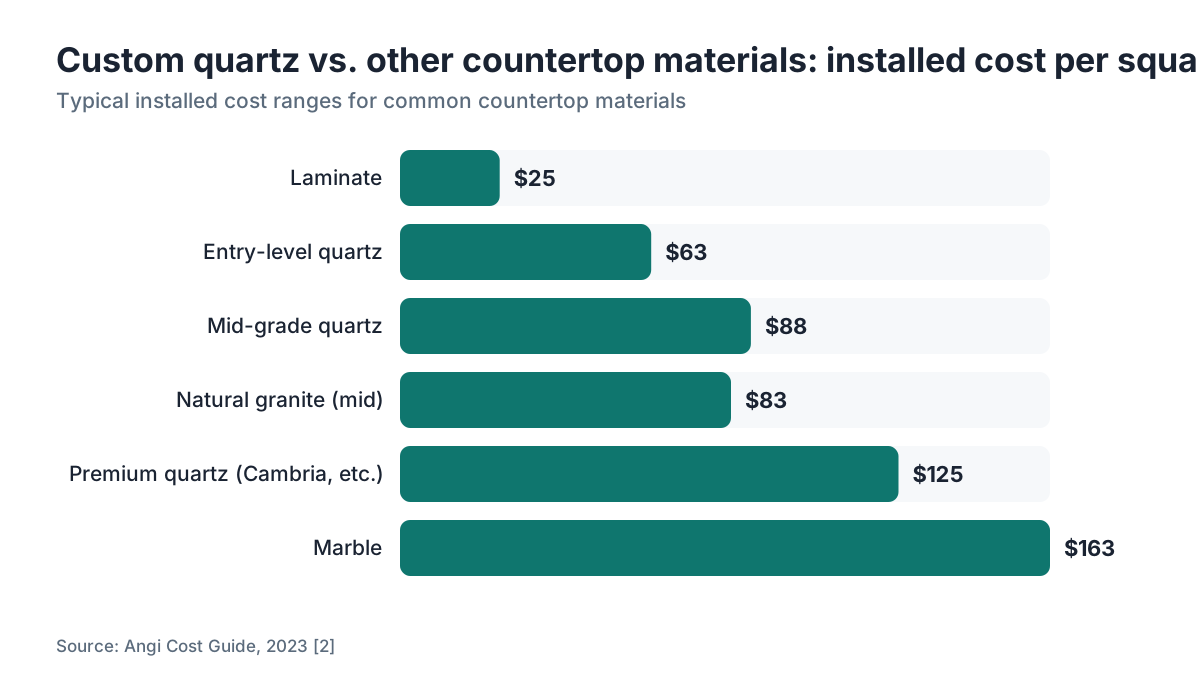
Installed cost runs $50 to $150 per square foot, and most kitchens land in the $75 to $125 range [2]. A midsize kitchen with 40 square feet of countertop comes out to roughly $3,000 to $5,000 all-in at mid-grade quartz. Add an island, waterfall edges, and a premium brand, and a large kitchen jumps to $8,000 to $12,000.
Here's how quartz stacks up against other materials:
| Material | Typical installed cost per sq ft |
|---|---|
| Laminate | $10, $40 |
| Tile | $20, $50 |
| Entry-level quartz | $50, $75 |
| Mid-grade quartz | $75, $100 |
| Premium quartz (Cambria, Caesarstone top line) | $100, $150 |
| Natural granite (mid-grade) | $55, $110 |
| Marble (installed) | $75, $250 |
A few line items drive the number up fast. Waterfall edges, where the slab wraps vertically down the side of the cabinet, add material plus miter work, often $200 to $600 per waterfall section. A mitered 4 cm edge that fakes a thick slab bonds two pieces of 2 cm material face-to-face, which adds labor. Undermount sink cutouts run $100 to $250 per sink. Cooktop cutouts cost about the same.
Fabricators price by the square foot of finished countertop, and most set a minimum job size (commonly 15 to 20 sq ft) because templating, delivery, and setup cost the same no matter how small the job. So a 10 sq ft bathroom vanity often costs nearly what a 20 sq ft one does at the same shop [3].
If you want a fabricator's view of what pushes quotes up or down, the quoting tools at SlabWise let shops model edge profiles, cutouts, and material tiers so the line items stay visible instead of buried in one lump number.
Which quartz brands are worth the premium?
Cambria is the only major quartz manufacturer that's entirely US-owned and US-made, with production in Le Sueur, Minnesota [4]. Its warranty (lifetime, transferable) is the best in the category, and its slabs run large, which matters for a big island. Cambria countertops sit at the high end, $100 to $150 installed.
Caesarstone is an Israeli company that started the engineered quartz category in 1987 and still holds real market share. Its porcelain-quartz hybrid lines are worth a look for outdoor kitchens because they handle UV better than standard resin-bound quartz.
Silestone (owned by Cosentino in Spain) added an antimicrobial silver compound to some lines. That sounds impressive, but the real-world benefit over just cleaning a normal surface is modest at best. Its HybriQ technology uses 20% recycled water and 99% renewable energy in production, which counts if sustainability drives your purchase [10].
MSI and Vicostone are the value plays, often $50 to $85 installed, and the quality gap behind the premium brands is smaller than the price gap. On a tight budget, MSI Q Premium is a fair pick.
For most kitchens, mid-grade quartz from any of these brands behaves about the same day to day. The premium names win on pattern variety, slab consistency, and warranty terms, not on how well the surface holds up to a busy kitchen.
How does custom quartz compare to granite, marble, and other countertop materials?
The honest comparison turns on what you actually care about.
Versus granite: Granite is natural stone, so every slab is one of a kind, which pulls in buyers who want something nobody else has. Granite needs sealing every 1 to 3 years; quartz never does. Granite takes heat better, because the resin in quartz starts to fail above about 300°F while granite shrugs off higher temps [5]. Mid-grade pricing is close between the two. Granite countertops covers that side in depth.
Versus marble: Marble is porous and scratches easily. It etches (dulls) the moment acidic liquids like lemon juice or wine sit on it. Quartz has none of those problems. But marble has movement and veining that even the best "Calacatta" quartz can't fully copy. Marble costs more and asks more of you. See marble countertops for the full breakdown.
Versus laminate: Laminate costs a fraction of quartz ($10 to $40 per sq ft installed) and has gotten much better with high-pressure laminate (HPL). It still scratches and can't be repaired. Quartz lasts longer and takes harder use. Laminate countertops and Formica countertops are worth reading if budget is the main driver.
Versus solid surface (Corian): Solid surface can be sanded to erase scratches, which quartz can't. Quartz is harder and more heat-resistant than solid surface. Corian countertops explains the repair edge more fully.
Versus butcher block: A completely different use case. Wood is warm, knife-friendly, and repairable. It needs oiling and isn't happy around a wet sink. Butcher block countertops helps if you're mixing materials in one kitchen.
The short version: quartz is the lowest-maintenance engineered option at a mid-range price. It doesn't win every category. It loses the fewest.
What are the real drawbacks of quartz countertops?
Heat is the big weakness. The polymer resin that binds the quartz particles starts to discolor or crack somewhere above 300°F [5]. A pan pulled straight from the oven and set on the surface can leave a permanent white or yellow mark. Trivets aren't optional with quartz. They're required. This is the single most common way people void a warranty.
UV exposure wears the resin down too. Quartz installed outdoors or in a sunroom near direct sun yellows over time. Most warranties flat-out exclude outdoor installation. For an outdoor kitchen, look at porcelain slabs or granite instead.
Quartz chips at edges if you hit it hard. A sharp square edge is the most exposed spot. Rounded or eased edges resist chipping a little better than a strict 90-degree corner.
The pattern doesn't fool a trained eye. Engineered quartz has improved a lot, and some current patterns look genuinely convincing at a glance. Stare at the surface long enough, though, and you can usually spot the repeat that natural stone never has.
Repair is harder than people expect. Chips fill with color-matched epoxy kits, but the patch is rarely invisible. Cracks from impact or bad support need a pro or a full slab replacement. Unlike solid surface, you can't sand quartz back to new.
How is a custom quartz countertop templated and installed?
It starts with a template. After the cabinets are set and level, a fabricator comes out to measure. Most shops now use a digital laser templating device (Laser Products Industries' LT-2D3D is common) that maps every wall, corner, and appliance to the millimeter. Some still cut a physical template from luan or cardboard strips. Either way, the template locks in the exact shape so the slab gets cut right the first time.
Back at the shop, a CNC machine cuts the slab from the template file. A router or edge polisher shapes the profile. Sink cutouts get a mix of CNC routing and hand finishing. A good fabricator dry-fits the whole job before loading the truck.
Install day takes two to four people depending on weight. A 3 cm quartz slab runs roughly 18 to 22 lbs per square foot, so a 40 sq ft section weighs 700 to 880 lbs [11]. The crew carries the pieces in, sets them on the cabinets, checks the fit, and tightens up the seams. Silicone adhesive holds the slab to the cabinet. Seams between sections fill with color-matched epoxy and polish flush. The sink gets mounted and caulked.
From template to finished install usually runs 1 to 2 weeks, though a busy shop in peak season (spring and fall) can be booked 3 to 4 weeks out [3]. See countertop installation for a closer look at install day.
For kitchen countertops specifically, the timeline mistake people make most is templating too early. Don't template until the cabinets are fully set and level, or the template won't fit.
What edge profiles are available and how much do they cost?
Edge profile is one of the bigger style calls in a quartz project, and it moves the price more than people expect. An eased edge (a slight bevel on the top corner) is the baseline that most fabricators fold into the base price. An ogee (an S-curve) adds $10 to $25 per linear foot. A waterfall mitered edge, where the island face drops straight to the floor, adds the most: $200 to $600 per side depending on run height and whether it needs piecing.
Common edge options:
| Profile | Typical upcharge per linear ft |
|---|---|
| Eased / straight | $0 (usually included) |
| Beveled (1/4" or 1/2") | $5, $12 |
| Bullnose (full round) | $8, $15 |
| Ogee | $12, $25 |
| Dupont / reverse ogee | $12, $25 |
| Laminated (mitered 4 cm look) | $20, $40 |
Thicker looks are having a moment. A 4 cm mitered edge (two 2 cm pieces bonded face-to-face so the edge reads 4 cm tall) gives that chunky, substantial feel designers keep specifying on islands. It costs more, but the visual weight is real.
For most people, an eased or slight bevel edge is honest and clean. Fancy profiles trap grease and take longer to wipe down. That's a practical opinion, not a design law.
How do you maintain and clean custom quartz countertops?
Daily cleaning is simple: warm water, a soft cloth or sponge, a little mild dish soap when needed. Quartz is non-porous, so it doesn't soak up stains the way marble or granite can [5]. You never seal it.
For dried food or grease, use a non-abrasive surface cleaner and a plastic scraper. Skip full-strength bleach, though diluted bleach (1 tablespoon per quart of water) used briefly for sanitizing is generally fine if you rinse it off quickly. High-pH cleaners like oven cleaner can dull the resin.
Steel wool and abrasive pads scratch the polish. Permanent marker and some dyes stain if they sit long enough, but usually wipe off with isopropyl alcohol.
The routine here is far simpler than for quartzite or soapstone. If you want to see how other stone surfaces compare, how to clean quartzite countertops, how to clean soapstone countertops, and how to clean stone countertops are useful reads.
One thing people miss: don't reach for Windex or other ammonia-based glass cleaners on a regular basis. They slowly break down the surface sheen. Use a cleaner made for engineered stone if you want to go past soap and water.
Does quartz add resale value to a home?
It helps, but not dollar for dollar. Remodeling Magazine's Cost vs. Value report consistently shows a major kitchen remodel recoups roughly 54 to 60% of its cost at resale nationally, and countertops are only one piece of that [6]. Buyers notice the counters. They rarely pay a premium that matches what you spent.
Quartz has strong buyer recognition. "Quartz countertops" is a phrase buyers actively filter on in listing platforms like Zillow. A dated laminate kitchen can drag down a sale; a clean quartz kitchen reads as move-in ready, which shortens time on market more than it lifts the price.
Here's the practical call: if you're installing quartz purely as a resale play, pick a neutral color. White and light gray (Calacatta whites, soft gray veining) hit the widest buyer pool. Dark, heavily patterned slabs split opinion.
If you're installing for yourself and resale is a distant second, buy the one you'll enjoy looking at every morning.
What questions should you ask a fabricator before signing a contract?
Before you sign, get clear answers on these.
What's included in the square-foot price? Ask flat out whether the basic edge, sink cutout, cooktop cutout, and seam placement are included or billed as separate lines. Shops vary wildly on this.
How is waste calculated? Most fabricators charge for the full slab, or for the slab area needed including cutout waste, which is more than your finished countertop area. A big island can force a second full slab even when the square footage seems to fit one, because of how the pieces lay out.
Where will the seam fall? An L-shape or a long run will have seams. Ask to see where they land before the template gets cut. A good fabricator puts seams in less visible spots and matches the pattern across them.
What's the turnaround right now? Get a written date. Spring and fall are peak, and timelines stretch.
What's the warranty on fabrication, separate from the manufacturer's material warranty? A fabricator should back their own work for at least a year.
Can I see the actual batch, more than a display board? Color and veining shift between production runs. On a large project, ask to see the real slabs you'll get.
Shops running quoting software like SlabWise can show a line-item quote with material, edge, cutout, and labor broken out, which makes comparing bids apples to apples much easier.
Get at least three quotes. Fabrication pricing isn't standardized, and regional variation is real. A $30-per-square-foot spread between shops in the same city is common.
Are there health or safety concerns with engineered quartz?
The concern is silica dust in fabrication shops, not the finished countertop in your home. The US Occupational Safety and Health Administration (OSHA) set a permissible exposure limit for respirable crystalline silica of 50 micrograms per cubic meter of air, measured as an 8-hour time-weighted average, effective 2018 [7]. Cutting and grinding quartz throws off silica dust that can blow far past that limit without proper controls, and there have been reported cases of silicosis among countertop fabricators.
For a homeowner with installed quartz, there's no documented health risk from the finished surface under normal use. The silica is locked in cured resin. It doesn't release as dust during cleaning or everyday cooking.
If you run a shop, OSHA's standard calls for wet cutting, local exhaust ventilation, and respiratory protection when engineering controls aren't enough [7]. This is a genuine occupational health problem in the trade, and it's one reason more shops have moved to water-fed CNC tables and enclosed cutting areas.
California fabricators face extra state-level rules under Cal/OSHA, one of the more aggressive state programs on silica enforcement [8].
How do I pick the right quartz color for my kitchen?
Start with your cabinets and flooring. Quartz is the connecting surface, so it has to read well against both. Light cabinets (white, cream, light gray) pair easily with almost any quartz tone. Dark cabinets (navy, forest green, deep espresso) look sharp under light quartz that gives contrast, and can still work with dark quartz if the floor provides enough relief.
Samples look different under showroom lighting than under your own kitchen's. Take full-size samples home. A 12x12 inch sample is the smallest that's useful; many fabricators will loan out larger pieces.
Veining scale matters. A small kitchen (under 150 sq ft) gets swamped by large-scale veining that looks great in a big open plan. Smaller, subtler patterns tend to age better and sell better.
White and light quartz show every crumb and water spot right away, which some people love (instant feedback on the mess) and others hate (constant wiping). Darker quartz hides crumbs but shows dust and water spots differently. Neither is truly easier. It comes down to what bugs you more.
The most popular colors right now lean toward whites with soft gray veining (the Calacatta look), warm whites with gold veining, and soft greens. Trends move, but classic Carrara-style patterns have held steady for a decade and are a safe long-term bet.
Frequently asked questions
How long do custom quartz countertops last?
With normal use and reasonable care, quartz countertops last 20 to 30 years or longer. The surface doesn't break down the way natural stone can because it's non-porous and resin-sealed at the factory. The most common causes of early failure are heat damage from hot pans (which discolors the resin binder) and impact chips on edges. Cambria and Caesarstone both offer lifetime limited warranties on material defects.
Can quartz countertops be repaired if they chip or crack?
Small chips fill with a color-matched epoxy or acrylic repair kit sold by stone repair suppliers. The patch is rarely invisible but works. Larger cracks or serious impact damage usually mean replacing a section. Unlike solid surface, you can't sand quartz back to a fresh surface. For anything visible, hire a fabricator who does stone repair rather than attempting a DIY fix.
Does quartz need to be sealed?
No. Quartz is manufactured non-porous and never needs sealing, at installation or after. That's one of the clearest advantages over natural granite and marble, both of which need periodic sealing. Applying a granite sealer to quartz is harmless but pointless. Save the time and the money.
Can you cut directly on quartz countertops?
You can, and quartz is hard enough that a knife won't mark it quickly. But don't. Cutting on quartz dulls your knives much faster than a wood or plastic board, because quartz (Mohs 7) is harder than knife steel. Use a cutting board. The quartz wins every time, at the cost of your blade edge.
What thickness should I choose for quartz countertops?
Most residential kitchen counters use 3 cm (about 1.25 inches) slabs. It's the standard because it's rigid enough for typical spans without extra support and looks substantial. Two-centimeter slabs are thinner and cost a bit less but need plywood underlayment for support. The 4 cm look is faked by mitering two 2 cm pieces together at the edge, usually on islands where visual weight is the point.
How do I get an accurate quote for custom quartz countertops?
The most accurate number needs an in-person template, but you can get a solid ballpark by measuring your countertop footprint (length by depth of each section, in square feet), listing every edge profile you want, and counting sink and cooktop cutouts. Share that with at least three fabricators. Watch for quotes that bundle everything versus quotes that itemize. Bundled ones often hide upcharges that surface at invoice time.
Is quartz better than quartzite?
They're different materials. Quartz is engineered stone; quartzite is natural metamorphic rock. Quartzite is harder (Mohs 7 to 8), handles heat better, and has natural variation quartz can't copy. Quartzite needs sealing and costs more, typically $80 to $200 installed per square foot. Quartz is easier to maintain and more consistent in look. Neither is universally better. Your priorities on maintenance, looks, and budget decide it.
Can quartz countertops go outside or in a sunroom?
Most quartz manufacturers void warranties on outdoor installs. The polyester or epoxy resin binder yellows and degrades under prolonged UV. Direct sun through a sunroom window causes the same problem over time. For outdoor kitchens or sun-drenched spaces, porcelain slab or granite is the better call. Some porcelain-quartz hybrids from Caesarstone are rated for outdoor use, but confirm UV ratings with the specific manufacturer first.
What is the difference between quartz and porcelain countertops?
Porcelain countertops are fired ceramic clay, which makes them extremely hard (Mohs 7 to 8), fully heat-resistant, and UV-stable. Quartz uses crushed stone bound with resin, which leaves it somewhat heat- and UV-sensitive. Porcelain slabs are thinner (usually 6 or 12 mm), lighter per square foot, and need specialized fabrication tools. Quartz is more widely available and easier for most shops to work. Porcelain is growing in outdoor kitchens because of that UV resistance.
How do I compare quartz countertop bids from different fabricators?
Make sure each bid covers the same scope: same slab brand and grade, same thickness, same edge profile, same cutout count, same template and delivery terms. Price per square foot only means something when those match. Ask each shop how they handle seam placement and what happens if something chips during installation. The cheapest bid with no warranty isn't cheaper in the long run.
How soon can I use quartz countertops after installation?
The silicone adhesive and seam epoxy used during install usually cure within 24 hours. Most fabricators say wait at least 24 hours before setting heavy objects on seams or using the sink. Light use, like setting things down and wiping the surface, is fine the same day in most cases. Full silicone cure is closer to 48 to 72 hours depending on temperature and humidity. Ask your installer for their specific guidance, since formulations vary.
Do quartz countertops stain?
Quartz resists staining far better than marble or unsealed granite because it's non-porous. Most everyday kitchen liquids (coffee, wine, juice) wipe off clean if you get to them reasonably soon. A few things stain if left long enough: strong dyes, permanent marker, heavily pigmented foods like turmeric paste. Isopropyl alcohol lifts most of them. Strong chemicals like paint stripper or high-concentration bleach can discolor the resin surface.
What is a waterfall edge on a quartz countertop and is it worth the cost?
A waterfall edge is where the slab keeps going vertically down the side of an island or peninsula, all the way to the floor. It needs extra slab material and a precise miter at the corner. Cost typically adds $200 to $600 per waterfall side, plus the extra slab. It's a strong visual move and works best on veined quartz where the grain can be book-matched across the seam. Worth it or not is purely a design and budget call.
How much countertop square footage does a typical kitchen have?
A small kitchen runs roughly 25 to 35 square feet of countertop. A mid-size kitchen is typically 35 to 55 square feet. A large kitchen with an island can hit 60 to 100 square feet or more. Fabricators measure the full surface including areas over appliances and the full overhang depth. Add 10 to 15% for layout waste when estimating material cost, since slabs can't always be used completely depending on job geometry.
Sources
- Natural Stone Institute (formerly Marble Institute of America), Engineered Stone Technical Resources: Engineered quartz is produced from roughly 90 to 95% crushed quartz aggregate bound with polymer resin, compressed under vacuum and vibration, then oven-cured
- Angi (formerly HomeAdvisor), Quartz Countertop Cost Guide: Quartz countertops typically cost $50, $150 per square foot installed, with most projects landing in the $75, $125 range
- National Kitchen & Bath Association (NKBA), Kitchen & Bath Market Index: Fabricator lead times for countertop installation extend to 3 to 4 weeks during peak remodeling seasons in spring and fall
- Cambria Company LLC, About Cambria: Cambria is the only quartz manufacturer that is entirely US-owned and produced, with its manufacturing facility in Le Sueur, Minnesota
- Caesarstone Ltd., Care & Maintenance Guide: Quartz surfaces are non-porous and require no sealing; the resin binder can be damaged by sustained heat above approximately 300°F
- Remodeling Magazine, Cost vs. Value Report 2023: A major kitchen remodel recoups roughly 54 to 60% of its cost in home resale value nationally
- U.S. Occupational Safety and Health Administration (OSHA), Crystalline Silica Rule (29 CFR 1910.1053): OSHA set a permissible exposure limit (PEL) for respirable crystalline silica of 50 micrograms per cubic meter of air as an 8-hour time-weighted average, effective 2018
- California Department of Industrial Relations, Cal/OSHA (Division of Occupational Safety and Health): California's Cal/OSHA program enforces state-level silica exposure standards that apply to countertop fabrication shops, and has been active in enforcement actions in this sector
- U.S. Geological Survey (USGS), National Minerals Information Center: Quartz (silicon dioxide) has a Mohs hardness of 7, making engineered quartz countertops harder than marble and comparable to granite
- Silestone by Cosentino, Sustainability and Product Specifications: Silestone's HybriQ technology uses 20% recycled water and 99% renewable energy in production
- Natural Stone Institute, Dimension Stone Design Manual: A 3 cm quartz slab weighs approximately 18 to 22 pounds per square foot, creating significant handling requirements for installation crews
- Remodeling Magazine, Cost vs. Value Report 2023: Kitchen and bath remodeling return-on-investment data used for the countertop resale value discussion
Last updated 2026-07-09