TL;DR
- Custom countertops are cut and finished to your exact kitchen or bath dimensions, edge profile, and finish.
- Costs run roughly $40 to $200+ per square foot installed, depending on material.
- Granite, quartz, marble, quartzite, butcher block, and laminate all qualify.
- Lead times run 1 to 4 weeks.
- The single biggest way to save money is getting three quotes from local fabricators.
What does 'custom countertop' actually mean?
A custom countertop is any top cut to your specific dimensions instead of sold in a standard off-the-shelf size. That sounds simple. It covers everything from a granite slab templated to a complex island shape, to a butcher block panel trimmed for an awkward peninsula, to a laminate sheet routed to a curved backsplash.
The opposite is a stock countertop: pre-cut sections sold at home centers in fixed widths (usually 25.5 inches deep) and lengths in 2-foot increments. Stock pieces cost less upfront. They also force more seams and often leave gaps you have to work around. Custom fabrication kills that compromise.
Most custom countertops go through the same basic process no matter the material. A fabricator visits your kitchen, takes a digital or physical template of the exact layout (every wall angle, cooktop cutout, and sink opening), cuts the slab or panel in the shop, finishes the edges, and installs. The templating step is what makes the fit precise. Skip it and you will almost always regret it.
One thing worth knowing: custom does not automatically mean expensive. A custom laminate countertop can cost less than a stock quartz remnant, depending on your market. The word just means made to order for your space.
What materials can be made into custom countertops?
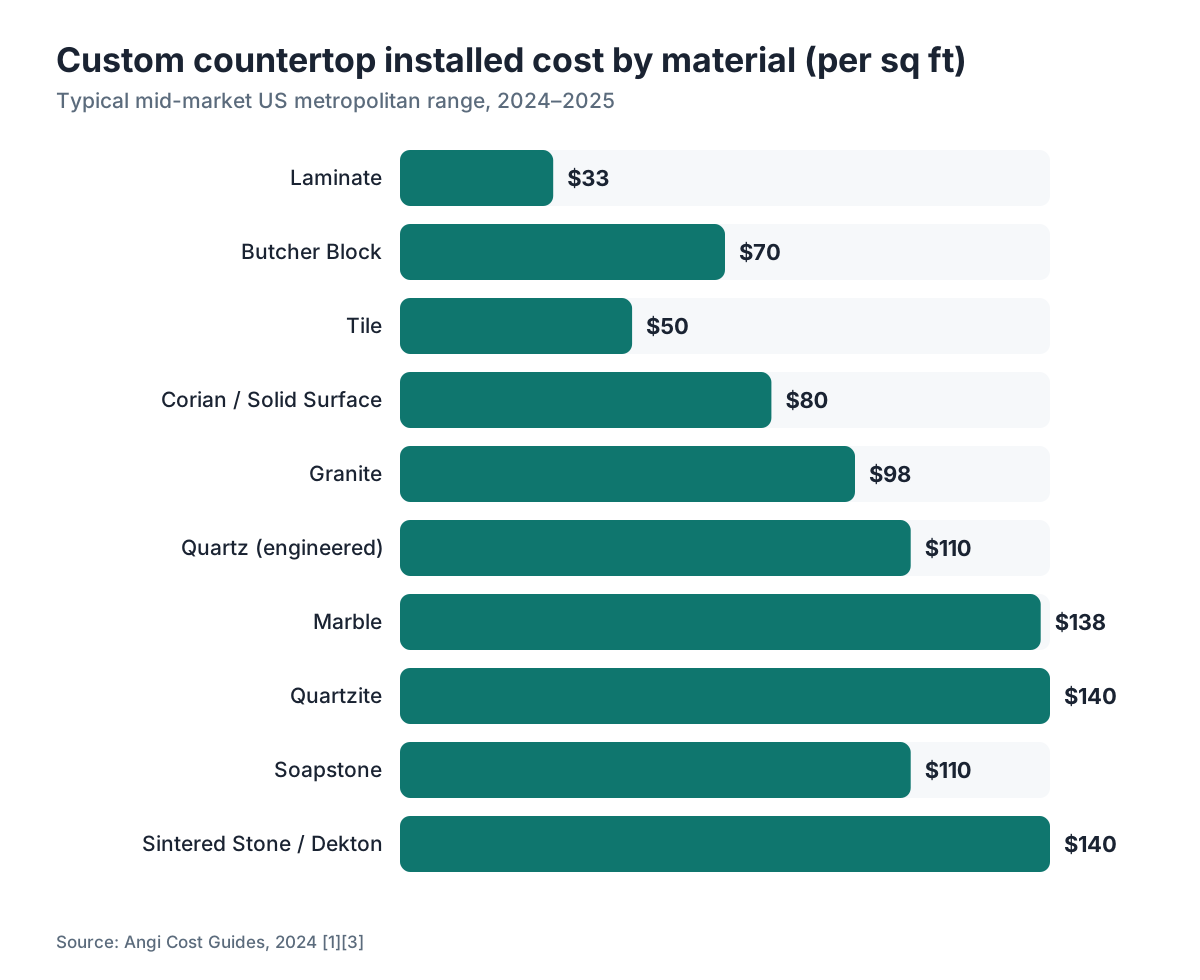
Almost any hard, workable material qualifies. Here is the short list most fabricators stock, with installed cost ranges.
| Material | Typical installed cost (per sq ft) | Common thickness | DIY-friendly? |
|---|---|---|---|
| Laminate (Formica, etc.) | $15, $50 | 1.5 in post-form | Yes, with practice |
| Butcher block (wood) | $40, $100 | 1.5 to 3 in | Yes |
| Tile (ceramic/porcelain) | $20, $80 | Varies | Yes |
| Quartz (engineered) | $70, $150 | 3/4 in or 1.25 in | No |
| Granite | $55, $140 | 3/4 in or 1.25 in | No |
| Marble | $75, $200 | 3/4 in or 1.25 in | No |
| Quartzite | $80, $200+ | 3/4 in or 1.25 in | No |
| Soapstone | $70, $150 | 3/4 in, 1.5 in | No |
| Concrete | $75, $150 | 1.5 to 2 in | Possible with skill |
| Stainless steel | $80, $200+ | 16 to 18 gauge | Fabricator only |
| Dekton/Sintered stone | $80, $200+ | 4 to 20 mm | No |
Cost ranges come from aggregated installer estimates and vary by region, slab grade, and edge complexity [1][2]. The ranges above assume a typical US metropolitan market. Rural areas and luxury markets can push well outside these numbers.
For granite countertops, the slab grade (first-choice versus commercial) shifts cost more than most homeowners expect. A Level 1 granite installed can hit $55/sq ft. A Level 4 exotic can top $130/sq ft before edge upgrades. The same pattern holds for marble countertops and quartzite, where veining and rarity price individual slabs rather than whole categories.
Laminate countertops and Formica countertops deserve more credit than they get. Modern laminate prints have gotten genuinely convincing, the material is easy to clean, and a skilled installer can make custom laminate look sharp. On a tight budget, it is my first pick over cheap engineered stone.
Corian countertops and similar solid-surface materials sit in a middle tier. They thermoform into curves other materials cannot, seams disappear when done right, and scratches sand out. The trade-off is heat sensitivity.
How much do custom countertops cost in 2025?
Cost depends on five variables: material, square footage, edge profile, cutouts, and your local labor market. No single number covers all of them. Anyone who quotes you a flat per-foot price over the phone is guessing.
Here is how each variable moves the price.
Material is the biggest lever. Engineered quartz from a domestic fabricator runs $70, $110/sq ft installed in most US cities. Italian Calacatta marble can top $200/sq ft. Professional butcher block installation runs $40, $100/sq ft depending on species and thickness, which makes it one of the cheaper custom surfaces [3].
Square footage is not linear. Most fabricators charge a minimum job fee, often $500, $800, so tiny jobs cost more per foot. Large kitchens with simple layouts often get a slightly lower per-foot rate because setup costs spread across more material.
Edge profiles add $10, $40 per linear foot above a basic eased edge. An ogee or waterfall edge on a 20-linear-foot island perimeter adds $200, $800 to the quote.
Cutouts (sinks, cooktops, outlets) run $100, $300 each, more for complex undermount work.
Labor market matters enormously. The same granite job can cost 30 to 40% more in San Francisco than in suburban Dallas. Get at least three quotes from local fabricators instead of trusting online estimates.
Here is a real-world anchor. According to the National Kitchen and Bath Association's 2023 market data, the median countertop budget for a major kitchen remodel was roughly $4,000 to $7,000, covering 50 to 80 square feet at mid-range materials [4].
Want to see how a fabricator builds a quote before your first meeting? Countertop installation breaks the line items down.
What is the custom fabrication process from start to finish?
Custom countertops move through five steps: pick the slab, template the space, cut and finish in the shop, install, and seal. Knowing the sequence protects you from surprises and helps you ask sharper questions.
Step 1: Material selection. You visit a slab yard or showroom and pick your specific slab (or board, or sheet). For natural stone, pick the exact slab by eye rather than by name. Two slabs of Santa Cecilia Gold granite can look nothing alike.
Step 2: Template. The fabricator sends a technician to your home, usually after cabinets are set and level. Digital templating systems (like those from Laser Products Industries) capture wall angles to within 1/16 of an inch. Old-school shops still use cardboard templating, which works fine. The template drives every cut in the shop.
Step 3: Shop fabrication. The template imports into CNC cutting software. A bridge saw or waterjet makes the rough cuts. CNC routers handle edge profiles and cutouts. For granite, marble, and quartzite, the edges get hand-polished or machine-polished.
Step 4: Installation. The crew arrives with the finished pieces and sets them on the cabinets with epoxy or silicone. Seams (if any) get filled with color-matched epoxy, then polished flush. Sinks are secured from below. The whole install for an average kitchen takes 2 to 4 hours.
Step 5: Sealing (if applicable). Natural stone typically gets a penetrating sealer on-site or in the shop. The Natural Stone Institute recommends sealing for granite, marble, quartzite, and soapstone [5]. Quartz, laminate, and solid surface do not need sealing.
Lead time from template to install runs 7 to 14 days for most shops in normal periods, up to 3 to 4 weeks during busy seasons (spring and fall remodel peaks). Confirm the lead time before you schedule any plumbing or appliance work.
What are custom butcher block countertops and when do they make sense?
Butcher block countertops are wood panels, edge-grain or end-grain, usually maple, walnut, cherry, or oak, glued up and finished as a work surface. Custom just means panels cut to your dimensions instead of bought in a home-center standard size.
They make sense in a few spots: a kitchen island that sees heavy prep, a baking station where you want a softer landing for rolling pins, or a kitchen where the warmth of wood is the whole point. They also work as a contrast to stone, say a quartz perimeter with a walnut island top.
The downside people underestimate is maintenance. Butcher block needs regular oiling (food-safe mineral oil or a beeswax blend), and it is vulnerable to standing water at seams and near the sink. If nobody in your household will commit to oiling and quick wipe-downs after spills, butcher block near a sink will degrade. Away from the sink, properly maintained wood lasts decades.
For how different species perform and how to pick a product, butcher block countertops covers the details.
My picks by use case: hard maple for durability and knife work, walnut for richness in a dark kitchen, white oak for a Scandinavian-influenced look. End-grain shrugs off knife marks better but costs more and is harder to refinish. Edge-grain is the practical choice for most homeowners.
Can you install butcher block countertops yourself?
Yes. DIY butcher block install is one of the most doable countertop projects for anyone comfortable with basic carpentry. You do not need a fabricator, and material for a typical kitchen runs $400 to $1,200.
Here is the basic process.
- Measure carefully and order the panel at least 1 inch oversized on every dimension you plan to trim.
- Cut to final length with a circular saw and a fine-tooth blade (at least 40 teeth). A straightedge clamped to the panel gives a factory-quality cut.
- Cut the sink opening with a jigsaw after drilling a starter hole.
- Sand all cut edges through 120, then 180, then 220 grit.
- Apply food-safe mineral oil before installation, let it soak, wipe off, and repeat 3 to 5 times until the wood stops drinking it in.
- Set the panel on the cabinets. Do not glue it down solid. Wood moves with humidity. Use figure-8 fasteners or elongated clips that allow movement.
- Seal the underside and all edges, more than the top. Exposed end grain near the sink needs extra attention.
The biggest DIY mistake is over-fastening. Screw the top down rigid and it cracks as it expands and contracts through the seasons.
Where to order panels: IKEA sells edge-grain block in standard sizes that many DIYers cut down. Cali and specialist suppliers like Bally Block and John Boos ship custom dimensions to order. John Boos publishes maple block spec sheets with NSF certification data for food-contact use [6].
The learning curve for a full DIY butcher block project, edge profiles and oiling included, is about a weekend. Dollar for dollar, it is one of the best DIY countertop projects you can take on.
How do you template and measure for custom countertops?
Templating is where custom countertops succeed or fail. A bad template means cuts that come up short, uneven overhangs, and misaligned seams. Get it right and everything downstream falls into place.
If you are hiring a fabricator, you do not template anything. They do. Your job is to make sure cabinets are fully installed, level, and shimmed before the template appointment. Clear the walls of any existing countertop. If a farmhouse sink is going in, have it on-site so the fabricator can template around it.
For DIYers working with butcher block or laminate, here is how to measure accurately.
Start at the wall. Walls are never perfectly straight. Use a 4-foot level or straightedge to check for bowing. Scribe the back edge of your template (or the panel itself) to the wall's actual profile if the gap tops 1/4 inch.
Measure depth from the wall to the front of the cabinet face frame, not the drawer front. Standard is 25.5 inches for a 24-inch deep cabinet. Check it in several spots.
Measure the exact angle at every corner. Most inside corners in US residential construction read 90 degrees. Plenty do not. A digital angle finder (under $20 at any hardware store) removes the guesswork.
For a sink cutout, use the template that ships with the sink. Every sink comes with one. Do not freelance the dimensions.
Mid-to-large fabricators now capture all of this as a CAD file that feeds the CNC machine directly. Quoting and nesting platforms (SlabWise is one fabricators use to link template data to cutting layouts) cut out the manual transcription errors that cause expensive remakes. If you are still doing paper takeoffs, the remake rate alone justifies switching.
One measuring rule that saves money: count every linear foot of exposed edge. Edges you cannot see (against the wall, against an appliance) do not need a finished profile. Fabricators bill per linear foot for fancy edges. Pay only for the edges that show.
What edge profiles are available and do they matter?
Edge profiles are the cross-sectional shape of the countertop's exposed front edge. Most of the choice is aesthetic. A few have real practical consequences for chipping and cleaning.
Here are the common profiles and approximate upcharges over a basic eased edge.
| Profile | Description | Upcharge per linear foot |
|---|---|---|
| Eased (straight with tiny chamfer) | Clean, modern | $0 (base price) |
| Beveled | Angled flat face | $5, $15 |
| Bullnose (full) | Fully rounded top and bottom | $10, $20 |
| Ogee | S-curve, traditional | $20, $40 |
| Dupont | Flat top with curved return | $15, $30 |
| Waterfall mitered | Vertical drop to floor | $100, $200+ per side |
| Chiseled/leathered | Textured natural look | $15, $30 |
The practical notes: eased and beveled edges chip less on natural stone than a full bullnose, because the thin edge of a bullnose can fracture under impact. Ogee and dupont profiles trap crumbs in the crevice where the profile meets the surface. If you cook a lot and hate cleaning edges, stay with eased or bevel.
Waterfall edges (where the stone panel drops vertically to the floor on one or both sides of an island) are popular right now. They look genuinely good and add real material cost, because you are buying full-height panels just for the sides. On a 4-foot island, each waterfall side adds one square foot of stone per inch of countertop height, so a 36-inch tall side needs 3 square feet just for that panel. Price it in early.
For busy, hard-used kitchen countertops, my honest pick is an eased or 1/8-inch bevel. Not exciting. Durable and easy to wipe.
What questions should you ask a fabricator before hiring them?
Most homeowners ask only about price. That gets you the cheapest quote, not the best value. Here is what separates good fabricators from mediocre ones.
Do you own your saws and CNC, or outsource cutting? Shops that outsource have less control over tolerances and scheduling. Not automatically a red flag, but worth knowing.
Will I see my specific slab before fabrication? For natural stone the answer has to be yes, or you are gambling on a slab that looks nothing like the showroom sample.
How do you handle a mistake? Every fabricator occasionally mis-cuts. The good ones have a clear policy: they eat the cost of a new slab and remake the piece. Ask for it in writing, or at least ask and watch the reaction.
Can I see seam placement for my layout? Seam placement affects both looks and strength. Seams should never fall over a dishwasher (vibration), in the middle of a cooktop opening, or at a stress point. A fabricator who shows you a seam diagram before cutting knows what they are doing.
What warranty do you offer on installation? Reputable shops offer at least 1 year on workmanship. Material warranties (quartz is usually 10 to 15 years against defects) are separate.
Do you pull permits? In most jurisdictions countertop replacement needs no permit. Move a sink or touch structural cabinets and permits may apply. Check with your local building department; the International Code Council publishes adopted codes by jurisdiction through its Digital Codes library [7].
Get at least three written quotes for any job over $2,000. The spread between low and high for identical scope often runs 30 to 50%, which tells you the market is competitive and comparison shopping pays.
How do you maintain and clean custom countertops after installation?
Maintenance swings a lot by material, and getting it wrong shortens the life of an expensive surface. Match the routine to the material and most tops last for decades.
Natural stone (granite, marble, quartzite, soapstone): Seal on installation, then reseal every 1 to 3 years depending on density and use. The water bead test tells you when: put a tablespoon of water on the surface. If it beads, you are fine. If it soaks in and darkens the stone within 5 minutes, reseal. For daily cleaning, use pH-neutral dish soap and warm water. The Natural Stone Institute warns that acidic cleaners like vinegar and lemon etch marble and quartzite, so keep them off [8]. For more, how to clean stone countertops and how to clean quartzite countertops go deep.
Engineered quartz: One of the lowest-maintenance surfaces. No sealing needed. The polymer resins that bind quartz are UV-sensitive, so keep it out of direct outdoor sun. Indoors, wipe with a non-abrasive cloth and mild soap. Hard water stains respond to a damp cloth with a little Bar Keepers Friend, but test a hidden spot first [9].
Butcher block: Mineral oil, applied generously, worked in, and wiped off, is the core step. Do it every 4 to 6 weeks in a dry climate or dry heating season, less often otherwise. Never let standing water pool near seams or the sink. Small scratches and knife marks sand out with 120-grit then 220-grit, then re-oil right away.
Laminate and solid surface: Wipe with a damp cloth. Skip abrasive pads. Laminate edges and seams are vulnerable to water infiltration, so keep the caulk fresh around the sink and backsplash joint.
For how to clean soapstone countertops, the routine is even simpler than other stones: soap and water, plus periodic mineral oil to darken and even out the natural oxidation.
Is custom fabrication worth the cost over stock countertops?
For most kitchens with even one odd angle, an island, or a non-standard cabinet depth, yes. Stock countertops save money upfront and create problems that often cost as much to fix: extra seams that collect bacteria and weaken the surface, overhangs that do not match, and sections that need filler strips.
The math tracks your kitchen size. For a small galley (25 to 35 sq ft of counter) with straight runs and no island, a stock laminate top can look perfectly fine at $15, $25/sq ft installed versus $40, $70 for custom laminate. That gap is real money on a tight budget.
Go bigger or more complex and the economics flip. A 60-square-foot kitchen with an island and two inside corners is almost always cheaper to do right with custom fabrication than to patch together stock sections plus filler plus the labor to force it all to fit.
Resale is the other factor. Remodeling Magazine's Cost vs. Value report tracks how much of a kitchen investment comes back at sale, though isolating the countertop's specific contribution from the whole renovation is genuinely hard and nobody has clean causal data on countertop-only ROI [10].
My actual opinion: if you are already spending $3,000 or more on countertops, pay for custom. The step up from stock to custom fabrication in stone is often just $5, $15/sq ft more, and it buys a perfect fit plus zero seams you do not actually need. Usually worth it.
How does a fabricator quote a custom countertop job?
Fabricators quote in square feet (sometimes square inches for billing precision) plus line items for edges, cutouts, and delivery. Here is the math from the fabricator's side.
Slab yield is the starting point. The Natural Stone Institute puts a standard granite slab at roughly 50 to 65 square feet of usable surface [11]. The fabricator nests your layout onto that slab to minimize waste. Complex layouts with many cutouts or odd angles waste more. A kitchen that wastes 40% of a slab raises your effective material cost per usable square foot by 67%.
Quoting software automates this nesting. Platforms like SlabWise let fabricators drag layouts onto a slab outline, auto-calculate material cost and remnant value, and generate a customer-facing quote in minutes instead of an hour of hand math. Do this by hand and you are giving up pricing accuracy, and probably under-quoting your complex jobs.
Labor rates in fabrication shops run $40, $100/hour depending on market and skill, and a typical kitchen install takes 4 to 8 shop hours plus 2 to 4 hours on site.
Markup on material is where shops vary most. A shop buying a slab at $500 may sell it at $900, $1,400 depending on overhead and competitive pressure. That is legitimate: they carry inventory risk, storage, and the cost of a mis-cut.
For homeowners, this framework helps you read quotes. If one shop is dramatically lower on material, ask whether they are using thinner stone (20mm versus 30mm), a lower grade, or an inferior slab. If a shop is higher, ask what grade and finish the price includes. Every quote should spell out stone grade or name, thickness, edge profile, and number of included cutouts.
Frequently asked questions
How long does it take to get custom countertops installed?
From template to install, most fabricators take 7 to 14 business days in normal season. Spring and fall remodel peaks can push it to 3 to 4 weeks. Template cannot happen until cabinets are fully installed and level, so build that dependency into your timeline. If a fabricator promises 3 days, ask whether they are outsourcing cuts, which can add quality control variability.
What is the cheapest custom countertop option?
Custom laminate is consistently the least expensive professionally fabricated option, typically $15, $40/sq ft installed. If you will DIY, butcher block panels cut to size run about $10, $30/sq ft in materials alone, with species like pine or maple at the low end. Tile set on a custom substrate is another budget route, though grout maintenance makes it less popular than it was a decade ago.
How much does butcher block countertop installation cost if I hire someone?
Professional butcher block installation runs $40, $100 per square foot all-in, material and labor, depending on wood species and market. Walnut costs more than maple. End-grain costs more than edge-grain. A typical 40-square-foot kitchen in hard maple runs $1,600, $3,200 installed. DIY with purchased panels cuts that roughly in half, down to material cost only.
Can you put custom countertops on old cabinets?
Yes, as long as the cabinets are structurally sound, level within 1/8 inch across the run, and secured to the wall. Old cabinets that sag, twist, or sit unlevel must be shimmed before templating. A fabricator will often check and note levelness during templating but is not obligated to correct cabinet issues. Unlevel cabinets crack stone, so fix the base first.
What is the difference between fabricated quartz and custom quartz countertops?
There is no meaningful difference. All quartz countertops are engineered in a factory, then cut by a fabricator to your kitchen dimensions. Custom quartz just means the quartz was templated and cut for your specific space rather than sold as a stock section. The material itself is always factory-made from ground quartz and resin, regardless of what a retailer calls it.
Do custom countertops add resale value to a home?
Replacing countertops generally returns 50 to 80% of cost at resale, based on Remodeling Magazine's Cost vs. Value data, though the countertop's own contribution is hard to isolate from the full kitchen project. Natural stone and quartz photograph better and draw buyer attention in listings. Dated laminate in an otherwise updated kitchen can be a visible drag. The ROI case is stronger in mid-to-high price tier neighborhoods than in entry-level markets.
What thickness should I specify for stone countertops?
3cm (about 1.25 inches) is the US residential standard and what most fabricators quote by default. It is structurally sound without requiring full-perimeter substrate support. 2cm (about 3/4 inch) costs slightly less in material but needs a plywood buildup underneath and shows a thinner edge. 2cm is common in Europe and some commercial work, but 3cm is the default here.
Are custom countertop seams visible?
Good seams on natural stone are visible on close inspection but not obvious at normal standing distance. Color-matched epoxy filled flush and polished cuts visibility a lot. Vein-matched seams, where the fabricator aligns the natural veining across the joint, are nearly invisible even up close but cost more in labor and sometimes require two matching slabs. Book-matched seams mirror the veining symmetrically and are the highest-end approach.
How do I find a reputable custom countertop fabricator?
Ask kitchen designers or general contractors in your area for referrals. Check for verifiable Google or Houzz reviews rather than a website claim. Ask whether they own their CNC equipment. Get at least three itemized quotes. Visit the shop if you can: a clean, organized shop with visible equipment usually tracks with quality work. Avoid any shop that cannot show you your actual slab before cutting.
What is diy butcher block countertop installation actually like?
It is manageable for anyone comfortable with a circular saw and a jigsaw. The skills that matter are accurate measurement, straight saw cuts with a clamped guide, and patience with finishing. The wood is heavy (a 4x8 sheet of 1.5-inch maple weighs 60 to 80 lbs), so a second person helps. The most common mistake is over-fastening: wood moves seasonally, and rigid screws cause cracking. Use figure-8 fasteners that allow movement.
Do outdoor custom countertops need different materials?
Yes. Engineered quartz is not suitable outdoors because UV light degrades the polymer resin, causing discoloration and pitting. Good outdoor choices include granite, porcelain tile, concrete, soapstone, and stainless steel. All outdoor stone needs sealing more often than indoor installs because of weather exposure. Confirm the fabricator has done outdoor work before ordering.
What permits do I need for custom countertop replacement?
In most US jurisdictions, a straight countertop replacement (same footprint, no plumbing relocation) needs no permit. If the project moves a sink drain, adds a gas cooktop, or involves structural cabinet changes, permits likely apply. Check your local building department. The International Code Council's Digital Codes library at codes.iccsafe.org provides access to most adopted local building codes by jurisdiction.
Can Cambria or other brand-name quartz be custom fabricated?
Yes. Brand-name engineered quartz like Cambria, Silestone, and Caesarstone is always custom fabricated. You pick the color and finish from the manufacturer's line, and a licensed fabricator in that brand's dealer network cuts and installs it to your kitchen dimensions. Some brands, like Cambria, require installation through their authorized network. The process is identical to generic quartz; you pay for the specific patterns and brand warranty.
Sources
- HomeAdvisor (Angi), Countertop Installation Cost Guide: Typical installed countertop costs by material, ranging from $15 to $200+ per square foot depending on material and region
- Remodeling Magazine, Cost vs. Value Report 2024: Kitchen remodel cost benchmarks including countertop component, national averages
- HomeAdvisor (Angi), Butcher Block Countertop Cost Guide: Butcher block countertop installation cost runs $40, $100 per square foot professionally installed
- National Kitchen and Bath Association, 2023 Kitchen & Bath Market Index: Median countertop budget for major kitchen remodel approximately $4,000, $7,000 in 2023
- U.S. Environmental Protection Agency, Indoor Air Quality: Granite Countertops and Radiation: Natural stone including granite is a common finished countertop material; sealing is a standard care step for porous stone
- John Boos & Co., NSF Certified Food Service Cutting Surfaces: John Boos maple butcher block carries NSF certification for food-contact surfaces in commercial and residential use
- International Code Council, Digital Codes Library: US municipal building codes accessible by jurisdiction; countertop replacement permit requirements vary by locality
- University of Minnesota Extension, Cleaning and Caring for Natural Stone Surfaces: Acidic cleaners including vinegar and lemon-based products etch marble and other calcite-based stone and should be avoided
- Bar Keepers Friend, Product Usage Guidelines: Bar Keepers Friend can be used on quartz countertops for hard water stains with caution and spot testing
- Remodeling Magazine, Cost vs. Value Report 2024: Kitchen remodel projects, including countertop replacement, recover roughly 50 to 80 percent of cost at resale
- Natural Stone Institute, Dimension Stone Design Manual: Standard granite slab provides approximately 50 to 65 square feet of usable countertop surface
Last updated 2026-07-09