TL;DR
- Cream quartz countertops run $50, $120 per square foot installed, depending on brand, thickness, and edge profile.
- They mimic the warm whites and soft veining of marble without the sealing and staining headaches.
- Engineered from roughly 90 to 94% crushed quartz bound with polymer resin, they're non-porous and scratch-resistant.
- Good fit for kitchens, baths, and laundry rooms.
What exactly is cream quartz and how is it made?
Quartz countertops are engineered stone, not a natural slab cut from a quarry. Manufacturers grind natural quartz crystals, mix them with pigments and polymer resins (usually polyester or epoxy), press the mixture under vacuum and high pressure, then cure it into slabs. The finished product is roughly 90 to 94% quartz by weight, with the rest being binders and pigments [1].
Cream quartz sits at the warm end of the white spectrum. The pigment recipes produce backgrounds ranging from pure off-white to warm ivory to lightly tawny beige, often layered with veining that mimics calcite or soft grey movement. The veining is printed or pressed in during manufacturing, so no two brands get quite the same look, but no two slabs from the same brand will vary the way natural stone does.
That consistency is the whole point for some buyers and a dealbreaker for others. If you want that alive, slightly unpredictable quality of real marble, quartz won't fully scratch that itch. But if you want a kitchen that looks nearly identical to marble countertops while skipping the sealing, etching, and stain anxiety, cream quartz is the practical trade.
The polymer binder is also what makes quartz non-porous by ASTM standards [2]. No liquid gets through the surface under normal use, which is why the Marble Institute of America notes that engineered quartz requires no sealing. That's not marketing copy. It's a structural property of the material.
How much do cream quartz countertops cost?
Installed price for cream quartz typically lands between $50 and $120 per square foot in the United States, based on data from multiple industry pricing surveys [3]. The range is wide because several variables stack on top of each other.
Material tier matters most. Entry-level cream quartz from brands like MSI or Silestone's lower lines runs $50, $70 installed. Mid-range from Caesarstone or Cambria countertops lands around $70, $95. Premium and designer lines with complex veining can push $100, $120 or higher.
Edge profiles add cost. A basic eased or beveled edge is usually included in a fabricator's base price. Ogee, waterfall, or triple pencil profiles can add $10, $30 per linear foot depending on the shop.
Thickness changes price too. Standard 3 cm (about 1.25 inches) is the default for kitchen counters and what most quotes assume. Thinner 2 cm slabs are used in some bath applications or stacked for a thick look. Going to a mitered 4 cm edge on island counters adds material and labor.
Cutouts for sinks and cooktops are usually line-itemed separately, typically $50, $150 per cutout for a standard undermount. Seams cost money if your countertop layout requires them. The number and placement of seams depends on slab dimensions (usually 55 to 65 inches wide by 110 to 130 inches long for standard slabs) and your kitchen's layout.
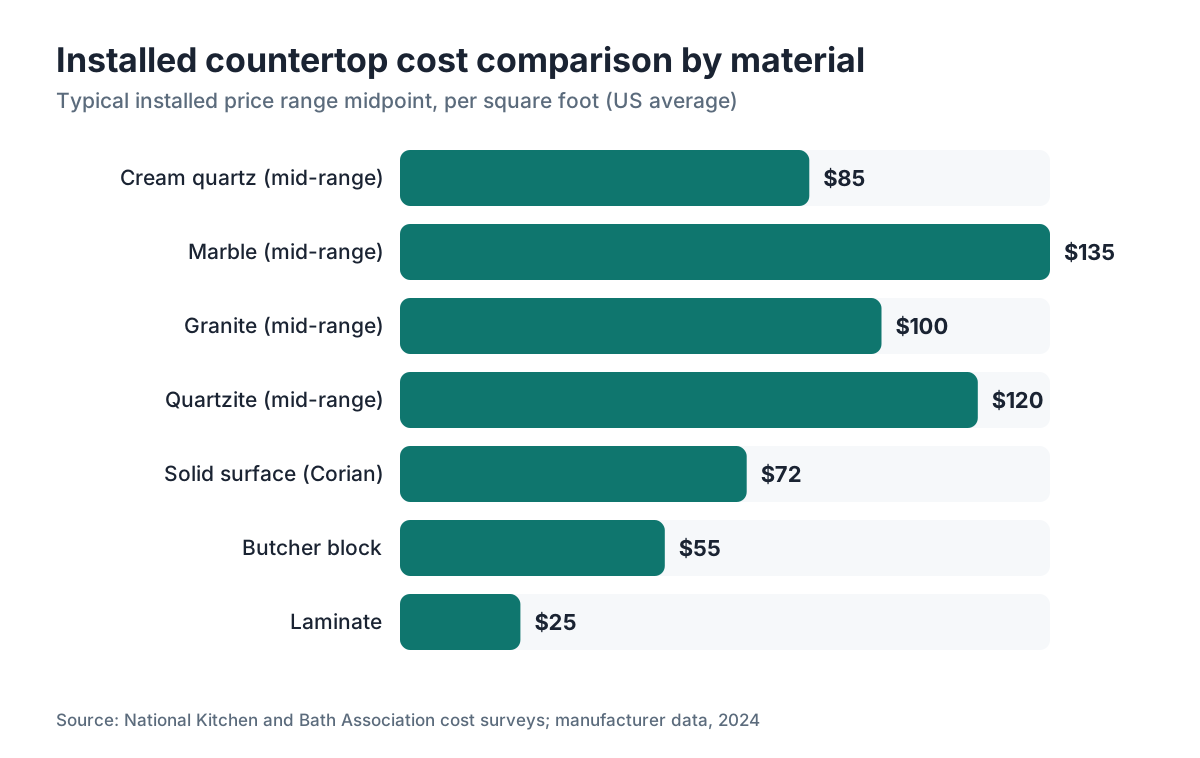
See the comparison table below for how cream quartz stacks up against other surface materials on cost and key properties.
How does cream quartz compare to marble, granite, and other countertop materials?
| Material | Installed cost (per sq ft) | Sealing needed | Porosity | Heat resistance | Typical warranty |
|---|---|---|---|---|---|
| Cream quartz | $50, $120 | No | Non-porous | Moderate (up to ~300°F) | 10 to 15 yr (manufacturer) |
| Marble | $75, $250 | Yes, annually | Porous | Good | None from mfr |
| Granite | $45, $200 | Every 1 to 3 yr | Low-moderate | Excellent | None from mfr |
| Quartzite | $60, $200 | Yes, annually | Moderate | Excellent | None from mfr |
| Butcher block | $30, $80 | Oil regularly | High | Poor | Varies |
| Laminate | $10, $40 | No | Non-porous | Poor | 1 to 5 yr |
| Solid surface (Corian) | $45, $100 | No | Non-porous | Poor | 10 yr |
Sources: National Kitchen and Bath Association cost surveys [3], manufacturer specification sheets [4].
The category where quartz loses to natural stone is heat. Polymer resin can discolor, crack, or warp under sustained direct heat. Quartz manufacturers universally recommend trivets and hot pads. A 500°F cast iron skillet set directly on quartz can damage it permanently, and most warranties exclude thermal shock. Granite and quartzite simply don't have that vulnerability.
The category where quartz wins is maintenance. Marble etches from acid contact (citrus juice, vinegar, wine) and stains if a seal degrades. Granite countertops are more resistant but still need periodic sealing. Quartz needs neither. Wipe it with a damp cloth and mild soap. That's the whole maintenance program.
For buyers who want a cream-toned surface and genuinely don't want to think about it again for a decade, quartz is the straightforward answer. Buyers who want the real thing and are comfortable with the upkeep should look at marble or quartzite. There's no wrong answer. They're different materials solving different problems.
Which cream quartz colors and brands are worth looking at?
Every major quartz brand has at least one cream or soft white option. A few that come up repeatedly in fabricator circles:
Caesarstone Calacatta Nuvo and Statuario Maximus both deliver the white-to-cream background with soft grey veining that reads as marble from across the room. Caesarstone publishes detailed technical data sheets including flexural strength and hardness ratings [4].
Cambria has a long lineup of warm whites: Brittanicca Warm, Swanbridge, and Whitby are all in the cream family. Cambria slabs are made in the US (Jordan, Minnesota) and the brand is known for consistent slab sizing and good warranty terms.
Silestone's Eternal Calacatta Gold has a warm ivory background. Silestone was among the first brands to introduce an antibacterial additive (HybriQ technology), though the practical significance of that feature in a non-porous material is debatable since bacteria can't colonize the surface anyway.
MSI Q Quartz has more budget-friendly cream options including Calacatta Laza. If you're cost-sensitive and okay with a slightly simpler vein pattern, MSI delivers reasonable quality at a lower price point.
LG Viatera's Minuet and Aria are soft warm whites that fabricators often recommend for bath vanities because the slab pricing is competitive.
A few things to check regardless of brand: get the actual slab, more than a sample chip. Veining on a 2-inch sample chip can look very different spread across 8 feet of countertop. Ask the fabricator to pull the book-matched slab (or the specific slab) you'll be getting, stand back six feet, and look at it under the lighting conditions close to your kitchen's. Showroom lighting is usually flattering. Your kitchen might be different.
Is cream quartz good for kitchens specifically, or does it show stains and grime?
Cream and off-white surfaces show soil faster than darker surfaces. That's just physics. Coffee rings, cooking grease, and dirty water splashes are more visible on a cream background than on a charcoal or dark grey surface. If that bugs you, better to know before you buy than after.
The good news: because quartz is non-porous, nothing actually penetrates the surface. That coffee ring wipes up. It didn't soak in. With marble or an unsealed natural stone, the same coffee ring can leave a permanent ghost stain.
In practice, most homeowners with cream quartz report they do a quick wipe after cooking and a more thorough clean once a day, and the counters stay looking good. Heavy-use households with kids or people who cook constantly sometimes wish they'd gone slightly darker. Light-use kitchens or people who keep a clean counter by habit are usually happy.
One practical tip that fabricators give clients: avoid harsh cleaners. Bleach-based cleaners, abrasive powders, and anything with a high pH can dull the resin finish over time. Mild dish soap and warm water is what quartz manufacturers specify. For a deeper look at stone and engineered stone cleaning protocols, see how to clean stone countertops.
Another real consideration for kitchens: the seam. Cream quartz with soft veining is actually easier to seam well than bold dramatic marble because the pattern isn't as directional. A skilled fabricator can hide a seam in the veining. On a stark white or solid cream surface, a seam is more noticeable because there's no pattern to break it up. Discuss seam placement with your fabricator before templating, not after.
How do you clean and care for cream quartz countertops?
Daily care is simple: warm water, a soft cloth, and a drop of dish soap. That handles 95% of messes. Quartz manufacturers including Caesarstone and Cambria specify this in their care guides and say it's all you need for routine maintenance [4].
For dried-on food or sticky residue, a plastic scraper and a little warm water loosens most things without scratching. Avoid steel wool, abrasive pads, or anything that would scratch the surface.
Stains that actually resist wiping are rare given the non-porous surface, but if you get something stubborn, a non-abrasive cleaner like Bar Keepers Friend Soft Cleanser (not the powder, which is more abrasive) or a diluted isopropyl alcohol solution can help. Test in a hidden spot first.
Things to genuinely avoid: bleach-containing cleaners used repeatedly, oven cleaners, paint strippers, nail polish remover with acetone, and drain cleaners. These can break down the resin binder or dull the finish. A single accidental exposure usually doesn't ruin the surface, but repeated exposure does.
Sunlight is worth mentioning. Some quartz colors, especially those with organic pigments, can shift slightly in color with prolonged direct UV exposure. This matters more for outdoor kitchen applications or a south-facing kitchen with a large window directly over the counter. Most manufacturers don't warrant outdoor use. Ask specifically if you're planning an outdoor application.
See how to clean quartzite countertops if you're comparing quartz care to natural quartzite, which has a very different maintenance profile despite the similar name.
What are the durability and scratch resistance limits of cream quartz?
Quartz rates 7 on the Mohs hardness scale [1]. For reference, a steel knife is around 5.5 to 6.5, so a knife dragged across quartz won't scratch the surface under normal pressure. A diamond is 10. Porcelain tiles are around 6 to 7. Practically speaking, quartz is harder than most things that will touch it in a kitchen.
Scratch resistance in real use is excellent. You'd need something like a carbide blade or diamond-coated tool to mark the surface. That said, fabricators still advise using a cutting board, because cutting directly on the surface dulls your knife faster than it damages the quartz.
Impact is a different story. Quartz is hard but not flexible. A heavy cast iron pan dropped on a corner or edge can chip the surface, and chips on engineered quartz are noticeable because the material underneath is the same color (usually). Repairs are possible, but a chip on cream quartz is harder to hide than on a heavily veined dark surface.
The heat vulnerability is the real limitation. The Marble Institute of America's technical specs and quartz manufacturer guidelines consistently place the safe exposure threshold around 150 to 300°F for brief contact [4]. A hot pot from the stove can exceed 400°F and will leave a thermal mark, sometimes a whitish discoloration or a small crack in the resin. This is the most common warranty exclusion and the most common source of homeowner complaints post-installation. Trivets. Always trivets.
How does the quartz fabrication and installation process work?
Most countertop installations follow the same sequence regardless of material. You select and purchase your slab (or the fabricator sources it). A templater comes to your home after cabinets are set and makes a precise digital or physical template of the countertop footprint. The fabricator cuts and finishes the slabs to those exact dimensions, then installers set and adhere them in place.
Digital templating with a laser measuring device has become standard in professional shops. It reduces measuring errors and lets the fabricator nest cuts on the slab digitally before any stone is cut, which reduces waste. Software that handles quartz nesting and job costing (SlabWise is one example fabricators use for this) can significantly reduce how much material gets scrapped on a job, which directly affects the final price.
Lead times vary. After the template appointment, most fabricators take 5 to 15 business days to complete the job, though busy shops in high-demand markets can run 3 to 4 weeks out. Ask before you sign.
Installation day for a typical kitchen takes 3 to 6 hours. The old countertops come out, the new ones go in, the undermount sink gets attached, and silicone caulk gets applied at backsplash joints. You're usually asked to stay off the countertop for 24 hours to let the adhesive cure.
For more on the full installation process, including what to ask a fabricator before signing a contract, see countertop installation.
For homeowners getting quotes on a cream quartz project, getting at least three quotes is standard advice. Prices vary more than most people expect between shops, and the variance isn't always correlated with quality. Ask each shop to quote the same slab material, same thickness, and same edge profile so you're comparing apples to apples.
How does cream quartz affect resale value and home design?
Neutral is safe. Cream and soft white countertops are popular precisely because they read as neutral to most buyers and work with nearly any cabinet color. A strong design statement countertop (think dramatic black and gold veining) can be beautiful but also narrows your buyer pool when you sell.
The National Association of Realtors doesn't publish countertop-specific ROI data with the precision that would let you say "cream quartz returns 78 cents on the dollar." What the NAR's remodeling impact data does show is that complete kitchen renovations have an estimated cost recovery of around 52 to 75%, depending on scope and market [5]. Countertop replacement as a standalone project typically recovers less than a full renovation but also costs a fraction as much.
The practical design takeaway: cream quartz pairs well with white or grey shaker cabinets (obviously), but it also works well under dark navy or forest green cabinetry where it provides contrast without competing. It pairs poorly with very warm wood tones unless the cream has a correspondingly warm undertone. Cool-leaning cream quartz next to honey oak or warm walnut can look slightly off. Pull a cabinet door and bring it to the slab yard when you're selecting.
For kitchens with natural wood elements, butcher block countertops as an island or prep surface alongside cream quartz perimeter counters is a combination that reads warm and intentional rather than cold and sterile. Many designers use mixed surface materials for exactly this reason.
What should you ask a fabricator before buying cream quartz?
A few questions worth asking directly:
Can I see the actual slab I'm getting? Not a sample, not a photo. The slab. Veining varies across the surface, and you want to see what's on the piece your kitchen will be cut from.
Where will seams fall, and can we move them? Seam placement is partly geometry and partly fabricator discretion. Good fabricators will walk through the layout with you before templating and show you where seams are planned. On cream quartz with light veining, seam placement matters more than on busier patterns.
What edge profile does this price include, and what do upgrades cost? Base quotes often assume a simple eased or bevel edge. If you want something different, get the upgraded price upfront.
What's excluded from the warranty? Get the manufacturer warranty terms in writing and ask the fabricator what their own workmanship warranty covers. Thermal damage is almost universally excluded. Some manufacturers also exclude damage from chemicals or improper cleaning.
What's the timeline from template to installation? Then ask what happens if there's a flaw in the slab after it's cut. Do they have a replacement slab in stock or will you wait 4 to 6 weeks for a new order?
For homeowners comparing budgets across very different material categories, see how quartz compares to laminate countertops (dramatically cheaper, dramatically different performance and feel) or Corian countertops (similar non-porous properties, different texture and repairability profile).
Are there environmental or health considerations with quartz countertops?
Two things come up repeatedly in this conversation and both deserve straight answers.
First, silica dust during fabrication. The quartz cutting and grinding process creates fine respirable silica dust, and there is a well-documented occupational health risk to fabrication workers who lack proper respiratory protection and dust control. The Occupational Safety and Health Administration (OSHA) has specific permissible exposure limits for respirable crystalline silica of 50 micrograms per cubic meter of air as an 8-hour time-weighted average, and has enforcement guidance specifically addressing the stone fabrication industry [6]. OSHA issued a final rule in 2016 tightening these limits. This is a real risk for workers, not for homeowners with an installed countertop. Once quartz is cut, polished, and installed, it doesn't release silica dust under normal use.
Second, VOC emissions from the resin binder. Some older quartz products emitted low levels of volatile organic compounds, particularly formaldehyde from polyester resins, during curing. Current products from major brands comply with GREENGUARD or similar indoor air quality certifications [4]. The California Air Resources Board's CARB Phase 2 standard for formaldehyde is what most certified products reference [7]. Installed product in a ventilated kitchen is not a significant indoor air quality concern under current manufacturing standards.
On the environmental footprint side: quartz is an abundant mineral, but engineered stone manufacturing is energy-intensive and polymer resins are petroleum-derived. The countertop industry doesn't have a strong lifecycle assessment database the way building products like insulation or framing lumber do, so any specific carbon footprint claim you see from a brand should be read skeptically unless it references a published third-party LCA.
How do you get an accurate quote for cream quartz countertops?
The most reliable path to an accurate quote has three steps: measure your countertop area, pick a specific material, and get quotes from multiple fabricators on the same spec.
Measure in square feet: length times depth of each countertop section, convert from inches, add them up, and add 10 to 15% for waste and cutouts. A typical 10x10 kitchen (the industry standard for cabinet comparisons) has roughly 25 to 30 square feet of countertop area, though actual kitchens vary widely [3].
Bring the fabricator a floor plan or rough sketch with dimensions. Online calculators give ballpark numbers but fabricators quote from actual measurements or templates. The quote you get from a photo or a verbal description is a rough range, not a price.
For fabricators who are quoting cream quartz jobs regularly, accurate material costing depends on knowing the yield from the specific slab dimensions of that brand's product, since slab sizes differ by manufacturer. Digital quoting tools that handle slab nesting (including software like SlabWise) help shops price jobs more precisely and reduce the margin of error that leads to underquoting or overquoting.
Get at least three quotes. Ask each one to itemize: material cost, fabrication labor, edge profile, cutouts, and installation. The line items reveal more about a shop's pricing approach than the total number alone does.
Frequently asked questions
Is cream quartz hard to keep clean in a busy kitchen?
Not particularly. Because quartz is non-porous, spills sit on the surface rather than soaking in. Cream does show everyday grime like coffee rings and grease more visibly than darker surfaces, but wiping with a damp cloth removes it. Households with kids or heavy cooking volume sometimes prefer a slightly darker or more heavily veined surface that hides day-to-day use between cleanings.
Can you put hot pots directly on cream quartz countertops?
No. Polymer resins in quartz can discolor or crack under sustained direct heat above roughly 150 to 300°F. A pot straight from a 400°F oven or a hot cast iron pan can leave a permanent thermal mark. Quartz manufacturers universally exclude thermal damage from warranties. Trivets or silicone mats between any hot cookware and the surface are necessary, not optional.
How does cream quartz compare to white marble in appearance?
Well-designed cream quartz mimics marble's look closely enough that most people can't distinguish them in photos or from a few feet away. Real differences show up close: marble has natural movement and depth that engineered stone replicates but doesn't fully match. Marble also etches from acid contact and requires sealing. Cream quartz stays consistent and needs no sealing. Which you prefer depends on how much the authentic material quality matters to you.
What thickness should I choose for cream quartz countertops?
3 cm (about 1.25 inches) is the standard for kitchen countertops and what almost every fabricator quotes by default. It's structurally sound, visually substantial, and compatible with all undermount sink and cooktop cutouts. The 2 cm thickness is mainly used for bath vanities or where weight is a concern. Mitered edges to simulate a thicker profile are cosmetic and add cost. Stick with 3 cm for kitchens unless you have a specific reason.
Does cream quartz need to be sealed?
No. Quartz is engineered to be non-porous, so sealing is neither needed nor recommended. Unlike granite or marble, there are no pores for a sealant to penetrate. The polymer resin binder forms a continuous, impermeable surface during manufacturing. Applying a stone sealer to quartz is a waste of money and won't add any protection. If a salesperson tells you otherwise, that's not accurate.
Which is cheaper, cream quartz or granite?
They overlap significantly. Basic granite runs $45, $75 installed, basic quartz runs $50, $70. Mid-range and premium versions of both materials land in similar territory. Granite has a wider ceiling: exotic imported slabs can run $150, $200 per square foot or more. Quartz tops out around $120 for most brands. For budget-conscious buyers, the price difference at the entry level is small enough that the material choice should come down to look and maintenance preference rather than cost.
Will cream quartz countertops yellow over time?
Some early-generation white and cream quartz products had yellowing issues, particularly from UV exposure or certain cleaning chemicals reacting with the resin. Current products from reputable brands are formulated to resist this, but prolonged direct sunlight is still a documented risk. If your counter gets direct sun through a south-facing window for several hours a day, ask the manufacturer specifically about UV stability for the color you're considering. Indoor kitchens without direct sun exposure rarely see yellowing.
How long does cream quartz last?
With normal use and care, quartz countertops routinely last 20 to 30 years or longer. The material itself doesn't degrade under normal kitchen conditions. What fails first is usually the edge or corners from impact chips, or the caulk joint at the backsplash (easily replaced). Manufacturer warranties on major brands like Cambria and Caesarstone run 10 to 15 years and cover material defects. The countertop itself will likely outlast the kitchen design cycle.
Can cream quartz countertops be repaired if they chip?
Yes, but repairs are visible, especially on a light-colored surface. A fabricator can fill a chip with color-matched epoxy or resin, and from a normal viewing distance it's often unnoticeable. Up close, repairs rarely disappear entirely. Corners and edges are the most vulnerable spots. If a section cracks significantly or a large area is damaged by thermal shock, replacing the damaged section is technically possible but involves resourcing the same slab color, which can be difficult if it's been discontinued.
Is cream quartz a good choice for bathroom vanities?
Yes, and it's one of the most popular applications. Bathrooms see less heat exposure and less heavy daily use than kitchens, so the thermal limitation of quartz matters less. The non-porous surface resists soap scum and toiletry stains well. Cream and off-white tones pair naturally with most bathroom tile palettes. Because vanity tops are smaller than kitchen counters, the cost per project is lower, and you can often use a remnant piece from a fabricator's leftover inventory at a significant discount.
How many square feet does a standard quartz slab cover?
Standard quartz slabs run roughly 55 to 65 inches wide by 110 to 130 inches long, depending on the manufacturer. That translates to approximately 42 to 55 square feet of raw slab area. After accounting for cutouts and layout waste, a single slab typically yields 30 to 45 usable square feet for a countertop installation. A typical kitchen requires one to two slabs. Your fabricator's template appointment is when exact slab requirements get confirmed.
What cabinet colors work best with cream quartz countertops?
Cream quartz is genuinely flexible. It pairs naturally with white, off-white, and grey shaker cabinets. It also works well as a contrast surface under darker colors like navy, forest green, or charcoal. The tricky pairings are warm wood tones: a cool-toned cream quartz next to honey oak or unstained maple can look incongruent. When in doubt, bring a cabinet door sample to the slab yard and look at them together under similar lighting conditions before committing.
Is there a difference between quartz and quartzite countertops?
Yes, and the distinction matters. Quartz countertops are engineered stone made from crushed quartz crystals bound with polymer resin. Quartzite is a natural metamorphic rock quarried as solid slabs. They look different, feel different, and behave differently. Quartzite is heat-resistant like granite, requires sealing, and has natural variation. Engineered quartz needs no sealing, is vulnerable to heat, and is consistent slab to slab. The similar names cause real confusion. Make sure you know which one a vendor is quoting.
Sources
- USGS Minerals Information: Quartz and Silica: Quartz rates 7 on the Mohs hardness scale; engineered quartz products contain roughly 90 to 94% quartz by weight
- ASTM International, Standard Specification C1648 (Quartz Agglomerate Slabs): Engineered quartz is classified as non-porous by ASTM specification standards for agglomerate slabs
- National Kitchen and Bath Association, NKBA Cost vs. Value Report: Installed cream quartz countertops typically cost $50, $120 per square foot; a standard 10x10 kitchen has roughly 25 to 30 square feet of countertop area
- Caesarstone Technical Data and Care Guide: Caesarstone specifies warm water and mild soap for routine maintenance; GREENGUARD certifications referenced; heat resistance threshold guidance provided
- National Association of Realtors, Remodeling Impact Report: Complete kitchen renovations have an estimated cost recovery of approximately 52 to 75% depending on scope and market
- OSHA, Occupational Exposure to Respirable Crystalline Silica Final Rule (29 CFR 1910.1053): OSHA permissible exposure limit for respirable crystalline silica is 50 micrograms per cubic meter as an 8-hour time-weighted average; final rule issued 2016
- California Air Resources Board, CARB Airborne Toxic Control Measure for Formaldehyde: CARB Phase 2 formaldehyde standards are referenced by quartz manufacturers for indoor air quality certification of installed products
- Marble Institute of America, Quartz Surfacing Technical Bulletin: Engineered quartz requires no sealing due to its non-porous structure; maximum brief heat exposure cited at approximately 300°F
- Cambria, Product Specifications and Warranty Documentation: Cambria offers manufacturer warranties up to 10 years; Brittanicca Warm and Swanbridge listed as cream-palette quartz products; slabs manufactured in Jordan, Minnesota
- Remodeling Magazine, Cost vs. Value Report (annual): Kitchen countertop replacement as a standalone project recovers a lower percentage of cost than full kitchen renovation; data context for ROI discussion
Last updated 2026-07-09