TL;DR
- Waste factor for countertop bids usually runs 15% to 35%.
- It depends on material, slab size, layout, and edge profiles.
- A plain rectangular run needs only 15 to 18% added to net square footage.
- A layout with bookmatch seams or exotic stone can push past 30%.
- Get this number wrong and you eat your margin one slab at a time.
What is waste factor in countertop fabrication, exactly?
Waste factor is the percentage of raw slab you buy but cannot sell to the homeowner. It covers offcuts, sink cutouts, saw kerfs, and the dead zones around an irregular slab edge that never become finished countertop. Every shop tracks it a little differently. The concept never changes: you buy more stone than the finished job measures.
Here is the simplest version of the math. A kitchen measures 45 square feet of finished countertop. Apply a 20% waste factor and you order 45 / (1 - 0.20) = 56.25 square feet of slab. Some shops flip it and just multiply by 1.20, which gets you 54 square feet. The division method is more accurate. The multiplication shortcut is common on the shop floor anyway. Know which one your estimating sheet uses, because the two give you different numbers on the same job.
Waste is not overage. Overage is extra material you order on purpose for future repairs or matching. Waste is the material that hits the floor as scrap. Many bids blur the two, and that is how shops quietly lose money on jobs they thought were winners.
What waste factor percentages do fabricators actually use?
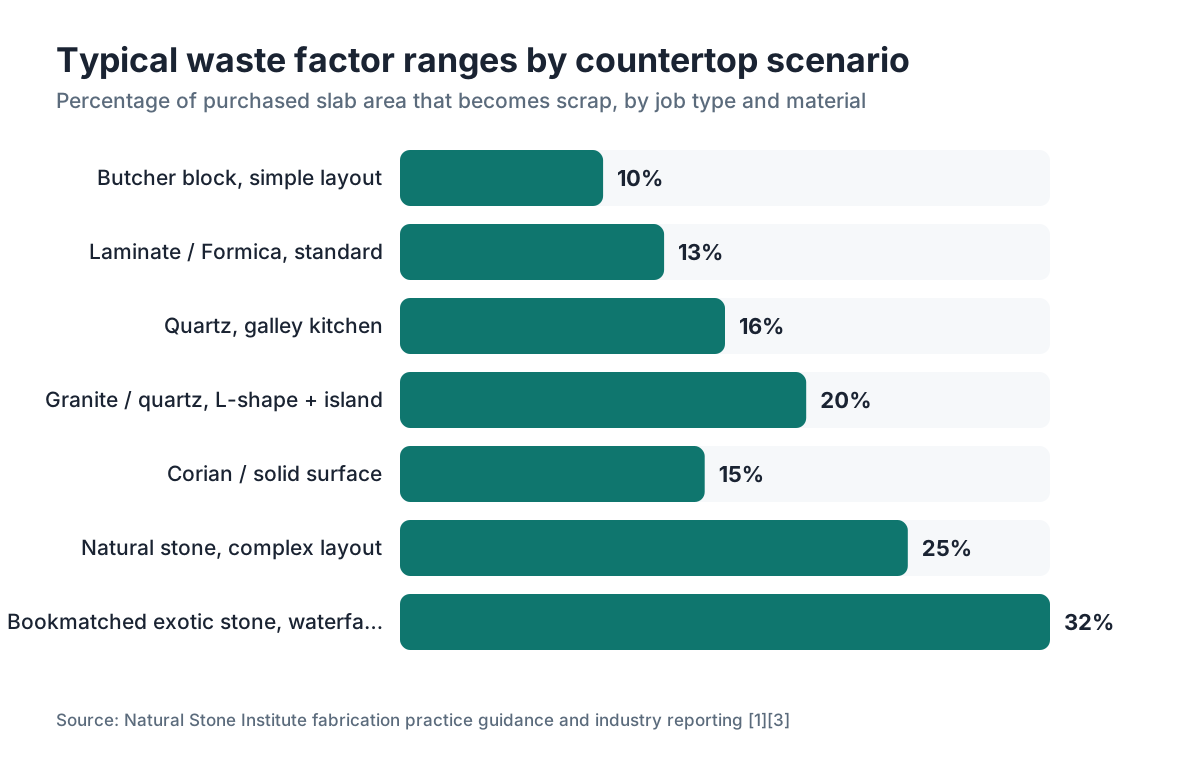
No trade body publishes one official number. But the range that comes up over and over in shop owner discussions and fabrication training runs 15% to 35%, with the middle of the pack around 18 to 22% for a typical granite or quartz kitchen [1].
Here is how the common ranges break down by scenario:
| Scenario | Typical waste factor |
|---|---|
| Simple galley kitchen, rectangle slabs, no island | 15 to 18% |
| L-shaped kitchen, one island, standard sinks | 18 to 22% |
| Complex layout, multiple seams, farmhouse sink | 22 to 28% |
| Bookmatched veining, exotic slab, waterfall island | 28 to 35%+ |
| Laminate sheet goods (Formica, similar) | 10 to 15% |
| Butcher block planks | 8 to 12% |
These ranges bend. A shop with a strong nesting program can shave 3 to 5 percentage points off what it used to quote by hand, because software packs remnants from one job into cutouts from another. A shop cutting by hand with chalk lines loses more.
Quartz like Cambria comes in fixed slab sizes, often around 56" x 120" or 63" x 132" depending on the line, which makes layout planning predictable [2]. Natural granite and marble slabs vary wildly in shape and size. That is the big reason granite countertops and marble countertops carry higher waste factors than engineered stone.
What drives waste factor up on a specific job?
Seven things reliably push waste higher. Walk through each one as you build a bid.
Slab shape and size. Natural stone slabs are not rectangles. They have organic edges, thick ends, thin ends, and sometimes cracks you cannot use. A slab that reads 55 square feet on the ticket may yield only 46 usable feet after you dodge the tapered ends and a hairline fissure near the middle. Account for that before you start nesting.
Kitchen layout complexity. Every inside corner, peninsula, and angled wall adds a cut that makes scrap. A straight galley run is about as efficient as stone gets. A kitchen with an L, a bump-out, and a curved island is a waste machine.
Sink and cooktop cutouts. A standard 33" undermount sink cutout is roughly 4 to 5 square feet of material you pay for and cannot sell. A farmhouse apron sink is bigger. Two sinks plus a cooktop can add 10 to 12 square feet to your scrap pile on a mid-size kitchen.
Veining and pattern matching. Bookmatching a dramatic slab like Calacatta Gold, or a book-matched quartzite, forces you to orient pieces so the veins line up at seams. You may leave 8 to 12 inches of perfectly good stone unused on either side of a cut because it breaks the pattern. This is the single biggest waste driver on high-end natural stone.
Edge profiles. Thick mitered edges and waterfall sides eat extra material. A 2cm waterfall on a 36" island panel needs a separate piece laminated to look 4cm thick, or a full laminated stack. Either way, more pieces to cut.
Remnant reuse policy. Shops with an organized remnant yard fill small pieces in a bid from other jobs, which lowers effective waste per job. Shops that toss or sell remnants right away cannot.
Saw kerf and CNC tolerances. A bridge saw blade takes roughly 1/8" to 3/16" of material per cut. On a job with 30 cuts, that adds up. CNC routers used for cutouts and edge detailing remove material too. Small per cut. Not zero.
How does material type change the waste factor calculation?
Material type matters as much as layout. Some materials come in standard sheets and some do not. Some cost so much per square foot that a 2% swing in waste factor moves the whole job's profit.
Natural stone (granite, marble, quartzite, soapstone). Slab dimensions vary, so waste is hard to pin down before you see the actual stone. Expect 18 to 28% as a baseline and adjust up for vein matching. See also how to clean quartzite countertops and how to clean soapstone countertops for why these materials need care from cut to install.
Engineered quartz. Slabs come in consistent sizes, so nesting software works cleanly. Waste factors of 15 to 22% are realistic for most layouts [2].
Laminate countertops and Formica countertops. Sheet goods come in 4x8 or 4x12 panels. Waste stays low, often 10 to 15%, because you cut rectangles from a rectangle. The material is cheap enough that waste barely dents the dollar total.
Butcher block countertops. Sold by the linear foot or in panels. Waste runs 8 to 12% for simple layouts. Glue-up waste from edge-grain construction is baked into the product price by the manufacturer, so you are not losing material at the fabrication stage the way you do with stone.
Corian and solid surface. Sheet dimensions are consistent and the material is thermoformable, so offcuts can sometimes be reformed and cutout waste drops. Waste in the 12 to 18% range is typical.
The dollar impact depends on material cost. On a $10/sq ft laminate job, a 5% miscalculation on waste costs you maybe $20. On a $180/sq ft exotic quartzite job, the same 5% error on a 50 sq ft kitchen costs you $450 straight out of margin.
How do you calculate waste factor for a specific bid, step by step?
Here is a method you can walk through before you submit a bid.
Step 1: Measure net finished area. Add up all countertop runs in square feet. Include the island. Add nothing for waste yet.
Step 2: Count and size your cutouts. List every sink, cooktop, and appliance cutout. Estimate each in square feet. A standard undermount kitchen sink is about 4.5 sq ft. A cooktop is roughly 2.5 to 3 sq ft. Add them up.
Step 3: Assess the layout. Simple run or complex kitchen? Use the table above to pick a starting waste percentage.
Step 4: Assess the material. Is the veining strong enough that you have to match it at seams? Add 5 to 10 percentage points if yes.
Step 5: Know your slab dimensions. If you are buying specific slabs, measure their usable area before you commit. Some suppliers let you walk the slabs. Take that chance.
Step 6: Gross up. Divide net area by (1 minus your waste factor) to get the slab area you need to buy. Example: 52 sq ft net / (1 - 0.22) = 66.7 sq ft.
Step 7: Check against actual slab inventory. One slab typically runs 45 to 65 sq ft of usable surface. If your gross number needs more than one slab, decide whether you can nest the pieces well or whether you are paying for two full slabs. The number of slabs you buy, not the abstract percentage, is often the real cost driver.
For shops doing more than a few bids a week, software that nests the actual kitchen against a specific slab size makes step 7 far more accurate than gut feel. SlabWise runs the nesting inside the quoting step, so you see projected yield before you commit to a slab count. That is the thing that closes the gap between your estimated waste factor and your actual shop waste.
What is the difference between waste factor and yield, and why does it matter for pricing?
Waste factor and yield are two sides of the same calculation, and which one you use can quietly change your price.
Yield is the percentage of purchased material that ends up in the finished countertop. A 20% waste factor means an 80% yield. A 25% waste factor means a 75% yield.
The difference shows up in how you mark up material cost. If your slab costs $1,200 and you have a 20% waste factor, the material cost for a 50 sq ft finished kitchen is not $1,200 divided by the slab's total square footage. It is $1,200 divided by the yield-adjusted square footage you actually got out of that slab for this job. Shops that do not think in yield tend to underprice material, especially on complex jobs where they buy two slabs but use 1.3 slabs worth.
A good rule of thumb: track your actual scrap area per job across 30 jobs. Calculate your real yield by material type. That number beats any industry guideline because it reflects your equipment, your templaters, and your typical customer.
How does seam placement affect waste in a bid?
Seam placement is a lever. Moving a seam by 6 inches can be the difference between fitting everything on one slab or needing two.
The general rule for visible seams in stone is that they go away from high-traffic areas and outside corners, and align with any veining pattern if pattern matching is expected [3]. Those aesthetic rules sometimes fight the most material-efficient cut plan. You have to decide how to balance them.
A practical example. On an L-shaped kitchen with a 96" run and a 60" return, one seam plan puts the joint at the inside corner. Efficient, but visible. Another plan keeps the corner monolithic and pushes the seam farther out on the long run. Looks better, but may need a larger slab or a cut that wastes a long strip of stone.
When you bid, sketch two or three seam plans and estimate material for each. The cheapest plan can save 8 to 12 square feet on a large kitchen. At $60 to $100 per square foot of installed stone, that is $480 to $1,200 of material cost you could leave on the table by not thinking through seams before you price.
Some fabricators build seam placement into the bid as a line item: a standard seam plan is included, a premium low-visibility plan adds a material surcharge. That is honest, and it prices the trade-off correctly.
How do slab size and remnant use affect the waste factor you quote?
The slab market is not uniform. A jumbo 63" x 126" quartz slab nests very differently than a 48" x 96" standard slab of the same material, even for the same kitchen. Bigger slabs often cut waste because you have room to move the pieces around. But bigger slabs cost more per unit, so the math is not always a clean win.
Remnants from past jobs can lower the effective waste factor on a new bid if you have the right piece. A remnant of the same material that covers a small peninsula return lets you charge for a fraction of a slab instead of a full one. Organized remnant tracking is worth more than most shops think.
Here is a rough way to see the scale. A shop doing 200 kitchen jobs a year at an average 22% waste factor turns 22% of all purchased slab into scrap. If average job size is 50 sq ft and average stone cost is $50/sq ft, that is roughly 11 sq ft of scrap per job, worth maybe $180 to $220 if the remnants could be reused. Across 200 jobs, that is $36,000 to $44,000 in potential remnant value sitting in the yard. Capture even 20% of that through smarter matching and resale and it is real money.
The kitchen countertops and countertop installation guides for homeowners explain why fabricators charge what they do, which helps customers see waste factor as a legitimate line item and not padding.
Should waste factor be a visible line item on a customer quote?
Fabricators disagree here, and both sides have a point.
The case for showing it: transparency builds trust. If a homeowner sees "Material: 52 sq ft x $85/sq ft" and wonders why you charge for 52 sq ft when their kitchen measures 43, a visible waste line explains the gap. It shortens the "why is your quote higher than the other guy" conversation.
The case against: customers fixate on line items they do not understand and use them as bargaining chips. If your competitor buries waste in a per-square-foot rate and yours shows separately, you look more expensive even when the total is identical.
The middle path many shops use: show the gross material area (waste included) but describe it as "slab material required: 52 sq ft" rather than calling out "waste factor: 20%." Honest, and it does not hand someone a number to argue about.
Quoting a commercial or contractor job where sophisticated buyers read every line? Show the method clearly. On residential retail quotes, the simplified version usually works better.
One thing you should never do: understate material area to win the bid, then hit the customer with a change order for more material once you are standing in the slab yard. That destroys trust and it is how shops earn bad reviews.
What are common mistakes fabricators make when estimating waste factor?
The mistakes that cost real money are usually not dramatic. They are small systematic errors that compound across dozens of jobs.
Using one flat percentage for everything. A 20% factor on a bookmatched marble waterfall island leaves you short. A 20% factor on a simple three-run quartz kitchen is probably 3 to 4 points too high. Flat factors are fast, but they average your errors across customers instead of pricing each job right.
Forgetting irregular slab shape. The supplier ticket says 58 sq ft. The usable area after the tapered short end and an edge crack is 51 sq ft. Price off the ticket and you are in the hole before you make a cut.
Not adjusting for vein matching until the job is in process. This is the most expensive version. You bid a Calacatta marble kitchen at 22% waste, get to the slab yard, and realize matching the veins at the island seam costs you 14" off a slab end. Your real waste on that job is 31%.
Ignoring the difference between 1.2cm, 2cm, and 3cm stock. Thicker material costs more per square foot, and the waste in square feet is the same, so the dollar cost of waste is higher. Apply one flat percentage regardless of thickness and you understate cost on 3cm jobs.
Not tracking actuals. Never compare estimated waste to the scrap that actually left the shop and you have no feedback loop. Build a simple job costing sheet, even in a spreadsheet, and record it.
How do experienced fabricators track and improve their waste factor over time?
The shops with the tightest margins are the ones that measure. Here is what that looks like in practice.
After each job, record three numbers: the square footage you quoted, the slab area you bought, and the slab area that went into the finished countertop. Purchased minus finished is your actual waste. Divide it by purchased area to get the waste percentage for that job.
Do this for 20 to 30 jobs, sorted by material type and kitchen complexity. You will find your own numbers, which may differ from industry averages because your shop, your equipment, and your templating methods are your own. Those numbers become your real bid parameters.
Nesting software, standalone or built into a quoting tool, is the most direct way to cut waste for shops doing volume. Reported material savings from digital nesting over hand-drawn cut plans run 3 to 7 percentage points [4]. That is not trivial on a $2,000 to $4,000 slab.
Some shops photograph or scan their slabs at the yard and enter the exact outline into their software, so the nesting reflects the real slab shape instead of a rectangle. That closes the gap between estimated and actual waste almost completely on natural stone.
SlabWise's quoting and nesting tools are built to tie the waste estimate to a real slab outline before the bid goes out, which is the step where most hand-estimated bids go wrong.
Frequently asked questions
What is a good waste factor percentage for a standard kitchen countertop bid?
For a typical L-shaped kitchen in granite or quartz, 18 to 22% is the most common range. A simple galley kitchen can be as low as 15%. A complex layout with pattern matching, waterfall edges, or a farmhouse sink can run 28 to 35%. Use the simplest layout in your shop as your baseline and add points for each complicating factor.
Is waste factor the same thing as overage?
No. Waste factor is the material that hits the floor as scrap during fabrication: offcuts, sink cutouts, saw kerfs, and unusable slab edges. Overage is extra material you order on purpose for future repairs or color matching. Some shops order 5 to 10% overage on top of their waste-adjusted quantity, especially on discontinued materials.
How do I calculate how many slabs to order after applying a waste factor?
Divide your net finished square footage by (1 minus your waste factor). So if you need 50 sq ft finished and your waste factor is 22%, you need 50 / 0.78 = 64.1 sq ft of slab. Then check that number against the actual usable area of the slabs at your supplier. One natural stone slab typically yields 45 to 60 usable sq ft, though slab sizes vary.
Does vein matching on marble or quartzite really change the waste factor that much?
Yes, a lot. Bookmatching a dramatic veined stone can add 8 to 15 percentage points of waste versus a non-matched cut plan on the same kitchen. You may discard usable stone at slab ends to keep the mirror image aligned at seams. Price vein-matched jobs at 28 to 30% waste or higher, and check actual slab dimensions before you finalize the number.
Should I show the waste factor as a line item on the homeowner's quote?
Most shops avoid calling it out as a percentage. Instead, show the gross material area required (for example, "slab material: 54 sq ft") without labeling it waste. That is transparent about the quantity without handing customers a number to argue about. For commercial or contractor bids where buyers expect detailed breakdowns, showing the full method builds credibility.
How does slab size affect waste factor?
Larger slabs give you more room to move cuts around, which generally cuts waste. A 63" x 132" slab nests pieces from an L-shaped kitchen more efficiently than a 48" x 96" slab of the same material. The trade-off is that larger slabs cost more per unit and are heavier to handle. Check whether the yield gain from the bigger slab beats its price premium on each job.
Can remnants from other jobs reduce the waste factor on a new bid?
Yes. If your remnant yard has a piece of matching material that covers a small peninsula return or bathroom vanity, you can bid that piece at remnant pricing instead of full slab cost. Shops with organized remnant inventory and good tracking regularly save 3 to 5% on effective material cost versus shops that treat every job as starting from a fresh slab.
Does waste factor differ for laminate versus stone countertops?
Yes. Laminate sheet goods like Formica come in standard panels (typically 4x8 or 4x12 feet) with consistent dimensions and low material cost, so waste runs 10 to 15%. Stone slabs are irregular in shape, far more expensive per square foot, and need pattern matching on veined materials, pushing waste to 15 to 35%. The dollar impact of a given percentage is much higher on stone.
What software do fabricators use to calculate and reduce waste factor?
Dedicated countertop quoting and nesting software nests kitchen layouts against actual slab outlines digitally, which cuts waste versus hand-drawn plans. Reported material savings from digital nesting range from 3 to 7% over manual methods. Some fabricators also use general CAD tools or specialized stone industry programs. The key is tying the cut plan to a real slab size before the bid goes out.
How do sink and cooktop cutouts factor into waste calculations?
Cutouts are material you pay for but cannot use in the finished countertop. A standard 33" undermount kitchen sink cutout is roughly 4 to 4.5 square feet. A 36" farmhouse apron sink is larger. A cooktop cutout is about 2.5 to 3 square feet. Two sinks and a cooktop mean 11 to 12 sq ft of purchased material going straight to scrap before any other waste.
What is the best way to track actual waste factor so I can improve my bids over time?
After each job, record the slab area purchased and the finished countertop area delivered. Divide the difference by the purchased area to get actual waste for that job. After 20 to 30 jobs, break the results down by material type and kitchen complexity. Your shop's real numbers will likely differ from industry benchmarks and give you far more accurate bid inputs than any general guideline.
Do waterfall edges and thick mitered profiles increase waste factor?
Yes. A waterfall island side needs an added slab piece cut to cover the vertical panel, which may not cut from the same sheet as the horizontal top without waste. Mitered thick edges need extra stone laminated or cut from the same slab. Budget an extra 5 to 10% waste, or quote waterfall and miter pieces as separate line items with their own material allowance.
How does waste factor affect the price per square foot I charge customers?
If your slab material costs $60/sq ft and your waste factor is 20%, your true material cost per delivered square foot is $60 / 0.80 = $75. Price at $60/sq ft and forget to gross up for waste, and you lose $15/sq ft on material alone before labor, overhead, or profit. Divide your slab cost by your yield percentage rather than passing the raw per-square-foot cost through.
Sources
- Natural Stone Institute, Fabrication Best Practices: Industry waste factor ranges of 15 to 35% for natural stone countertop fabrication are consistent with reported practice among NSI member fabricators
- Cambria, Product Specifications: Cambria engineered quartz slabs are manufactured in standardized dimensions, aiding layout planning and nesting efficiency
- Marble Institute of America (now Natural Stone Institute), Dimension Stone Design Manual: Seams in stone countertops should be placed away from high-traffic areas and outside corners, and should align with veining patterns where pattern matching is specified
- Stone World Magazine, Shop Efficiency and Nesting Software Survey: Digital nesting software has been reported by fabricators to reduce material waste by 3 to 7 percentage points compared to manual cut planning
- U.S. Geological Survey, Mineral Commodity Summaries: Stone, Dimension: Dimension stone slabs for construction applications vary substantially in size and yield based on quarry of origin and material type
- National Kitchen and Bath Association, Kitchen and Bath Market Index: Natural stone and engineered quartz are the dominant countertop materials in kitchen remodels tracked by NKBA member designers and dealers
- Occupational Safety and Health Administration, Silica in the Stone Fabrication Industry: Stone countertop fabrication generates silica dust during sawing and CNC routing; OSHA's respirable crystalline silica standard (29 CFR 1910.1053) applies to fabrication shops
- Home Innovation Research Labs, Annual Builder Practices Survey: Countertop material selections and installed areas per kitchen are tracked annually in the Builder Practices Survey, providing baseline square footage data for residential kitchens
- U.S. Census Bureau, American Housing Survey: Kitchen size and remodeling activity data from the American Housing Survey provide context for typical countertop square footage in U.S. homes
Last updated 2026-07-11