TL;DR
- The standard waste factor for stone countertops is 15 to 20% on straightforward rectangular kitchens.
- Complex layouts with islands, angled cuts, or figured slabs push that to 25 to 35%.
- Fabricators build this into every quote because stone gets cut from fixed-size slabs and the offcuts rarely get reused.
- Homeowners pay for it.
- Here is exactly why it is unavoidable, and how to check the number.
What does 'waste factor' actually mean on a countertop quote?
A waste factor is the percentage of raw slab a fabricator buys beyond the net finished square footage of your counters. The shop measures the exact surface you need, say 45 square feet, then multiplies by a waste factor to decide how much slab to purchase. At 20% waste, that 45-square-foot job needs 54 square feet of slab.
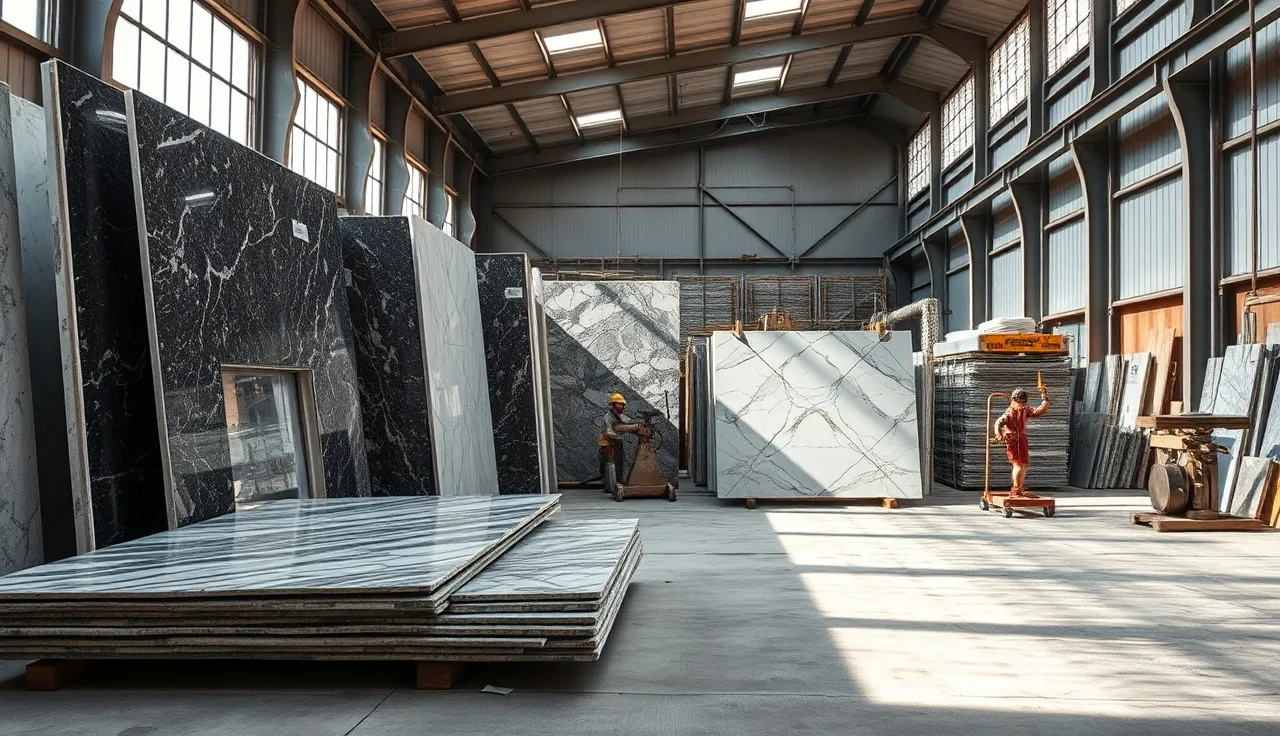
The leftovers rarely get sold or reused. Cut-off strips, the sink knockout, cooktop holes, edge trim. Stone slabs come in fixed dimensions, commonly 55 to 65 square feet for a standard bundle slab or 120 square feet and up for a jumbo [1]. Whatever you do not use stays in the yard or gets scrapped. The waste factor is how fabricators price that reality into the job.
This is different from a material overage in flooring or tile, where you buy 10% extra and return the unopened boxes. You cannot return a cut slab. The waste factor is a real cost, not a buffer you get back.
What is the standard waste factor percentage for stone countertops?
The standard waste factor for stone countertops is 15 to 20% for a typical residential kitchen with rectangular runs, one or two standard sinks, and few angled walls [2]. That range holds across granite, quartz, marble, and quartzite. No trade body mandates it. It comes from fabricator practice and estimating guides [2][3].
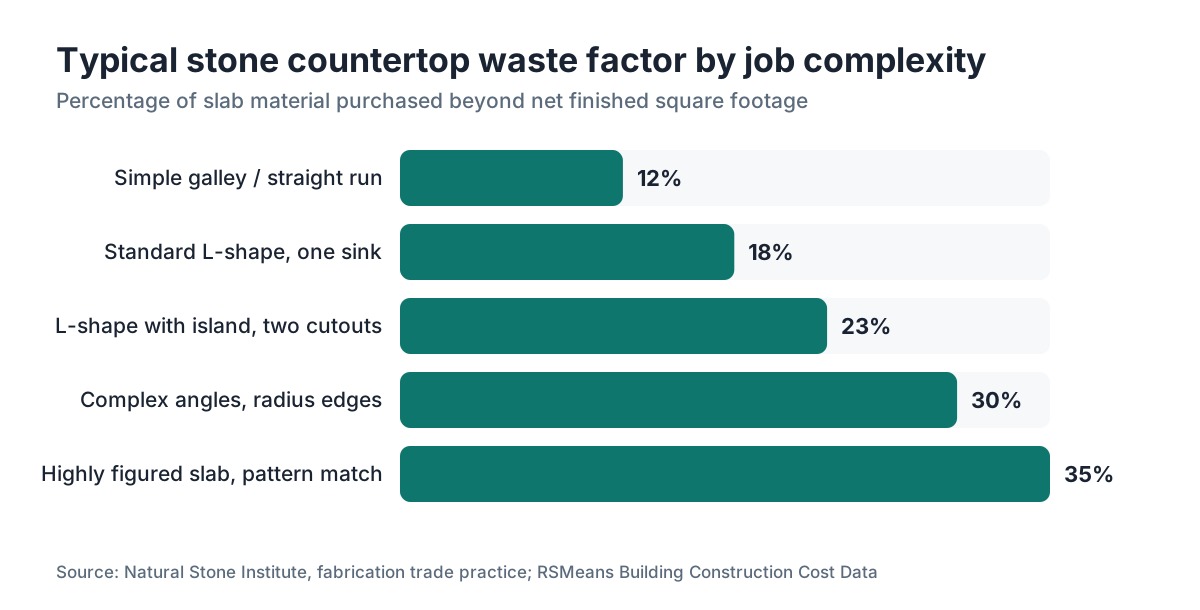
Here is how waste breaks down by job complexity:
| Job Type | Typical Waste Factor |
|---|---|
| Simple galley or straight-run kitchen | 10 to 15% |
| Standard L-shape kitchen, one sink | 15 to 20% |
| L-shape with island, two cutouts | 20 to 25% |
| Complex angles, radius edges, book-match | 25 to 35% |
| Highly figured slab with pattern matching | 30 to 40% |
The honest answer is that 15% is the floor for even the cleanest job. Cutting rectangles out of a fixed slab always leaves corners and strips behind.
A fabricator who quotes 0% or 5% waste is either making a math error or has padded the price per square foot somewhere else. Want to verify? Ask to see the slab layout.
Why is there always waste even on a simple kitchen?
Stone does not come in rolls you unroll to fit. A typical residential slab runs about 9 feet wide by 5 to 6 feet deep for a standard size, or up to 10 feet by 6 feet for a jumbo [1]. Your countertop pieces almost never match those dimensions.
Every L-turn leaves a triangular offcut at the inside corner. Every sink knockout, usually a 12x16-inch or 14x18-inch hole for an undermount bowl, produces a piece too small to reuse. Seam decisions to hide joints in low-visibility spots sometimes force a cut that wastes a strip along one edge. Overhangs and mitered edges add length to each piece.
Then there is breakage. A 1.5% to 3% breakage allowance is common on top of the geometric waste, more with thin material or long unsupported spans [2]. A crack at the saw or a chip during transport, and part of that slab is gone.
Natural stone like granite or marble adds vein matching. You may need to orient pieces so the veining flows across an island, which stops the fabricator from laying out the slab the most efficient way. That one constraint can add 5 to 10 percentage points.
Does the waste factor differ by material (granite vs. quartz vs. marble)?
The geometric waste is identical no matter the material. Cutting rectangles from slabs is the same math for quartzite as it is for engineered quartz. A 20-square-foot island top wastes the same percentage either way.
Material type changes waste through pattern matching and slab consistency. Engineered quartz like Cambria has a consistent pattern across slabs, so layout stays flexible and waste sits at the low end, 15 to 18% for most kitchens [3]. Natural stone with dramatic veining, think Calacatta marble or Blue Bahia granite, needs careful orientation and matching, which pushes waste to 25 to 35% on complex layouts.
Book-matching opens two adjacent slab halves like a book to mirror the vein pattern. It can double the material needed per visible square foot, because two slabs cover one surface with the match. Fabricators should tell you this before you fall in love with the look.
Thickness affects how many pieces you get per slab. Going from 2 cm to 3 cm does not change the waste percentage, but each square foot of slab costs more, so the dollar cost of waste climbs on 3 cm material.
For non-stone options like laminate countertops or Corian, waste runs 10 to 15%, because sheet goods come in sizes closer to countertop dimensions and skip pattern matching.
How does kitchen layout affect the waste factor?
Layout is the biggest driver of waste after material type. A straight galley run of 10 feet by 25 inches is close to a rectangle you can cut cleanly from one slab strip. An L-shape with a 90-degree corner throws away the triangle at the inside turn. Add a peninsula, an island, or a bump-out, and each new piece multiplies the offcuts.
Angled walls are expensive. A 45-degree wall angle makes every piece along it a trapezoid, and the triangular waste on both ends adds up fast. Some shops charge a layout surcharge instead of raising the waste factor. The effect on your total is the same.
Islands are the worst offender. An island top usually gets cut from the widest part of the slab, leaving strips on both sides too narrow to use elsewhere. A 4-foot-wide island top on a slab 5.5 feet deep leaves an 18-inch strip. That strip may fit nothing else in your kitchen.
Seam placement matters too. Fabricators like to hide seams near the sink or in a corner, which sometimes means cutting a piece shorter than optimal and wasting the off-cut end. A good shop shows you a cut sheet or a digital layout so you see where each piece falls on the slab. If yours does not offer one, ask. SlabWise's nesting tool exists for exactly this, so fabricators can walk a client through the layout on screen before any stone gets cut. That kind of transparency helps both sides see where the waste comes from.
For a full picture of kitchen countertop costs, layout is the variable that surprises people most.
How do fabricators calculate waste factor in a quote?
Most fabricators use one of two methods. The flat multiplier: measure net square footage, multiply by 1.20 for 20% waste, and that is the billable square footage. Fast and simple. The slab-based calculation: lay out the pieces on paper or on screen, count the slabs needed, multiply slabs by slab cost, then divide by net square footage to get an effective cost per square foot.
The slab-based method is more accurate and usually favors the customer on simple jobs. A galley kitchen might use only 60% of one slab, so real waste is low. An L-shape with an island might need exactly two slabs, where the slab-based math shows 30% waste rather than the flat 20% the multiplier assumes.
Small shops lean on the flat multiplier because it is quick. Larger and software-driven shops run actual nesting. The gap is real money. On a job with a $60 per square foot material cost, moving from 20% to 15% waste on 50 net square feet saves about $150.
For homeowners, the takeaway is simple: ask which method the shop uses. If it is a flat multiplier, ask the percentage. Higher than 20% on a straightforward kitchen? Ask why. Understanding the number lets you compare quotes on equal terms.
What does the waste factor mean for the price I actually pay?
Waste factor inflates the square footage you pay for, even though you only keep the net area. On a kitchen quoted at $65 per square foot with 50 net square feet, a 15% waste factor means you pay for 57.5 square feet, or $3,737. A 25% waste factor on the same kitchen means 62.5 square feet and $4,062. That is a $325 difference from the waste assumption alone.
Pricier materials make waste cost more in dollars even at the same percentage. Marble at $120 per square foot with 25% waste adds $1,500 in waste cost to a 50-square-foot kitchen. Budget granite at $40 per square foot adds just $500.
Some shops quote an all-in price per square foot and fold waste into their margin. Others break it out. Neither is dishonest, as long as the final number reflects real material cost. Watch for the quote that looks cheap per square foot but runs a 35% waste factor on a simple kitchen. The math can make a low-looking quote cost more than a higher per-foot quote with a realistic waste factor.
Fabrication labor, edge profiles, sink cutouts, and countertop installation usually get quoted separately from material. Waste factor inflates the material line only, never labor.
Can you reduce waste factor, and should you try to?
Some waste cuts are real and worth doing. Others backfire.
The legitimate moves: simplify your layout where you can (fewer pieces, fewer cutouts), pick a material with a consistent pattern that allows flexible orientation, and ask for a digital cut sheet before fabrication so you can check that pieces are nested tightly.
Ask whether the shop has remnants that match your material. A remnant from a previous job can cover a bathroom vanity or a small bar top without the waste overhead of a fresh slab, because you pay only for the piece you need. Remnant prices swing widely, but buying them for secondary surfaces is a smart way to save.
What you should not do is lean on a fabricator to quote an artificially low waste factor to hit a target price. If someone promises 5% waste on a complex layout, they are either going to eat the loss or squeeze pieces out of leftover slab with questionable seams. Neither ends well for you.
Waste is not a profit center for most shops. Material gets priced at or near cost, with margin coming from fabrication labor. A legitimate shop has no reason to inflate waste. If a shop's number seems high, it may just be a flat multiplier applied without looking at your actual layout. That is worth a conversation, not a red flag.
Does waste factor apply to all stone types the same way?
The 15 to 20% baseline covers all cut-to-size natural stone: granite, marble, quartzite, soapstone (see our guide on how to clean soapstone countertops once yours is installed), and travertine. Same geometry, same math.
Engineered quartz comes with more consistent dimensions and color, which allows tighter nesting and lands waste at the low end, 12 to 18%. Some engineered stone makers publish recommended waste factors in their install guides. Cambria, for example, tells fabricators to add material for cuts, seams, and pattern considerations when estimating [3].
Natural quartzite gets confused with quartz, but it is a 100% natural metamorphic stone, and its waste factors match granite. See our guide on how to clean quartzite countertops for care specifics.
Slab goods like butcher block countertops work differently, because wood comes in linear board widths and can be edge-glued. Fabricators still apply a 10 to 15% waste factor for end cuts, jointing, and defects. Same principle, different material.
How should homeowners verify the waste factor in their quote?
Start with two numbers: the billable square footage and the net measured square footage. Divide billable by net, subtract 1, and you have the implied waste factor. If a shop quotes 72 billable square feet for a 58-square-foot kitchen, that is a 24% waste factor. Reasonable for a complex layout, worth a question on a simple one.
Next, ask the slab size and how many slabs the job needs. If you need 72 billable square feet and standard slabs run 55 to 60 square feet, you need two slabs. Two slabs covering a 58-square-foot kitchen means more than 100 square feet purchased for 58 square feet of finished surface, a 72% effective waste rate. Certain kitchen shapes force that, but it should be explained plainly, not hidden inside a per-square-foot price.
Comparing quotes gets easy once you know your kitchen's net square footage. Measure it or ask your designer before you gather bids. Then judge each quote on dollars per net square foot instead of dollars per billable foot. A shop at $85 per billable foot with 15% waste is actually cheaper per finished surface than a shop at $80 per billable foot with 25% waste.
A real quote should also break out material, fabrication labor, edge profile upcharges, cutout fees, and installation. Everything bundled into one square-foot number is harder to read and harder to trust.
What do industry estimating guides say about waste factors?
RSMeans, the most widely cited construction estimating reference, includes stone countertop waste in its assemblies and recommends 10 to 15% for standard installations [4]. Fabricator communities and regional stone associations generally use 15 to 20% as the residential standard, with the understanding that complex layouts run higher [2].
The National Kitchen and Bath Association publishes design guidelines that shape how kitchens get laid out, including recommended clearances and island sizing, which indirectly affects waste by constraining piece dimensions [5]. NKBA guidelines do not name a waste percentage, but following their clearance standards tends to produce more regular countertop shapes that keep waste down.
The Marble Institute of America, now part of the Natural Stone Institute, has long published installation standards for stone surfaces, including guidance that fabricators account for material loss from cutting in every estimate [6]. The specific percentage is left to fabricator judgment based on layout.
The honest summary: no government body or major industry group mandates a single waste percentage. The 15 to 20% range is trade practice, not a regulated number. That is fine. Waste really is a function of job complexity, and one fixed number would be wrong for half the jobs out there.
Frequently asked questions
What is a normal waste factor for a simple rectangular kitchen?
A straight-run or galley kitchen with one sink and no angles typically runs a 10 to 15% waste factor. The geometry allows efficient cutting with minimal offcuts. Even so, the sink knockout and end cuts mean you never reach 0% waste on stone. Budget 15% to stay safe.
Why do fabricators charge for waste if I'm not getting that material?
The fabricator buys the full slab upfront and cannot return the unused portions. Stone distributors sell by the full or half slab, not by the square foot. The offcuts from your job sit in their yard. The waste factor is the cost of using a material that comes in fixed large sheets, not a surcharge the shop invents.
Does a kitchen island increase the waste factor?
Yes, usually by 5 to 10 percentage points. An island top is a wide piece cut from the widest part of the slab, leaving strips on the sides too narrow to use elsewhere. If your island needs a specific vein orientation or matches the perimeter counters, waste climbs further.
Is the waste factor higher for book-matched stone?
Dramatically. Book-matching uses two slabs opened like pages to create a mirrored vein pattern. You use two slabs' worth of material to cover one surface with the match. Effective waste on a book-matched feature can reach 40 to 60% of total material purchased, which is why it stays reserved for showpiece walls and islands and gets priced accordingly.
How does waste factor affect the cost of expensive stone like Calacatta marble?
The dollar impact scales directly with material cost. Calacatta marble can run $80 to $200 per square foot of slab. At 25% waste on a 50-square-foot kitchen, you pay for 12.5 square feet of marble you never see installed. At $120 per square foot that is $1,500 in waste cost alone. A simpler layout or a non-directional material brings it down.
Can I buy a remnant piece to avoid the waste factor?
Sometimes. Fabricators and stone yards sell remnant pieces, offcuts from previous jobs, at a discount and usually by the piece rather than per square foot. If a remnant covers your bathroom vanity or laundry room top, you skip the waste overhead entirely. Remnants are irregular shapes, so verify the piece is large enough for your specific cut before buying.
Do quartz countertops have a lower waste factor than natural stone?
Slightly. Engineered quartz has a consistent pattern across slabs, so pieces orient any direction without matching concerns. That allows tighter nesting and keeps waste at 12 to 18% rather than the 15 to 25% common with veined natural stone. On a complex layout with an island, the gap narrows because geometry, not pattern matching, drives most of the waste.
How can I compare countertop quotes that use different waste factors?
Ask each shop for two numbers: net measured square footage and total billable square footage. Divide the total material price by the net number to get cost per net square foot. That strips out the waste factor and lets you compare apples to apples. A shop with a lower per-billable-foot price but a 30% waste factor can cost more than one with a higher rate and 15% waste.
What's the waste factor for a bathroom vanity countertop?
Small tops raise the waste percentage. A 22x61-inch vanity top is an odd shape against a full slab, so waste factors of 20 to 35% are common because little of the slab is usable. Many fabricators charge a minimum slab purchase rather than a per-square-foot rate for very small pieces.
Does a waste factor apply to laminate or solid-surface countertops?
Yes, but at a lower rate. Laminate sheet goods come in 4x8 or 4x12 foot panels closer to countertop dimensions, so waste runs 10 to 15%. Solid surface like Corian comes in similar sheets and joins with invisible seams, allowing efficient layout. The waste concept applies, just at a smaller magnitude than natural stone slabs.
Should waste factor be shown separately on my countertop quote?
It does not have to be a separate line item, but you should be able to find out what it is. Ask for net square footage and total square footage billed. If the shop bundles everything into one price, ask what waste percentage they used. A shop that cannot or will not tell you is not a great sign. Transparent quotes are easier to audit and compare.
What causes waste to run higher than expected on my specific job?
The common surprises: walls that are not square (tapered cuts), a peninsula or island cut from the widest slab section, unusual cutout shapes like farmhouse sink aprons or oversized cooktops, and natural stone with strong directional veining that limits orientation. Your fabricator should flag these before fabrication, not after.
Is 30% waste factor ever legitimate, or is someone padding the quote?
Thirty percent is legitimate for a complex kitchen with an island, angled walls, multiple cutouts, and figured stone that needs vein matching. It is also legitimate when the layout forces two slabs where one would cover the net square footage. If your kitchen is a simple L-shape with no unusual features and someone quotes 30% waste, that deserves a direct question.
Sources
- Marble Institute of America / Natural Stone Institute, Dimension Stone Design Manual: Standard residential stone slab dimensions typically range from 55 to 65 sq ft for standard slabs to 120+ sq ft for jumbo slabs from major quarries and distributors.
- Natural Stone Institute, Technical Bulletin on Stone Fabrication and Estimation: Industry fabrication practice applies a 15 to 20% waste factor for typical residential countertop jobs, with 1.5 to 3% additional breakage allowance common in estimating.
- Cambria, Fabricator Installation Guide: Cambria recommends fabricators add additional material for cuts, seams, and pattern considerations when estimating engineered quartz countertops.
- RSMeans Building Construction Cost Data, Stone Countertop Assemblies: RSMeans construction cost data references a 10 to 15% waste factor for standard stone countertop installations in residential assemblies.
- National Kitchen and Bath Association (NKBA), NKBA Kitchen and Bathroom Planning Guidelines: NKBA planning guidelines specify recommended clearances and island sizing standards that shape kitchen countertop dimensions and layout.
- Natural Stone Institute, ANSI/NSI 373 Sustainable Production of Natural Dimension Stone: Natural Stone Institute standards specify that fabricators must account for material loss from cutting and finishing in all stone surface estimates.
- U.S. Geological Survey, Mineral Commodity Summaries: Stone, Dimension: USGS dimension stone commodity data documents slab production volumes and standard commercial slab sizes used in the domestic countertop fabrication market.
- National Institute of Standards and Technology (NIST), Handbook 44, Specifications for Weighing and Measuring Devices: NIST weights and measures standards govern how material quantities including stone are measured and sold in commercial transactions.
- Occupational Safety and Health Administration (OSHA), Silica in Construction: Countertop Fabrication: OSHA documentation on stone fabrication processes confirms cutting and grinding operations that generate silica dust, consistent with the material removal processes that create countertop waste.
- Home Innovation Research Labs, Builder Practices Survey: Kitchen and Bath: Home Innovation annual builder survey tracks countertop material market share and installation practices including material estimating conventions among residential fabricators.
Last updated 2026-07-11