TL;DR
- Cream granite countertops run $40, $100 per square foot installed, depending on slab origin, thickness, and edge profile.
- They cover a wide tonal range, from nearly white Kashmir White to warm ivory Giallo Ornamental.
- The color holds well over decades, sealing takes 5 minutes a year, and they pair with almost any cabinet color.
- The main risk is variation between slab lots, which you manage by selecting your actual slabs in person.
What counts as cream granite, and which stones fall into that category?
Granite is an igneous rock formed when magma cools slowly beneath the earth's surface. The resulting crystals, mostly quartz, feldspar, and mica, determine the finished color. Feldspar, the most abundant mineral in granite, spans a wide palette from white to salmon to deep gray. When feldspar dominates in pale form and the other minerals stay light, the slab reads as cream, ivory, or off-white.
There is no strict industry definition for "cream granite." The category is a trade grouping, not a geological one, and different fabricators draw the line slightly differently. In practice, the stones most commonly sold as cream granite include:
- Kashmir White (India): fine-grained, nearly white background with burgundy and black specks. One of the most consistent stones in the category.
- Giallo Ornamental (Brazil): warm ivory to beige with gray and brown veining. Very widely available, usually priced as a commercial-grade stone.
- Bianco Romano (Brazil): white to light gray base with movement that approaches marble territory.
- Crema Pearl (Norway): extremely fine-grained, almost solid cream with minimal visible crystals. The quietest pattern in the group.
- Colonial White (India): off-white background with burgundy specks and occasional dark mineral clusters.
- Santa Cecilia (Brazil): gold-cream ground with large gray and dark inclusions, more pattern than the others.
- Valley White (India): pale gray-white, often grouped with cream granites in showrooms.
Some designers also call pale quartzite or marble-look stones "cream granite" in casual conversation, but they behave very differently. True granite is harder and more acid-resistant than marble, and denser than most quartzite. Know exactly what stone you are buying before you commit. The Mineralogical Society of America notes that commercial "granite" often includes gneisses, anorthosites, and other rocks that are not technically granite by the strict QAPF diagram classification [1].
If you want to compare how granite sits against other stone families, the granite countertops overview covers the broader category.
What do cream granite countertops actually cost per square foot in 2025?
Pricing has three layers: slab cost, fabrication, and installation. They rarely travel together in the quotes you see online, so it pays to understand each one.
Slab cost for cream granite ranges from about $5, $20 per square foot at the wholesale level for commercial-grade stones like Giallo Ornamental. Rarer stones or particularly dramatic slabs run higher. You almost never buy at wholesale; the fabricator marks this up.
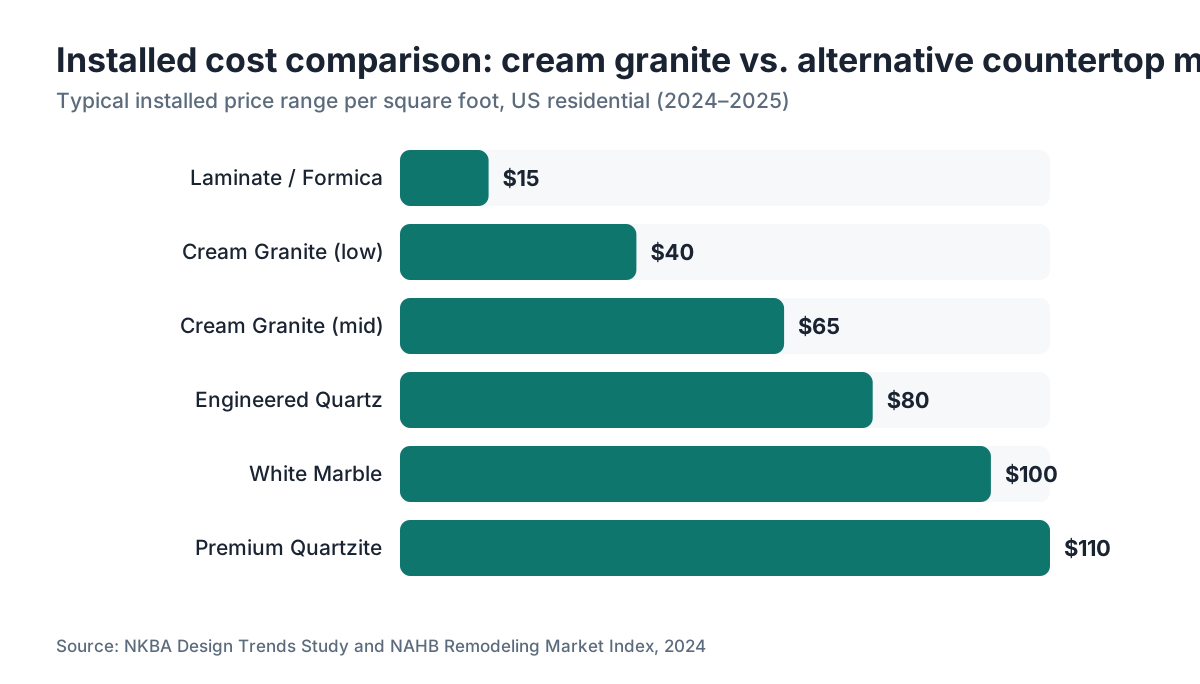
Fabricated and installed price (the number homeowners actually pay) runs $40, $100 per square foot for most cream granite, with the mid-range sitting around $55, $75. The National Kitchen and Bath Association's industry cost data and multiple fabricator surveys consistently show this range for granite generally, and cream stones tend to sit in the lower-to-middle portion because supply is strong [2].
What pushes cost up:
- Premium slab origin (Norwegian Crema Pearl costs more to ship than Brazilian Giallo)
- Thick slabs (3 cm is now standard; 2 cm is cheaper but requires substrate support)
- Complex edge profiles (ogee, dupont, laminated edges add $15, $30 per linear foot over eased)
- Cutouts for sinks and cooktops ($100, $250 each depending on shape)
- Seams in difficult locations
- Your region (labor rates vary significantly; the Mountain West and parts of the South run lower than coastal metros)
What doesn't move the needle much: basic sealing, standard square footage, simple eased or beveled edges.
For a typical 40-square-foot kitchen, budget $1,600, $4,000 for fabrication and installation, before any demolition of old countertops (add $200, $500 for removal). Homeowners often compare cream granite against laminate countertops or Formica countertops, which start closer to $10, $20 per square foot installed. The gap is real, but so is the durability difference.
How durable is cream granite for everyday kitchen use?
Granite is one of the hardest countertop materials you can put in a kitchen. It scores 6 to 7 on the Mohs hardness scale [3], which means a standard kitchen knife (typically 5.5 to 6.5 Mohs) will dull before it scratches the stone. You can cut on cream granite, though most fabricators will tell you not to because the stone will win and your knives will lose.
Heat resistance is excellent. Granite forms at temperatures above 1,200°F underground, so a 400°F pot from the oven is not going to cause a thermal crack under normal circumstances. Sudden extreme thermal shock from a commercial blast chiller or similar is a different story, but that almost never comes up in residential kitchens.
Acid sensitivity is lower with granite than marble. The quartz and feldspar matrix in granite does not react with mild acids the way calcite in marble does. You can leave a lemon on cream granite without ruining the finish, though you should still clean it up in reasonable time because etching is possible on some stones sold as granite that contain calcite bands.
Staining is the main risk. Lighter cream stones show oil stains more visibly than dark granite because there is less visual noise to camouflage a shadow. A proper seal dramatically reduces absorption. Testing is straightforward: drop a few tablespoons of water on the surface. If it beads, the seal is good. If it starts darkening the stone within a few minutes, seal it [4].
Chipping is possible at edges, particularly on thin 2 cm slabs or on fine-grained stones at outside corners. Standard 3 cm fabrication with a slightly rounded edge profile (eased or small bevel) is the practical answer. Bullnose and pencil profiles round the edge more aggressively and chip even less.
A well-maintained cream granite countertop installed today will almost certainly outlast the kitchen it goes into. The stone itself does not wear out.
Do cream granite countertops need to be sealed, and how often?
Yes. Almost all granite needs sealing, and light-colored stones need it more attentively than dark ones because stains show more clearly. That said, sealing is not complicated.
A quality penetrating sealer (impregnator) fills the microscopic pores in the stone with a water- and oil-repellent compound, usually siloxane or fluoropolymer chemistry. It does not coat the surface like a paint; it bonds inside the stone. The Marble Institute of America (now Natural Stone Institute) recommends testing absorption before assuming a sealer is needed, but in practice most cream granites benefit from sealing on installation and annually after that [4].
The actual process: clean the surface, apply sealer with a cloth or applicator pad, let it penetrate for the time specified on the product label (usually 10 to 20 minutes), wipe off excess before it hazes. The whole job takes 15 to 30 minutes for an average kitchen. You do not need a professional to do this.
Products to look for: StoneTech BulletProof, Miracle Sealants 511, and Aqua Mix Sealer's Choice Gold are all widely available and well-regarded. A 24-ounce bottle typically covers 200 to 400 square feet, more than enough for one application in a kitchen.
One thing homeowners often get wrong: they assume a newly installed slab is pre-sealed by the fabricator and skip the first application. Some fabricators do seal before delivery; many do not. Ask specifically, and if you are not sure, apply a fresh coat yourself. It cannot hurt.
For a full cleaning and maintenance approach that applies to stone generally, how to clean stone countertops covers the daily routine in detail.
Which cabinet colors work best with cream granite?
Cream granite's real advantage over stark white stone is its warmth. The ivory or gold undertones in stones like Giallo Ornamental, Colonial White, and Crema Pearl read as neutral but not cold. That warmth makes color pairing easier than you might expect.
What works well:
- White cabinets (any shade): classic combination, the stone keeps the white from feeling sterile.
- Medium wood tones (maple, cherry, oak): the cream ground in the stone connects with the wood's warmth without competing.
- Navy or deep blue cabinets: the contrast is strong and popular; the cream keeps the kitchen from going too dark.
- Soft sage or muted green: earthy, currently popular in design, works particularly well with Giallo Ornamental's gold notes.
- Gray cabinets: works, though very pale gray cabinets can blend too closely with some cream stones and lose definition. Use a stone with more movement if you go this route.
What to think through more carefully:
- Very dark espresso or black cabinets: the contrast can be striking, but the cream stone may not have enough drama to hold its own. A stone with bolder veining or movement, like Santa Cecilia, is a better choice here than a quiet stone like Crema Pearl.
- Orange or honey-toned wood: can amplify the yellow in some cream granites to a point where the kitchen reads more 2005 than current. Test with a large sample in your actual lighting before committing.
Lighting matters more than most people expect. Cream granite under warm incandescent or Edison-bulb lighting looks rich and inviting. Under cool LED (4000K+), the same stone can look slightly greenish or gray depending on the specific mineral content. Take a sample home and look at it under your actual lighting conditions.
How does cream granite compare to white marble, quartzite, and quartz countertops?
This is the question most homeowners are actually trying to answer, even when they search for just one material.
| Material | Hardness (Mohs) | Acid Resistance | Needs Sealing | Installed Cost / sq ft | Heat Resistance |
|---|---|---|---|---|---|
| Cream Granite | 6 to 7 | Good | Yes, 1x/year | $40, $100 | Excellent |
| White Marble | 3 to 4 | Poor (etches easily) | Yes | $50, $150 | Good |
| White Quartzite | 7+ | Good, Excellent | Yes | $60, $120 | Excellent |
| White/Cream Quartz (engineered) | ~7 | Good | No | $55, $120 | Poor (heat-sensitive resin) |
Marble is the classic comparison. White and cream marble slabs are beautiful and timeless, but the calcite matrix etches on contact with anything acidic, including lemon juice, wine, and tomato sauce. Etching is different from staining; it is a chemical change to the surface that leaves a dull mark. You can live with marble if you accept the patina it develops. Most people who cook aggressively should not put marble in their kitchens. See marble countertops for the full picture.
Quartzite is often confused with quartz (the engineered product) and with marble. True quartzite, like White Macaubas or Sea Pearl, is extremely hard and acid-resistant. The problem is that some quartzite contains calcite bands that will etch, and not all slabs in the same lot are consistent. The how to clean quartzite countertops guide gets into the testing protocol.
Engineered quartz (Cambria, Silestone, Caesarstone, etc.) has no sealing requirement and very consistent color because it is manufactured. The trade-off: it uses polymer resins that can scorch from direct high heat, and it does not look quite like real stone. Cambria countertops covers that product family specifically.
For most homeowners who want the look of pale natural stone with manageable upkeep, cream granite sits in a practical sweet spot. It is harder than marble, more available and lower-priced than premium quartzite, and more convincingly natural-looking than engineered quartz.
What are the common problems with cream granite and how do you avoid them?
Every material has failure modes. Here are the ones that actually show up with cream granite.
Lot variation. This is the biggest practical problem. Cream granite slabs from the same quarry, extracted the same month, can look noticeably different. If you select from a photo in a showroom catalog and your fabricator orders the slab remotely, you may get a stone that is technically the right name but looks different from what you expected. The fix is simple: select your actual slabs in person at the stone yard before the fabricator orders. For a kitchen with multiple slabs, see them side by side.
Oil staining at the sink. The area around the sink takes the most abuse in a kitchen: water, soap, cooking oils. Even well-sealed cream granite can develop a shadow or darkening in this zone over time if sealing is neglected. Annual resealing, combined with not letting oil pools sit, keeps this from happening.
Chips at outside corners. 90-degree outside corners on any stone countertop are the most vulnerable point. A falling pan or a heavy impact can chip the corner even on hard granite. Specify an eased or slightly rounded edge at outside corners rather than a sharp 90-degree profile. Some fabricators do this automatically; ask.
Grout hazing on backsplash work. Not a granite problem per se, but tile installers working above a new countertop sometimes let grout haze fall on the stone. Dried grout is difficult to remove cleanly. Cover the stone with kraft paper or cardboard before any tile or grout work begins.
Yellowing myths. A common concern online is that cream granite "turns yellow" over time. This is largely a misconception. The stone itself does not discolor from oxidation the way some metals do. What can happen: certain sealers or adhesives applied incorrectly can leave a yellow tint. Strip the old sealer with a stone-safe stripper and reapply fresh product if you suspect sealer yellowing.
How do fabricators price and quote cream granite jobs?
Fabricators build quotes from a few core inputs: gross square footage of the slab material needed (which includes waste from cuts and template shapes), edge linear footage, number of cutouts, seam count, and any special work like mitered edges or waterfall panels.
Most shops calculate gross material using a nesting layout, where template shapes are fit onto slab dimensions to minimize waste. The waste factor for a typical kitchen run in cream granite is 15 to 25% of gross slab area depending on layout complexity and the number of angled cuts. A fabricator who quotes you exactly your net countertop square footage without a waste factor is going to end up short on material, which usually means an expensive delay or a mismatched patch slab.
Shops that have moved to software-based quoting and nesting, like SlabWise, can give customers an accurate material cost faster and reduce over-ordering that gets charged back to the homeowner. The practical benefit for a homeowner is a more transparent quote line-item breakdown rather than a single number.
For a typical kitchen, ask your fabricator for a line-item quote showing: material cost per square foot, fabrication rate, edge profile charge per linear foot, cutout charges, delivery and installation, and sealing. If they give you only a total, ask them to break it down. Reputable shops have no reason to refuse.
The countertop installation article covers what happens on install day and how to prep your kitchen.
What should you look for when selecting cream granite slabs in person?
Going to the stone yard is one of the few steps in this process you should not hand off entirely to your fabricator or designer. It is worth an afternoon.
First, look at the slab wet and dry. Stone yards sometimes wet slabs to show color depth. The sealed and polished version in your kitchen will be somewhere between the two states. Ask to see both.
Second, check for fissures vs. cracks. Natural fissures (linear features that follow the mineral grain) are normal in granite and are not structural weaknesses. True cracks, which cut across the slab and often have slight separation, can propagate over time under stress. Run your fingernail across any linear feature; a fissure is usually flush, a crack has a detectable gap [10].
Third, look at the back of the slab. Mesh backing on the reverse side indicates that the slab has fissures that the fabricator or quarry filled and reinforced. This is common practice and not automatically disqualifying, but it tells you the slab has some structural sensitivity and should be fabricated and installed carefully.
Fourth, for projects requiring more than one slab, lay both slabs next to each other and look at the join point. Even within the same lot, color and pattern variation is normal. The question is whether the variation bothers you in context. If it does, ask whether the yard has consecutive slabs from the same block, which will match more closely.
Fifth, check thickness consistency at the edges. 3 cm (approximately 1.25 inches) is standard. Some slabs are nominally 3 cm but vary 2 to 3 mm across their length. Minor variation is normal; a slab that varies more than 4 to 5 mm end to end is going to create leveling headaches during installation.
How do you maintain cream granite countertops for the long term?
Day-to-day maintenance is genuinely simple. Wipe spills quickly (especially oil, red wine, and coffee), clean with warm water and a few drops of dish soap or a pH-neutral stone cleaner, and dry with a soft cloth. That covers 95% of what you need to do.
Avoid: acidic cleaners (vinegar-based products, citrus cleaners), abrasive scrubbers, bleach-based products, and anything marketed as a multi-surface spray with added fragrance (these often contain citric acid as a preservative). The Natural Stone Institute's care guidance specifically calls out pH-neutral products as appropriate for daily cleaning on natural stone [4].
Annual sealing, as covered above, is the one recurring task that requires more than two minutes.
For stubborn stains, a poultice is the standard professional remedy. Mix a paste of diatomaceous earth or kaolin clay with hydrogen peroxide (for organic stains like food or coffee) or acetone (for oil-based stains), apply it to the stained area, cover with plastic wrap, tape the edges, and let it sit 24 to 48 hours. The poultice draws the stain out of the pores as it dries. This works better than scrubbing because scrubbing just spreads the stain.
One thing that surprises homeowners: granite does not need any special treatment after the first few years just because it is "old." The stone does not degrade. A 20-year-old cream granite countertop that has been sealed regularly is functionally identical to a new one. The only real aging is any edge chips you accumulate and the general wear of cabinet hardware and fixtures around it.
For parallel cleaning guidance on other stone surfaces, how to clean soapstone countertops covers a material with different chemistry but some overlapping care principles.
Is cream granite a good choice for bathrooms and other non-kitchen applications?
Yes, with a few adjustments to expectations.
Bathroom vanities are actually a gentler environment for granite than kitchens. Less heat exposure, less cooking oil, fewer acidic food products. The main bathroom hazard is toothpaste and some cosmetics (certain makeup removers contain acids or solvents). A sealed cream granite vanity top will perform beautifully for decades.
Outdoor kitchens are more complicated. Granite is UV-stable (the minerals do not fade in sunlight), but the sealer is not. Outdoor sealed granite needs resealing more often, roughly every six months in regions with intense sun and freeze-thaw cycles. The freeze-thaw issue is specific to unsealed stone that absorbs water; if water in the pores freezes and expands, it can eventually cause surface spalling. Keep the seal current and you largely eliminate this risk.
Fireplace surrounds: granite performs well here. The stone handles intermittent heat without cracking. Make sure the fabricator knows about any sustained direct flame exposure, which requires a different installation approach.
Outdoor flooring: cream granite can work but the finish matters. Polished granite is very slippery when wet. Specify a honed, flamed, or brushed finish for any outdoor or wet floor application. The same applies to outdoor steps.
Island waterfall panels are a popular current application. Cream granite with decent linear movement in the veining looks excellent on a mitered waterfall edge. Very tight, uniform stones like Crema Pearl look less impressive as a waterfall because there is nothing to carry the eye down the panel.
What does the installation process look like, and what should you do to prepare?
A standard cream granite kitchen countertop installation runs 2 to 4 hours for an average kitchen, assuming the template was done on a prior visit (which is normal practice for natural stone).
The sequence: the old countertop comes off first, which the installer may or may not include in their scope (clarify this). The cabinets are checked for level; any cabinet that is out of level gets shimmed. The slabs come in pre-cut to the template, are dry-fit first, then set with silicone adhesive or epoxy at the cabinet tops and seams. Seams are filled with a color-matched epoxy, then polished flush. Undermount sinks get clipped from below. The whole surface gets cleaned and often a first sealer application.
What you need to do before install day:
- Clear everything off the countertops and out of any cabinets with items near the edge.
- Make sure the plumber has already disconnected the sink and faucet if you have an existing countertop. Many fabricators will not do plumbing disconnects; it is outside their license in most states.
- Verify the cabinets are fully anchored to the wall and level. Installers can shim minor variation, but a significantly unlevel cabinet run should be fixed by your cabinet installer first.
- Have a helper or make sure the install crew has the right number of people. 3 cm granite slabs are heavy. A 6-foot kitchen slab can weigh 100 to 150 pounds. Professional crews handle this routinely, but they need clear access paths.
For more detail on what to expect and how to avoid common installation day problems, the countertop installation guide covers the process step by step.
Frequently asked questions
What is the most popular cream granite for kitchens?
Giallo Ornamental is probably the most widely sold cream granite globally, largely because Brazilian quarries produce it in high volume and it sits at the commercial-grade price point. Kashmir White from India and Colonial White are close behind. All three are widely available at most stone yards in the US.
Does cream granite show stains more than darker granite?
Yes, somewhat. Dark granite has more visual complexity that camouflages minor discoloration. A pale cream stone will show an oil shadow or coffee drip more visibly if you do not wipe it up. The fix is consistent sealing and prompt cleaning, not avoiding light-colored stone. Most homeowners have no problems once they establish a routine.
How long does cream granite last?
Indefinitely under normal use. The stone itself does not wear out. Properly installed and sealed cream granite countertops from the 1990s are still in service and functionally identical to new. The limiting factor is usually that the rest of the kitchen gets remodeled before the countertops need replacing.
Can you put hot pans directly on cream granite?
Technically yes; granite forms at over 1,200°F so a 400°F pan is not going to damage the stone thermally. In practice, most fabricators recommend using a trivet anyway. The risk is not to the granite but to the sealer, which can be degraded by repeated high heat. Use a trivet and your seal lasts longer.
Is cream granite the same thing as white granite?
They overlap but are not identical categories. White granite usually refers to stones with a bright white background and minimal other color, like Alaska White or Bianco Crystal. Cream granite includes stones with more warmth, ivory, or gold in the base color. Some stones are listed as both in different showrooms.
How do I get a quote for cream granite countertops?
Measure your countertop footprint in square feet (length times depth of each run, add them up), note the linear footage of edge you want profiled, count your cutouts, and bring that to a fabricator. They will template your kitchen before cutting. Getting quotes from two or three local fabricators is reasonable and will show you how prices differ by shop, material source, and edge selection.
Will cream granite go out of style?
Light neutral countertops have been popular in American kitchens for at least 30 years and show no sign of fading. Specific stones cycle in and out of fashion (Santa Cecilia peaked around 2010, for example), but the broader category of pale, warm stone countertops is about as durable a design choice as kitchen countertops get.
What edge profile should I choose for cream granite?
For most kitchens, an eased edge (a slightly softened 90-degree corner) or a small bevel is practical, durable, and relatively timeless. Ogee and dupont profiles are classic but add cost and can look dated in modern kitchens. Waterfall (mitered full-thickness edge) is popular in contemporary design and shows off the full slab thickness. Avoid sharp 90-degree square edges on outside corners; they chip.
How thick should cream granite countertops be?
3 cm (about 1.25 inches) is the current standard for residential countertops in the US and is strong enough to span standard cabinet openings without substrate support. 2 cm slabs are thinner, slightly cheaper, and require a plywood underlayment. They are less common now. Most fabricators will quote 3 cm by default unless you specify otherwise.
Can cream granite be repaired if it chips or cracks?
Chips on edges can be filled with a color-matched epoxy filler and polished; the repair is usually visible on close inspection but not obvious from normal standing distance. Surface cracks that do not go through the slab are similar. Full cracks through the slab thickness are harder; in some cases the slab needs to be replaced, though a skilled fabricator can stabilize a crack with epoxy and mesh from below.
Is cream granite safe for food contact?
Yes, sealed granite is food-safe. The stone itself is inert. The sealer, once cured, is also considered food-safe by the major product manufacturers. The FDA does not maintain a specific countertop material approval list, but sealed natural stone surfaces are widely accepted in residential and commercial kitchen applications.
How is cream granite different from cream quartz countertops?
Cream granite is natural stone with unique mineral patterns, needs annual sealing, handles heat well, and costs $40, $100 installed per square foot. Cream quartz is engineered from crushed stone and polymer resin; it requires no sealing and has very consistent color, but it can be damaged by direct high heat and looks slightly more uniform. Neither is universally better; it depends on your priorities.
Sources
- National Kitchen and Bath Association (NKBA), NKBA Design Trends Study: Granite countertop installed pricing in the range of $40, $100 per square foot is consistent with NKBA industry cost benchmarks for natural stone.
- U.S. Geological Survey, Mohs Hardness Scale Mineral Resources: Granite scores 6 to 7 on the Mohs hardness scale based on its primary mineral composition of quartz and feldspar.
- Natural Stone Institute, Care and Maintenance Guidelines for Natural Stone: Natural Stone Institute recommends testing absorption before sealing, using pH-neutral cleaners for daily care, and periodic resealing of granite surfaces.
- U.S. Geological Survey, National Minerals Information Center: Brazil and India are among the largest exporters of granite slabs to the US market, including the cream granite varieties widely sold commercially.
- National Institute of Standards and Technology (NIST), Physical Measurement Laboratory: 3 cm (approximately 1.25 inches) slab thickness standard used in fabrication corresponds to metric dimensional standards applied in stone trade.
- Marble Institute of America / Natural Stone Institute, Fabrication and Installation Standards: Recommended granite fabrication waste factors of 15 to 25% are consistent with industry installation standards for natural stone layout and cutting.
- University of Florida IFAS Extension, Countertop Material Comparison for Homes: Comparison of countertop materials including granite and engineered quartz shows granite's superior heat resistance relative to polymer-resin engineered products.
- National Association of Home Builders (NAHB), Remodeling Market Index and Cost Data: Countertop removal and disposal in kitchen remodels typically costs $200, $500 depending on material and regional labor rates.
- Natural Stone Institute, Dimension Stone Design Manual: Fissures in natural stone are normal and not structural weaknesses; true cracks with separation can propagate under stress.
Last updated 2026-07-09