TL;DR
- A countertop store can mean a big-box retailer, a dedicated showroom, or a fabricator who sells direct.
- Installed prices run from roughly $15/sq ft for laminate to over $200/sq ft for premium stone.
- The right store depends on your material, your timeline, and whether you want one company handling everything from slab to installation.
What exactly is a countertop store, and who sells countertops?
The phrase 'countertop store' covers at least four different business models, and mixing them up is the fastest way to get a confusing quote or a bad experience.
First, you have dedicated countertop showrooms. These are usually local or regional businesses that carry samples of granite, quartz, quartzite, marble, and sometimes laminate or solid surface. Many of them are actually fabricators with a sales floor attached, which means the same company that shows you the slab also cuts and installs it. That's generally the best arrangement for stone work because there's one throat to choke if something goes wrong.
Second, you have home improvement chains like Home Depot and Lowe's. Both sell countertops, but they typically subcontract the fabrication to a local shop. You get the convenience of a national brand warranty, and a stranger is cutting your stone. Pricing at these chains is often competitive for laminate and basic quartz. Less so for natural stone.
Third, some stone distributors or slab yards run a consumer-facing side. You can walk their warehouse, pick a specific slab, and either hire a separate fabricator or use their in-house service. This works well if you know exactly what you want and want to see the actual slab before committing.
Fourth, there are online countertop retailers. They ship prefabricated sections or tiles, mainly for laminate, butcher block, and solid surface. Convenient, yes. Good for an irregular custom kitchen? Usually not.
Knowing which model you're dealing with changes every question you should ask.
How much do countertops cost at a store, by material?
Installed price is the number that matters. Material-only figures look cheap until you add fabrication, edge profiles, cutouts, and installation, which together often run 60 to 80 percent of the final bill for stone.
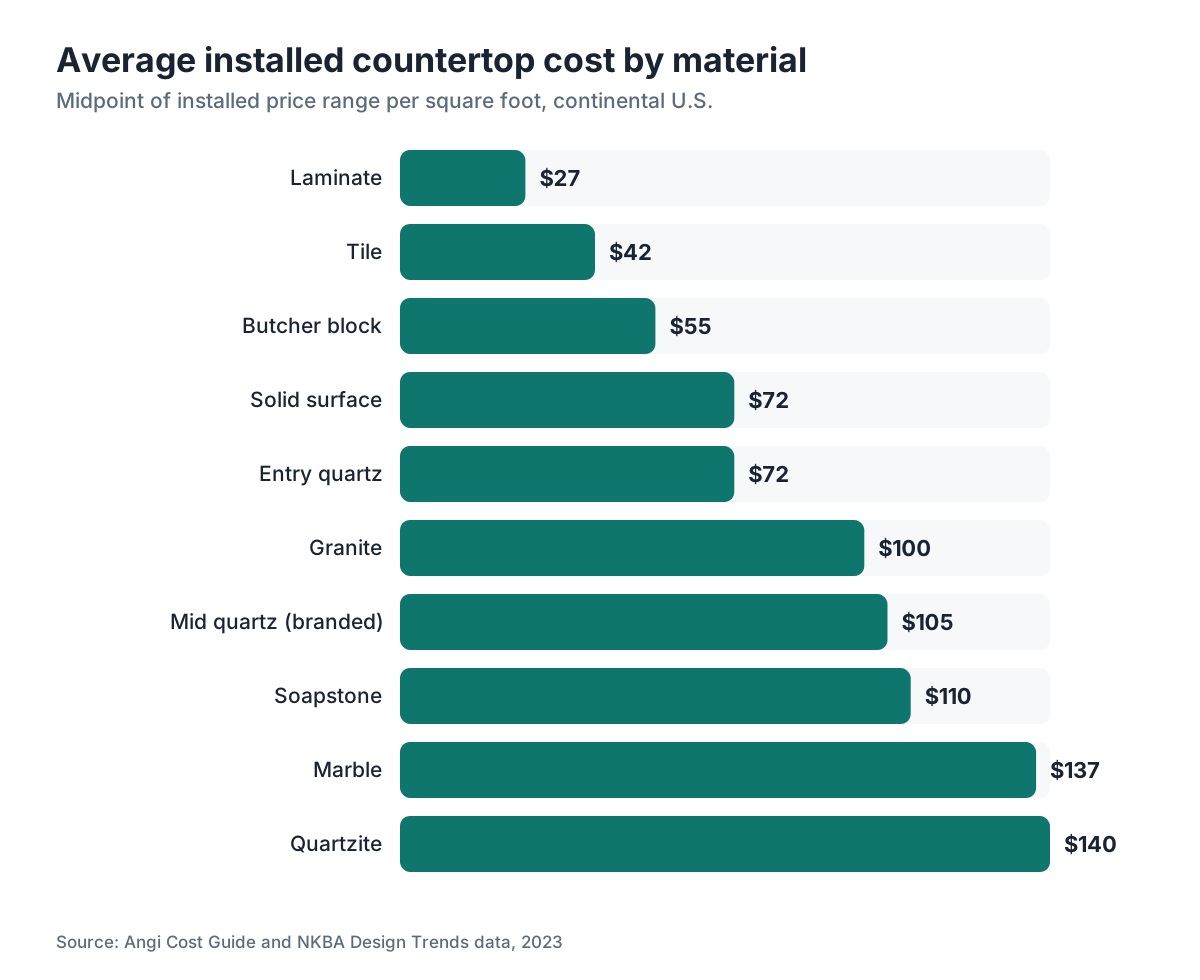
The table below shows realistic installed ranges from current market data compiled by industry sources. Prices reflect the continental U.S. and assume a typical kitchen of 30 to 45 square feet. High-cost metros (San Francisco, New York, Boston) can run 20 to 40 percent above the top of these ranges.
| Material | Installed price range (per sq ft) | Notes |
|---|---|---|
| Laminate (Formica-type) | $15, $40 | DIY-friendly; lower-end stores do this well |
| Butcher block | $30, $80 | Solid wood; sealing and maintenance required |
| Tile (ceramic/porcelain) | $20, $65 | Grout lines are a real maintenance issue |
| Solid surface (Corian-type) | $45, $100 | Seams can be invisible; repairable |
| Entry quartz | $55, $90 | Mass-market colors; wide availability |
| Mid-range quartz | $80, $130 | Brand-name (Cambria, Silestone, etc.) |
| Granite | $50, $150 | Huge range depending on rarity and origin |
| Marble | $75, $200+ | Etches; sealing mandatory; visually unmatched |
| Quartzite | $80, $200+ | Often confused with quartz; truly natural stone |
| Soapstone | $70, $150 | Develops patina; nearly heat-proof |
Sources: National Kitchen and Bath Association (NKBA) cost surveys and HomeAdvisor (now Angi) aggregated project data [1][2].
A few things to watch. Edge profiles add $10 to $30 per linear foot depending on complexity. Sink cutouts typically run $100 to $250 each. Cooktop cutouts are similar. Seams, if your layout requires them, can add another $100 to $300 per seam. None of this is hidden if you read the quote carefully, but stores vary a lot in how they bundle these line items.
What questions should you ask a countertop store before buying?
Most homeowners walk in with a material preference and a vague square footage guess. That's fine as a starting point. But five specific questions separate a shop that will deliver a clean job from one that will leave you arguing over a crooked seam.
-
Do you fabricate in-house, or do you subcontract? An honest answer here tells you a lot. If they subcontract, ask who the fabricator is and whether you can visit the shop. If they won't tell you, that's a red flag.
-
Can I see the actual slab I'm buying? For natural stone, this matters enormously. Two slabs of the same granite can look nothing alike. Reputable stores either have a slab yard onsite or will take you to their distributor. Stores that work only from small samples and photos are fine for quartz (which is engineered for consistency) but risky for granite, marble, or quartzite.
-
What's included in the quoted price? Get a line-item breakdown: material, fabrication, edge profile, cutouts (sink, cooktop, soap dispenser), delivery, and installation. Ask if the template (measurement) visit is included or billed separately.
-
Who installs, and are they licensed? In most states, countertop installation doesn't require a specialty contractor's license, but any plumbing reconnection does. Confirm that whoever reconnects your sink is licensed for that work. Some states require a general contractor or plumber for that step even if the countertop work itself is unlicensed [3].
-
What's the warranty, and who backs it? A national retailer may offer a store warranty, but the fabricator is the one who can actually fix a crack or redo a bad seam. Know who you'd call.
Ask those five and you'll know within 20 minutes whether you're dealing with a competent shop.
What are the red flags that a countertop store isn't worth your money?
A few patterns repeat in bad countertop experiences, and most of them show up before you sign anything.
No written, itemized quote. If a salesperson hands you a single total number without breaking out material, fab, and install, you have no way to compare it to a competitor's quote or catch errors. Demand a line-item document.
Reluctance to let you see the slab. For quartz or laminate, this matters less, since those products are manufactured to tight specs. For any natural stone, buying from a photo is a gamble. A sample chip in a showroom can look nothing like an 80-square-foot installation.
Vague lead times. Countertop fabrication typically takes one to three weeks from template to installation for a standard job. If a shop won't commit to an approximate timeline, they're probably overbooked or disorganized.
No physical address for the fabrication shop. Some brokers quote countertops and then shop the job to the cheapest sub they can find that week. Nothing wrong with that model, but you should know that's what's happening.
Pressure to decide same-day. Stone prices do move with slab availability, and a specific slab you love can genuinely sell before you come back. But a shop that won't hold a slab for 48 hours with a credit card is not operating in your interest.
Unrealistically low price on natural stone. Fabrication labor costs are relatively fixed. A quote that's 30 to 40 percent below every other store for granite or marble reflects lower-quality material, thinner slabs (3/4-inch vs. 1-1/4-inch), or an inexperienced crew. Sometimes all three.
Should you buy from a big-box store or a local countertop fabricator?
This is genuinely a tradeoff, not a clear winner.
Big-box stores win on a few dimensions. Financing options are usually better (Home Depot and Lowe's both offer project-specific financing). If you're doing a full kitchen renovation and buying cabinets, flooring, and countertops from one place, the convenience is real. For laminate and tile, big-box stores often have better selection than small shops. And if something goes wrong, the national brand has more pressure on it to make things right.
Local fabricators win for stone. Period. A shop that owns its own bridge saw, CNC machine, and polisher produces tighter seams and better edge profiles, and turns jobs around faster than any subcontracted arrangement. They also have real skin in the game because their reputation is local and searchable. The NKBA estimates that about 70 percent of stone countertops are installed by independent fabricators rather than big-box subcontractors [1].
For quartz specifically, it's closer. Engineered quartz needs accurate templating and clean installation, but the material itself is forgiving compared to marble or quartzite. A competent big-box subcontractor can do good quartz work.
If you're torn, get quotes from both. A local fabricator's written quote is also a bargaining chip at the big-box store if you prefer the convenience of the chain.
For kitchen countertops in natural stone, I'd take the local fabricator over a chain every time unless the price difference is dramatic and the reviews are solid.
How does the countertop buying process work from store to installation?
Most people don't know the steps before they walk in, which means they're surprised by the timeline and the deposit structure. Here's the typical sequence.
Step 1: Showroom visit and rough quote. You look at samples, pick a direction, and get a ballpark number based on your approximate square footage. Most shops do this at no charge.
Step 2: Slab selection (for natural stone). You or your fabricator visits the slab yard to pick the actual slabs you want held. This is critical for any natural stone. The shop will usually put a hold on them with your deposit.
Step 3: Template. A technician comes to your home after your cabinets are installed (or the old countertops are confirmed flat and square) and makes a precise template, either with physical strips or a digital laser templating system. This visit typically costs $75 to $150 if billed separately, or is included in the package. Never let a shop template before cabinets are in place.
Step 4: Fabrication. The shop cuts, edges, and polishes your pieces. Standard lead time is one to two weeks for stock materials, two to four weeks for specialty stone or complex jobs [2].
Step 5: Installation. A crew brings the finished pieces and sets them. For stone, expect a two- to four-person crew for a standard kitchen. The job usually takes two to five hours depending on complexity.
Step 6: Plumbing reconnection. Your countertop installer typically does not reconnect plumbing. Budget for a plumber's visit the same day or the next morning.
Step 7: Sealing (for natural stone). Some shops seal onsite before they leave. Others leave sealer with instructions. Either way, plan to let the surface cure 24 hours before heavy use.
What should you know about countertop store pricing, deposits, and contracts?
Deposit norms vary by shop, but 50 percent down at signing with the balance due at installation is the most common structure for custom stone work. Some shops require 100 percent up front for small jobs or high-cost slabs. That's not unusual for specialty stone, where the shop buys your slab before cutting.
Get a written contract that spells out the specific material (by name, color, and thickness), the edge profile, every cutout location and type, the timeline, what happens if there's a defect, and the payment schedule. This isn't paranoia. It's how any legitimate contractor operates.
Pricing can also vary by thickness. Standard quartz and granite come in 2 cm (about 3/4 inch) and 3 cm (about 1-1/4 inch). The 3 cm material costs more but looks more substantial at the edge and typically doesn't need a plywood substrate. Most residential jobs today use 3 cm for stone. If a quote comes in well below competitors, check whether it's using 2 cm material.
Some stores charge a restocking or cancellation fee if you back out after a slab is cut. That's fair. Once your slab is cut to your template dimensions, it's yours. Make sure the contract states what happens if the slab arrives damaged or the installation is faulty before you sign.
For software-savvy fabricators and shop owners: accurate quoting is where jobs get profitable or painful. Tools like SlabWise help shops generate line-item quotes quickly, which makes the sales conversation cleaner for everyone and cuts the chance of a scope dispute later.
For countertop installation specifics, including what the crew actually does onsite, that's worth reading separately before your install day.
What materials do most countertop stores carry?
The selection at any given store depends heavily on its model and size. Small local fabricators often have a core of five to eight materials they know well and source reliably. Large showrooms or warehouse stores may stock 20 or more.
Here's the realistic breakdown of what you'll find and where:
Granite: Available nearly everywhere. It's the workhorse of the stone countertop market. Hundreds of colors and patterns. Prices range from cheap to expensive depending on the rarity of the specific stone. Granite countertops are still the most commonly installed natural stone in U.S. kitchens.
Quartz (engineered): The most popular countertop material by volume in U.S. residential sales as of 2023 [1]. Available at every type of store. Brands like Cambria countertops are sold only through certified dealers, so not every shop carries every brand.
Marble: Common at stone fabricators and upscale showrooms. Rarer at big-box stores except as prefabricated vanity tops. Marble countertops require more maintenance than any other countertop material, and any store selling marble should tell you that up front.
Quartzite: Increasingly common at stone-focused shops. Often confused with quartz (they're completely different materials). Ask explicitly whether a stone is quartzite or quartz.
Laminate: Every big-box store, most home goods stores, and many small fabricators. Laminate countertops and Formica countertops are the most budget-friendly option and have improved a lot in surface texture and realism.
Solid surface (Corian-type): Available at larger showrooms and home improvement chains. Corian countertops are particularly common for bathrooms and laundry rooms.
Butcher block: Home improvement chains, dedicated kitchen showrooms, and some online retailers. Butcher block countertops need annual oiling or sealing and shouldn't be installed near sinks without extra sealing attention.
Soapstone: Specialty stone shops. Not common at big-box stores. Beautiful and heat-resistant. For care guidance, how to clean soapstone countertops covers what ownership actually requires.
How do you compare quotes from different countertop stores?
Comparing countertop quotes is harder than it looks because stores bundle line items differently. A quote for $3,200 from one shop and $3,800 from another might actually favor the second shop once you account for what's included.
Build a comparison sheet with these rows: material cost per square foot, fabrication cost, edge profile (specify the profile by name so it's the same thing), number of cutouts and cost each, delivery, installation labor, template fee, and sales tax. Fill in each store's numbers. Now you're comparing the same thing.
Also compare lead time. A shop that costs $200 more but can install in two weeks versus four weeks is often worth it if you have contractors waiting on your countertops.
Check reviews specifically for installation quality, more than sales experience. A smooth showroom visit followed by a botched installation is a common pattern in negative reviews. Google, Houzz, and Yelp reviews that mention 'seam', 'level', or 'chip during install' are the ones to read carefully.
For stone, ask whether you can visit the fabrication shop and see finished work. Most legitimate shops welcome this. If a shop declines, ask yourself why.
Finally, ask each shop what happens if the installed countertop has a visible defect. The answer tells you more about the business than any marketing claim.
What do online countertop stores offer that local stores can't, and vice versa?
Online countertop retailers have gotten genuinely useful for a narrow range of projects. They work best for prefabricated laminate sheets and postform tops, butcher block sections in standard widths, solid surface panels, and tile. Some ship cut-to-size quartz or granite for DIY installation, though accuracy depends on your measurements being perfect.
Where online stores fall short: anything requiring a physical template, specialty stone with significant natural variation, complex kitchen layouts with multiple angles, and any job where you need to see the actual slab. A photo of a granite slab is not the same as standing in front of it.
Prices online can look attractive because there's no showroom overhead. But factor in shipping (stone is extremely heavy; freight shipping for a kitchen's worth of quartz can run $300 to $800) and the cost of hiring a local installer separately. The total often rivals or exceeds what a local shop charges fully installed.
For routine laminate replacements, bathroom vanity tops, or a simple butcher block island, online can be genuinely convenient. For a full kitchen in natural stone, it's a gamble that most experienced fabricators would not recommend.
For maintenance after installation, resources like how to clean stone countertops and how to clean quartzite countertops are worth bookmarking regardless of where you buy.
What should fabricators and shop owners know about running a competitive countertop store?
This section is for the shop side of the business.
The countertop retail and fabrication market in the U.S. is fragmented. The stone and countertop fabrication industry (NAICS 327991 adjacent) has several thousand firms, most with fewer than 20 employees [4]. Gross margins in fabrication are typically 35 to 55 percent, but quoting errors, material waste, and remakes eat that margin fast.
The stores that sustain strong margins do a few things consistently. First, they template with precision, either with traditional methods or digital laser tools that eliminate measurement error. Second, they quote with full line-item detail so there are no surprises for the customer and no scope creep for the shop. Third, they manage their slab inventory well, meaning they know which slabs are committed to which jobs and don't oversell material.
Quoting software built specifically for countertop shops, like SlabWise, addresses the second and third points directly: it generates detailed quotes from accurate measurements and tracks remnant inventory, which reduces waste on a per-job basis. Shops doing more than 15 jobs a month typically see measurable margin improvement once quoting is systematized.
On the customer experience side, the shops with the best reputations do one thing that's simple but rare: they call the customer the day before installation to confirm time and set expectations. Customers who are surprised on install day are customers who leave bad reviews.
Pricing strategy matters too. Competing purely on price against big-box chains is a losing game for most independent shops. Compete instead on material knowledge, slab selection, seam quality, and plain accountability. That wins more jobs at better margins.
Frequently asked questions
How much does a typical countertop store charge for installation?
Installation labor alone typically runs $10 to $30 per square foot depending on material and region, on top of the material and fabrication costs. Laminate and tile installations sit at the low end. Heavy stone like granite or quartzite, which needs multiple workers and careful handling, sits at the high end. Always ask whether your quote includes installation or prices it separately.
Can I just buy a countertop from a store and install it myself?
For laminate sheets, butcher block, and some prefabricated tile, DIY installation is realistic. For stone, it's extremely difficult. Granite and quartz slabs weigh 15 to 20 pounds per square foot, need precise cutting and polishing equipment, and must sit perfectly level or they'll crack. Most homeowners who try DIY stone installation either damage the material or end up hiring a professional anyway.
How long does it take from visiting a countertop store to having countertops installed?
The typical timeline is three to six weeks from first showroom visit to installation. Slab selection, deposit, and scheduling take about a week. The template visit is usually within one to two weeks of signing. Fabrication takes one to three weeks. Rush jobs exist but cost more and depend on the shop's schedule. Custom or specialty stone can take four to eight weeks, especially if the slab needs to be ordered from a distributor.
What's the difference between a countertop store and a countertop fabricator?
A countertop store may or may not fabricate in-house. Many stores are showrooms that subcontract cutting and installation to a separate fab shop. A fabricator owns the equipment (saw, CNC machine, polisher) and does the work directly. When the store and fabricator are the same business, accountability is clearer and turnaround is usually faster. Always ask before assuming.
Do countertop stores offer financing?
Many do, especially big-box retailers. Home Depot and Lowe's offer project-based financing through third-party lenders, sometimes with deferred interest promotions. Local shops increasingly offer financing through services like GreenSky or Acorn Finance. Terms vary widely. Deferred-interest deals require full payoff before the promo period ends or you owe back interest, so read the fine print carefully.
Is it cheaper to buy countertops online or from a local store?
For standard laminate and butcher block, online can be cheaper, but freight shipping for heavy materials ($300 to $800 for a kitchen's worth) plus the cost of a separate local installer often close the gap. For stone, the math almost always favors a local fabricator because custom templating, precise fabrication, and installation come bundled. Buying stone online and installing it separately rarely saves money and adds risk.
What is a standard deposit for a countertop store order?
Fifty percent at contract signing is the most common deposit structure. The remaining balance is typically due at installation or sometimes at delivery. Some shops require full payment upfront for high-value or specialty slabs they must purchase specifically for your job. Always get the deposit terms in writing, and confirm the refund policy if the job is cancelled or delayed.
Can a countertop store match a slab I already own or a specific photo I found online?
Fabricators can match a specific slab only if the same quarry is producing it and a distributor has it in stock. Photos from Pinterest or Instagram are often of stones that may no longer be in production or in your region. Bring the photo and ask, but be prepared for the answer to be 'we have something similar' rather than an exact match. Natural stone variation means even the same quarry run won't be identical.
What countertop thickness should I ask for at the store?
3 cm (about 1.25 inches) is the current residential standard for stone countertops and what most stores quote by default. It's heavier and more expensive than 2 cm material but looks more substantial at the edge and generally doesn't need a plywood substrate. If a quote seems surprisingly low, confirm whether it's for 2 cm or 3 cm material. For laminate, thickness is typically 1.5 inches including the substrate and is not a variable you choose.
How do I know if a countertop store is reputable?
Look for at least three years of operating history, a physical shop address (more than a showroom), reviews that specifically mention installation quality rather than just salespeople, and willingness to provide references from recent jobs. Ask to visit the fabrication shop. A reputable store welcomes this. Also verify that whoever reconnects your plumbing is licensed for that work in your state, which any legitimate shop can confirm.
What edge profiles do countertop stores typically offer?
Most stores offer eased (slightly rounded), beveled, bullnose (fully rounded), ogee (S-curve), and waterfall profiles as standard options. Specialty profiles like dupont, chiseled, or laminated (stacked) edges cost more and take longer. Edge price is typically quoted per linear foot, running $10 to $30 for standard profiles and $30 to $60 or more for decorative ones. Confirm which profiles are included in your base quote.
Do countertop stores handle the plumbing after installation?
Generally, no. Countertop installers set and secure the stone but typically do not reconnect sink plumbing. You'll need a plumber for that step, which usually takes one to two hours. In some states, disconnecting and reconnecting a sink drain requires a licensed plumber. Coordinate your plumber to arrive the same day as or the morning after your countertop installation so you're not without a sink for multiple days.
Sources
- National Kitchen and Bath Association (NKBA), NKBA Design Trends Reports: Quartz is the most popular countertop material by volume in U.S. residential sales as of 2023; approximately 70 percent of stone countertops are installed by independent fabricators
- Angi (formerly HomeAdvisor), Cost Guide: Countertop Installation: Installed countertop price ranges by material and typical fabrication lead times of one to four weeks for standard jobs
- U.S. Department of Labor, Occupational Safety and Health Administration (OSHA): Plumbing reconnection typically requires a licensed plumber in most states, separate from countertop installation licensing
- U.S. Census Bureau, County Business Patterns, NAICS sector data for stone and countertop fabrication: The countertop fabrication industry includes several thousand firms, most with fewer than 20 employees
- U.S. Geological Survey (USGS), National Minerals Information Center: Dimension Stone: Granite and marble import and domestic production data supporting price range variation by stone rarity and origin
- U.S. Consumer Product Safety Commission (CPSC), Home Improvement Safety Guidelines: Safety standards relevant to heavy material handling during countertop installation
- National Stone, Sand and Gravel Association (NSSGA): Industry data on stone fabrication practices and countertop material weight (15 to 20 lbs per square foot for granite and quartz)
- U.S. Bureau of Labor Statistics, Occupational Outlook Handbook: Tile and Stone Setters: Labor cost context for countertop installation workers and regional wage variation
- Home Depot, Kitchen Countertop Installation Services overview: Big-box store financing options and countertop subcontracting model for installation
- Lowe's, Countertop Buying Guide: Big-box countertop material selection, pricing structure, and project financing offerings
Last updated 2026-07-09