TL;DR
- A laminated countertop edge glues a strip of matching stone or material to the underside of the slab's front edge, creating the look of a thicker slab without paying for one.
- Common profiles include eased, beveled, bullnose, ogee, and waterfall.
- Costs range from $5 to $50+ per linear foot depending on profile complexity and material.
- Mitered edges are the premium alternative when you want a joint that all but disappears.
What is a laminated countertop edge, exactly?
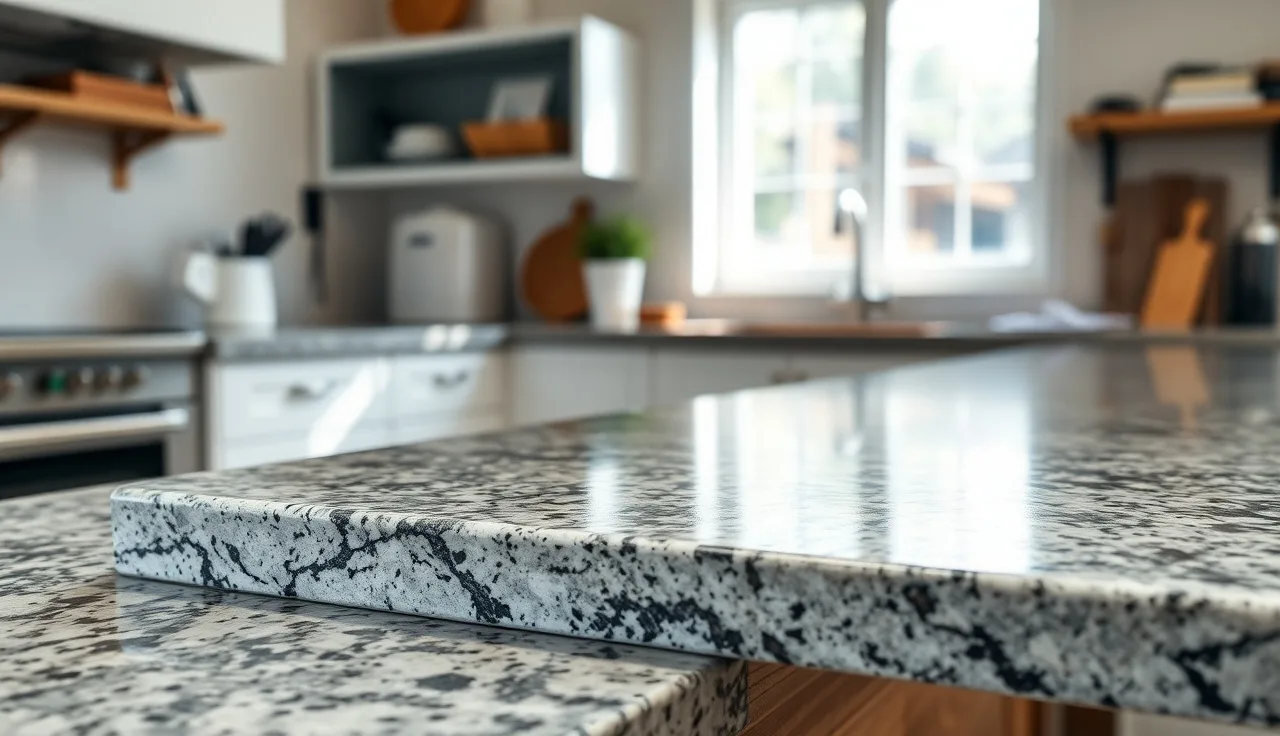
A laminated edge is a second piece of stone (or whatever material the top is made from) bonded to the underside of the slab's front edge. The goal is simple: make a 2 cm or 3 cm slab look thicker than it really is. Without lamination, a 3 cm (roughly 1.25-inch) granite slab has a front edge that shows exactly how thin it is. Add a 2 to 3 cm buildup strip and suddenly the edge looks like a 6 cm (about 2.5-inch) thick slab.
This matters for two reasons. First, full-slab thickness is expensive. A 6 cm slab takes twice the stone, twice the weight, and in many quarries, twice the cost per square foot. Lamination gives homeowners the visual presence of thick stone at a fraction of the price [1]. Second, edge profiles are cut into the combined laminated piece, which means you can run almost any profile on a built-up edge exactly as you would on a solid one.
For fabricators, laminated edges are a daily production reality. A shop running residential kitchen jobs will laminate dozens of front edges per week. Getting the joint tight, the glue color right, and the profile consistent across a mitered corner is a real skill that separates average shops from good ones.
The term comes up constantly alongside "countertop miter edge profile" searches, and there's a good reason: the miter edge is the most demanding version of the laminated edge. Instead of a flat butt joint at the bottom, a mitered joint runs at 45 degrees so the seam hides on the angled face of the edge itself. More on that below.
What are the standard laminated edge profiles and which should you choose?
Profile choice is mostly about looks, but practicality matters too. Some profiles collect crumbs. Some chip more easily. Some look dated in five years.
Here's a breakdown of the most common profiles you'll see quoted on residential jobs:
| Profile | What it looks like | Chip risk | Era / style fit | Relative cost |
|---|---|---|---|---|
| Eased (flat polished) | Square corners, very slight softening | Low-medium | Clean, modern | $ |
| Bevel | Angled flat cut, usually 45° | Low | Transitional | $ |
| Half bullnose | Top edge rounded, bottom stays flat | Medium | Traditional | $$ |
| Full bullnose | Both top and bottom edges fully rounded | Medium | Traditional | $$ |
| Ogee | S-curve profile with Roman heritage | High at tip | Classic, formal | $$$ |
| Dupont (cove + step) | Flat table edge with a recessed cove below | Medium | Transitional | $$$ |
| Waterfall (mitered) | Stone wraps continuously down the cabinet side | Low (no edge detail) | Contemporary | $$$$ |
| Chiseled / leathered | Natural rough break, textured | Very low | Rustic, industrial | $$$ |
Eased edges are the workhorse. They're the fastest to run, they show off the slab's face the most, and they forgive a lot on corners. If you're unsure, start with eased and upgrade from there.
Ogee profiles are beautiful, but that delicate top point is the first thing to chip if someone drops a cast iron pan. On a busy kitchen island with kids, I'd honestly steer most people toward a full bullnose or a flat bevel instead.
For very thick laminated builds, usually 6 cm or more, a flat eased edge with a pencil line at the glue joint can look elegant. It makes no attempt to hide the lamination and frames the slab like a painting. This is a designer trick, not a fabrication shortcut.
For granite countertops specifically, the eased and beveled profiles tend to show the slab's movement and color best. For marble countertops, ogee and dupont profiles have a long historical association with the material, and many homeowners request them by name.
What does a laminated countertop edge cost per linear foot?
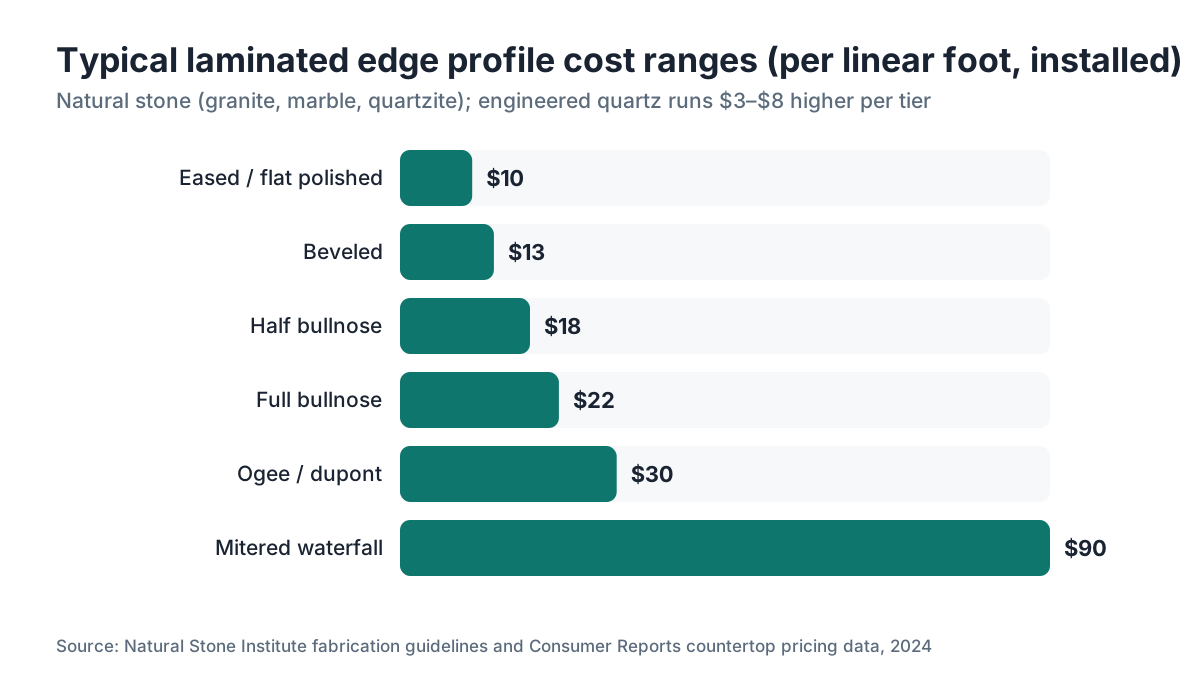
A laminated edge costs $5 to $50+ per linear foot installed, depending on profile complexity and material. Pricing shifts by region, by material, and by whether you're upgrading from a builder-grade package. The numbers below reflect shop-rate billing for fabrication and installation in 2024 to 2025, with raw material cost bundled in.
For natural stone (granite, quartzite, marble):
- Eased or flat polished: $5 to $15 per linear foot
- Beveled: $8 to $18 per linear foot
- Half or full bullnose: $12 to $25 per linear foot
- Ogee or dupont: $20 to $40 per linear foot
- Full mitered waterfall (countertop miter edge profile): $50 to $150+ per linear foot, depending on material cost and corner complexity [2]
Engineered quartz runs slightly higher for the same profiles because some manufacturers' warranties require specific grinding techniques. Expect to add $3 to $8 per linear foot over stone pricing.
Laminate countertops and Formica countertops use a different lamination process entirely (a post-form or self-edge applied at the factory or by a millwork shop), so those costs don't compare directly to stone.
On a typical 25-linear-foot kitchen edge (a common U-shaped kitchen measurement), the gap between a basic eased edge and an ogee runs $625 to $750 in labor and tooling alone. That's a real number to weigh against whether you'll actually notice the ogee every day versus a clean flat bevel.
When you get quotes, ask the fabricator to break out edge pricing separately from slab pricing. Many shops bundle it or bury it in a per-square-foot rate that makes comparison hard. Fabrication quoting software like SlabWise can itemize edge footage separately in the quote so homeowners see exactly what each upgrade costs [10].
How does a laminated edge differ from a mitered edge?
A standard laminated edge glues the buildup strip flat under the front of the slab, so the joint sits on the bottom face. A mitered edge cuts both pieces at 45 degrees so the joint sits on the angled face and nearly vanishes. That's the whole difference, and it drives the cost gap.
On a standard laminated edge, looking at the edge head-on, you can sometimes see the glue line where the two pieces meet, especially in lighter stones. Fabricators match the glue color carefully, but the joint is technically visible if you go looking for it.
On a mitered edge, the two 45-degree faces bond together so the seam rides the angle of the combined edge instead of the bottom. On a well-cut miter, the joint disappears into the geometry and reads as nearly invisible when the glue color is right [3].
Mitered edges take more material (each piece is cut at an angle, creating waste), more time on the saw, and more skill to pull off. They're the right choice when:
- The stone has strong veining that needs to flow through the edge uninterrupted
- The client wants an ultra-clean, contemporary look with no visible joint
- The edge is a waterfall that wraps down the side of the cabinet to the floor
For most kitchens and bathrooms, a well-matched flat lamination with a good profile is indistinguishable from a miter once it's installed. The miter premium is real. Spend it when it actually shows.
The phrase "laminated granite countertop edge profiles" often shows up in searches from homeowners who've seen the word "laminated" and worry their new granite will look cheap. It won't. Lamination is standard, professional practice, not a budget workaround.
How thick should the lamination strip be?
A standard 3 cm slab with a single lamination strip finishes at about 6 cm, close to the old-school 6 cm full slabs that were common before 3 cm became the industry norm [4]. That's the default for most kitchen work.
Some designers push for thicker edges, up to 10 to 12 cm on kitchen islands. That takes either two lamination strips stacked (a double laminate) or a mitered build with extra material. Double lamination is more common in high-end residential and commercial work because it's structurally simpler than a triple miter.
For 2 cm slabs (less common now but still seen in some imported materials and Cambria countertops on custom orders), lamination is almost always required to reach a presentable edge thickness. A bare 2 cm edge looks like a tile, not a countertop.
Bathroom vanities are often where thinner edges stay. A 3 cm slab on a 22-inch-deep vanity with no buildup can look proportional because the countertop depth is already reduced. Run a full 6 cm laminated edge on a small powder room vanity and it can look top-heavy. Read the proportion before you commit.
What materials can be laminated and how are the strips bonded?
Almost any stone or engineered material takes a laminated edge: granite, quartzite, marble, engineered quartz, porcelain slabs, soapstone, limestone, travertine, and concrete. The strip is always cut from the same material, ideally from the same slab or slab lot, to match color and movement.
The adhesive is typically a two-part polyester or epoxy, colored with pigment to match the stone. Polyester sets in about 15 to 30 minutes and is sandable, which makes it easier to tune the glue line during polishing. Epoxy cures harder and is the pick for very light or translucent stones like white marble, where polyester can yellow over time [5].
For granite and other dark stones, polyester in a gray or charcoal pigment is the standard shop choice. For calacatta marble or any white stone with dark veins, matching the glue to the vein color and feathering it by hand is a fabricator skill that takes real practice.
For materials like soapstone, the bonding is similar but the stone is softer, so edge profiles usually stay simple (eased or bevel) to avoid fragile thin points. Butcher block countertops handle edge buildup differently: they use wood glue and mechanical fasteners, and the "profile" is a router pass rather than a CNC or bridge saw operation. Note that cutting, grinding, and profiling stone all throw crystalline silica dust, which OSHA regulates under its silica standard, so any shop doing this work needs wet cutting or dust extraction in place [7].
What can go wrong with a laminated edge and how do fabricators prevent it?
Three failure modes account for almost every callback on laminated edges.
First: the glue line is visible. This happens when the pigment doesn't match, when the joint wasn't tight before bonding (gaps fill with adhesive that reads differently than stone), or when polishing pulls too much adhesive before it's fully cured. The fix is shop discipline: tight-fitting joints, matched pigment, and proper cure time before polishing [5].
Second: the strip delaminates. Rare with modern adhesives, but it happens on outdoor installations where freeze-thaw cycles stress the joint, or where someone applies steady heat (think a canning pot at full boil for four hours sitting right on the edge). The fix is proper surface prep (clean, dry, slightly abraded surfaces before bonding) and the right adhesive for the environment.
Third: the profile chips. This is mostly a design problem. Ogee profiles with thin sharp tips on busy kitchen islands chip. The solution is sometimes as simple as steering the client toward a profile with more mass at the edge. If they insist on ogee, warn them up front.
For shops running quoting and production software, tracking edge footage separately from field measure data flags jobs where edge complexity is out of proportion to slab area. A 20-square-foot island with 18 linear feet of double-laminated ogee miter is a very different job than the square footage suggests.
How do laminated edge profiles affect countertop installation?
The lamination happens in the shop before delivery. By the time the slab reaches the job site, the edge is already built up, profiled, and polished. The crew's job is to set the slab on the cabinets, align the seams, and anchor it down without cracking anything.
The extra weight matters. A 3 cm granite slab weighs roughly 18 to 20 pounds per square foot [6]. Add a 3 cm buildup strip across 25 linear feet of front edge and you add maybe 30 to 50 pounds to the job. Not a huge number, but it stacks up when you're carrying through a narrow hallway.
For waterfall islands where the laminated (or mitered) panel runs down the cabinet side, the crew has to support the vertical panel while the adhesive cures and keep the miter joint from shifting under the panel's weight. Many fabricators template the waterfall panel as a separate piece and use L-brackets or threaded rod through the cabinet substrate to hold it permanently.
For the full installation process on stone tops, the countertop installation guide covers substrate prep, support requirements, and seam placement decisions that interact with your edge profile choices.
How do you match a laminated edge on a replacement or repair?
Matching a laminated edge on a repair is one of the harder problems in stone fabrication. If one section needs replacement (say, a crack from a dropped object), matching the original profile requires knowing the profile name, the original slab material, and ideally a remnant from the original job.
Profile names aren't standardized across the industry. What one shop calls "ogee" another calls "classic Roman." The best move is to bring a physical template (cut from cardboard or captured with a profile gauge from a hardware store) and show the fabricator exactly what you need matched. Photos help, but they don't capture depth accurately.
Material matching is harder. Natural stone varies by quarry block. Matching a 10-year-old uba tuba granite exactly is essentially impossible. The best outcome is a close match from current inventory. Pull multiple remnant samples and compare them in the actual kitchen light.
For engineered quartz like Cambria or Corian countertops, the manufacturer can often supply the specific color if it's still in production, which helps a lot [9]. Both brands keep relatively stable product lines compared to natural stone.
What do fabricators need to know about quoting laminated edges accurately?
Edge pricing is where shops most often leave money on the table or surprise clients with charges they didn't expect. Here's what good quoting practice looks like.
Measure edge footage at templating, not from the drawing. Kitchen layouts change, walls aren't square, and the actual linear footage of profiled edge is almost always different from the design drawing. Measure every edge that gets a profile: front edges, exposed ends, and any return edges at walls.
Price profiles by tier, not one at a time. Most shops run three or four tiers: standard (eased/bevel), premium (bullnose/half bullnose), designer (ogee/dupont), and custom (miter/waterfall). Tiered pricing is easier to explain and faster to quote.
Flag profile transitions early. When a client wants ogee on the island but eased on the perimeter, those profiles have to meet somewhere. That transition point needs custom handwork. It's a line item, not a freebie.
Account for corner types. Inside corners don't get a profile. Outside corners get profiled on both faces, which takes extra time and produces more waste. A countertop miter edge profile at an outside corner requires the two adjacent pieces to be mitered to meet, which is its own pricing category.
Shops using SlabWise can assign profile tiers to individual edge segments during the estimate, which rolls the right labor rate and material waste factor into the quote without manual math.
For homeowners comparing quotes, ask each shop to show the edge footage total and the per-linear-foot rate by profile tier. If a quote just says "edges included," you have no way to weigh it against another quote. The kitchen countertops buying guide covers what else to look for when comparing fabricator bids.
Are there trends in laminated edge profiles homeowners should know about?
Profile trends move slower than cabinet hardware or tile, but they do move.
The past decade has been a clear shift toward cleaner, flatter profiles. Ogee and dupont were everywhere from the late 1990s through the mid-2000s. By the mid-2010s, eased and mitered waterfall edges had taken over in design-forward kitchens. As of 2024 to 2025, the dominant residential profiles in new construction are eased (by volume) and waterfall miter (by design press coverage) [12].
Thicker edges have come back. The ultra-thin 2 cm look that was briefly fashionable around 2015 has given way to 5 to 8 cm laminated edges that make an island feel more substantial. Some designers go even thicker, up to 12 cm, on freestanding islands that anchor an open plan like furniture.
High-contrast glue lines are occasionally done on purpose now, using a contrasting grout or colored epoxy at the joint as a design detail. It's niche, but it's legitimate.
For anything other than eased or bevel, look at samples in a showroom under lighting close to your kitchen before you commit. Profile photos online are almost always shot under perfect studio light. The way a dupont profile catches overhead recessed lighting in a real kitchen is different from how it photographs.
Frequently asked questions
What is the most popular laminated countertop edge profile?
The eased edge (also called flat polished or straight edge) is by far the highest-volume profile in residential fabrication. It's clean, modern, fast to produce, and works with almost any cabinet style. Bullnose profiles come second, especially on traditional and transitional kitchens. Ogee has lost significant market share over the past 15 years as design preferences shifted toward simpler lines.
Can you change the edge profile after a countertop is installed?
Yes, but it's expensive and disruptive. A fabricator can re-profile an installed edge in place using handheld angle grinders and polishing pads, but the options are limited (you can remove material, not add it), the dust is significant, and matching the finish to the rest of the slab is difficult. If you're unsure about the profile, pick something simple you can upgrade later rather than a complex profile you might want to simplify.
Does a laminated edge make the countertop stronger?
It adds mass at the front edge, which slightly cuts the chance of a chip from a direct hit, but the lamination itself is a glue joint. It doesn't add structural strength the way a thicker slab would. For applications where strength matters most (outdoor installations, commercial use, heavy-traffic edges), a thicker slab or reinforced substrate matters more than lamination.
What is a waterfall countertop edge and how is it built?
A waterfall edge is when the countertop material runs continuously down the side of the cabinet to the floor, making a visual 'waterfall' of stone. It's built with a mitered joint at the top corner where the horizontal slab meets the vertical panel. The vertical panel is cut from the same slab (matching veining takes careful planning) and bonded at 45 degrees. It's one of the most material-intensive and labor-intensive edge treatments, typically adding $50 to $150+ per linear foot.
How do fabricators hide the glue line on a laminated stone edge?
Two techniques minimize the glue line. First, a tight mechanical fit between the slab and the buildup strip so there's minimal adhesive gap. Second, careful pigment matching so the adhesive color blends with the stone's background and vein tones. Some fabricators mix multiple pigments to match complex stones. After bonding, the joint is polished flush so the adhesive layer is as thin as possible. On mitered edges, the 45-degree geometry moves the joint off the most visible face.
Is an ogee edge profile hard to keep clean?
The cove (concave curve) portion of an ogee does collect crumbs and grease more than a flat bevel or eased edge. It's not a deal-breaker, but it takes an extra moment with a cloth to clean the cove fully. If you cook heavily or run a busy household, factor that in. The sharp tip at the top of the ogee is also the most vulnerable point for chipping. A dupont profile has a similar look with a slightly less pronounced tip, which is a reasonable compromise.
How long does it take to fabricate a laminated countertop edge?
A standard laminated eased edge on a typical kitchen (20 to 30 linear feet) adds roughly one to two hours to shop fabrication time beyond cutting and polishing the slab face. Complex profiles like ogee or dupont on the same run add two to four hours. A full mitered waterfall island panel can be a half-day job by itself once you account for cutting, fitting, bonding, and polishing the miter corner.
Do edge profiles cost extra when buying from a big-box store versus a fabricator?
Almost always yes, and the structure is different. Big-box programs (Home Depot, IKEA stone programs) typically include one or two basic profiles (eased, half bullnose) in the base price and charge per linear foot for upgraded profiles, just as independent fabricators do. The difference is that big-box pricing is usually less negotiable and the profile selection is more limited. Independent fabricators offer more profile options and can do custom work the big-box programs won't touch.
Can laminated edges be done on quartz countertops the same way as on granite?
Yes, the process is essentially identical. Engineered quartz is cut and bonded with the same adhesives and profiling equipment. Some quartz manufacturers (Cambria, Silestone, others) include edge fabrication guidelines in their warranty terms, specifying minimum edge thickness and acceptable profile types to keep coverage. Always check the manufacturer's spec sheet before choosing an unusual profile on a warranted engineered quartz product.
What is a double laminate edge on a countertop?
A double laminate adds two buildup strips instead of one, making a total edge thickness of roughly 9 cm (about 3.5 inches) on a 3 cm slab. It's most common on large kitchen islands where designers want a furniture-scale presence. The second strip bonds below the first with the same adhesive and process. The total edge can be profiled as a single piece once bonded. It adds material and labor cost, typically 40 to 80 percent more than a single laminate for the same profile.
How does a fabricator template for a laminated edge?
The template captures the exact perimeter of the slab, including where the profiled edge will sit. Edge type and thickness are noted on each edge segment of the template drawing. For mitered waterfall panels, a separate template is usually pulled for the vertical panel to account for wall irregularities and floor levelness. Digital templating systems (laser or structured light) record edge designations digitally and pass them directly to CNC programming, which cuts down on shop floor misreads.
What edge profiles work best for a bathroom vanity versus a kitchen countertop?
Bathroom vanities generally suit lighter, more refined profiles because the scale is smaller and the countertop is viewed close-up. Eased, thin bevel, and half bullnose all work well. On kitchen countertops, where the edge takes more impact and gets seen from across the room, thicker profiles like full bullnose or dupont read better and hide minor wear. Waterfall miter is increasingly popular on both, particularly on floating vanity designs where the stone panel replaces a traditional cabinet side.
Is a laminated edge the same thing as a built-up edge?
Yes. The terms are interchangeable in fabrication shops. 'Built-up,' 'laminated,' 'stacked,' and 'double-thick' all refer to bonding one or more strips of material to the underside of the slab's front edge to increase apparent thickness. The one technical distinction some fabricators draw is that 'mitered' is a specific lamination method where the joint is at 45 degrees rather than a flat butt joint, but even that blurs in casual conversation.
How do I describe the edge profile I want to a fabricator if I don't know the name?
Bring a photo, but also use a profile gauge (a cheap analog tool available at most hardware stores for under $15) to capture the exact shape from a sample you like in a showroom or a friend's kitchen. The gauge holds the shape as a physical template you can hand to the fabricator. If you're working from a photo, say whether you want the corners rounded or sharp, whether there's a step or cove below the main edge, and whether the bottom edge is eased or left raw.
Sources
- Natural Stone Institute, Dimension Stone Design Manual: Industry standard practice of laminating stone edges to achieve greater apparent thickness without full-depth material cost
- Marble Institute of America (now Natural Stone Institute), Countertop Fabrication Guidelines: Mitered waterfall edge fabrication requires additional material waste and skilled labor, driving higher per-linear-foot costs
- Natural Stone Institute, Technical Bulletin: Stone Countertop Fabrication: 45-degree mitered joint geometry positions the seam on the angled face to minimize visibility when adhesive color is matched
- Natural Stone Institute, Industry Standards for Countertop Slab Thickness: 3 cm became the dominant residential slab thickness replacing older 6 cm slabs; lamination replicates the heavier appearance
- Adhesive and Sealant Council, Technical Guide for Stone Bonding Adhesives: Epoxy adhesives preferred over polyester for white and translucent stones due to polyester yellowing tendency over time
- OSHA, Material Handling and Ergonomics for Stone Fabrication: Granite slabs weigh approximately 18 to 20 pounds per square foot at 3 cm thickness, informing lifting and installation load planning
- OSHA, Crystalline Silica in Stone Fabrication: Engineered quartz and natural stone fabrication (cutting, grinding, profiling) generates crystalline silica dust requiring exposure controls
- National Kitchen and Bath Association (NKBA), Kitchen Design Guidelines: Edge profile selection guidelines for residential kitchen countertops including standard edge heights and overhang recommendations
- Cambria, Warranty and Fabrication Specifications: Cambria specifies acceptable fabrication methods including edge profiling to maintain product warranty coverage
- Consumer Reports, Kitchen Countertop Buying Guide: Cost ranges for countertop edge upgrades in residential kitchen projects; edge pricing varies significantly by profile complexity and material
- U.S. Bureau of Labor Statistics, Producer Price Index: Cut Stone and Stone Products: Stone fabrication labor and material costs tracked by PPI; basis for per-linear-foot edge pricing benchmarks
- Home Innovation Research Labs, Annual Builder Practices Survey: Shift in countertop material preferences and edge profile trends in new residential construction over the past decade
Last updated 2026-07-09