TL;DR
- A countertop installer measures, cuts, and sets countertop slabs in your kitchen or bath.
- Most charge $300 to $700 for a standard kitchen install, or $40 to $100 per hour.
- Granite installers need special tools and usually work through a stone fabrication shop.
- Hiring the right one means checking licensing, insurance, seam placement, and warranty terms before any deposit changes hands.
What does a countertop installer actually do?
A countertop installer handles everything from the moment fabricated pieces leave the shop to the moment they're fixed permanently in your kitchen or bath. That sounds simple. It isn't.
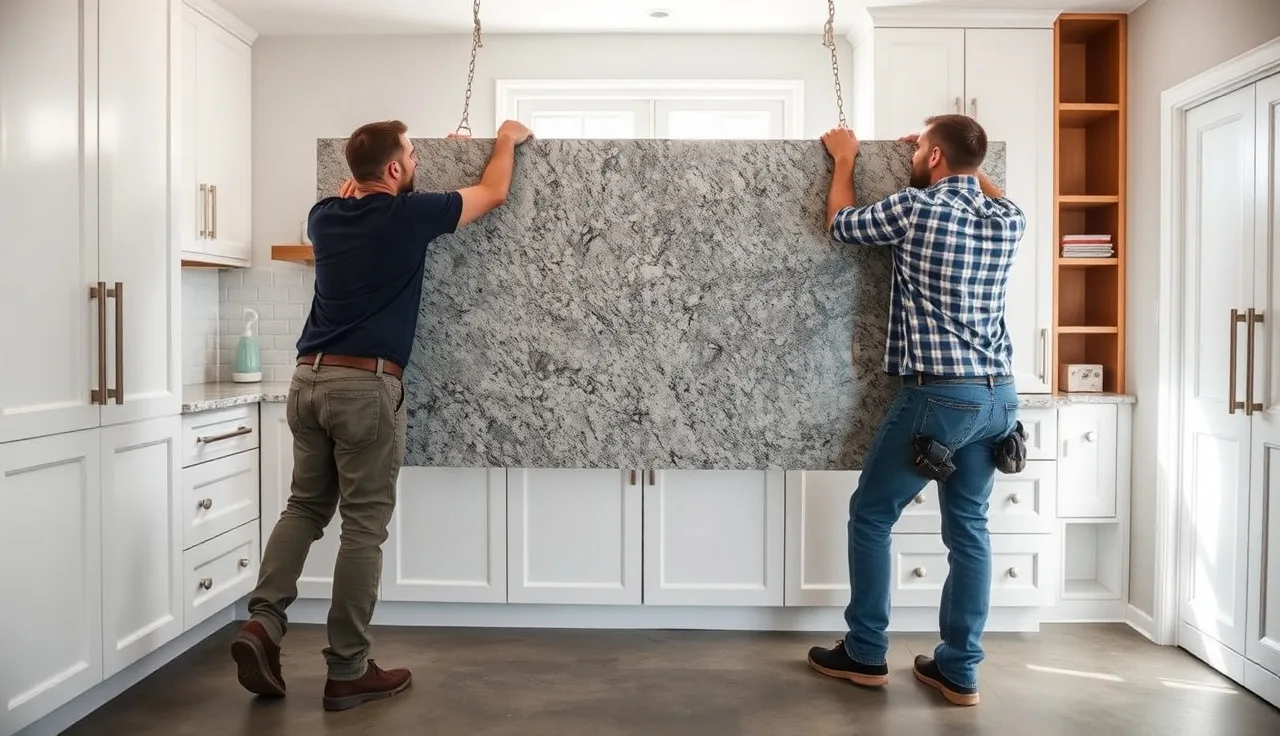
The job starts with a template or a set of measurements, usually taken days before install day. On install day the crew brings the finished slabs, which for a typical kitchen weigh 400 to 800 pounds total depending on material and thickness. They pull the old countertop, check that the cabinets are level (they almost never are perfectly), shim where needed, dry-fit each piece, mix and apply adhesive or silicone, set and clamp seams, then connect any undermount sinks. Stone installers also caulk all perimeter edges and, for natural stone, apply an initial sealer.
That's a full day of physical, precision work. A two-person crew installs a standard 40-to-55 square foot kitchen in four to six hours. Complex layouts, full-height backsplashes, or islands with waterfall edges stretch that to a full day or more.
The line between fabricator and installer matters. A fabricator cuts and finishes the stone. An installer sets it. Many shops do both. Not all. If you buy slabs from a slab yard and hire a separate shop to fabricate, you may also need to contract installation on its own. Clarify who does what before signing anything.
For the full scope of the job, see countertop installation.
What are the different types of countertop installers?
Not every installer handles every material. The skill sets diverge sharply, and hiring the wrong specialist costs you money and headaches.
Stone fabricator-installers handle granite, quartzite, marble, soapstone, and engineered quartz. They run CNC machines or wet saws, polish edges, and use vacuum lifters. Most granite countertop installers fall into this category. They work out of a fabrication shop and either run in-house crews or subcontract installation. If a shop quotes fabrication and installation together, this is who you're hiring.
Laminate installers work with sheet laminate products like Formica countertops and laminate countertops. The work is routing, contact cement, and tight scribing to walls. Some general contractors do this themselves.
Solid surface installers handle materials like Corian countertops. These get glued and seamed differently from stone, and the seams can be sanded invisible. Corian and similar products often require factory-certified installers to keep the warranty valid.
Wood and butcher block installers deal with expansion and contraction that stone crews never face. Butcher block countertops need to float or have slotted fasteners so the wood can move with the seasons.
Big-box store installers are subcontractors hired by Home Depot or Lowes to set countertops bought through those retailers. Quality varies a lot by market and crew. You're not hiring the store. You're hiring whoever they send.
Know what you're buying before you pick an installer. A granite installer is the wrong person to seam and bond Corian.
How much does a countertop installer charge?
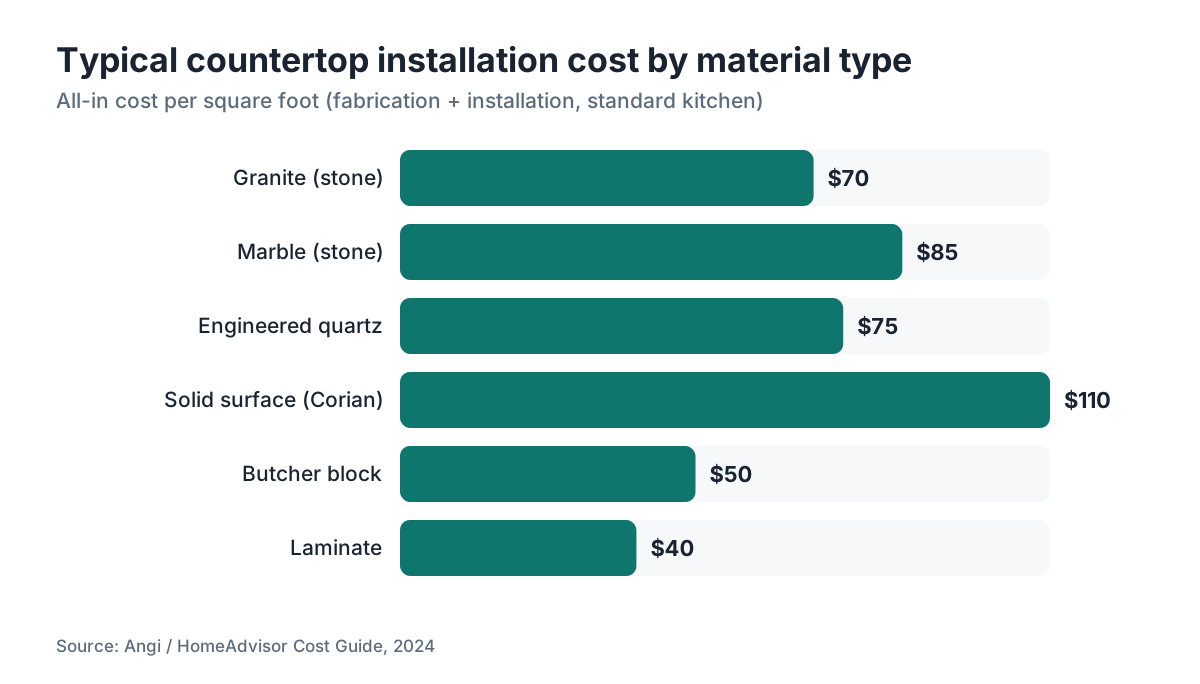
Installation pricing comes in three shapes: per square foot, flat per project, or hourly. For stone, the norm is a per-square-foot labor rate bundled into the fabrication quote.
Fabrication plus installation for granite runs roughly $40 to $100 per square foot for the finished product, depending on edge profile, number of cutouts, and your market [1]. When shops break out labor as a standalone line, the install portion alone usually runs $10 to $30 per square foot.
For smaller jobs or independent installers, flat-rate project pricing is common. A standard kitchen install (no fabrication, just setting pre-cut pieces) often runs $300 to $700. A bathroom vanity top runs $150 to $350.
Hourly rates run $40 to $100 per hour for a single installer, or $75 to $175 for a two-person crew [2]. Most stone installs need at least two people for safety. A 3cm granite slab weighs roughly 18 to 20 pounds per square foot [10].
| Install type | Typical range | Notes |
|---|---|---|
| Granite kitchen (full job) | $40 to $100/sq ft | Includes fab + install |
| Stone install only (labor) | $300 to $700 flat | Pre-fabricated pieces |
| Bathroom vanity top | $150 to $350 flat | Small crew, under 1 hr |
| Laminate (labor only) | $30 to $50/sq ft | Includes postform or custom |
| Solid surface (Corian) | $75 to $150/sq ft | Certified installer often required |
| Butcher block | $40 to $60/sq ft | Plus oil/finish coat |
Add-ons that raise the bill: extra cutouts ($100 to $200 each), removing the old countertop ($50 to $150), specialty edge profiles ($10 to $30 per linear foot above a simple eased edge), and cooktop cutouts ($150 to $250).
Geography moves prices a lot. A granite installer in metro New York or San Francisco charges far more than one in rural Tennessee. Construction wage data from the Bureau of Labor Statistics shows labor costs vary by as much as 40% between high-cost and low-cost metro areas [3].
Should you hire through a fabrication shop or find an independent installer?
For stone, hire through a fabrication shop almost every time. When the shop that cut the stone also installs it, accountability is clean. If a seam fails or a slab cracks at the sink cutout, there's no finger-pointing between a fab shop and a separate installer. The shop owns the whole job.
Good shops also carry the slab from template through install in one controlled chain of custody, which cuts the chance of damage in transit.
Independent installers make sense in narrow cases: you sourced slabs and fabrication yourself and just need a crew to set the pieces, or you're doing a material like laminate where the installer and fabricator are usually the same person.
Big-box installs sit in the middle. Home Depot's measure-and-install program is convenient, but your choices are limited to what they sell, and subcontractor quality swings hard. You're also paying a markup on install coordination. For granite countertops or marble countertops with complex edge work, an independent stone fabricator almost always produces a better result.
To compare quotes across fabricators fast, tools like SlabWise's instant quote system let you enter your measurements and get a real fabrication estimate in minutes. That gives you a baseline before you call any shop.
One rule with no exceptions: never let an installer skip the template step. Field templating, either physical cardboard or a digital laser system, is how the pieces get fitted to your specific walls. A shop offering to install from rough measurements is cutting a corner you'll see every day.
What licenses and insurance should a countertop installer carry?
Licensing rules for countertop installers vary by state, and homeowners often assume more is required than actually is. Insurance matters more than the license in most cases.
In most states, countertop installation counts as a specialty trade under general contractor licensing. Some states require a contractor's license for any job above a dollar threshold, often $500 or $1,000 [4]. California requires an active Contractors State License Board license for home improvement work done in residences, including countertops [5]. In lightly regulated states, an installer may operate legally with no license at all.
What you should verify no matter the state:
General liability insurance. A minimum of $1 million per occurrence is standard for trades. This covers damage to your cabinets, floors, or plumbing if something goes wrong. Ask for a certificate of insurance with your name as the certificate holder.
Workers' compensation insurance. The U.S. Department of Labor notes that workers' comp "provides benefits to workers who are injured on the job." If an uninsured worker is hurt in your home, you could face a claim against your homeowner's policy or personal liability [6]. Most states require employers to carry workers' comp for employees, but independent subcontractors are often exempt, which pushes risk onto you.
Contractor's license number. In states that require it, confirm the license is active. California's CSLB and most other state boards have free public search tools [5].
A reputable installer hands you proof of insurance without being asked. Hesitation on that request is a real signal.
How do you find and vet a countertop installer near you?
Start with stone fabrication shops in your area, not general handyman or remodel contractor listings. The fabrication shop is the professional home for granite installers. Their core work is stone, they own the right equipment (vacuum lifters, wet saws, seam grinders), and their crews handle stone every week, not once a season.
Finding candidates:
- Search the Marble Institute of America's member directory for fabricators in your region [7].
- Ask your kitchen designer or cabinet installer for referrals. They see countertop work on almost every job.
- Read Google reviews for mentions of install quality, seam placement, and cleanup, more than the stone itself.
- Get referrals from neighbors who recently redid their kitchens. A walk-through of real installed work beats any photo gallery.
Vetting a specific installer or shop:
- Ask how long they've been in business. Under two years doesn't disqualify anyone, but longevity matters in trades.
- Ask whether their install crew is in-house or subcontracted. Both can be fine. Subcontracted crews mean less control over training and accountability.
- Ask to see photos of seam work. Seams are the hardest part of stone installation to do well, and a good installer is proud of tight, well-matched ones.
- Ask for two or three references from installs in the past six months, and call them.
- Get at least three written quotes. Not for the lowest price, but to see what each shop includes. One may cover removal of the old countertop. Another may not.
For kitchen countertops especially, vet hard. The kitchen is the most expensive room in the house and the most visible.
What questions should you ask before signing a contract?
A signed contract is your protection when something goes wrong. Most disputes between homeowners and countertop installers trace back to something nobody wrote down.
Key questions to get in writing:
Who does the template, and when? Template to install should run no more than two weeks at most shops. Longer than that and you're sitting without a usable kitchen.
Where will the seams go? For granite or other natural stone, seams belong away from high-stress zones (not over a sink cutout, not in the middle of a busy prep area). Ask for a layout drawing before fabrication starts. You should approve seam placement.
What's included in the quoted price? Removal of old countertops, sink reconnection, cooktop cutouts, and caulking are sometimes extra. Know before you sign.
What happens if a slab cracks or a seam opens? The answer should sound like "we come back and fix it at no charge within X days." Get the warranty period in writing. Ninety days is reasonable. Some shops offer a year.
What's the payment schedule? A typical split is 50% deposit at signing, 50% on completion. Never pay 100% upfront. If an installer wants full payment before the job starts, walk away.
Who pulls the permit if one's required? Most countertop installs don't need a permit, but if the work touches electrical or plumbing (a new undermount sink, a cooktop), permits may apply. Clarify who's responsible.
Have opinions and state them early. If you want the seam at the window and not in the middle of the island, say so before fabrication. Moving seam placement after cutting is expensive or impossible.
How long does a countertop installation take from start to finish?
From contract to finished countertop runs longer than most homeowners expect, and most of that time is not install time. Realistic total: one to four weeks in normal seasons.
Measure and template: Usually one to three days after you sign and pay a deposit. The fabricator sends a crew with a laser templating system or cardboard templates. It takes one to two hours in the home.
Fabrication lead time: This is the long part. Most shops run one to three weeks from template to finished slab. During busy stretches (spring remodel rush, fall before the holidays), lead times stretch to four to six weeks at busy shops [8]. If you're coordinating a kitchen remodel, build at least three weeks into your schedule for this window, and confirm the specific lead time in writing before signing.
Install day: The actual set is one to six hours for a kitchen, depending on size and complexity. Bathrooms with a single vanity top are often done in under two hours.
Curing and use: Silicone adhesive and caulk need 24 hours to cure. Most installers ask you to wait 24 hours before using the sink and to keep the countertop dry overnight.
Plan for the longer end. Coordinating plumbers, tile, and paint around a moving fabrication date is where remodels fall apart.
What can go wrong during countertop installation, and how do you protect yourself?
Most professional installs go fine. Knowing the common failure points helps you catch trouble before it turns expensive.
Poor seam quality. Seams that sit misaligned, show visible color gaps, or run higher on one side are the top complaint about stone installation. Prevention: see seam photos from past jobs, and watch the dry-fit before adhesive goes on. If something looks off then, say so.
Cabinet leveling skipped. Countertops set on out-of-level cabinets can crack over time, especially at seams or cutouts. A good crew checks level at every cabinet run and shims before setting stone. If you see them skip this, ask about it.
Slab cracking at cutouts. Sink and cooktop cutouts pull material right where the stone is under the most stress. Cracks running from cutout corners are almost always a fabrication issue (too tight a corner radius or a rough grind) rather than an install issue, but the installer should inspect the pieces at delivery and refuse to set a cracked slab.
Undermount sink drop. An undermount sink that isn't bonded and clipped right will drop over time, especially heavy cast iron. Ask the installer to show you the clip system they use.
Damage to floors or cabinets during install. Heavy stone and vacuum lifters in a finished kitchen are a hazard. Good crews lay down protection before bringing stone in. If they don't, ask them to.
Photograph the cabinets and floors before the crew arrives. Document everything. That's not paranoia. It's project management.
Does the type of countertop material change what the installer needs to do?
Yes, and the differences run deep enough that you want an installer who specializes in your material.
Granite and natural stone: Heavy, brittle at thin sections, handled with vacuum lifters or extreme care. Seams need color-matched epoxy. Natural variation means the installer has to think about pattern flow, especially for bookmatched slabs. Granite installers who work with stone daily read grain direction and hide visual breaks at seams. Sealing happens at install and repeats every one to three years depending on stone density [9].
Quartzite: Harder than most granite, but some quartzites delaminate if the wrong adhesive or too much heat gets applied. For care after install, see how to clean quartzite countertops.
Marble: Softer, etches with acids, and the veining makes seams stand out. Installers match veining direction carefully. See marble countertops for what to expect from this material.
Engineered quartz (Cambria, Silestone, etc.): Consistent in color, which makes seams easier to place but also more obvious when misaligned. Many engineered quartz brands like Cambria countertops require certified fabricator-installer programs to keep the warranty.
Soapstone: Soft, needs full support underneath. Soapstone installers often rub in a first coat of mineral oil at install. For care details, see how to clean soapstone countertops.
Laminate: Different tools entirely. No wet saw, no vacuum lifter. The installer uses a router, contact cement, and careful scribing. It's light enough that one person handles a whole kitchen.
Material knowledge is a real differentiator. The best granite installer you find may have never touched laminate, and shouldn't pretend otherwise.
How do fabrication shops price installation, and what should a quote include?
An honest quote from a stone fabrication shop breaks into several cost components. Seeing each one makes comparing quotes from multiple installers much easier.
Material cost: The price per square foot of the slab, usually the shop's cost plus a markup that shifts by shop and slab rarity. Exotic granite or marble carries a higher markup than commodity slabs.
Fabrication labor: The cost to cut, edge-profile, and finish the stone. CNC programming and skilled saw work live here.
Edge profile: A standard eased or beveled edge is usually included. Ogee, dupont, or waterfall profiles add $10 to $30 per linear foot above base.
Cutouts: Sink, cooktop, and outlet cutouts are almost always charged separately. Expect $100 to $250 per cutout depending on shape.
Installation: The labor and transport to deliver and set the finished pieces. Some shops bundle it. Others line-item it.
Removal of existing countertop: Frequently left out of the base quote. Ask specifically.
Sealing: An initial sealer coat at install is standard for porous stone. Ongoing sealing is on you.
Shops that run modern quoting software (SlabWise is one example) produce itemized digital quotes that make these lines visible, which also makes comparison shopping cleaner. Whatever format you get, ask for a written, itemized quote before approving fabrication. A verbal estimate is not a contract.
For a full breakdown of what drives installation cost and scope, the countertop installation guide covers the process in detail.
What stone countertop care should you know before the installer leaves?
The install crew is one of your best sources of material-specific care advice, and it's easy to forget to ask once the job's done and they're packing up. Before they leave, get answers to these.
What sealer did they apply, and when should it be redone? Most penetrating sealers on granite last one to three years. Denser stones (black absolute granite, some quartzites) go longer. The Marble Institute of America suggests a simple water test: put a little water on the surface, and "if the water beads, the stone is sealed." If it soaks in within a few minutes, reapply [7].
What cleaners are safe? Neutral pH cleaners only for stone. Skip anything with bleach, ammonia, or acid like vinegar. For a full guide, see how to clean stone countertops.
What counts as normal variation? Natural stone has pits, fissures, and color shifts that are traits of the material, not install defects. A good installer points these out and explains what's normal before leaving, so you don't file a warranty claim over a natural feature.
Get the installer's direct number for follow-up. Seams sometimes need a small touch-up after the adhesive fully cures. A shop that stands behind its work handles this fast and without drama.
Frequently asked questions
How much does a countertop installer charge per square foot?
For stone, labor-only installation typically runs $10 to $30 per square foot when a shop breaks it out separately. More often, granite installers bundle fabrication and installation together, which runs $40 to $100 per square foot total depending on edge profiles, cutouts, and your local market. Laminate installation is typically $30 to $50 per square foot, including material in many quotes.
Do countertop installers need a license?
It depends on the state. Many states require a general or specialty contractor license for jobs above a dollar threshold, often $500 to $1,000. California requires an active CSLB contractor license for any home improvement work in a residence. Some states have minimal requirements. Verify your state's rules, and ask for the installer's license number and proof of general liability insurance regardless.
How long does it take for a countertop installer to finish a kitchen?
Actual install time for a standard kitchen is four to six hours for a two-person crew. But from contract signing to finished countertop, expect one to four weeks. Most of that is fabrication lead time, which runs one to three weeks at most shops and longer in busy seasons. Template measurement happens a day or two after you sign; installation follows once fabrication is done.
What is the difference between a countertop fabricator and a countertop installer?
A fabricator cuts, edges, and finishes the stone or material. An installer delivers and permanently sets the finished pieces in your home. Many shops do both under one contract. Some don't. If you buy slabs separately or use an independent stone yard, you may need to hire fabrication and installation from different parties. Clarify who owns each step before signing.
Can a countertop installer also do the plumbing reconnection?
Usually no. Installers typically disconnect and reconnect the sink clips and silicone, but plumbing connections (water supply lines, drain, garbage disposal) are plumber's work in most states. Some experienced installers handle simple reconnections as a courtesy, but they shouldn't do licensed plumbing work. Budget separately for a plumber if your install involves a new or repositioned sink.
What should I do if a seam cracks after installation?
Contact the fabrication shop right away and document the crack with photos. Most reputable installers and shops warrant seams against failure for at least 90 days, and many offer a year. Seam failure is usually a fabrication or installation defect, not a maintenance issue. The shop should come out and repair or re-epoxy the seam at no charge within the warranty period.
Is it cheaper to buy countertops from a big-box store and hire an independent installer?
Sometimes, but rarely by much once you count everything. Big-box stores mark up both material and install coordination. Buying slabs directly from a stone yard and hiring a local fabricator-installer often produces a better result at a similar or lower price, with more material selection. The savings window for big-box installs is mostly on entry-level laminate or prefab granite, where their pricing is genuinely competitive.
How do I know if my granite countertop installer did a good job?
Check seams first: they should be tight, level, and color-matched. Run your hand across each seam; you shouldn't feel a lip. Confirm the overhang is consistent around the perimeter. Verify all cutouts are clean with no chips at corners. Make sure the sink is clipped securely and doesn't move. Check that all perimeter edges are caulked. Any epoxy squeeze-out at seams should be cleaned off before the crew leaves.
Do granite countertop installers move the refrigerator or appliances?
Usually yes, if appliances need to move to reach the countertop run. Most crews include this in a standard install. Confirm it in your contract. Installers won't typically disconnect gas appliances; a licensed plumber or gas fitter handles that. If your install requires moving a gas range, plan that separately and make sure the gas is off before the countertop crew arrives.
What should I tell a countertop installer to prepare for install day?
Clear everything off existing countertops and empty the under-sink cabinets. Make sure someone is home for the full install window. Turn off the water supply to the sink. Keep a clear path from the entrance to the kitchen so the crew can carry stone without obstacles. If you have pets, secure them away from the work area. Point out any flooring or cabinet damage that existed before they arrived.
Can a countertop installer work around an existing cooktop or sink without replacing them?
Yes, if the new countertop has the same or a larger cutout than the existing fixture. The installer templates around the existing opening. If you're changing sink or cooktop models, give the new specs to the fabrication shop before templating so they cut the correct opening. Don't assume an old cutout size will match a new appliance.
How many quotes should I get from countertop installers?
Three is a reasonable minimum. You're looking past the lowest price for clarity on what each quote includes, how seam placement gets decided, what the fabrication lead time is, and what the warranty covers. One unusually low quote almost always means something is excluded or the shop is cutting corners. A quote that breaks material, fabrication, and installation into separate lines is a sign of a professional operation.
What is a reasonable deposit for countertop installation?
Fifty percent at contract signing is the industry standard for stone fabrication and installation. It covers the cost of buying your specific slab, which the shop can't return once cut for your job. The remaining 50% is due on completion. Never pay 100% upfront. Some states, like California, cap home improvement contract deposits at 10% or $1,000, whichever is less. Check your state's rules.
Sources
- HomeAdvisor (Angi), Countertop Installation Cost Guide: Granite countertop installation including fabrication typically runs $40 to $100 per square foot depending on market and complexity
- HomeAdvisor (Angi), Countertop Installer Hourly Rates: Independent countertop installers charge $40 to $100 per hour; two-person crews run $75 to $175 per hour
- U.S. Bureau of Labor Statistics, Occupational Employment and Wage Statistics: Construction labor wages vary by as much as 40% between high-cost and low-cost metropolitan areas
- U.S. Small Business Administration, Apply for Licenses and Permits: Most states require a contractor license for construction work above a minimum dollar threshold
- California Contractors State License Board (CSLB): California requires an active CSLB license for home improvement work including countertop installation; deposits are capped at 10% or $1,000 whichever is less
- U.S. Department of Labor, Workers' Compensation Overview: Workers' compensation provides benefits to workers injured on the job; if an uninsured worker is injured on a homeowner's property, the homeowner may face personal liability
- Marble Institute of America (Natural Stone Institute): Sealer effectiveness can be tested by placing water on the stone surface: if the water beads, the stone is sealed; if it soaks in, reapply. Member directory lists certified fabricators by region
- National Kitchen and Bath Association (NKBA): Countertop fabrication lead times stretch to four to six weeks at busy shops during peak remodel seasons
- Marble Institute of America (Natural Stone Institute), Care and Cleaning of Natural Stone: Penetrating sealers on natural stone should be reapplied every one to three years depending on stone density and use
- U.S. Geological Survey, National Minerals Information Center, Dimension Stone: Granite and other dimension stone slabs weigh approximately 18 to 20 pounds per square foot at 3cm thickness
Last updated 2026-07-09