TL;DR
- The best way to onboard a countertop installer runs about 60 to 90 days: a structured first week of shop and field shadowing, written SOPs for each material type, silica training tied to OSHA's standard before any cutting, a skills checklist that gates solo work, and a 30-60-90 day review cadence.
- Shops that skip this see avoidable callbacks within 60 days of hire.
Why does installer onboarding matter so much for a countertop shop?
Callbacks eat money. One botched install, a cracked slab, a crooked seam, an edge profile that doesn't match what was sold, can wipe out the margin on three or four other jobs. The installer is the last person to touch the product before the customer does. Whatever happens in that final hour is what the customer remembers.
The trade has a turnover problem. Bureau of Labor Statistics data for stone cutting and polishing workers shows tenure that tracks closely with the broader construction trades, where 20 to 30 percent of workers leave within their first year [1]. Shops that build a structured onboarding process keep people longer, because the installer knows what's expected and feels competent sooner.
There's a regulatory angle too. OSHA's silica standard (29 CFR 1926.1153 for construction, 29 CFR 1910.1053 for general industry) requires employers to train workers on silica hazards before they perform tasks that generate respirable crystalline silica dust [2]. Engineered stone can contain more than 90 percent silica by weight, and cutting, grinding, or dry polishing throws off extremely fine particles [10]. An onboarding checklist without silica training isn't just weak. It's a compliance failure.
Good onboarding isn't complicated. It's a checklist, some scheduled time, and a senior installer willing to treat teaching as part of the job.
What should happen in the first week of an installer's onboarding?
Day one shouldn't start on a job site. It starts in the shop. The new hire needs to see how slabs get received, labeled, and stored before they ever handle a finished piece in a customer's kitchen.
A practical first week looks like this:
- Day 1: HR paperwork, shop tour, safety orientation (PPE requirements, silica training documentation, emergency procedures), introduction to the material inventory system.
- Day 2: Observe a full installation from load-out at the shop through cleanup at the job site. The new hire carries, watches, and asks questions. They don't cut anything.
- Day 3: Hands-on with tools in a controlled setting. Practice seam placement on scrap material. Learn the adhesive mixing ratios and working time windows.
- Day 4: Second job-site shadow, this time with clear responsibility for a defined sub-task like setting and leveling cabinets, applying adhesive, or running a grinder on an edge correction.
- Day 5: Debrief, written skills self-assessment, review of any SOPs they need to re-read over the weekend.
Week one is about orientation, not production. Shops that push a new installer into solo work on day three because they're short-staffed are borrowing trouble. The installer doesn't know your standards yet, your adhesive brands, your seam placement logic, or how your shop passes along job changes. A week of structured shadow time is a small bet against months of callbacks.
What training topics does a countertop installer need to cover?
Material knowledge comes first. An installer who can't tell granite from quartzite from engineered quartz from marble will make the wrong call when something goes sideways mid-install. Granite countertops and marble countertops break in different ways and need different handling during transport and seaming. Engineered products like Cambria countertops have adhesive compatibility requirements that vary by manufacturer.
Training topics should include, at minimum:
Safety and compliance
- Silica exposure controls: wet methods, HEPA vacuums, respiratory protection [2]
- Proper lifting mechanics for heavy stone (3cm granite runs 18 to 20 pounds per square foot)
- Electrical safety around sinks and dishwasher cutouts
- Chemical handling for adhesives, sealers, and strippers
Technical installation skills
- Cabinet leveling and substrate assessment
- Measuring and fitting around appliances, walls, and plumbing
- Seam placement, color matching, and adhesive application
- Sink and faucet cutout technique
- Backsplash alignment and silicone application
- Post-install cleanup without damaging cabinet faces or flooring
Customer interaction
- How to handle a customer who notices a vein they weren't expecting
- What to say (and not say) when there's a problem mid-install
- How to document the finished job for quality records
Material-specific quirks deserve their own training segments. Butcher block countertops need expansion gaps that stone does not. Laminate countertops and Formica countertops use trim and scribing techniques that share almost nothing with stone work. If your shop installs multiple material types, the new hire has to know which rules apply to which product, more than the general principles.
What OSHA rules apply specifically to countertop installers?
OSHA's respirable crystalline silica standard is the regulation that governs this work most directly. There are two versions. 29 CFR 1926.1153 covers construction, which includes most countertop installation done at job sites. 29 CFR 1910.1053 covers general industry, which applies to fabrication work back in the shop [2].
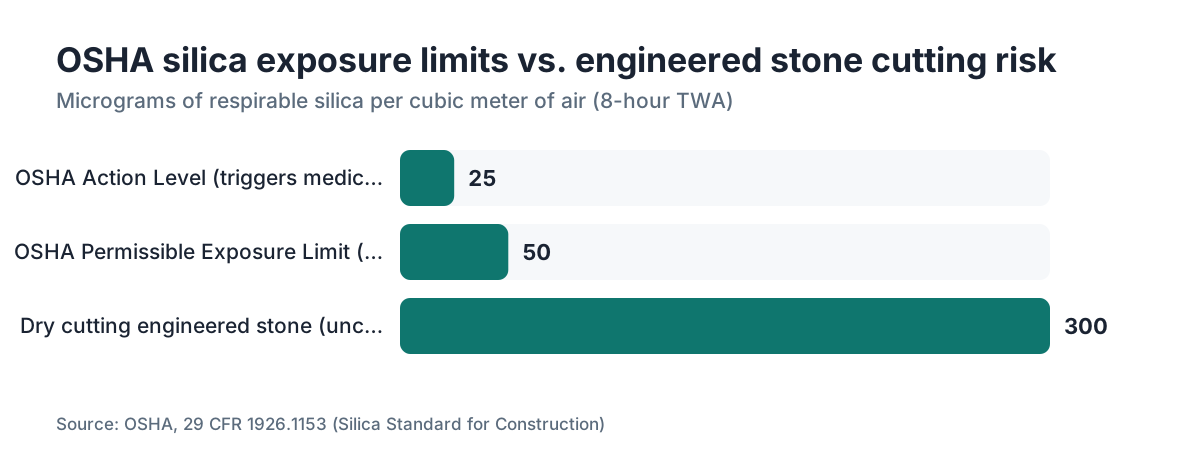
The permissible exposure limit is 50 micrograms per cubic meter of air as an 8-hour time-weighted average. The action level, which triggers extra requirements like medical surveillance when exposure is sustained, is 25 micrograms per cubic meter [2]. Engineered stone throws off silica dust far above those limits during dry grinding or dry cutting without controls [10].
OSHA requires employers to train employees before they perform tasks covered by the standard. That training has to cover the health hazards of silica exposure, the specific tasks that could expose the employee, what the employer is doing to protect them (controls, PPE), the limits of those controls, and how to get the written exposure control plan [2].
Document it. Keep a signed acknowledgment form in each employee's file. If OSHA inspects and you can't show that your installer got silica training before their first cutting task, you're looking at a serious violation.
OSHA's Table 1 for construction lists specific engineering and work practice controls for common tasks, including a wet saw with water delivery or a tool with an integrated vacuum and shroud [2]. Bake those controls into the install SOPs, more than the safety training. The installer shouldn't have to choose the safe way. The safe method should be the only method your shop runs.
How do you structure a skills checklist or competency gate for installers?
A competency gate is simple: before an installer works solo on a given type of job, a senior person signs off that they've shown the skill. Skip it and you're trusting self-report, which is shaky, especially from new hires who want to look capable.
Build the gate around task categories, not time served. Ninety days on the payroll doesn't mean someone is ready for a complex multi-piece island with a waterfall edge. A competency checklist might look like this:
| Task Category | Gate Level | Verifier Required? |
|---|---|---|
| Standard drop-in sink cutout | Level 1 (can do with supervision) | Yes |
| Undermount sink cutout and polish | Level 2 (can do independently) | Yes |
| Seam on solid color material | Level 2 | Yes |
| Seam on veined or patterned stone | Level 3 (advanced) | Senior installer |
| Waterfall or miter edge | Level 3 | Senior installer |
| Multiple-piece complex island | Level 3 | Senior installer |
| Outdoor or special substrate install | Level 3 | Senior installer |
Spell out what "can do" means. For a sink cutout: the cut is within 1/16 inch of the template, the edge is polished to the specified profile, the undermount clip spacing is correct, and the silicone bead runs continuous with no voids. Vague standards produce inconsistent installs.
Revisit the checklist at 30, 60, and 90 days. The 30-day review is mostly a check-in: how are they doing, what questions have come up, where do they need more reps. The 60-day review should have the installer complete a full solo job while a senior person reviews the photos and does a brief walkthrough. The 90-day review is the formal assessment where you decide if they're ready for unsupervised work across most job types.
What should be in a countertop installer's written standard operating procedures?
SOPs only work if installers actually read them. So keep them short, specific, and organized by task instead of by material or policy category. A 40-page manual that covers everything gets read once and then ignored. A laminated one-page job aid for seam placement that lives in the truck gets used.
For a countertop operation, the SOPs you can't skip:
Load-out checklist (verify before leaving the shop): slab count matches work order, edge profiles confirmed, all hardware and adhesives loaded, template reviewed.
Site arrival checklist: cabinet level and secure, measurements match template, plumbing and electrical cleared, customer walkthrough of the job scope before any cuts.
Seam placement SOP: who approves seam location (documented in the work order), minimum distance from sink or cooktop, adhesive brand and mix ratio, color pigment matching protocol, clamp spacing.
Sink cutout SOP: template verification, blade selection by material type, water cooling requirement, undermount support method, silicone brand and bead specification.
Completion checklist: all cutouts clean, silicone cure time communicated to customer, seams level and smooth, backsplash tight, cleanup done, customer sign-off obtained, photos taken.
Photos at completion are underrated. They prove the install left your crew in good condition and give you evidence if a customer later claims a chip or crack existed before your crew left. Make photo documentation non-negotiable in the completion SOP.
For shops running several jobs and crews at once, job management tools track which SOPs are attached to which order and flag when a step hasn't been checked off. Software like SlabWise can link job documentation to specific orders so nothing slips mid-project.
How do you handle the 30-60-90 day review process for a new installer?
The 30-60-90 review isn't a performance improvement plan. It's a structured conversation on a predictable schedule, so nobody gets blindsided.
The 30-day check-in is informal. Sit down for 30 minutes. Ask what's been harder than expected, what's clicking, and whether the SOPs make sense. Listen more than you talk. New installers at 30 days are often still nervous about admitting they don't understand something, so ask specific questions. "Show me how you'd decide where to place this seam" tells you more than "how's seam work going?"
The 60-day review needs a direct observation piece. Send a senior installer to watch one full job, or run a same-day quality walkthrough before the customer is present. Assess against the competency checklist, not a vague feel for quality. Write down what you saw.
At 90 days, make a clear call on status. The options: fully cleared for independent work on all job types the shop handles, cleared with specific exceptions (no complex waterfall edges yet), or extended probation with a named development plan. Leaving it fuzzy is a management failure. The installer deserves to know where they stand.
SHRM's onboarding research reports that organizations with a structured onboarding process improve new hire retention by 82 percent and productivity by over 70 percent [3]. Those figures come from cross-industry survey data, not countertop fabrication specifically, but the direction matches what shop owners report.
How do you train an installer on different countertop materials?
Each material has quirks that turn into real problems when the installer doesn't know them going in.
Natural stone (granite, marble, quartzite) is heavy, brittle at edges and cutouts, and varies in thickness even within a single slab. An installer needs to know how to handle a slab that's 1.9 cm on one end and 2.3 cm on the other without leaving a visible lip at the seam. Veining in marble or quartzite means seam alignment is about matching the pattern, more than the color.
Engineered quartz (Silestone, Caesarstone, Cambria, and others) is more dimensionally consistent but carries very high silica content. The key training point: any on-site modification requires wet cutting or a vacuum shroud, full stop [10]. Installers trained on natural stone often assume quartz is easier. It is in some ways, but the silica exposure risk is higher, not lower.
Solid surface and Corian-type materials allow field modifications stone won't, including heat forming and sanding for invisible seams. Installers new to Corian countertops often over-tighten mounting hardware and crack the material at the fastener points.
Laminate and Formica products use scribing techniques for out-of-square walls and different adhesives and edge trim methods than stone. See our full coverage of laminate countertops and Formica countertops for material-specific detail.
Wood and butcher block need expansion gaps against walls because wood moves with humidity. An installer who screws butcher block countertops down rigid in all four corners will see cracking in the first winter heating season.
Build a one-page job aid for each material type your shop installs. Laminate it, keep it in the truck, and make reviewing the right one a required step before unloading on any job.
What equipment and tool training does a new installer need?
Tool competency is where onboarding gets physical. You can read about seam clamping all day. The skill lives in the hands.
Stone installers work with the angle grinder (edge work and adjustments), the wet saw or track saw (field cuts), a router (cutout profiles), suction cups and A-frames (handling), and hand tools for silicone work and cabinet leveling. Each one needs specific training before solo use.
Grinder safety deserves extra attention. Angle grinders are among the most common sources of lacerations in construction and fabrication. The CDC's National Institute for Occupational Safety and Health documents hand and wrist injuries from angle grinders as a significant share of power tool emergency room visits [4]. Training should cover wheel inspection before use, correct guard position, body positioning, and what to do when a wheel grabs or kicks.
For the wet saw, cover blade selection by material and thickness, water flow rate and cooling adequacy, feed rate by material, and the technique for plunge cuts versus through cuts. Have the new hire make practice cuts on scrap for a full session before touching customer material.
Vehicle and slab transport training gets skipped because it feels obvious. It isn't. Loading sequence matters for weight distribution. A-frame angle matters for stability. Shop-specific protocols for how slabs get strapped and padded should be written down and reviewed, not modeled once and assumed learned.
If you track which tools ride on which truck and which jobs used which equipment, tying that to your job management system helps flag when a tool is overdue for maintenance.
How should a shop document installer onboarding for HR and legal compliance?
Documentation protects both sides. When something goes wrong, a workplace injury, a customer damage claim, an OSHA inspection, your onboarding records are the evidence of what training you provided and when.
Keep at least this in each installer's personnel file:
- Signed acknowledgment of silica training (with date, trainer name, and topics covered) [2]
- Signed receipt of the written exposure control plan
- Completed competency checklist with dates and verifier signatures
- Notes from each 30-60-90 day review
- Copies of any certifications (forklift, first aid, and so on)
- Signed receipt of the employee handbook or shop policies
If your state has its own construction training requirements, check those separately. California's Division of Occupational Safety and Health (Cal/OSHA) adds requirements for hazard communication and heat illness prevention beyond the federal OSHA floor [5]. Washington and New York have similar state-level additions.
For shops with five or more employees, look at whether your state's workers' compensation rules call for specific training documentation. Most state workers' comp boards let an employer contest a claim or reduce liability when they can show the employee got adequate safety training and then violated a known procedure [6].
Hold records at least three years. OSHA's recordkeeping rule (29 CFR 1904) requires three years for OSHA 300 logs, and it's cleaner to keep all training records on the same retention schedule [7].
What are the most common mistakes shops make when onboarding installers?
The most common mistake is rushing. The shop is short a body, someone starts Monday, and they're on a solo job by Wednesday. Three weeks later a callback comes in because the seam shows and the customer is unhappy, and the owner is annoyed at the installer instead of at the onboarding process that set him up to fail.
Second: verbal-only training. "I showed him how to do it" is not the same as a written SOP with a sign-off. Verbal training doesn't scale, doesn't survive turnover, and won't help you in a dispute.
Third: treating every installer the same regardless of background. Someone from tile setting brings spatial reasoning and hand skills that carry over, but zero stone-specific knowledge. Someone who ran granite for a competitor may have strong technical chops and all the wrong habits for your standards. Assess what each person actually knows before you decide what training they need.
Fourth: ignoring soft skills. The installer is standing in a customer's home. How they talk to the homeowner, how they handle surprises, and how they carry your shop's name decides whether that customer refers the neighbor. A technically sharp installer who leaves a bad impression is still a liability. Put at least one session on customer communication in the plan.
Fifth: no feedback loop. If an installer's first solo jobs show a pattern, consistently blowing the time estimate, or seam trouble with darker stones, someone has to see that and act. Build a quality review step into every completed job, more than new-hire jobs, and use it to catch patterns early.
How long does it take to fully onboard a countertop installer?
Honest answer: it depends on the installer's background and your job complexity, but plan for 60 to 90 days before an installer is truly independent across all job types.
Week 1 to 2: orientation, shop training, supervised field work, no solo jobs. Weeks 3 to 4: supervised installs with growing responsibility, start of the competency checklist. Weeks 5 to 8: semi-independent work with senior review of finished jobs by photo and the occasional in-person check. Weeks 9 to 12: full 90-day review, determination of independent status.
For simple job mixes (mostly standard kitchen runs, no complex edges or multi-piece assemblies), some shops clear installers faster, closer to 45 days. For shops doing a lot of high-end work with complex materials like marble countertops or quartzite, 90 days is the floor and senior oversight often runs informally past it.
Don't mistake speed for confidence. An installer who feels confident at two weeks may still be missing the judgment that only comes from seeing enough different situations. The competency gate handles this better than a calendar, because it asks for demonstrated skill instead of elapsed time.
For what the actual install looks like from the customer's side, see our guide on countertop installation.
What role does fabrication software play in installer onboarding?
Software doesn't replace human training, but it cuts down what an installer has to keep in their head. When job orders, template notes, material specs, and customer contact info all live in one system, the installer spends less time hunting for details and more time doing the work right.
For onboarding, digital job packets get new installers to the site with the right information. A work order that carries the edge profile, the seam placement decision (made at template), the customer's name, and the exact material type means the installer isn't guessing or calling the shop.
SlabWise, for one, ties quoting and job documentation together so what got captured at the estimate flows through to the install work order. That continuity matters most for new installers, who haven't built the shop-specific instinct to fill in gaps from memory.
The other spot software helps is quality documentation. When completed-job photos and sign-off checklists come through a structured system instead of a text to somebody's personal phone, you get a searchable record of how each installer's jobs are trending. That data pays off at the 60 and 90-day reviews.
No software fixes a bad onboarding process. Good software just removes the administrative friction that pushes even experienced installers to skip steps.
Frequently asked questions
How long should countertop installer onboarding take before they work solo?
Plan for 60 to 90 days for most installers to reach full independence across all job types. Shops with simple job mixes may clear installers closer to 45 days, while high-end or complex work warrants a full 90-day period. Use a competency checklist gated by demonstrated skills rather than calendar time alone, since elapsed days don't guarantee readiness.
What OSHA training is required before a countertop installer starts cutting stone?
OSHA's respirable crystalline silica standard (29 CFR 1926.1153 for job-site work) requires employers to train workers on silica hazards before they perform covered tasks. Training must cover health risks, specific tasks that generate dust, engineering controls in place, PPE requirements, and how to access the written exposure control plan. Document the training with a signed acknowledgment and keep it for at least three years.
What should be in a countertop installer's onboarding checklist?
A solid checklist covers: silica and general safety orientation, PPE issuance, shop tour and material inventory review, tool competency sessions for angle grinder and wet saw, supervised field shadowing, material-specific training for each product type the shop installs, customer communication guidelines, completion SOP review, and the 30-60-90 day review schedule. Verify each item with a date and signature rather than just a checkbox.
How do you train an installer on seam placement and seam quality?
Start with scrap material. Have the new installer practice seam alignment, adhesive mixing, pigment color matching, and clamping on off-cuts before working on customer slabs. Review the shop's written seam placement SOP together, then observe the installer execute at least two seams on supervised jobs before signing off on independent seam work. For veined or patterned stone, require additional supervised practice.
What's the best way to document installer training for compliance purposes?
Keep signed acknowledgments for silica training, receipt of the written exposure control plan, and the completed competency checklist in each employee's personnel file. Add notes from every 30-60-90 day review. Retain records for at least three years to align with OSHA's 300 log retention rule. If you're in California, Washington, or New York, check state-specific requirements that go beyond federal OSHA minimums.
Should a new countertop installer shadow on the first day or start with shop training?
Start in the shop. Day one should cover safety orientation, PPE, and how the shop receives and manages material before the installer ever goes to a job site. Field shadowing starting on day two is fine, but sending someone into a customer's home before they understand your shop's safety and quality basics is backward. The shop context makes the field observations more meaningful.
How do you onboard an installer who already has countertop experience?
Don't assume their habits match your standards. Start with a skills assessment: watch them execute a seam, a sink cutout, and a standard install on scrap or on a supervised job. They may compress the orientation phase, but they still need your shop's specific SOPs, tool protocols, and quality standards. Previous bad habits from another shop can take longer to undo than no habits at all.
What are the most common callbacks caused by poor installer onboarding?
Visible or mismatched seams top the list, followed by undermount sink support failures, silicone voids at walls and backsplash transitions, edge chips from transport or grinding errors, and uneven height at seam joints. Most of these trace back to the installer not knowing the shop's specific standards or skipping a checklist step because no checklist existed. A written completion SOP with mandatory photo documentation prevents the majority of callbacks.
Do countertop installers need any specific certifications?
There's no nationally required certification to install countertops, but OSHA's silica standard training is mandatory before dust-generating tasks. Some shops require installers to complete OSHA 10 general industry or construction training, which runs 10 hours and covers broader workplace safety. If your shop uses forklifts or aerial lifts for slab handling, OSHA requires specific operator training for those equipment types separately.
How should a shop handle an installer who isn't progressing as expected after 60 days?
Be direct at the 60-day review. Document specific observed gaps against the competency checklist, not general impressions. Create a written development plan with named skills, specific practice requirements, and a clear timeline for re-assessment. Extend supervised work for the problem areas rather than pulling the installer from the field entirely. If the same gaps persist at 90 days, that's the decision point for extended probation or separation.
What customer service training should a countertop installer receive?
Cover three scenarios in training: a customer who is unhappy with a material variation (vein placement, color shift), a problem discovered mid-install that requires a shop call, and a post-install question about care and cleaning. Installers should know your shop's escalation path, what to say before calling the office, and what not to promise on the spot. Role-play these scenarios; reading a guideline is not the same as practicing the conversation.
How do different countertop materials change the installer training requirements?
Each material has distinct handling and installation rules. Natural stone varies in thickness and requires pattern-matched seams for veined materials. Engineered quartz has high silica content requiring wet cutting always. Solid surface allows field modifications stone does not. Wood products like butcher block need expansion gaps. Laminate uses different adhesives and trim techniques entirely. Build a separate one-page job aid for each material type your shop installs.
What photos should an installer take at the end of every job?
At minimum: overall view of the completed countertop in context, close-up of each seam, close-up of the sink cutout and undermount area, backsplash transition at every wall, and any area where a field modification or adjustment was made. Photos should be taken before any cleanup materials leave the site and before the customer signs off. They document the condition your crew left the job in and protect against later damage claims.
Sources
- U.S. Bureau of Labor Statistics, Occupational Employment and Wage Statistics, Stone Cutters and Carvers: Median tenure and turnover rates for stone cutting and polishing workers track with broader construction trades, where 20 to 30 percent of workers leave within the first year.
- OSHA, Respirable Crystalline Silica Standard for Construction (29 CFR 1926.1153): OSHA requires training before workers perform silica-generating tasks; the PEL is 50 micrograms per cubic meter as an 8-hour TWA and the action level is 25 micrograms per cubic meter; Table 1 lists engineering controls including wet saws and HEPA vacuums.
- Society for Human Resource Management (SHRM), The True Cost of a Bad Hire and Onboarding Research: Organizations with a structured onboarding process improve new hire retention by 82 percent and productivity by over 70 percent, per SHRM's 2022 survey data.
- CDC / National Institute for Occupational Safety and Health (NIOSH), Power Tool Safety: Hand and wrist injuries from angle grinders account for a significant share of power tool emergency room visits in construction and manufacturing.
- California Department of Industrial Relations, Cal/OSHA Standards and Guidance: Cal/OSHA has additional requirements for hazard communication and heat illness prevention that go beyond federal OSHA minimums for California employers.
- U.S. Department of Labor, Office of Workers' Compensation Programs: Many state workers' compensation rules allow employers to contest claims or reduce liability when documented training shows an employee violated a known, trained procedure.
- OSHA, Recordkeeping Rule 29 CFR 1904: OSHA's recordkeeping rule requires employers to retain OSHA 300 logs for three years; aligning training records with the same retention schedule is standard compliance practice.
- Natural Stone Institute, Safety and Training Resources for Stone Fabricators: The Natural Stone Institute provides industry guidance on installer training standards and safety compliance for stone fabrication and installation operations.
- CDC / NIOSH, Morbidity and Mortality Weekly Report on Silicosis in Engineered Stone Workers (2019): Engineered stone countertops can contain more than 90 percent silica by weight, and fabrication workers cutting or grinding these materials face elevated silicosis risk without effective engineering controls.
Last updated 2026-07-10