TL;DR
- A countertop edge profile is the shaped cut along the exposed edge of a slab.
- A basic eased or beveled edge is usually included in a fabricator's base price.
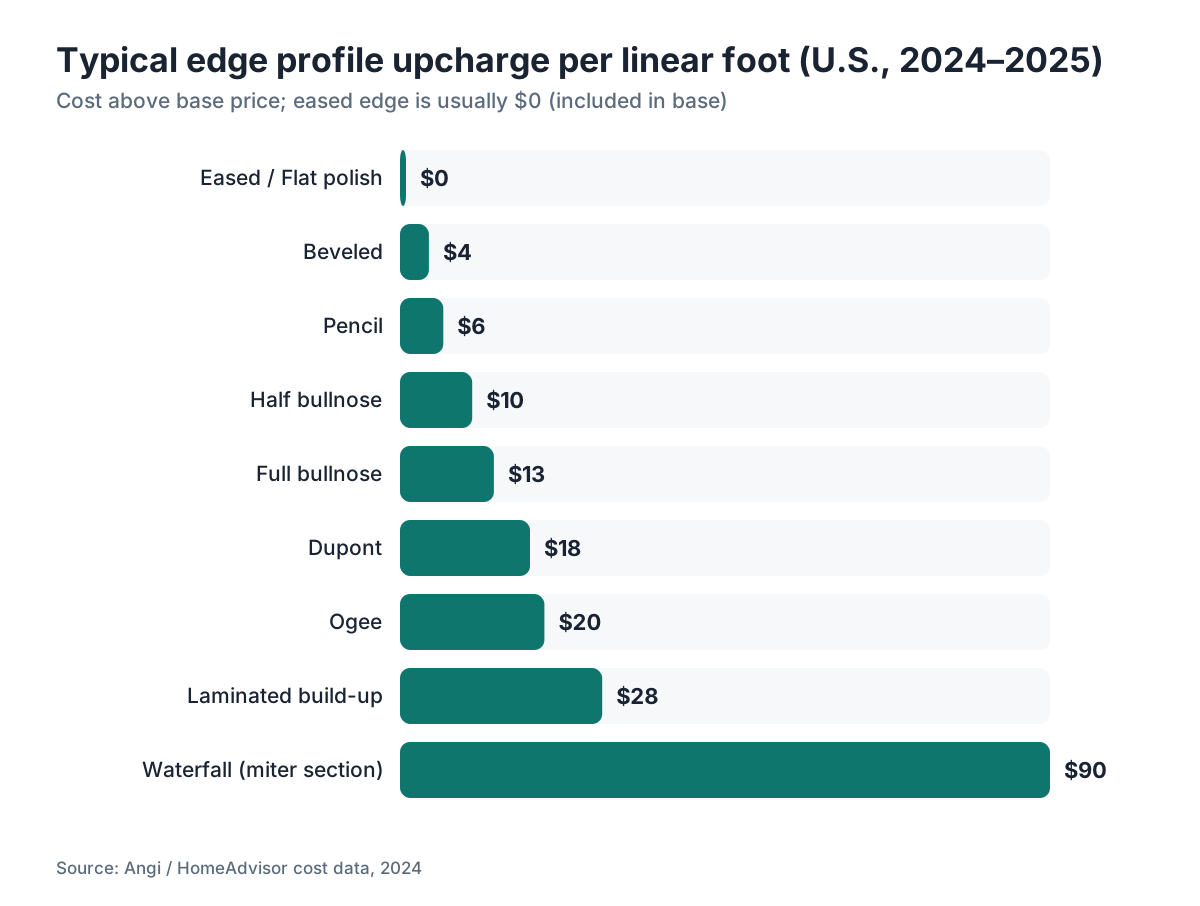
- Decorative profiles like ogee or waterfall add $10 to $35 or more per linear foot.
- Your best choice depends on stone thickness, cabinet style, safety needs, and budget.
What is a countertop edge profile?
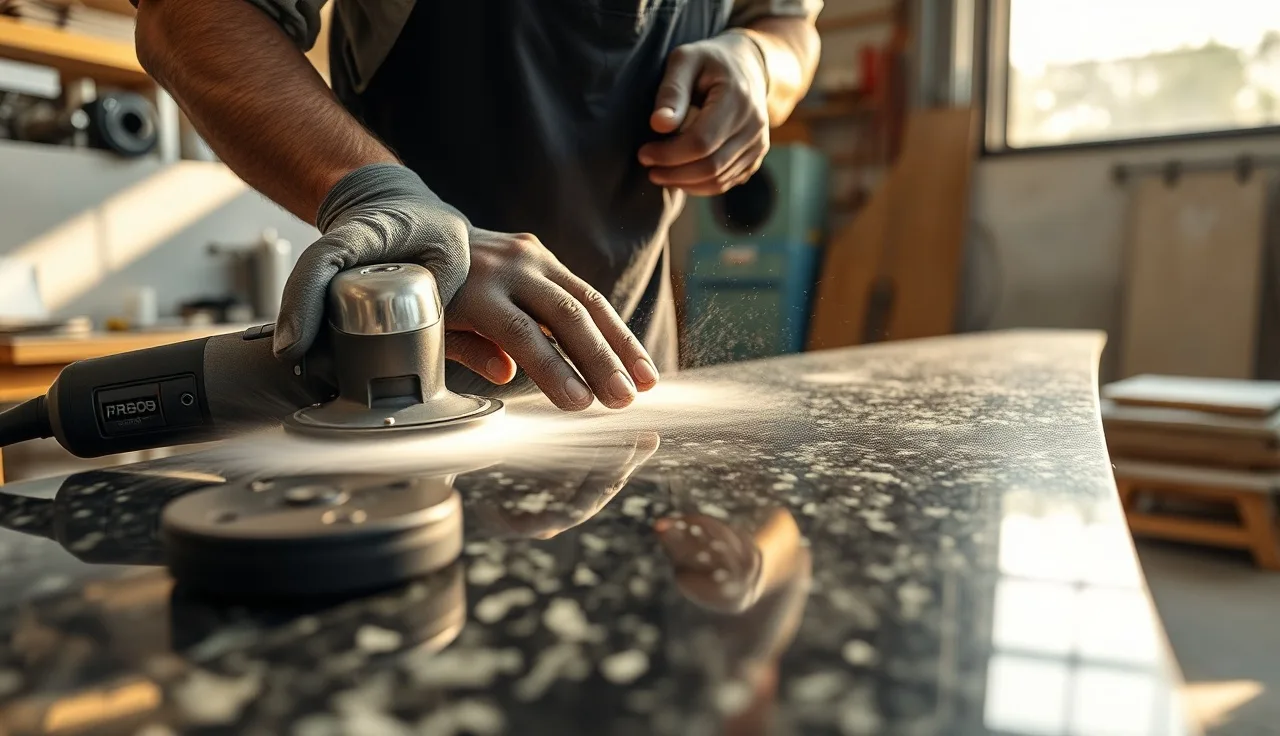
An edge profile is the cross-sectional shape machined along every exposed edge of a countertop slab. When a fabricator finishes a piece of granite, quartz, or marble, they don't cut it square and call it done. They run a CNC router or a hand-held grinder with a diamond-tipped bit along the visible edges to create a specific contour. That contour is the profile.
The profile changes how light hits the stone, how the surface feels under your hand, how easy the edge is to wipe clean, and how well the corner survives a bump. A sharp square corner chips easier than a rounded one. A deeply undercut profile like a dupont collects crumbs a flat eased edge never would.
Every countertop has an edge profile, chosen or not. If you didn't specify one, your fabricator almost certainly ran a simple eased or pencil edge and moved on. Knowing the options before you walk into the shop hands you real control over the finished look.
What are all the different edge profiles available?
Most shops carry about a dozen standard profiles, plus a few premium multi-step options and fully custom work. Here's the practical breakdown.
Eased (also called flat polish or straight): The top corner is barely softened, maybe 1/16 inch, and the face stays flat. This is the default at most shops and almost always rides in the base price. Clean, modern, fast to fabricate.
Beveled: A flat angled cut across the top corner, usually 45 degrees. Simple, with a bit of visual sharpness. Common on contemporary kitchens.
Pencil: A small, tight radius on the top edge. Very subtle. Good for thin materials or a bathroom where you want polish without spending money.
Bullnose (full): The whole edge rounds into a half-circle. Classic, soft on the hands, easy to clean. It works in family kitchens because there's no sharp corner to catch a hip on.
Half bullnose (demi bullnose): Only the top half rounds over; the bottom stays square. A common mid-range pick.
Ogee (standard): A flowing S-curve with a concave undercut and a rounded top. This is the traditional ornate edge and reads formal or classical. It eats more CNC time, so it costs more.
Dupont: Same S-curve idea as the ogee but with a flat step on top. It can look dated depending on the era you associate it with, though it still shows up in plenty of showrooms.
Cove dupont: Adds a cove cut under the flat step. More shadow lines, more depth, higher cost.
Waterfall (mitered): The slab keeps going vertically down the side of the cabinet to the floor, with a nearly invisible mitered seam at the 90-degree corner. This is the priciest option and burns a lot of stone. It works best on slabs with dramatic veining, because matching the grain across the miter is both the point and the hard part [1].
Laminated (built-up) edge: Two or three layers of stone stack at the edge to fake a thicker slab. Common on 2 cm material dressed up to look like 4 cm or 6 cm. Adds cost for both stone and labor.
Chiseled or leathered edge: A rough, hand-textured look that exposes the natural grain. Common on quartzite and granite for rustic or farmhouse kitchens.
Mitered thin (knife edge): Two pieces mitered at 45 degrees to fake an ultra-thin slab with almost no visible thickness on the face. Very high-end, very unforgiving on the fabricator.
| Profile | Complexity | Typical upcharge (per LF) | Best material fit |
|---|---|---|---|
| Eased | Minimal | $0 (usually included) | Any |
| Beveled | Low | $0, $5 | Quartz, granite |
| Pencil | Low | $2, $8 | All; great for thin slabs |
| Half bullnose | Low, medium | $5, $12 | Family kitchens, granite |
| Full bullnose | Medium | $8, $15 | Granite, quartz |
| Ogee | High | $12, $25 | Granite, marble |
| Dupont | High | $12, $22 | Granite |
| Waterfall | Very high | $50, $150+ per section | Book-matched slabs |
| Laminated build-up | High | $15, $35 | 2 cm stone on islands |
These ranges reflect typical U.S. fabrication shop pricing for 2024 to 2025. Regional labor and shop minimums push numbers all over the place, so treat this as orientation, not a quote [2].
How much does an edge profile upgrade cost?
Most fabricators bundle one basic profile, usually eased or beveled, into the base countertop price. Every step up in complexity adds a per-linear-foot charge, and that charge lands only on the exposed, finished edges, not on the full perimeter of every piece.
A typical kitchen island runs 10 to 14 linear feet of exposed edge. At a $15 per linear foot ogee upcharge, that's $150 to $210 extra on the island alone. Run the same profile around the full kitchen and a peninsula and you could hit 30 to 50 linear feet, which puts the upcharge at $450 to $750 before tax.
Waterfall edges price differently because they eat extra slab. Budget for at least one extra square foot of stone per inch of cabinet height (36 inches is standard) per waterfall side, plus the miter labor. On $80 per square foot quartzite, that's $2,880 in stone alone for a 36-inch drop on two sides of an island, before any fabrication markup [3].
Laminated build-up edges cost the extra stone plus adhesive and grinding time. On a 2 cm slab, building up to a 4 cm edge look usually runs $20 to $40 per linear foot depending on layers and finishing.
Comparing bids? Make each quote name the profile and state the linear footage being charged. "Standard edge" means five different things at five different shops.
Which edge profile works best for granite, quartz, and marble?
The material sets the limits. Granite is dense and holds fine detail without chipping, so it takes complex profiles like ogee and dupont well. Engineered quartz holds detail too and runs consistent all the way through, so any profile is achievable. Marble is softer and prone to corner chipping, which makes heavily undercut profiles a mild gamble in a busy kitchen. A bullnose or half bullnose on marble outlasts a sharp ogee.
Quartzite (the true metamorphic stone, not the soft material sometimes mislabeled as quartzite) is hard but often carries natural fissures that can run during aggressive profiling. A good fabricator plans around them. If you're working with quartzite, ask the shop if they've cut that specific stone before.
For granite countertops, a full or half bullnose is probably the most common mid-range pick. It shows off the stone's depth and polish without demanding the priciest CNC time. For marble countertops, a simpler eased or beveled edge cuts down the number of exposed corners that can chip or stain.
Laminate and solid surface work differently. Laminate uses post-form bending or applied edge banding instead of a stone router bit. Acrylics like Corian countertops and Formica countertops can be routed much like stone, but each manufacturer's profile catalog is specific to their material.
Butcher block countertops get shaped with woodworking bits. You can get a bullnose, an ogee, or a square edge, and sanding refinishes the surface later if it chips.
Does the edge profile affect durability and chipping?
Yes, and the difference is real. The physics is simple: the sharper a corner, the more stress piles up there under an impact. A full bullnose spreads a bump across a radius. A sharp square edge or a mitered knife edge concentrates it on a line or a point.
In practice, granite and quartz both hold a square edge fine in a low-traffic spot like a bathroom vanity that never gets hit. In a kitchen where kids, pots, and heavy mugs graze the edge all day, a rounded profile lasts longer. A 2019 paper in the Journal of Cultural Heritage on stone fracture mechanics found that edge geometry strongly influences where crack propagation starts under point loading [4]. That study looks at historic stone, but the underlying mechanics carry over.
Undercut depth matters too. A deeply cut dupont or ogee leaves a thin section of stone just below the overhang. On a soft or fissured stone, that thin section can crack or spall away. Fabricators should check for natural fissures running toward an edge before committing to an aggressive profile.
For homes with young kids, the Consumer Product Safety Commission (CPSC) sets no countertop edge standard, but its home safety guidance repeatedly flags sharp corners as a laceration risk, especially at eye and head height for toddlers [5]. A full bullnose or a radiused eased edge is the practical fix.
What edge profile is most popular right now?
Eased and beveled edges win on volume, plainly because they're the defaults and most homeowners never change them. Among the profiles people actually pay to upgrade to, half bullnose and full bullnose lead across every price point. They're familiar, they read finished without being fussy, and they sit comfortably next to both traditional and transitional cabinets.
Ogee had a long run as the prestige edge through the 1990s and 2000s, then cooled off in contemporary kitchens. It still signals a formal, traditional look, which some buyers want. Renovating a traditional kitchen with raised-panel cabinets and choosing Cambria countertops or similar premium quartz? An ogee still fits.
The waterfall edge is the high-design pick of the moment, pushed hard by interior designers on social media. It shines on book-matched slabs with dramatic movement. On plain white quartz, it reads more as a spending decision than a design one. Cost and slab waste keep it mostly on islands as a focal point rather than around every perimeter counter.
For kitchen countertops broadly, current contemporary taste leans toward thin-looking edges, either a true mitered thin profile or a laminated 2 cm build-up that mimics one, because a thin edge reads lighter than the heavy thick-slab ogee look of earlier decades.
How is an edge profile actually cut in the shop?
Modern shops cut profiles on CNC (computer numerical control) routers with diamond-tipped profile bits. The fabricator loads the slab dimensions from a digital template, picks the profile, and the router runs the bit along the edge path. One pass doesn't finish it. Most shops make multiple passes at finer and finer grits, ending with polishing pads that bring the edge to the same sheen as the face.
Simple profiles like eased or pencil take one or two passes. A full ogee, with its stacked curves, forces the router to change speed and path several times, and some shops finish the detail by hand. That extra time is exactly why complex profiles cost more.
For field adjustments after installation, fabricators reach for angle grinders with diamond cup wheels and profile-specific wet polishing pads. This is hand work, and matching a shop finish takes real skill. If a corner chips after installation and needs re-profiling on site, expect the polish to vary a bit from the factory edge.
Waterfall miters get cut at 45 degrees, usually on a bridge saw or a manual saw with a tilting head, then hand-finished where the two pieces meet. The inside corner of that miter is the most vulnerable spot on the entire countertop. Fabricators often reinforce it from below with a fiberglass rod epoxied across the seam.
OSHA regulates the dust side of all this: silica controls during CNC routing and hand grinding apply to every edge you cut [10]. Shops that track template data digitally, the kind of workflow countertop quoting software like SlabWise is built around, can feed profile selections straight into CNC programs from the quote stage, which cuts rework when a homeowner changes their mind at the last minute.
Can you change a countertop edge profile after installation?
You can, but it's no small job. A fabricator can re-profile an installed countertop in place with a handheld router and wet polishing tools. The catch is access. You can't run a CNC on an installed piece, so you're getting hand work, and the result rides entirely on who you hire.
Going from a complex profile to a simpler one, like grinding off an ogee and cutting a bullnose, removes material and can't be undone. You can't add stone back.
Going the other way, simpler to more complex, sometimes isn't possible at all. A narrow-radius pencil edge can open into a bullnose if there's enough edge material left. But if your slab is already profiled close to final thickness, there may not be enough stone to cut a deeper ogee curve without exposing the underside.
If you have a chip and want to blend a repair, a fabricator can sometimes re-profile the whole edge of that section to hide the damage inside the new geometry. As a repair strategy, that one is genuinely useful.
So choose carefully before installation. Changing your mind later costs money and may not land at shop quality.
How do edge profiles affect cleaning and maintenance?
This part gets ignored, and it shouldn't. An eased or flat edge wipes clean in one pass with a damp cloth. Ogee and dupont profiles have undercuts that trap crumbs, grease, and cleaning residue. You need a narrow brush or the corner of a cloth to get into the concave section.
Stone that needs sealing, like many granites and nearly all marbles, needs its profiled edge sealed too, and the undercut areas are the hardest spots to reach with a penetrating sealer. A poorly sealed undercut on granite can soak up grease over time and grow a dark stain line right along the most visible part of the edge.
The cleaning methods in how to clean quartzite countertops, how to clean soapstone countertops, and how to clean stone countertops all apply to the edge as much as the field. The profile changes how hard the cleaning is, not the chemistry behind it.
Waterfall edges hand you a whole new surface, the vertical face, often right at splashback height where cooking residue builds up fast. That vertical section needs the same sealing and cleaning attention as the horizontal top.
How do you specify an edge profile when getting a countertop quote?
Ask for the profile by name and ask to hold a physical sample. Most shops keep a sample board with 6 to 12 profiles cut in a standard granite or quartz. Feeling the actual edge in your hand beats any diagram.
Three things belong on the quote: the profile name, the upcharge per linear foot, and the total linear footage of finished edge being charged. If the shop breaks out "outside corners" separately (corners often cost more because they force the profile geometry to match in two planes at once), make sure those are on the page.
For a mitered waterfall, ask exactly how many miter joints are included, whether the stone is in the price or quoted separately, and whether the miter gets reinforced. Ask to see a finished waterfall in their portfolio too, because a bad miter is one of the more permanent mistakes in this trade.
Doing countertop installation in phases, with the island going in before the perimeter? Specify the same profile for both phases in writing at the start. Mismatched profiles between two pieces installed six months apart look off, and they're hard to explain to a future buyer.
Shops running several jobs at once use software to track which profile belongs to which job so nothing gets cut to the wrong spec. SlabWise, for one, carries edge profile selections from the quote through to the shop ticket, which shrinks the "we cut the wrong edge" conversation that still happens more than it should.
Are there building code or ADA requirements for countertop edges?
The ADA (Americans with Disabilities Act) Standards for Accessible Design set requirements for countertop height and knee clearance in accessible kitchens and bathrooms, but they name no edge profiles [6]. The standards require that accessible surfaces have no sharp or abrasive edges that could injure someone making contact while using a mobility aid, which in practice rules out razor-sharp square corners and harsh chiseled edges on accessible-height surfaces.
The Architectural Barriers Act of 1968 and its enforcing standards (ABAAS) apply the same idea to federally funded or owned buildings [7]. For a private home, neither ADA nor ABAAS governs a homeowner's choice unless the renovation is a commercial rental open to the public or a facility taking federal money.
Local building codes don't spell out edge profiles either. The International Residential Code (IRC) says nothing about them [8].
On child safety, the CPSC has no mandatory standard covering residential countertop edge geometry. It does publish voluntary guidance recommending padding on sharp furniture corners in homes with young children, which some homeowners extend to countertops but more often use on table corners [5].
The short regulatory answer: in a private home, the edge is your call. In a commercial or publicly accessible space, pick a radiused profile and stay on the safe side of ADA intent.
How does slab thickness affect which profiles are possible?
Thickness is a hard physical limit. Standard stone slabs come in 2 cm (about 3/4 inch) and 3 cm (about 1-1/4 inch). Some engineered quartz comes in 1.2 cm for specific uses.
A 2 cm slab doesn't carry enough depth for a full ogee, because the ogee's undercut needs more vertical stone than 2 cm gives you. To get the ogee look on 2 cm, a fabricator builds up the edge with a second or third layer, which adds cost. A full bullnose on 2 cm is also shallower than on 3 cm, so the curve reads less pronounced.
3 cm slabs are the current standard for U.S. kitchen countertops because they're thick enough for nearly any profile without a build-up, and stiff enough to span cabinets without extra plywood substrate in most cases. The Marble Institute of America (now part of the Natural Stone Institute) has long recommended 3 cm for kitchens for exactly that reason [9].
Ultra-thin porcelain panels, sometimes 6 mm or 12 mm, get handled differently. Many thin-panel makers specify a mitered edge as the only structurally sound option because there's not enough material for a routed profile. The miter bonds to a substrate or to a second panel laminated underneath.
Got 2 cm stone and want a thick-looking edge without paying for a waterfall? A laminated build-up on the visible edge only is the cheapest path. It adds 1 to 2 inches of visual depth at the edge while the field stays at 2 cm.
Frequently asked questions
What is the cheapest countertop edge profile?
An eased edge is the cheapest because most fabricators include it in the base price at no upcharge. It's a very slightly softened flat edge. A pencil edge or small bevel usually runs $2 to $8 per linear foot extra if the shop charges at all. On a tight budget, confirm "eased edge included" is written into your quote before you sign.
What is the most durable edge profile for a busy kitchen?
A full bullnose or half bullnose is the most durable pick for a high-traffic kitchen because the rounded geometry spreads impact load instead of piling it on a sharp corner. Eased edges hold up well too. Avoid deeply undercut profiles like ogee or dupont on stones prone to fissures, since the thin undercut section can crack under repeated impact.
What edge profile is best for a modern or contemporary kitchen?
Eased, beveled, or a thin mitered edge all read contemporary. The waterfall edge is the high-design modern choice right now, but it costs a lot more. Ogee reads traditional. Half bullnose lands in the middle and works in transitional kitchens. If your cabinets are flat-front or shaker, stick with an eased or thin bevel for a cohesive look.
How many linear feet of edge does a typical kitchen countertop have?
A typical U-shaped kitchen has roughly 20 to 40 linear feet of total countertop perimeter, but only the exposed edges get profiled and priced. Interior edges against walls or backsplashes usually stay square or lightly eased at no charge. Exposed edges on an average kitchen run 15 to 25 linear feet. An island adds another 10 to 14 linear feet of exposed edge.
Can I mix edge profiles in the same kitchen?
Technically yes, but it almost always looks like a mistake unless you have a design reason. One common intentional move is a different profile on the island versus the perimeter counters to set them apart. Unintentional mismatches, like two phases of work with different profiles, are hard to un-see. If you renovate in phases, lock in the same profile name in writing from the start.
Does an ogee edge require more maintenance than a bullnose?
Yes. The concave undercut on an ogee or dupont traps crumbs, grease, and cleaning residue that a cloth can't reach in one pass. You need a narrow brush to clean it right. The undercut also needs careful sealing on porous stones. If easy cleaning matters to you, a bullnose or eased edge is genuinely simpler to live with day to day.
Is a waterfall edge worth the extra cost?
On a slab with dramatic veining, a well-cut waterfall can be the best feature in the room. On plain or low-movement stone, it often just adds cost with little visual payoff. The miter joint is the structural weak point and needs real reinforcement. Budget at least two to three times the cost of a standard island in stone and labor before you expect a quality result.
What edge profile is best for bathroom vanities?
Eased, pencil, or half bullnose all work well in bathrooms. Vanities see far less impact than kitchen counters, so chip resistance matters less. A small pencil or eased edge looks clean on a thin vanity top. Want a spa-like feel? A full bullnose on a 3 cm slab reads luxurious without the cleaning hassle of an ogee. Match the profile to your cabinet style.
Does the edge profile affect the countertop price per square foot?
Edge upcharges are priced per linear foot of finished edge, not per square foot of slab. A more complex profile doesn't change your material cost per square foot. It adds a separate line item for edge fabrication. That matters when comparing quotes: one shop might have a lower slab price but a higher edge upcharge, or the reverse. Always price the complete job, more than the material.
What is a laminated or build-up edge?
A laminated or build-up edge stacks two or three strips of stone at the visible edge to make a 2 cm slab look as thick as 3 or 4 cm. The strips bond with color-matched epoxy. The result is a thicker edge that can carry profiles like ogee or bullnose that 2 cm alone can't support. Cost runs $20 to $40 per linear foot depending on layers and finishing.
Can laminate countertops get fancy edge profiles like stone can?
Laminate countertops get their edge shape from post-forming (bending the laminate over a rounded substrate) or from applied edge banding strips. The radius options are more limited than stone and are set by what the laminate maker offers. You can get a basic bullnose post-form edge or a flat square edge with laminate banding. A CNC stone router profile doesn't apply to standard laminate construction.
How long does edge profiling take in the shop?
A simple eased or bevel edge on a standard kitchen job takes minutes per piece on a CNC router. A full ogee or complex custom profile on a large island can take 45 minutes to over an hour including polishing passes. Waterfall miters add real time for both cutting and fitting. Edge profiling is rarely the production bottleneck; templating, cutting, and seam fitting usually take longer.
What should I ask my fabricator about edge profiles before signing a contract?
Ask: what profile is included in the base price? Can I see a physical sample board? What's the upcharge per linear foot for the profile I want? How many linear feet of exposed edge are in my project? Are outside corners priced separately? For a waterfall, ask to see a completed example, confirm the reinforcement method, and clarify whether the extra stone is in the quoted price or separate.
Sources
- Natural Stone Institute, Technical Manuals: Waterfall and mitered edge profiles require precise grain matching and additional slab material, particularly on book-matched slabs.
- Angi, Cost to Install Countertops: Edge profile upcharges in U.S. fabrication shops typically range from $0 for basic eased edges to $35 or more per linear foot for complex profiles.
- Natural Stone Institute, Technical Manuals: Waterfall edge installations consume additional slab area proportional to the vertical drop height, typically 36 inches for standard cabinet height.
- Journal of Cultural Heritage (Elsevier), stone fracture mechanics research: Edge geometry significantly influences where crack propagation initiates under point loading in stone materials.
- U.S. Consumer Product Safety Commission, home safety guidance: The CPSC flags sharp furniture and countertop corners as a laceration risk for young children and recommends padding or radiused edges in homes with toddlers.
- U.S. Access Board, ADA Standards for Accessible Design: ADA Standards for Accessible Design specify countertop height and knee clearance requirements but do not mandate specific edge profile names; surfaces must not have sharp or abrasive edges that could injure users.
- U.S. Access Board, Architectural Barriers Act Accessibility Standards (ABAAS): The Architectural Barriers Act and its enforcing standards apply to federally funded or owned buildings and require surfaces free of sharp or abrasive edges.
- International Code Council, International Residential Code (IRC): The International Residential Code does not specify countertop edge profile requirements for residential construction.
- Natural Stone Institute (formerly Marble Institute of America), technical guidelines: The Natural Stone Institute recommends 3 cm slab thickness for kitchen countertop applications to support standard profiles without requiring build-up edges.
- U.S. Occupational Safety and Health Administration (OSHA), respirable crystalline silica standards: OSHA regulates stone fabrication shop practices including silica dust controls during CNC routing and hand grinding operations, which apply to all edge profiling work.
Last updated 2026-07-09