
TL;DR
- Countertop installation costs roughly $400 to $8,000 or more for a typical kitchen, depending on material, square footage, edge profiles, and your local labor market.
- Laminate sits at the low end ($10 to $40 per square foot installed), quartz runs $50 to $120, and natural stone like marble or quartzite can reach $150 or higher.
- Plan for removal, plumbing disconnect, and backsplash work as separate line items.
What does countertop installation actually cost?
The honest answer: it depends on material more than anything else. But here are the real ranges most homeowners face.
A full kitchen countertop replacement, assuming 40 to 50 square feet of surface (a common mid-size American kitchen), runs from about $400 on the absolute low end for a DIY laminate job to well over $8,000 for thick exotic stone with a waterfall edge. Most fabricators quote an installed price per square foot, which bundles material, cutting, edge profiling, and labor into one number. That bundled figure is the only apples-to-apples comparison you can make across shops.
A few costs almost always get quoted separately: demolition and hauling of old countertops (typically $50 to $150 flat or $2 to $5 per linear foot [1]), plumbing disconnect and reconnect (often $75 to $200 per fixture), and any electrical work if outlets need to move. If a quote seems low, ask specifically whether those items are in it.
Labor alone, when shops break it out, typically runs $35 to $100 per hour for installation [1]. A standard kitchen install takes two to four hours with a crew of two. Complexity adds time fast. Angled walls, multiple sinks, cooktop cutouts, and undermount sink support all push the clock.
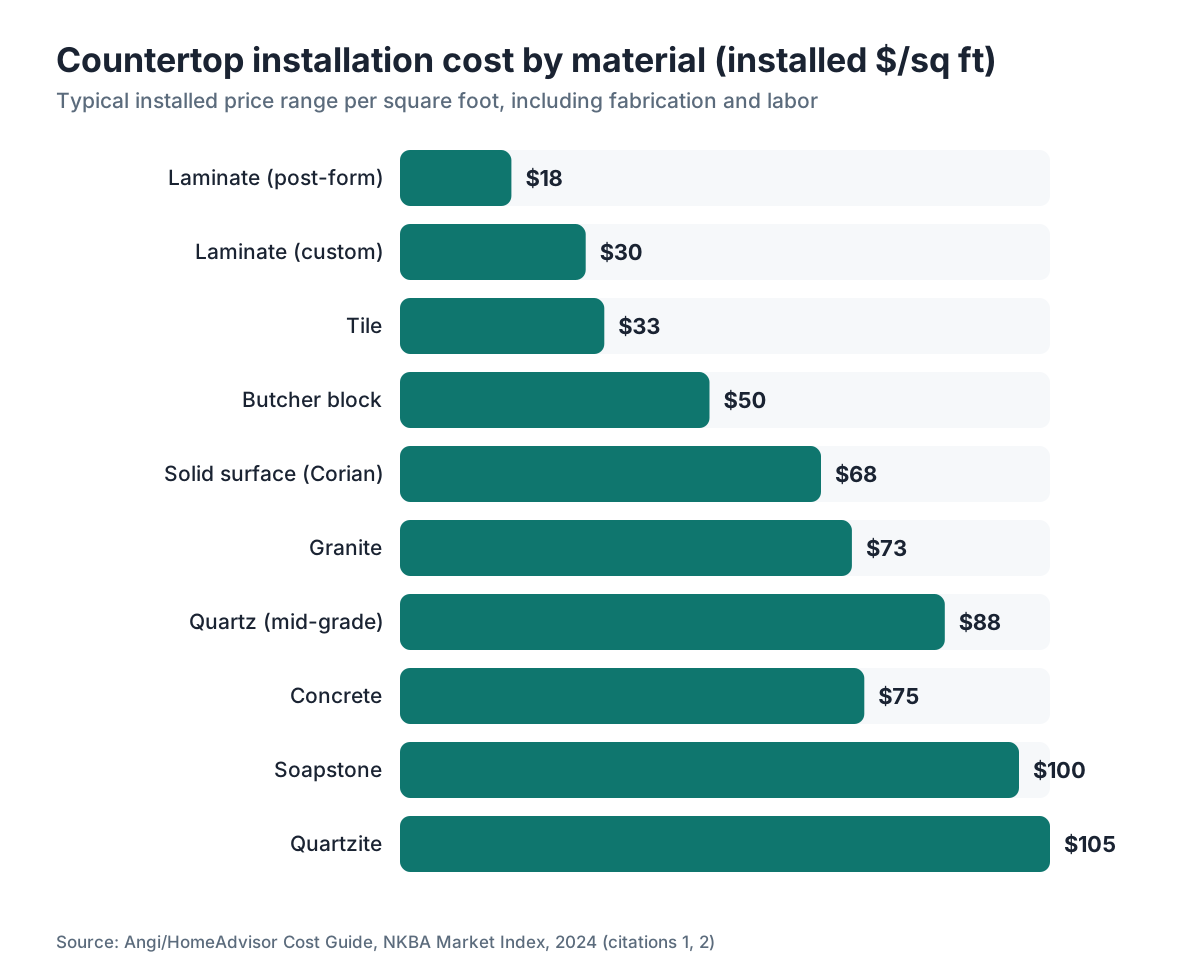
See the table below for a full material-by-material breakdown, then read on for what drives the number up or down the most.
How much does each countertop material cost installed?
Material is the biggest single lever. Here are real installed price ranges per square foot based on industry data from Remodeling Magazine, the National Kitchen and Bath Association (NKBA), and contractor surveys [1][2][3]. These include typical fabrication and installation. Unusually complex jobs run higher.
| Material | Installed $/sq ft (low) | Installed $/sq ft (high) | Notes |
|---|---|---|---|
| Laminate (post-form) | $10 | $25 | Pre-formed, no seam options |
| Laminate (custom) | $20 | $40 | Square edges, custom cutouts |
| Tile (ceramic/porcelain) | $20 | $45 | Grout lines, DIY-friendly |
| Butcher block / wood | $30 | $70 | Needs sealing; DIY possible |
| Concrete | $50 | $100 | Custom weight and cure time |
| Solid surface (Corian, etc.) | $45 | $90 | Invisible seams, repairable |
| Quartz (engineered) | $55 | $120 | Consistent color, low maintenance |
| Granite | $45 | $100 | Varies by slab grade |
| Quartzite | $70 | $140 | Harder than granite, less common |
| Marble | $75 | $150 | Etches easily; premium aesthetic |
| Soapstone | $70 | $130 | Matte finish, heat-resistant |
| Cambria (premium quartz) | $80 | $140 | Lifetime warranty |
Premium designer quartz brands like Cambria or Silestone charge more than generic engineered quartz because they carry longer warranties and more tightly controlled slab consistency. That premium is real, more than marketing.
Granite countertops cover an enormous price range depending on the grade of slab (Levels 1 through 5 or higher at most yards), and a Level 1 granite installed can actually compete with upper-end laminate. Marble countertops are gorgeous and expensive to maintain. Budget for sealing every six to twelve months and accept that etching is inevitable around acids.
Laminate countertops, including classic Formica countertops, get unfairly dismissed. The texture and edge options today are genuinely good, and the cost to have laminate countertop installed is lower than any other professionally finished surface.
What square footage do most kitchens actually have?
Most kitchens run 30 to 60 square feet of countertop surface [2], and homeowners consistently guess low. Square footage for countertop purposes is the total surface area, not the room size. That distinction is where budgets go sideways.
Here's how fabricators measure it: they multiply the length of each run (in inches) by the depth (usually 25 to 25.5 inches for a standard overhang with a 24-inch base cabinet), then convert to square feet. The island, if you have one, adds separately. A 4-foot by 6-foot island alone adds 24 square feet.
If you give a fabricator your kitchen dimensions in feet and they quote you, say, 45 square feet, that's a reasonable estimate for most U-shaped or L-shaped kitchens. Take that number times your installed price per square foot and you have a ballpark. Actual templates always differ because walls aren't perfectly square and appliances take up real space.
A bathroom is much smaller. A single vanity top might be only 5 to 15 square feet. Many shops charge a minimum cut fee (often $200 to $400) on very small jobs, so the cost per square foot on a tiny bathroom vanity can look shocking next to a full kitchen.
What is the cost to have quartz countertops installed specifically?
Installed quartz typically runs $55 to $120 per square foot. For a 45-square-foot kitchen, that's $2,475 to $5,400. The midpoint, around $80 to $85 per square foot, covers most mid-grade quartz (Caesarstone, MSI, Vicostone) with a standard eased or beveled edge.
Quartz is the best-selling countertop material in the United States right now, according to the NKBA's 2023 Design Trends report [3]. That popularity means real price competition, which is good for buyers.
What moves the quartz price up:
- Exotic or book-matched patterns (veined quartz that mimics marble) often run $90 to $120 per square foot because the matching process wastes more slab.
- Thick slabs: 3 cm (about 1.2 inches) is now standard and is already priced into most quotes. Older 2 cm slabs are cheaper but need plywood buildup, which can erase the savings.
- Waterfall edges, where the slab continues vertically down the cabinet face, need extra material and mitered seams. Add $500 to $1,500 or more depending on island size.
- Premium brands with lifetime warranties (Cambria, Silestone) add roughly 20 to 40 percent over generic mid-grade.
Region matters too. Labor in San Francisco or New York City runs materially higher than in rural Midwest markets. Expect to pay 30 to 50 percent more for labor in high cost-of-living metros [1].
For kitchen countertop pricing context across all materials, our kitchen countertops guide covers the trade-offs in more depth.
What factors drive the installation cost up the most?
Material per square foot is the obvious driver. Several less obvious factors can add hundreds or thousands to a final bill.
Edges. A standard eased edge (slightly rounded over) is usually in the base price. Step up to a full bullnose, ogee, or waterfall, and the price jumps $10 to $30 per linear foot on top of your base quote. For a kitchen with 20 linear feet of edge, that's an easy $200 to $600 add. Double-edge profiles (both the top and the front panel profiled) cost more again.
Cutouts. Every sink, cooktop, and outlet cutout takes time and creates waste. Undermount sink cutouts typically add $50 to $150 each. A farmhouse (apron-front) sink needs a specific cutout shape and often a support system, which can add $200 to $400 [2].
Number of seams. Stone slabs come in standard sizes, often around 55 to 65 inches wide and 110 to 130 inches long [5]. Large kitchens or long runs need seams. Each seam requires precise alignment, epoxy color-matching, and polishing. Shops usually charge $150 to $400 per seam.
Backsplash. Some homeowners assume a backsplash is included. It's almost never included unless the quote says so. A standard 4-inch stone backsplash bump adds roughly $10 to $20 per linear foot.
Removal and disposal. Old countertop removal runs $50 to $200 for a typical kitchen, plus disposal fees. Pull them yourself beforehand and you save that money, but ask your fabricator whether self-removal voids any warranty on the new install.
Access and site conditions. Narrow hallways, stairs to upper-floor kitchens, and elevators all add labor time. Some shops charge an explicit access fee. Others just quote higher. Ask upfront.
Plumbing. Your fabricator is not a plumber. If you have an undermount sink, someone has to disconnect the plumbing before the old top comes off and reconnect after the new one goes in. That's usually a separate $100 to $300 plumbing call.
How do installation costs differ between DIY and professional installation?
Some materials are realistic DIY projects. Others genuinely are not.
Laminate (post-form countertops, the kind with the rolled front edge) is one of the few surfaces where a handy homeowner saves real money. Materials from a home center run $10 to $20 per linear foot, and the install needs a jigsaw, a drill, and some patience. The cost to have laminate countertop installed professionally runs $20 to $40 per square foot. Doing it yourself cuts that roughly in half. The downside: you can't make inside-corner seams look as tight as a fabricator with proper miter-cutting tools.
Tile is also genuinely DIY-able if you're comfortable with a wet saw. Butcher block countertops are a popular DIY option too. They ship in standard sizes, cut with woodworking tools, and oil-finish at home. Solid surface like Corian countertops is technically DIY-able, but the adhesive bonding and seaming needs specific tooling.
Natural stone, engineered quartz, and concrete are not realistic DIY. A 3 cm quartz slab at 55 by 120 inches weighs 350 to 450 pounds [5]. Moving, cutting, and templating it takes specialized saws, vacuum lifters, and seaming tools. More practically: crack a $2,000 slab during self-installation and you own that slab. Most fabricators won't warranty material they didn't supply and install.
The practical DIY savings on stone-type materials is close to zero once you factor in rental equipment, risk, and time. The savings on laminate and tile are real.
Does removing old countertops cost extra?
Yes, almost always. Removal and disposal are typically not bundled into a fabricator's per-square-foot installed price unless the quote explicitly says so.
Expect $50 to $200 for removal of a standard kitchen's old countertops, depending on the material (tile with thin-set is harder to remove than laminate), whether the old top is glued to the cabinets, and local dump fees [1]. Some fabricators waive removal fees to win competitive bids, but that's a negotiating point, not a baseline expectation.
Replacing a tile surface set in mortar? Warn your fabricator. Mortar-bed tile removal can take an extra hour or two and may damage the cabinet substrate underneath. That's a real repair cost if the plywood needs patching before the new top goes on.
One honest tip: pull the old laminate countertops yourself if you can. It's usually just screws from inside the cabinet and silicone at the wall. You save the removal fee and your fabricator gets a clean workspace.
How do I get an accurate quote from a fabricator?
Give the shop enough information to price your job right. Walking in with "I want quartz in my kitchen" gets you a ballpark, not a number you can budget against.
Here's what to bring or communicate:
- A rough sketch with dimensions of all countertop runs (in feet or inches). Include the island separately.
- Your sink type (undermount, drop-in, farmhouse) and how many sinks.
- Whether you have a cooktop or range. A cooktop cutout adds cost; a freestanding range does not.
- The material and color family you want (even "mid-grade quartz in a white or light gray" is enough to quote).
- Whether you want a specific edge profile or are open to whatever's included in the base price.
- Whether you need the old countertops removed.
A well-run shop sends someone for a template measurement (often $50 to $150, sometimes credited to the job if you proceed) before finalizing the price. The template is where real dimensions are confirmed and seam locations are decided. Don't accept a final, binding quote based only on your hand-drawn sketch.
Shops that use quoting and nesting software, like SlabWise, can often turn around a preliminary quote in minutes from your dimensions, which helps you compare shops faster. Ask any fabricator how they calculate slab waste in their quotes. Shops that nest jobs efficiently pass some of those savings along.
Get at least three quotes. Price variation between shops for identical material and scope routinely runs 20 to 30 percent [2].
What does countertop installation look like as a total project cost?
Let's put real numbers together for common project types.
Small bathroom vanity (8 sq ft, quartz, single sink): Material and fabrication: $640 to $960. Minimum job fee if applicable: $200 to $400. Plumbing disconnect/reconnect: $100 to $200. Removal of old top: $50 to $100. Total realistic range: $500 to $1,500.
Medium kitchen (45 sq ft, mid-grade quartz, undermount sink, eased edge): Material and fabrication: $2,475 to $5,400. Sink cutout: $75 to $150. Removal and disposal: $100 to $200. Plumbing: $150 to $250. Total realistic range: $2,800 to $6,000.
Large kitchen plus island (70 sq ft, granite Level 3, farmhouse sink, ogee edge): Material and fabrication: $3,150 to $7,000. Edge upgrade (15 linear feet, $20 upcharge): $300. Farmhouse sink cutout and support: $350. Two seams: $400 to $600. Removal and disposal: $150 to $250. Plumbing: $150 to $300. Total realistic range: $4,500 to $8,500.
These are honest ranges based on contractor cost surveys and Remodeling Magazine's Cost vs. Value data [1][4]. Your actual number will be specific to your market and your shop. The Midwest runs cheaper than coastal metros on labor. Rural areas run cheaper still, but the slab selection at local yards is often thinner.
For countertop installation details on timeline and process, that guide covers what happens from template day through final polish.
Does a new countertop add resale value to a home?
A minor kitchen remodel that includes countertop replacement returns 70 to 80 percent of its cost at resale in most U.S. markets, according to Remodeling Magazine's annual Cost vs. Value Report [4]. That puts it among the higher-return home improvement projects.
A full kitchen remodel, which involves cabinetry, flooring, and appliances on top of countertops, returns a lower percentage (around 50 to 60 percent nationally) because it's a much larger total spend. That math argues for replacing just the countertops and hardware rather than the whole kitchen if the cabinets are structurally sound.
Real estate agents often cite countertops and kitchen updates as among the first things buyers notice, but hard data on isolated countertop-only resale impact is thin. The National Association of Realtors' 2024 Remodeling Impact Report found that kitchen upgrades "consistently rank among the most impactful for buyer appeal" without putting a single dollar-per-dollar number on countertops alone [6]. Take agent opinions here with some skepticism. The recoup rate matters most if you're selling within a few years. If you'll live there a decade, buy what you actually want to use.
Are there ways to reduce countertop installation costs without sacrificing quality?
Yes. Some strategies work. Others are false economies.
Real savings:
Choose a material one tier down. Going from Cambria to a standard engineered quartz brand often saves $20 to $40 per square foot with minimal real-world difference in durability. For most homeowners, mid-grade quartz is indistinguishable from premium quartz once installed.
Stick with a standard eased or bevel edge. Fancy ogee or waterfall edges are genuinely beautiful, but the labor premium is real. A $15-per-linear-foot edge upcharge on 25 linear feet is $375 you could spend elsewhere.
Avoid unnecessary seams by laying out your kitchen runs before selecting slab size. A fabricator using layout software can often show you how to orient cuts to minimize seam count.
Buy your own sink and have it ready on template day. Fabricators often mark up fixtures. Buy the undermount sink yourself from a plumbing supply house and hand it to the fabricator at template.
Get quotes in slower months. Fabricators tend to be busiest in late spring and summer (kitchen remodel season). Fall and winter quotes sometimes come in 5 to 15 percent lower.
False economies:
Thin slab (2 cm instead of 3 cm) sounds cheaper, but the required plywood buildup adds labor and sometimes costs more than the slab savings. Ask your fabricator to quote both.
Skipping the sealer on natural stone is a false economy. A $30 bottle of impregnating sealer and 30 minutes of your time once a year protects a $4,000 countertop. The how to clean stone countertops and how to clean quartzite countertops guides cover maintenance in practical detail.
DIY removal of stone or tile bonded in mortar is often not worth it. Damage the cabinet box and you're paying a carpenter before the fabricator even shows up.
How long does countertop installation take from start to finish?
A typical project runs 1 to 3 weeks from signed contract to finished countertop. It's longer than a day, which surprises a lot of homeowners. Here's the general sequence:
Days 1 to 7: Template. A fabricator or their templater comes to your home and creates either a physical template (Luan strips taped together) or a digital scan. This usually takes 30 to 90 minutes. You can't schedule template until the cabinets are fully installed and level. That's a hard dependency.
Days 3 to 10: Fabrication. After template, the shop programs and cuts your slabs. A typical turnaround is 3 to 7 business days, though busy shops in peak season can run 10 to 14 days. Shops using CNC fabrication cut more precisely and faster than hand-cut shops.
Installation day: The crew arrives, usually 2 to 4 people for a full kitchen, and installs in 2 to 6 hours depending on complexity. You can typically use the countertop immediately after install (quartz and stone are already cured). The exception is if sealer needs to go on natural stone, which needs 24 to 72 hours to cure before heavy use.
On a renovation timeline? Tell your fabricator your cabinet completion date as early as possible so they can hold a slot in their production schedule. Last-minute template requests in high season often push the timeline out a week or more.
Frequently asked questions
How much does it cost to install countertops in an average kitchen?
A mid-size kitchen with 40 to 50 square feet of countertop surface typically costs $1,800 to $6,000 installed, depending on material. Laminate runs $800 to $2,000 for that range; mid-grade quartz runs $2,500 to $5,500; granite varies from about $1,800 to $5,000 depending on slab grade. Add $200 to $600 for removal, plumbing, and cutouts.
What is the cheapest countertop option to have professionally installed?
Post-form laminate is the least expensive option at $10 to $25 per square foot installed. Tile comes close at $20 to $45 per square foot but requires grout maintenance. Custom laminate with square edges runs $20 to $40 per square foot and offers much more design flexibility than post-form. Both are legitimate surfaces, more than budget compromises.
Is quartz or granite cheaper to install?
They're close. Entry-level granite (Level 1 slab) can install for less than mid-grade quartz, sometimes as low as $45 to $55 per square foot. But higher-grade granite with exotic veining quickly passes the quartz midrange. In practice, a mid-grade granite and a mid-grade quartz in the same market from the same shop often quote within $5 to $15 per square foot of each other.
What's included in a countertop installation quote?
A standard installed price typically covers the slab material, CNC or hand cutting, edge profiling to one standard profile, and labor to set and secure the top. It often does not include old countertop removal, plumbing disconnect/reconnect, backsplash fabrication, sink supply, or permits. Always ask specifically what is and is not in the price before comparing quotes between shops.
How much does labor cost for countertop installation?
When shops break out labor separately (many quote all-in), installation labor runs $35 to $100 per hour per installer. A two-person crew takes 2 to 4 hours for a standard kitchen, so raw labor cost is roughly $140 to $800 for the install day alone. Complexity such as multiple sink cutouts, unusual angles, or difficult site access pushes toward the high end.
Can I save money by removing my old countertops myself before the fabricator comes?
Often yes. Laminate countertops are typically screwed from inside the cabinet and caulked at the wall; a homeowner with a utility knife, screwdriver, and an hour can pull them before the fabricator arrives. Old tile set in mortar is harder and risks cabinet damage. Stone tops should be removed by the fabricator's crew since they're very heavy and need safe handling.
How much does countertop installation cost for a bathroom vanity?
A single bathroom vanity top (typically 5 to 15 square feet) costs $300 to $900 installed for quartz or granite, but many shops charge a minimum job fee of $200 to $400 that applies to small projects. This makes the per-square-foot cost look high on small vanities. Plumbing disconnect and reconnect adds another $100 to $200 for an undermount sink.
Do fabricators charge extra for waterfall edges or unusual designs?
Yes. A waterfall edge, where the countertop slab continues vertically down one or both sides of an island, needs additional slab material and precise mitered seam cuts. Expect to add $500 to $1,500 or more per waterfall drop depending on the height and width. Decorative edge profiles like ogee or dupont add $10 to $30 per linear foot over a basic eased edge.
How many quotes should I get for countertop installation?
Three is the practical minimum. Price variation between shops for identical material and scope routinely runs 20 to 30 percent. Some of that reflects different overhead, some reflects different slab sourcing, and some just reflects how much a shop wants your job that week. Three quotes also help you spot an outlier: a bid that's dramatically low usually means something is missing from the scope.
Does countertop installation require a permit?
In most jurisdictions, replacing countertops alone does not require a permit because it doesn't involve structural work or new plumbing. If you're moving plumbing or changing the cabinet layout, that work may trigger a permit requirement. Check with your local building department if you're unsure; requirements vary by municipality. A licensed plumber reconnecting your sink is typically covered by their own license.
How long after countertop installation can I use my sink and cook on the surface?
Quartz and granite can typically be used the same day; the epoxy used to secure undermount sinks usually cures within a few hours. Natural stone that needs sealing should ideally sit 24 hours before heavy use, though light use is usually fine. Concrete countertops have specific cure protocols set by the installer, often 24 to 72 hours. Ask your fabricator for their specific guidance.
What is the cost difference between 2 cm and 3 cm stone countertops?
A 3 cm slab (about 1.2 inches thick) is now the standard for most stone installations and is heavier, stronger, and doesn't require a plywood buildup along the front edge. A 2 cm slab is thinner and cheaper per square foot by roughly $5 to $15, but it needs a laminated or built-up edge to look substantial, which adds fabrication labor. In most cases the total cost difference is small, and 3 cm looks better.
How does geographic location affect countertop installation pricing?
Labor costs vary substantially by region. High cost-of-living metros like San Francisco, New York, Boston, and Seattle typically run 30 to 50 percent higher on installation labor than mid-sized Midwest or Southern markets. Material prices vary less since slabs are shipped nationally, but local slab yard selection and transportation distance do affect what's available and at what cost. Always get quotes from local shops rather than national averages.
Does upgrading countertops increase home resale value?
A minor kitchen remodel including countertops returns roughly 70 to 80 percent of its cost at resale nationally, according to Remodeling Magazine's Cost vs. Value Report. That's a solid return relative to most home improvements. The National Association of Realtors also rates kitchen updates as among the highest for buyer appeal. The return is strongest when buyers can see quality materials without the project being so expensive that the price isn't recouped in the local market.
Sources
- HomeAdvisor (Angi) -- Countertop Installation Cost Guide: Countertop installation labor runs $35 to $100 per hour; removal and disposal of old tops runs $50 to $200 for a typical kitchen; regional labor costs in high cost-of-living metros run 30 to 50 percent higher
- National Kitchen and Bath Association (NKBA) -- Kitchen and Bath Market Index: Average kitchen countertop area is 30 to 60 square feet; fabricators send templaters before final quotes; price variation between shops runs 20 to 30 percent for same scope
- National Kitchen and Bath Association (NKBA) -- 2023 Design Trends Report: Quartz is the best-selling countertop material in the United States as of 2023
- Remodeling Magazine -- 2024 Cost vs. Value Report: A minor kitchen remodel returns approximately 70 to 80 percent of costs at resale in most U.S. markets
- Marble Institute of America (Natural Stone Institute) -- Stone Industry Education: Standard stone slabs are approximately 55 to 65 inches wide and 110 to 130 inches long; 3 cm quartz slabs at standard dimensions weigh 350 to 450 pounds
- National Association of Realtors -- 2024 Remodeling Impact Report: Kitchen upgrades "consistently rank among the most impactful for buyer appeal" according to the 2024 NAR Remodeling Impact Report
- U.S. Bureau of Labor Statistics -- Occupational Employment and Wage Statistics: Tile and Stone Setters: National wage data for tile and stone setters used to validate installation labor rate ranges
- U.S. Bureau of Labor Statistics -- Consumer Price Index: Housing and Home Improvement: Home improvement materials and labor price trends underpinning 2025 to 2026 cost estimates
- U.S. Census Bureau -- American Housing Survey: Kitchen size and home improvement spending data used to validate average countertop square footage estimates
- Cambria -- Product Warranty Documentation: Cambria offers a lifetime warranty on its quartz products, which contributes to its price premium over generic engineered quartz brands
Last updated 2026-07-09