TL;DR
- Installed countertops cost roughly $40, $100 per square foot for the most common materials (quartz, granite, laminate), but the real range is $15 to $250-plus depending on material, edge profile, sink cutouts, and your local labor market.
- A typical kitchen with 50 square feet of countertop runs $1,500 to $5,000 all-in.
- Stone and luxury materials push that to $8,000 or more.
What is the average cost of new countertops installed?
The honest answer is: it depends heavily on material, but here are real numbers you can use.
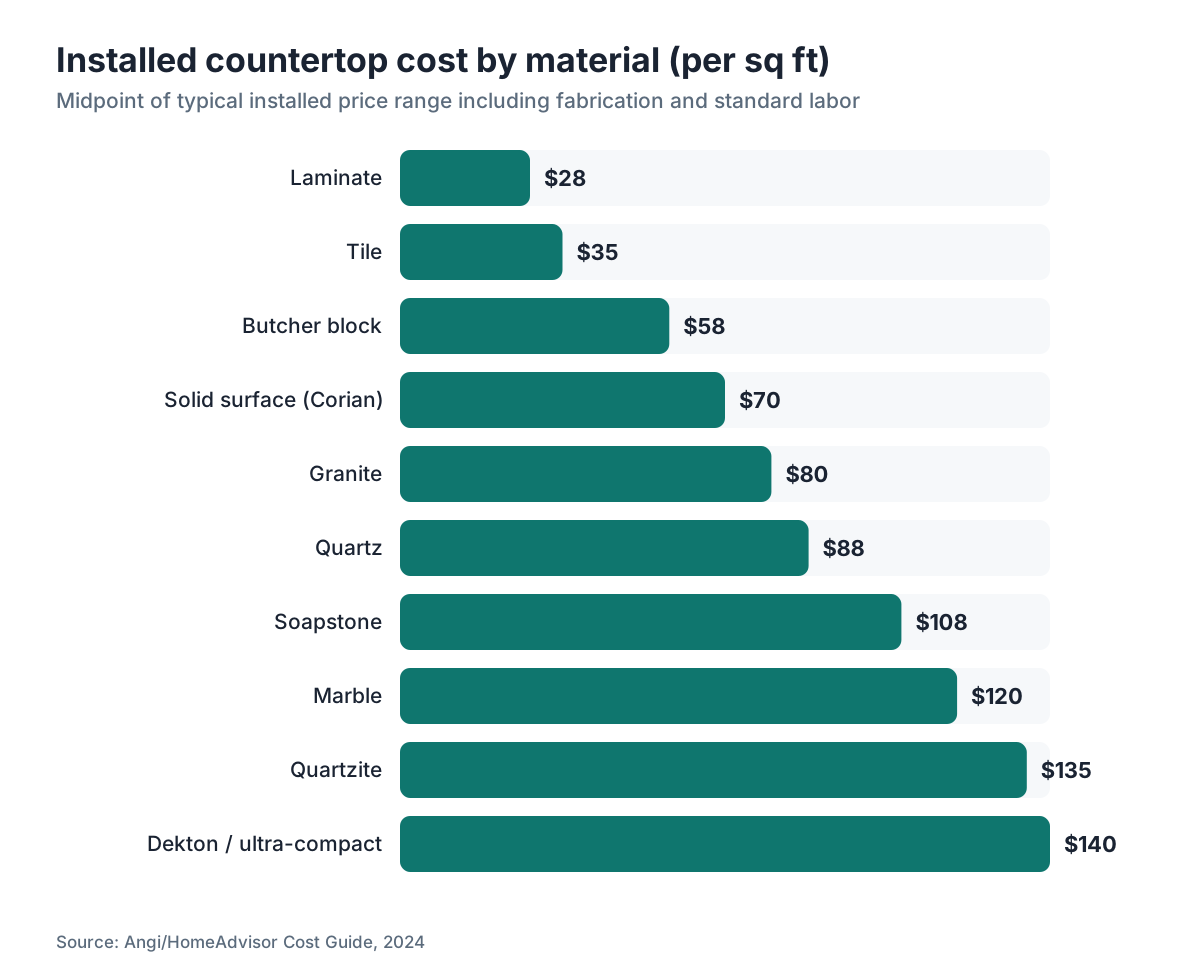
For a typical U.S. kitchen with roughly 45 to 55 square feet of countertop area, total installed costs break down like this [1]:
| Material | Installed cost per sq ft | Typical kitchen total |
|---|---|---|
| Laminate | $15, $40 | $675, $2,200 |
| Tile | $20, $50 | $900, $2,750 |
| Butcher block / solid wood | $30, $85 | $1,350, $4,675 |
| Quartz (engineered stone) | $55, $120 | $2,475, $6,600 |
| Granite | $50, $110 | $2,250, $6,050 |
| Marble | $65, $175 | $2,925, $9,625 |
| Quartzite | $70, $200 | $3,150, $11,000 |
| Soapstone | $65, $150 | $2,925, $8,250 |
| Concrete | $65, $140 | $2,925, $7,700 |
| Dekton / ultra-compact | $80, $200 | $3,600, $11,000 |
| Corian / solid surface | $45, $95 | $2,025, $5,225 |
Those ranges cover material, fabrication (cutting, edging, polishing), and standard installation labor. They leave out demolition of old countertops, plumbing reconnection, and backsplash work, all of which add cost.
The national median for installed countertops sits around $60 per square foot across all materials, according to data compiled by the U.S. Census Bureau's American Housing Survey [2]. That figure blends the huge volume of laminate with the premium stone jobs, so it probably understates what most people searching this question are actually planning to buy.
What drives the cost up or down the most?
Material choice is the biggest lever. Going from laminate to quartz can triple your cost per square foot before you even think about edges or cutouts.
After material, these factors matter most:
Square footage. Fabricators price by the square foot, so a galley kitchen with 30 sq ft of counter is genuinely cheaper than an L-shaped kitchen with 70 sq ft. Measure carefully: include the depth (usually 25.5 inches for base cabinets, which is just over 2 feet) and all runs.
Edge profile. A standard eased or beveled edge is typically included in the per-square-foot price. Step up to an ogee, waterfall, or full bullnose and you pay an upcharge, often $10, $25 per linear foot extra [1].
Cutouts. Every hole costs money. A single undermount sink cutout runs $100, $200. A cooktop cutout is similar. A faucet hole is usually $25, $50 each. On a stone countertop, these aren't optional extras; they require diamond tooling and precise work.
Thickness. The standard for stone is 3 cm (about 1.25 inches). Some fabricators still offer 2 cm slabs, which are cheaper but need a plywood substrate for most applications. Going to 5 cm (two-layer laminated mitered) for a dramatic look adds $30, $60 per linear foot on the front edge.
Seams. If your kitchen layout requires seams (long runs, L-shapes, islands), each seam adds labor. A well-placed seam costs $100, $200 to fabricate and fill. Matching veining across a seam in marble or quartzite is skilled work.
Demolition and haul-away. Tearing out existing tile or stone countertops costs $200, $600 depending on adhesion and weight. Laminate removal is easier, often $100, $200.
Plumbing reconnection. Your fabricator typically disconnects the plumbing before installation. A licensed plumber reconnects it after. Budget $100, $300 depending on your area and whether you have a garbage disposal.
How does material choice change the total installed price?
Material is where the money goes, so let's be specific about each major option.
Laminate is the cheapest countertop material, and it doesn't deserve to be written off. Modern laminate (brands like Formica and Wilsonart) looks dramatically better than it did 20 years ago. Installed cost of $15, $40 per square foot puts a full kitchen under $2,000. The weak spot is heat and moisture resistance at the seams.
Butcher block runs $30, $85 installed and works well in specific zones like prep islands. It needs annual oiling and isn't ideal next to a sink long-term. Full guide on butcher block countertops.
Solid surface (Corian and similar) costs $45, $95 installed and lets you bond an undermount sink right into the top with no visible joint. Repairs are easy since you sand out scratches. See more on Corian countertops.
Quartz (engineered stone) is the most popular choice in U.S. kitchens right now. It's non-porous, doesn't need sealing, and comes in hundreds of colors. The $55, $120 installed range covers most residential slabs; designer brands like Cambria push toward the top.
Granite remains a strong value for natural stone. At $50, $110 installed, you get a unique slab, good heat resistance, and proven durability. Needs sealing every 1 to 3 years. Detailed breakdown at granite countertops.
Marble is $65, $175 installed, and the premium is real. Marble etches from acidic liquids (wine, citrus juice). Beautiful in bathrooms or low-traffic kitchens; a liability in a busy cooking household. Full picture at marble countertops.
Quartzite confuses a lot of buyers because it sounds like quartz. It's a natural metamorphic rock, harder than marble, and genuinely gorgeous. Installed cost runs $70, $200 per square foot. Maintenance is similar to marble or granite; periodic sealing required.
For complete guidance on choosing and maintaining stone, kitchen countertops covers the comparison in depth.
How much does labor cost for countertop installation?
Labor for standard countertop installation runs $10, $30 per square foot, and that number is often baked into the total installed quote you get from a fabricator [1]. When you get a separate line item, you're typically seeing:
- Template fee: $0, $200 (many fabricators include it; some charge a trip fee)
- Fabrication labor: absorbed in the per-sq-ft price at the shop
- Installation crew: $200, $600 flat for a typical kitchen, or $15, $30 per sq ft
Geography matters more than people expect. Labor in San Francisco or New York City runs 30 to 50% higher than in smaller Midwestern markets, reflecting both wages and the cost of operating a shop in those cities [6].
Some fabricators quote materials and labor separately; others give you one installed price. Always ask what's included. The biggest source of budget surprises is the quote that covers the slab but not the cutouts, edge upgrade, or sink reconnection.
What does countertop installation actually involve, step by step?
Understanding the process helps you see why costs land where they do.
Template. A fabricator sends a tech (or uses a digital templating tool) to measure your cabinets precisely. This step sets all cuts, seam locations, and cutout positions. It takes 30 to 90 minutes on-site.
Fabrication. The slab goes to the shop, where it's cut to template dimensions with a CNC saw or bridge saw. Edges are shaped and polished. Sink and cooktop openings are cut. This is where most of the skilled labor cost lives. Typical turnaround is 3 to 10 business days after template.
Installation. A two-person crew brings the finished pieces and sets them on the cabinets with silicone adhesive. They join the seams, level everything, and caulk the wall line. For a standard kitchen, installation takes 2 to 4 hours. Stone is heavy (granite 3 cm runs about 18 to 20 lbs per sq ft), so you won't do this yourself with most materials [3].
Plumbing reconnection. Either the fabricator's crew reconnects the basic drain and supply, or you call a plumber. Confirm this before install day.
For a deeper look at what each stage involves, see the countertop installation guide.
How much does it cost to replace countertops without replacing cabinets?
You can absolutely replace countertops while keeping existing cabinets. The cost matches any new installation; you just also pay to demo the old surface.
Demo costs:
- Laminate on plywood: $100, $200 (relatively easy, screws from underneath)
- Tile on cement board: $200, $400 (messy, risk of cabinet damage)
- Stone slab: $200, $600 (heavy, needs two people)
One real risk: pulling out stone countertops sometimes damages drywall or tile backsplash at the wall line. Budget a small contingency for touch-up work.
Wondering about the average cost of new kitchen cabinets and countertops installed together? Industry data from the National Kitchen and Bath Association puts a full cabinet and countertop replacement in the $15,000, $45,000 range, depending on cabinet grade and kitchen size [4]. Cabinets are usually the bigger ticket item. Semi-custom cabinets average $150, $380 per linear foot installed; stock cabinets are $60, $200 per linear foot.
What are the real costs for a bathroom countertop installed?
Bathroom vanity tops are smaller than kitchen countertops, typically 22 to 25 sq ft for a double vanity, but they're not proportionally cheaper.
A few reasons: Small jobs hit minimum charges. Most fabricators set a minimum of $400, $800 regardless of square footage. Odd shapes (curved fronts, integrated sinks) add complexity. And an undermount sink cutout on a small top costs the same as on a large one.
Typical bathroom countertop installed prices:
| Scenario | Price range |
|---|---|
| Single vanity, laminate or cultured marble | $150, $500 |
| Double vanity, quartz or granite | $600, $2,500 |
| Master bath with large slab and custom edge | $1,500, $4,000 |
Cultured marble (polyester resin with marble dust) is cheap at $15, $30 per sq ft installed and comes in integrated sink units that work fine for builder-grade bathrooms. For something that looks like real stone, budget for quartz or granite and expect to hit the minimum charge.
Can you save money with a DIY countertop installation?
Yes, with conditions.
Laminate and butcher block are realistic DIY projects for someone comfortable with a circular saw and router. You can buy post-form laminate at home improvement stores for $20, $50 per linear foot, uninstalled, and cut it to fit yourself. The savings are real.
Natural stone and engineered quartz are a different situation. The slabs weigh hundreds of pounds, the cuts require diamond tooling, and a bad seam or chip in a $3,000 slab is not recoverable. Most fabricators won't sell raw stone to homeowners for DIY installation, and those who do typically void any material warranty.
Tile countertops are a middle ground. A confident DIYer can set tile and grout it competently. The cost drops to materials plus your time, maybe $8, $20 per sq ft in materials. Grout maintenance is the ongoing trade-off.
Here's the honest ROI math: on a $3,500 quartz job, the labor portion is roughly $800, $1,200. You can't touch that savings as a homeowner on stone. On laminate, you might save $400, $800. Decide accordingly.
What hidden costs do most estimates miss?
This is where budgets go wrong.
Plumbing. Reconnecting a garbage disposal and two supply lines after a new countertop goes in costs $150, $300 for a plumber. Some installers do it; many don't. Ask before you sign.
Backsplash gap. When you remove old counters, you often expose unpainted drywall or missing tile where the old counter met the wall. Budget $100, $500 for patching and painting, or plan a new backsplash at the same time.
Structural issues. If your cabinets are out of level by more than about 1/4 inch over 8 feet, your fabricator may need to shim, or you may need a carpenter to level the boxes before stone can go in. This is rare but happens, especially in older homes.
Delivery and crane fees. On upper-floor installations or tight access situations, some fabricators charge a delivery surcharge of $100, $300.
Permit requirements. A countertop replacement generally doesn't require a permit in most U.S. jurisdictions. But if you're moving a sink or adding a new gas cooktop cutout that involves gas line work, you'll need permits for that trade work. Check your local building department; requirements vary by county and city [5].
Fabricators running their businesses on software like SlabWise can generate itemized quotes that break out edge upgrades, cutouts, and delivery fees separately. If your quote is a single lump number, ask for the line-item breakdown before you commit.
How do countertop costs compare by region of the United States?
Labor markets drive regional differences more than material costs do, because slabs are a national commodity shipped from quarries in Brazil, Italy, India, and domestic sources.
Based on contractor data and regional cost-of-living indices [2][6]:
| Region | Relative cost vs. national avg |
|---|---|
| Pacific Coast (CA, WA, OR) | 20 to 40% above avg |
| Northeast (NY, NJ, CT, MA) | 15 to 35% above avg |
| Mid-Atlantic | 5 to 15% above avg |
| Southeast | At or slightly below avg |
| Midwest | 5 to 15% below avg |
| Mountain West | At avg or slightly above |
| South Central (TX, OK, AR) | 5 to 15% below avg |
These are rough guides. A rural market in any region may have few fabricator options and therefore less competitive pricing. A metro area with many stone shops usually delivers sharper pricing through competition.
Material costs for stone don't swing as hard as labor, but transport adds cost in remote areas. A quartzite slab trucked from a Dallas distributor to a Wyoming shop carries real freight cost.
How do you get an accurate countertop quote?
Get at least three quotes. That's standard advice for a reason: countertop pricing is not uniform, and the same slab can be quoted at wildly different all-in prices by different shops.
When you call or visit a fabricator, have this ready:
- Your kitchen layout dimensions (measure every run of cabinets that needs a top)
- Sink type (drop-in vs. undermount, and model if known)
- Cooktop type and model if applicable
- Whether you want a standard or upgraded edge profile
- Who handles plumbing reconnection
A professional quote should spell out square footage, edge linear footage, number and type of cutouts, and all applicable fees. The U.S. Federal Trade Commission's guidance on home improvement contracts recommends getting everything in writing before work starts [5].
Online cost estimators give you a ballpark, but they can't account for your slab choice, veining complexity, or local labor. The templating visit is the only way to get a real number. Many fabricators offer free templates with a signed contract; some charge a template fee that's credited toward your job.
If you want to run numbers yourself before calling anyone, SlabWise's instant quote tool lets you input your dimensions and material preference and get a realistic range based on current shop pricing in your area.
What should you know about warranties and material quality before buying?
Warranties vary dramatically by material and manufacturer.
Engineered quartz from major brands (Cambria, Silestone, Caesarstone) typically carries a lifetime limited warranty against manufacturing defects [7]. That warranty covers the material, not the installation. If your installer chips the corner during setting, that's a different conversation.
Granite and natural stone come with no manufacturer warranty because there's no manufacturer. You're buying what a mountain made. The fabricator's workmanship warranty (usually 1 year on seams, cutouts, and installation quality) is what matters.
Laminate countertops from major manufacturers carry 5- to 10-year warranties against delamination and manufacturing defects when installed per spec.
Solid surface like Corian carries a 10-year limited warranty on residential installations from DuPont and successor licensees [9].
For every material, the warranty is only as good as your paperwork. Keep the invoice with the material brand, color name, lot number, and installer's contact information. You'll need this if something fails.
For care and maintenance after installation, see the guides on how to clean stone countertops, how to clean quartzite countertops, and how to clean soapstone countertops.
Frequently asked questions
What is the average cost of new countertops installed in a kitchen?
For a typical U.S. kitchen with 45 to 55 square feet of counter space, installed costs run $1,500, $5,000 for laminate, tile, butcher block, or solid surface. Quartz and granite land at $2,500, $6,500. Marble, quartzite, or high-end designer stone can reach $8,000, $12,000 or more. The national median across all materials is roughly $60 per square foot installed.
How much does quartz countertop installation cost per square foot?
Quartz runs $55, $120 per square foot installed for residential jobs. That range covers material, fabrication (cutting and edging), and standard installation labor. A basic white or gray quartz with a simple eased edge sits at the lower end. Designer brands like Cambria, detailed edge profiles, and large format slabs push toward $100, $120 or above.
Is granite cheaper than quartz to install?
Marginally, on average. Granite runs $50, $110 per square foot installed vs. $55, $120 for quartz. At overlapping price points, the difference often comes down to the specific slab rather than the material category. Exotic granites with dramatic veining can cost as much as mid-range quartz. Entry-level granites are often slightly cheaper than comparable quartz.
How much does it cost to replace countertops in a small bathroom?
A small single-vanity bathroom countertop replacement runs $150, $500 for laminate or cultured marble. For quartz or granite, most fabricators have a minimum charge of $400, $800 regardless of size, making the effective cost per small job similar to a much larger kitchen area. A double vanity in granite or quartz typically costs $600, $2,500 installed.
Does countertop installation include sink cutouts?
Usually not by default. Sink cutouts are typically line-item charges of $100, $200 per opening for stone or quartz. Always ask your fabricator what the quoted price includes. Some shops bundle one sink cutout into the job; others itemize everything. Faucet holes add $25, $50 each. Get the cutout count and pricing in writing before signing.
How long does countertop installation take?
The installation itself takes 2 to 4 hours for a typical kitchen once fabrication is complete. Total project timeline is longer: template visit, then 3 to 10 business days of shop fabrication, then the install appointment. Plan for your kitchen to be out of commission for one to three weeks from the day you sign a contract to the day the plumbing is reconnected and the caulk is cured.
What is the cheapest installed countertop option?
Laminate is the least expensive installed countertop at $15, $40 per square foot. Post-form laminate (the pre-formed style with an integrated backsplash) is even cheaper and installs quickly. Modern laminate products from brands like Formica and Wilsonart are far more durable and realistic-looking than older versions. For a tight budget, laminate is a genuine choice, not a compromise.
Do I need a permit to replace countertops?
In most U.S. jurisdictions, a straight countertop replacement does not require a permit. The exception is if you're relocating a sink (which involves plumbing work) or modifying a gas line for a cooktop. Permit requirements vary by city and county, so check with your local building department before starting any work that involves moving utilities.
What is the average cost of new kitchen cabinets and countertops installed together?
A full kitchen cabinet and countertop replacement typically costs $15,000, $45,000 combined, depending on cabinet grade and kitchen size. Semi-custom cabinets run $150, $380 per linear foot installed; stock cabinets are $60, $200 per linear foot. Countertops are usually 15 to 25% of a total kitchen remodel budget. Doing cabinets and countertops at the same time saves on demo and allows better layout coordination.
Can I save money by buying the slab myself and having a fabricator cut it?
Sometimes, but less than you'd expect. Some fabricators won't work with customer-supplied materials because they can't warranty a slab they didn't source. Those who do often charge a higher fabrication fee to offset the risk. The bigger savings opportunity is choosing a material category, not hunting for a cheaper slab on your own. Get multiple quotes from fabricators including their material pricing before going down the supply-your-own path.
How much does a waterfall edge countertop cost?
A waterfall edge (where the countertop material runs vertically down the side of an island to the floor) adds significant cost because it requires extra slab material and precise mitered seams. Budget an extra $500, $2,000 on top of the standard countertop cost, depending on the height of the island and the material. Marble and quartzite waterfalls at the high end can add $3,000 or more.
Are there countertop materials that don't need professional installation?
Laminate post-form tops, tile, and butcher block are realistic DIY options for a reasonably skilled homeowner. Natural stone slabs (granite, marble, quartzite) and engineered quartz require professional installation because of weight, precision cutting requirements, and the skill needed to set seams. Attempting stone yourself risks cracking an expensive slab and is not covered under any material warranty.
How do I measure my kitchen countertops for an accurate cost estimate?
Measure the length of each cabinet run in inches, then multiply by the cabinet depth (typically 25.5 inches for base cabinets). Add the dimensions of any island. Convert to square feet (divide total square inches by 144). Add 10 to 15% for waste and seam placement. Bring your sketch with measurements to any fabricator; they'll template precisely before cutting, but your numbers help ballpark the quote.
Sources
- HomeAdvisor (Angi), Countertop Installation Cost Guide: Per-square-foot installed costs by material type, edge profile upcharges of $10, $25 per linear foot, and sink cutout costs of $100, $200
- U.S. Census Bureau, American Housing Survey: National median countertop replacement cost and regional labor cost variation data for home improvement projects
- Natural Stone Institute, Natural Stone Weight Reference: Granite slab at 3 cm thickness weighs approximately 18 to 20 pounds per square foot
- National Kitchen and Bath Association, Cost vs. Value and Kitchen Remodel Data: Full kitchen cabinet and countertop replacement cost range of $15,000, $45,000 depending on cabinet grade and kitchen size
- U.S. Federal Trade Commission, Home Improvement and Contractor Guidance: Get all home improvement contract terms in writing before work starts; permit requirements vary by local jurisdiction
- Bureau of Labor Statistics, Occupational Employment and Wage Statistics, Construction Trades: Regional wage variation for construction and installation trades supporting 20 to 40% higher labor costs in Pacific Coast and Northeast markets
- Cambria, Warranty Information: Cambria quartz carries a lifetime limited warranty against manufacturing defects for residential installations
- Corian Design (DuPont), Warranty Terms: Corian solid surface carries a 10-year limited warranty on residential installations
- Remodeling Magazine, Cost vs. Value Report: Kitchen remodel cost benchmarks and countertop share of total remodel budget (15 to 25%) in major U.S. metro markets
Last updated 2026-07-09