TL;DR
- Quartzite countertops run $60 to $130 per square foot fully installed in most U.S.
- markets, with rare or exotic slabs pushing past $200.
- Material grade, slab thickness, edge profiles, and your local fabricator's labor rate all move the number.
- Budget $3,000 to $7,500 for a typical kitchen; complex layouts or premium stone cost more.
What does quartzite cost per square foot installed?
Installed quartzite countertops land between $60 and $130 per square foot in most U.S. markets, when you fold in material, fabrication, and standard installation [1]. Entry-level slabs from high-volume stone yards, in neutral whites or grays, anchor near the low end. Exotic quartzite from Brazil or Norway, with dramatic veining and limited import quantities, regularly hits $150 to $200 per square foot installed. Genuinely rare material like Super White from quarries that have slowed production sometimes sells for more.
The $60 floor is real but thin. At that price you're getting a commercial-grade white quartzite, a basic eased edge, and a fabricator running a tight operation. Add a waterfall island, book-matched veining, or mitered edges and you can double the job cost before you've changed the stone.
A typical U.S. kitchen has 30 to 40 square feet of countertop. At $85 per square foot fully installed, that's $2,550 to $3,400. Most homeowners land between $3,500 and $7,000 for a full kitchen when material, cutouts, and installation are all in [1][2]. A large kitchen with an island can easily exceed $10,000 with premium quartzite.
For comparison, a basic granite countertops job costs $40 to $100 per square foot installed, and marble countertops run $50 to $150. Quartzite sits between them on price, but it's denser and harder than marble, which matters for long-term performance.
What factors move the price up or down?
Stone grade is the biggest lever. Quartzite is graded loosely by importers, but common tiers run Group 1 (commercial, $30, $50 per square foot raw slab) through Group 5 or "Exotic" ($80, $150+ raw). The raw slab price sets a floor: fabricators typically add $30 to $60 per square foot for cutting, polishing, edge work, and installation [2].
Slab thickness matters more than most homeowners expect. The industry standard for countertops is 3 cm (roughly 1.25 inches). Some budget jobs use 2 cm material with a built-up laminated edge to mimic the thicker look, which saves $5 to $15 per square foot on material but adds labor. True 3 cm is almost always the better call for a kitchen that gets real use.
Edge profiles add cost. A simple eased or beveled edge is usually included in the quoted price. Ogee, waterfall, or mitred edges can add $15 to $30 per linear foot. A 40-foot kitchen perimeter with a waterfall island could add $800 to $1,500 just in edge work.
Cutouts for sinks and cooktops run $100 to $300 each, depending on complexity. An undermount farmhouse sink in thick quartzite is at the high end because the fabricator has to support the stone while cutting a large rectangular opening without cracking it.
Layout complexity, stair-step cuts around appliances, and any book-matching (aligning vein patterns across two slabs so they mirror each other) all add fabrication time. Book-matching is beautiful and genuinely difficult to do well; expect to pay for it.
Local labor rates also swing the total. Fabricators in high-cost metros like San Francisco, New York, or Seattle charge more per square foot than shops in the Midwest or South. The national range for fabrication and installation labor alone is roughly $25 to $50 per square foot [2].
How does quartzite compare to granite, marble, and quartz on installed cost?
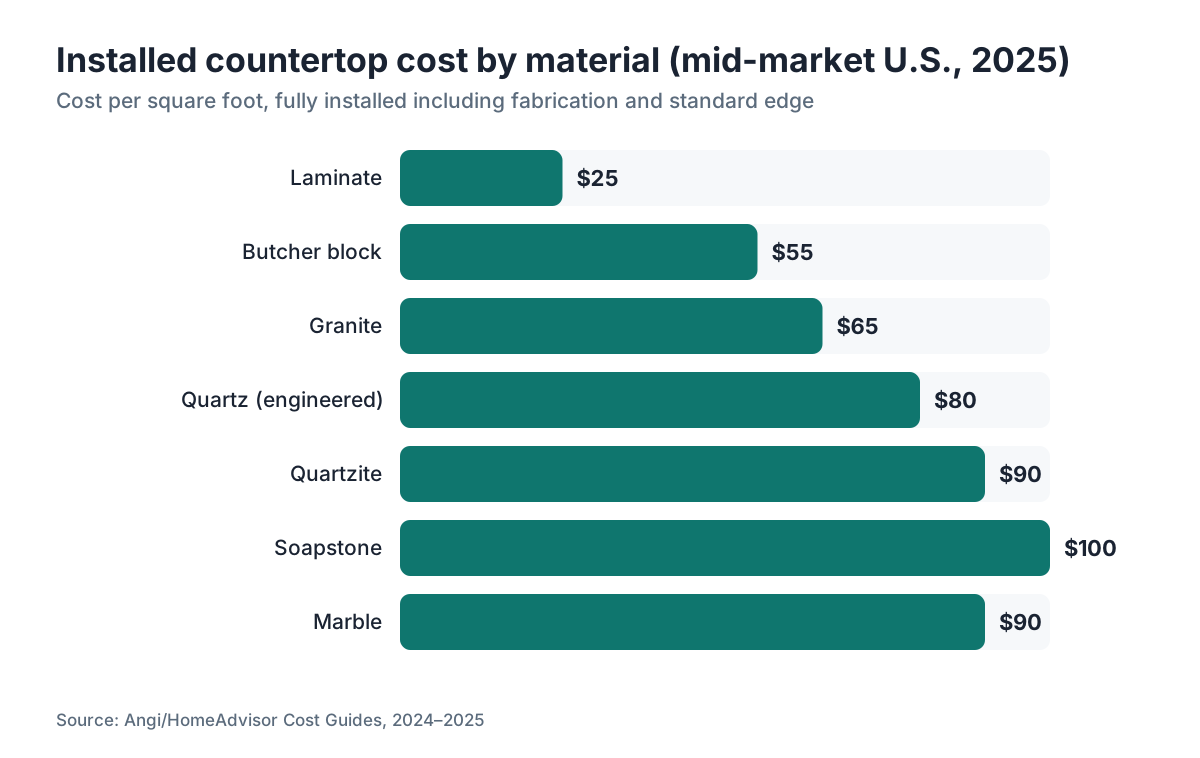
Here's a straightforward comparison of installed countertop costs by material, using mid-market U.S. figures.
| Material | Low ($/sq ft) | Mid ($/sq ft) | High ($/sq ft) |
|---|---|---|---|
| Laminate | $15 | $25 | $40 |
| Butcher block | $30 | $55 | $100 |
| Granite | $40 | $65 | $100 |
| Quartz (engineered) | $55 | $80 | $130 |
| Quartzite | $60 | $90 | $200+ |
| Marble | $50 | $90 | $200+ |
| Soapstone | $70 | $100 | $150 |
The cost of soapstone countertops installed runs $70 to $150 per square foot, which puts it in the same conversation as quartzite [3]. Soapstone is a softer stone (Mohs 1 to 2 vs. quartzite's 7+) that scratches more easily and needs periodic oiling. The trade-off is that it's non-porous and never needs sealing, which appeals to some homeowners. If you're comparing those two specifically, quartzite is harder and more stain-resistant; soapstone is lower-maintenance in a different way.
Granite countertops almost always come in cheaper than quartzite for comparable quality, because granite is quarried in enormous volumes globally and pricing is competitive. Marble countertops and quartzite overlap heavily at mid-to-high tiers; the practical difference is durability. Quartzite is significantly harder than marble and more resistant to etching from acidic foods.
Engineered quartz (Silestone, Cambria, MSI, etc.) competes directly with quartzite on price and is easier to fabricate, which gives some shops a cost advantage. But engineered quartz is not heat-resistant the same way quartzite is, and you can spot the difference between a natural and manufactured stone if you know what to look for. Cambria countertops run $80 to $130 installed and carry a lifetime warranty, which is a real advantage over natural stone for some buyers.
What's actually included in an installed price quote?
A complete installed quote should cover slab material, templating, CNC or hand fabrication, a standard edge profile, one sink cutout, and removal plus disposal of the old countertop. Some fabricators bundle all of this; others itemize. Always ask what's included before you compare quotes.
Templating, where a tech measures your existing cabinets exactly (either with a laser templating system or a physical template), typically costs $50 to $150 if billed separately. Many shops fold it into the job at no extra charge. Skip this step and you're gambling with a $5,000 slab.
Removal of existing countertops is sometimes an add-on at $100 to $300. Plumber reconnection for the sink is almost never included; budget $100 to $200 for a plumber to disconnect and reconnect the p-trap and supply lines.
Sealing is worth asking about explicitly. Quartzite, despite being denser than marble, is still a natural stone with some porosity. Most fabricators apply one coat of penetrating sealer at installation. Expect to reseal every one to three years depending on use and the specific stone [4]. That's a DIY job with a $20 to $50 product, but it's not free.
If your quote seems low, look for what's missing. A $55 per square foot quote that excludes templating, excludes disposal, and tacks on a "delivery surcharge" is often not competitive with a $75 all-in quote.
Is quartzite actually harder and more durable than marble?
Yes, by a wide margin. Quartzite is a metamorphic rock formed when sandstone undergoes heat and pressure until the quartz grains recrystallize. The result is one of the hardest natural stones used in countertops, typically 7 on the Mohs hardness scale [5]. Marble is calcium carbonate, which sits around 3 to 4 on the same scale. Etching from lemon juice, vinegar, or wine that would leave a dull mark on marble within seconds has essentially no effect on true quartzite.
The confusion in the market is real and worth flagging. Some soft marbles and dolomitic marbles are sold as quartzite by importers, either innocently (loose use of the term) or not. "Fantasy Brown," "Sea Pearl," and some slabs labeled "White Macaubas" are actually marble or dolomite, not quartzite [6]. A simple acid test, a drop of muriatic acid or even vinegar on a sample, will tell you: quartzite won't react; marble and dolomite will fizz.
For a kitchen that gets daily cooking use, quartzite's hardness is a genuine advantage over marble. It's not indestructible. Heavy impacts can chip or crack any stone. But it holds up to cutting boards, hot pans, and general abuse better than its look-alike competitors.
How do fabricators price quartzite jobs, and what should you know before getting quotes?
Most fabricators price quartzite jobs using a per-square-foot model that bakes in material cost plus fabrication plus a margin. Some shops separate material (sold at slab yard cost plus markup) from fabrication (charged as a flat rate per square foot). Either approach works; what matters is that you know the total before you sign.
Fabricators measure and bill in square feet of finished countertop surface. They don't bill you for the offcuts. But they do need to order full slabs, which typically come in "full slabs" (roughly 55 to 65 square feet) and "half slabs." If your job is 38 square feet and the layout requires two full slabs for grain matching, you'll often pay for some of that second slab's material even if you don't take the remnant home.
Ask about remnants explicitly. A small bathroom vanity or laundry room top can often be cut from a leftover piece of your kitchen slab at a steep discount, sometimes just the fabrication cost.
Shops running quoting software can turn around accurate estimates faster and with fewer errors because their material costs, edge pricing, and labor rates are already loaded. SlabWise, for example, is quoting and nesting software built specifically for stone fabricators that handles this pricing logic automatically. If a shop takes two weeks to get you a quote, that's often a capacity problem, not a complexity one, and it can affect your timeline.
Get at least three quotes. Quartzite is not a commodity material; the same slab from the same quarry can be priced very differently across shops depending on their overhead, volume, and how hungry they are for the job. A 20% spread across quotes on the same scope of work is common.
What are the best quartzite slabs for kitchens, and does the type affect cost?
The most popular quartzite varieties in U.S. kitchens right now are Super White (bright white with gray veining, often confused with marble), Taj Mahal (warm cream, subtle veining, relatively consistent appearance), White Macaubas (gray-white, dramatic veining), and Calacatta Macaubas (white with thick gold and gray veins). All of them come from Brazil and are priced in the mid-to-upper tier.
Slab variety affects cost in two ways: raw material price and fabrication difficulty. A consistent, lower-contrast stone like Taj Mahal is easier to lay out without worrying about vein alignment. A dramatic stone like Fusion or Sea Pearl requires more planning to avoid awkward vein terminations at seams, which adds labor.
Color and movement also affect seam placement strategy. Quartzite with strong linear veining, like Calacatta Macaubas, almost always benefits from a layout discussion before the shop cuts anything. This is where the choice of slab really does change the cost because it may require more material to achieve a pleasing result.
For a lower-maintenance, lower-cost kitchen project, Taj Mahal consistently earns good reviews from fabricators and homeowners alike. It's genuinely hard quartzite, not a dolomite. It has a forgiving surface for everyday use. And mid-grade material is broadly available in most stone yards.
How does the installation process work and how long does it take?
The typical quartzite countertop installation runs three to five days from template to install, though busy shops in peak season can stretch that to two to three weeks [2].
Day one: templating. A tech visits your home with a laser templating system or physical template material and measures every run of cabinetry precisely. This step is non-negotiable for stone; even a quarter-inch error means a gap at the wall or a slab that won't seat.
Days two through four (at the shop): the fabricator programs the cuts into a CNC machine, executes rough cuts, shapes the edges, polishes all finished surfaces, and cuts the sink opening. This is where most of the labor cost lives.
Installation day: a two-person crew brings the finished pieces, applies construction adhesive or silicone to the cabinet tops, sets each piece in order, and seams adjacent sections with epoxy mixed to match the stone. Seams in quartzite can be nearly invisible with good color-matching and craftsmanship. After the adhesive cures (usually a few hours), the sink is dropped in or undermounted and the plumber does their reconnection.
For a standard kitchen, installation itself takes three to six hours. Complex installs with islands, multiple sink cutouts, or cooktops in the countertop run longer.
For everything you need to know about countertop installation, the process is similar across stone types, but quartzite's hardness means the tooling has to be sharp and the CNC feeds slower than on softer materials. That adds shop time on exotic or very hard slabs.
How do you maintain quartzite and what does upkeep cost over time?
Quartzite is one of the lower-maintenance natural stones if it's sealed correctly and the sealer is refreshed on schedule. A penetrating impregnating sealer, applied every one to three years depending on use and the specific stone's porosity, is all most quartzite surfaces need [4]. A quality sealer like Tenax Proseal or Miracle 511 costs $20 to $50 for a kitchen-sized application. You apply it, let it soak, wipe the excess, and you're done.
Daily cleaning is soap and water or a pH-neutral stone cleaner. Avoid anything acidic or alkaline: no bleach, no vinegar, no citrus-based cleaners. The stone can handle them better than marble, but there's no reason to push it.
For how to clean quartzite specifically, see our guide on how to clean quartzite countertops. For general natural stone care, how to clean stone countertops covers the principles that apply across granite, quartzite, and soapstone.
Repairs are the one maintenance cost that can sting. A chip at a corner or a crack from a heavy impact requires a skilled fabricator to fill with color-matched epoxy. A minor chip repair runs $100 to $300; a crack repair, if it doesn't require a section replacement, is $200 to $500. Full section replacement in a quartzite top is expensive because matching the original slab after years have passed is often impossible.
How does quartzite compare to soapstone on cost and long-term value?
The cost of soapstone countertops installed is $70 to $150 per square foot, placing it in roughly the same range as mid-tier quartzite [3]. But the two stones have almost nothing in common beyond price.
Soapstone is soft (Mohs 1 to 2), scratches easily from everyday use, and develops a patina over time. Most owners rub it with mineral oil periodically to even out the color and accelerate the darkening process, a ritual some people love and others find tedious. The upside is that soapstone is non-porous, never needs sealing, and handles acidic foods and cleaners without any reaction.
Quartzite is hard (Mohs 7+), scratch-resistant, and needs sealing but otherwise asks little of you day to day. It stays looking new for longer without deliberate maintenance.
For a working kitchen where someone actually cooks, quartzite is the more forgiving surface. For a kitchen that wants a specific rustic or historical look, soapstone is hard to beat. Both hold resale value well; neither is a bad choice if you know what you're getting.
For more on soapstone care, see how to clean soapstone countertops.
How do you get an accurate quartzite countertop quote?
Measure your countertop runs before you call anyone. Run a tape measure along the front of each cabinet section and note the depth (usually 25 to 25.5 inches for a standard kitchen). Multiply length by depth, convert to square feet, and you have a rough number to work with. Add 10% for waste and seam placement.
Call at least three fabricators. Ask each for a quote that breaks out: material cost per square foot (and the specific slab name/grade they're pricing), fabrication cost, edge profile cost, number of cutouts included, whether templating is included, and whether demolition of existing countertops is included.
Visit the stone yard yourself before committing. Quartzite is a natural material with significant variation between slabs even from the same quarry lot. The slab you see in a 4-inch sample is not necessarily what you'll get when the yard pulls your specific pieces. See the actual slab, preferably wet (water approximates a polished finish) and standing up so you can read the veining the way it will appear on a counter.
For homeowners who want a rough number before calling anyone, the instant quote tool at SlabWise can give you a ballpark based on your dimensions and material category, which is useful for setting a budget before you walk into a fabricator's showroom.
For a broader look at all your surface options, kitchen countertops covers the full field with comparisons across materials and budgets.
Frequently asked questions
Is quartzite more expensive than granite?
Usually, yes. Granite countertops installed run $40 to $100 per square foot in most markets; quartzite starts around $60 and commonly goes to $130 or higher for premium material. The gap is largest at the top: exotic quartzite can exceed $200 per square foot installed, while granite rarely does. For comparable mid-grade material, expect quartzite to run 20 to 40 percent more than granite.
Is quartzite the same as quartz countertops?
No, they're completely different materials. Quartzite is a natural metamorphic rock formed from sandstone under heat and pressure. Quartz (engineered quartz) is a manufactured product made from roughly 90 percent ground quartz crystals bound with polymer resins. Both are hard and durable, but quartzite is natural stone with real variation slab to slab, while engineered quartz is consistent and manufactured. They overlap on price and are often compared, but they're not interchangeable.
How much does a quartzite kitchen island cost?
A standard kitchen island top in quartzite, around 40 to 60 square feet, runs $2,400 to $7,800 depending on the material grade and any special features. A waterfall island, where the stone wraps over the sides, adds significant material and labor cost, often $1,500 to $4,000 more, because mitered edges are labor-intensive and you need additional slab material. Budget for the island separately from the perimeter countertops.
What is the most affordable quartzite for countertops?
High-volume white and gray quartzites from Brazilian quarries, like White Macaubas or budget grades of Calacatta Macaubas, tend to be the most affordable, often available as raw slab in Group 1 or Group 2 pricing from stone distributors. These can yield installed prices in the $60 to $80 per square foot range at shops with efficient operations. Taj Mahal is slightly more expensive but widely regarded as the best balance of quality, beauty, and durability.
How much does quartzite cost compared to marble?
They overlap significantly in price. Marble countertops installed run $50 to $200 per square foot, similar to quartzite's $60 to $200 range. The practical difference is durability: quartzite is much harder and resists etching that would damage marble. If you're choosing between the two for a kitchen that gets real use, quartzite is the more practical choice, particularly if you cook with acidic ingredients regularly.
Does quartzite increase home resale value?
Natural stone countertops, including quartzite, generally have positive effects on kitchen resale appeal, though precise ROI data for quartzite specifically is limited. Remodeling Magazine's Cost vs. Value report shows kitchen remodels typically recoup 50 to 80 percent of their cost at resale, with higher-end finishes performing better in markets where buyers expect premium kitchens. Quartzite's durability and perceived luxury help in those markets, but it's not a guaranteed dollar-for-dollar return.
How long does quartzite last as a countertop?
Quartzite, properly sealed and maintained, can last the lifetime of the house. It's one of the hardest natural stones, highly resistant to scratching, and won't etch or stain under normal kitchen conditions if sealed. The limiting factors are physical impacts (chips, cracks) and seam quality over time. Properly fabricated and installed quartzite tops routinely last 20 to 30 years or more without needing replacement.
Is quartzite hard to install compared to other countertops?
It's one of the harder materials to fabricate. Quartzite's hardness (Mohs 7+) wears tooling faster than marble or granite and requires slower CNC feed rates. That adds shop time and cost. Installation on-site is similar to other stone slabs: a two-person crew, construction adhesive, and color-matched epoxy seams. The difficulty is in the fabrication shop, not necessarily the install day, which is why getting a skilled stone fabricator matters more for quartzite than for softer materials.
Do quartzite countertops need to be sealed?
Yes. Despite quartzite's density, most quartzite used in countertops has some porosity and should be sealed with a penetrating impregnating sealer at installation and every one to three years after that. The frequency depends on the specific stone and how heavily the surface is used. A simple water test tells you when it's time: drop water on the surface, and if it soaks in rather than beading, it's time to reseal. Sealer costs $20 to $50 for a kitchen-sized application.
What are the downsides of quartzite countertops?
Cost is the obvious one. Quartzite is also heavy (roughly 18 to 20 pounds per square foot for 3 cm material), which can require cabinet reinforcement in some cases. Market confusion is a real problem: misidentified dolomite or marble sold as quartzite is common, so buyers need to verify they're getting what they pay for. Seams in dramatic-veined quartzite are more visible than in uniform stones, and some slabs have natural fissures that concern buyers but are generally not structural defects.
Can I get quartzite for a bathroom vanity and what does it cost?
Yes, and bathroom vanities are a good application for quartzite given the smaller size and lower daily stress compared to a kitchen. A typical bathroom vanity top runs 10 to 20 square feet, which at $70 to $130 per square foot installed comes to $700 to $2,600. Fabricators often have remnant pieces from kitchen jobs that are perfect for vanity tops and priced at a significant discount, sometimes just the cost of fabrication and installation.
How do I know if I'm getting real quartzite and not marble or dolomite?
Ask the stone yard for a stone identification report or mineral assay if it's a significant purchase. As a field test, apply a few drops of diluted muriatic acid or plain white vinegar to an inconspicuous corner: real quartzite won't react; marble and dolomite will fizz or show a reaction within a minute. Also scratch test with a steel knife: quartzite at Mohs 7 will not scratch, while a softer imposter will. Both tests are simple and the acid test takes under two minutes.
Sources
- HomeAdvisor (Angi) - Quartzite Countertops Cost: Quartzite countertops typically cost $60 to $130 per square foot installed in most U.S. markets; full kitchen installs commonly run $3,000 to $7,500.
- HomeAdvisor (Angi) - Countertop Installation Cost Guide: Fabrication and installation labor for natural stone countertops runs roughly $25 to $50 per square foot nationally; typical project timelines run 3 to 5 days from template to install.
- HomeAdvisor (Angi) - Soapstone Countertops Cost: Soapstone countertops installed cost $70 to $150 per square foot, placing them in the same price range as mid-tier quartzite.
- Marble Institute of America (MIA+BSI) - Care and Maintenance of Natural Stone: Natural stone countertops including quartzite should be sealed with a penetrating impregnating sealer at installation and resealed every one to three years depending on use and porosity.
- U.S. Geological Survey - Mineral Resources Program, Quartzite: Quartzite is a metamorphic rock formed from sandstone under heat and pressure; quartz, the primary mineral, rates 7 on the Mohs hardness scale.
- Marble Institute of America (MIA+BSI) - Stone Identification and Misidentification: Some stones marketed as quartzite in the U.S. trade are actually marble or dolomite; acid testing and hardness testing can distinguish true quartzite from softer look-alikes.
- Remodeling Magazine - Cost vs. Value Report: Kitchen remodels nationally recoup 50 to 80 percent of cost at resale; higher-end finishes perform better in premium markets.
- U.S. Geological Survey - Minerals Yearbook, Stone (Crushed and Dimension): Dimension stone including quartzite is tracked for domestic production and trade; Brazil is a major source of quartzite imported to the U.S. market.
- U.S. Census Bureau - American Housing Survey: Kitchen countertop area in U.S. homes averages approximately 30 to 40 square feet, informing total installed cost estimates.
- National Stone, Sand and Gravel Association - Natural Stone Overview: Natural stone countertops including quartzite, marble, and granite are categorized by grade, origin, and hardness, which directly affects pricing at the wholesale and retail level.
- Marble Institute of America (MIA+BSI) - Dimension Stone Design Manual: Standard countertop slab thickness is 3 cm (approximately 1.25 inches); 2 cm material requires laminated edge buildup and adds labor cost.
Last updated 2026-07-09