TL;DR
- Quartz countertops run $50 to $150 per square foot installed in 2026, and most homeowners land between $70 and $100.
- Material grade, edge profiles, cutouts, and your region all move that number.
- Entry-level quartz starts around $40 per square foot for material alone.
- Premium designer slabs push past $120 before labor.
What does quartz cost per square foot in 2026?
The honest installed range is $50 to $150 per square foot. The number you'll see quoted most, $75 to $100, covers a standard kitchen with a mid-grade slab, a simple edge, and one or two cutouts. That range comes from aggregated contractor data published by Angi (formerly HomeAdvisor) and from fabrication labor patterns tracked by the Bureau of Labor Statistics. [1][8]
Material alone runs $25 to $80 per square foot at retail. Labor and fabrication, meaning cutting, polishing, edge work, and installation, adds $30 to $50 per square foot on top of that. So when a supplier hands you a material-only price, add at least 40 to 60 percent to get the installed total. People forget this constantly and blow their budgets.
The tier breakdown looks like this:
| Grade | Material only ($/sq ft) | Installed ($/sq ft) |
|---|---|---|
| Entry-level (solid colors, 1.25 cm) | $25, $40 | $50, $70 |
| Mid-grade (veined, 2 cm, name brands) | $40, $65 | $70, $100 |
| Premium (thick slab, designer series) | $65, $120 | $100, $150 |
| Ultra-premium (Silestone Eternal, Cambria) | $90, $130+ | $130, $175+ |
Those are national medians. Coastal metros and high cost-of-living markets run 15 to 30 percent above them. Rural areas can come in 10 to 20 percent below.
What factors push quartz countertop prices up or down?
Slab thickness is the fastest way to explain price jumps. The industry sells quartz in 1.25 cm (half-inch), 2 cm, and 3 cm thicknesses. Most residential installs use 3 cm today because it needs no plywood substrate and it reads as substantial. Going from 2 cm to 3 cm can add $10 to $20 per square foot to the material cost alone. [1]
Edge profiles are another variable people underestimate. A standard eased edge (just a slightly softened square) is usually included in the base quote. Upgrade to a waterfall edge, a mitered edge, or an ogee, and you can add $15 to $30 per linear foot. A kitchen with 20 linear feet of edge work gets expensive fast.
Cutouts for sinks and cooktops cost $100 to $350 each, depending on complexity. Undermount sinks require precise polished cuts that take time. A farmhouse apron sink cutout on a thick slab is a genuinely labor-intensive job.
Layout complexity matters too. A straight galley kitchen with a single run of counters is much cheaper to fabricate than an L-shape or U-shape with inside corners, because corners mean more waste and more seaming decisions.
Brand recognition moves price a lot. Engineered quartz from Caesarstone, Cambria, Silestone, and MSI all carry a premium over off-brand or private-label material sourced from overseas. The product may look similar, but the warranty terms differ substantially, and installers who see failures report they cluster in lower-priced no-name slabs. [3]
Demolition and haul-away of existing counters typically adds $50 to $200 to a project if you're not doing it yourself.
How does quartz cost per square foot compare to granite?
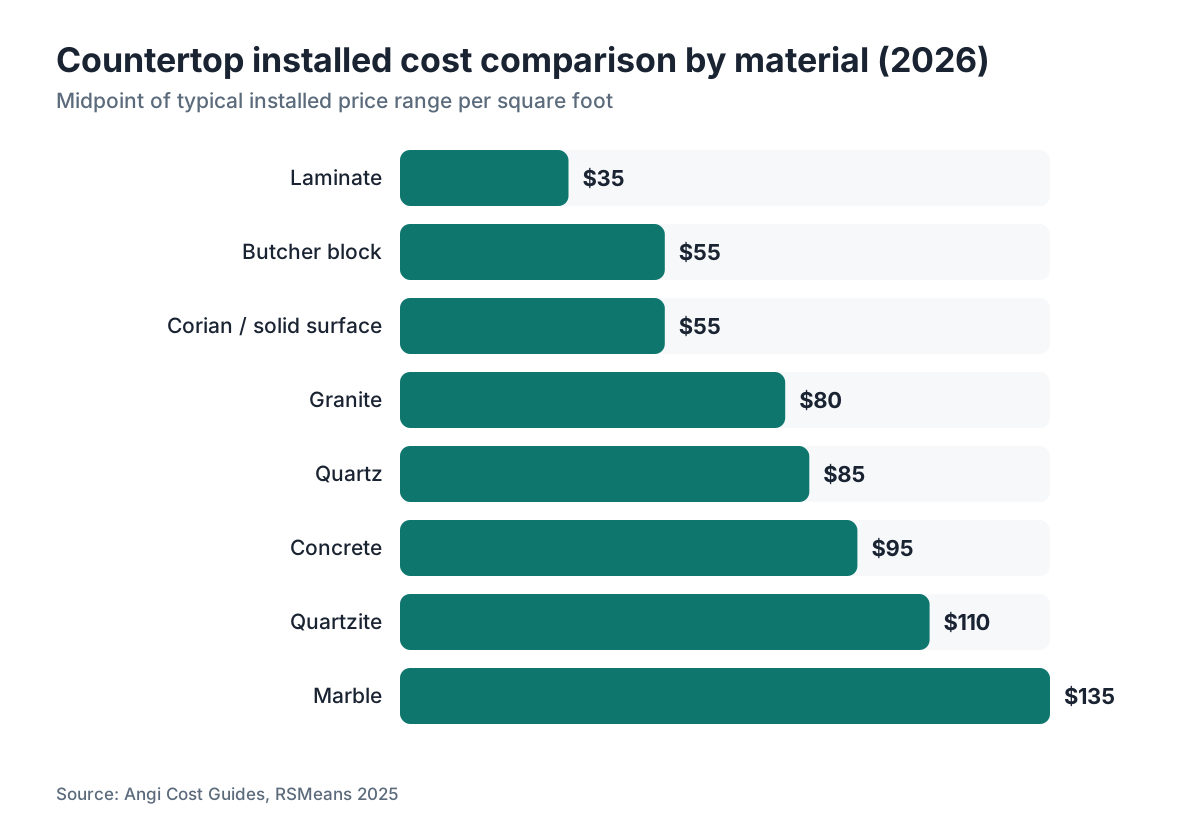
This is the most common comparison question, and the answer is closer than most people expect. Granite countertops cost $40 to $140 per square foot installed in 2026, so the ranges overlap heavily. [4]
| Material | Installed range ($/sq ft) | Typical mid-point |
|---|---|---|
| Quartz | $50, $150 | ~$85 |
| Granite | $40, $140 | ~$80 |
| Marble | $75, $250 | ~$130 |
| Quartzite | $60, $200 | ~$110 |
| Laminate | $20, $50 | ~$35 |
| Butcher block | $30, $100 | ~$55 |
Granite's low end beats quartz's because you can find remnant granite slabs at small shops for as little as $15 to $25 per square foot in common colors like Ubatuba or Santa Cecilia. Quartz remnants exist but turn up less often at small fab shops.
At the high end, rare exotic granite (think Blue Bahia or Fantasy Brown with natural veining) runs more than premium quartz. Quartz tops out around $175 installed. Some exotic granite projects hit $200 to $250.
Maintenance is where quartz genuinely wins. Granite needs sealing every one to three years, which costs $20 to $100 in materials or $100 to $200 for professional service. Quartz is non-porous and never needs sealing. Over ten years, that gap adds up.
See our full breakdown of granite countertops if you're seriously weighing both.
One thing to know: quartz is manmade, roughly 90 to 95 percent ground stone bound with polymer resins, while granite is 100 percent natural. That's not better or worse, just different. Some buyers care deeply. Most don't. [5]
How many square feet does a typical kitchen need?
This is where a lot of budgets go sideways. People hear a per-square-foot price, multiply it by the floor area of their kitchen, and land on a wildly wrong number.
Countertop square footage is measured on the countertop surface, not the floor. A standard 10x10 kitchen template (the industry benchmark) has roughly 30 to 35 square feet of counter surface. Actual kitchens vary a lot. Small galley kitchens can have 20 to 25 square feet. Large open-plan kitchens with islands can hit 60 to 80 square feet. [6]
Fabricators quote you on the square footage of slab required, which includes waste from cutouts and layout. A typical kitchen job runs 25 to 50 square feet of finished surface, but the shop may allocate 35 to 65 square feet of raw slab to cover that.
For rough budgeting:
- Small kitchen, no island (20 to 25 sq ft): $1,500 to $3,500 installed
- Average kitchen, no island (30 to 40 sq ft): $2,500 to $5,500 installed
- Large kitchen with island (55 to 75 sq ft): $5,000 to $12,000 installed
Those ranges are wide because material grade and region still swing the number hard. Get at least three local quotes. That's the only way to anchor the estimate to your actual market.
What does quartz countertop installation cost on its own?
Labor runs $30 to $50 per square foot in most U.S. markets in 2026. High-cost metros like San Francisco, New York, or Seattle push that to $50 to $70 per square foot. This covers templating, fabrication time on the CNC saw, edge polishing, and the install crew. [1][8]
Some shops quote a flat fabrication and install fee per job rather than a per-square-foot rate. A kitchen in the 35 to 45 square foot range often sees a flat labor quote of $1,200 to $2,500 from mid-sized regional shops.
Templating, the step where a tech measures your cabinets precisely, sometimes gets charged separately at $100 to $250. Many shops roll it into the quote. Digital templating (laser or LiDAR) beats older stick templates on accuracy and cuts waste, which is better for you.
Removal of old countertops, if needed, adds $5 to $15 per square foot, or $150 to $500 for a typical kitchen.
Is quartz worth the price compared to cheaper countertop options?
Compared to laminate countertops at $20 to $50 per square foot installed, quartz costs two to four times as much. Laminate has gotten better, with options that convincingly mimic stone, but it chips at edges, swells near water, and won't take a hot pan the way stone does.
Compared to Corian countertops and other solid-surface options at $35 to $75 per square foot, quartz is harder and more scratch-resistant, though solid surface can be repaired in place, which quartz can't.
Compared to concrete countertops at $65 to $135 per square foot, quartz is more consistent and less prone to cracking or staining, but concrete has a custom handmade quality some buyers love.
For most kitchens, quartz hits a reasonable middle: durable, low-maintenance, wide style selection, no sealing. If budget is the main constraint, laminate or butcher block countertops are the realistic alternatives. If look and longevity both matter, quartz and granite are the two honest competitors.
Here's my take. Quartz makes the most sense for busy kitchens where the owner doesn't want to think about maintenance. It's not the most beautiful material at its price point (nice marble or quartzite beats it aesthetically for many people), but it's the most forgiving day to day.
How do you get an accurate quartz countertop quote?
The most useful thing you can do before calling fabricators is sketch your countertop layout and measure the linear footage of base cabinets. Multiply linear feet by your cabinet depth (usually 25.5 inches for standard, plus about 1.5 inches for the overhang, giving roughly 2.1 feet of depth) to get approximate square footage.
Get at least three quotes. Quote variation in this trade is big. The same Caesarstone slab installed in the same kitchen can come in at $3,200 from one shop and $5,100 from another, and both quotes can be legitimate depending on overhead, crew efficiency, and margins.
Ask each shop:
- Is this price for the slab grade I specified, or a comparable substitute?
- Is the edge profile included, and which ones cost extra?
- Does this include sink cutout, and is it polished or rough?
- Is demolition of existing counters included?
- What's the warranty on fabrication and on the material?
For fabricators reading this, accurate quoting is where a lot of margin leaks. Shops using modern quoting software like SlabWise price jobs faster and with better slab yield estimates, which matters when you're quoting three dozen jobs a week.
If you're a homeowner wanting an instant ballpark before calling shops, the kitchen countertops hub on SlabWise has a quick estimate tool.
What are the most popular quartz brands and how do their prices compare?
The major brands in the U.S. market and their approximate material-only price ranges per square foot in 2026:
| Brand | Origin | Price range (material only) |
|---|---|---|
| Cambria | Minnesota, USA | $65, $120 |
| Caesarstone | Israel (made in Israel + USA) | $50, $100 |
| Silestone (Cosentino) | Spain | $50, $110 |
| MSI Q Premium | Multiple | $35, $75 |
| Vicostone | Vietnam | $30, $65 |
| Pental | Multiple | $30, $70 |
| Private label / builder grade | Multiple | $25, $45 |
Cambria is the only major brand that manufactures entirely in the U.S. (in Le Sueur, Minnesota), and it charges for that. Its warranty is lifetime and transferable, which has real value if you sell the house. [7]
Caesarstone and Silestone both carry strong warranties (lifetime limited) and have long track records in commercial and residential work. MSI and Vicostone offer comparable visual quality at lower prices and have grown their U.S. distribution fast.
Builder-grade or unbranded quartz from distributors like Floor & Decor runs cheapest, but often lacks any meaningful warranty and comes in thinner slabs with more color variation.
How do quartz countertop prices vary by region in the U.S.?
Regional price variation is real and big. The Bureau of Labor Statistics tracks construction labor wages by metro area, and fabrication labor follows similar patterns. [8]
Roughly speaking, U.S. regions break down like this for installed quartz cost per square foot:
| Region | Installed range ($/sq ft) |
|---|---|
| Northeast (NYC, Boston, DC) | $85, $175 |
| Pacific Coast (LA, SF, Seattle) | $80, $160 |
| South Atlantic (Miami, Atlanta) | $65, $130 |
| Midwest (Chicago, Minneapolis) | $60, $120 |
| Mountain West (Denver, Phoenix) | $65, $125 |
| South Central (Dallas, Houston) | $60, $115 |
| Rural markets (any region) | $50, $100 |
These are rough buckets, not precise data. The actual spread within any region depends heavily on shop overhead, competition density, and whether you're buying through a showroom, a big box store, or a direct fabricator.
Big box stores (Home Depot, Lowe's) hold pricing more consistent across regions but typically run 10 to 25 percent higher than a local independent fabricator for comparable material, and their installation subcontractor networks vary wildly in quality. [9]
Can you save money on quartz countertops without sacrificing quality?
Yes, and here's where the real savings live:
Remnant slabs. Fabricators always have leftover pieces from larger jobs. For kitchens under 30 square feet or for bathroom vanities, remnants can cut material cost 30 to 60 percent. Call local shops directly and ask what remnants they have on the rack.
Simpler layout. Avoiding islands, inside corners, and special cutout shapes reduces fabrication time and waste. Design the kitchen with a straight run and the quote drops.
Eased or beveled edge only. A fancy edge profile doesn't make the countertop more durable. It just costs more. A clean eased edge looks fine for 95 percent of kitchens.
Skip the big-box premium. Direct fabricators almost always beat big-box pricing on equal material. The tradeoff is thinner showroom experience and less sales hand-holding at a small shop.
Time your purchase. Some fabricators slow down in January and February, after the holiday rush and before the spring remodel season. They may negotiate on labor during that window.
DIY demo. Pulling out old laminate or tile counters yourself saves $150 to $500 and isn't hard for most homeowners. Stone on stone is trickier and may not be worth the risk.
Does quartz add value to a home?
Remodeling Magazine's annual Cost vs. Value report tracks this, and the honest finding is that minor kitchen remodels (which include countertop upgrades) return roughly 85 to 96 percent of cost at resale in many markets, which puts them among the better remodeling investments. A full major kitchen remodel returns far less, often 40 to 60 cents on the dollar. [10]
Quartz specifically reads as a selling point to buyers in the $300,000-and-up home price range in most U.S. markets, per NAR buyer preference surveys. Below that price point, buyers value it but may not pay a premium for it.
The practical truth: quartz is now expected in mid-range and above kitchens. Not having it can hurt a sale. Having it won't necessarily lift the price beyond what you paid. It's table stakes, not a luxury add.
For a deeper look at quartz countertops beyond pricing, including maintenance and material specs, that article covers the full picture.
How do you verify a quartz countertop quote is fair?
A fair quote should break out at least these line items: material cost per square foot, fabrication and edge work, number of cutouts and their cost, installation labor, and any applicable taxes. If a shop hands you a single number with no detail, ask for the breakdown.
National cost data from RSMeans (the construction cost database contractors and estimators rely on) shows installed stone countertop costs in the $75 to $110 per square foot range for a typical mid-grade residential job in 2025, which matches what most homeowners report. [11]
If a quote is 40 percent below the others you've received, ask why. Sometimes it's efficiency or lower overhead. Sometimes it's a thinner slab, a worse edge finish, or a shop that cuts corners on templating. Ask to see photos of completed kitchens.
If a quote is 40 percent above the others, it's usually a showroom with high overhead or a boutique installer marketing to a premium buyer. That's fine if you value the experience, but you're buying a service tier, not a better countertop.
Fabricators who want to sharpen their own quoting accuracy, especially on slab yield and waste, can request a demo from SlabWise to see how the math changes.
Frequently asked questions
How much does quartz countertop installation cost per square foot in 2026?
Labor and fabrication (cutting, polishing, edge work, install) runs $30 to $50 per square foot in most U.S. markets, and $50 to $70 in high-cost cities. Some shops quote a flat fee per project rather than per square foot. A typical kitchen install without demolition costs $1,200 to $2,500 in labor alone.
Is quartz more expensive than granite per square foot?
At mid-range, they're nearly identical. Granite runs $40 to $140 installed and quartz runs $50 to $150. Granite's floor is slightly lower because remnant slabs and common colors are cheaper. Quartz's ceiling is capped because it's engineered, while rare exotic granite can exceed $200 per square foot installed.
What is the cheapest quartz countertop option?
Builder-grade or private-label quartz in solid colors or simple patterns starts around $25 to $35 per square foot for material, or $50 to $65 installed. Remnant slabs from local fabricators can drop material cost 30 to 60 percent below retail. MSI, Vicostone, and Pental offer legitimate brand-name quartz at the lower end of the price spectrum.
How many square feet are in a typical kitchen countertop?
A standard 10x10 kitchen layout (the industry benchmark) has roughly 30 to 35 square feet of countertop surface. Actual kitchens range from 20 square feet for a small galley to 75 or more for large open-plan kitchens with islands. Measure linear feet of base cabinets and multiply by about 2.1 feet of depth to estimate.
Does quartz countertop thickness affect the price?
Yes, significantly. Standard residential installs use 3 cm (1.2-inch) slabs. Going to 2 cm can save $10 to $20 per square foot on material but usually requires a plywood substrate and looks less substantial. The thinnest option, 1.25 cm, is cheapest but rarely used in kitchens. Most fabricators default to 3 cm for good reason.
How much does a quartz kitchen island cost?
An island of 15 to 25 square feet in mid-grade quartz runs $2,000 to $4,500 installed, depending on edge profiles and whether there's an overhang for seating. Waterfall edges on an island, where the slab wraps vertically down the side, add $500 to $1,500 or more depending on the number of faces.
How much does quartz countertop cost for a bathroom vanity?
A single bathroom vanity counter of 5 to 10 square feet runs $400 to $1,200 installed. Shops often have minimum job charges of $300 to $600, which drives up the per-square-foot cost on small jobs. Remnant slabs are ideal for vanities and can bring material cost down considerably.
What does a quartz countertop quote include?
A complete quote should cover material per square foot, edge profile (noting which are included and which cost extra), number of sink and cooktop cutouts, installation labor, and taxes. It may or may not include templating and demo of old counters. Always ask for a line-item breakdown before signing anything.
How long do quartz countertops last?
Quartz is one of the most durable countertop materials. With normal use, a quality installation lasts 20 to 30 years or more. The material itself won't degrade, though prolonged UV exposure near windows can cause slight yellowing over years in some older formulations. Major brands like Cambria and Caesarstone back their product with a lifetime limited warranty.
Does quartz need to be sealed?
No. Quartz is non-porous by design, engineered with polymer resins that fill any gaps in the stone particles. It doesn't absorb liquids and doesn't need sealing, which is a real ongoing cost and maintenance difference versus granite and natural stone. Any product sold as a quartz sealer is unnecessary and won't harm anything but your wallet.
Can quartz countertop cost vary by color or pattern?
Yes. Solid white or gray quartz is the cheapest because it's the easiest to manufacture consistently. Complex veined patterns that mimic Calacatta or Carrara marble cost more because the manufacturing process is harder to control. Some designer series slabs add $20 to $40 per square foot over entry-level material purely for the visual pattern.
How accurate are online quartz countertop cost calculators?
Most online calculators give a rough ballpark within 20 to 30 percent of real quotes. They're useful for setting a budget range before calling shops. They can't account for your specific edge profile choices, demolition needs, cutout complexity, or regional labor rates, which are all significant. Use them as a floor estimate, not a final budget.
Is it cheaper to buy quartz at a big-box store or a local fabricator?
Local fabricators are almost always cheaper for equal material, typically 10 to 25 percent less than Home Depot or Lowe's installed pricing. Big-box stores add a layer of overhead and subcontract the installation. The tradeoff is that big-box stores offer a consistent purchasing experience and easier recourse if something goes wrong.
What is the cost of quartz countertops in a whole-house renovation?
A full house with kitchen and three bathrooms might have 80 to 120 square feet of countertop. At $75 to $100 per square foot installed, that's $6,000 to $12,000. Buying all surfaces at once from one shop often opens room for negotiation, since the shop lands a larger job. Minimum charges per room still apply, but the room to bargain is there.
Sources
- Angi (HomeAdvisor), Countertop Installation Cost Guide: Installed quartz countertop costs range from $50 to $150 per square foot nationally, with labor comprising $30 to $50 per square foot of that total.
- National Tile Contractors Association (NTCA), Industry Resources: Fabrication and installation cost benchmarks for hard surface countertop trades, used to contextualize labor range estimates.
- Marble Institute of America (MIA+BSI), Engineered Stone Technical Manual: Engineered quartz product quality and warranty standards; failure clustering in lower-grade unbranded material.
- Angi (HomeAdvisor), Granite Countertop Installation Cost Guide: Granite countertops installed cost $40 to $140 per square foot nationally in 2025-2026.
- U.S. Geological Survey, Mineral Commodity Summaries: Industrial Minerals: Engineered quartz countertop material is 90 to 95 percent ground quartz bound with polymer resin, distinguishing it from natural granite.
- National Kitchen and Bath Association (NKBA), Kitchen Design Guidelines: The 10x10 kitchen benchmark represents roughly 30 to 35 square feet of countertop surface; standard kitchen counter depth is approximately 25.5 inches.
- Cambria, Warranty Documentation: Cambria manufactures exclusively in Le Sueur, Minnesota, and provides a lifetime transferable warranty on their quartz products.
- U.S. Bureau of Labor Statistics, Occupational Employment and Wage Statistics: Construction and stone worker labor costs vary significantly by metro area, informing regional countertop installation price variation.
- Consumer Reports, Kitchen Countertop Buying Guide: Big-box store countertop pricing typically runs 10 to 25 percent higher than local independent fabricators for comparable material.
- U.S. Census Bureau, American Housing Survey and Construction Spending: Minor kitchen remodels including countertop upgrades rank among higher-return home improvements; major remodels recover a smaller share of cost at resale.
- Gordian RSMeans, Building Construction Cost Data: RSMeans data shows installed stone countertop costs in the $75 to $110 per square foot range for mid-grade residential work in 2025.
Last updated 2026-07-09