TL;DR
- A professional fabricator or plumber charges $50 to $150 per hole for a standard faucet cutout in quartz, and up to $250 for large or custom holes.
- DIY diamond bit kits cost $30 to $80 but risk cracking a slab worth thousands.
- Hole size, location, slab thickness, and whether the countertop is already installed all drive the final number.
What does it actually cost to drill a hole in quartz?
Most homeowners pay $50 to $150 per hole when a professional does it. That range covers a standard 1-3/8-inch faucet hole in a typical 3/4-inch or 1-1/4-inch quartz slab. Larger openings, like a 1-3/4-inch soap dispenser hole or a 3-1/2-inch air gap cutout, push toward the top of the range or a bit past it.
A few things move the price hard. If the countertop is already installed and the pro has to work in place under a cabinet, expect a labor premium. Drilling on a workbench is clean and fast. Drilling upside-down in a cramped base cabinet while keeping the bit cool is a different job entirely.
Get a new countertop and add holes at the templating stage, and the math changes in your favor. Many fabricators include one or two standard faucet holes in the base price, or charge a flat add-on of $25 to $60 each. That's the cheapest way to get holes in quartz. Adding them after installation is where costs climb.
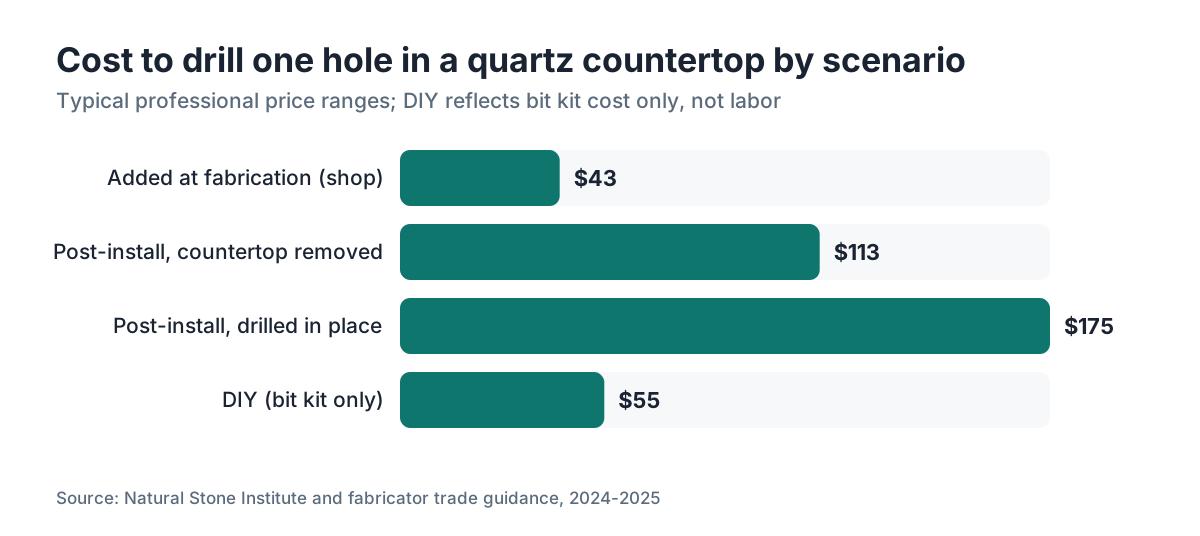
The table below shows what to expect across the most common scenarios.
| Scenario | Typical cost per hole |
|---|---|
| Added at template/fabrication (shop setting) | $25 to $60 |
| Post-installation by a fabricator (countertop removed) | $75 to $150 |
| Post-installation in place (plumber or fabricator on-site) | $100 to $250 |
| DIY with a diamond core bit kit | $30 to $80 (bit cost only) |
These ranges come from fabricator pricing discussions and installer guides. No single industry survey tracks hole-drilling fees specifically, so treat the numbers as a solid benchmark, not a guarantee.
What factors change the price the most?
Hole diameter is the biggest lever. A 1-3/8-inch faucet hole takes a small diamond core bit and maybe 10 to 15 minutes in a shop. A 3-1/2-inch hole for a farmhouse-style faucet body takes a bigger bit, more passes, and more cooling time. Larger bits cost more and wear faster, and that cost flows downstream to you.
Slab thickness matters too. Standard quartz runs 3/4 inch (20 mm) or 1-1/4 inches (30 mm). The thicker the slab, the longer the bit stays engaged, the more heat builds, and the higher the risk of micro-fractures. Fabricators working with 1-1/4-inch material may charge 10 to 20% more per hole than for 3/4-inch, simply because the job takes longer and bit wear is higher.
Location is huge. Holes near an edge are riskier than holes in the field of the slab. The trade rule is to keep any hole at least 1.5 to 2 inches from a slab edge, seam, or cutout, because quartz is engineered stone: roughly 90 to 95% ground quartz particles bound in polymer resin, and that resin does not redistribute stress the way solid granite does [1]. A hole too close to an edge concentrates stress and can crack the slab [8].
Whether the countertop is installed also changes who can do the work. A fabricator at the saw table has water cooling, a stable surface, and proper bit speeds. A plumber drilling in place is improvising with a handheld drill and a spray bottle. Both can produce clean holes. The in-place job just takes more time and skill, and time is money.
Your geographic market moves the baseline too. Labor rates for skilled construction trades run 40 to 60% higher in metros like San Francisco or New York than in smaller markets [2]. A $75 hole in Omaha might run $120 to $130 in Boston.
Who should drill the hole: fabricator, plumber, or DIY?
Your fabricator, during fabrication, is almost always the right choice. They have the right bits, the right speeds (typically 300 to 600 RPM for quartz with a diamond core bit), and they drill on a stable surface with continuous water cooling [6]. Ordering a new countertop? Call out every hole you need before the template appointment. Forgot one? Call before they cut.
A licensed plumber can drill quartz on-site after installation, and many do it routinely when adding a filtered-water dispenser or soap pump. A good plumber carries a diamond hole saw kit and knows to keep the bit wet. Ask before you book, though. Some plumbers are comfortable with stone. Others will tell you straight up to call a stone guy.
DIY is possible, but the risk-reward math is ugly. A diamond core bit kit for quartz runs $30 to $80 at most hardware stores or online [3]. If you've done it before and you keep the bit cool with a constant water drip or a clay dam filled with water, you can produce a clean hole. The problem is that one mistake, a dry pass, too much downward pressure, or a bit that wanders, can crack a $600 to $2,000+ quartz slab. Fabricators see cracked DIY holes all the time. Saving $100 on a professional hole is not worth gambling a whole slab.
If you do go DIY, use a variable-speed drill set to 300 to 500 RPM, keep the bit wet the entire time, apply light steady pressure, and stop often to clear slurry. Never use a hammer drill setting on quartz. And never drill dry: dry cutting quartz throws off crystalline silica dust, a serious respiratory hazard that OSHA regulates under its respirable crystalline silica standard [10].
Can you drill quartz without cracking it?
Yes, with the right bit and technique. Quartz countertop material (brands like Silestone, Caesarstone, and Cambria) is engineered stone, not solid natural rock, and it takes diamond core drilling well as long as heat stays controlled [4]. The polymer resin binder is more sensitive to heat than the quartz particles themselves. When a bit runs dry, the resin can micro-fracture before you see or hear anything wrong, and the crack propagates later under thermal stress.
The two failure modes pros work to avoid are running a dry bit (heat cracking) and drilling too close to a sink cutout or edge (stress cracking). Both are preventable.
Cambria, one of the major American quartz brands and the only one that quarries its own natural quartz in the U.S., publishes care and fabrication guidance that calls for professional installation and specifically warns against DIY cutting or drilling [4]. Most other engineered-stone makers say the same.
Quartz can be drilled cleanly. The material isn't fragile. But the margin for error is small enough that it's worth paying a professional unless you have real experience with stone.
How much does a diamond drill bit for quartz cost?
A single diamond-tipped hole saw sized for a standard faucet hole (1-3/8 inch) costs roughly $15 to $35 from hardware retailers or Amazon. A kit with three or four sizes runs $30 to $80 [3]. Professional-grade bits with more diamonds and better heat management run $40 to $80 each.
Bit lifespan varies widely. A cheap bit might drill five or six holes cleanly before the diamonds wear out. A good professional bit might handle 50 to 100 holes. Fabricators build bit amortization into their per-hole price, which is part of why professional drilling at $75 to $150 isn't as padded as it sounds.
Drilling one hole ever? A mid-range kit at $40 to $60 makes sense if you're committed to DIY. Drilling regularly as a plumber or remodeler? A quality bit set pays for itself fast.
One thing to avoid: spade bits, twist bits, and carbide-tipped bits marketed for tile. None of them belong in engineered quartz. You need a wet-cutting diamond core bit. Full stop.
How long does drilling a hole in quartz take?
In a shop, a standard faucet hole takes 10 to 20 minutes including setup, drilling, and cleanup. A pro cutting multiple holes on a single slab at the facility can move fast.
On-site, in an installed countertop, add 20 to 30 minutes for setup: protecting the cabinet below, building a water dam, positioning the drill. Total job time for a single hole runs 45 to 60 minutes for a careful professional.
DIY takes longer on a first attempt, often 60 to 90 minutes once you factor in the learning curve and extra caution. Rushing is the main cause of cracked slabs in DIY drilling, so build in the time.
For a new countertop with holes added at fabrication, there's basically no turnaround delay. The holes are part of the CNC program or the templated cutout. Adding holes to an already-cut slab back at the shop adds a day or two to the schedule if the shop is busy.
What is the standard faucet hole size for quartz countertops?
The industry standard for a single-handle or widespread faucet supply line hole is 1-3/8 inches (35 mm) in diameter. Most faucets are built around this size. Some euro-style faucets use a 1-1/4-inch hole, and some large-body faucets need up to 1-3/4 inches.
Check your faucet's installation instructions before anyone drills. The spec sheet lists the required hole diameter and the minimum deck thickness the faucet accepts. Moen, Delta, Kohler, and the other big brands post installation PDFs on their websites with exact specs.
For accessories beyond the main faucet:
| Accessory | Typical hole diameter |
|---|---|
| Standard faucet | 1-3/8 in (35 mm) |
| Soap/lotion dispenser | 1-3/8 in (35 mm) |
| Hot water dispenser | 1-3/8 in (35 mm) |
| Air gap for dishwasher | 1-3/8 to 1-1/2 in |
| Water filter tap | 1-1/4 to 1-3/8 in |
| Side spray | 1-3/8 in (35 mm) |
Adding a second or third hole to an existing countertop? Measure the spacing your faucet requires. Most widespread faucets need holes on 8-inch centers. Bridge faucets vary. Getting spacing wrong means re-drilling or patching, and neither is cheap or invisible on quartz.
Can a cracked hole in quartz be repaired?
Sometimes, but not always invisibly. A small hairline crack radiating from a hole can be filled with color-matched epoxy or cyanoacrylate adhesive, and a skilled fabricator can blend it reasonably well. The repair is structural as much as cosmetic, and it can hold for years.
Larger cracks, or cracks that run toward an edge, are a different story. They compromise the countertop's structural integrity, and a repair may not be worth it if the slab has to be cut back and a seam introduced, or if the hole sits near a sink cutout where the remaining material is thin.
Repair cost tracks severity. A simple crack fill and polish runs $100 to $300 from a stone restoration specialist. A crack that requires cutting and re-seaming can cost $400 to $800 or more, and the seam will always show to some degree.
This is the core reason most fabricators say to let a professional drill the holes. The downside of a cracked quartz slab is more than the repair bill. It's time without a working kitchen, coordinating multiple trades, and sometimes living with a visible seam for the life of the countertop.
Does drilling a hole void the quartz warranty?
It can. Major quartz manufacturers, including Caesarstone, Silestone, and Cambria, require professional installation and fabrication as a condition of their limited lifetime or 10-year warranties [5]. If a homeowner drills a hole and a crack develops from or near it, the manufacturer can and often will deny the claim.
The warranty language is what decides it. Caesarstone's residential limited warranty covers defects in material and workmanship but excludes damage resulting from improper installation or modification [5]. A DIY-drilled hole that cracks would almost certainly land inside that exclusion.
Professional drilling by a certified installer or licensed plumber usually doesn't void coverage, but confirm it with your specific brand and installer. Keep records. A dated invoice from a professional showing the work performed is useful documentation if you ever need to file a claim.
For fabricators running quoting and production software like SlabWise, noting hole locations and the drilling party in the job record creates that documentation automatically and protects everyone downstream.
How does drilling quartz compare to drilling granite or other countertop materials?
Quartz (engineered stone) and granite are the two most commonly drilled countertop materials, and the process is similar for both: diamond core bit, low RPM, continuous water cooling. Granite is 100% natural stone and tends to forgive minor technique variations a little more, because there's no resin to overheat. Quartz is more uniform but more heat-sensitive.
Laminate countertops like Formica and Corian are far easier and cheaper to drill. A standard spade bit handles laminate. Corian (solid surface) takes a standard hole saw at higher RPM with no water needed. Drilling laminate usually costs $0 extra since any plumber or carpenter can do it. Corian hole-drilling runs $20 to $50 if a professional handles it.
Marble countertops behave more like granite: natural stone, diamond bit required, water cooling recommended, pricing comparable to quartz. Butcher block countertops are wood and take a standard hole saw or spade bit, no diamond needed, $0 to maybe $30 for a plumber's time.
The table below sums it up:
| Material | Bit type needed | Water cooling | Pro cost per hole | DIY difficulty |
|---|---|---|---|---|
| Quartz (engineered) | Diamond core | Yes, required | $75 to $250 | High risk |
| Granite | Diamond core | Yes, recommended | $75 to $200 | High risk |
| Marble | Diamond core | Yes, recommended | $75 to $200 | High risk |
| Corian/solid surface | Standard hole saw | No | $20 to $50 | Low risk |
| Laminate (Formica) | Standard spade/hole saw | No | $0 to $30 | Very low risk |
| Butcher block | Standard spade/hole saw | No | $0 to $30 | Very low risk |
Still deciding on material for a new kitchen countertop project? Factor in that harder stone materials cost more to modify later. Quartz is among the most widely installed countertop materials in new U.S. homes, which is why post-installation drilling is such a common service request [9].
How do you get an accurate quote for drilling a hole in quartz?
Call your original fabricator first. They know the slab, have the tools, and carry liability if something goes wrong. If they're booked or the cost is too high, get quotes from two or three fabricators or stone shops nearby. Most will quote a single hole over the phone once you describe hole diameter, slab thickness, whether the countertop is installed, and how accessible it is.
Plumbers are a legitimate option for post-installation holes. Call two and ask specifically whether they drill stone. Many do. Some will send you to a stone shop instead. Either answer is useful.
Be specific when you call. Say: "I have a 1-1/4-inch Silestone quartz countertop, already installed, and I need a 1-3/8-inch faucet hole added. It's accessible from above. What do you charge?" Vague questions get vague quotes.
For fabricators juggling multiple quoting scenarios, production software like SlabWise lets shops build drilling fees as line items in a quote template, so customers see the cost upfront instead of getting surprised on the invoice. Consistent pricing on small add-ons like hole drilling cuts disputes and speeds up approvals.
One more thing. If a quote seems very low, ask what bit they use and whether they keep it wet. A shop that drills dry to save time is the shop that cracks your countertop.
Frequently asked questions
How much does it cost to add a faucet hole to a quartz countertop after installation?
Post-installation drilling by a professional typically runs $100 to $250 per hole, depending on accessibility and your local labor market. In-place drilling in a cramped cabinet costs more than shop work because setup takes longer and the risk of bit wander is higher. Call your original fabricator first since they know the slab and carry the right equipment.
Can I drill a hole in quartz myself?
Technically yes. You need a diamond core bit (1-3/8 inch for most faucets), a variable-speed drill set to 300 to 500 RPM, and continuous water cooling throughout the cut. The risk is real: a dry bit or too much pressure can crack a slab worth hundreds or thousands of dollars. Most fabricators see cracked DIY holes regularly. Unless you have prior experience drilling stone, hire a professional.
What size hole do I need for a faucet in a quartz countertop?
The industry standard for most single-handle and widespread faucets is 1-3/8 inches (35 mm). Some euro or vessel-filler faucets use 1-1/4 inch, and some large-body faucets need 1-3/4 inch. Always check the installation sheet that comes with your faucet before any drilling. Getting the size wrong means re-drilling, which doubles the risk of cracking.
Will drilling a hole void my quartz warranty?
DIY drilling often voids the warranty. Major brands, including Caesarstone and Cambria, require professional installation as a warranty condition and exclude damage from improper modification. Professional drilling by a licensed installer or fabricator typically does not void coverage, but confirm with your specific brand. Keep the invoice as documentation in case you ever file a claim.
How many holes can you drill in a quartz countertop?
As many as the design requires, within spacing limits. Each hole should sit at least 1.5 to 2 inches from any edge, seam, or other cutout to avoid stress fractures. Common configurations include one to four holes for faucet, soap dispenser, hot water tap, and air gap. More holes mean more cost, so plan them all before fabrication rather than adding them piecemeal.
How long does it take to drill a hole in a quartz countertop?
In a fabrication shop: 10 to 20 minutes per hole including setup. On-site, in an installed countertop: 45 to 60 minutes for a careful professional once you include setup, drilling, and cleanup. DIY takes 60 to 90 minutes on a first attempt if you're being careful. Rushing is the leading cause of cracked slabs during DIY drilling, so don't race through it.
Can a cracked quartz hole be fixed?
Small hairline cracks can be filled with color-matched epoxy by a stone restoration specialist, usually for $100 to $300, and the repair can hold structurally for years. Larger cracks that run toward an edge or a sink cutout may require cutting the slab and adding a seam, which costs $400 to $800 or more and always shows to some degree. Prevention is far cheaper than repair.
Do plumbers drill holes in quartz countertops?
Many do. Ask specifically when you call: some plumbers drill stone routinely and carry diamond core bit kits, while others prefer to refer stone work to a fabricator. Either answer is honest and useful. A plumber who drills stone should know to keep the bit wet and use low RPM. If they're not sure what bit type they use on quartz, hire a fabricator instead.
How much does a diamond drill bit for quartz cost?
A single diamond core hole saw for a standard 1-3/8-inch faucet hole runs $15 to $35. A kit with multiple sizes costs $30 to $80. Professional-grade bits run $40 to $80 each but last much longer, often 50 to 100 holes versus 5 to 10 for a budget bit. For a one-time DIY job, a mid-range $40 to $60 kit is adequate. Never use spade bits, twist bits, or tile carbide bits on quartz.
Is quartz harder to drill than granite?
In practice, they're similar. Both require diamond core bits and water cooling at 300 to 600 RPM. Granite is natural stone and slightly more forgiving of minor technique variations. Quartz uses polymer resin as a binder and is more heat-sensitive: a dry bit on quartz can cause micro-fractures that stay invisible until the crack propagates later. Treat both materials with equal caution and never drill dry.
Can you add holes to quartz after the countertop is already installed?
Yes. It's done regularly when homeowners add a soap dispenser, filtered-water tap, or upgrade a faucet. A fabricator or experienced plumber drills in place using a diamond core bit with a water-cooling dam. The job costs $100 to $250 per hole post-installation versus $25 to $60 during fabrication, so plan ahead if you can. Done correctly, the result is clean and indistinguishable from a factory hole.
How close to the edge can you drill a hole in quartz?
The trade standard is a minimum of 1.5 to 2 inches from any slab edge, seam, or sink cutout. Quartz distributes stress differently than solid stone because of its resin matrix, and holes too close to an edge concentrate stress that can crack the slab during installation, thermal cycling, or even minor impact. Your fabricator will flag a placement that violates this clearance before drilling.
Does the number of holes affect countertop installation cost?
Yes, modestly. Most fabricators include one or two standard faucet holes in a base quote and charge $25 to $60 for each additional hole cut during fabrication. Holes add machining time and bit wear. If you're getting a full countertop installation, the cost per hole at fabrication is much lower than adding them afterward, so finalize your fixture plan before the template appointment.
Sources
- Natural Stone Institute (formerly Marble Institute of America), Quartz Surface Products Technical Guide: Engineered quartz is composed of approximately 90-95% ground quartz particles bound in polymer resin, affecting how stress concentrates near holes and edges.
- U.S. Bureau of Labor Statistics, Occupational Employment and Wage Statistics: Labor rates for skilled construction trades vary significantly by metro area, with high-cost metros like San Francisco and New York showing 40-60% higher wages than smaller markets.
- U.S. Consumer Product Safety Commission, Power Tool Safety: Diamond core bit kits for stone drilling are widely available at hardware retailers for $30 to $80; safe use requires correct RPM and continuous cooling.
- Cambria, Care and Maintenance Guide: Cambria advises professional installation and fabrication and warns against DIY cutting or drilling of its engineered quartz surfaces.
- Caesarstone, Residential Limited Warranty: Caesarstone's residential limited warranty covers defects in material and workmanship but excludes damage resulting from improper installation or modification, including unauthorized cutting or drilling.
- Silestone by Cosentino, Technical and Installation Guide: Silestone recommends diamond core bits with water cooling at 300 to 600 RPM for any hole-cutting in their engineered quartz products.
- U.S. Bureau of Labor Statistics, Consumer Price Index for Building Materials: Material and labor cost benchmarks used to contextualize regional price variation in countertop-related trades.
- Natural Stone Institute, Fabrication Standards and Guidelines: Industry fabrication standards recommend a minimum clearance of 1.5 to 2 inches from any hole to a slab edge, seam, or adjacent cutout to prevent stress fractures in stone and engineered stone countertops.
- Home Innovation Research Labs, Annual Builder Practices Survey: Quartz (engineered stone) is among the most widely installed countertop materials in new U.S. homes, making post-installation modification a common service need.
- Occupational Safety and Health Administration (OSHA), Respirable Crystalline Silica standard (29 CFR 1926.1153): Dry cutting or drilling of quartz and stone generates crystalline silica dust, a serious respiratory hazard; wet methods are required under OSHA's respirable crystalline silica standard for construction.
Last updated 2026-07-09