TL;DR
- A quartz countertop overlay costs about $35 to $80 per square foot installed.
- The price swings on slab grade, edge profile, and whether your existing top is flat and solid enough to bond to.
- Most kitchens land between $1,400 and $3,200 total.
- Full slab replacement costs more upfront, but it avoids the cracking and delamination risk of overlaying a bad base.
What is a quartz countertop overlay and how does it work?
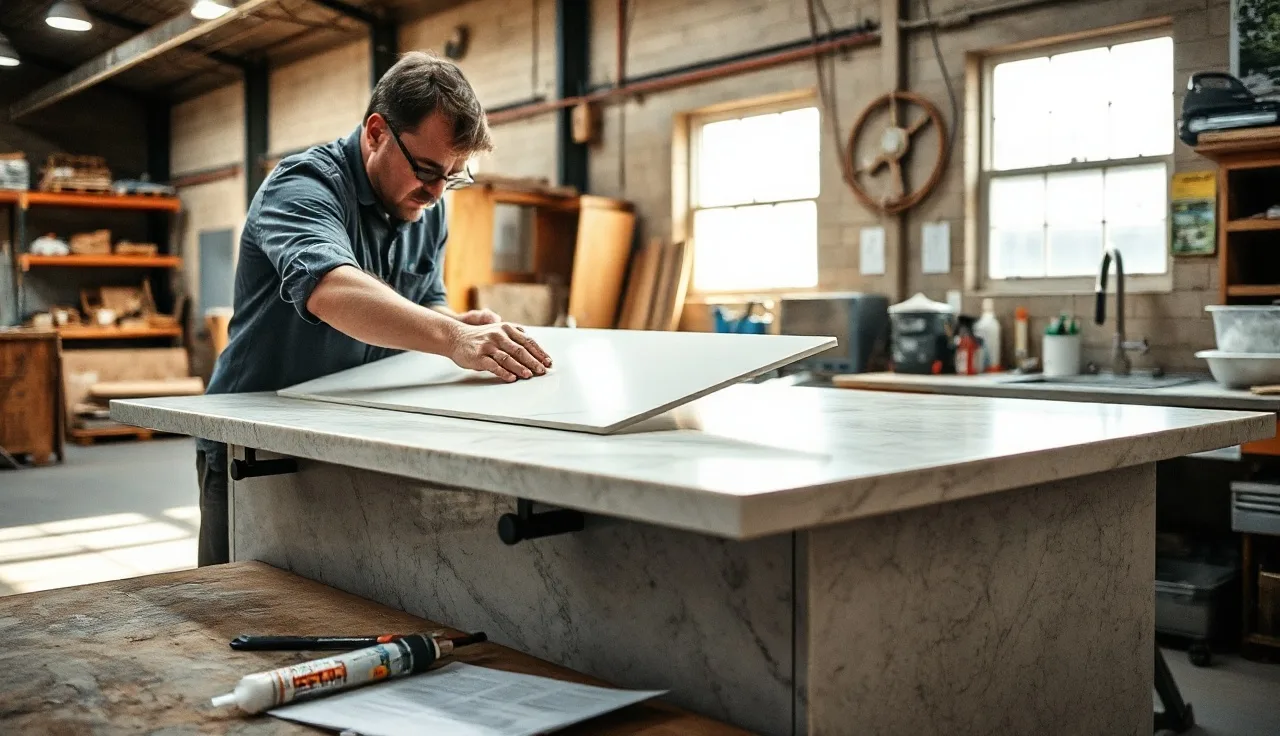
A quartz overlay is a thin slab of engineered quartz glued right on top of your existing countertop. You also hear it called a cap or a skin. Standard quartz runs 3 cm thick (about 1.25 inches). Overlay material runs 1 cm to 1.2 cm, roughly 3/8 to 1/2 inch. The thinner slab costs less, weighs less, and skips the demo and dump fees that come with ripping out the old top.
The process sounds simple. A fabricator measures the existing top, cuts the overlay to fit, builds up edge returns if needed, and bonds it down with epoxy or a structural silicone. Real jobs get messier. If your existing top flexes, has hollow spots, has major chips, or is made of something that won't hold a bond (certain laminates, older tile with grout ridges), the overlay can crack or lift over time. A good fabricator probes and inspects before agreeing to anything.
Not every shop offers overlays. The technique shows up most in renovation markets where a homeowner wants a fresh look without touching the cabinets. Solid base cabinets and a flat, sound existing top make an overlay a real option. Miss either condition and you should skip it.
How much does a quartz countertop overlay cost per square foot?
A quartz overlay costs $35 to $80 per square foot installed [1]. Where you land depends on a few things, and slab grade matters most.
Entry-level engineered quartz in overlay thickness (Silestone, MSI, and similar) costs fabricators about $12 to $22 per square foot wholesale before any cutting. Premium designer patterns, the Calacatta looks with heavy veining, push wholesale past $30 per square foot, and that flows straight into your quote [2].
Fabrication and install run a little lower than a full replacement because nobody demos, hauls away, or preps new substrate. But cutting time is about the same, and some shops add a premium for overlay work because the tolerances are tighter. A mistake in a thin slab is much harder to hide than one in a 3 cm slab.
| Cost component | Typical range (per sq ft) |
|---|---|
| Overlay quartz material | $12, $32 |
| Fabrication (cutting, polishing, edges) | $10, $20 |
| Installation and adhesive | $8, $18 |
| Edge profile upgrade (ogee, waterfall, etc.) | $5, $15 additional |
| Substrate prep / leveling | $0, $10 |
| Total installed | $35, $80 |
Take a typical kitchen with 40 square feet of counter. That's a total installed cost of roughly $1,400 to $3,200. A bathroom vanity with 10 to 15 square feet comes out to $350 to $1,200. These figures track what the major home improvement cost guides report for overlay and resurfacing work [1].
How does overlay cost compare to full quartz countertop replacement?
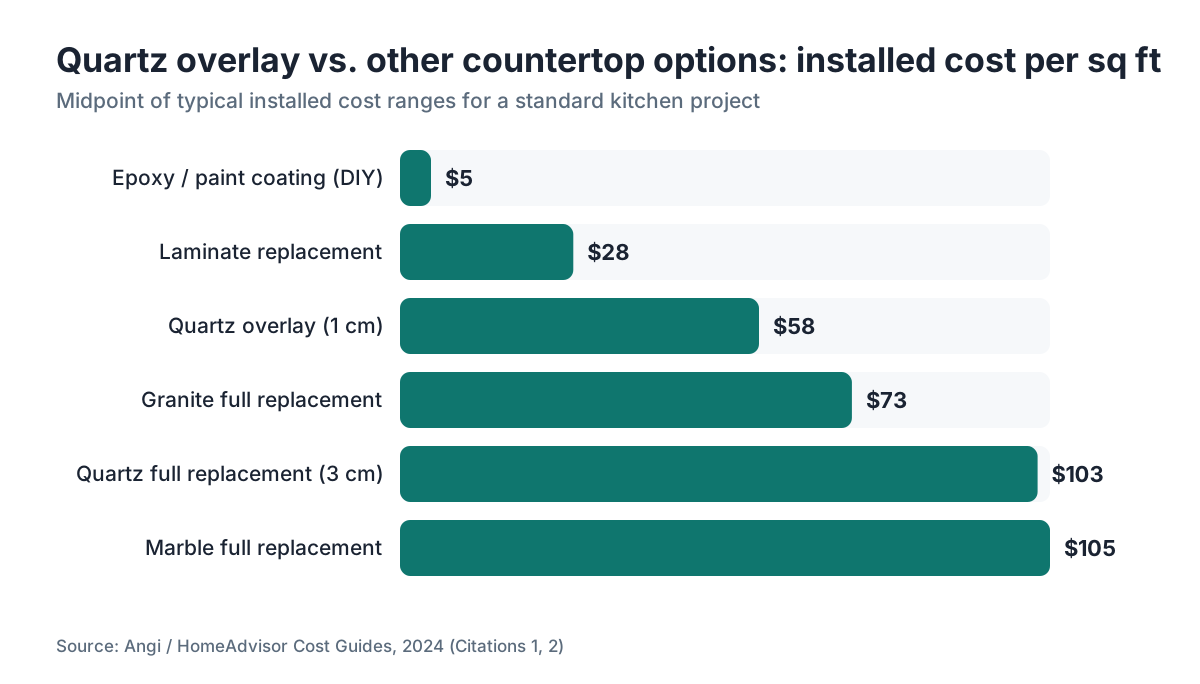
Full replacement costs more. No argument there. Standard 3 cm quartz installed runs $55 to $150 per square foot depending on grade and complexity [2]. On a 40-square-foot kitchen that's $2,200 to $6,000. On paper the overlay saves you $800 to $2,800.
The savings isn't always real. If the existing top needs reinforcing or repair before the overlay goes down, or the edge geometry needs custom buildup, those costs eat the gap fast. Demo and disposal for a full replacement runs $150 to $400 for a typical kitchen, which is real money but not the whole story [3].
The honest comparison is lifespan. A full-replacement quartz top on a solid substrate holds up for decades. An overlay on a marginal substrate can develop cracks within a few years if the base flexes or the bond fails. Fabricators who are straight with you will say the overlay only pays off on a dead-flat, rigid existing surface.
Compare overlay to laminate countertops or formica countertops and the math flips. Laminate is cheap to replace, $15 to $40 per square foot installed, so overlaying laminate to fake a quartz look can cost more than just installing a mid-grade quartz slab outright. Run your actual square footage before you commit.
What factors drive the price up or down on a quartz overlay?
Edge profile is the line item people underestimate. A basic eased or bevel edge usually comes with the base quote. An ogee, dupont, or waterfall edge adds $10 to $30 per linear foot, and on a kitchen with 20 linear feet of exposed edge that's another $200 to $600 [4].
Cutouts add up too. Each sink cutout runs $100 to $200, and a cooktop cutout runs $75 to $150. Adding a farmhouse sink with the overlay means a complex cutout through thinner material, and some shops charge a premium for that.
Location drives labor hard. Metro rates in New York, Boston, or San Francisco push installed overlay cost toward $65 to $80 per square foot. Rural Midwest and Southeast markets come in at $35 to $50 on the same material. Distributors price the slab nationally, so material varies less than labor.
The condition of the existing surface is the biggest wildcard. Laminate in good shape (flat, tight seams, no bubbles) bonds fine. Tile is trouble, because the grout ridges make high and low spots you have to fill and level, and that adds prep time. A cracked or delaminating surface usually disqualifies the job entirely.
Brand matters at the end. Cambria countertops, made in the US, tend to run $10 to $20 per square foot more than comparable imported quartz. Cambria also doesn't publicly sell an overlay-specific line, so fabricators source overlay-thickness slabs elsewhere for that application.
Is a quartz overlay a good idea, or should you just replace the whole top?
Here's the honest answer: an overlay works in a narrow set of cases. The base top has to be flat (less than 1/8-inch variation across any 8-foot run [8]), structurally sound, and made of something that bonds well. Check all three, want a new look without touching the cabinets, and an overlay saves you real money.
Skip it if the existing top is tile, if there's water damage around the sink, if the top flexes when you press on it, or if the top is already an overlay. Stacking overlays is asking for trouble.
For fabricators, overlays can be good money when priced right. Margin often beats a full replacement because material costs less and haul-away overhead disappears. The risk is callbacks. A delaminated overlay is a warranty nightmare, and the fix usually means pulling everything anyway. Shops that run overlays well qualify the substrate hard and document the condition of the existing top before anyone signs a contract.
Quoting tools built for fabricators (like SlabWise) can run overlay and full-replacement scenarios side by side in a few minutes. That helps the shop price the risk and helps the homeowner read the quote they're handed.
For a sense of kitchen countertops pricing across every material, the overlay lands below mid-grade full-replacement quartz and above budget options like laminate.
What does a quartz overlay installation involve, step by step?
A quartz overlay install goes roughly like this, and it's fast.
First, a fabricator or estimator comes out to measure and inspect. They check flatness, whether the surface bonds, and whether adding roughly 1 cm of height causes problems with appliances, backsplash transitions, or drawer clearance. Adding nearly half an inch sounds trivial until an under-counter appliance no longer fits.
Second, the top gets templated (usually digitally now) and the overlay is cut in the shop. Edges get polished, cutouts get made, and the piece is dry-fit before any glue touches it.
Third, on install day the existing surface gets cleaned and lightly abraded to help adhesion. A structural adhesive, usually epoxy or a polyurethane-modified silicone, goes down in a grid or bead pattern. The overlay is set, aligned, and clamped or weighted while it cures. Most adhesives hit handling strength in a few hours, but full cure takes 24 to 48 hours.
Fourth, seams (if the top is big enough to need them) get filled with color-matched epoxy. Caulk joints run at the wall and around the sink.
A typical kitchen install takes four to eight hours. No demo day. No dumpster. The kitchen is usually usable the next morning. That speed sells the job. Our countertop installation guide covers what full-replacement installs involve by comparison.
What are the risks and downsides of quartz overlays?
Delamination is the big one. If the adhesive bond fails, or the substrate flexes enough to stress the thin slab, you get cracks or sections that lift. Quartz is rigid and does not flex. A 1 cm slab has almost no tolerance for substrate movement. This isn't theoretical. It's the most common complaint about overlay jobs that go bad.
Height is a practical headache. Your counter sits about 3/8 to 1/2 inch higher than before. That can create a step at the base of a tile backsplash, foul a built-in appliance, or make an existing undermount sink fit awkwardly. A good fabricator raises this before cutting anything.
Overlays box in your future options. Want to change the counter again in ten years? You'll pull the overlay and maybe the original surface under it, which is more work than a standard removal. Now you're dealing with two layers of material.
Weight is worth a mention, though it's less than with a full slab. A 1 cm quartz overlay adds about 6 to 7 pounds per square foot. On a 40-square-foot kitchen that's 240 to 280 extra pounds sitting on cabinets that weren't designed for it. Most modern frameless and face-frame boxes handle it fine. Older or lightweight cabinets should be checked.
One more thing. Not every fabricator offers overlays, which shrinks your pool of competing quotes and can cut into price competition on the job.
How does quartz overlay compare to other countertop resurfacing options?
Want a refreshed counter without full replacement? You've got a few paths.
Epoxy coating or paint kits (Rust-Oleum Countertop Coating, Giani, and the like) are the cheapest, $50 to $200 in materials for a DIY kitchen. The result looks and performs like paint on a countertop. Durability is poor. Scratches show within a year or two of normal cooking. This isn't a serious rival to a quartz overlay, but homeowners run into it, so it's worth naming.
Laminate resurfacing (new laminate over old) runs $15 to $40 per square foot installed. If budget rules the decision, laminate beats an overlay on price. The trade-off is weight and heat resistance you don't get from laminate. Our laminate countertops piece has the full rundown.
Granite countertops come in full-replacement slabs at roughly $45 to $100 per square foot installed, right in the same range as a quartz overlay. Given that choice, most fabricators and most homeowners take the full-replacement granite. You get a thicker slab and zero dependence on the substrate underneath.
Marble countertops run $60 to $150 installed for full replacement and don't come as overlays from major suppliers. Want the marble look in overlay form? That's engineered quartz in a marble pattern, not real marble.
Butcher block countertops cost $30 to $75 installed for full replacement and can be sanded and refinished in place, a resurfacing trick unique to wood. No overlay product matches that longevity for the right kitchen.
Our kitchen countertops guide lines up every surface side by side.
What questions should you ask a fabricator before getting an overlay quote?
A bad overlay quote is easy to get. The shop skips a real substrate assessment, you agree to the price, and six months later a seam lifts by the sink. Ask these before you sign anything.
First: will you inspect the existing surface before committing to the overlay? Any shop willing to quote from a photo or a rough description is cutting corners. The substrate inspection is the whole foundation of the decision.
Second: what adhesive do you use, and what's your bond test protocol? The answer should name a specific product (more than just "epoxy") and a process for confirming the surface is clean and bondable.
Third: what's your warranty on overlay work, and what voids it? Some shops offer shorter warranties on overlays than on full replacement. That's fair, but get it in writing.
Fourth: will the added height affect my appliances or backsplash tiles? A fabricator who hasn't thought this through hasn't done many overlays.
Fifth: what happens if you inspect and the substrate isn't suitable? You want a clear promise they'll tell you before starting, not after cutting the slab.
Ask for references from overlay jobs specifically, not general quartz work. Overlays are different enough that general quartz experience doesn't fully carry over. And get at least two quotes. Overlay pricing is wide enough that a second opinion almost always saves money or flags a problem in the first quote.
Fabricators who want to move faster on the quoting side can lean on software like SlabWise to generate overlay quotes that account for material thickness, edge pricing, and cutout complexity. That cuts the odds of underpricing a job that turns into a warranty problem.
Are there any building codes or permit requirements for quartz overlays?
In most US jurisdictions, replacing or resurfacing a countertop needs no building permit [5]. Countertop work counts as a cosmetic renovation. The exceptions are work that moves plumbing (relocating a sink) or modifies electrical (moving an outlet for a new cooktop). Those need permits no matter what's happening to the counter surface.
In a condo or HOA, check your governing documents. Some associations require notification or approval for work involving outside contractors, even cosmetic work. That's an HOA rule, not a building code, but ignoring it can bite you at resale.
For food-service or commercial installs, the health code picture changes. The FDA Model Food Code says food contact surfaces must be smooth, nonporous, and cleanable [6]. Engineered quartz meets all three, so a quartz overlay in a commercial kitchen is generally compliant on the material front. Inspectors focus on joint sealing and whether the surface meets NSF/ANSI 51, which "establishes minimum food protection and sanitation requirements for materials used in the construction of food equipment," depending on your jurisdiction [9].
Homeowners renovating under an existing permit (as part of a bigger kitchen remodel) should confirm with the contractor that the countertop scope is inside the permit. It usually is. Assumptions cause trouble at final inspection.
How do fabricators price and profit on overlay jobs?
Fabricators should price overlays differently than full replacement. Material per square foot is lower because the slab is thinner, but handling and cutting risk is higher. A 1 cm slab cracks more easily during fabrication than a 3 cm slab, and a broken overlay piece on install day is a full redo.
Most shops add a 15 to 30 percent premium on overlay fabrication labor versus standard work, which fits the risk. Material markup on overlay-thickness quartz runs about the same as standard slab markup, 40 to 70 percent over wholesale [7].
The profitable overlay job shares a few traits. Clean substrate that needs no extra prep. Standard edge profiles that don't need hand-finishing. Project size above 20 square feet. Tiny jobs, like a single 8-square-foot bathroom vanity, carry setup costs that thin the margin fast.
Demo savings are real for the shop. No dumpster rental, no helper to demo and haul, no tile dust or old laminate disposal. That's two to three hours saved on a typical kitchen. The quote should reflect that time, but not all of it goes back to the customer. The shop keeps some as margin for taking on the overlay risk.
Job costing on overlays is where quoting software pays for itself. The line items differ enough from standard replacement that eyeballing the numbers leads to lost margin or quotes nobody will accept.
Frequently asked questions
Can you put a quartz overlay over tile countertops?
Technically yes, but grout lines create high and low spots you have to fill and level before the overlay can bond flat. Most fabricators charge $5 to $10 per square foot extra for tile-substrate prep, and many decline the job outright if the grout joints are deep or the tile has loose pieces. If the tile is in poor shape, full replacement is the smarter path.
How long does a quartz countertop overlay last?
On a flat, sound substrate with proper adhesive, a quartz overlay lasts 10 to 20 years, similar to a full-thickness slab. The risk is the bond, not the quartz. Overlays on marginal substrates can delaminate in two to five years, especially near the sink where moisture cycles stress the adhesive. Ask your fabricator about the warranty and what inspections they run before installing.
Is a quartz overlay the same as a countertop skin or cap?
Yes. The trade uses the terms interchangeably. Overlay, cap, skin, and quartz resurfacing all mean the same thing: bonding a thinner-than-standard slab on top of an existing countertop instead of removing and replacing it. The material is engineered quartz, typically 1 cm to 1.2 cm thick versus the standard 3 cm for full-replacement slabs.
Does a quartz overlay add too much height to the counter?
A 1 cm overlay adds about 3/8 inch, bringing a standard 36-inch counter to roughly 36.375 inches. Most people never notice. Where it matters: under-counter appliances with tight clearances, slide-in range alignment, and the transition to an existing tile backsplash. A fabricator should measure those clearances during the inspection visit, before any cutting happens.
What is the approximate cost of quartz countertops for a full kitchen replacement versus overlay?
Full quartz replacement runs $55 to $150 per square foot installed for a 3 cm slab, putting a 40-square-foot kitchen at $2,200 to $6,000. A quartz overlay on the same kitchen runs $35 to $80 per square foot, or $1,400 to $3,200. The overlay saves $800 to $2,800 before you account for substrate prep, edge upgrades, or extra cutouts.
Can you do a quartz overlay yourself as a DIY project?
Not practically. Most distributors don't sell overlay-thickness quartz to retail customers, and cutting quartz needs a wet saw with diamond blades plus real experience to keep a 1 cm slab from cracking. Edge polishing needs specialized gear. Even seasoned tile setters who try a quartz overlay usually crack at least one piece. This is a job for a licensed stone fabricator.
Does quartz overlay work on bathroom vanity countertops?
Yes, and vanities are often better overlay candidates than kitchens. The surfaces are smaller, thermal stress is lower, and the substrate is usually in better shape. A bathroom overlay runs $350 to $1,200 for a typical 10 to 15 square foot vanity. The undermount sink needs careful planning, since the overlay has to return down around the cutout cleanly.
How does the weight of a quartz overlay affect existing cabinets?
A 1 cm quartz overlay adds roughly 6 to 7 pounds per square foot. A 40-square-foot kitchen adds 240 to 280 pounds to the cabinet tops. Most standard cabinets, frameless or face-frame, handle 600 pounds or more on the box and top, so weight is rarely a structural problem. Older, lightweight, or water-damaged cabinet boxes should be checked before an overlay goes on.
What quartz brands make overlay-thickness slabs?
Several major suppliers offer 1 cm or 12 mm slabs for overlay applications, including Silestone, MSI, and various imported engineered quartz lines. Cambria does not currently sell overlay-thickness product. Availability varies by region and distributor. Ask your fabricator which 1 cm lines they stock or can order, and request samples first, since color and veining can look different at thinner cuts.
Are there any hidden costs in a quartz overlay quote I should watch for?
Yes. Watch for substrate prep charges listed as optional in the initial quote that become mandatory once the fabricator inspects your top. Watch for per-linear-foot edge charges, cutout fees that differ by appliance type, and adhesive or sealant charges billed separately. Get a written itemized quote that names the included edge profile, the number of covered cutouts, and whether substrate prep is included or conditional.
Is quartz overlay a good option for a rental property countertop update?
It can be, if the existing top is in good shape and you want a look upgrade without a full renovation budget. The low upfront cost appeals. The risk in a rental is that overlays on marginal substrates fail faster under heavy use, and repair or removal costs can eat the savings. A durable mid-grade laminate replacement may be the better investment for high-turnover units.
How do I find a fabricator who does quartz overlays?
Not every stone shop offers overlays. Call local fabricators and ask specifically about 1 cm overlay installs, not standard quartz replacement. A shop that hesitates or has to ask around internally probably hasn't done many. Look for a fabricator who asks about your existing substrate on the first call, not one who just wants square footage and gives an instant price. Online directories and local tile associations help narrow the list.
Can you put a quartz overlay over an existing quartz countertop?
Technically yes, on bond adhesion. Quartz bonds to quartz well. The practical problem is height: adding 1 cm to an existing 3 cm slab brings you to about 1.625 inches of thickness, which looks bulky at the edge and can conflict with undermount sink geometry. Most fabricators will tell you overlaying an existing quartz top is rarely worth it, and full replacement makes more sense if you already have quartz underneath.
Sources
- HomeAdvisor / Angi, Countertop Cost Guide: Quartz countertop overlay and resurfacing typically costs $35 to $80 per square foot installed, depending on material grade and region.
- HomeAdvisor / Angi, Quartz Countertop Cost Guide: Full quartz countertop replacement costs $55 to $150 per square foot installed for standard 3 cm slabs.
- HomeAdvisor / Angi, Countertop Removal Cost Guide: Demo and disposal for countertop removal typically costs $150 to $400 for a standard kitchen.
- HomeAdvisor / Angi, Countertop Edge Profile Pricing: Edge profile upgrades such as ogee or dupont typically add $10 to $30 per linear foot to countertop fabrication cost.
- U.S. Department of Housing and Urban Development: Cosmetic countertop replacement or resurfacing generally does not require a building permit in most US jurisdictions.
- U.S. Food and Drug Administration, FDA Model Food Code: The FDA Model Food Code specifies that food contact surfaces must be smooth, nonporous, and cleanable.
- Stone World Magazine, Fabricator Pricing and Markup Survey: Typical material markup for quartz overlay slabs among fabricators runs 40 to 70 percent over wholesale cost.
- Natural Stone Institute (formerly Marble Institute of America), Dimension Stone Design Manual: Industry standards for countertop substrate flatness require less than 1/8-inch variation across an 8-foot span for overlay applications to be structurally sound.
- NSF International, NSF/ANSI 51 Food Equipment Materials: NSF/ANSI 51 establishes minimum food protection and sanitation requirements for materials used in the construction of food equipment, including countertops in commercial kitchens.
- U.S. Census Bureau, American Housing Survey: Kitchen renovation and countertop replacement are among the most common home improvement projects reported by US homeowners.
- Remodeling Magazine, Cost vs. Value Report: Minor kitchen remodels including countertop upgrades show strong cost recoupment at resale relative to major renovations.
Last updated 2026-07-09