TL;DR
- A backsplash is the wall surface between your countertop and upper cabinets, usually 15 to 18 inches tall, that stops water, grease, and food splatter from wrecking the drywall.
- Fabricators price it separately from the counter, usually per square foot, though many bundle a 4-inch stone ledge into the countertop quote.
- Installed cost runs $10 to over $100 per square foot depending on material.
What exactly is a backsplash?
A backsplash is the finished wall surface directly behind a countertop, covering the gap between the counter and the upper cabinets or open wall above. Its job is protection. Water, cooking grease, and food splatter hit that wall constantly, and raw drywall stains, swells, and rots when it gets wet.
In a standard kitchen, the backsplash zone runs from the countertop surface up to the bottom of the upper cabinets, a height of roughly 15 to 18 inches [8]. Behind a range or cooktop, code inspectors and designers often expect a non-combustible surface reaching higher, sometimes all the way to the range hood. In bathrooms, a backsplash usually sits behind the sink and vanity, running 4 to 6 inches up the wall, though full-height tile shows up in higher-end projects.
Here's where quotes go sideways. The word gets used two ways in the trade, and the ambiguity causes real confusion. A "full backsplash" means tile, stone, or another material covering most of the exposed wall above the counter. A "4-inch backsplash" (sometimes called a "back ledge" or "splash") is a narrow strip of the same stone as the countertop, stood vertically against the wall at the rear edge of the slab. These get priced completely differently. Plenty of homeowners don't figure out which one the fabricator included until the crew is packing up.
What materials are used for backsplashes?
Ceramic and porcelain tile win by a wide margin. They're waterproof, heat-resistant, and come in thousands of sizes and finishes. A skilled tile setter installs standard formats for $25 to $50 per square foot all-in [1]. Large-format porcelain slabs (think 24x48 or bigger) run more, often $60 to $100+ per square foot, because cutting thin porcelain without cracking it takes specialized wet-saw blades and a careful hand.
Natural stone tile, marble, travertine, and slate show up where the countertop is also stone. Marble backsplash tile runs roughly $15 to $40 per square foot for material alone; installed hits $50 to $100 or more in most metro markets [1]. Stone is porous, so the grout joints need sealing on a schedule.
Full slab stone backsplashes, where the same granite, quartzite, or quartz as the countertop climbs the wall in a single sheet, have taken off in high-end kitchens. The look pays off. So does the cost. The fabricator templates the wall carefully, cuts precise holes for outlets and switches, and wrestles heavy slabs through tight spaces. Budget $80 to $150 per square foot installed for a slab-match backsplash.
Glass tile sits in its own bucket. It's beautiful and unforgiving to cut and grout, and cheaper versions chip or discolor. Installed cost usually lands between $30 and $75 per square foot. Stainless steel panels, brick, painted beadboard, and cement board with a waterproof coating round out the field, each with its own price and upkeep.
Laminate countertops and budget kitchens often use a simple 4-inch stone or laminate ledge instead of a tiled wall. That keeps the backsplash cost near zero beyond the countertop slab itself.
How do fabricators price a backsplash separately from the countertop?
It depends entirely on whether you mean a 4-inch stone ledge or a full tiled wall. Those are genuinely different scopes of work, and mixing them up in a quote conversation leads straight to budget surprises.
The 4-inch stone ledge (same material as the countertop)
Most stone fabricators fold the 4-inch ledge into the countertop quote by default, treating it as part of the slab layout. They take the linear feet of ledge, multiply by the height (usually 4 inches, or 0.33 feet), and add it to the total square footage. At typical stone prices of $60 to $120 per square foot for granite or quartz, a 10-foot run of 4-inch ledge adds roughly 3.3 square feet and maybe $200 to $400 to the job [2]. That number rarely causes sticker shock.
Some shops break it out as its own line item so you can opt out and tile instead. Either way is fine, as long as the quote says what's included.
The full tile or slab backsplash
This is almost always left out of a countertop fabricator's quote. Tile is a separate trade. Most fabricators don't set tile, and the ones who do usually subcontract it. You either hire a tile contractor directly or ask the fabricator to coordinate it and pay a markup for the trouble.
When a fabricator does price a full-height stone slab backsplash in the same material, they measure the exposed wall square footage, subtract for windows, and charge a per-square-foot rate that runs 20 to 40 percent above the countertop rate. The premium covers the harder template, the precision cuts around outlets, and the adhesive installation instead of a flat drop-in. On a 20-square-foot backsplash zone using $80-per-square-foot quartz, budget $1,600 to $2,200 for that section alone [2].
Shops running quoting software like SlabWise can split these components into separate line items automatically, so you see exactly what each element costs instead of decoding one combined number.
What does a backsplash cost per square foot in 2024 and 2025?
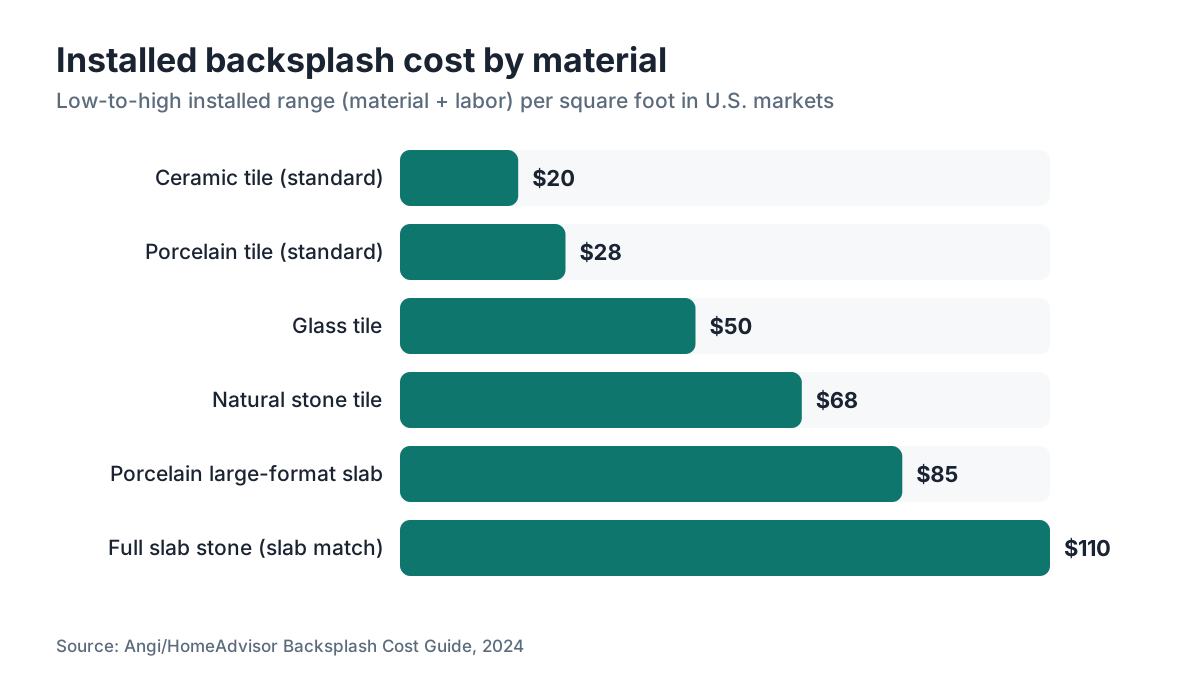
Installed cost swings hard by market, material, and job complexity. The table below shows realistic installed ranges (material plus labor) for common options in U.S. markets, pulled from industry survey data [1][3].
| Material | Low (per sq ft) | High (per sq ft) | Notes |
|---|---|---|---|
| Ceramic tile (standard) | $10 | $30 | Cheapest; good DIY candidate |
| Porcelain tile (standard) | $15 | $40 | Tougher than ceramic |
| Porcelain large-format slab | $50 | $120 | Specialized cuts; limited DIY |
| Natural stone tile (marble, travertine) | $35 | $100 | Needs sealing; grout maintenance |
| Full slab stone (granite/quartz, slab match) | $70 | $150 | Fabricator-installed; premium look |
| Glass tile | $25 | $75 | Fragile to cut; slow grouting |
| Stainless steel panel | $30 | $80 | Commercial look; fingerprint magnet |
| 4-inch stone ledge (added to countertop) | $0 | $15 (addl.) | Usually bundled into countertop price |
Tile labor alone typically runs $10 to $20 per square foot in most U.S. cities [3]. In high-cost metros like New York, San Francisco, or Boston, those numbers push 25 to 40 percent higher. A simple 30-square-foot kitchen backsplash in standard ceramic tile might land at $600 to $900 installed in the Midwest and $900 to $1,400 in coastal cities [1].
How much backsplash square footage does a typical kitchen have?
Most kitchens fall between 20 and 50 square feet of backsplash area once you account for windows, upper cabinets, and the range hood zone. A galley or small U-shape might have only 15 to 25 square feet of exposed wall above the counter. A large open-plan kitchen with an island and full perimeter counters can approach 60 to 80 square feet.
To measure it yourself, take the linear feet of countertop that runs along a wall, multiply by the wall height from counter surface to cabinet bottom (usually 15 to 18 inches, so 1.25 to 1.5 feet), then subtract for windows. The range area usually gets a taller measurement, often 24 to 36 inches from counter to hood, so run that section separately.
For a rough budget on a mid-size kitchen (35 square feet of tile at $35 installed), expect about $1,225 for a basic porcelain job and $2,450 or more for natural stone [1]. A slab-match full backsplash on that same kitchen at $100 per square foot is $3,500. That's real money on top of a countertop job that may already run $4,000 to $8,000 for the stone.
Is a backsplash required by building code?
No universal federal code mandates a backsplash behind kitchen counters. Building codes in the U.S. get adopted at the state and local level, and most jurisdictions use the International Residential Code (IRC) as their base [4]. The IRC requires that wall and floor surfaces in wet areas (like the zone around a kitchen sink) be smooth, non-absorbent, and water-resistant, but it doesn't call for tile or any particular backsplash material [4].
In practice, many jurisdictions read the water-resistant surface requirement to mean raw drywall behind a sink isn't acceptable. A painted wall kept intact and sealed around the sink edges usually passes inspection, though it's a weak long-term choice for durability. Painted moisture-resistant drywall (the stuff called "green board" or "purple board") behind a properly sealed countertop is generally fine for kitchen applications in most areas.
Behind a shower or bathtub, the rules get stricter and explicitly demand waterproof or water-resistant surfaces to set heights. That's a different project from a kitchen backsplash, but worth knowing if you're remodeling a bathroom too [4].
The real reason to install a proper backsplash isn't code. It's that water sneaking past a countertop silicone seal eventually reaches the wall and grows mold or rots the drywall. The EPA notes that moisture behind unsealed wall surfaces is a direct path to mold growth [10]. A backsplash is cheap insurance against a drywall repair and remediation bill.
Can you negotiate the backsplash out of a countertop quote?
Yes, and sometimes you should.
If a quote includes a 4-inch stone ledge and you plan to tile all the way up to the cabinets, you may not want the ledge at all. Some tile installers prefer the wall surface to run straight down to the countertop edge so the tile sits flush without a raised stone strip creating an awkward inside corner. Ask flat out: "Does this quote include a 4-inch splash, and can I drop it if I'm tiling the wall?"
Removing that 4-inch splash typically saves $150 to $400 depending on the run of counter and the stone price, because the fabricator uses less material and skips the edge work on the ledge. Some shops won't budge because it's already baked into their template and cutting layout. Many will.
What you can't reasonably negotiate out is the silicone caulk bead at the seam between countertop and wall. That joint gets caulked, not grouted, so it can move without cracking. Any reputable installer insists on it no matter what backsplash you choose [5].
How does a slab backsplash differ from tile, and which is better?
A slab backsplash and a tile backsplash solve the same problem in completely different ways. Neither one wins outright. It depends what you're optimizing for.
A slab backsplash runs the countertop stone (granite, quartz, marble, or quartzite) straight up the wall with no grout joints. No grout to clean, none to seal, and a single unbroken sweep from counter to cabinet. For a busy cook who hates scrubbing grout, that's a real quality-of-life win, more than a look.
The downsides are real too. Slab backsplashes cost a lot more (see the table above). They're harder to change if you later want a pot filler or an extra outlet. And if your walls have any twist or bow, and almost all walls do, the installer has to scribe or shim to seat the slab flat, which adds labor. A badly uneven wall might not suit a slab approach at all.
Tile forgives imperfect walls, repairs easily when a piece cracks, and offers far more design options. Swap a broken tile and you're done. A cracked slab section is a much bigger fix.
For kitchen countertops in a house you're keeping, when you're already spending serious money on stone, the slab match usually looks proportionally great and holds up well. For a rental, a house you're staging to sell, or a budget kitchen, quality porcelain tile is the smarter place to put the money.
Granite countertops and marble countertops both look great as slab backsplashes when the material has strong movement or veining that reads well across a big vertical surface. Solid-color or quiet stones tend to look better as tile, with grout lines breaking up the expanse.
What questions should you ask a fabricator about backsplash pricing?
Before you sign any countertop quote, get straight answers to these five questions:
-
Does the quote include a 4-inch stone backsplash ledge? If yes, how many linear feet, and what's the credit to remove it if I go with tile instead?
-
If I want a full slab backsplash in the same material, do you fabricate and install that, or do I need a separate contractor?
-
If I tile the backsplash myself or hire a tile contractor separately, does that affect the countertop install schedule or any warranty?
-
Who caulks the seam between the countertop and the wall after installation?
-
Will you template the backsplash area at the same visit as the countertop template, even if we're tiling it separately?
That last one matters. Outlet locations, window sill heights, and wall irregularities all shape how the tile contractor lays out the job, and a shared template visit saves a second site trip.
Fabricators using structured quoting software produce quotes where these line items already appear separately, which makes the whole conversation cleaner. If you're staring at a handwritten or single-line quote, push for an itemized breakdown before you agree to anything.
How does backsplash installation timing work with countertop installation?
The standard order is simple: countertops go in first, then the backsplash tile goes on the wall above them. The tile installer needs the counter in place to set that first horizontal row perfectly level at the right height.
The wrinkle is the countertop installer needs the wall finished before setting the stone, because the silicone seal runs along the back edge of the slab. Raw drywall there is fine. If tile were already on the wall, the slab could still go in, but the sequencing gets clumsy and the crew has to slide the slab in without chipping the tile edges.
For new construction or a gut renovation, the typical order runs: rough plumbing and electrical, drywall, prime the walls, install countertops, then install tile backsplash. Painting happens either before the countertops (easier to mask) or after the tile (cleaner lines above it). Most painters would rather paint before tile since they can move fast and loose, then the tile hides any drips near the counter.
Replacing counters in an existing kitchen where the old backsplash tile stays? The fabricator needs to know upfront. They'll slide the new slab under any tile that overhangs the counter edge, or cut the slab to fit tight against existing tile. That can add $100 to $300 in template complexity and cutting time [2].
For how countertop installation flows from template to drop-in, that process has its own sequencing that decides when you can book your tile contractor.
Can you DIY a backsplash to save money?
Yes. Tile backsplash is one of the more approachable DIY jobs in a kitchen remodel, especially with standard square or subway tile in manageable sizes. The tools you need, a wet tile saw (or a score-and-snap cutter for simple cuts), a notched trowel, tile spacers, and a grout float, all rent at most home improvement stores for under $50 a day [6].
The savings are real. If pro tile labor runs $15 per square foot and your kitchen has 35 square feet of backsplash, that's $525 in labor you keep. Material costs the same whether you hire it out or do it yourself.
The hard parts to do well: cutting cleanly around electrical outlets, fitting tile into inside corners where the wall isn't plumb, and holding grout joints consistent across a long horizontal run. Subway tile with 1/8-inch joints on a 10-foot run telegraphs every wobble. Large-format tile (anything over 12x12) also needs flat, prepped walls and a back-buttering technique most beginners skip, which leaves hollow spots that crack later [9].
Slab stone backsplash is not a DIY project. The weight, the precision cuts for outlets, and the adhesive chemistry for vertical stone all take professional tools and experience. One dropped slab does thousands of dollars of damage.
On budget-conscious projects, pairing DIY tile work with professionally installed stone counters is a smart split. The stone is where the money and the fabrication skill live; the tile is where your own labor actually pays.
Does the backsplash material need to match the countertop?
No. In many designs it's better when it doesn't match exactly.
Most kitchen designers work from contrast or complement, not matchy-matchy. A white quartz counter with white subway tile reads clean and timeless. That same white quartz with a matte black tile or a warm terracotta tile creates interest without clashing. An active marble slab with heavy veining usually pairs better with a quiet, solid-color tile that doesn't fight it for attention.
Exact matching makes its strongest case in the slab backsplash scenario above. When the same stone slab runs continuously from counter up the wall, the match is the whole point: the veining flows through, the material reads as one piece, and the seam between counter and backsplash basically disappears. This works best with book-matched stone or stones with long linear movement.
Practically speaking, quartzite countertops cleaned properly and soapstone countertops maintained correctly both have distinct visual characters that often look better paired with tile that complements rather than competes.
Working with a neutral counter like honed white quartz, Cambria countertops, or Corian countertops? You have wide latitude on backsplash material and color. The countertop won't fight whatever tile you pick.
Frequently asked questions
What is the standard height for a kitchen backsplash?
The standard kitchen backsplash runs from the countertop surface to the bottom of the upper cabinets, typically 15 to 18 inches. Behind a range or cooktop, it often climbs higher to meet the range hood, adding another 12 to 24 inches. There's no single code-mandated height for kitchens, but most designers use the upper cabinet line as the natural stopping point.
Is the backsplash included in a countertop quote?
Usually only the 4-inch stone ledge (a narrow strip of the same stone set against the wall) makes it into a fabricator's quote, and even that varies by shop. A full tile backsplash almost never does; that's a separate trade. Always ask your fabricator to spell out exactly what the quote covers before signing.
How much does it cost to add a backsplash to a kitchen?
Installed cost ranges from $10 per square foot for basic ceramic tile up to $150 per square foot for a slab-matched natural stone backsplash. A typical 30 to 40 square foot kitchen backsplash with mid-range porcelain tile installed runs $900 to $1,800 in most U.S. markets. High-end stone slab treatments on the same area run $2,100 to $6,000.
Can I skip the backsplash and just paint the wall?
Technically yes in most jurisdictions, as long as the wall is smooth and reasonably water-resistant away from the direct splash zone. Paint won't hold up long behind a sink or cooktop where daily moisture hits it. A painted wall behind a sealed countertop is passable short-term but tends to show staining, peeling, or mold within a few years if it isn't kept sealed.
What's the difference between a 4-inch backsplash and a full backsplash?
A 4-inch backsplash (also called a back ledge or splash) is a narrow strip of the same countertop stone stood vertically at the rear edge of the slab, running up the wall only 4 inches. A full backsplash covers the entire wall from the countertop up to the upper cabinets, usually 15 to 18 inches. They get priced, installed, and often contracted completely differently.
What is the cheapest backsplash option for a kitchen?
Standard ceramic tile is the least expensive, with installed cost as low as $10 to $20 per square foot. Peel-and-stick tile panels cost even less (sometimes $5 to $10 per square foot for materials) but have durability and heat-resistance problems near cooktops. For a permanent install, basic ceramic or simple subway tile done DIY is the most cost-effective durable choice.
How do I calculate how many square feet of backsplash I need?
Measure the linear feet of countertop running along walls, multiply by the wall height from counter to upper cabinet (usually 1.25 to 1.5 feet), then subtract for windows and major appliances. Add 10 percent for waste and cuts. A standard galley kitchen typically runs 20 to 30 square feet; a larger L-shaped or U-shaped kitchen runs 35 to 55 square feet.
Does a backsplash add value to a home?
Yes, though the return varies. Kitchen renovations overall return roughly 60 to 80 percent of their cost on resale according to Remodeling Magazine's annual Cost vs. Value report. A backsplash is a visible, high-impact element buyers notice, and a dated or missing one often gets called out in listings. It's unlikely to recoup dollar-for-dollar in an otherwise average kitchen, but it supports the overall impression.
Can I install a tile backsplash over existing tile?
Often yes, if the existing tile is solidly adhered, flat, and the added thickness won't cause problems at the countertop edge or outlet boxes. The new tile bonds to the old surface, though you'll want a polymer-modified thinset and you need to confirm the total wall weight is within what the substrate holds. The bigger snag is that outlet boxes may sit too deep once you add tile, requiring extender rings.
What grout should I use for a kitchen backsplash?
Unsanded grout for joints under 1/8 inch, sanded grout for joints 1/8 inch and wider. Epoxy grout is the most stain-resistant option and skips the sealing step, but it's harder to apply and costs a lot more. Standard cement-based grout sealed after installation works fine for most kitchens. The seam between countertop and the first row of tile should always be caulked, not grouted, so it can move.
Who installs a backsplash, the countertop fabricator or a tile contractor?
A tile backsplash is installed by a tile contractor, not the countertop fabricator. The fabricator sets the stone slab and the 4-inch stone ledge if included. If you want a full slab stone backsplash (same material as the counter running up the wall), that's usually the fabricator's job as a separate scope. Coordinate timing carefully, since tile goes in after the countertop is set.
How long does backsplash installation take?
A pro tile installer usually finishes a standard kitchen backsplash (30 to 40 square feet of subway or ceramic tile) in one day, with grouting done that day or the next morning. Complex patterns like herringbone, hand-cut shapes, or large-format slab tile take two to three days. Keep the area dry for 24 to 72 hours after grouting before using the sink or cooking.
Does a backsplash go on before or after cabinets are installed?
Backsplash tile goes in after cabinets and countertops are installed. Cabinets set the upper reference line and the countertops set the lower one; tile fills the wall between them. Installing tile before cabinets is possible in theory but creates alignment and scribing headaches experienced contractors avoid. Drywall finishing and priming happen before any of these trades.
What is a full-height backsplash and is it worth it?
A full-height backsplash runs from the countertop all the way to the ceiling or upper cabinets, sometimes continuing above the upper cabinets too. It's a bold move that visually heightens a kitchen and kills the painted wall break. Cost is higher because there's more square footage. In a kitchen with high ceilings or minimal upper cabinets, it can be worth the money for a dramatic result.
Sources
- HomeAdvisor (Angi), Backsplash Installation Cost Guide: Installed backsplash costs range from $10 to over $100 per square foot depending on material; labor typically $10, $20 per square foot
- Natural Stone Institute, Dimension Stone Design Manual: Stone fabricators price slab backsplash installation at a premium over countertop rates due to template complexity and vertical installation requirements
- Bureau of Labor Statistics, Occupational Employment and Wage Statistics, Tile and Stone Setters: Tile and stone setter wage data supporting labor cost estimates for backsplash installation
- International Code Council, International Residential Code (IRC): The IRC requires wall surfaces in wet areas to be smooth and water-resistant but does not specifically mandate tile or a particular backsplash material in kitchen applications
- Tile Council of North America, TCNA Handbook for Ceramic, Glass, and Stone Tile Installation: The seam between countertop and tile backsplash must be caulked, not grouted, to accommodate movement and prevent cracking
- Ceramic Tile Education Foundation (CTEF), tile installation tools and methods: Basic tile installation tools (wet saw, notched trowel, spacers, grout float) are widely available and rentable for DIY backsplash work
- Remodeling Magazine, Cost vs. Value Report: Kitchen renovations return roughly 60 to 80 percent of their cost on resale; backsplash is a high-visibility element buyers notice
- National Kitchen and Bath Association (NKBA), Kitchen Planning Guidelines: Standard kitchen backsplash height runs from countertop surface to bottom of upper cabinets, typically 15 to 18 inches
- Ceramic Tile Education Foundation (CTEF), Tile Installation Best Practices: Large-format tile requires back-buttering and flat substrate preparation; hollow spots from skipped technique lead to cracking
- U.S. Environmental Protection Agency, Mold and Moisture in Homes: Water infiltration behind unsealed wall surfaces leads to mold growth; a proper backsplash prevents moisture from reaching wall materials
Last updated 2026-07-11