TL;DR
- Granite countertops run $40 to $200 per square foot installed.
- Most homeowners land between $80 and $130 per square foot for mid-grade material.
- Total kitchen projects average $2,000 to $8,000 depending on slab grade, edge profiles, number of cutouts, and your local labor market.
- Entry-level granite beats quartz on price; exotic slabs can cost more than marble.
What does granite cost per square foot installed?
Granite countertops run $40 to $200 per square foot, fully installed. That range sounds useless until you understand what drives it, so here's the honest breakdown.
Entry-level granite starts around $40 to $60 per square foot installed. Think solid Absolute Black or basic Venetian Gold. These are common stones with predictable yield, and fabricators buy them by the container. Mid-grade material covers most of what goes into American kitchens, and it runs $75 to $130 per square foot installed. Exotic or rare slabs (Blue Bahia, Van Gogh granite, highly figured Brazilian stone) push $150 to $200 per square foot and beyond [1].
The national average for a full kitchen granite installation sits around $3,200 to $4,500, according to cost data compiled by HomeAdvisor [1]. A small kitchen with 30 square feet at mid-grade material might land around $2,400 to $3,900. A large kitchen with an island, 70-plus square feet, premium stone, and multiple cutouts can hit $8,000 to $14,000 without much trouble.
These are installed prices. Shop remnants and hire a handyman to set them, and your cost structure looks completely different. So does your risk.
What factors change the price most?
Stone grade is the biggest lever. Granite gets sorted into tiers (often Level 1 through Level 4 or higher, though naming varies by supplier) based on rarity, country of origin, thickness, and visual complexity. A Level 1 slab might cost a fabricator $5 to $10 per square foot wholesale. A Level 4 exotic can run $25 to $60 per square foot before anyone touches a saw [2].
Thickness matters more than most homeowners expect. Standard countertop granite is 3 cm (about 1.2 inches). You can still find 2 cm material, which is thinner and needs a substrate or laminated edge to look substantial, and it's usually cheaper. But most fabricators default to 3 cm now because waste, breakage risk, and substrate labor on 2 cm often eat the savings. Stick with 3 cm unless cost is genuinely tight.
Edge profiles add real money. A simple eased or beveled edge costs little or nothing extra because a CNC machine cuts it in seconds. A full bullnose, ogee, or waterfall profile means more passes, more hand-polishing, more time. Expect $10 to $30 per linear foot for premium edge work, and a kitchen has a lot of linear feet [3].
Cutouts are a cost driver buyers forget. Each sink cutout adds $100 to $250. A cooktop cutout is similar. A faucet hole runs $35 to $75 per hole. If you have an undermount sink (and most granite kitchens do), the fabricator has to cut to your template, polish the reveal, and keep everything structurally sound. That takes time.
Geography shifts installed prices hard. Labor and overhead in San Francisco or New York run 30 to 50 percent higher than in the rural Midwest or Southeast [1]. Stone availability varies too. A slab that's common in Atlanta (close to major import hubs) costs more to truck to Montana.
Layout complexity drives up both material waste and labor. An L-shaped kitchen with a peninsula and a curved island needs more slab per net square foot, more templating time, and more precision on install day.
How does granite compare to quartz, marble, and other countertop materials by cost?
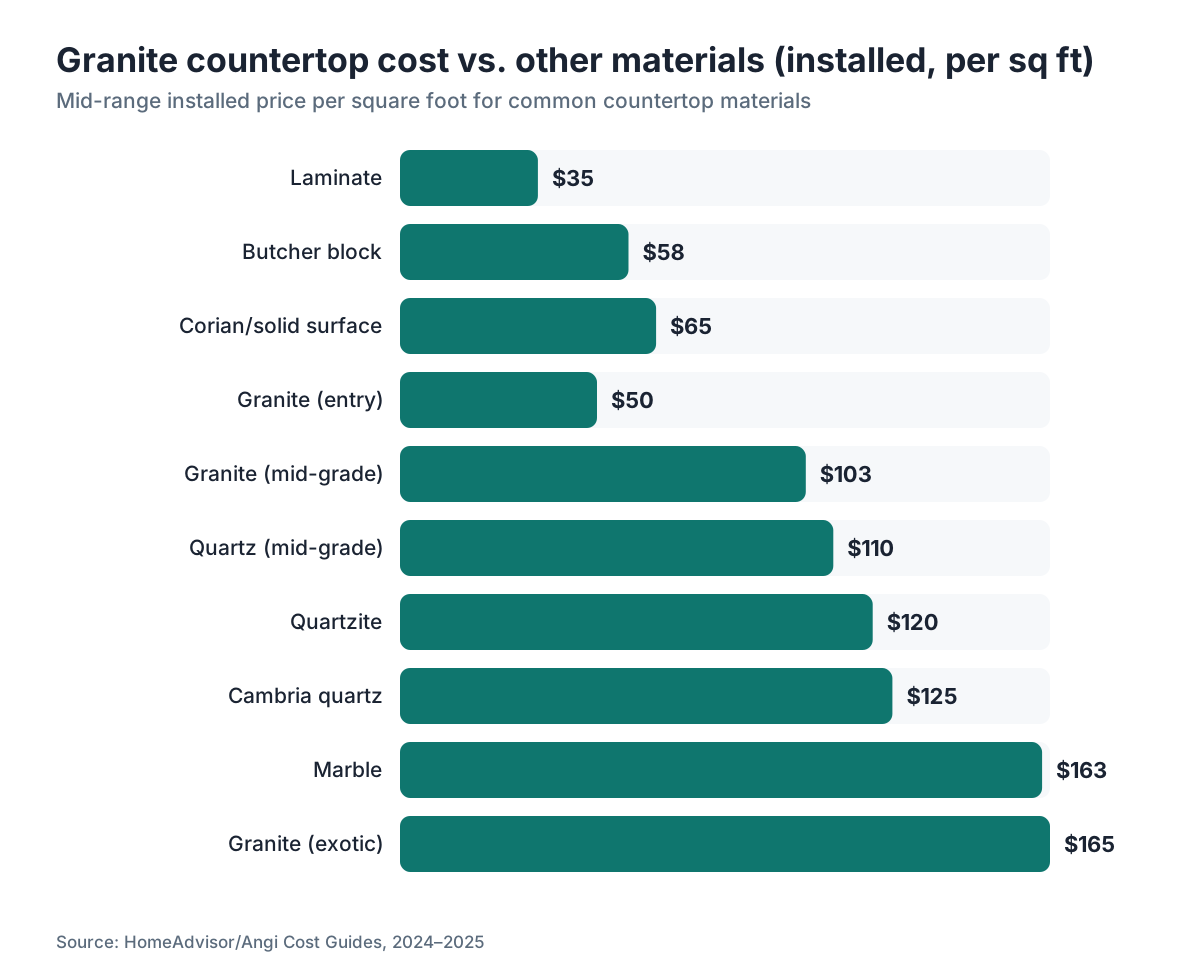
Here's a straight comparison across common countertop materials, using mid-range installed cost estimates. These reflect 2024-2025 market pricing from industry cost surveys [1][4].
| Material | Installed cost range (per sq ft) | Notes |
|---|---|---|
| Granite (entry-level) | $40, $60 | Level 1-2 slabs, simple edges |
| Granite (mid-grade) | $75, $130 | Most common kitchen installs |
| Granite (exotic) | $130, $200+ | Rare Brazilian, blue, or figured stone |
| Quartz (engineered) | $70, $150 | Brands like Cambria run $100, $150 [4] |
| Marble | $75, $250 | High maintenance, stunning look |
| Quartzite | $80, $160 | Often confused with quartz; it's natural stone |
| Butcher block | $35, $80 | Warm look, needs sealing |
| Laminate | $20, $50 | Budget option, no stone comparison |
| Corian/solid surface | $45, $85 | Joins hide well, repairable |
Granite and engineered quartz overlap heavily in the $80 to $130 range, which is why homeowners compare them nonstop. Cambria countertops run at the high end of the quartz range and beat entry granite pricing. Marble countertops can go higher than granite but ask for more maintenance. Laminate countertops and Formica countertops live in a different category entirely if budget is the priority.
The honest take: for most kitchens, granite delivers better cost-per-year than its sticker price suggests. Natural stone sealed properly lasts decades. Quartz competes on price and it's durable too, but it isn't natural stone, and some buyers care about that.
What does a typical granite countertop installation include?
Most fabricator quotes are all-in for material, fabrication, and installation. Here's what usually comes with it and what gets billed on top.
Typically included: templating (measuring and building a digital or physical template of your layout), slab material up to the quoted square footage, one standard edge profile, basic cutouts listed on the quote (usually one sink), and installation with adhesive and seaming.
Typically extra: additional cutouts beyond the first (each faucet hole, cooktop, or prep sink adds cost), premium edge profiles, a travel fee if you're outside the normal service area, removal and disposal of your old countertops (usually $150 to $400), and plumbing reconnection. Fabricators don't do plumbing, so you'll need a plumber to reconnect your sink at $100 to $300.
Some fabricators include one application of sealer. Many don't. Ask. Granite sealer is cheap ($20 to $50 a bottle retail), and applying it yourself is easy, so this isn't worth a fight.
For a full overview of what happens from template to install day, see countertop installation.
Timing matters too. From the day you sign to install day, most fabricators run 1 to 3 weeks. Custom or complex jobs take longer. Rush orders, if a shop offers them at all, add cost.
How do granite slab grades and levels work?
There's no universal grading standard for granite. That matters, because when a fabricator quotes you a "Level 2" stone, that level is internal to their pricing system, not an industry certification [2]. One shop's Level 2 might be another shop's Level 3.
What the levels generally reflect: wholesale slab cost, country of origin (Brazilian and Italian exotics cost more than Indian or Chinese domestic stone), color and pattern complexity (exotic movement means more variability and more waste per slab), and thickness consistency.
Walk into a slab yard and you'll see slabs grouped by price tier. The low tiers have plenty of inventory and predictable patterns. The high tiers might carry one or two slabs of a given lot, which means your kitchen will have seams that need careful color matching.
Stone names that reliably land in the affordable tier: Absolute Black, Venetian Gold, Giallo Ornamental, Uba Tuba, Santa Cecilia. Mid-grade reliables: Alaska White, Colonial White, White Ice, New Caledonia. Higher end: Blue Pearl (Norwegian), River White, Kashmir White, and most Brazilian exotics.
These prices move. A stone that was exotic five years ago can go common once importers bring in more inventory. Ask your fabricator what's shifted recently.
Does granite need sealing, and what does that cost?
Granite is porous. Some granites are dense enough that sealing is optional (Absolute Black absorbs almost nothing). Others, especially lighter stones with visible crystal structure, need sealing to resist staining from oil, wine, and acid [5].
Sealing at installation is often included or costs $50 to $150 as an add-on. DIY sealer runs $20 to $50 per bottle at any home improvement store, and applying it takes about an hour. You reapply every 1 to 3 years depending on the stone and how much wear it sees.
The water test is simple. Drop a tablespoon of water on the surface. If it beads up, your sealer is holding. If it soaks in within a few minutes and darkens the stone, reseal. Costs nothing, takes ten seconds.
Some fabricators use an impregnating sealer that penetrates the stone and lasts longer than surface products. Ask specifically whether they use a penetrating sealer and how long the manufacturer rates it. Brands like StoneTech and Tenax are common in the trade [5].
For ongoing care, the same rules that apply to other natural stones apply here. See how to clean stone countertops for a maintenance guide that covers granite directly.
What are the hidden costs of granite countertops buyers miss?
Old countertop removal surprises a lot of buyers. If you have existing tile, laminate, or thick stone that has to come off carefully to avoid wrecking cabinets, demolition adds $150 to $400. Some fabricators do it, some don't.
Plumbing disconnection and reconnection is another one people overlook. The fabricator sets the stone but doesn't move your plumbing. A licensed plumber to disconnect before and reconnect after runs $100 to $300, depending on your sink setup [6].
Material waste hides in the quote. Countertop quotes are priced per square foot of finished surface, but the fabricator cuts from full slabs. If your layout forces awkward cuts or leaves large scraps, that waste is already priced in (or should be). Buyers get burned when they change their mind about the stone mid-project after a slab is already bought.
Seam placement and visibility. A granite kitchen with a large island almost always has at least one seam. Seams in natural stone show more than in engineered materials because the pattern can't match perfectly across slabs. If you care about hiding seams, learn which slabs come from the same lot and plan your layout at the yard.
Lead time. If your contractor is on a tight schedule and granite takes 2 to 3 weeks, that can push your kitchen completion and cost you in temporary living arrangements or contractor idle time.
Resale value. The National Association of Realtors has consistently found that kitchen upgrades return strong value, and buyers recognize granite [7]. But this is a long-term calculation. Don't overspend on exotic stone expecting dollar-for-dollar ROI.
How do I get an accurate granite countertop quote?
Get at least three quotes from licensed fabricators, not big-box stores alone. Big-box pricing is convenient but usually runs 10 to 20 percent higher than a direct fabricator for equivalent material, and the customization options are narrower [1].
Before you call anyone, measure your countertop area. Length times depth for each run, then add them up. Include the island. Don't guess, but a rough measurement within 10 percent gives a fabricator enough for a ballpark.
Ask each fabricator to quote the same scope: square footage, edge profile (specify eased, beveled, or your preferred profile), number of cutouts, and whether removal is included. Apples-to-apples comparison falls apart if one quote includes removal and two don't.
Visit the slab yard in person before you commit. Photos of granite lie. The actual slab has variation, pattern, and movement that a website image can't capture. Pick your specific slab and write down the lot number.
Fabricators who use digital templating and CNC fabrication give more precise quotes because they can calculate material yield, waste, and edge linear footage exactly. Shops running software like SlabWise can show you a nesting layout on your actual slab before they cut, which means fewer surprises on seam placement and material use. If a fabricator can show you a digital layout at quoting time, that's a good sign they know their numbers.
For kitchen countertops more broadly, compare material options before you commit to stone. And if you're weighing granite against quartz countertops, read the granite overview first so you know what you're choosing between.
Is granite a good investment compared to cheaper materials?
Cost-per-year is the honest way to think about this. Granite installed right and sealed periodically lasts 30 to 50 years or more. Laminate lasts 10 to 20 years before it looks worn, and budget laminate sometimes chips within 5 years in a working kitchen.
At $4,000 installed for a mid-grade granite kitchen over 30 years, you're paying about $133 a year for your countertops. At $1,500 for laminate replaced every 12 years, you're paying $125 a year, plus two to three weeks of kitchen disruption each time you swap it out.
That math makes mid-grade granite roughly cost-neutral against decent laminate over time, and granite looks a lot better to buyers. The Remodeling Magazine Cost vs. Value report consistently shows kitchen remodels recoup 60 to 80 percent of their cost at resale, though the granite-specific premium depends heavily on local market expectations [8].
The case against granite: it's heavy (needs strong cabinet support), it chips on edges if you drop something hard, and a crack in the wrong place can mean a costly repair or full replacement. Fabricators repair chips and small cracks with color-matched epoxy [3], but it shows on close inspection.
Want the stone look for less? Butcher block countertops are worth a look for islands, and engineered surfaces like Corian countertops hide their joins well at a lower price point.
What should I know about granite countertop installation day?
Your cabinets must be level before the fabricator arrives. Granite won't flex to correct an unlevel cabinet run. The crew will shim, but major level problems need fixing beforehand.
Clear everything out of the upper and lower cabinets near the work area. Fabricators move heavy slabs through your kitchen, and the vibration can rattle dishes off shelves. Sounds obvious. Gets forgotten constantly.
The sink gets dropped in and dry-fit, but plumbing reconnection is on you or your plumber. Book that appointment for the same day or the day after so you're not living without a kitchen sink for a week.
Curing time matters. Most fabricators want 24 hours before you put weight on seams or lean hard on the sink area. Some two-component epoxies used for seams cure faster, but give it 24 hours anyway.
Inspect the work before the crew leaves. Check seam alignment, edge polish consistency, cutout fit, and whether the overhang is even across the run. Minor touch-ups are far easier to fix before the crew packs the truck than after.
For a detailed walkthrough of the process, countertop installation covers what to expect at every stage.
Where can homeowners find the best granite deals?
Remnant slabs are the best-kept secret for small kitchens and bathrooms. Fabricators cut remnants (leftover pieces from bigger jobs) and often sell them 50 to 70 percent below full-slab pricing [2]. A bathroom vanity, a bar top, or a small laundry room almost always fits a remnant. Many shops keep a remnant yard or a corner of the warehouse. Ask specifically.
Timing matters. January and February are slow months for most fabricators in cold-weather markets. You'll get more attention, faster lead times, and sometimes better pricing than during the spring remodeling rush.
Direct import suppliers often beat distributors on price, but minimum purchases and slab-level decisions take knowledge. If you're willing to learn the stone, buying from an importer and bringing slabs to a fabricator can shave 15 to 25 percent off material cost.
Don't buy stone from a fabricator you don't plan to use for installation. The markup is built into the full job, and fabricators sometimes won't work on stone they didn't supply (liability concerns about checking slabs for hidden cracks before cutting). If you want to supply your own stone, say so upfront.
Big-box stores (Home Depot, Lowe's) sell granite, and their prices are competitive on entry-level material. The tradeoff is less customization, longer lead times, and installation typically subcontracted to third parties whose quality varies. Read reviews about the installation experience, more than the store.
Frequently asked questions
How much does granite cost per square foot without installation?
Granite slab material alone costs $5 to $60 per square foot at wholesale, depending on grade. Retail slab pricing at a stone distributor runs $15 to $80 per square foot. Fabrication (cutting, polishing, edge work) typically adds another $25 to $50 per square foot on top of material. Fabricators rarely offer material-only quotes; they price the full scope.
What is the average cost of granite countertops for a kitchen?
Most full kitchen granite projects run $2,500 to $7,000 installed, with the national average around $3,200 to $4,500. Small kitchens under 30 square feet land closer to $2,000 to $3,500 with mid-grade stone. Large kitchens with islands, premium slabs, and multiple cutouts can push past $10,000. Your square footage and stone grade are the two biggest variables.
Is granite cheaper than quartz countertops?
Entry-level granite runs cheaper than most quartz, often $40 to $60 per square foot installed versus $70 to $90 for quartz. Mid-grade granite and mid-grade quartz overlap heavily at $80 to $130 per square foot. Premium quartz brands like Cambria typically run $100 to $150 per square foot installed, more than most granite except exotics. The gap is smaller than most people expect.
How long does granite last?
Properly installed and sealed granite lasts 30 to 50 years or longer. The stone itself doesn't degrade; what wears is the seal and, over decades, the polish on high-use areas. Chips and cracks happen if heavy objects fall on edges. A fabricator can repair chips with color-matched epoxy, but prevention (a good edge profile, careful use near corners) beats repair.
Does granite need to be sealed?
Most granite needs sealing, but not all. Dense dark granites like Absolute Black absorb very little and may not need sealer. Light-colored granites with visible crystal structure are more porous and should be sealed at installation and every one to three years. The water bead test (a spoonful of water on the surface) tells you if your current seal still holds.
Can I install granite countertops myself?
Technically possible on small projects with remnants; practically risky on full kitchens. Granite slabs are heavy (a 3 cm slab runs 18 to 20 pounds per square foot), and cutting them without a wet saw and diamond blade risks cracking. Undermount sink cutouts especially demand precision. Most fabricators won't warranty material they didn't install. DIY makes more sense for bathroom vanity tops using pre-cut pieces.
What edge profile should I choose for granite countertops?
Eased or slightly beveled edges are the most popular and cheapest. They're clean, modern, and easy to wipe down. Ogee profiles have a classical carved look but chip more easily and cost $15 to $30 per linear foot extra. Waterfall edges (stone running vertically down the cabinet side) are a big trend but add real cost, often $500 to $1,500 depending on the run. Choose based on kitchen style and how much edge traffic your household creates.
How much does it cost to remove old countertops before installing granite?
Countertop removal typically costs $150 to $400, depending on material and size. Tile removal takes more labor than laminate because of adhesive and the risk of damaging the substrate. Some fabricators include removal in their quote; most don't. Ask explicitly. Disposal fees may be separate if your area charges for construction debris.
Do granite countertops add value to a home?
Kitchen remodels consistently recoup 60 to 80 percent of their cost at resale, according to Remodeling Magazine's Cost vs. Value report. Buyers recognize granite as a quality material, and it can help a home sell faster in competitive markets. The ROI depends heavily on your local market and price point; granite in a $200,000 home adds less relative value than in a $600,000 home.
What are the cheapest granite options?
Remnant slabs are the cheapest route, sometimes 50 to 70 percent less than full-slab pricing for small kitchens or bathrooms. Among full slabs, Absolute Black, Uba Tuba, Giallo Ornamental, and Santa Cecilia are reliable low-cost options that fabricators stock in volume. Buying in January or February (slow season) and choosing a simple eased edge with no extra cutouts keeps total project cost down.
What's the difference between granite and quartzite, and does it affect cost?
Granite is an igneous rock; quartzite is a metamorphic rock made from sandstone under pressure. Both are natural stone and both are durable. Quartzite typically runs $80 to $160 per square foot installed, overlapping with mid-to-high granite pricing. The confusion with engineered quartz (a totally different product) causes endless buyer frustration. Quartzite care is similar to granite.
How do fabricators calculate the price of a granite countertop job?
Fabricators measure your countertop square footage, then factor in slab cost at wholesale, a yield adjustment for cutting waste, CNC or hand fabrication time, edge linear footage, number of cutouts, and installation labor. Most shops price per square foot all-in, with cutouts and specialty edges as line-item add-ons. Digital fabrication software calculates yield and nesting to give a precise cost before cutting.
Sources
- HomeAdvisor (Angi), Granite Countertop Cost Guide: National average granite countertop installation cost and per-square-foot price ranges for entry, mid-grade, and exotic slabs; geographic variation in labor costs
- Natural Stone Institute, Natural Stone Slab Standards and Grading: Slab grading is not universally standardized across suppliers; wholesale slab cost ranges by origin and grade; remnant pricing discount ranges
- Natural Stone Institute, Dimensional Stone Design Manual (fabrication and finishing): Edge profile labor cost differences; chip and crack repair methods using color-matched epoxy
- Cambria, Official Pricing and Product Information: Cambria engineered quartz countertops retail at the high end of the quartz range, approximately $100, $150 per square foot installed
- HomeAdvisor (Angi), Plumber Cost Guide: Plumber reconnection cost for kitchen sink after countertop replacement runs $100, $300 depending on complexity
- National Association of Realtors, Remodeling Impact Report: Kitchen upgrades including stone countertops are widely recognized by home buyers and support resale value
- Remodeling Magazine, Cost vs. Value Report 2024: Kitchen remodels recoup 60 to 80 percent of project cost at resale; ROI varies by local market and home price point
- U.S. Geological Survey, National Minerals Information Center: Dimension Stone: Granite is classified as an igneous rock; quartzite is a metamorphic rock; both are dimension stone categories tracked by USGS
- EPA, Indoor Air Quality (IAQ): Natural stone materials including granite are evaluated for indoor emissions; EPA provides guidance on building material selection
Last updated 2026-07-09