TL;DR
- Black granite countertops typically cost $40 to $200 per square foot installed, with most homeowners landing between $60 and $120.
- Stone variety drives the spread.
- Budget-grade black granite like Absolute Black runs $40 to $70 installed.
- Premium exotics like Black Fusion or Volga Blue push $130 to $200.
- Edges, cutouts, thickness, and your region move the final number.
What does black granite cost per square foot in 2025?
Black granite runs $40 to $200 per square foot installed, and that includes material, fabrication, and standard installation. The range is that wide because "black granite" covers dozens of different stones sold under one label.
Most kitchens land between $60 and $120 per square foot installed. At the low end you get entry-level slabs like Absolute Black or Black Pearl. India and Brazil quarry these in enormous volume, so supply is high and prices stay soft. At the top end sit the rare stones: Black Fusion (sold as Fusion Brown or Cosmos), Volga Blue, and Black Marinace. Those slabs have dramatic movement and small quarry output, and the price reflects both.
For a 40-square-foot kitchen, which is a common planning midpoint for U.S. residential kitchens according to NKBA design data, a mid-grade black granite runs $2,400 to $4,800 total installed. [8] A premium exotic in the same space can hit $6,000 to $8,000 before you add a single upgrade.
Here is how the number gets built. Labor alone runs $10 to $30 per square foot depending on your market, edge complexity, and cutout count. [1] Fabrication (cutting, polishing, edge work) adds $10 to $40 per square foot. The raw slab, at the wholesale price your fabricator pays, usually runs $5 to $60 per square foot depending on grade.
How do different black granite varieties compare in price?
Not all black granites are the same rock, and that changes both price and how the stone behaves. Here is how the common varieties stack up.
| Stone Name | Origin | Installed Cost ($/sq ft) | Notes |
|---|---|---|---|
| Absolute Black | India | $40, $70 | True solid black, no veining; very consistent |
| Black Pearl | India | $45, $75 | Subtle silver fleck under light |
| Black Galaxy | India | $50, $85 | Gold/copper mineral flecks; popular for kitchens |
| Impala Black | South Africa | $55, $90 | Fine grain, blue-grey undertone |
| Baltic Brown | Finland | $60, $95 | Brown and black mix; technically a dark granite |
| Black Forest | Brazil | $70, $110 | White veining on black body |
| Black Fusion / Cosmos | Brazil | $110, $160 | Gold metallic movement; visually dramatic |
| Volga Blue | Ukraine | $130, $200 | Deep blue-black with labradorite shimmer |
| Black Marinace | Brazil | $120, $180 | River-pebble look embedded in black matrix |
Absolute Black is the most available and the lowest priced. It is one of the few granites that is truly jet black with no movement at all. Some designers love that. Others find it flat. Black Galaxy and Black Pearl are the sweet spot for most homeowners who want some visual interest without paying exotic prices.
Volga Blue sits near the top of the range. It is technically a gabbro (a dark intrusive igneous rock) rather than a true granite by strict geology, but the trade sells it as granite and always has. The USGS classifies both granite and gabbro as dark intrusive igneous rocks. [2] The label does not change how the stone performs in a kitchen.
Want to compare these against other stone options? The granite countertops guide covers the full spectrum of granite pricing and characteristics.
What factors drive the final installed cost up or down?
The square foot price is just the opening bid. Here is what actually moves your total.
Slab grade and source. Commercial-grade Absolute Black from high-volume Indian quarries is cheap because supply is huge. India is the largest exporter of dimension granite to the United States, which is exactly why Indian black stones stay affordable. [6] Stones with small quarry yields cost more. Period.
Edge profiles. A standard eased edge (slightly rounded) is usually in the base price or adds $5 to $15 per linear foot. Step up to an ogee, dupont, or full bullnose and add $20 to $50 per linear foot. A waterfall edge on an island adds $300 to $800. [1]
Cutouts. Each sink cutout typically adds $150 to $300. Cooktop cutouts run about the same. Undermount sinks in thick slabs cost more because they take more time and tooling.
Thickness. Slabs come in 2 cm (about 3/4 inch) and 3 cm (about 1-1/4 inch). The Tile Council of North America treats 3 cm as the standard for natural stone in kitchens; 2 cm needs a plywood substrate. [9] Most shops now default to 3 cm. Going from 2 cm to 3 cm on the same stone adds roughly $5 to $15 per square foot in material.
Layout complexity. Angled cuts, tight corners, mitered edges, and lots of seams all mean more fabricator time. A galley kitchen with one long run costs less per square foot than an L-shape with a peninsula.
Your region. Labor swings hard by market. Shops in San Francisco or New York charge a lot more than shops in rural Tennessee or Oklahoma. BLS wage data for stone workers shows the same job can differ 30 to 50 percent between high-cost metros and lower-cost markets. [3]
Removing the old tops. Demo and haul-away adds $100 to $400 depending on material and whether the backsplash comes off too.
Sealing. Most black granites are dense and low-porosity, so they seal easily. Some shops throw in a first seal. Ongoing sealing costs $1 to $3 per square foot in materials if you DIY it every 1 to 2 years.
How does black granite compare to other countertop materials by cost?
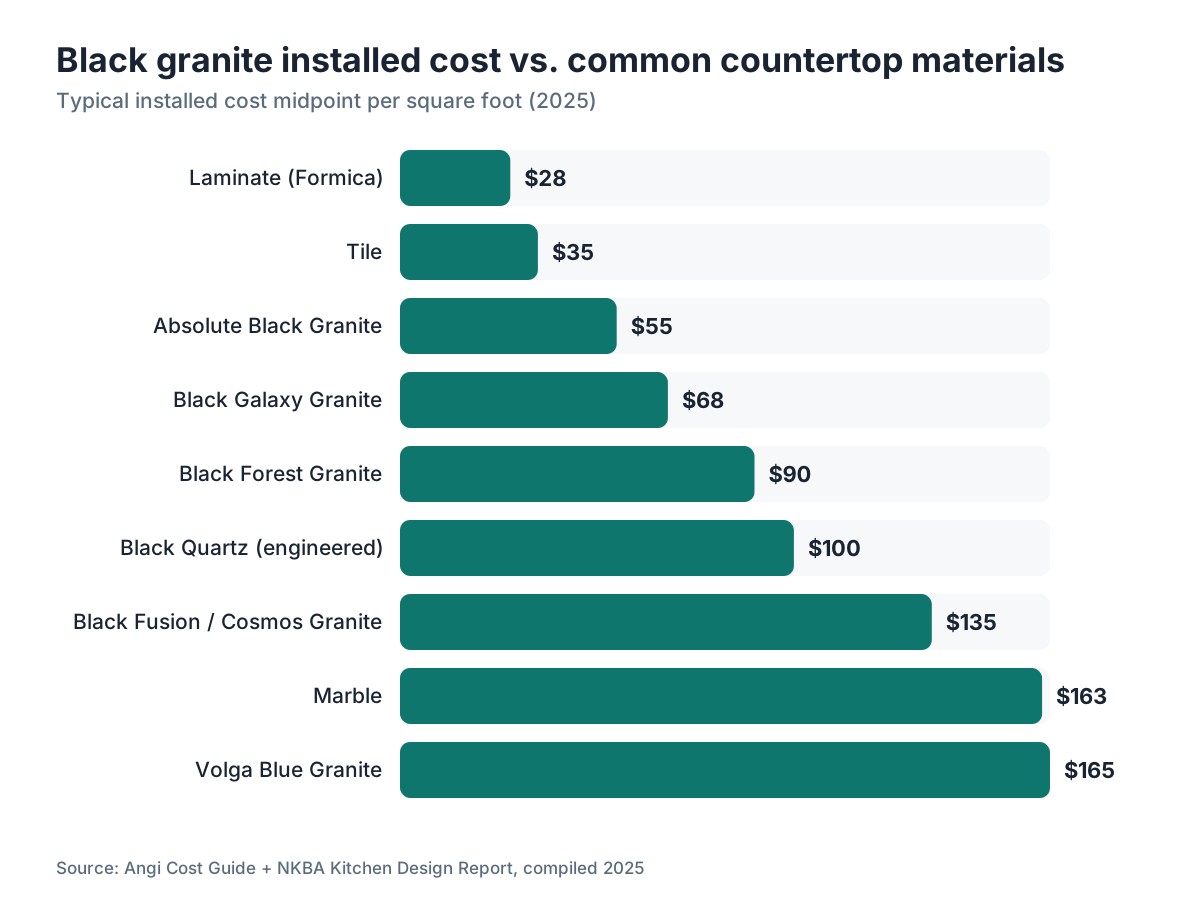
Black granite sits in the middle of the countertop price ladder. Here is how it lines up against the materials homeowners actually cross-shop.
| Material | Installed Cost ($/sq ft) | Durability | Heat Resistance | Maintenance |
|---|---|---|---|---|
| Laminate (Formica) | $15, $40 | Low-moderate | Poor | Very low |
| Tile | $20, $50 | Moderate | Good | Moderate (grout) |
| Black Granite | $40, $200 | High | Excellent | Low |
| Quartz (engineered) | $55, $150 | High | Moderate | Very low |
| Marble | $75, $250 | Moderate | Good | High |
| Quartzite | $80, $200 | Very high | Excellent | Low |
| Cambria (quartz) | $85, $140 | High | Moderate | Very low |
Formica versus black granite is the comparison homeowners make most. Laminate runs $15 to $40 per square foot installed, so laminate saves you $25 to $80 per square foot. On a 40-square-foot kitchen, that is $1,000 to $3,200 in your pocket. But laminate wears out faster, cannot take a hot pan, and reads as a negative to most buyers at resale. The laminate countertops guide and the Formica countertops guide go deeper on what you give up for the savings.
Quartz is black granite's most direct rival in the mid-range. Dark engineered quartz runs $55 to $150 installed and needs zero sealing. The catch is heat: quartz resin binders can scorch, and the pattern looks more uniform and less natural than stone. Cambria countertops are a premium quartz brand in that $85 to $140 range.
Marble countertops cost more and ask for more care. Marble etches from acid and stains more readily than nearly any black granite.
Is black granite cheaper or more expensive than other granite colors?
Black granite sits on the cheaper end of the granite color spectrum, not the pricey end. It comes down to quarry volume and how much of the stone reaches the global market.
White granites with heavy veining (Alaska White, River White) run $60 to $110 installed. Blue granites like Azul Bahia can hit $200 to $400 per square foot because the quarry output is tiny. Pink and red granites swing all over the place. Exotic multicolor granites with big crystal movement, like Fusion Bordeaux, run $100 to $180.
Solid black granites, especially the Indian-quarried ones, are among the highest-volume stones in global trade. India and Brazil dominate U.S. dimension stone imports, and that supply keeps prices soft. [7] If your goal is a dark, dramatic look for the least money in natural stone, black granite is usually the answer.
The exception is the exotic blacks. Volga Blue and Cosmic Black with heavy labradorescent shimmer price like exotic whites and blues. They are genuinely rare, and the tag shows it.
What does a full kitchen project actually cost? Real budget scenarios
Here are three kitchens with real numbers attached.
Scenario 1: Budget remodel, 35 square feet Stone: Absolute Black, 3 cm, eased edge Work: basic layout, one undermount sink cutout Estimated total: $1,750 to $2,800
Scenario 2: Mid-range kitchen, 45 square feet Stone: Black Galaxy or Black Pearl, 3 cm, slight bevel or bullnose edge Work: L-shape with peninsula, one sink cutout, one standard seam Estimated total: $3,600 to $5,400
Scenario 3: High-end kitchen, 60 square feet with waterfall island Stone: Black Fusion or Volga Blue, 3 cm, mitered waterfall edge on island Work: complex layout, two cutouts, book-matched island Estimated total: $9,000 to $14,000+
These are ranges from real jobs, not marketing bait. The waterfall island by itself adds $800 to $2,500 in labor because it needs precision mitering on thick stone.
For fabricators pricing jobs like these, the square footage and cutout count are where quotes live or die. SlabWise pulls the takeoff straight from a template or DXF file so the quote reflects actual slab yield instead of a guess.
The countertop installation guide covers what to expect on install day and how to check the work.
How do fabricators price black granite jobs? What the quote actually includes
A granite quote bundles several things into one number, and it helps to see them separately.
Most shops price per square foot with these already baked in:
- The wholesale slab cost plus markup (usually 30 to 60 percent over what they paid)
- Standard fabrication (cutting, edge work, polishing)
- One or two cutouts (extras charged separately)
- Basic installation including sink support clips
What is usually left out:
- Plumbing reconnection after the sink goes in
- Backsplash tile work
- Demo and disposal of old tops
- Permits (rarely needed for countertops, though some jurisdictions require them for structural changes)
- Haul-away of old material
Stone shops buy slabs from importers and distributors. A slab of Absolute Black might cost the shop $200 to $400 (a standard slab runs 45 to 55 square feet). A Black Fusion slab might run $800 to $1,500. Add fabrication labor at $15 to $35 per square foot, plus edge work, overhead, and markup, and you get the quote in front of you.
Shops that show you the actual slab before cutting are doing you a favor. With black granites that have movement, like Black Forest or Black Fusion, the specific slab changes the whole look. Ask to pick yours from the yard.
Does black granite increase home resale value?
Granite countertops have shown up as a positive at resale for years. The National Association of Realtors tracks this in its Remodeling Impact Report, which finds kitchen upgrades among the top projects for recouping value at sale, with natural stone countertops viewed positively by buyers. [4] The exact percentage swings by market and project scope.
Black granite polarizes buyers less than the loud exotic colors. It photographs clean, modern, and neutral in staging. A solid black counter in a white kitchen is one of the most-shared kitchen looks going right now, so buyers recognize it and respond to it.
Here is the honest limit. No countertop saves a failing kitchen. Dated cabinets, an awkward layout, or tired appliances will drag the appraisal no matter what you put on top. The value comes from the whole room reading well together.
Want the stone look with less upkeep (no sealing, less edge-chip risk)? The kitchen countertops guide is worth comparing against granite.
What are the pros and cons of black granite countertops?
Black granite has real strengths and real headaches. Here they are without the sales pitch.
Pros:
Heat resistance is genuine. Set a hot pan on black granite and it will not scorch, melt, or discolor. That beats quartz, laminate, and most solid surface.
Scratch resistance is excellent. Granite rates 6 to 7 on the Mohs hardness scale, making it one of the hardest surfaces in a residential kitchen. [2] Normal use will not mark it.
Longevity is real. A properly installed and occasionally sealed granite counter can outlast the house. There is no realistic wear-out scenario.
Cost for the look. For a natural stone surface that reads high-end, black granite is one of the cheapest ways in.
Cons:
Fingerprints and water spots show constantly on polished black. This is the number-one real-world complaint. Leathered and honed finishes cut it way down.
Seams show in black. Dark stone reveals seams more than light stone, especially under certain lighting. A skilled fabricator minimizes them but cannot erase them.
Edges chip. Thin or sharp profiles on dark stone eventually chip. A thicker profile (eased or dupont) holds up far better than a pencil or knife edge.
Resin fill. Some black granites, Absolute Black especially, get sold with resin or epoxy filling to mask pits or hairline cracks. That is standard practice for lower grades, not fraud, but the surface can look different in a few years as the filler ages. Ask your supplier where the slab falls.
For care once it is installed, the how to clean stone countertops guide covers daily wipe-down through stain removal.
Honed vs polished vs leathered black granite: does finish affect cost?
Yes. Finish changes both cost and appearance. Polished is the default and usually sits in the base price. Honed (matte) and leathered (textured) finishes take extra processing and typically add $5 to $20 per square foot.
Polished black granite is glossy and throws light, which pushes the drama on stones like Black Galaxy or Volga Blue. The trade is that every fingerprint and water drop reads loud.
Honed black granite has a flat matte face. It hides fingerprints far better. The color reads a touch lighter and less saturated than polished. It seals the same as polished, though some sources note matte finishes may need sealing slightly more often because they are marginally more porous. [5]
Leathered finish comes from running diamond-tipped brushes over the surface to raise a slight texture. It hides fingerprints and adds a tactile feel. It is the priciest finish, and it genuinely looks like nothing else in a kitchen. Not every stone takes it well. Absolute Black and Black Pearl leather beautifully. Stones with heavy mineral movement can go muddy.
My honest pick for most black granite kitchens is leathered, budget permitting. It kills the fingerprint problem that causes the most daily annoyance.
How to get the best price on black granite without getting burned
Here is what I would actually do buying black granite today.
Get three quotes, then go stand in each shop's yard. Online stone quotes are notoriously loose because material quality varies slab by slab. A shop quoting "Absolute Black" might be holding tight-grained Grade A stone or bargain material laced with hairline cracks. See what you are buying.
Ask about remnants. If your kitchen is under 25 square feet, a shop's remnant pile can hold exactly what you need at 40 to 60 percent off full slab pricing. This is the best-kept secret in the business for small jobs.
Make them itemize. Ask for slab cost, edge profile per linear foot, cutout charges, installation, and hauling as separate lines. Shops that bundle are not hiding anything, but itemized numbers let you compare quotes head to head.
Time the buy. Shops often run end-of-year or slow-season deals, and January and February are usually dead in colder markets. Not guaranteed, but worth asking.
Do not cheap out on thickness. Moving from 2 cm to 3 cm costs more upfront but saves on substrate and makes the install more durable. Most experienced fabricators default to 3 cm for kitchen work anyway.
For a rough number before you call anyone, SlabWise has a quote tool that ballparks by material and square footage, so you can tell whether a shop's number is in the right universe.
Comparing black granite to a cheaper alternative for an island? The butcher block countertops guide is worth a read where heat and scratch resistance matter less.
What should fabricators know about quoting and nesting black granite jobs?
For shop owners reading this, black granite has quirks that hit profitability directly.
Absolute Black is easy to underquote. The material is cheap, so shops accept thin margins figuring it is a volume play. But dense black stone eats blade life faster than softer granites, and it kicks up respirable silica like any other stone cut, which OSHA regulates under 29 CFR 1910.1053. [10] Factor tooling and dust control into the real cost.
Book-matching exotic blacks (Black Fusion, Marinace) burns real time on the template and layout side. Pricing a waterfall island with a book-matched face means the seaming has to be dead-on, and black stone is less forgiving than a busy white where pattern movement hides small misalignments.
Nesting matters most on the exotics because waste hits margin directly. A 45-square-foot slab of Volga Blue you paid $1,200 for should yield every usable inch. Good nesting software tells you how many slabs the job needs and where to place cuts to minimize drops. Keep the drops as sellable remnants, not landfill.
Running multiple black jobs at once (common for production builders on Absolute Black or Black Pearl) is where inventory tracking earns its keep. Committing the same slab to two jobs is a costly mistake, and it is the exact workflow SlabWise was built to prevent.
Frequently asked questions
How much does black granite cost per square foot installed?
Installed black granite runs $40 to $200 per square foot depending on the stone variety. Entry-level options like Absolute Black and Black Pearl land at $40 to $75 installed. Mid-range stones like Black Galaxy run $50 to $90. Exotic varieties like Volga Blue and Black Fusion push $130 to $200 per square foot installed, including fabrication and standard installation labor.
What is the cheapest black granite for countertops?
Absolute Black granite from India is consistently the least expensive black granite, typically running $40 to $70 per square foot installed. It is quarried in high volume, which keeps prices low. Black Pearl and Black Galaxy from India are close behind at $45 to $85 installed. All three are good quality stones, just with limited visual movement compared to exotic varieties.
Is black granite more expensive than white granite?
Generally no. Most popular black granites (Absolute Black, Black Galaxy, Impala Black) cost less than popular white granites with heavy veining like Alaska White or White Ice. Exotic black stones like Volga Blue are an exception and can beat mid-range whites on price. As a category, black granites have strong global supply, which keeps average prices lower.
How does the cost of Formica countertops compare to black granite?
Formica laminate runs $15 to $40 per square foot installed, versus $40 to $200 for black granite. On a typical 40-square-foot kitchen, that is roughly $1,000 to $3,200 in savings with laminate. Laminate cannot handle direct heat, scratches more easily, and most buyers read it as lower-end at resale. Granite costs more upfront but lasts longer and holds better resale appeal.
Does black granite need to be sealed?
Most black granites, especially dense varieties like Absolute Black and Impala Black, are low-porosity and need minimal sealing. A water test tells you: pour water on the surface, and if it beads up and does not darken the stone after 10 minutes, you are fine. Most black granites benefit from sealing every 1 to 3 years. Sealer costs roughly $30 to $60 per bottle, and one bottle usually covers a full kitchen.
Why does polished black granite show so many fingerprints?
Polished black surfaces show oils and water because the glossy finish reflects light directly, and any residue interrupts that reflection and becomes visible. The fix is a honed or leathered finish, which cuts the reflection. If you keep polished, a quick microfiber wipe after cooking handles it. Some homeowners use a granite sealer with a light polish agent that makes prints bead up instead of streak.
How long does black granite last?
Granite countertops can last the lifetime of a home when properly installed and occasionally sealed. Granite rates 6 to 7 on the Mohs hardness scale, so it resists scratching well. The most common failures are chips at unsupported overhangs or thin edge profiles, not surface wear. A well-installed 3 cm black granite counter set today could easily still be in service 50 years from now.
Is black granite good for kitchens?
Yes, with a few real tradeoffs to know upfront. Black granite handles heat from pots and pans without damage, resists scratching well, and holds up to daily cooking. The main complaints are fingerprints on polished finishes and visible seams under certain lighting. A leathered or honed finish solves the fingerprint problem. Islands and perimeter counters are both good applications.
How much does a black granite kitchen island cost?
A granite kitchen island countertop typically costs $1,500 to $6,000+ depending on size and stone. A 25-square-foot island in Black Galaxy with an eased edge runs roughly $1,500 to $2,500 installed. Add a waterfall edge on two sides and that is $800 to $2,500 more in labor. Book-matched exotic slab islands (Black Fusion, Volga Blue) in larger formats can reach $5,000 to $12,000 for the top alone.
What edge profile is best for black granite?
Eased, slightly beveled, or dupont profiles hold up best on black granite. These thicker profiles chip less than pencil, knife, or thin waterfall edges. Ogee edges look elegant but have a sharp upper lip that can chip on dense black stone. For high-use kitchens, an eased or small bevel is the practical choice. Save decorative profiles for lower-traffic spots like bathroom vanities.
Can I get black granite remnants to save money?
Yes, and it is one of the best ways to cut costs on small projects. Shops pile up drop pieces from larger jobs. For bathroom vanities, small kitchen sections, or bar tops under 20 to 25 square feet, remnants often work at 40 to 60 percent below full slab pricing. Call local shops and ask what they have in stock. Availability changes week to week and is rarely listed online.
How does black granite compare to black quartz in cost?
Black quartz (engineered stone) typically runs $55 to $150 per square foot installed, overlapping heavily with mid-range black granite. Absolute Black granite usually costs less than comparable black quartz. Premium granite exotics cost more than most quartz. Quartz needs no sealing and has a more uniform pattern; granite has natural variation. Heat resistance goes to granite. Both are durable for kitchen use.
What is Volga Blue granite and why is it so expensive?
Volga Blue is a dark igneous stone (technically a gabbro) quarried in Ukraine, prized for its deep blue-black body with labradorescent shimmer that catches light. Limited quarry output and steady designer demand make it one of the priciest black-family stones at $130 to $200 per square foot installed. Supply has also been squeezed by regional geopolitical instability in recent years, adding pressure to pricing.
Do black granite countertops add resale value to a home?
Natural stone countertops including black granite consistently show up as a positive in home resale data. The National Association of Realtors Remodeling Impact Report shows kitchen upgrades recouping meaningful value at sale, especially in markets where stone counters are the baseline for move-in-ready homes. Black granite photographs well for listings and appeals broadly to buyers. The value added depends heavily on the overall kitchen condition.
Sources
- Angi (formerly HomeAdvisor), Granite Countertop Cost Guide: Labor for granite countertop installation typically runs $10, $30 per square foot; edge profile upgrades add $20, $50 per linear foot for decorative profiles
- U.S. Geological Survey, Mineral Resources Program: Granite and gabbro are both dark intrusive igneous rocks; granite rates 6 to 7 on the Mohs hardness scale
- U.S. Bureau of Labor Statistics, Occupational Employment and Wage Statistics: Regional labor cost variation in stone fabrication and installation can differ by 30 to 50% between high-cost metros and lower-cost rural or mid-tier markets
- National Association of Realtors, Remodeling Impact Report: Kitchen upgrades including countertop replacement are among the top projects for recouping value at resale, with natural stone countertops viewed positively by buyers
- Natural Stone Institute, Care and Maintenance Guidelines for Natural Stone: Honed and matte stone finishes may require slightly more frequent sealing than polished surfaces due to marginally higher surface porosity
- U.S. Geological Survey, National Minerals Information Center (Dimension Stone): India is a leading exporter of dimension granite to the United States, explaining the high availability and relatively low cost of Indian black granites like Absolute Black and Black Galaxy
- U.S. International Trade Commission: India and Brazil are dominant sources of imported dimension stone (including black granites) to the United States; import volume directly affects domestic wholesale pricing
- National Kitchen and Bath Association (NKBA), Kitchen Design Report: Average kitchen countertop area in U.S. residential kitchens is approximately 30 to 50 square feet, with 40 square feet as a commonly cited midpoint for planning purposes
- Tile Council of North America, Installation Standards: Standard countertop thickness in the U.S. is 3 cm (approximately 1-1/4 inch) for natural stone slabs in kitchen applications; 2 cm slabs require additional substrate support
- Occupational Safety and Health Administration (OSHA), Crystalline Silica: Stone fabrication including granite cutting and polishing generates respirable crystalline silica; OSHA regulates permissible exposure limits under 29 CFR 1910.1053
Last updated 2026-07-10