TL;DR
- Black pearl granite is a dark, sparkle-flecked igneous stone quarried mainly in India and Norway.
- Installed cost runs $40 to $100 per square foot depending on slab grade and edge profile.
- It needs sealing every 1 to 3 years, shrugs off heat, and works in kitchens and baths.
- The real-world catch: fingerprints and water spots show constantly on a polished finish.
What exactly is black pearl granite?
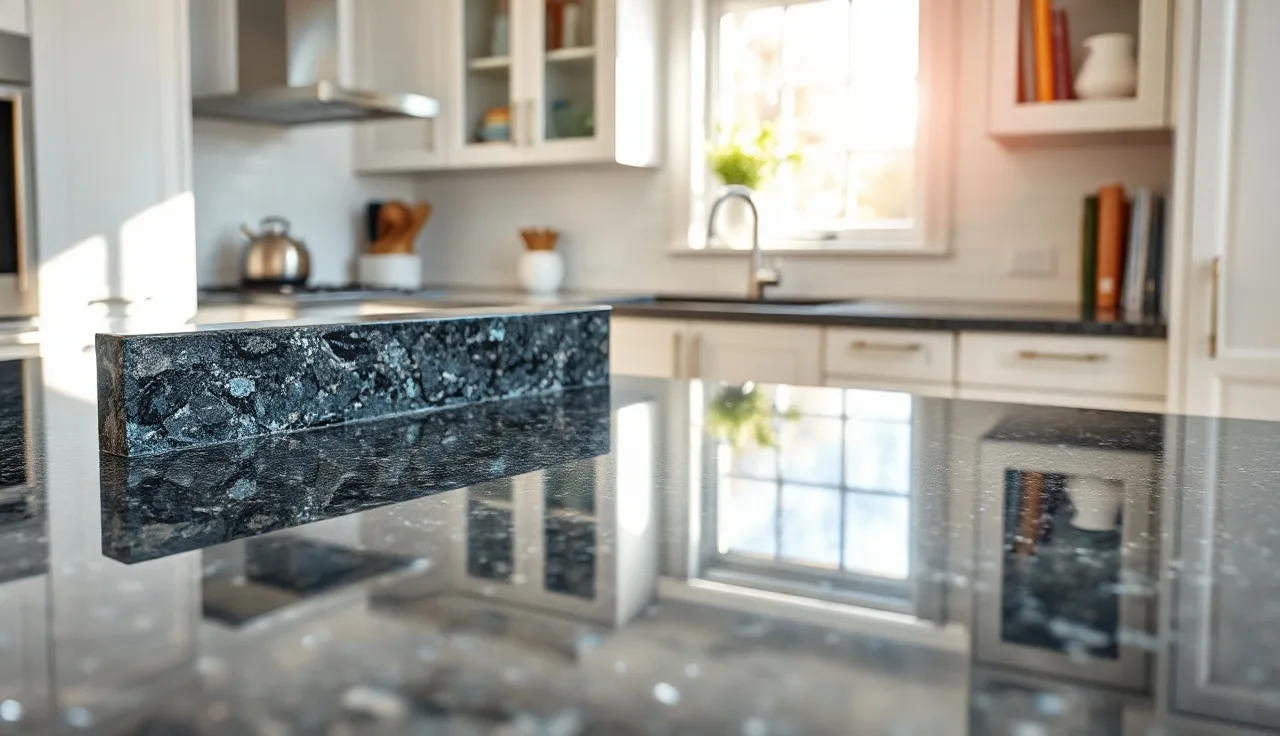
Black pearl granite is a natural igneous rock, classified as a larvikite or a dark biotite granite depending on which quarry it came from. The prized version comes from the Larvik region of Norway, where the stone's blue-silver shimmer (called schiller or labradorescence) comes from feldspar crystals that catch light at different angles. A second, far more available commercial version is quarried in Andhra Pradesh, India, and sold under the same trade name. The Indian material shows a warmer, less iridescent sparkle. It's the slab you're most likely to find at a big-box stone yard in the United States.[1]
Both types share a near-black base with silver, grey, and sometimes teal flecks. The pattern is fairly uniform, which is part of the draw. You don't have to fight dramatic veining that refuses to match at a seam. That consistency also makes fabricators happy, because waste from a bad layout stays low compared to high-variation stones.
"Black pearl" is a trade name, not a geological one. Different suppliers hang it on slightly different materials, so always look at the actual slab. Color, crystal size, and iridescence swing noticeably from bundle to bundle.
How much do black pearl granite countertops cost?
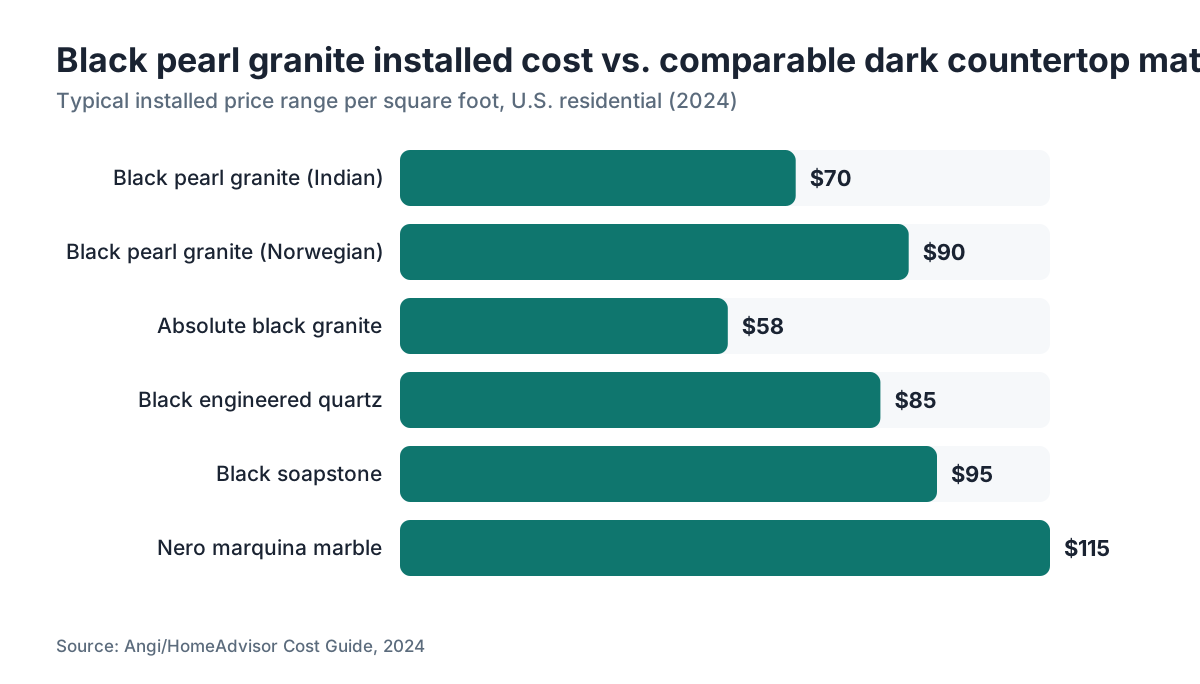
Installed cost across the U.S. typically lands between $40 and $100 per square foot, with most projects settling in the $55 to $75 range for mid-grade material and a standard edge.[2] That number covers the slab, fabrication (cutting, polishing edges), and basic installation. It does not cover demolition of old countertops, plumbing reconnection, or unusual structural work.
Slab-only prices at the yard, before any labor, usually run $5 to $20 per square foot for Indian black pearl and $15 to $35 for Norwegian larvikite. The Norwegian material costs more because quarry volume is lower and shipping is longer.[2]
Several things move your final number:
- Finish. A leathered or honed finish typically adds $10 to $20 per square foot over a standard polish.
- Edge profile. A simple eased or beveled edge is usually baked into a base quote. An ogee or waterfall edge can add $15 to $40 per linear foot.
- Thickness. 3cm (about 1.25 inches) is the U.S. residential standard and the most common pick. 2cm slabs cost less but need a plywood substrate and show up less often on counters.
- Layout complexity. Islands, curved edges, cooktop cutouts, and farmhouse sink cutouts each add fabrication time.
- Region. Labor in coastal metros runs 20 to 40% higher than in the Midwest or rural South.[2]
For a typical kitchen of 45 to 55 square feet of counter, total installed cost commonly lands between $2,500 and $4,500. A premium Norwegian slab in a high-labor market can clear $6,000 without much trouble.
Want a fast budget number before you call a fabricator? The instant quote tool at SlabWise takes your layout dimensions and returns a rough range in minutes.
For context on where black pearl sits in the broader granite countertops market, granite overall averaged about $50 to $100 per square foot installed in 2024. That puts black pearl squarely mid-tier.[2]
How does black pearl compare to other dark countertop materials?
Dark countertops are a category, not a single product. Here's how black pearl granite stacks up against the competitors people actually cross-shop.
| Material | Installed cost (per sq ft) | Hardness (Mohs) | Needs sealing? | Heat resistance | Fingerprint visibility |
|---|---|---|---|---|---|
| Black pearl granite | $40, $100 | 6 to 7 | Yes, every 1 to 3 yrs | Excellent | High (polished) |
| Black soapstone | $70, $120 | 1 to 2 | No (oil instead) | Excellent | Low |
| Black quartz (engineered) | $60, $110 | ~7 | No | Moderate | Moderate |
| Absolute black granite | $35, $80 | 6 to 7 | Yes | Excellent | High |
| Nero marquina marble | $80, $150 | 3 to 4 | Yes, frequently | Poor | Moderate |
| Matte black granite (honed) | $50, $120 | 6 to 7 | Yes, more often | Excellent | Low, Moderate |
A few things jump out. Marble countertops like nero marquina look stunning and cost more, but they etch from acids: lemon juice, vinegar, wine. Black soapstone is softer than any granite, scratches easily, and wants periodic oiling instead of sealing, close to how you'd treat butcher block countertops. Engineered black quartz skips sealing but can discolor under long UV exposure and doesn't survive a hot pan set straight on the surface as well as stone does.[3]
The schiller is what separates black pearl from absolute black granite. Absolute black is a true gabbro and shows almost no crystal movement. Want the sparkle? Black pearl. Want a flat, matte void of color? Absolute black, or a honed finish on that same material, is closer to the picture in your head.
Matte black granite countertops, meaning a honed or leathered finish on black pearl or a similar dark granite, took off around 2020 because they hide fingerprints far better than a mirror polish. The trade-off: honed surfaces are more porous and want sealing more often, maybe every 12 to 18 months instead of every 2 to 3 years.
What are the real pros and cons of black pearl granite?
Let's be direct about both sides.
What genuinely works well:
Hardness is real. Granite rates 6 to 7 on the Mohs scale, so your knives won't scratch it under normal use, though you'll dull those blades fast if you cut directly on it.[4] Heat resistance is legitimate too. A hot pan off the stove won't crack or scorch the stone the way it can stress quartz or warp laminate. The dark color hides stains better than white or cream stone, especially red wine or coffee that would sit visible for days on a lighter surface. And the sparkle looks good under decent kitchen lighting. People who like it tend to like it a lot.
What causes real regret:
Fingerprints on polished black pearl never quit. Every hand that touches the surface leaves a smudge. If you cook often, have kids, or just move around the kitchen a lot, you'll wipe that counter down several times a day to keep it looking clean. This is the single most common complaint in owner reviews. Take it seriously before you commit.
Hard-water spots are nearly as bad. Dishes dry in a rack, or someone wipes with a damp cloth and walks off, and the mineral deposits show clearly against the dark stone.
Sealing is required, full stop. Granite is porous to varying degrees. Black pearl isn't among the thirstiest granites, but it will drink oils and liquids without sealant, and that leads to stains that can be hard or impossible to pull back out.[5] Most fabricators seal at installation, but the coating wears off. A simple water test tells you when it's time: drop a few tablespoons of water on the surface, wait 15 to 30 minutes, and if the stone darkens where the water sat, reseal.[5]
Color variation between slabs bites on large projects. If your kitchen needs more than one slab, go to the yard and pick consecutive slabs from the same bundle. Quarry output shifts subtly even inside a single shipment.
How do you seal and maintain black pearl granite?
Sealing is easy, and most homeowners can do it themselves. Clean the surface completely, let it dry at least an hour, apply an impregnating stone sealer per the product instructions, wipe off the excess before it hazes, and let it cure.[5]
For daily cleaning, a pH-neutral cleaner or plain warm water with a soft cloth does the job. Skip anything acidic (vinegar, lemon-based cleaners) and anything alkaline (ammonia-based glass cleaners). Both break down the sealant faster, and with repeated use they can etch a polished surface. A little dish soap is fine as long as you rinse it off.[6]
For honed or leathered black pearl, the matte black granite countertops version, the same rules apply but sealing comes around sooner. Many stone care pros seal honed dark granites every 12 to 18 months rather than the 2 to 3 year interval for polished, because the open texture exposes more of the stone's pore structure.[5]
For a wider look at caring for natural stone, how to clean stone countertops covers the same principles across granite, quartzite, and similar materials.
One thing surprises new owners: the dark color makes dried water spots and cleaning residue show more than lighter stone does. Buff dry with a microfiber cloth after any wet cleaning and the counter looks noticeably better day to day. It sounds fussy. It takes about 30 seconds and turns into habit fast.
Does black pearl granite need sealing more or less than other granites?
Porosity varies by stone, not by color. The industry test is the water absorption method in ASTM C97, which measures water absorption by weight.[7] Most commercial granites fall between 0.1% and 0.6% absorption. Black pearl from India tests in the lower-middle of that range: moderately dense, but not among the tightest options.
Compare that to absolute black granite, a true gabbro that's nearly impervious and sometimes marketed as needing no sealing at all, though most stone care experts still push for at least one application. Lighter granites like Kashmir white or colonial gold run more porous and want sealing more often.
The practical plan for black pearl: seal at installation, then every 2 to 3 years for polished, or every 12 to 18 months for honed. Run the water test once a year and reseal when it fails, not on a rigid calendar. Reach for a good impregnating sealer, not a topical coating. Topical sealers leave a film that peels and ends up looking worse than no sealer at all.[5]
If you want a lower-maintenance dark stone and sealing feels like a chore you'll skip, engineered quartz in a dark color or black soapstone with its oil routine may fit your life better. Neither needs sealant the way granite does.
What finishes are available for black pearl granite, and which should you pick?
Three finishes show up commonly. Each one changes how the stone looks, how it feels, and how you'll maintain it.
Polished: The mirror-bright finish most people picture. It shows the schiller at maximum intensity. It shows every fingerprint and water spot at maximum intensity too. This is standard pricing at most fabricators and what you see in showroom displays.
Honed: A flat, matte surface with no reflective sheen. Fingerprints still appear but read far softer than on polished. The stone looks quieter and more understated. This is what people mean by matte black granite countertops in most design conversations. Honed costs more to fabricate (roughly $10 to $20 per square foot more) because the polishing step gets swapped for a multi-stage grinding process. It also wants sealing more often.
Leathered: A textured, slightly matte surface with a soft relief pattern. It hides fingerprints and dust well, has a tactile quality polished can't touch, and looks genuinely different from the other two. Leathering adds a cost premium similar to honing. Not every fabricator offers it, so ask.
My honest take: for a busy kitchen with multiple people in it daily, honed or leathered earns its premium. You'll spend far less time wiping. For a bathroom vanity or a low-traffic spot, polished is perfectly fine and shows off the stone's best feature, which is that sparkle.
For kitchen countertops specifically, finish choice matters more than almost any decision after the stone type itself.
How is black pearl granite fabricated and installed?
Fabrication follows the standard granite workflow. The fabricator takes dimensions from a template (physical or digital scan), programs a CNC waterjet or bridge saw to cut the slab to shape, then profiles the edges, cuts sink and cooktop openings, and polishes everything to the chosen finish.[8]
Black pearl's uniform pattern makes layout simpler than heavily veined stone. There's no mirror-matching veins across a seam and no planning around a dramatic movement. Here's the catch: the near-black base makes seams show more readily than lighter stone, because even a small gap or height mismatch is visible. A good fabricator uses color-matched epoxy and spends extra time aligning and leveling seams on dark stone.
Installation on standard cabinets is straightforward. The pieces get set in adhesive, shimmed level, and joined at the seams with epoxy. Weight is a real consideration. A 3cm granite slab weighs roughly 18 to 20 pounds per square foot.[9] A 50-square-foot kitchen means about 900 to 1,000 pounds of stone landing on your cabinets, so confirm cabinet condition before installation day. Old cabinets with soft floors, or cabinets that aren't well secured to the wall, can turn into a problem.
For a full walkthrough of installation day, countertop installation covers the process from template to final polish.
Fabricators running shop management and quoting software, like the tools at SlabWise, can optimize slab layouts to cut waste, which matters on a premium material where offcuts are expensive to throw away.
What design styles work well with black pearl granite?
Black pearl is flexible in ways some other bold stones aren't. The dark base reads as a neutral, and the silver-blue sparkle adds interest without locking you into a color family.
It works especially well with white or off-white cabinetry, where the contrast runs strong and the sparkle pops. It pairs naturally with stainless appliances, brushed nickel or chrome hardware, and pale grey or white subway tile. This combination is basically the standard modern-transitional kitchen of the last decade, and black pearl slides right in.
With dark cabinets, navy or charcoal in particular, the result turns dramatic and moody. You lose some contrast, but the room feels sophisticated if the lighting is right. Warm under-cabinet lighting helps a lot.
Wood accents, like open shelving in white oak or walnut, soften the stone's coolness and add warmth so the space doesn't feel cold. Find the sparkle too flashy? A honed finish cuts the visual intensity while keeping the dark color.
Black pearl is less at home in traditional kitchens with honey-toned oak or raised-panel cherry. The stone's cool tones fight warm wood. In those rooms, absolute black or a warmer dark material reads better.
For bathrooms, black pearl on a vanity top with vessel sink cutouts is a strong look, and the lower traffic means less daily maintenance than a kitchen.
How does black pearl granite hold up long term?
With reasonable care, granite countertops last the life of the building. The stone itself doesn't wear out. What degrades is the sealant, and after that the finish polish at high-friction spots like the area in front of the sink or the main prep zone.
Over 10 to 20 years of heavy use, polished black pearl may show slight dulling in the most-used areas. That's normal, and a stone restoration pro can re-polish it, though it's a specialized service that runs $5 to $15 per square foot.[10] If the finish matters to you, go in knowing it isn't permanent without maintenance.
Edge chipping happens from impact, especially on thin or sharp profiles like a pencil edge. Ogee and similar ornate profiles are actually a bit more chip-resistant, because the curved geometry spreads impact better than a square corner. A chip fills with color-matched epoxy, though on dark stone any repair stays somewhat visible under certain lighting.
Cracks from bad support or impact are rare but possible, and they trace back to fabrication or installation rather than a material defect. Make sure the fabricator uses proper support strips under any span wider than about 18 inches, especially around sink openings.
For comparison, lower-cost dark options like laminate countertops or formica countertops won't last as long under heat or impact, though they cost a fraction of granite and swap out easily.
Where is black pearl granite quarried and how does that affect availability?
Two main sources feed the market, Norway and India, and they produce meaningfully different materials despite sharing a trade name.
Norwegian larvikite comes from the Larvik region of Vestfold county. It's been quarried there for well over a century and counts as a protected geological resource in Norway.[11] Production volume is limited, exports are controlled, and the material is genuinely scarcer than Indian stone. When a black pearl quote lands at the high end of the range, Norwegian origin is usually the reason.
Indian black pearl comes mainly from quarries in Andhra Pradesh and Telangana, regions that together produce a big share of the world's commercial granite. Volume runs much higher, pricing runs lower, and availability at U.S. stone yards stays consistent. This is the material most American homeowners actually buy.
A third minor source is Zimbabwe, where similar dark stones get quarried and sometimes sell under the black pearl or black zimbabwe trade names. Color and sparkle differ from both the Norwegian and Indian material.
Availability at your local yard depends on what importers currently stock. Norwegian larvikite in particular can be hard to source in some U.S. markets. If origin matters to you, ask the yard flat out for the country of origin and look at the slab yourself. The Norwegian material's labradorescence stands out under good lighting: a broader, bluer-silver flash next to the finer, warmer sparkle of Indian black pearl.[1]
Is black pearl granite a good choice for outdoor kitchens?
Granite is one of the better natural stone picks for outdoor use, but black pearl brings specific considerations.
The stone handles temperature swings well. Granite's low thermal expansion means it resists cracking from the freeze-thaw cycles that damage softer stones.[7] In climates with hard winter freezing, though, moisture that works into unsealed pores can expand and cause spalling over time. Outdoor applications want more frequent sealing, maybe annually, with a sealer rated for exterior use.
The bigger outdoor concern with black pearl is heat absorption. Dark surfaces in direct sun get very hot. A polished black granite counter in full afternoon sun in a southern climate can reach temperatures that are uncomfortable or unsafe to touch and could, in theory, affect the adhesives at joints. Installing in a shaded or partly shaded spot, or using a lighter stone for exposed work surfaces, is worth weighing.
For outdoor kitchens in mild climates with shade, black pearl works well and holds up. For exposed surfaces in harsh climates, it's a manageable choice with proper sealing and maintenance, but lighter or more weather-tested materials like some quartzites make a more practical pick.
Frequently asked questions
Is black pearl granite good for kitchens?
Yes, with one honest caveat: polished black pearl shows fingerprints and water spots constantly in a busy kitchen. It handles heat, resists cuts, and lasts decades. If you cook a lot and don't want to wipe the counter down several times a day, choose a honed or leathered finish. That cuts fingerprint visibility significantly and keeps every durability benefit of granite.
Does black pearl granite scratch easily?
No. At Mohs 6 to 7, it's harder than nearly anything that will touch it, including steel knives. You won't scratch the stone under normal use. The reverse is true: cutting directly on granite dulls your knife blades fast, because the stone is harder than the blade steel. Use a cutting board to protect your knives, not the counter.
How often does black pearl granite need to be sealed?
For polished black pearl, every 2 to 3 years is a common guideline, though the water-drop test beats a fixed schedule. If water dropped on the surface darkens the stone within 15 to 30 minutes, reseal. Honed or leathered finishes need it more often, roughly every 12 to 18 months, because the more open surface texture absorbs liquids faster.
What is the difference between black pearl and absolute black granite?
They look similar from across the room but are different stones. Absolute black is a gabbro (not technically a granite) with almost no crystal variation, a uniformly dark surface, and nearly no sparkle. Black pearl holds feldspar crystals that reflect light with a silver or blue-silver shimmer called schiller. Want a flat, matte void of dark color? Absolute black. Want depth and sparkle? Black pearl.
Can I put hot pans directly on black pearl granite?
Technically the stone handles it. Granite's heat resistance is high, and a single hot pan won't crack or scorch it. That said, thermal shock from an extreme temperature gap, like a pan straight off a high burner onto a cold counter, has cracked granite in rare cases. Most fabricators recommend trivets as a habit to skip the risk entirely, even though the stone tolerates heat most of the time.
How do I remove water spots from black pearl granite?
Hard-water spots are mineral deposits, usually calcium carbonate. On sealed granite they sit on top and lift with a paste of baking soda and water or a commercial stone-safe hard-water remover. Never use vinegar or lemon juice to remove them; the acid etches the stone and degrades the sealer. If spots keep coming back, buffing dry after wet cleaning stops them from building up.
What edge profile works best with black pearl granite?
No single right answer, but a few practical notes. Beveled and eased edges are the most durable, because the slight chamfer resists chips better than a sharp square edge. Ogee and other ornate profiles look formal and suit traditional kitchens. Waterfall edges (the slab running vertically down the side of an island) are very current but add real fabrication cost and require a full extra slab. On dark stone, edge choice reads more clearly than on lighter stone because contrasts show.
Is black pearl granite from Norway different from Indian black pearl?
Yes, meaningfully. Norwegian larvikite has a broader, more intense blue-silver labradorescence from its specific feldspar structure and is scarcer, which drives higher cost, roughly $15 to $35 per square foot at the slab level versus $5 to $20 for Indian material. Indian black pearl has a finer, warmer sparkle. Both sell under the black pearl name, so ask the yard for country of origin and inspect the actual slab before buying.
What cabinets go best with black pearl granite?
White, off-white, and light grey cabinets give the strongest contrast and let the sparkle show. Navy and charcoal create a dramatic, monochromatic look that works with strong lighting. Warm wood tones (honey oak, golden cherry) tend to clash with black pearl's cool silver undertones. If your cabinets run warm, consider absolute black or a warmer dark stone, or set a sample in your actual space before committing.
How does the cost of black pearl granite compare to quartz?
They overlap a lot. Black pearl granite typically installs for $40 to $100 per square foot; engineered black quartz runs $60 to $110. For a 50-square-foot kitchen, the total difference in material and installation is often only a few hundred dollars. Quartz skips sealing, granite wins on heat. The choice comes down to maintenance habits and preference more than a clear price edge either way.
Can black pearl granite be used in bathrooms?
Yes, and it works very well there. Lower traffic means less fingerprint frustration, and the dark stone looks striking on a vanity top, especially with white vessel sinks or undermount bowls in bright white. The same sealing rules apply. Bathrooms hit granite with frequent moisture and soap, so annual water-drop testing and resealing when needed matters here.
What cleaners should I avoid on black pearl granite?
Avoid anything acidic: vinegar, lemon-based products, and citrus-infused all-purpose sprays. Avoid ammonia-based cleaners, including most commercial glass cleaners. Both types degrade the sealer and can etch a polished surface over time. Bleach in high concentrations can discolor the stone. Stick to pH-neutral stone cleaners or plain warm water. The simpler the cleaner, the less likely you cause damage.
Does black pearl granite increase home resale value?
Granite countertops broadly appeal to buyers, and dark stone trends well in current design preferences. The National Association of Realtors has reported kitchen upgrades among higher-return projects, though specific ROI varies by market and how the renovation is done.[12] Black pearl won't hurt resale value and often helps it, but no stone type guarantees a dollar-for-dollar return.
How long does black pearl granite installation take?
From the day you pick your slab to the day it's installed, expect 1 to 3 weeks for most residential projects. Templating happens after cabinets are set and any layout-affecting appliances are in place. Fabrication from template to ready-to-install typically takes 3 to 7 business days depending on shop workload. Installation itself is usually a single day, often 2 to 5 hours for a standard kitchen.
Sources
- Geological Survey of Norway (NGU), Larvikite mineral description: Larvikite from the Larvik region of Norway produces the blue-silver schiller effect (labradorescence) characteristic of premium black pearl granite, distinct from Indian commercial black granite
- HomeAdvisor (Angi), Granite Countertop Cost Guide: Granite countertops average $40, $100 per square foot installed in the U.S.; slab-only prices vary by origin and grade
- Natural Stone Institute, Natural Stone vs. Engineered Stone guidance: Engineered quartz can discolor from prolonged UV exposure and has lower heat tolerance than natural granite
- U.S. Geological Survey (USGS), Mohs Hardness Scale reference: Granite rates 6 to 7 on the Mohs hardness scale, harder than steel knives which rate approximately 5.5 to 6.5
- Natural Stone Institute, Care and Maintenance of Natural Stone: Granite is porous and requires impregnating sealers; water absorption test (darkening of stone within 15 to 30 minutes) indicates when resealing is needed; topical sealers are not recommended
- Natural Stone Institute, Stone Cleaning Guidelines: Acidic and ammonia-based cleaners degrade stone sealers; pH-neutral cleaners are recommended for daily granite maintenance
- ASTM International, ASTM C97 Standard Test Methods for Absorption and Bulk Specific Gravity of Dimension Stone: ASTM C97 measures water absorption of dimension stone including granite; commercial granites typically fall between 0.1% and 0.6% absorption by weight
- Natural Stone Institute, Fabrication Standards for Dimensional Stone: Standard granite fabrication involves CNC cutting, edge profiling, sink/cooktop cutouts, and finish polishing per template dimensions
- Natural Stone Institute, Stone Weight Reference: 3cm granite slab weighs approximately 18 to 20 pounds per square foot, making structural assessment of cabinet support necessary before installation
- Natural Stone Institute, Stone Restoration guidance: Professional granite re-polishing services run approximately $5, $15 per square foot depending on area size and condition
- Norwegian Ministry of Trade, Industry and Fisheries / Geological Survey of Norway, mineral resource information: Larvikite quarrying in Norway's Vestfold county is a limited, regulated geological resource
- National Association of Realtors, 2023 Remodeling Impact Report: Kitchen renovations rank among higher-return home improvement projects for resale appeal; granite countertops are cited as a buyer-attracting feature
Last updated 2026-07-09