TL;DR
- Quartz costs about $50 to $120 per square foot installed.
- Granite runs $40 to $200, depending on slab grade and where it's quarried.
- The gap comes down to one thing: quartz is made in a factory with steady costs, while granite is cut from the earth and its price swings with rarity and shipping.
- Explain those two facts honestly and most confusion disappears.
Why does this conversation matter so much?
Most customers walk in having Googled "quartz vs granite cost" and left more confused than they arrived. They've seen prices that differ by $100 per square foot with no reason given. They assume somebody is padding the bill.
Your job isn't to defend the price. It's to explain the mechanics so clearly that the customer feels smart, not pressured. The best fabricators and salespeople treat the explanation as a service.
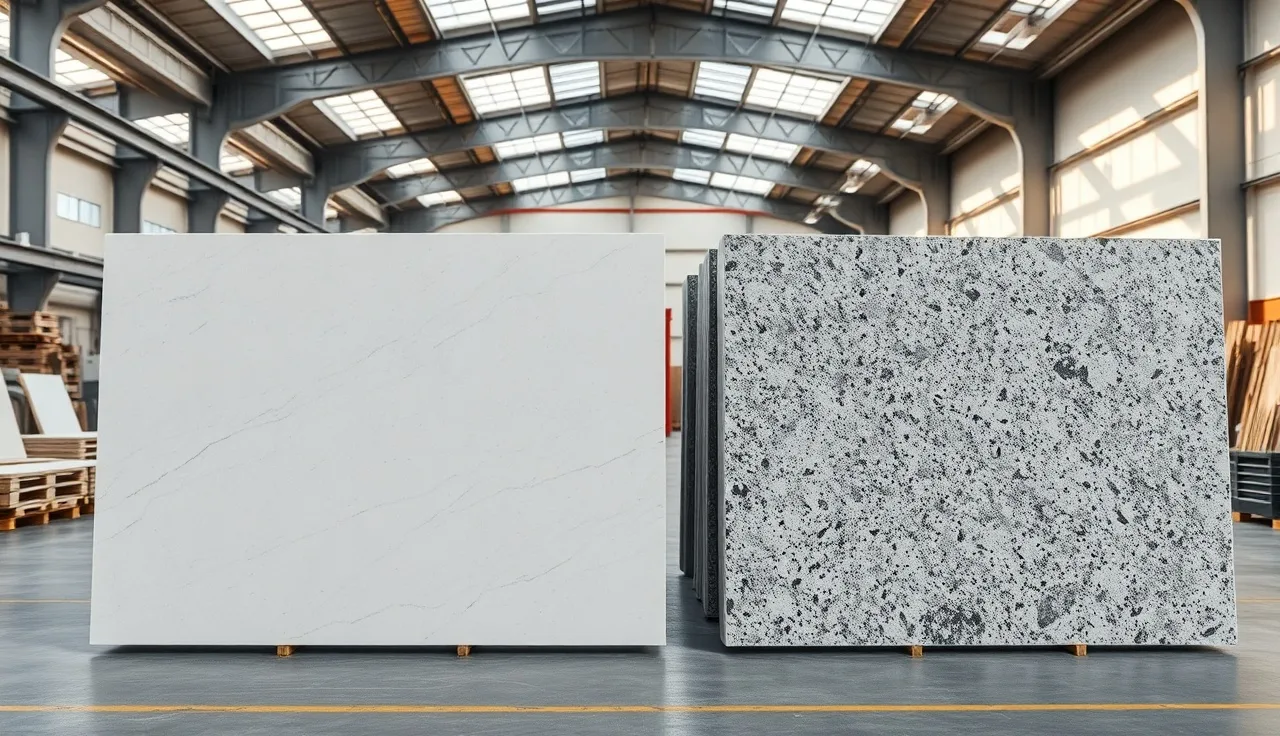
Here's the short version. Quartz is an engineered product with predictable production costs, so its price band is narrow. Granite is natural stone pulled from a quarry, so its price swings hard on rarity, country of origin, slab thickness, and demand. Two sentences. Once a customer gets those, most of the fog lifts.
What does quartz actually cost per square foot, installed?
Quartz countertops run about $50 to $120 per square foot fully installed, fabrication and basic edge work included. [1] The low end is builder-grade quartz (often thin 2 cm slabs, limited colors). The high end is designer lines from Cambria or Silestone using thicker slabs, larger formats, and more complex surface textures.
Here's how that number splits inside the shop:
| Component | Typical share of installed cost |
|---|---|
| Slab material | 40 to 50% |
| Fabrication (cutting, polishing, edge work) | 30 to 40% |
| Installation and tearout | 10 to 20% |
| Consumables (blades, adhesives, seams) | 5 to 10% |
Nobody has perfectly clean industry-wide data on these splits, but the ranges match what fabricators report across trade forums and cost surveys. Quartz material costs more than granite at the same entry price point because the manufacturing is capital-intensive. The Breton-process binder, the vacuum vibro-compaction machinery, and the quality control that keeps slabs consistent all add overhead that quarried stone never carries. [2]
For an average kitchen with about 45 square feet of countertop, that puts a quartz job somewhere between $2,250 and $5,400 before upgrades. If a customer waves a big-box ad quoting quartz at $35 per square foot, that's slab-only or a loss-leader tier. It doesn't include fabrication, edge profiles, or tearing out the old counters.
What does granite actually cost per square foot, installed?
Granite spreads much wider: roughly $40 to $200 per square foot installed, with a realistic mid-grade average around $60 to $85. [1] The low end gets you a domestic or high-volume imported granite in a common color (Uba Tuba, Santa Cecilia, New Caledonia) where slabs are cheap and everywhere. The high end gets you rare material like Blue Bahia, Cosmic Black with heavy movement, or large-format stones that toe the line between granite and quartzite.
The granite cost breakdown looks a lot like quartz:
| Component | Typical share of installed cost |
|---|---|
| Slab material | 35 to 55% |
| Fabrication | 25 to 35% |
| Installation and tearout | 10 to 20% |
| Sealing and finishing | 3 to 8% |
Fabrication for granite runs close to quartz, sometimes a bit higher on very hard stones like quartzite or dense Black Absolute because blade wear climbs. The wild card is slab cost. A builder-grade Level 1 slab might cost a fabricator $3 to $5 per square foot wholesale. An exotic Level 4 or Level 5 slab can hit $25 to $50 per square foot or more. Even a lean shop has to price that job well above the quartz midrange just to cover material. [3]
For granite countertops, slab selection is the biggest price lever there is. Two kitchens with the same layout and the same shop can differ by $1,500 on the slab alone.
What actually drives the price difference between the two?
This is the core of it. Three honest reasons.
Reason 1: How the material gets made or found. Quartz slabs are manufactured. The raw material (93 to 95% crushed quartz bound with polymer resin and pigment) is blended, pressed, and cured in a factory to spec. [2] That costs money, but it produces a known quantity. You know the color, the thickness, and that it matches the showroom sample. Granite is cut from a single block in a quarry, and every slab is different. A quarry in Brazil or India means extraction gear, cutting, container shipping, import duties, and US distribution. Supply is finite. When a popular color goes out of production or a quarry floods, prices jump.
Reason 2: Consistency against variation. Because quartz is engineered, factories run high volume and hold pricing steady. Granite prices move with raw material availability, container fuel costs, and exchange rates against big exporters like Brazil, India, and China. [4] A fabricator who bought a pallet of Colonial White last year at $4 per square foot may pay $7 today for the same stone. That volatility lands somewhere. It lands in the quote.
Reason 3: Rarity and looks. Some of what people pay for with exotic granite is genuinely irreplaceable. Want a slab of Titanium granite with gold veining? There's a finite amount of it on earth, and once the quarry runs dry, that material is gone. Quartz makers can reproduce a look forever. Neither fact is good or bad. It's a real difference that shows up in the price.
How should you explain stone grades (Level 1 through Level 5) to a customer?
Levels are shorthand, not science. A lot of customer confusion gets manufactured right here by salespeople who never explain them. There is no universal grading scale for granite. The Level 1 through Level 5 system (some shops go to Level 7) is a wholesale and retail convenience invented by individual distributors, not a geological or regulatory standard. [3]
The honest explanation: levels track how rare, thick, and visually busy a slab is, plus what the distributor paid to get it. Level 1 is usually a thin (3/4") slab of a common color quarried in bulk. Level 3 might be a 1.25" slab of a moderately rare stone with real movement. Level 5 is typically an exotic stone in a large format with dramatic patterning and short supply.
Quartz tiers are simpler because manufacturing controls most of the variables. Entry quartz is thinner, uses lower-grade resin, and comes in fewer patterns. Premium quartz (Cambria's Brittanicca, say) runs full 1.25" thickness, larger slabs, and finer surface textures. The gap between entry and premium quartz is real but tighter than granite's.
A fabricator running quoting software can attach slab cost tiers straight to quote line items and show a customer three granite options at three price points, side by side, with no mystery about what each level means. (SlabWise does exactly this.) Clear quoting kills price pushback before it starts.
Does quartz always cost more than granite?
No, and this is the most common thing customers get wrong. At the entry level, granite often beats quartz by $5 to $15 per square foot installed, because common granites are cheap material. At the mid-range ($60 to $90 installed), the two overlap heavily. At the top, exotic granite can double or triple even premium quartz.
Frame it this way for customers: quartz has a tight, predictable price band, and granite has a wide one with a lower floor and a higher ceiling.
| Material | Low end (installed) | Mid-range (installed) | High end (installed) |
|---|---|---|---|
| Entry granite | $40 to $55 | $60 to $85 | $100 to $200+ |
| Quartz | $50 to $65 | $70 to $95 | $110 to $130 |
Prices shift by region, shop overhead, and market conditions. These ranges draw on Angi/HomeAdvisor consumer cost data and fabricator trade reports as of 2024. [1]
When a customer says "I heard quartz is always more expensive," correct it gently. The low end of granite is usually cheaper. The midranges overlap. Exotic granite is where the real separation happens.
How does maintenance cost factor into the total price of ownership?
Smart customers ask about this, and it changes which material is actually cheaper over time.
Granite needs periodic sealing, and how often depends on the stone's porosity. A dense, dark granite like Absolute Black might need sealing every 3 to 5 years. A lighter, more porous stone might want it yearly. [5] Professional sealing runs about $50 to $100 for a typical kitchen, or a homeowner can DIY it with a product like Tenax Proseal for $20 to $30 a pass. Over 10 years, budget $100 to $500 in sealing for a granite kitchen.
Quartz is nonporous and never needs sealing. That's a genuine win. But quartz takes heat damage where granite usually shrugs it off. A hot pan set straight on quartz can discolor or crack the resin binder. [6] A professional repair for heat damage runs $100 to $300, and some of it is permanent.
Chipping happens to both at the edges, but quartz repairs tend to show more because color-matched epoxy rarely blends into a consistent manufactured color. Granite hides patches better because the natural variation camouflages them.
For most homeowners, the maintenance gap over 10 to 15 years is real but small. Call it $200 to $600 in granite's favor for quartz's no-sealing edge, then knock some of that back off for the heat-damage risk.
What are the most common customer objections and how do you answer them honestly?
"The store down the street quoted me granite for $35 a square foot." That's almost certainly slab-only or fabrication-only, not installed. Ask what it includes. If it truly includes everything, it's a very thin builder-grade slab with a basic edge and no sink cutout. Get the full scope before comparing.
"I heard quartz holds up better, so why isn't it always more expensive?" Durability is real but depends on the threat. Quartz resists staining better than most granite. Granite resists heat better. Neither one wins across the board. Price reflects manufacturing inputs and rarity, not a simple durability ladder.
"Why are two slabs of the same granite priced differently?" Slabs from the same quarry, even the same block, can look nothing alike. A slab with bold, even movement might cost 30% more than its dull sibling off the same production run. Visual quality moves price. Normal and true.
"Can I just buy the slab myself and hire a fabricator?" Sure, some customers do. They buy from a stone yard and hire a shop separately. It can save money but adds coordination risk. If the slab breaks during fabrication, the liability questions get ugly fast. Most fabricators would rather supply the slab because it controls quality and simplifies the job. Say that plainly.
How does installation complexity affect the final price for both materials?
Both quartz and granite price out per square foot of surface, but the final number jumps based on what the shop has to do to install it. See our guide to countertop installation for the full walkthrough.
Seam placement is a big one. A long island with no seams is cheaper per square foot than a chopped-up layout with six seams, because every seam takes skilled time to align, glue, and polish. Granite seams forgive more visually because the natural variation hides them. Quartz seams fight you on solid or subtly patterned slabs and take longer to make disappear.
Sink cutouts add $100 to $300 depending on type (undermount vs. drop-in) and the hardness of the stone. Cooktop cutouts, fancy edge profiles (ogee, waterfall, dupont), and angled or curved runs all pile on labor time, which becomes price.
Waterfall edges, where the stone runs vertically down the side of an island, keep getting more popular. They need miter cuts and careful grain matching. Quartz's consistency makes pattern-matching easier. With granite, you may have to buy a second slab just to get a bookmatched panel, which raises material cost a lot.
Staircases, laundry rooms, any job with multiple level changes: all of it adds time. A shop that quotes everything at one flat per-square-foot rate will bleed money on complex jobs or overcharge the simple ones to make up for it.
Should homeowners choose based on resale value?
The honest answer: not as much as the renovation industry wants you to believe.
The National Association of Realtors publishes a Remodeling Impact Report tracking cost recovery on renovations. Countertops as a standalone item, separate from a full kitchen remodel, don't show up as their own line in the most-cited appraisal data. What the broader remodeling numbers tell us is that a complete kitchen renovation recovers roughly 58 to 67% of its cost at resale on average. [7] The specific countertop material matters less to appraisers than the overall condition and how the kitchen hangs together.
Agents often tell sellers that quartz or granite helps the sale, and for a buyer comparing two otherwise identical homes, a stone kitchen is a positive signal. But treating a $3,000 countertop upgrade as an investment with a predictable payout isn't something the data backs up.
Better framing for the customer: buy the material you actually want to live with, because you'll live with it for 10 to 20 years before the house sells. If the mid-grade granite at $65 per square foot makes you happy and quartz at $85 doesn't, buy the granite.
How do fabricators quote quartz vs. granite differently on the back end?
This part is mostly for fabricators, but homeowners reading it will finally see why quotes sometimes look opaque.
For quartz, slab pricing is predictable. Manufacturers publish dealer price lists, and variance between slabs in the same line is tiny. A fabricator can quote a Calacatta quartz job and stay within 5% of the expected material cost. Yield waste is easier to calculate too, because slab dimensions stay consistent.
For granite, slab pricing is a moving target. The fabricator either buys from a distributor at whatever the market says today, or works off inventory bought at a different price months ago. Exotic stones may exist at only one distributor in the region. When a customer picks something unusual off a sample, the shop has to confirm current availability and pricing before committing to a number.
Nesting (cutting slabs to waste as little as possible) works differently for each. Granite comes in irregular natural sizes, roughly 9x5 feet to 10x6 feet, but the exact dimensions vary slab to slab. Quartz from the major makers is standardized, so yield math is cleaner and waste percentages more predictable.
Software that handles both materials and tracks real slab inventory (more than per-square-foot estimates) earns its keep here. SlabWise was built for this quoting problem, letting shops attach actual slab cost and dimensions to each job instead of guessing at yield.
For kitchen countertops with complex layouts, accurate nesting is the line between a profitable job and a break-even one.
How do you compare quartz and granite to other countertop materials by price?
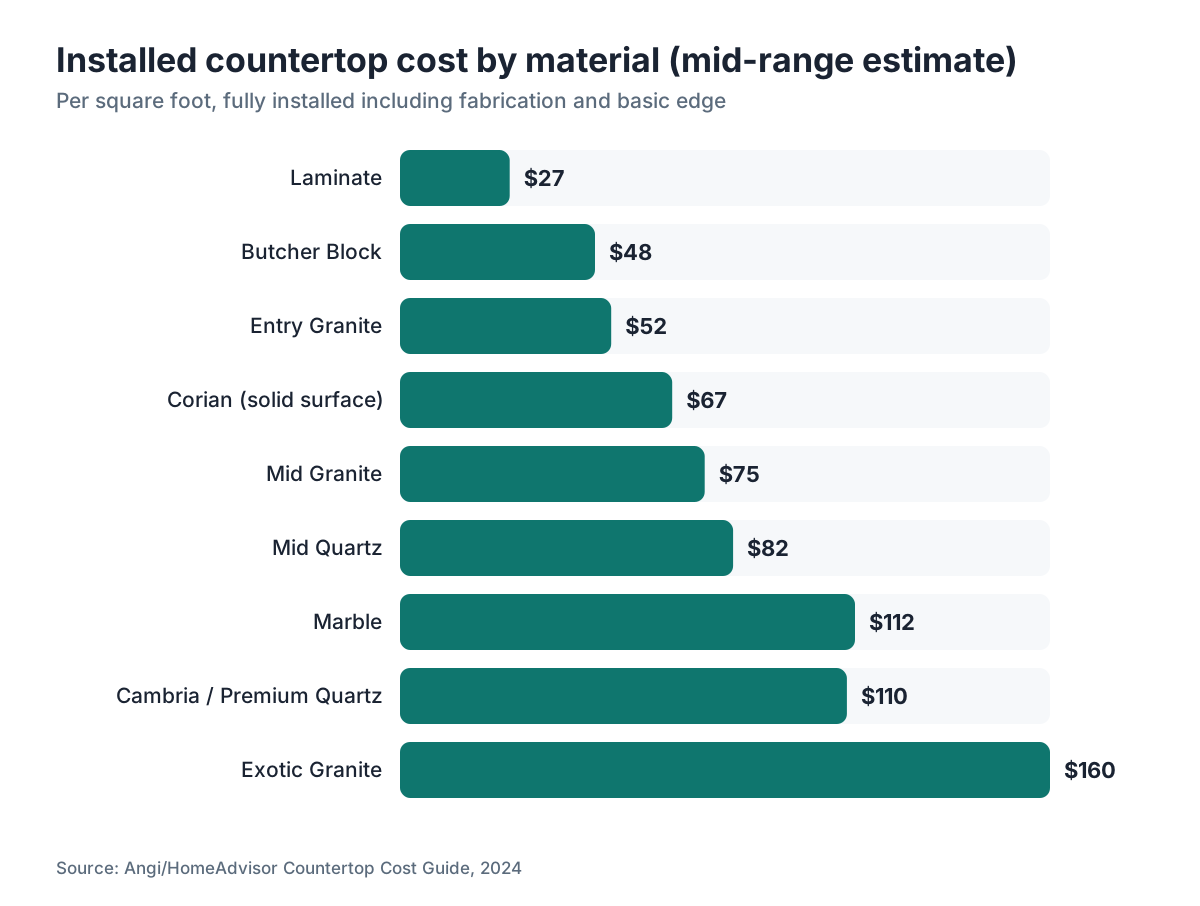
Customers need a reference frame. Here's how the common materials stack up at installed mid-range prices, drawing on published cost data. [1] [8]
| Material | Installed mid-range (per sq ft) | Notes |
|---|---|---|
| Laminate countertops | $15 to $35 | Cheapest; weak on heat and cuts |
| Formica countertops | $20 to $40 | Brand of laminate; similar range |
| Butcher block countertops | $35 to $60 | Warm look; needs oiling; not waterproof long-term |
| Entry granite | $40 to $65 | Everywhere; needs sealing |
| Mid granite | $65 to $100 | Most common residential pick |
| Quartz (mid) | $70 to $100 | Consistent; no sealing; heat-sensitive |
| Corian countertops | $45 to $90 | Solid surface; repairable; not stone |
| Marble countertops | $75 to $150 | Beautiful; high maintenance; etches easily |
| Cambria countertops | $90 to $130 | Premium quartz; US-made; lifetime warranty |
| Exotic granite | $100 to $200+ | Rare stones; price all over the map |
This table works on customers anchored to a $200-per-square-foot exotic granite quote who can't understand why it's so far above "normal" stone. It puts their options in context without any pressure.
What's the single clearest way to explain the price gap in under two minutes?
If you're at the counter and need a clean explanation you can deliver without fumbling, here it is.
Tell the customer:
"Quartz is made in a factory, so the price doesn't swing much. It runs between $50 and $120 installed for most kitchens. Granite is cut from the earth, and some stones are rare while others are common. Common granite can be cheaper than quartz. Rare granite can be twice the price of quartz. The level system on our slabs tells you where on that range you're shopping. The mid-range of both materials overlaps around $70 to $90 per square foot installed, so you're really choosing based on what you like looking at, not budget alone unless you're comparing extremes."
That's it. Two minutes, no jargon, no overselling. Customers who want more will ask. Customers ready to move will feel informed enough to choose.
The worst move is reciting features like you're reading a spec sheet. Customers buy countertops because they have a picture of their kitchen in their head. Connect that picture to the right material at a price that makes sense to them. Don't defend your margin, and don't parrot manufacturer talking points.
Frequently asked questions
Is quartz always more expensive than granite?
No. Entry-level granite commonly runs $40 to $55 per square foot installed, below most quartz that starts at $50 to $65. The mid-ranges overlap around $70 to $95. Granite gets expensive on rare, exotic slabs that can top $200 per square foot. Quartz keeps a narrower, more predictable price band. You can't say either one is always cheaper.
Why does granite vary so much in price compared to quartz?
Granite is natural stone quarried from specific spots around the world. Its price moves with rarity, country of origin, slab thickness, shipping, and demand. Quartz is manufactured with controlled inputs, so pricing stays consistent. Common granite is cheap because it exists in bulk. Exotic granite is expensive because it's genuinely rare and the supply is finite.
What does 'Level 1' or 'Level 3' granite actually mean?
These grades aren't an industry-wide standard. Individual distributors use them as shorthand for rarity, slab thickness, and visual complexity. Level 1 is typically thin, common, and widely available. Level 3 and up means rarer stone, more thickness, and bolder patterning. There's no universal definition, so always ask your fabricator what their specific levels mean in slab specs and wholesale cost.
How much does a typical granite kitchen cost installed?
For a mid-grade granite in a kitchen with roughly 40 to 50 square feet of counter, expect $2,400 to $4,250 installed. That covers material, fabrication, and basic installation including a standard undermount sink cutout. Exotic stones, complex edges, or unusual layouts push it higher. Builder-grade granite jobs can land closer to $1,800 to $2,200.
How much does a typical quartz kitchen cost installed?
A mid-range quartz kitchen of 40 to 50 square feet typically costs $2,800 to $4,750 installed. Entry-level quartz runs closer to $2,000 to $2,500 for the same footprint. Premium designer quartz (Cambria, high-end Silestone) can pass $5,500 for that job. Edge profiles, extra cutouts, and seam placement all move the final number.
Does quartz or granite add more resale value to a home?
Neither has a clear, data-backed edge for resale. The National Association of Realtors' Remodeling Impact Report shows full kitchen remodels recover roughly 58 to 67% of cost at resale on average, but countertop material alone isn't tracked separately. Appraisers weigh condition and overall kitchen quality more than the specific brand or stone. Buy what you want to live with.
Does quartz require sealing like granite does?
No. Quartz is nonporous and never needs sealing. Granite is porous to varying degrees and typically needs sealing every 1 to 5 years depending on the stone's density. Sealing costs $50 to $100 professionally or $20 to $30 as a DIY job. Over a decade, quartz's no-sealing benefit saves a few hundred dollars and some effort, though its heat-damage risk offsets part of that.
Can a customer buy granite slabs and hire a fabricator separately to save money?
Yes. Some homeowners buy slabs directly from stone yards and contract fabrication separately. It can cut material markup but adds coordination headaches. If a slab breaks during fabrication, liability between the buyer, stone yard, and fabricator gets murky. Most fabricators prefer supplying the slab to control quality and keep accountability clean. Savings exist but aren't guaranteed, and it takes more work from the homeowner.
Why does a quartz seam look worse than a granite seam in some kitchens?
Quartz seams are harder to hide because the engineered, consistent pattern makes any break obvious. On solid white or subtly veined quartz, even a flawless seam shows up close. Granite's natural variation in pattern and color camouflages seams better. Heavily veined quartz mimicking marble is especially tough at seams and needs careful placement planning.
How do edge profiles affect the price of quartz vs. granite?
Edge profiles add fabrication cost for both. A standard eased or beveled edge usually comes in the base price. Complex profiles like ogee, dupont, or waterfall miters add $10 to $30 per linear foot. Granite edge work on very hard stones takes longer and costs a bit more. On quartz, the resin means some ultra-detailed profiles chip more easily than they would on granite.
Is the price difference between quartz and granite smaller for a bathroom than a kitchen?
Yes. A bathroom vanity might be only 10 to 20 square feet of stone. The dollar difference between mid-grade granite and mid-range quartz could be just $100 to $300 for the same bathroom job. Fixed costs like delivery, setup, and a sink cutout don't scale with square footage, so the per-square-foot advantage matters less on small jobs. That's also why fabricators set minimum job charges.
How do I know if a low granite quote is legitimate or leaves something out?
Ask for an itemized quote that spells out slab cost and grade, fabrication (cutting, polishing), edge profile, number and cost of sink or cooktop cutouts, tearout of existing counters if needed, and installation. A quote that just says '$42 per square foot' for installed granite almost certainly leaves something out. The national average for a complete mid-grade granite kitchen sits higher than that. Full transparency protects the customer and the fabricator.
Can you mix quartz and granite in the same kitchen to manage cost?
Yes, and it can be a smart way to manage cost. Some homeowners run a cheaper granite on the perimeter and a premium quartz or marble on the island as the focal point, or the reverse. The trick is making the transition look intentional. A good designer or experienced fabricator can make mixed materials read as a choice, not a budget compromise.
What's the cheapest stone countertop option that still looks high-end?
A Level 1 or Level 2 granite in an interesting pattern (Santa Cecilia, Ubatuba, or New Venetian Gold are perennial picks) can look far more expensive than it costs, often $50 to $65 installed. These are high-volume stones that have looked good in millions of kitchens for decades. On a tight budget with a taste for natural stone, common granite with strong visual interest is usually the best value.
Sources
- Angi (formerly HomeAdvisor), Granite vs. Quartz Countertops Cost Guide: Quartz countertops cost $50 to $120 per square foot installed; granite runs $40 to $200 per square foot installed depending on grade and complexity.
- Breton S.p.A., Technology for Engineered Stone: Engineered quartz slabs are produced using vibro-compaction under vacuum (Bretonstone process), binding 93 to 95% crushed quartz with polymer resin under high pressure.
- Natural Stone Institute (formerly Marble Institute of America), Natural Stone Specifications and Standards: There is no universal industry-standard grading scale for granite; level designations are applied by individual distributors based on rarity, thickness, and visual quality.
- U.S. International Trade Commission, DataWeb Trade Statistics: Major granite-exporting countries to the United States include Brazil, India, and China; shipping and tariff costs contribute to domestic price volatility for imported stone.
- Natural Stone Institute, Care and Maintenance Guidelines for Natural Stone: Granite porosity varies by stone type; sealing frequency ranges from annually for porous stones to every 3 to 5 years for dense, low-porosity granites.
- Cosentino (Silestone), Technical Data Sheet and Product Care Guide: Quartz surfaces can be damaged by direct heat contact due to the polymer resin binder; hot pans placed directly on the surface may cause discoloration or cracking.
- National Association of Realtors, 2022 Remodeling Impact Report: Complete kitchen renovations recover approximately 58 to 67% of project cost at resale on average according to NAR remodeling impact data.
- Angi (formerly HomeAdvisor), Countertop Installation Cost Guide: Laminate countertops install for $15 to $35 per square foot; butcher block runs $35 to $60; marble ranges $75 to $150 per square foot installed.
- U.S. Geological Survey, National Minerals Information Center: The USGS tracks domestic quarrying output for granite and other dimension stone; natural stone supply is geologically finite and subject to quarry depletion.
- Cambria Company, Product Specifications and Warranty Information: Cambria quartz products are manufactured in the United States and carry a lifetime limited warranty covering manufacturing defects.
- U.S. Customs and Border Protection: Imported granite slabs are subject to harmonized tariff classifications under Chapter 68; tariff rates and country-of-origin rules affect wholesale stone pricing for US fabricators.
Last updated 2026-07-11