TL;DR
- A GC stone fabricator takes raw stone slabs, cuts them to your layout, finishes the edges, and installs your countertops.
- They work with general contractors, designers, and homeowners directly.
- Prices run $40 to $250 per square foot installed depending on material.
- Knowing how a shop prices and schedules work saves you from delays, cost surprises, and bad installs.
What does a GC stone fabricator actually do?
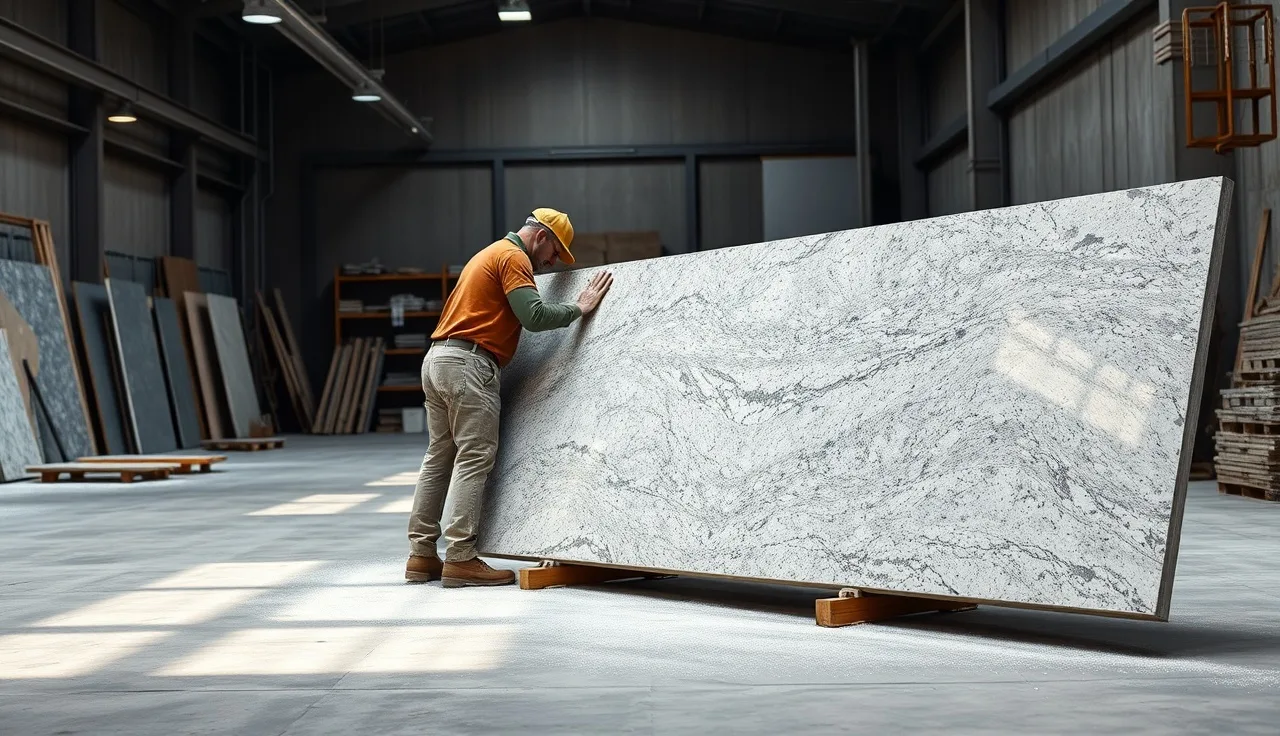
A stone fabricator does three things: templates your space, cuts slabs to fit, and installs the finished pieces. That sounds simple. In practice it involves CNC waterjet or bridge-saw cutting, edge profiling on a multi-axis router, seam planning to hide joints in the least-visible spots, cutouts for sinks and cooktops, and then a crew that carries 400-pound slabs into your kitchen without cracking a cabinet.
The "GC" part of the name means they work regularly with general contractors on residential and commercial projects. Some fabricators live almost entirely in the GC channel and rarely sell direct to homeowners. Others do both. The distinction matters when you're pricing a job. A shop that runs high GC volume has tighter margins and faster turnaround expectations baked into its workflow, which cuts either way depending on how complex your project is.
Fabrication is different from stone distribution. A distributor or slab yard sells raw slabs. A fabricator buys from the yard and does the value-add work. Some larger shops are vertically integrated, importing containers of material and running their own fabrication floor. Those shops tend to have better pricing on commodity stones like granite or quartz but less flexibility on unusual stones.
Here's the part homeowners miss. When you hire a fabricator directly, you cut out the GC markup, which typically runs 10 to 20 percent on the fabrication line item. That's real money on a kitchen. But you also pick up the coordination job yourself.
How do stone fabricators price a job?
Fabricators price by the square foot, almost always. The square footage comes off your template, not your rough estimate, so the number in a bid and the number on the final invoice should match closely. Where homeowners get surprised is the extras: sink cutouts, cooktop cutouts, edge upgrades, waterfall edges, and delivery and install fees that weren't clearly spelled out.
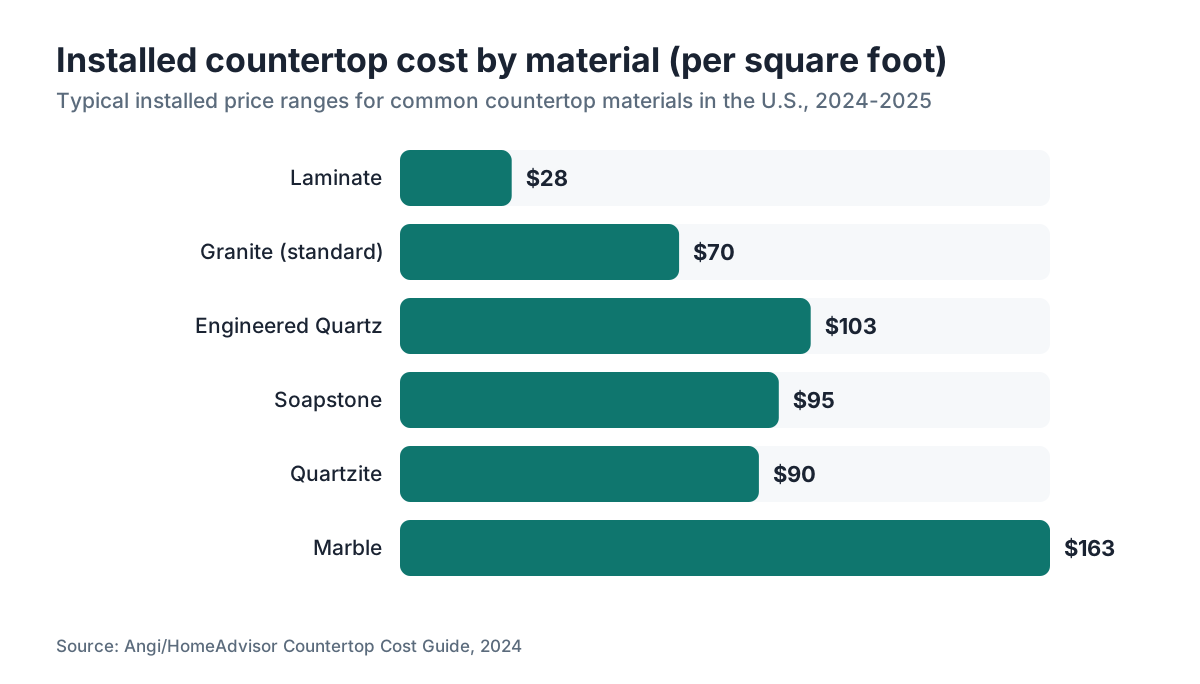
Typical price ranges in the United States as of 2024 to 2025 [1]:
| Stone Type | Installed Cost (per sq ft) |
|---|---|
| Laminate (for reference) | $15, $40 |
| Granite (standard grades) | $40, $100 |
| Quartz (engineered) | $55, $150 |
| Quartzite (natural) | $60, $120 |
| Marble | $75, $250+ |
| Soapstone | $70, $120 |
| Quartzite or exotic stone | $100, $300+ |
These are installed prices, meaning material plus fabrication plus install. Material is often 40 to 60 percent of the total, and fabrication labor is the rest [1].
Edge profiles add cost. A standard eased or beveled edge is usually included. Ogee, mitered, or waterfall edges can add $10 to $30 per linear foot or more, depending on the shop and region [2].
Sink cutouts run $100 to $250 each at most shops. Cooktop cutouts are similar. Faucet holes are cheaper, $20 to $50 each. Got a farmhouse sink with a 36-inch apron? Expect a higher cutout charge, because the geometry is harder and the risk of cracking the material at that span is real.
For fabricators quoting GC work: the GC expects your bid to cover everything, period. If installation conditions turn out harder than expected (say, out-of-square walls or load-bearing cabinets that can't be shimmed without structural work), that's a change-order conversation. Have it early.
What's the difference between a stone fabricator and a stone supplier?
A supplier, also called a distributor or slab yard, sells raw slabs. They don't cut, polish edges, or install anything. You can walk a slab yard and pick your exact piece of material, which is worth doing for any natural stone where veining and color matter, like marble or dramatic granite.
A fabricator buys from the yard and does the work. Some fabricators keep showrooms with display slabs, but those slabs are representative samples. The actual slab in your kitchen comes from the yard's stock. If you care about the exact veining on a bookmatched waterfall island, go to the yard yourself, select and tag the slabs, then have the fabricator pick them up.
Some large fabrication shops now own their own slab inventory, blurring the line. They import containers, hold 500 or 1,000 slabs in their own warehouse, and sell from that stock. This can mean better pricing and more control over material quality, but their selection is limited to what they bought. Want a particular Brazilian quartzite that isn't in their warehouse? You're either waiting on a container or going elsewhere.
For kitchen countertops specifically, the workflow that goes smoothest is this: decide on material, visit the yard (or the fabricator's showroom if they hold their own stock), select your slabs, then get the fabrication quote. Don't finalize a quote before you know the material cost. Exotic slabs can swing the total by thousands of dollars.
How does the templating process work and why does it matter so much?
Templating is the measurement step, and it's where accuracy lives or dies. A templater comes to your home (usually after cabinets are installed and level, and before any flooring goes in around the perimeter if possible) and captures the exact geometry of your countertop space.
Older shops use cardboard or luan templates cut by hand. Most modern shops use laser templating, where a device like a Proliner captures thousands of points digitally. The digital file goes straight into the CNC cutting software, cutting out transcription error [3].
Why it matters: stone can't be returned once it's cut. If the template is wrong, the slab is wrong. A bad template on a kitchen with an out-of-square corner means a gap at the wall or a piece that won't seat properly. Re-cutting means another slab, another wait, and a tense conversation about who pays.
For homeowners: make sure your cabinets are fully installed, shimmed, and level before the templater arrives. If you're adding an undermount sink, have it on site so the templater can confirm the rough opening dimensions. Some shops will template with a stand-in sink of the same model. That's fine as long as they physically have the sink dimensions confirmed.
For fabricators: templating is also your chance to flag conditions that could affect the install or the quote. Walls more than 1/4 inch out of square over a 10-foot run. HVAC vents or outlets that need to be worked around. A peninsula that overhangs farther than the cabinets can safely cantilever without support. These are change-order conversations that go better before you start cutting.
What should you ask a stone fabricator before signing a contract?
Most homeowners ask the wrong questions. They ask about price and turnaround, which matter, but skip the questions that decide whether the job goes well.
Ask where the shop's fabrication happens. Some shops that present as local fabricators are actually brokers: they take your order, send the template to another shop, and mark it up. Nothing wrong with that model, but you should know, because it affects your recourse if something goes wrong and your ability to inspect work in progress.
Ask what stone thicknesses they stock and fabricate. Most residential work uses 3 cm (about 1-3/16 inches) slabs. Some shops still carry 2 cm material, which is lighter but needs a plywood substrate for support. If you don't specify 3 cm explicitly, you might get 2 cm.
Ask about their seam placement policy. On a large L-shaped kitchen with one slab, you may need a seam. Where it goes matters. Get it in writing, ideally with a simple sketch showing the proposed seam location.
Ask who does the install. A shop that uses in-house installers generally has better accountability than one that subs the install to a crew they don't supervise directly.
Ask about their workmanship warranty. Practice varies. Some shops warrant their fabrication and install for one year. Others offer nothing in writing. Get it in writing.
Finally, ask how they handle damage. Cracks and chips happen during install. The answer to "what happens if you crack my slab on the way in?" tells you a lot about a shop's culture.
How do stone fabrication shops manage the GC relationship?
General contractors and fabricators have a codependent and sometimes contentious relationship. The GC controls the schedule. The fabricator controls the lead time. When those two collide, everyone loses.
Most residential fabrication shops run 2 to 4 week lead times from template to install in normal conditions. During construction booms that number has stretched to 6 to 10 weeks at busy shops [4]. GCs who don't build that into their schedules create the classic problem: they call the fabricator wanting an install date for next Tuesday, and the shop's calendar says three weeks out.
The best GC-fabricator relationships work because the GC treats templating and fabrication lead time as fixed constraints, not afterthoughts. The fabricator gets templated as soon as cabinets are set, submits a cut sheet and layout for approval within a day or two, and locks a confirmed install date before cutting starts.
Payment terms in the GC channel are a real friction point. Homeowners typically pay 50 percent at contract and 50 percent at install. GCs often want net-30 or net-45 terms. A fabrication shop carrying 30 days of receivables on large projects feels it in cash flow, especially if they're also financing slab inventory. Smaller shops often push back on net-30 and require payment closer to install. This is a negotiation, not a given.
For fabricators tracking multiple GC jobs at once, job-costing software stops being optional. Knowing which jobs turn a profit, which GCs pay on time, and where material waste runs over estimate is how a shop gets smarter each year. Tools like SlabWise are built for this, handling quoting and slab nesting so shops see their actual material yield per job instead of guessing.
What materials do GC stone fabricators typically work with?
The most common materials in residential stone fabrication are granite, engineered quartz (sold under brand names like Silestone, Cambria, MSI, and others), marble, quartzite, and soapstone. Some shops also work with porcelain slabs, compact surfaces, and sintered stone (like Dekton or Neolith).
Engineered quartz is the dominant product by volume in most U.S. markets. It's consistent, doesn't need sealing, and comes in predictable thicknesses. Cambria countertops, for example, are made in the U.S. from quartz and carry a limited lifetime warranty to the original purchaser, which fabricators use as a selling point [5].
Granite is still widely sold and is often the entry-level natural stone option. Pricing depends heavily on grade. Level 1 or "builder grade" granite can be installed for $40 to $60 per square foot. Exotic granites with rare color or dramatic movement cost more than some marbles.
Quartzite is a natural stone that gets confused with quartz constantly. It's a metamorphic rock, harder than marble, and needs sealing like any natural stone. It can look like marble but holds up better to acids. The cleaning and care questions come up often. This guide to cleaning quartzite countertops covers the basics.
Soapstone is a softer natural stone with a distinctive matte feel. It shows up in kitchens and labs because it's non-porous and shrugs off heat. For care information, how to clean soapstone countertops has the specifics.
Porcelain slab fabrication is a growing category, and it's harder to work with. The material is brittle and needs diamond tooling calibrated specifically for it. A shop that's great with granite isn't automatically equipped for 12mm porcelain. Ask explicitly whether the shop has experience with the exact material you want.
How does slab nesting and material yield work in a fabrication shop?
Slab yield is one of the most important numbers in a fabrication business, and most shops track it imprecisely at best. Yield is the percentage of a purchased slab that ends up in finished, installed countertops. The rest is waste: offcuts, corners, material lost to saw kerfs, and pieces that can't be used on future jobs.
A typical residential kitchen might use 50 to 55 square feet of finished countertop. A standard slab is roughly 55 to 60 square feet, though sizes vary a lot by stone type and origin [6]. That sounds like a near-perfect fit. It isn't. Seam placement, grain matching, avoiding natural fissures in the stone, and the irregular shape of most kitchens push real single-slab yield down to 70 to 80 percent before remnants are factored in.
Nesting is the process of laying out multiple job pieces on a slab to squeeze out yield. Say a shop has two jobs that each need 40 square feet and 100-square-foot slabs on hand. Good nesting might get both jobs from one slab plus a usable remnant. Bad nesting wastes 20 square feet.
For fabricators: digital nesting software has made this measurable for the first time. Manual nesting on paper or by eye loses money that shops often blame on other causes. Tracking actual yield per slab per stone type, month over month, is how you find out whether a particular material or job type is eating your margin.
For homeowners: remnants from your job belong to the fabricator unless you negotiate otherwise. If your kitchen leaves a nice piece, ask. Many shops sell remnants at a discount, and that piece could become a bathroom vanity or laundry room top for a fraction of full price.
What are the most common problems with stone fabrication jobs and how do you avoid them?
Bad seams are the most common complaint. A seam that's poorly colored, misaligned, or placed where it catches the eye every day is maddening. The best seams are nearly invisible, sitting in a low-traffic visual zone and filled with epoxy color-matched to the stone. Ask the shop to show you examples of their seam work on similar material before you commit.
Chipping at cutouts is the second most common issue, particularly on undermount sinks. The edges around the sink cutout take stress during the cutout process and again during install. Thinner materials (2 cm) chip more easily. If you see a chip, it should be addressed before the crew leaves, not after.
Uneven installation usually comes from unlevel cabinets, not bad fabrication. Stone can't flex. If the cabinets aren't level, the stone either rocks on a high point or bridges a low point. Shimming stone at install is standard practice, but there are limits. Cabinets more than 3/8 inch out of level over a 10-foot run cause real problems.
Sealing failures happen when homeowners are told their natural stone is low-maintenance and then learn it needs sealing annually or every few years depending on the stone and use. How to clean stone countertops covers sealing and daily care. Fabricators should hand every homeowner this information at install.
Delays almost always trace to one of three things: the template was done before cabinets were level (and had to be redone), the GC changed the schedule and the fabricator's slot vanished, or material availability. Exotic stones sometimes carry 4 to 8 week lead times just to get the slab, before fabrication even starts.
Price increases after the quote happen when the scope wasn't clear in the first place. A quote that doesn't line-item edge profiles, sink cutouts, and install separately is a quote that will surprise you.
How does countertop installation actually work on install day?
Install day is fast. A typical kitchen install takes 2 to 4 hours for an experienced crew. They arrive with slabs or pieces already cut, edged, and polished. The pieces go in one at a time, set in a thin bed of silicone on the cabinet tops, shimmed to level, and seamed in place.
Seams are joined with color-matched epoxy, clamped with seam setters or router-based pullers, then cleaned up with a razor blade once cured. The sink gets set into the opening and mounted from below. Backsplash pieces, if stone, go up last.
The crew will ask you to stay out of the kitchen during install for obvious reasons. After install, silicone needs 24 hours to cure before the countertop is loaded or the undermount sink plumbed in. The fabricator should give you a written care sheet. If they don't, ask for one.
For more on what the countertop installation process looks like from the homeowner side, including how to prep your space and what to check before the crew leaves, that article walks through it step by step.
Here's the thing many homeowners miss: inspect every inch before the crew leaves. Run your hand along every edge. Look at every seam from standing height and from seated height. Check the cutout edges for chips. Open drawers and cabinets to make sure nothing was overtightened or disturbed. Issues caught before the crew walks out get fixed same day. Issues caught three days later mean scheduling, liability discussions, and a lot more friction.
How do fabricators stay competitive and what separates the good shops from the average ones?
The fabrication business has consolidated significantly since 2010. Larger regional shops with CNC equipment, digital templating, and real job-costing systems have taken share from smaller shops still running bridge saws by hand and quoting from gut feel. That said, small shops that specialize, treat customers well, and return calls still do fine in most markets.
What separates good shops: digital templating (faster, more accurate, fewer remakes), experienced installation crews who've done thousands of jobs (not rotating day labor), a real quoting process that itemizes everything, and a policy of being honest when something goes wrong rather than hoping the homeowner doesn't notice.
For fabricators specifically: the shops growing profitably right now are the ones that know their numbers. What does it cost per square foot to fabricate by material type? What's their actual material yield? Which GC accounts make money and which ones cost money in rush jobs and payment delays? Most small shops can't answer those questions with any precision. Getting there takes job-costing software that connects the quote to the actual material used and hours spent. SlabWise offers a free demo for fabricators who want to see what that looks like in practice.
For homeowners: price is not the best filter. A quote $200 lower than the next shop might mean a shop that cuts corners on template accuracy or uses less experienced installers. Ask for references from recent jobs, ask to see their shop, and read actual reviews on Google and Houzz rather than curated testimonials on their website.
Frequently asked questions
How much does a GC stone fabricator charge per square foot?
Installed prices for stone countertops typically run $40 to $100 per square foot for granite, $55 to $150 for engineered quartz, and $75 to $250 or more for marble, depending on material grade and region. Edge profiles, sink cutouts, and delivery fees are often priced separately and can add several hundred dollars to a typical kitchen job.
What does a stone fabricator include in the price vs. what's extra?
Most fabricator quotes include material, cutting, one standard edge profile, and installation. Extras that are frequently not included: sink cutouts ($100 to $250 each), cooktop cutouts, upgraded edge profiles ($10 to $30 per linear foot), faucet holes ($20 to $50 each), backsplash pieces, and sealing after install. Always ask for a line-item quote so you can see exactly what's covered.
How long does stone fabrication take from template to install?
Most residential fabrication shops turn around jobs in 2 to 4 weeks from templating to install. Busy periods, exotic material availability, and large or complex jobs can push that to 6 weeks or more. Ask the shop for their current lead time at the time you book, not a general estimate, because it varies significantly with their workload.
Should I go directly to a stone fabricator or hire through a GC?
Going direct to a fabricator typically saves you 10 to 20 percent on the fabrication line item, which a GC marks up as part of their overhead and profit. The trade-off is coordination: you manage scheduling directly with the fabricator instead of the GC handling it. For a straightforward kitchen remodel where you're acting as your own GC, direct is almost always the better financial choice.
What questions should I ask a stone fabricator before hiring them?
Ask where fabrication happens (in-house or subcontracted), who does the installation, how they handle seam placement, what's included in the quote vs. extra, how they handle damage during install, and what their current lead time is. Ask to see examples of seam work on material similar to yours. Get the scope of work, seam locations, and any warranty in writing.
What's the difference between quartz and quartzite, and do fabricators treat them differently?
Engineered quartz is a manufactured product made from crushed quartz bound with resin. Quartzite is a natural metamorphic stone. They look similar in some grades but are fabricated differently. Quartzite requires sealing like other natural stones; engineered quartz does not. Both are cut and edged on the same equipment, but fabricators who specialize in natural stone tend to have more experience managing the variation in quartzite slabs.
How do I pick the right slab if I'm buying natural stone?
Go to the slab yard in person. Natural stones like granite, marble, and quartzite vary slab to slab in color, veining, and background tone, even within the same lot. Select and tag your specific slabs before ordering. If bookmatching (mirroring adjacent slabs for a waterfall or island), you need to select sequential slabs from the same bundle. Don't rely on a photo or a showroom sample for natural stone.
Can a stone fabricator do outdoor countertops or fire pit surrounds?
Many can, but not all materials are suitable outdoors. Granite and soapstone handle exterior exposure well. Engineered quartz is generally not recommended outdoors because UV exposure and temperature swings can degrade the resin binder over time. Porcelain slabs are increasingly used outdoors. Ask the fabricator specifically about outdoor applications for the material you're considering and check the manufacturer's warranty terms.
What is slab nesting and why does it affect my project cost?
Nesting is how a fabricator lays out the cut pieces from your job on the raw slab to minimize waste. Better nesting means more of the slab ends up in your countertop and less is scrapped. On a one-slab kitchen, efficient nesting might let the shop sell the remnant or use it for another job, which is part of how they manage material cost. It can also affect seam placement, since nesting decisions and seam location are linked.
What happens if the fabricator cracks my slab during fabrication or install?
A reputable shop takes responsibility and replaces the material at their cost. Get clarity on this before signing. Ask explicitly: what happens if material is damaged during fabrication or install? The answer should be clear: they replace it, full stop. If a shop hedges or talks about shared liability before the job even starts, that's a signal. Damage happens in this trade; the question is whether they stand behind their work.
Do stone fabricators do backsplash tile as well?
Some do, most don't. Stone fabricators typically handle stone or porcelain slab backsplashes, which are cut from the same material as the countertop. Ceramic or glass tile backsplashes are usually done by a tile setter, not a fabricator. If you want a stone slab backsplash (a continuous piece behind the range, for example), ask the fabricator to include it in the quote; the template and material are already on hand.
Is it cheaper to use laminate or a solid-surface material instead of stone?
Yes. Laminate countertops run $15 to $40 per square foot installed, a fraction of stone. Modern laminates like Formica have improved a lot in realism and durability, though they're not impervious to moisture at seams or heat. Solid surface products like Corian sit in the middle, around $40 to $80 installed, and can be joined into a continuous surface with invisible joints that stone can't match. Stone wins on heat resistance and longevity; laminate wins on budget.
How do I know if a stone fabricator is licensed and insured?
Licensing requirements for stone fabricators vary by state. Most states require a general contractor license for anyone doing structural or finish work. Ask for the contractor license number and verify it on your state's licensing board website. Ask for a certificate of insurance showing general liability coverage (at minimum $1 million per occurrence is typical) and workers' compensation. A legitimate shop provides both without hesitation.
What is a bridge saw and does it matter what equipment a fabricator uses?
A bridge saw is the primary cutting tool in a stone fabrication shop, a diamond blade mounted on an overhead gantry that moves across a fixed slab. More advanced shops use CNC bridge saws that read digital template files and cut automatically with high precision. Manual bridge saws require a skilled operator to cut accurately. For most standard jobs the difference is small; for complex shapes or tight tolerances, CNC equipment consistently produces better results.
Sources
- HomeAdvisor (Angi), Countertop Installation Cost Guide: Installed countertop prices by material type, ranging from $40 to $100 per sq ft for granite and $55 to $150 for quartz
- HomeAdvisor (Angi), Countertop Edge Profile Costs: Edge profile upgrades cost $10 to $30 per linear foot above standard eased or beveled edges
- Natural Stone Institute, Fabrication and Installation Resources: Digital templating captures countertop geometry as a digital file that feeds CNC cutting software, reducing measurement transcription error
- National Kitchen and Bath Association (NKBA), Industry Outlook: Fabrication lead times stretched to 6 to 10 weeks at busy shops during high-demand construction periods
- Cambria, Warranty and Product Information: Cambria offers a limited lifetime warranty to the original purchaser on their engineered quartz surfaces
- Natural Stone Institute, Stone Industry Reference: Standard residential stone slabs range from roughly 55 to 65 square feet, with variation by stone type and quarry origin
- U.S. Bureau of Labor Statistics, Construction and Extraction Occupations: Tile and stone setters and related trades are classified under construction and extraction occupations with defined licensing frameworks by state
- U.S. Small Business Administration, Apply for Licenses and Permits: State licensing requirements for contractors vary; businesses should verify requirements with their specific state licensing board
- Natural Stone Institute, Fabrication and Installation Standards: Industry standards for seam placement, substrate requirements, and installation tolerances for natural stone countertops
- Natural Stone Institute, ANSI/NSI Residential Installation Standard: Cabinets should be level to within industry tolerances before stone template; out-of-level conditions require documented field conditions
- MSI Surfaces, Slab and Countertop Product Reference: Engineered quartz product line pricing and slab size specifications for the U.S. residential market
- Occupational Safety and Health Administration (OSHA), Crystalline Silica: OSHA's crystalline silica rule requires stone fabrication shops to implement engineering controls and exposure monitoring when cutting stone containing silica
Last updated 2026-07-10