TL;DR
- Quartz countertops run roughly $40, $120 per square foot installed in the U.S., with budget slabs starting around $20, $30/sq ft material-only.
- The cheapest installed jobs land in the $50, $75/sq ft range when you pick a standard color, keep the layout simple, and shop remnants or big-box retailers.
- Going below $40 installed usually means cutting corners on fabrication quality.
What does quartz actually cost per square foot right now?
The honest range for installed quartz in 2024 is $40 to $120 per square foot, with the national average sitting somewhere around $75 to $85/sq ft [1]. That spread is wide because "quartz" covers everything from a basic white slab at a home center to a thick Calacatta-pattern slab from a premium brand with a 25-year warranty.
Material alone, before any labor, runs $20 to $65/sq ft depending on the brand, thickness, and where you buy. Fabrication and installation add another $20 to $45/sq ft [1]. Edges, cutouts for sinks and cooktops, and removal of old countertops layer on top of that.
For a typical 30-square-foot kitchen (roughly 10 linear feet of standard-depth counter), you're looking at $1,200 to $3,600 installed on the low end and $2,250 to $4,500 at mid-range prices. Those numbers assume a single straight run with one sink cutout. Add an island, a full-height backsplash, or a waterfall edge and the price climbs fast.
If someone quotes you under $35 installed, ask hard questions. That price is possible on remnant pieces or in a market with very low labor costs, but it often signals thin material (1.2 cm instead of 2 or 3 cm), a less experienced shop, or a slab with cosmetic defects.
What makes some quartz cheaper than others?
Quartz is an engineered stone: ground quartz crystals (usually 90 to 95% by weight) bound with polymer resin and pigments, then pressed and cured [2]. The core recipe is similar across brands, so where does the price difference actually come from?
Thickness is the biggest driver after brand name. Standard residential quartz comes in 1.2 cm, 2 cm, and 3 cm. Most fabricators default to 3 cm (about 1.25 inches) because it doesn't need a plywood substrate, handles edge profiles cleanly, and is harder to crack during transport. Budget jobs often spec 2 cm with a laminated edge to fake the look of 3 cm. That's a real cost saving but a real quality trade-off.
Brand premium is significant. Caesarstone, Cambria, Silestone, and Quartz Master all charge different rates, and a lot of it is marketing plus warranty confidence. Cambria, for instance, is made in the U.S. and costs more than Chinese-manufactured quartz, which has flooded the market. Generic or "private label" quartz from distribution houses can run 30 to 40% less than name-brand slabs at similar specs.
Pattern complexity also moves the price. A solid white or solid gray is cheap to manufacture. A convincing marble-look with realistic veining requires more sophisticated printing or layering, and those slabs cost more. For budget buyers, a simple speckled pattern or a clean solid is the practical choice.
Finally, the number of seams your layout requires affects cost directly. A simple straight run has one or zero seams. An L-shape, a peninsula, or an island each add seams, and each seam takes time to cut, polish, and align. Fabrication labor is real money.
Where can you buy cheap quartz countertops?
You have four main channels, and they differ meaningfully in price and service.
Big-box retailers (Home Depot, Lowe's): Both sell quartz countertops through in-store programs. Home Depot's installed quartz starts around $40, $55/sq ft for their entry-level options and they run periodic promotions that drop that further [3]. Lowe's is comparable. The upside is a fixed price, a national warranty process, and no negotiating. The downside is a limited color selection and subcontracted installation, which means quality varies by market.
Local fabricators: A regional shop can often beat big-box prices because they have direct distributor relationships and lower overhead than a national program. The range is wider, though. A well-run local shop might quote $55, $70 installed for a budget slab. A smaller operation with higher waste and less efficient cutting might quote similarly but deliver a rougher result. Getting three quotes is the minimum. Ask to see their work or visit the shop.
Remnant slabs: This is the best-kept secret for cheap quartz. Every fabricator accumulates offcuts from larger jobs. A remnant that's 25 to 40 square feet is perfect for a small kitchen, a bathroom vanity, or a laundry room. Prices for remnants run $10, $25/sq ft for material because the shop would otherwise scrap it. You still pay fabrication and installation, but the total can come in 20 to 35% below buying new slab. The catch: color and size selection is whatever they have that week.
Online direct and warehouse clubs: Costco has sold quartz through third-party programs. There are online countertop retailers that ship cut-to-size pieces. Both can work for straightforward layouts, but verify the installer's credentials and who handles warranty claims before you commit.
For a full picture of installed countertop costs across all materials, see kitchen countertops.
How does cheap quartz compare to other budget countertop options?
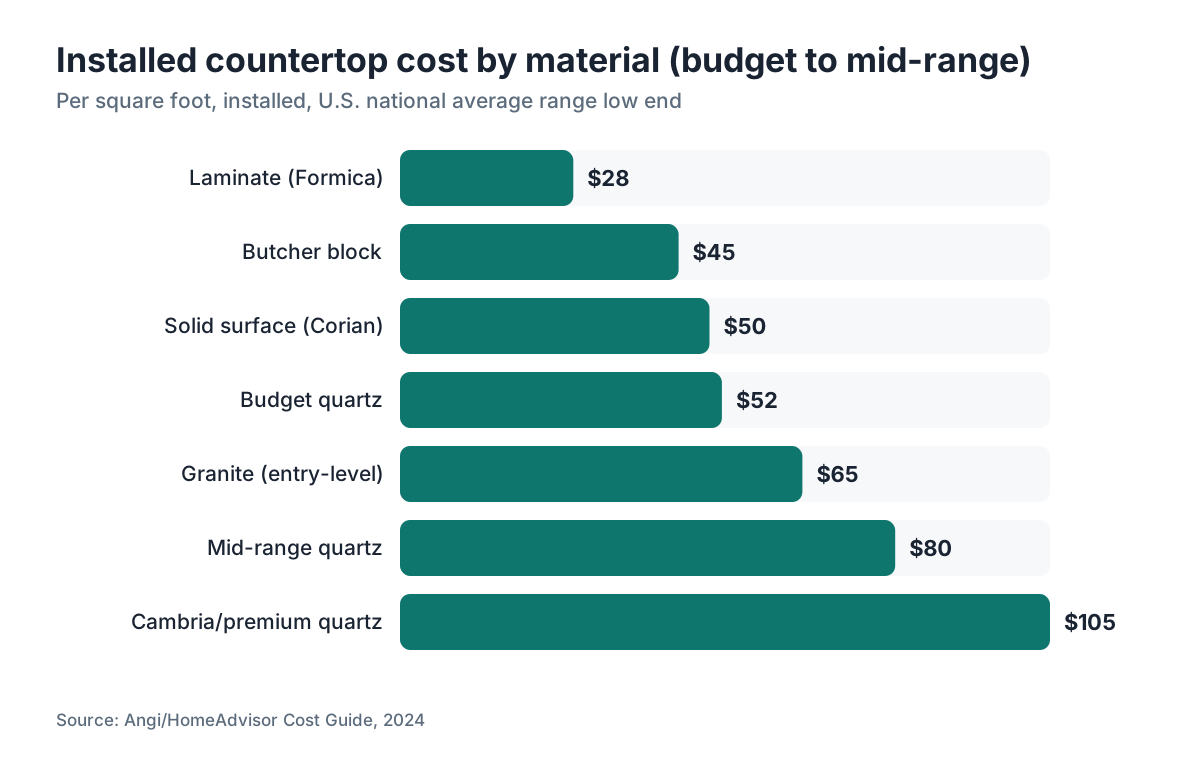
Budget quartz doesn't exist in a vacuum. Here's how it stacks up against the main alternatives at the lower price tier.
| Material | Installed cost range ($/sq ft) | Durability | Heat resistance | Sealing required |
|---|---|---|---|---|
| Budget quartz (2cm, basic color) | $40, $65 | High | Low (resin melts) | No |
| Laminate (Formica, etc.) | $15, $40 | Medium | Low | No |
| Corian/solid surface | $35, $65 | Medium-High | Low | No |
| Butcher block | $30, $60 | Medium (with maintenance) | Medium | Yes (oil/wax) |
| Granite | $45, $85 | Very High | High | Yes (periodic) |
Laminate is genuinely cheaper installed and has gotten much better-looking in the last decade. If budget is the hard constraint, laminate countertops are not a bad choice for a rental property or a low-traffic space. The main knock is that you can't repair a gouge; you replace it.
Granite at the low end competes directly with budget quartz. A basic granite from an oversupplied color can cost less than mid-tier quartz and will outlast it in heat resistance. The trade-off is periodic sealing (every 1 to 3 years depending on the stone and sealer) and the fact that natural stone has more variation, which some buyers want and others don't.
Solid surface like Corian is worth a look for bathrooms and laundry rooms because it can be joined with invisible glue seams and repaired more easily than quartz. It's not a great choice for heavy kitchen use.
If your main goal is to not spend much money and the space is low-stakes, laminate is probably the honest recommendation. If you want quartz's non-porous, no-sealing maintenance story and you're willing to stretch to $50, $65 installed, budget quartz delivers real value.
What are the cheapest quartz brands worth considering?
There's no authoritative independent ranking of quartz brands by value because most testing data comes from manufacturers themselves. That said, the market has a rough tier structure that fabricators generally agree on.
At the budget end, brands like MSI Q Premium Natural Quartz, VIATERA (LG), and various private-label lines distributed through Dal-Tile or Floor & Decor tend to run $20, $35/sq ft for material. Quality is solid for residential use. These aren't Caesarstone, but they're not fragile either.
Mid-tier brands like Caesarstone and Silestone run $35, $60/sq ft for material. Caesarstone is made in Israel and the U.S. and has a good track record. Silestone is Spanish-made and has introduced antimicrobial additives to some lines.
Premium domestic brands like Cambria start at $55/sq ft and go up. For buyers who are cost-sensitive, Cambria is probably not the right call unless you have a specific design requirement only they fill. You can see a full breakdown of what you get from them at Cambria countertops.
For budget buyers, the real move is to ask your local fabricator which lines they stock in quantity. A shop that moves a lot of MSI or VIATERA will price those competitively because they have efficient cutting patterns and good remnant management. A shop that rarely handles a brand will charge more for the same slab.
How do you actually get the lowest price from a fabricator?
Getting a good price on quartz fabrication is partly about the material you choose and partly about how you structure the job. Fabricators are running a manufacturing business, and jobs that fit their workflow cost less.
Keep the layout simple. Every cutout (sink, cooktop) adds time. Every inside corner is a potential crack point that requires care. A straight run or a simple L is the cheapest layout to fabricate. If you can put your cooktop in an island instead of cutting through a continuous run, ask whether that changes the price.
Choose a standard edge. A simple eased or beveled edge costs less to cut than an ogee or a mitered waterfall. The difference can be $10, $20 per linear foot depending on the shop. For budget projects, flat or eased is fine.
Ask about remnants explicitly. Call or visit local shops and ask if they have remnant inventory that fits your job. This conversation doesn't happen unless you initiate it.
Get three written quotes that include material, fabrication, edge profile, number of cutouts, and installation. Quotes that don't itemize these things are harder to compare. Some shops quote low on material and make it up on the cutout fee.
Time your purchase if you can. Shops have slow periods, often winter in most U.S. markets, when they're more negotiable. A job that fits between two larger jobs can sometimes get a discount because it fills idle machine time.
For fabricators managing their own quoting process, tools like SlabWise help generate accurate quotes fast, which reduces the friction of competitive bidding and makes it easier to price remnant jobs profitably without losing money on them.
For a detailed walkthrough of the full installation process and what affects cost, see countertop installation.
Are cheap quartz countertops durable enough for a real kitchen?
Yes, with one important caveat. The polymer resin in quartz is vulnerable to sustained high heat. Setting a hot pan directly on quartz can cause thermal shock, discolor the resin, or in extreme cases crack the slab [4]. This is true of premium quartz too, more than the cheap stuff. Use trivets. That's it. That's the maintenance rule.
Otherwise, budget quartz is hard, non-porous, and resistant to most common kitchen damage. The Mohs hardness for quartz mineral is 7, higher than most knives (around 5 to 6), so it resists scratching well [5]. Because it's non-porous, bacteria and moisture don't penetrate the surface the way they can with natural stone. You don't need to seal it.
The durability gap between a $20/sq ft slab and a $55/sq ft slab is mostly in aesthetics and warranty terms, not in day-to-day function. A thinner slab (2 cm vs. 3 cm) is more vulnerable to cracking at the corners of cutouts and along overhangs, so that's where thickness matters. If you're choosing 2 cm to save money, make sure the overhang is supported and the fabricator is using proper undermount sink support clips.
Long-term, quartz is one of the more durable counter materials available. The NSF/ANSI 51 standard covers food equipment materials including countertops, and most major quartz brands are certified to it [6]. For cleaning guidance, the same principles that apply to natural stone surfaces are a useful reference: how to clean stone countertops.
What are the hidden costs that surprise people on a quartz job?
The square footage price is just the start. Several costs show up after the initial quote that catch buyers off guard.
Old countertop removal runs $100, $300 for a typical kitchen if you're not doing it yourself. Some fabricators include it, many don't. Ask upfront.
Plumbing disconnection and reconnection is usually not included in countertop quotes. If you have an undermount sink, the plumber needs to drop and reset it. Budget $150, $300 for a simple sink swap.
Haul-away of old material isn't always included. If your fabricator is hauling out tile or granite, there may be a disposal fee.
Backsplash gap. When new counters go in at a slightly different height than the old ones, the tile backsplash may not reach the new surface, leaving a gap. Patching or replacing backsplash tile is an often-unbudgeted follow-on cost.
Permits are generally not required for countertop replacement in most jurisdictions, but if you're combining the project with plumbing or electrical changes, check local rules [7].
Overhang support. Standard overhang for bar seating is 12 inches or more. Quartz overhanging more than about 6 to 8 inches unsupported can crack. Steel corbels or brackets are required and cost $30, $80 each installed.
The quote-to-final-invoice variance on countertop jobs averages around 10 to 20% once all these items get added, according to multiple contractor cost guides, though hard industry-wide data on this is sparse.
How do you avoid getting burned by a cheap fabricator?
Price shopping is smart. Picking the cheapest shop without any vetting is a gamble. A bad quartz job is expensive to fix because the slab has to come out and be replaced.
Ask for photos of recent jobs. Any shop doing volume work has a portfolio. If they can't show you five completed kitchens, that's a sign.
Check licensing and insurance. Most states require contractors above a certain job size to carry general liability insurance and a contractor's license. The specific thresholds vary by state [7]. Ask for the certificate of insurance before signing anything.
Look at their shop or ask how they cut. A shop with a CNC waterjet or bridge saw and digital templating produces cleaner, more consistent cuts than a shop working with older tools. You don't need to be a machinist to visit a shop and ask one question: how do you template my counters?
Digital templating (using a laser or LT-55 templating arm) produces more accurate patterns than paper templates, which means better fitting seams and fewer gaps at walls. Ask if they use digital templating. It's been standard at well-run shops for years.
Read actual reviews. Not the curated ones on their website. Google, Yelp, and Houzz reviews for local fabricators tell you how they handle problems, which is what matters more than anything else.
Get a written contract that specifies: material, brand, color, thickness, edge profile, number of cutouts, overhang dimensions, installation date, and what happens if the slab arrives damaged or the seam placement isn't agreed on. Verbal assurances disappear.
Is cheap quartz a good idea for bathroom vanities and other non-kitchen uses?
Bathrooms are actually the ideal application for budget quartz. The usage demands are lower, the square footage is smaller, and the remnant market is well-suited to vanity tops, which often need only 8 to 20 square feet.
A 60-inch double vanity top runs 10 to 14 square feet of quartz. At remnant prices of $10, $25/sq ft for material plus $200, $400 for fabrication and installation, you can put in a genuinely nice quartz vanity for $400, $700 total. That's competitive with pre-made cultured marble vanities sold at big-box stores, and quartz will look better and last longer.
Laundry rooms and mudrooms are also good candidates. These are low-prestige spaces where the budget constraint is real and durability matters more than beauty. A simple white or gray quartz remnant over a laundry basin is practical and cleanable.
For outdoor kitchens, quartz is not the right choice. The resin degrades with prolonged UV exposure and the freeze-thaw cycle in cold climates can crack it. Granite or porcelain are better picks outdoors.
If you're comparing quartz to marble for a bathroom vanity, be aware that marble requires sealing and is vulnerable to etching from acidic products like toothpaste and certain cleansers. Budget quartz is a more practical choice for a bathroom used daily. See marble countertops for a full comparison.
What should your final budget actually be for a cheap quartz kitchen?
Let's build a realistic budget for a typical small-to-medium kitchen aiming for the lowest reasonable quartz price.
Assume 35 square feet of counter area (a common footprint for a 10x12 kitchen), one undermount single-bowl sink cutout, a simple eased edge, and 3 cm budget-tier quartz from a local shop or big-box retailer.
Material at $22/sq ft: $770 Fabrication and installation at $35/sq ft: $1,225 Sink cutout (one): $100, $150 Old counter removal: $150, $250 (skip this if you demo yourself) Plumbing disconnect/reconnect: $150, $250
Total honest range: $2,395 to $2,645 before surprises.
If you find a remnant and your layout is simple, you could shave $400, $600 off that material number. If you're in a high-labor market like San Francisco, New York, or Seattle, add 20 to 30% to the labor line.
The $1,500 quartz kitchen exists, but only with a very small footprint (a studio apartment galley or a bathroom vanity), self-demo, and remnant material. For a real kitchen, $2,000 to $2,800 installed is the realistic floor with budget quartz.
If that number is still too high, the honest alternatives are laminate countertops (which can be done for $800, $1,200 installed in the same kitchen) or keeping existing counters and refinishing them, which runs $300, $600 but has a shorter lifespan.
Shops that use quoting software like SlabWise can turn around detailed line-item quotes faster, which makes the competitive quote process easier for buyers too since you get comparable itemized breakdowns instead of a single number.
Frequently asked questions
What is the cheapest quartz countertop per square foot you can actually buy?
Material-only, budget quartz starts at roughly $18, $25/sq ft for private-label or off-brand slabs purchased through a distributor or big-box program. You can find remnant pieces for $10, $20/sq ft. Once you add fabrication and installation, the realistic floor for a finished, installed countertop is around $40, $50/sq ft in average-cost U.S. markets.
Is cheap quartz better than laminate?
For most kitchens, yes, if you can afford it. Budget quartz is harder, non-porous, and holds up better to moisture and daily abuse. Laminate is cheaper (often $15, $30 installed vs. $40, $65 for quartz) and has improved aesthetically, but a deep scratch or gouge in laminate requires replacement, not repair. For rental properties or low-budget flips, laminate is a defensible choice.
Can you get quartz countertops at Home Depot or Lowe's cheaper than a local shop?
Sometimes, especially during promotional periods. Home Depot's installed quartz programs have advertised starting prices around $40, $55/sq ft. Local shops can be competitive or cheaper, particularly on remnants or if they carry brands the big-box stores don't. The big-box advantage is price transparency and a structured warranty process. Local shops often offer more color choices and faster turnaround.
How much does a cheap quartz countertop cost for a small bathroom vanity?
A 24-inch single vanity top is roughly 4 to 6 sq ft of material. Using remnant quartz at $15, $25/sq ft for material and $200, $350 for fabrication, you're looking at $275, $500 total for a simple vanity top. A 60-inch double vanity (10 to 14 sq ft) runs $400, $700 with remnant material. These are among the best use cases for budget quartz.
Does cheap quartz look obviously cheap?
Not necessarily. A simple solid-color or fine-speckled pattern in white, cream, or gray reads as clean and modern regardless of price. Where budget quartz falls short aesthetically is in complex marble-look veining, which at low price points often looks printed rather than natural. If you want a convincing Calacatta look, you'll pay for it. For solid colors, budget quartz is hard to distinguish from premium.
Is 2cm quartz OK to use or should you always buy 3cm?
2cm quartz works fine with proper support: a plywood substrate underneath and no unsupported overhangs beyond about 4 inches. It's more vulnerable to cracking at cutout corners and during transport. 3cm is the better call for kitchen installations, especially around sinks. For a bathroom vanity with no cutout, 2cm is reasonable and saves money. Budget quartz jobs that use 2cm to cut costs aren't inherently bad, but the substrate requirement adds back some of the savings.
What is the best way to find cheap quartz remnants near me?
Call local fabrication shops directly and ask if they have remnant inventory available. Many don't advertise it. You can also check Craigslist, Facebook Marketplace, and local stone yard websites. Some shops post remnants on their own websites. Bring your measurements to compare against what's available. Remnants work best for bathrooms, small kitchens, and laundry rooms where the required piece is under 30 square feet.
Does cheap quartz need to be sealed?
No. Sealing is one of quartz's genuine advantages over natural stone. Because it's manufactured with polymer resin binders, the surface is non-porous and doesn't absorb liquids or bacteria. You clean it with mild soap and water. No sealer, no annual maintenance. This holds true for all quartz, budget or premium. The only cleaning precaution is avoiding harsh chemicals like bleach at full strength, which can degrade the resin over time.
How long does cheap quartz last compared to expensive quartz?
Both should last 20 to 30 years under normal residential use. The longevity difference between budget and premium quartz is smaller than the price gap suggests. Premium brands invest more in warranty coverage and customer service, not necessarily in a fundamentally more durable product. The main failure modes for any quartz are thermal shock, impact at unsupported edges, and chip damage at corners, all of which are installation and use issues more than material quality issues.
Can I install quartz countertops myself to save money?
DIY installation is possible but difficult. Quartz is heavy (around 20 to 25 lbs per square foot for 3cm), requires precise cuts for good seams, and needs proper adhesive and support. A botched seam or a cracked slab from handling is expensive to fix. Most fabricators won't sell you cut slabs for self-install, or they will but won't warranty the material if you install it. DIY makes more sense for tile or laminate. For quartz, professional installation is usually worth paying for.
Are there any quartz countertop brands to avoid?
There's no public recall list or independent safety database for quartz brands. The main risk with unknown-brand quartz imported from low-cost manufacturers is inconsistent thickness, color variation between slabs, and limited warranty support if something goes wrong. Stick to brands your fabricator has worked with before and can vouch for. If they can't tell you anything about the brand's track record, that's a flag.
What's the difference between cheap quartz and quartzite?
They're completely different materials despite the similar name. Quartz is engineered stone: crushed quartz mineral plus resin, manufactured in a factory. Quartzite is a natural metamorphic rock quarried from the earth, similar to marble in its formation process. Quartzite is harder and heat-resistant but requires sealing, varies significantly between slabs, and generally costs more. If you're researching quartzite, see how to clean quartzite countertops for its specific care requirements.
Do big-box quartz installation programs have a catch?
The main limitations are selection (you pick from their catalog, not the full distributor range), subcontracted installers (quality varies by market), and less flexibility on edge profiles and customization. For a straightforward job with a standard color, the big-box route is fine. For complex layouts, custom edges, or unusual colors, a local fabricator gives you more control. The pricing is often competitive but not always the cheapest option.
Sources
- HomeAdvisor (Angi), Quartz Countertop Cost Guide: Installed quartz countertops average $75, $85/sq ft nationally; material runs $20, $65/sq ft and labor adds $20, $45/sq ft
- U.S. Geological Survey, Mineral Resources: Industrial Minerals (Quartz): Engineered quartz countertops are composed of 90 to 95% quartz mineral bound with polymer resins
- Home Depot, Countertops installation services: Home Depot's installed quartz programs advertise starting prices around $40, $55/sq ft for entry-level options
- Marble Institute of America, Care and Maintenance of Natural Stone and Engineered Stone: Quartz countertops are susceptible to thermal shock and heat damage because of the polymer resin component; trivets are recommended
- U.S. Geological Survey, Mohs Hardness Scale: Quartz mineral registers 7 on the Mohs hardness scale, harder than most kitchen knives which run 5 to 6
- NSF International, NSF/ANSI 51 Food Equipment Materials Standard: NSF/ANSI 51 covers food-contact surface materials including countertops; most major quartz brands carry this certification
- U.S. Consumer Product Safety Commission, Home Improvement Contractor Licensing: Contractor licensing and insurance requirements for home improvement work vary by state; countertop replacement generally does not require a permit unless plumbing or electrical work is involved
- Caesarstone, Product Technical Guide: Caesarstone quartz is manufactured in Israel and the United States and carries a limited lifetime residential warranty
- Floor & Decor, Countertop product pricing: Private-label quartz distributed through Floor & Decor and similar warehouse retailers runs 30 to 40% less than name-brand equivalents at comparable specs
- National Kitchen and Bath Association, Cost vs. Value Report reference data: Kitchen countertop replacement is among the most common mid-range remodeling projects; average total kitchen remodel costs used to benchmark countertop share of budget
- Remodeling Magazine, Cost vs. Value Report 2024: Mid-range kitchen remodel costs and countertop pricing benchmarks used to contextualize the $40, $120/sq ft installed range
Last updated 2026-07-09