TL;DR
- Cambria quartz countertops come in more than 20 edge profiles grouped into standard and premium tiers.
- Standard edges like eased and bevel add little or no cost.
- Premium profiles like ogee, dupont, and waterfall can add $15 to $30 or more per linear foot.
- Your choice affects cleaning difficulty, chip risk, safety for young children, and the overall visual weight of the countertop.
What edge profiles does Cambria offer?
Cambria's edge catalog is bigger than most homeowners expect. As of their current published lineup, Cambria offers more than 20 distinct profiles, split into two tiers: standard edges included in most base quotes, and premium edges that carry an upcharge [1].
The standard tier covers the workhorse profiles that account for most residential installations. Eased (sometimes called straight or square), bevel, and half-bullnose are the common ones. These three are simple, flat-to-lightly-angled cuts that most fabricators can run fast on a CNC bridge saw or edge polisher with little setup.
The premium tier is where the catalog gets interesting. Cambria lists profiles including full bullnose, ogee, dupont, cove dupont, waterfall, triple pencil, and several compound combinations. Some fabricators also offer stacked or mitered variations using Cambria material, though those get negotiated outside Cambria's standard edge menu.
One thing worth knowing: Cambria's exact edge lineup and pricing tiers can differ between authorized dealers and fabricators. Cambria authorizes its fabricators independently, so the shop you use has some latitude on what they call standard versus premium. Always ask for a written quote that names the edge profile and its per-linear-foot cost before you sign anything.
If you want to compare edge options across stone types, the same profile names apply to granite countertops and marble countertops, so a little research now helps even if you later switch materials.
What is the difference between standard and premium Cambria edges?
The distinction is mostly about machining time and tooling wear. A flat eased edge takes one or two passes on an edge polisher. An ogee or dupont profile takes multiple passes with profiled diamond wheels, more hand-finishing time, and more waste at the edges. That added labor and tooling cost gets passed to you as a premium upcharge.
Standard edges are clean and simple. They suit contemporary, minimalist, and transitional kitchens well. Premium profiles have more curves, more shadow lines, and more visual mass. They read as traditional or ornate depending on the rest of the kitchen.
Durability is a real consideration too. Edges with tight inside curves, like the cove section of a dupont profile, are the most vulnerable spot on any quartz countertop. Quartz is hard but not flexible. A sharp impact at the thinnest cross-section of a complex profile can chip in a way that is very hard to repair invisibly. Eased and bevel edges have no delicate inside corners.
For households with young children or heavy kitchen use, a standard eased or slightly radiused edge is often the better call. The money you save on the edge upcharge can go toward a better slab pattern or a thicker 3 cm slab, both of which add more value per dollar than edge complexity.
How much do Cambria edge profiles cost per linear foot?
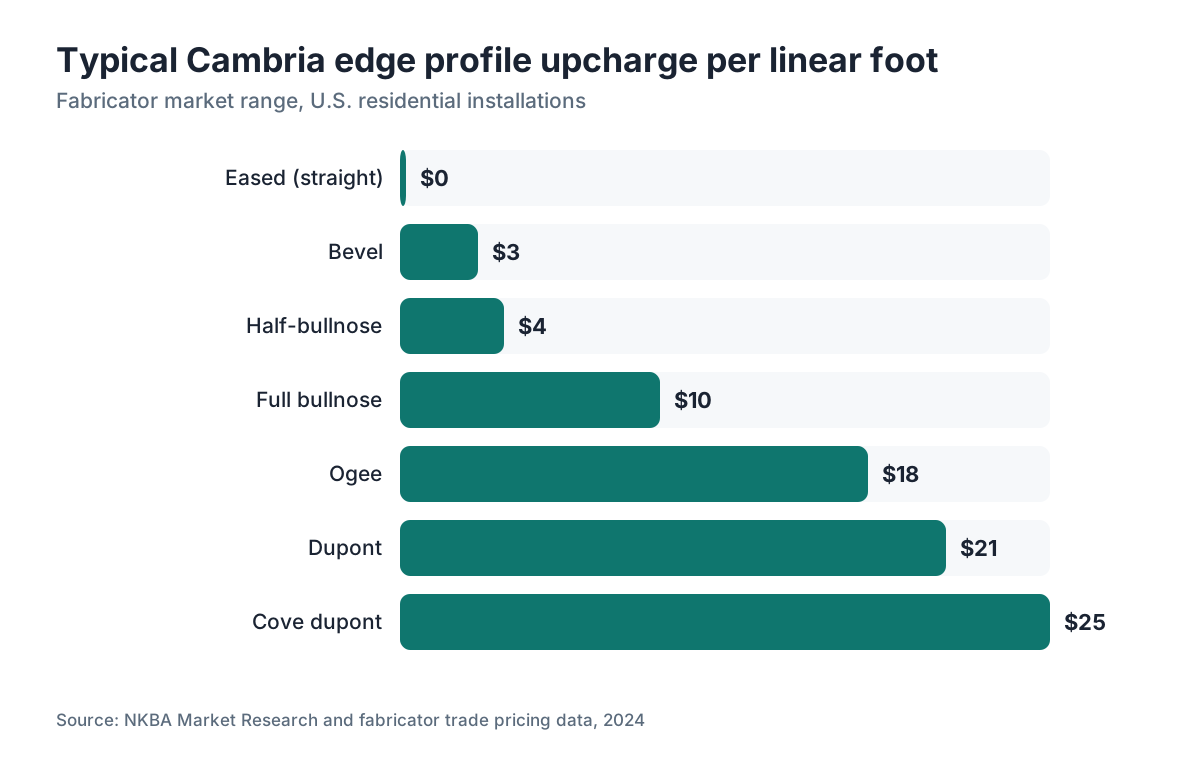
Cambria edge pricing varies by fabricator, region, and shop overhead, so treat any number here as a real-world range, not a price list. Based on quotes and fabricator pricing guides circulating in the trade, here is what to expect:
| Profile | Typical upcharge per linear foot |
|---|---|
| Eased (straight/square) | $0 (included) |
| Bevel | $0 to $5 |
| Half-bullnose | $0 to $5 |
| Full bullnose | $5 to $15 |
| Ogee | $10 to $25 |
| Dupont | $12 to $30 |
| Cove dupont | $15 to $35 |
| Waterfall (mitered) | $50 to $150+ (project-dependent) |
Those upcharges apply to every linear foot of exposed edge, which adds up fast. A kitchen island with 14 linear feet of exposed edge and a dupont profile at $20 per foot adds $280 to the quote. On a full kitchen perimeter of 40 linear feet, that same upcharge is $800.
Waterfall edges are a different animal. A true waterfall takes mitered pieces of slab that run vertically down the cabinet side, book-matched or matched to the horizontal surface. Material and fabrication for a waterfall panel can run $200 to $600 or more per side, depending on slab pattern complexity and whether book-matching is attempted [2].
Shops that use quoting software (like SlabWise) usually build edge upcharges directly into their line-item quotes, so you see exactly what you pay for each profile on each piece. If your fabricator's quote shows one lump number with no edge line item, ask them to break it out.
The same pricing dynamics apply to kitchen countertops across every stone and solid surface type, well beyond Cambria.
Which Cambria edge profile is the most popular?
Eased is the most common edge ordered in North American residential countertop projects, across all stone and engineered stone materials [3]. It is a square-cut edge with the top and bottom corners softened to take off the razor sharpness, usually with a 1/8 inch radius or a small chamfer.
Eased wins because it suits contemporary cabinetry, photographs well for listings and design portfolios, and costs nothing extra. It also cleans easily, since there are no curves to trap crumbs or cleaner residue.
Second most popular is probably bevel, which angles the top face edge at roughly 45 degrees to a depth of about 3/8 inch. It adds a little visual interest without any traditional feel, and it costs little or nothing extra at most shops.
Among premium profiles, ogee has been the historical leader in traditional and transitional kitchens because it mimics the profile on classical millwork and furniture. Its share has slipped as contemporary and transitional design have taken over new construction and renovation over the past decade.
Stuck on which to pick? Ask your fabricator to show you physical edge samples on an offcut of the actual Cambria design you selected. Color and pattern change how much the edge shows. A heavily veined white design like Brittanicca makes even a simple eased edge look dramatic. A darker, more uniform design may benefit from some profile complexity to add interest.
How do Cambria edge profiles compare to edges on other countertop types?
The profile names are the same across nearly every countertop material, but the execution and the limits differ.
Granite, marble, and quartzite all accept the same edge profiles as Cambria quartz. Natural stone has some advantages for complex profiles: the crystalline structure of granite tends to hold tight inside corners slightly better than engineered quartz under impact, though both will chip if hit hard enough.
Laminate is a completely different edge situation. Post-form laminate has a built-in rounded nosing, and self-edge laminate is limited to flat profiles because the material cannot be machined the same way. A bullnose on laminate is a different construction than a bullnose on stone. If you're comparing options, see our explainer on laminate countertops.
Corian and other solid surface materials (acrylic-based composites) accept routed profiles similar to stone, and they carry a repair advantage: chips and scratches sand out. See Corian countertops for more on that trade-off.
Concrete deserves its own mention because it offers more sculptural freedom than any other material. A concrete fabricator can form almost any edge geometry, including shapes that have no name in the stone industry, because the edge is cast rather than machined. Rounded, tapered, embedded tile borders, live-edge organic forms, all of it is possible in concrete. The tradeoff is weight, porosity, and cost, not profile selection.
Butcher block has its own edge vocabulary. A round-over or chamfer on a wood edge is routed and then hand-sanded. See butcher block countertops for how that changes maintenance.
What edge profile is easiest to keep clean?
Eased and bevel edges are the easiest to clean. The surfaces are flat or simply angled, so one wipe with a damp cloth clears everything. No concave recesses to hold residue.
Full bullnose is a touch harder because food and cleaner can pool at the curved underside where it meets the cabinet front, but it stays manageable.
Ogee and dupont profiles have one or two cove sections (concave curves) that trap debris. Over time in a busy kitchen, the inside curve of an ogee collects grease and cleaner buildup that needs a toothbrush or narrow tool to clear. Not a dealbreaker. Real maintenance, though.
Waterfall edges are largely self-cleaning because the vertical face sheds gravity naturally, but the inside miter seam at the top needs attention.
For households managing food allergies, the cleaning case for simple edges gets stronger. Allergen residue is genuinely harder to remove from profiled concave edges than from flat ones [8].
Cambria's quartz surface itself is non-porous [1], so the edge profile is the main variable in cleaning difficulty, not the material. For general guidance on keeping stone and engineered stone surfaces clean, see how to clean stone countertops.
Is a thick or thin edge profile better for Cambria quartz?
Cambria slabs come in two main thicknesses: 2 cm (about 3/4 inch) and 3 cm (about 1 1/4 inch). The thickness you choose decides which edge profiles are even possible, and it changes the visual proportions of every profile [9].
On a 3 cm slab, a full bullnose has a generous, furniture-like curve. The same profile on a 2 cm slab looks slight, almost tentative. Most fabricators who install 2 cm material laminate a second strip underneath the edge to build apparent thickness, which hides the lightweight look and gives a 4 cm stacked edge. That lamination adds cost and creates a seam that needs polishing.
Ogee and dupont profiles need enough material to carve into. They work well on 3 cm slabs and laminated 2 cm edges. They are not practical on thin 2 cm slabs without lamination.
For contemporary kitchens that want a thin, light look, a flat eased edge on a 2 cm slab with no lamination is a legitimate design choice. It reads as graphic and architectural. The tradeoff is that the exposed 2 cm thickness can look fragile, and the edge is slightly more prone to chipping than a thicker slab.
The industry has largely moved toward 3 cm as the default for quartz, granite, and marble, mostly because it removes lamination and its seam, and because it holds overhangs better [4].
What edge profile should you choose for a kitchen island?
An island has more exposed edge than any other run in the kitchen, and people touch it from all sides. That changes the math.
Safety is the most often missed variable. The hip-height edge of an island is exactly where a toddler's face lands when they run into the corner [6]. A full bullnose or even a well-radiused eased edge absorbs impact very differently than a sharp square edge or a bevel. If you have small children, take this seriously. A 1/4 inch radius on the eased edge costs nothing and makes a real difference.
Islands also benefit from profiles with some presence. You see an island from a distance and from several angles, so a profile with a visible shadow line reads better than on a wall run where the backsplash hides most of it. A bevel, half-bullnose, or eased with a slightly larger radius all photograph and live well on islands.
For high-traffic households, skip dupont and ogee on islands. The cleaning case is stronger here because islands take more daily contact and more food prep than perimeter counters.
If the island is a waterfall island, you are signing up for a real fabrication challenge. The slab pattern has to flow continuously from horizontal to vertical, which means careful grain matching or accepting a visible transition. Ask your fabricator whether the Cambria design you chose is available in enough quantity from the same batch to make a matched waterfall. Running out of matching material mid-project is a real problem.
Do edge profiles affect Cambria's warranty?
Cambria offers a transferable lifetime limited warranty on their quartz surfaces [1]. The warranty covers manufacturing defects in the material itself. It does not cover damage from bad installation, impact, misuse, or normal wear.
Edge chips are the most common damage claim that falls outside warranty coverage. If a complex profile chips because of an impact during everyday use, Cambria's warranty typically does not cover the repair. The warranty is written around material defects, not fabrication damage or post-installation wear.
That said, if a profile chips at the factory or during delivery before installation, that is a legitimate warranty or supplier claim. Document any damage before the slab goes in.
The warranty language is public on Cambria's website [1]. It covers defects in material and workmanship under normal use. Read it before signing your purchase agreement, especially the exclusion list.
On edge chip repairs, the honest answer is that a skilled fabricator can color-match and fill small chips with epoxy or acrylic filler to reasonable results, but the repair stays visible under close inspection. Complex profile areas are harder to fix cleanly than flat edges. Another argument for simpler edges in hard-use spots.
How does a fabricator actually cut and finish a Cambria edge profile?
Most production quartz fabrication uses a CNC bridge saw for straight cuts and a CNC router or dedicated edge polishing machine for profiles. The process has more steps than most homeowners realize.
First, the slab gets cut to the rough template shape. Then the edge is routed to the specified profile using diamond-tipped profiling wheels. Each profile needs a different wheel or set of wheels. A simple bevel takes one pass with a chamfer wheel. An ogee needs at least two distinct profiled wheels and may need hand-finishing at the junction between the convex and concave sections.
After routing, the edge runs through a sequence of progressively finer polishing pads to bring the surface to a mirror finish that matches the face of the slab, typically a 40 to 3000 grit sequence [7]. Cambria's quartz polishes well to a high gloss, and the edge should match that gloss when the job is done right. A dull or wavy edge is a quality control failure, not a material limit.
Shops with modern CNC edge polishers run standard profiles fast and consistent. Hand-finished profiles, common in smaller shops, can produce excellent results but depend more on the individual craftsperson. If you are paying for a premium profile, ask to see samples of that profile from the shop's recent work before you commit.
A note on the shop side: edge profiling generates respirable crystalline silica dust, and wet cutting plus local exhaust ventilation are required under OSHA's silica standard, 29 CFR 1926.1153 [10]. Fabricators who use shop management and quoting software can attach profile specs directly to job tickets, which cuts the risk of the wrong edge being cut. Accurate job documentation matters more than most homeowners know, especially on multi-piece projects where the same profile has to stay consistent across runs.
Can you change a Cambria edge profile after installation?
In theory, yes. In practice, it is expensive, disruptive, and sometimes impossible without pulling the countertop.
Changing from a simple edge to a more complex profile means grinding away material, running the new profile, then polishing to match the face. A fabricator does this either on the installed piece (hard, messy, and risky) or by removing the countertop, taking it to the shop, and reinstalling it. Removing Cambria quartz, which is adhesively bonded to the cabinets, almost always risks cabinet damage.
Going the other way, simplifying a complex profile to something flatter, is even harder because you are removing profile geometry that has already been machined.
The realistic answer: changing an edge after installation is a last resort, not a renovation path. Get edge samples before installation, confirm your choice in writing on the quote, and inspect the edge profiles on the delivered countertop before the installer applies adhesive.
For countertop installation logistics more broadly, see our guide on countertop installation.
Frequently asked questions
What is the cheapest Cambria edge profile?
Eased (straight/square) is the least expensive Cambria edge and is included in the base price at most fabricators with no upcharge. Bevel and half-bullnose are also typically included or cost only $0 to $5 per linear foot. If budget is the main concern, eased is the clear choice, and it happens to suit contemporary kitchen design very well.
What is the most durable edge profile for Cambria quartz?
Eased and bevel edges are the most chip-resistant because they have no tight inside curves or thin cross-sections. Complex profiles like ogee and dupont concentrate stress at the cove sections, which makes them more prone to chipping under impact. If durability is the priority, especially near heavy-use zones like sinks and prep areas, stay with a simple flat or lightly beveled edge.
Does Cambria charge extra for premium edge profiles?
Cambria sets material pricing; the edge upcharge is set by the authorized fabricator, not Cambria directly. Most shops charge $10 to $35 per linear foot extra for premium profiles like ogee, dupont, or cove dupont compared to a standard eased edge. Waterfall edges are priced separately as a project cost, often $200 to $600 or more per mitered panel.
Which Cambria edge profile is best for a white quartz countertop?
White and light quartz designs like Cambria Brittanicca or White Cliff show edge profiles clearly because the contrast between light and shadow is high. A simple eased or bevel edge looks clean and contemporary. Complex profiles like ogee are very visible and may suit traditional kitchens well. On white quartz there is nowhere to hide a poorly finished edge, so quality of polish matters more.
How long does it take to fabricate a premium Cambria edge?
A standard eased or bevel edge adds almost no time to a CNC shop's process. A premium ogee or dupont profile adds roughly 15 to 30 minutes of extra machine and finishing time per linear foot compared to a flat edge, depending on the shop's equipment. Hand-finished profiles take longer. This is partly why premium edges cost more: the time adds up on longer runs.
Can Cambria edges be matched across multiple pieces for a continuous look?
Yes, but it takes the same shop fabricating all pieces with consistent machine setup. Profile consistency across a full kitchen perimeter, island, and window sill is a quality control issue, not a material limit. Ask your fabricator whether they run all pieces in one CNC job or batch them across multiple days, because equipment settings drift between setups and can produce slightly mismatched profiles.
What Cambria edge profile works best for a bathroom vanity?
Bathroom vanities typically have shorter runs of exposed edge, so the per-linear-foot upcharge for a premium profile is a smaller total cost than on a full kitchen. A half-bullnose or full bullnose reads softly and elegantly on a vanity. Eased is popular for contemporary baths. Avoid very sharp square edges near a sink where water drips constantly, since the edge takes more contact there.
Is an ogee edge on quartz hard to repair if it chips?
Yes. The concave cove section of an ogee is the hardest spot to repair on any quartz edge. The repair involves color-matched filler, shaping to the profile, and polishing, and the curved geometry makes a truly invisible fix nearly impossible. Most repairs in cove sections show under close examination or raking light. This is the main practical reason to avoid ogee profiles in heavy-traffic zones.
Does the edge profile affect how much countertop overhang is safe?
The edge profile itself does not change safe overhang limits. Those limits depend on slab thickness, support structure, and whether corbels or brackets are used. The standard guideline for unsupported overhangs is a maximum of 12 inches for 3 cm quartz without added support. That applies whether you pick a flat eased edge or a complex dupont [4]. The profile is cosmetic; the overhang limit is structural.
How do Cambria edge profiles compare to those on Silestone or Caesarstone?
The profile names and categories are the same across all engineered quartz brands. The differences are in how each material machines and polishes. Cambria's quartz is 90 to 93 percent quartz by weight [5] and polishes to a high gloss comparable to other premium brands. Edge quality depends more on the fabricator's equipment and skill than on the quartz brand. Cambria, Silestone, and Caesarstone all produce good edges in capable shops.
What is a waterfall edge on a Cambria countertop?
A waterfall edge is not technically a machined edge profile. It is a design where the material continues vertically down the side of the cabinet, creating a continuous face of stone from countertop to floor. It takes a mitered joint at the top corner where horizontal meets vertical. On patterned Cambria designs, a convincing pattern match at that miter joint takes careful planning and sometimes book-matching, which is both expensive and not always possible with a given slab's pattern.
Can I get a Cambria edge profile sample before ordering?
Most Cambria authorized dealers and fabricators have physical edge samples, either on small stone blocks or mounted display boards. Ask specifically to see the edge in the material closest to your chosen Cambria design. Edge profiles look different in white, black, and heavily veined stones because the shadow line reads differently depending on tone and pattern. Looking at an ogee on a dark sample when you ordered a white design is not a useful comparison.
Sources
- Cambria, Warranty & Care: Cambria offers a transferable lifetime limited warranty and the surface is non-porous. Cambria's published warranty states coverage for defects in material and workmanship under normal use.
- National Kitchen and Bath Association (NKBA), Cost of Kitchen Remodeling Data: Waterfall countertop panel fabrication and installation cost ranges cited in trade industry references and NKBA market research.
- National Kitchen and Bath Association (NKBA), Kitchen Design Trends Study: Eased edges are the most commonly specified edge profile in residential countertop installations in North America.
- Marble Institute of America (MIA+BSI), Dimension Stone Design Manual: Standard guidance for unsupported countertop overhangs is a maximum of 12 inches for 3 cm stone without additional support structures such as corbels or brackets.
- U.S. Geological Survey (USGS), Mineral Commodity Summaries: Quartz Crystal: Engineered quartz countertop products typically contain 90 to 93 percent quartz by weight, bonded with polymer resins.
- U.S. Consumer Product Safety Commission (CPSC), Home Safety Resources: Sharp countertop edges at hip and face height present injury risk for young children in residential kitchen environments.
- Marble Institute of America (MIA+BSI), Fabrication Standards for Natural and Engineered Stone: CNC edge polishing machines use progressive diamond grit pads to bring stone and engineered stone edges to a finish matching the slab face, typically 40 to 3000 grit sequence.
- NSF International, NSF/ANSI 51 Food Equipment Materials Standard: Non-porous surfaces are easier to keep free of food allergen residue; concave edge profiles present greater surface area challenge for cleaning verification.
- Cambria, Product Specifications and Slab Thickness: Cambria quartz slabs are available in 2 cm and 3 cm thicknesses, with 3 cm being the predominant residential choice.
- Occupational Safety and Health Administration (OSHA), Silica in Construction: Countertop Fabrication: Stone countertop fabrication including edge profiling generates respirable crystalline silica dust; engineering controls including wet cutting and local exhaust ventilation are required under OSHA's silica standard 29 CFR 1926.1153.
Last updated 2026-07-09