TL;DR
- Aspire Stone Fabrications is a stone countertop fabrication company.
- This guide covers what shops like Aspire do, how they price work, which materials they carry, what installation looks like, and how to judge whether any fabricator is worth hiring.
- Installed granite or quartz runs $50 to $120 per square foot in most U.S.
- markets as of 2025.
What does a stone fabrication company actually do?
A stone fabricator takes a raw slab of granite, quartz, marble, or quartzite and turns it into a finished countertop. They cut the slab to your template, grind the edges to the profile you picked, cut the sink hole, and install the piece in your home. The showroom you walk into is usually just the front end. The fabricator is the factory behind it.
Some shops are vertically integrated. They run a showroom, a slab yard, a CNC waterjet or bridge saw, and their own install crews under one roof. Others are pure fabricators who take orders from kitchen designers or contractors and never talk to a homeowner. A shop operating under a name like Aspire Stone Fabrications usually lands in the middle: a local or regional operation with a showroom plus in-house cutting and installation.
The work breaks into a few clear steps. A templater comes to your home and measures the exact footprint of your cabinets. That measurement goes on paper, into a digital templating device, or into a laser scanner. The shop then programs the cuts, picks the best section of the slab for your layout, and runs it through a CNC machine or a saw operator. Edge profiling happens after cutting, by hand or by a CNC router. Install runs two to four hours for a standard kitchen.
The gap between a good fabricator and a mediocre one shows up in three spots: seam placement and polish, edge consistency, and whether the stone sits flat without rocking. Ask about all three before you sign anything.
What materials do stone fabricators typically carry?
Most full-service shops carry granite, quartz (engineered stone), marble, quartzite, soapstone, and sometimes porcelain slabs. Granite and quartz move the most volume. Marble and quartzite are the upsell. Porcelain slab is growing fast because it shrugs off heat and stains without any sealing.
Here is how the common materials stack up.
| Material | Hardness (Mohs) | Stain resistance | Needs sealing | Typical installed cost/sq ft (U.S., 2025) |
|---|---|---|---|---|
| Granite | 6-7 | Moderate | Yes, 1-3 yr | $50-$100 |
| Quartz (engineered) | 7 | High | No | $60-$120 |
| Marble | 3-5 | Low | Yes, annually | $75-$150 |
| Quartzite | 7+ | High | Yes, 1-2 yr | $80-$140 |
| Soapstone | 1-2 | High (non-porous) | No (oiling optional) | $70-$120 |
| Porcelain slab | 7-8 | Very high | No | $65-$130 |
Granite is still the dominant natural stone in American kitchens [1]. Quartz passed granite in overall countertop market share around 2018 and has held that lead, mostly because it skips sealing and the color runs predictable slab to slab.
When you compare prices, the number that matters is installed cost per square foot, not the material price. Fabrication labor, edge profiles, cutouts, and delivery are often left out of the headline slab price you see in a showroom. Ask for a fully installed, all-in quote. More on that below.
For detail on specific materials, see our guides on granite countertops, marble countertops, and kitchen countertops.
How much does stone fabrication cost?
Installed granite runs roughly $50 to $100 per square foot for mid-range material and a standard edge, based on cost surveys from HomeAdvisor and Fixr [2][3]. Quartz runs $60 to $120 per square foot installed. High-end exotics like book-matched marble or rare quartzite can push past $200 per square foot all-in.
A typical kitchen with 40 square feet of counter lands between $2,000 and $4,000 for granite and $2,400 to $4,800 for quartz. Those are rough midpoints. The real number depends on:
- Slab grade (builder-grade granite vs. premium exotic)
- Edge profile (eased is cheapest; ogee, waterfall, and mitered edges add $10-$30 per linear foot)
- Number of cutouts (sink, cooktop, faucet holes each add $150-$400)
- Seam count and difficulty
- Distance from the shop to your home
- Local labor rates
Major metros run higher. Prices in New York, San Francisco, and Boston sit 20 to 40 percent above the national midpoints. Rural markets can be cheaper, but your choices narrow because fewer shops compete.
One cost shops rarely advertise: removal and disposal of your old countertops adds $200 to $500. Ask whether it is in the quote. Most shops charge it separately.
To compare shops apples to apples, get three quotes against the same template dimensions, the same material code, the same edge profile, and the same sink cutout. Any shop that refuses to quote against a spec sheet is a shop worth skipping.
If you are also weighing lower-cost options while you budget, laminate countertops and formica countertops are worth a look before you commit to stone.
What is the templating and installation process like?
Templating is the measurement step, and it happens after your cabinets are installed and level. A tech measures the full footprint: every wall angle, every inside corner, every overhang. Old houses have walls that are not square, which is nearly every old house, so this step is not trivial. A good templater catches a wall that runs three degrees off. A bad one misses it, and you get a gap at the wall.
Digital templating with a device like a Proliner or an LT-2D3D laser scanner is now standard at most quality shops. It captures the exact geometry of your cabinets and sends the file straight to the CNC machine, which cuts human transcription error way down. Some smaller shops still use the old cardboard-and-lath stick method. That is fine in skilled hands, but it adds a step where mistakes creep in.
After templating, production takes three to seven business days at most shops. The spring remodel rush can stretch that to two weeks. Ask for a realistic lead time, not the optimistic one.
Installation day goes like this. The crew arrives with the cut slabs, usually two or three pieces for a full kitchen. They dry-fit first, then set the pieces with silicone adhesive, epoxy the seams, and bolt any undermount sink clips. The whole job runs two to five hours for a standard kitchen. Keep everything off the counters for 24 hours while the adhesive cures.
For a full walkthrough of install day, our countertop installation guide covers it step by step.
How do you evaluate whether a fabrication shop is worth hiring?
Online reviews for stone fabricators run lumpy. You get people who are thrilled and people who feel burned, with not much in between. Here is what actually signals quality.
Ask to see the shop. A fabricator who will not let you walk the floor is hiding something. You want organized slab storage (slabs stored vertically on A-frames, not stacked flat), a clean CNC or bridge saw area, and real dust management. Silica dust from cutting stone is a serious occupational health hazard that OSHA regulates [4]. A shop with no dust suppression is either cutting corners on worker safety or skipping wet-cutting, which also hurts cut quality.
Ask about seam technique. Seams are unavoidable on any run longer than the slab, which maxes out around 9 to 10 feet. Good seams are tight (under 1/16 inch gap), filled with color-matched epoxy, and placed where they hide best. Ask where the fabricator plans to put your seams before you sign. If they cannot tell you, they have not thought about it.
Check the warranty. A reputable fabricator warrants their labor for at least one year. Material defects usually fall under a separate slab-manufacturer warranty. Any shop offering zero labor warranty deserves a hard look.
Verify insurance. General liability and workers' compensation are both required by most state contractor licensing boards. If a crew member drops a slab on your hardwood or gets hurt on your property, you want the shop's insurance covering it, not yours.
Ask who does the installation. Some shops farm it out to a rotating pool of independent crews. That is not automatically bad, but the shop needs to stay accountable for those crews. If they shrug and say the sub handles complaints, walk away.
What edge profiles are available and do they affect the price?
Yes, edge profiles affect the price, sometimes a lot. The profile is the shape of the exposed front edge. Here are the common ones.
- Eased (flat with a slight bevel): cheapest, basically a square edge with the sharp corner knocked off
- Beveled: a 45-degree cut across the top edge, minimal upcharge
- Bullnose: fully rounded top edge, standard choice, small upcharge
- Ogee: an S-curve, more decorative, adds $10-$20 per linear foot
- Dupont: a right-angle step profile, similar upcharge to ogee
- Waterfall mitered: the surface runs down the side of the cabinet to the floor, adds $200-$600 or more per waterfall side depending on complexity
- Laminated edge: two layers of stone glued to fake a thicker slab, adds $15-$30 per linear foot
For most kitchens, a standard eased or bullnose is perfectly fine and saves real money. Decorative edges are one of the easiest places to spend $300 to $800 more than you need to without getting a better countertop. If you love the ogee look, get it. If you feel neutral, take the eased edge and put the money into better material.
What questions should you ask any fabricator before signing a contract?
Get specific answers to these before you commit.
- Is the quote fully installed, including templating, cutouts, edge profile, delivery, and seam epoxy? Or are those separate line items?
- Where will the seams land, and can you show me on a drawing?
- What is the production lead time right now, not the best case?
- Who does the actual installation: your own crew or a subcontractor?
- Do you carry general liability and workers' comp, and can I see the certificate?
- What is your labor warranty, and what does it cover?
- Do you remove and dispose of my old countertops, and what does that cost?
- Can I come see the slab before you cut it?
- What happens if I find a flaw in the installed stone?
- What is the payment schedule?
On payment: a reputable shop usually asks for a 50 percent deposit upfront and 50 percent on install day. Any shop demanding 100 percent before templating is a red flag. Any shop asking for nothing upfront is unusual too and hints at cash-flow trouble.
Seeing the slab before it is cut is underrated. Natural stone has veining and variation. The chip in the showroom is not the slab they pull from the yard. If you care how the stone looks, go to the yard and approve the actual slab.
What are common complaints about stone fabricators and how do you avoid them?
The complaints that show up most in consumer reviews and contractor forums cluster around a handful of problems.
Seams that do not match. When the epoxy color is off or the veining does not line up across a seam, it jumps out at you. Part material issue (busy-veined slabs are harder to match), part skill issue. Ask to see photos of seam work from recent jobs.
Chipped edges on delivery. Granite and quartz both chip at edges and corners if the slab gets mishandled in transport. Small chips sometimes take a color-matched epoxy filler. Larger chips on a prominent edge usually mean replacement. Document any chips the moment you see them on install day, and do not sign the completion paperwork until you are satisfied.
Uneven overhangs. The counter overhangs the cabinet face by a standard 1.5 inches in most kitchens. If the template was sloppy or the cabinets were not level, the overhang wanders along the run. That is a templating error, not a cutting error.
Delays. Fabrication is a production-scheduling business. If the shop is backed up, your job waits. Get a committed install date in writing and ask what the shop does if it misses that date.
For natural stone, people sometimes learn after install that the stone needs sealing and nobody warned them. Ask about sealing for whatever material you pick. How to clean stone countertops and how to clean quartzite countertops are good references for post-install care.
How does stone fabrication pricing compare to alternative countertop materials?
Stone is not your only option, and knowing where it sits in the price stack helps before you commit.
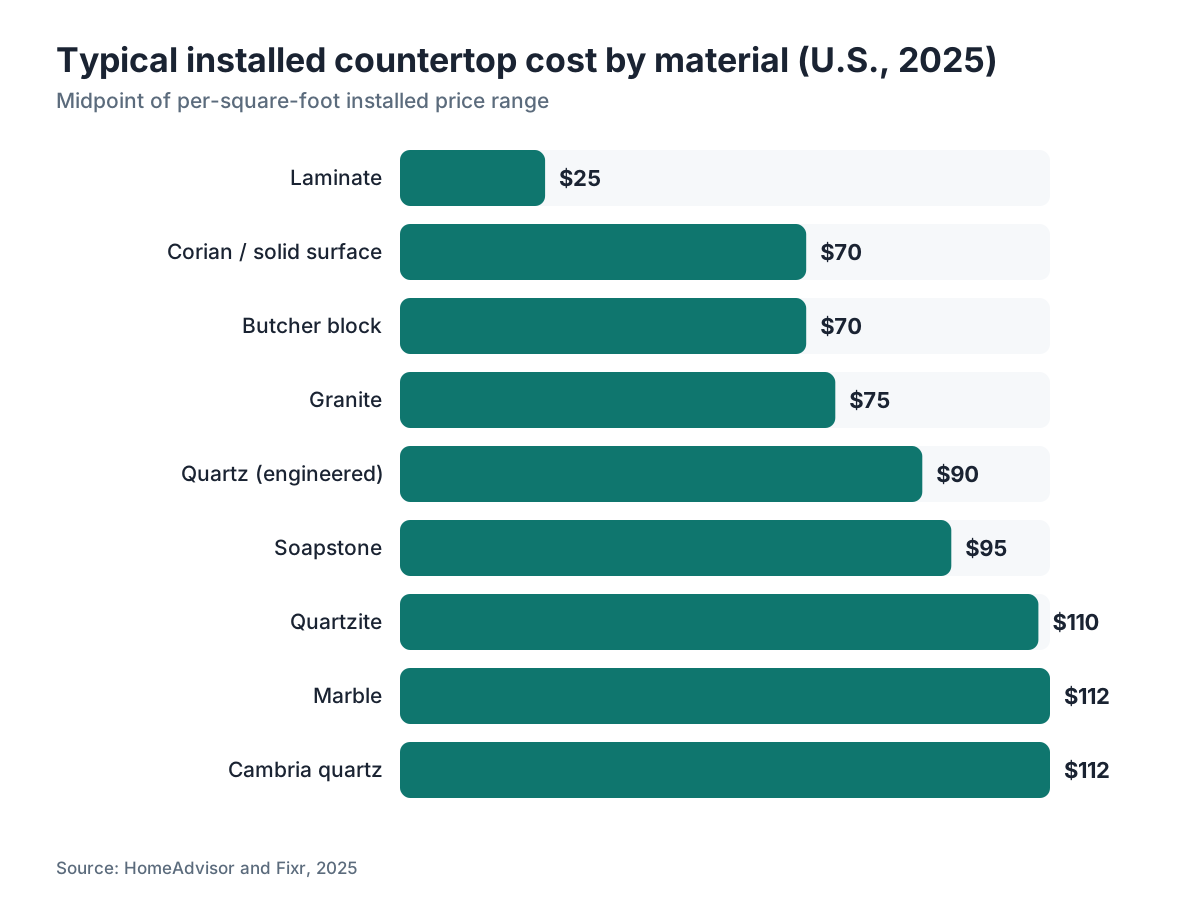
| Countertop type | Typical installed cost/sq ft (U.S., 2025) | DIY-friendly | Heat resistant | Needs sealing |
|---|---|---|---|---|
| Laminate | $10-$40 | Mostly | No | No |
| Butcher block | $40-$100 | Partial | Moderate | Oil/seal regularly |
| Granite | $50-$100 | No | Yes | Yes |
| Quartz | $60-$120 | No | Partial | No |
| Quartzite | $80-$140 | No | Yes | Yes |
| Corian (solid surface) | $45-$95 | Partial | No | No |
| Cambria quartz | $75-$150 | No | Partial | No |
For context: Cambria is a premium U.S.-made quartz brand with a lifetime warranty that covers fabrication defects [5]. It sits at the high end of the quartz range. Corian is a solid surface, not stone, and it can be repaired by sanding out scratches, which stone cannot.
If budget drives the decision, laminate countertops, butcher block countertops, and Corian countertops all land well below the stone floor. If prestige and longevity matter most, stone is hard to beat as a resale signal, though controlled studies on countertop ROI in home sales are scarce and most claims you read come from the industry itself.
How do fabricators price and manage jobs on the shop side?
From the fabricator's side, profit lives in the details of quoting and material yield. A shop that quotes 40 square feet of installed granite but burns 55 square feet of slab to get there, because of cutouts, offcuts, and veining match, eats that extra slab cost unless it priced the job right upfront.
Most shops price per square foot of finished, installed surface. The slab yield calculation underneath, which accounts for how tightly cuts nest onto the slab, sets the real material cost. A shop with poor nesting practices wastes 15 to 25 percent more stone than a well-optimized shop on complex layouts.
This is where fabrication software earns its keep. Tools that nest cuts onto slabs automatically, like SlabWise, help shops build accurate quotes by calculating real yield instead of guessing it. Bad material estimates are one of the leading causes of margin erosion in small and mid-size shops. Getting the quote right is the whole game.
For shop owners, the other lever is speed to quote. A customer who leaves your showroom without a price is a customer who gets a price from your competitor. Shops that produce a complete quote in under 15 minutes close more jobs than shops that call back in two days.
Pay for fabrication crews is usually an hourly base plus piece rate, though this varies widely by region and shop size. OSHA also requires silica exposure monitoring and control programs for any shop doing dry cutting of engineered stone, under the 2016 silica rule that took full effect in 2018 [4].
What should you know about stone care after fabrication and installation?
The fabricator's job ends at installation. Yours starts there.
Natural stone (granite, quartzite, marble) benefits from periodic sealing. A water test tells you when. Drip water on the surface and watch. If it beads, the seal is fine. If it soaks in within a minute or two, reseal. Most granite needs resealing every one to three years depending on how porous the specific stone is and how hard you use it [6].
Quartz does not need sealing. Its binder is resin, not mineral. What it will not tolerate is sustained heat. Quartz manufacturers almost all warn against setting hot pots directly on the surface because the resin can discolor or crack. Use trivets.
Marble is a different animal. The calcite in it reacts with acid. Lemon juice, vinegar, tomato sauce, and most acidic cleaners etch it. An etch looks like a dull spot where the shine is gone. It is not a stain, and it does not wipe off. It has to be polished out. If you want marble and you cook heavily, get a honed finish from the start. Etch marks hide better on honed marble than on polished.
For daily cleaning, warm water and a mild dish soap work on almost every stone surface. Skip bleach, ammonia, and anything abrasive. More detail by stone type lives in our how to clean soapstone countertops and how to clean stone countertops articles.
How do you find a reputable stone fabricator in your area?
Word of mouth is still the most reliable signal. Ask a friend who had countertops done in the last two years, not the last ten. Fabrication is a local business, and quality swings hard by market.
The Marble Institute of America (now part of the Natural Stone Institute) keeps a member directory of fabricators who agreed to its professional standards [7]. Membership is voluntary and does not guarantee quality, but it screens out shops that cannot be bothered with any professional association at all.
Google reviews filtered for photos beat the raw star average. Look for photos of actual installed work, and read the one-star reviews for pattern. One angry customer is noise. Five customers complaining about the same seam problem is signal.
Get at least three quotes, not mainly to price shop but because the quoting conversation tells you how a shop operates. A fabricator who asks good questions about your cabinet layout, your sink type, and your overhang preference before quoting is paying attention. One who throws out a number after a 90-second showroom chat is not.
Check your state contractor licensing board. Many states require stone fabricators to hold a contractor license for install work. In California, for example, installation that exceeds $500 in combined labor and materials generally requires a C-54 (tile) or B (general building) license [8]. Requirements differ by state, so confirm what applies where you live.
Frequently asked questions
Is Aspire Stone Fabrications a national chain or a local company?
A shop operating under the name Aspire Stone Fabrications is a local or regional business, not a national franchise. If you found one in your area, it is an independent operation. Verify its reviews, licensing, and insurance the same way you would for any local fabricator. There is no central corporate entity behind the name that standardizes quality or backs warranties across locations.
How long does the full countertop process take from deposit to installation?
Plan on two to four weeks from signed contract to installed countertops in a normal production environment. Templating happens after your cabinets are installed and level, usually within a few days of scheduling. Production runs three to seven business days after templating. During busy spring and fall remodel seasons, some shops carry a two to three week production backlog on their own. Ask for a committed install date in writing.
What is the difference between quartz and quartzite?
Quartz countertops are engineered: 90 to 95 percent ground quartz crystals bound with resin and pigment. Quartzite is a natural metamorphic rock that forms when sandstone gets cooked under heat and pressure. Quartzite is harder and more heat-resistant than engineered quartz, but it is porous and needs sealing. Quartz needs no sealing but can discolor under sustained heat. They are completely different materials that share part of a name.
Can I install stone countertops myself to save money?
Technically possible, rarely advisable. Stone slabs weigh 15 to 20 pounds per square foot. A 40-square-foot kitchen counter runs 600 to 800 pounds across multiple pieces. Precision cutting needs a wet saw with diamond blades and real skill. Seaming needs epoxy color-matching and clamping technique. Most people who try this once hire a fabricator the second time. The labor savings are real, but so is the risk of an expensive mistake on a $3,000 slab.
Does granite need to be sealed and how often?
Most granite needs periodic sealing, but frequency depends on the stone's porosity. Dense, dark granites like Absolute Black can go years without it. Lighter, more porous granites may need it yearly. The water bead test is the easiest check: drip water on the surface and see if it soaks in within a few minutes. If it does, reseal. A quality impregnating sealer applied by the homeowner takes about 30 minutes.
What edge profile is most popular and which is the best value?
Eased (a square edge with the corners softened) and bullnose (a fully rounded top edge) are the two most common profiles by volume. Both are included in base pricing at most shops. They are also the most durable because they have fewer tight angles to chip. Fancier profiles like ogee add $10 to $20 per linear foot and are purely aesthetic. For a 30-linear-foot kitchen, that adds $300 to $600 with no functional benefit.
How much does a sink cutout add to the cost?
A standard undermount sink cutout usually adds $150 to $400 to the fabrication quote, depending on the shop and whether the sink is a simple oval or a complex farmhouse apron shape. Faucet holes run $50 to $100 each. Budget for these separately, because some shops advertise a per-square-foot price that excludes all cutouts, and the extras add up fast on a full kitchen.
What is silica dust and why does it matter for stone fabrication?
Silica is a mineral in granite, quartz, and most stone. When stone is cut, ground, or polished dry, it releases fine respirable silica dust that causes silicosis, an irreversible lung disease, and is a recognized human carcinogen. OSHA issued a final rule in 2016 setting a permissible exposure limit of 50 micrograms per cubic meter of air for construction workers. Reputable shops use wet cutting and local exhaust ventilation to hold dust below that limit.
Does quartz add resale value to a home compared to laminate?
Honest answer: controlled data here is thin. The National Association of Realtors and Remodeling Magazine's Cost vs. Value report do not break out countertop material ROI on its own. Industry surveys, which are not independent, claim stone countertops return 70 to 80 percent of their cost at resale. What is clear is that stone reads as a strong signal in listing photos and buyer walkthroughs, especially in mid-to-upper price brackets. Whether that becomes dollar-for-dollar return is less clear.
What is the difference between a slab and a remnant, and can I save money using a remnant?
A remnant is the leftover piece of a slab after a previous job was cut from it. Shops sell remnants at a steep discount, often 30 to 60 percent below full slab pricing. If your area is small, say a bathroom vanity or a bar section, a remnant is a legitimate way to get premium material cheaply. The tradeoff is limited selection and no guarantee the remnant is large enough for future repairs or additions.
How do I know if a fabricator is licensed and insured?
Ask directly for their contractor license number and the name of their general liability carrier. Look up the license number on your state's contractor licensing board website. Most states publish active licenses in a public database. For insurance, ask for a certificate of insurance naming you as an additional insured for the duration of the project. Any reputable shop provides this without hesitation. If they resist, treat that as a meaningful red flag.
Can a chipped or cracked stone countertop be repaired?
Small chips on edges usually take a color-matched epoxy fill from a pro and come out nearly invisible. Larger chips on prominent edges, or cracks running through the slab, are much harder to disguise. A crack through the field of the countertop is a structural issue and usually means replacing that section. The repair quality depends heavily on the skill of the person doing it. Ask the fabricator if they offer repair services before you commit to the original install.
What is a Cambria countertop and how does it compare to other quartz brands?
Cambria is a family-owned U.S. manufacturer of quartz countertops based in Minnesota. It markets itself as the only American-made quartz brand and backs its products with a lifetime limited warranty. Cambria sits at the premium end of the quartz price range, roughly $75 to $150 installed per square foot. Independent reviews generally rate its quality as comparable to top-tier imported brands. See our guide on Cambria countertops for more.
Sources
- U.S. Geological Survey, Mineral Commodity Summaries: Dimension Stone: Granite remains the dominant natural dimension stone used for countertops in residential construction in the United States.
- HomeAdvisor, Countertop Installation Cost Guide: Installed granite countertops average $50 to $100 per square foot in the U.S. market.
- Fixr, Countertop Cost Guide 2025: Quartz countertops installed average $60 to $120 per square foot nationally.
- U.S. Occupational Safety and Health Administration, Respirable Crystalline Silica Standard for Construction (29 CFR 1926.1153): OSHA's 2016 silica rule sets a permissible exposure limit of 50 micrograms per cubic meter and requires dust controls including wet cutting for stone fabrication operations.
- Cambria, Cambria Warranty: Cambria offers a lifetime limited warranty covering manufacturing defects in its quartz countertop products.
- Natural Stone Institute, Care and Maintenance Guidelines: Natural stone countertops including granite typically require resealing every one to three years depending on porosity and use.
- Natural Stone Institute (formerly Marble Institute of America), Member Directory: The Natural Stone Institute maintains a member directory of stone fabricators who have agreed to professional standards.
- California Contractors State License Board, License Classifications: California requires a contractor license (C-54 tile or B general building) for installation work exceeding $500 in combined labor and materials.
- Remodeling Magazine, 2024 Cost vs. Value Report: The Cost vs. Value report tracks ROI on remodeling projects but does not isolate countertop material type as a standalone variable in resale return calculations.
- National Institute for Occupational Safety and Health (NIOSH), Silica and Stone Fabrication: NIOSH identifies engineered stone fabrication as a high-risk occupation for silicosis due to elevated crystalline silica content in quartz-based materials.
Last updated 2026-07-10