TL;DR
- A stone fabrication shop cuts, edges, and installs natural and engineered stone countertops.
- Homeowners pay roughly $40 to $200 per square foot installed depending on material and edge complexity.
- This guide covers how these shops operate, what separates a careful fabricator from a sloppy one, and how to get a quote you can actually compare.
What does a stone fabrication shop actually do?
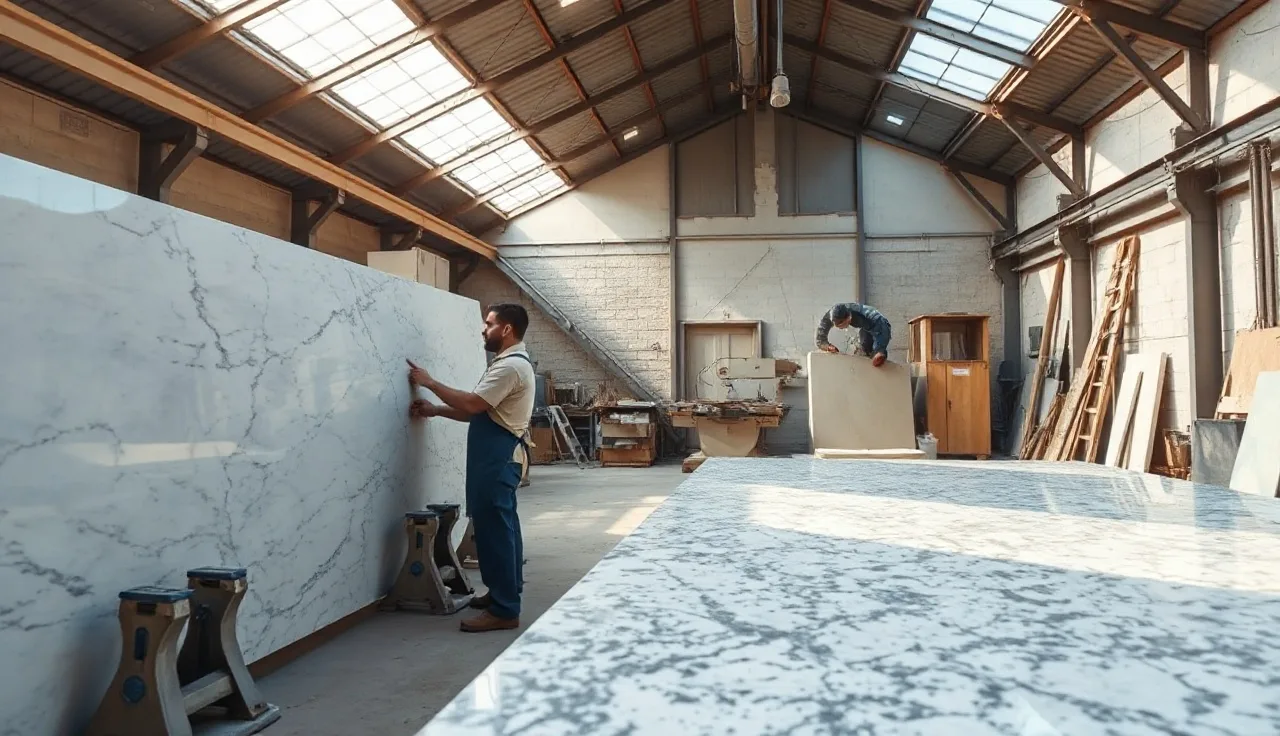
A stone fabrication shop takes raw slabs, cuts them to fit your exact kitchen or bathroom layout, profiles the edges, cuts sink and cooktop openings, and installs the finished pieces. That sounds simple. It is not.
Every job starts with a template. That is either a physical cardboard or wood template or, in most modern shops, a digital scan from a laser device like a Proliner. The template captures the exact dimensions of your cabinets, walls, windows, and any obstacle in the way. A bad template means a bad fit, and you cannot un-cut a slab that came out short.
After templating, the job goes to the saw. Most shops rough-cut the slab on a CNC bridge saw or waterjet, then shape the edge with a CNC router or a manual polisher. Common profiles include eased, beveled, bullnose, and ogee. An ogee or full bullnose on a 3cm slab takes more time and more tooling than a plain eased edge, which is exactly why edge upgrades cost extra.
Sink cutouts, faucet holes, and cooktop openings get cut with a router or a hand-held angle grinder, depending on the shop's equipment. The pieces are polished to the finish you picked, loaded onto an A-frame truck, and set with adhesive plus mechanical fasteners where the design needs them. A residential kitchen usually takes two experienced installers two to four hours on site [1].
Want the full picture of install day? See our guide to countertop installation.
What stone materials does a fabrication shop typically work with?
Most full-service shops work with granite, marble, quartzite, soapstone, travertine, and engineered quartz. Some also handle porcelain slabs and sintered stone like Dekton or Neolith. A few still do solid surface (Corian) and compact laminates, though those materials often go to shops that specialize in them.
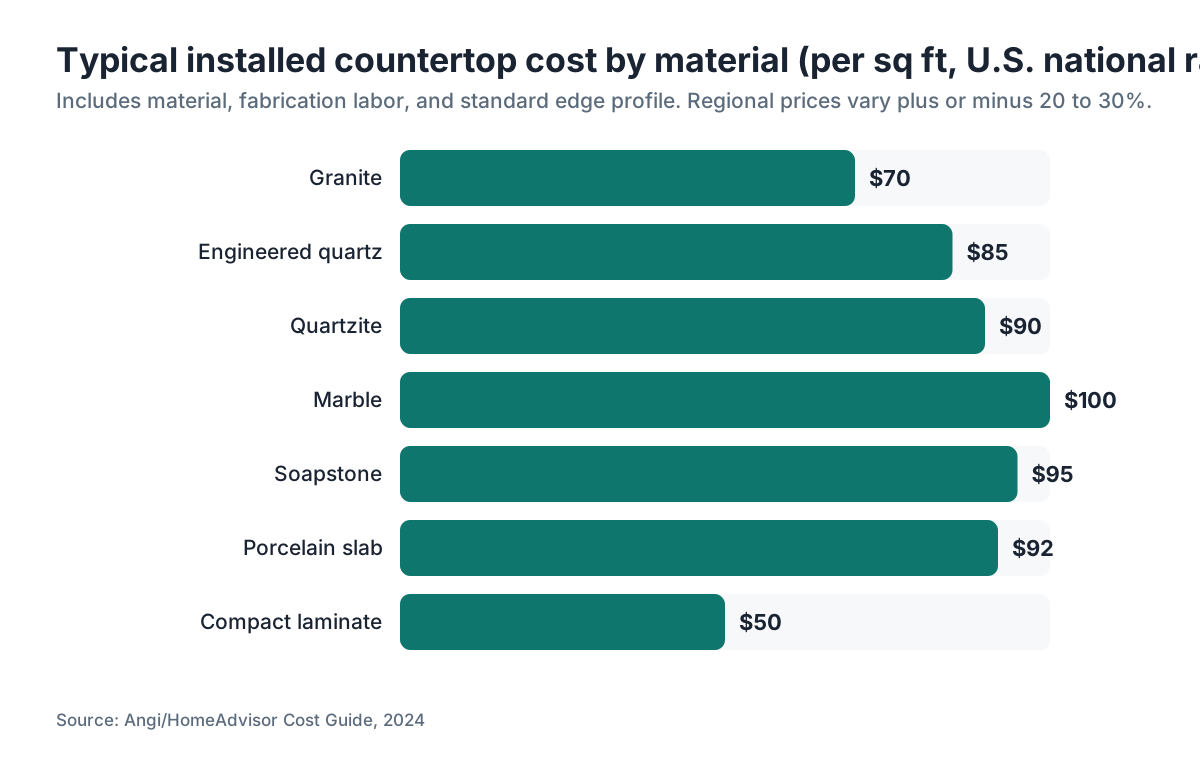
Here is a quick comparison of the materials most commonly fabricated and their typical installed cost ranges in the U.S. market:
| Material | Typical installed cost (per sq ft) | Hardness (Mohs) | Sealing needed? |
|---|---|---|---|
| Granite | $40 to $100 | 6 to 7 | Yes, annually |
| Marble | $50 to $150 | 3 to 4 | Yes, 2 to 4x/year |
| Quartzite | $60 to $120 | 7+ | Yes, annually |
| Engineered quartz | $50 to $120 | 7 | No |
| Soapstone | $70 to $120 | 1 to 2 | No (oil instead) |
| Porcelain slab | $55 to $130 | 7 to 8 | No |
| Compact laminate | $30 to $70 | N/A | No |
Those prices are installed cost: material, fabrication labor, and a basic edge profile. They come from aggregated contractor pricing surveys and the HomeAdvisor/Angi cost data as of 2024 [2]. Regional variation is real. Shops in the Northeast and on the West Coast often run 20 to 30% above the national midpoint.
Granite countertops are still the most commonly fabricated natural stone in the U.S. Marble countertops hold a strong second for bathrooms and high-end kitchens. Leaning toward a harder quartzite? Our guide on how to clean quartzite countertops covers the care side in detail.
How do stone fabrication shops price a job?
Fabricators price by the square foot of finished countertop, then add line-item charges for edges, cutouts, and special features. The square footage comes off the template, not your rough guess, which is why any quote given before templating is provisional.
Here is what typically adds to the base square-footage price:
- Sink cutouts: $50 to $150 each, depending on sink type (undermount costs more than drop-in because the cut edge shows and has to be polished).
- Faucet holes: $20 to $50 each.
- Cooktop cutouts: $75 to $200 depending on material hardness.
- Edge upgrades: a standard eased edge is usually included; an ogee or waterfall edge can add $15 to $30 per linear foot.
- Mitered edges for a thick-look countertop: $30 to $60 per linear foot on top of the base edge price.
- Backsplash strips: priced per linear foot, separate from the main slab.
- Seams: good fabricators plan seams to hide in natural locations; complex layouts with many seams add labor time.
The material cost is usually the slab purchase price divided by the usable yield. Most shops buy slabs at wholesale and mark them up 20 to 40%. When a homeowner brings their own slab, some shops charge a customer-supplied material fee to cover the risk of cutting stone they did not pick.
Nobody has perfectly standardized data on shop markup rates. The closest industry survey comes from the Marble Institute of America (now part of the Natural Stone Institute), which found median material markups of 25 to 35% for mid-size shops [3].
Shops that run tight operations use quoting software to nail square-footage calculations and nest cuts to cut slab waste. SlabWise is built for this workflow and shows fabricators real-time waste percentages per job. If you run a shop and your quoting still lives on a spreadsheet, a demo is worth 20 minutes of your day.
What is the difference between a fabricator and a stone supplier?
A stone supplier (also called a distributor or slab yard) imports or warehouses raw slabs and sells them to fabricators or straight to homeowners. They do not cut or install anything. A fabricator buys from the supplier, does the cutting and finishing, and handles the install.
Some companies do both. They carry inventory and run a fabrication shop under one roof. People call these full-service stone companies. Buying from one can save money because there is one fewer middleman, but you also lose flexibility to shop elsewhere for a slab if their inventory leaves you cold.
When you get a quote, ask one question up front: is the slab price included, or am I buying the slab separately? Some shops quote fabrication only and send you to a slab yard to pick your material. Others are turnkey. Both models are fine. You just need to know which one you are looking at so your quotes line up.
How do you evaluate whether a stone fabrication shop is good?
Reputation and portfolio matter, but a few concrete checks tell you more.
First, ask about their templating method. Cardboard templates can still produce accurate work, but laser digital templating (Proliner, Prodim, LT-2D3D) cuts human error way down, especially on crooked walls. A shop that invested in digital templating usually takes precision seriously [4].
Second, look at their seam placement policy. A reputable shop shows you a seam layout on paper before anything hits the saw. You should know where every seam falls before you approve the job.
Third, ask who does the installation. Some shops subcontract the install to a separate crew. That is not automatically bad, but it means the people who templated and cut the stone are not the ones setting it. When something goes sideways (a slab that will not sit flat, a seam that opens a hair), communication between shop and installer decides how fast it gets fixed.
Fourth, get the warranty terms in writing. A good shop warrants its workmanship for at least a year, covering seam separation, cracking from installation stress, and edge chip repair. Defects that were already in the slab are harder to warranty, because the slab yard sourced the stone, not the fab shop.
Fifth, read Google and Houzz reviews, but weight them right. One-star reviews about scheduling or communication tell you something real. A review that says "the counters look beautiful" tells you almost nothing about fabrication quality.
Once the stone is in, our how to clean stone countertops guide covers keeping it that way.
What questions should you ask before signing a stone fabrication contract?
Before you sign anything, get clear answers to these:
- What is the exact square footage you are quoting, and how was it measured? Ask for the count sheet.
- Where will the seams be, and can you show me on a drawing?
- Is the slab price included, and which slab bundle is this quote based on? (Prices vary by bundle even within the same material.)
- What edge profile is included, and what does my preferred profile cost to upgrade?
- Are sink and cooktop cutouts included, or are they line items?
- Who templates, who fabricates, and who installs, and are they the same crew?
- What is the lead time from template to install?
- What does your workmanship warranty cover, and for how long?
- What happens if the slab cracks or a seam opens within six months?
- Do you require cabinets to be level before templating, and who is responsible if they are not?
Most disputes that land in contractor complaint boards or small claims court trace back to the same three things: square footage, seam location, or who owned the unlevel-cabinet problem. Getting the answers in writing before you sign costs nothing and heads off nearly all of it.
How long does stone fabrication and installation take?
For a typical kitchen countertop job (30 to 50 square feet), the timeline usually looks like this:
- Template appointment: 30 to 90 minutes on-site.
- Fabrication turnaround: 3 to 10 business days after templating, depending on shop backlog and material availability.
- Installation: 2 to 5 hours on-site for the average kitchen.
High-end shops in busy markets sometimes run 2 to 3 week fabrication backlogs. Slower shops can turn a job in 2 to 3 days. Rush fees are common if you need it faster.
Bigger jobs with complex layouts, multiple seams, or specialty stone (thick slabs, book-matched panels) take longer. A master bathroom vanity with undermount sinks usually moves faster than a large kitchen. A commercial bar top with waterfall ends and mitered edges can take 2 to 3 weeks to fabricate right.
One number worth knowing: the Natural Stone Institute reports that U.S. shops handle roughly 30 to 50 kitchen jobs per month at full capacity [3]. That is why spring and summer scheduling gets tight.
What are the most common fabrication mistakes and how do you avoid them?
Fabrication mistakes fall into a few buckets.
Poor seam execution is the most visible one. A seam with a height mismatch (one side of the countertop sits slightly higher than the other) is almost always a cabinet leveling problem, not a fabrication error. But a seam with a visible gap, discolored epoxy, or a bad color match is a shop quality problem. Color-matched epoxy is standard practice. If your seams are filled with generic gray filler on a white marble, the shop cut a corner.
Improper support is less visible and causes long-term cracking. Natural stone needs continuous cabinet support, especially at overhangs. The Natural Stone Institute recommends that overhangs beyond 10 inches on 3cm stone be supported by corbels or steel brackets [3]. Some installers skip this to save time. Ask about overhang support before install day.
Oversized cutouts for undermount sinks show up in shops that are not templating the sink precisely. The reveal between the sink rim and the stone edge should be even all the way around. An oversized cutout is basically unfixable without a new slab.
Chipped edges during transport happen more often than shops admit. Inspect every linear inch of edge before the installers leave. Find a chip after they are gone, with nothing noted on the work order, and in most states' dispute frameworks it becomes your problem.
For how different materials age after installation, see how to clean soapstone countertops and how to clean quartzite countertops. On both, post-install care changes how the stone looks in five years.
How do stone fabrication shops handle natural stone vs. engineered quartz differently?
The cutting and edge profiling is largely the same. The differences that matter show up around the material itself.
Natural stone slabs vary. No two slabs of granite or marble are identical, and even two slabs cut from the same block can have different veining density. A good fabricator studies where the dramatic veining lands and decides how to position the cut: center it, match it across a seam, or dodge a natural fissure (a pre-existing crack that, if you cut across it, telegraphs through the finished surface).
Engineered quartz is the opposite. The pattern repeats, the factory controls the thickness (usually exactly 3cm), and there are no fissures. That makes quartz easier to template and cut with fewer surprises, though it is harder on tooling than softer natural stones.
One practical difference: quartz weighs more per square foot than most natural stone. A 3cm quartz slab runs about 18 to 20 lbs per square foot; granite runs 12 to 18 lbs depending on the specific stone [5]. That matters for cabinet load capacity and for how brutal the install is on the crew.
One more thing worth knowing before you choose: engineered quartz cannot be re-polished if it scratches. Granite and marble can be re-honed by a pro. Quartz cannot.
What should homeowners know about stone countertop warranties?
Countertop warranties cover two separate things: the material and the workmanship. They almost always come from different parties.
The material warranty, if one exists, comes from the manufacturer (for engineered quartz like Cambria or Silestone) or from effectively nobody (for natural stone, since a slab is a natural product). Engineered quartz makers typically offer 10-year to lifetime limited warranties that cover defects in the quartz itself, not damage from misuse or normal wear [6]. Read the exclusions. Most quartz warranties void coverage for heat, certain cleaners, and impact chips.
The workmanship warranty comes from the fabricator and covers the quality of the cut, the seams, and the install. Reputable shops offer one to two years. Some offer none. A fabricator with no written workmanship warranty is telling you something.
In most states, residential contractor work also carries implied warranty protections under state consumer statutes, regardless of what the written contract says. The Federal Trade Commission publishes guidance on warranty disclosures for consumer products under the Magnuson-Moss Warranty Act [7]. For contractor licensing rules, check your state's licensing board, since requirements swing widely.
Shopping a specific quartz brand? Our guide to Cambria countertops covers that warranty in more detail.
How does running a stone fabrication shop actually work as a business?
This section is for shop owners and fabricators, not homeowners.
A stone fab shop has three main cost buckets: materials (slab cost, adhesives, tooling), labor (templaters, saw operators, edge finishers, installers), and equipment (CNC saw, polishing gear, truck, templating hardware). The fixed costs are heavy. A production CNC bridge saw costs $80,000 to $250,000 new [8]. A Proliner digital templating system runs $10,000 to $20,000. An equipped delivery and installation truck is another $30,000 to $60,000 once you add the A-frame setup.
Most shops run gross margins of 35 to 55% depending on material mix and market. High-end natural stone jobs with complex edges carry better margins than commodity granite jobs that get competed down on price.
Two problems come up over and over: quoting accuracy and slab waste. Underquote a job because the square footage was wrong or the waste factor was ignored, and it eats straight into margin. Shops hand-calculating quotes on spreadsheets typically run 5 to 10% higher waste than shops using purpose-built nesting software, because manual nesting cannot optimize cut layouts across multiple jobs on the same slab.
SlabWise was built for exactly this. Quote jobs accurately, nest cuts automatically, and see waste percentages before you commit to a slab. If quoting is a recurring headache, request a demo.
Researching surfaces that skip stone fabrication entirely? Compare laminate countertops, Formica countertops, and Corian countertops. For the whole project from the top, start with our kitchen countertops guide.
Are there licensing or code requirements for stone fabrication shops?
Contractor licensing for countertop installation varies by state. Some states require a general contractor's license for any countertop install because it touches a permanent residential structure. Others treat it as a specialty trade with its own license category. A few have no specific requirement at all.
The California Contractors State License Board, for example, requires countertop installers to hold a C-54 (Tile and Marble) or D-50 (Cabinet, Millwork and Finish Carpentry) license depending on scope [9]. Texas requires general contractor registration for residential work in many counties. Florida requires specialty contractor registration for structural or permanent installations.
For shop operations, OSHA has standards that apply directly to stone fabrication. Silica dust from dry-cutting stone is a documented health hazard. OSHA's Respirable Crystalline Silica standards (29 CFR 1926.1153 for construction, 29 CFR 1910.1053 for general industry) set a permissible exposure limit of 50 micrograms per cubic meter averaged over an 8-hour shift [10][11]. Wet cutting, local exhaust ventilation, and respiratory protection are the standard controls. A shop that dry-cuts without dust suppression is violating federal OSHA standards, full stop.
For homeowners, the takeaway is simple. If a crew is cutting stone dry inside your home without water suppression, tell them to stop. The dust settles through the whole house and it is a real respiratory hazard.
Frequently asked questions
What is a stone fabrication shop?
A stone fabrication shop takes raw stone slabs, cuts them to your countertop layout, shapes the edges, cuts sink and appliance openings, and installs the finished pieces. They work with granite, marble, quartzite, engineered quartz, and similar materials. Most shops handle residential kitchens and bathrooms plus commercial projects. They are the middle step between the slab yard and your finished counter.
How much does stone fabrication cost per square foot?
Installed stone countertops run from about $40 per square foot for basic granite to $150 or more for exotic marble or thick engineered stone with complex edges. Granite's national midpoint is roughly $65 to $80 installed. Engineered quartz runs $55 to $120 installed. Prices vary by region, with coastal markets typically 20 to 30% above national averages.
How long does stone countertop fabrication take?
From template to install, a typical residential kitchen takes 5 to 14 business days. Templating takes 30 to 90 minutes on-site. The shop then needs 3 to 10 business days depending on backlog. Installation runs 2 to 5 hours for an average kitchen. Spring and summer push lead times longer. Ask your shop for current turnaround before you commit to a timeline.
What is the difference between fabrication cost and slab cost?
The slab cost is what you pay for the raw stone. Fabrication cost covers cutting, edge profiling, sink cutouts, polishing, and installation labor. Some shops quote an all-in price that bundles both. Others quote fabrication only and send you to a separate slab yard. When comparing quotes, confirm whether the slab is included so you are comparing the same scope of work.
Do stone fabrication shops work with customer-supplied slabs?
Most will, but many charge a customer-supplied material fee, typically $5 to $15 per square foot or a flat $100 to $300. That covers the risk of cutting a slab they did not select or inspect. If the slab has an undiscovered fissure that breaks during cutting, the shop wants some protection. Ask about this policy before you buy a slab elsewhere.
What edge profiles are standard vs. an upgrade at most stone shops?
Eased edge (a simple 45-degree or 1/8-inch break on the top corner) is included in most base quotes. Beveled, straight polished, and pencil edges are usually free or low-cost upgrades. Bullnose, ogee, dupont, and waterfall profiles cost more because they need more tooling time. Mitered edges for a thick-look countertop from 2cm stone add the most, often $30 to $60 per linear foot on top of the base.
What causes seam lines to be visible in stone countertops?
Three things usually do it: a height mismatch between the two slab pieces (from unlevel cabinets or imprecise installation), poor color-matching of the epoxy filler, or natural stone variation where the veining does not align across the seam. A good fabricator plans seam placement to minimize this and uses color-matched epoxy. Ask to see the seam layout before fabrication begins.
Is silica dust from stone cutting a real health hazard?
Yes, and it is serious. OSHA sets a permissible exposure limit of 50 micrograms per cubic meter for respirable crystalline silica (29 CFR 1910.1053). Dry-cutting granite or engineered quartz throws off silica dust that causes silicosis, an irreversible lung disease. Compliant shops use wet cutting with water suppression or local exhaust ventilation. If a crew is dry-cutting in your home without dust controls, stop it immediately.
Do fabrication shops need a contractor's license?
It depends on your state. California requires a C-54 or D-50 license for countertop installation. Other states require general contractor registration for permanent residential installations. A few states have minimal requirements. Ask your fabricator for their license number and verify it with your state's licensing board before signing. Unlicensed work can void your homeowner's insurance coverage for related damage.
How do you compare quotes from different stone fabrication shops?
Get at least three quotes and make sure each covers the same scope: same square footage (ask for the count sheet), same edge profile, same number of cutouts, same material bundle. Quotes that look dramatically cheaper often use a lower-quality slab bundle, exclude sink cutouts, or quote a different square footage. Once scope is aligned, price differences usually reflect labor quality, equipment, and shop overhead.
What happens if my stone countertop cracks after installation?
Document it with photos and contact the fabricator in writing. Cracking from installation stress (inadequate support, unsupported overhangs, or forcing the slab into place) is a workmanship issue the shop should cover under its warranty. Cracks from impact or thermal shock are generally not covered. Pre-existing fissures that opened up are a gray area, and a careful fabricator should have caught them before cutting.
Can a stone fabrication shop match existing countertops?
Matching existing natural stone is hard and often impossible. Slabs vary by quarry lot, and even two slabs from the same block look different. Fabricators can sometimes source a close match if the material is still in production, but exact matches are rare. Engineered quartz is easier to match if the product line is still active. If matching matters, bring a piece of the existing material to the slab yard first.
What is book-matched stone and does it cost more to fabricate?
Book matching means opening two consecutive slabs like a book so the veining mirrors across a seam or wall. It shows up most in marble feature walls, islands, and waterfall edges. It costs more because the shop has to plan the cut layout carefully, match the seam precisely, and sometimes waste more slab to get the mirror effect. Expect a premium of 15 to 30% over a standard job of the same size.
Does a stone fabrication shop also do repairs on existing countertops?
Many do, though repair work pays less than new installs so some shops deprioritize it. Common repairs include chip filling with color-matched epoxy, seam re-epoxying, crack stabilization, and re-polishing scratched or etched surfaces. Re-honing works on natural stone but not on engineered quartz. Call shops directly and ask; some fabricators refer repair work to specialists.
Sources
- Natural Stone Institute, Fabrication and Installation Guidelines: Typical residential countertop installation for an average kitchen takes two experienced installers two to four hours on site
- Angi (HomeAdvisor), Countertop Installation Cost Guide 2024: Installed countertop cost ranges by material: granite $40 to $100 per sq ft, marble $50 to $150, engineered quartz $50 to $120
- Natural Stone Institute, Industry Statistics and Business Benchmarks: Median material markups for mid-size fabrication shops are in the 25 to 35% range; average shop capacity is 30 to 50 kitchen jobs per month; overhangs beyond 10 inches for 3cm stone should be supported by corbels or steel brackets
- Natural Stone Institute, Dimensional Stone Design Manual: Digital laser templating reduces measurement error on irregular walls compared with physical cardboard or wood templates
- Natural Stone Institute, Stone Reference Manual: A 3cm quartz slab runs approximately 18 to 20 lbs per square foot; granite runs 12 to 18 lbs per square foot depending on specific stone density
- Cambria, Limited Lifetime Warranty Terms: Engineered quartz manufacturers typically offer 10-year to lifetime limited warranties covering defects in the quartz itself, with exclusions for heat damage, certain cleaners, and impact chips
- Federal Trade Commission, Warranties and the Magnuson-Moss Warranty Act: FTC guidance on warranty disclosure requirements for consumer products under the Magnuson-Moss Warranty Act
- Park Industries, CNC Bridge Saw Equipment Pricing: A production CNC bridge saw costs $80,000 to $250,000 new
- California Contractors State License Board, License Classifications: California requires countertop installers to hold a C-54 (Tile and Marble) or D-50 (Cabinet, Millwork and Finish Carpentry) license depending on scope of work
- OSHA, Respirable Crystalline Silica Standard for General Industry (29 CFR 1910.1053): OSHA's permissible exposure limit for respirable crystalline silica is 50 micrograms per cubic meter averaged over an 8-hour work shift
- OSHA, Respirable Crystalline Silica Standard for Construction (29 CFR 1926.1153): OSHA standard 29 CFR 1926.1153 applies to silica dust exposure in construction settings including stone countertop cutting and installation
Last updated 2026-07-09