TL;DR
- Corian is a solid-surface countertop material DuPont introduced in 1967, made of roughly one-third acrylic resin and two-thirds mineral filler (alumina trihydrate).
- It costs $45 to $90 per square foot installed, comes in over 100 colors, and can be sanded to remove scratches.
- It is not quartz, not stone, and not the same as laminate.
What is Corian countertops? (the material itself)
Corian is a brand name for a solid-surface countertop material that DuPont introduced in 1967. The full chemical name is acrylic polymer and alumina trihydrate composite. DuPont's own technical data sheets describe the composition as approximately 33% acrylic polymer (polymethyl methacrylate, or PMMA) and 66% alumina trihydrate (ATH), a naturally derived mineral filler. [1]
The result is a material that is solid all the way through. Cut a cross-section and it looks the same from the top surface to the bottom. That homogeneity is what makes Corian repairable in ways that stone, laminate, and even most engineered quartz are not.
DuPont sold the Corian business to Trinseo in 2020. The brand name, formulation, and manufacturing have continued under Trinseo's ownership. [2] If you read older articles calling DuPont a current manufacturer, they are out of date.
"Solid surface" is the product category, and Corian is the most recognized brand in that category, much the way Kleenex is to facial tissue. Other solid-surface brands include Wilsonart Solid Surface, LG Hi-Macs, and Formica's solid-surface line. They compete directly with Corian on price and properties but are distinct products.
Corian is not quartz engineered stone. It is not acrylic paint. It is not a thick laminate. The word "acrylic" in the composition surprises people who think of acrylic as a cheap plastic, but PMMA in sheet and slab form is a different beast: dense, machinable, and thermally formable. [10]
How much do Corian countertops cost?
Installed Corian countertops cost $45 to $90 per square foot, all in. [3] That range covers material plus fabrication, cutouts for sinks and cooktops, edge profiles, and basic installation. A few real variables push a project toward one end or the other.
Color tier is the biggest one. Corian groups its colors into design collections, and the premium collections (the ones with deeper veining effects or particulate patterns) cost more per sheet from the distributor. A basic solid white like "Glacier White" lands near the low end of the range. A pattern-rich color from the Volcanic line lands near the top.
Shop labor rate is the second variable. Fabricators in high cost-of-living metro markets charge more per hour, and solid surface takes more hands-on time than simply cutting granite. Seams have to be chemically bonded and sanded flush, which is skilled, slow work.
Project size matters too. A 30-square-foot galley kitchen gets a higher per-square-foot price than a 90-square-foot island-plus-perimeter kitchen, because the fixed overhead (templating, shop setup, delivery) gets spread over fewer billable square feet.
For a typical U.S. kitchen at roughly 45 to 55 square feet of countertop, expect a total installed cost of $2,025 to $4,950. [3] These are not guaranteed quotes. Get at least three bids from local fabricators.
Material only (slab or sheet, no fabrication) runs roughly $15 to $35 per square foot depending on color and where you buy it. DIY installation of solid surface is not a good idea for most people, and most Corian dealers require certified fabricators to keep any warranty valid.
If you want a ballpark number before calling anyone, a fabricator's quoting software can generate an estimate from your square footage and edge choices. SlabWise offers an instant quote tool that works for homeowners even before you've picked a shop.
How does Corian compare to quartz countertops?
This comparison comes up constantly, and it deserves a real side-by-side rather than a vague "it depends."
The term corian quartz countertops shows up online as if Corian and quartz are the same thing. They are not. They have different compositions, different manufacturing processes, different hardness levels, and different price ranges. Here is a direct comparison.
| Property | Corian (solid surface) | Quartz engineered stone |
|---|---|---|
| Composition | ~33% PMMA acrylic + ~66% ATH mineral | ~90 to 95% ground quartz + ~5 to 10% polymer resin |
| Hardness (Mohs) | ~2 to 3 [1] | ~6 to 7 [4] |
| Heat resistance | Low (scorches above ~150°F) | Moderate (resists up to ~300°F briefly) |
| Scratch resistance | Low to moderate; sandable | Moderate to high; not repairable |
| Repair | Sand out scratches at home | Scratches are permanent; chips difficult to fix |
| Seams | Nearly invisible when bonded properly | Visible seams, especially on dark colors |
| Edge profiles | Routed to any shape, including integrated sinks | Limited by stone thickness; no integrated sinks |
| Installed cost | $45, $90/sq ft | $55, $130/sq ft [4] |
| UV resistance | Moderate; some colors fade in direct sun | Better UV stability |
| NSF certification for food contact | Yes (NSF 51) [5] | Varies by brand |
For most homeowners, the decision comes down to two things. If scratch and heat resistance are your priority, quartz countertops are harder and easier to live with in a busy kitchen. If invisible seams, integrated sinks, and design flexibility matter more, Corian wins.
One real advantage Corian has that quartz cannot match: you can grind a Corian sink directly into the countertop sheet so there is no joint at the sink cutout. No grout line, no silicone bead to mold over time. For people who hate cleaning around undermount sinks, this is a genuine quality-of-life improvement.
For more on quartz engineered stone specifically, see our full article on quartz countertops.
How does Corian compare to granite and other stone?
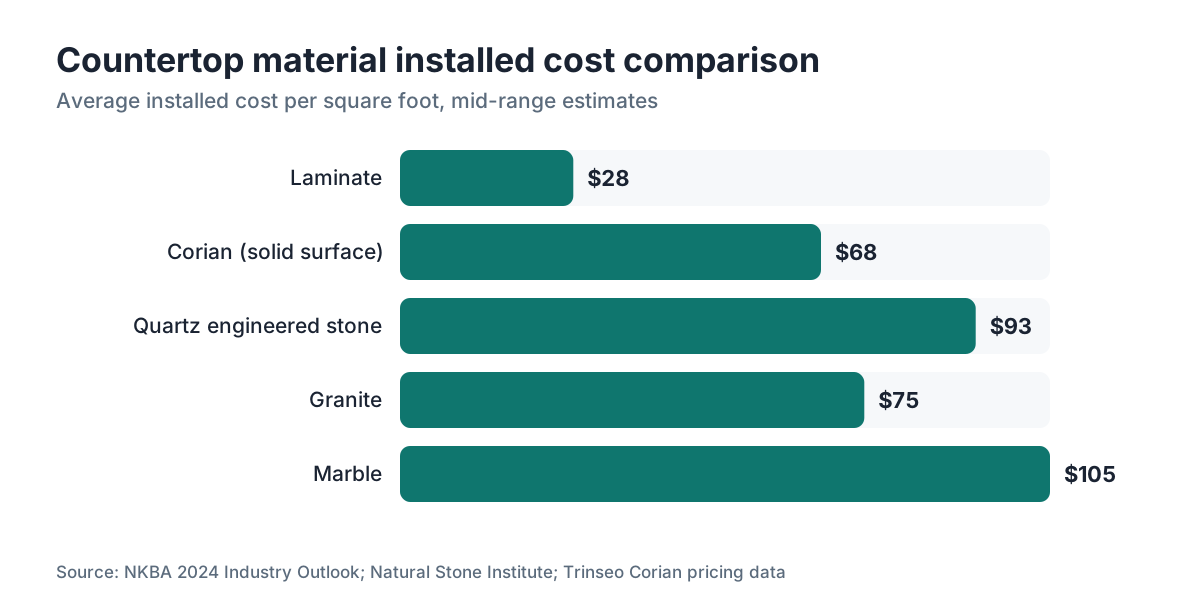
Corian versus granite countertops is a simpler comparison in some ways. Granite is a natural stone, quarried from the earth, cut into slabs, and polished. Its hardness ranges from about 6 to 7 on the Mohs scale, which makes it far harder than Corian. [6] You will scratch Corian with a chef's knife used directly on the surface. Granite shrugs off a knife.
Granite is not repairable the way Corian is. A chip in granite takes an epoxy fill that, on close inspection, usually looks like a fill. A scratch in Corian gets sanded out with 400-grit paper and buffed back to the original finish.
Granite needs periodic sealing (roughly once a year on most finishes) to prevent staining. Corian is nonporous at the surface and needs no sealing. That said, Corian can stain from turmeric, red wine, and concentrated dyes if they sit long enough. The stain is usually reversible with light abrasion, which is not true of an unsealed granite.
Granite has real visual depth that Corian's manufactured patterns cannot fully copy. If someone wants the movement and uniqueness of a natural slab, no solid-surface product is going to satisfy that.
On price, mid-range granite and mid-range Corian land in roughly the same installed cost zone. Entry-level granite can be cheaper. Premium granite slabs from rare quarries can run $150 to $200+ per square foot installed.
Versus marble countertops: Corian is more stain-resistant and much easier to maintain. Marble etches from acidic foods (lemon juice, tomatoes). Corian does not. For a kitchen that sees real cooking, Corian is the more practical of the two.
What are the advantages of Corian countertops?
Repairability is the headline. Because the color and composition run all the way through, a scratch or minor gouge sands out with progressively finer grits, then buffs back to the original finish. DuPont (now Trinseo) has always sold this as a benefit, and it is a real one. A 10-year-old Corian countertop that has been scratched up can look new again after an hour of careful sanding. [1]
Invisible seams are the second draw. A skilled fabricator bonds two Corian sheets with a color-matched adhesive and sands the joint flat until it disappears. On large kitchens, that means one continuous run without the seam lines you'd expect in granite or quartz.
Integrated sinks. You can have a sink fabricated from the same Corian sheet as the countertop, with no joint, no caulk line, and no rim to trap debris. For healthcare, commercial food service, and neat-freak homeowners, that is a real practical gain. The NSF 51 food-zone certification supports Corian's use in commercial kitchens. [5]
Design flexibility. Corian can be thermoformed (heated and bent) into curved shapes, backsplash integrations, and custom edge profiles that stone cannot hit without expensive milling. It routes to nearly any edge shape.
The material is relatively light compared to granite or quartz slabs, which matters in older homes where cabinet construction cannot carry heavy stone loads.
Corian also qualifies for LEED credits in some commercial projects because ATH is a naturally occurring mineral filler and the material can be recycled by specialty processors. [7] That is a niche benefit for most homeowners but real for commercial specs.
What are the disadvantages and limitations of Corian?
Heat is the biggest limitation. Corian can scorch, crack, or warp from direct heat. A hot pan taken straight from the stove and set on Corian leaves a mark. Discoloration from heat is often permanent even with sanding, because the damage changes the material chemistry rather than just the surface texture. Trivets are not optional with Corian. They are required.
Scratch susceptibility is the second real drawback. Corian sits around 2 to 3 on the Mohs scale, which means steel kitchen knives (Mohs ~6) scratch it easily. [10] Yes, scratches sand out, but you have to actually do the work. People who want to cut directly on their countertop, or who don't want to think about maintenance at all, should look at quartz or granite.
Appearance limits. Corian's patterns are manufactured, and even the best vein patterns read a little artificial next to a genuine natural stone slab. No Corian color passes for real marble under scrutiny. Homeowners who care deeply about the visual richness of natural stone will not be satisfied with solid surface.
Gloss retention. The standard semi-gloss finish dulls over time in high-use areas. You can correct it with periodic buffing, but it takes effort. Matte finishes hold more evenly and hide micro-scratches better.
UV exposure is a real concern for Corian used near large windows or in outdoor-adjacent spots. Some colors yellow or fade in prolonged direct sunlight. Trinseo does not certify Corian for outdoor use.
Is Corian durable enough for a busy kitchen?
The honest answer depends on what you mean by durable.
Corian resists chipping and impact well. Drop a cast-iron pan on the edge of a Corian counter and you are less likely to break a chunk out than with granite or quartz, which can chip at the edge. The material is somewhat flexible at scale and absorbs impact differently than brittle stone.
Corian shrugs off most household chemicals, including common cleaning products, diluted bleach, and mild acids. The NSF 51 certification means it passed food-contact safety testing. [5]
But in a kitchen that sees daily heavy cooking, Corian's scratch and heat vulnerability means ongoing maintenance. Some households find the "sand it out" repair process satisfying. Others find it a chore. If you're the kind of person who keeps a wood cutting board oiled and clean, you'll maintain Corian without drama. If you want to forget the countertop exists, look at quartz.
Corian carries a 10-year limited warranty when installed by a certified fabricator. [1] Stone slabs typically carry no manufacturer warranty at all, so in that narrow sense Corian has an edge for warranty-minded buyers.
How do you clean and maintain Corian countertops?
Day-to-day cleaning is simple: warm water, a mild soap or all-purpose cleaner, and a damp cloth. Rinse and dry. That is genuinely all it takes for routine upkeep.
For dried food or minor stains, a damp cloth with a little baking soda applied in a circular motion usually handles it. Turmeric, mustard, and concentrated fruit juices can stain if left for hours. Clean those up fast.
For light scratches in a semi-gloss finish, Corian recommends a Scotch-Brite pad in a circular motion with a mild household cleaner. For deeper scratches, 400-grit wet/dry sandpaper followed by 600-grit, then a Scotch-Brite buff, then a surface polish restores most damage. DuPont's original care guide, still broadly applicable under Trinseo's ownership, walks through this process step by step. [1]
Avoid strong solvents like paint thinner, drain cleaners, or products containing methylene chloride. These attack the acrylic binder in the material.
No sealing required. Ever. That alone saves time and money compared to maintaining granite or unsealed marble. For general guidance on keeping stone and solid surfaces clean, see our piece on how to clean stone countertops.
Can Corian be installed as a DIY project?
Technically possible. Practically, not a great idea for most people.
Corian cuts with carbide-tipped woodworking blades and routs with standard carbide router bits. It does not need a wet saw the way stone does. Some homeowners with woodworking experience have installed Corian successfully.
The hard part is seaming. A Corian joint uses a two-part color-matched adhesive (Corian Color Matched Seam Kit) that demands a precise fit, proper clamping, and sanding flush after cure. A botched seam is visible and almost impossible to fix cleanly after the fact. Pro fabricators spend years learning to make Corian joints disappear. Most DIYers, even careful ones, end up with a seam that shows in certain light.
The other issue is warranty. Corian's 10-year limited warranty requires installation by a Corian-certified fabricator. [1] DIY installation voids that warranty.
For a small bathroom vanity top with no seaming, DIY is more feasible. For a full kitchen, hire a certified shop.
Fabricators quoting Corian projects often use dedicated countertop software to generate accurate material estimates and cut layouts. Tools like SlabWise help shops price these jobs fast, so homeowners get quicker, more consistent bids.
How does Corian compare to laminate countertops?
Laminate (like Formica brand laminate) and Corian look similar in price at the low end, and both are man-made, but they are built differently.
Laminate countertops are a thin decorative layer (typically 1/16 inch or less) bonded to a particleboard or MDF substrate. Corian is solid material, 1/2 inch or 3/4 inch throughout. That distinction matters for two reasons: laminate cannot be sanded and repaired the way Corian can, and laminate is vulnerable at the substrate if water gets under the surface layer at seams or edges.
Laminate is cheaper. A basic installed laminate countertop runs $15 to $40 per square foot installed. [8] Corian's floor is about $45/sq ft. That gap is real money on a full kitchen.
For a rental property, a budget renovation, or a very low-traffic kitchen, laminate is a fine answer. For a kitchen that gets daily use and where you want a 15-plus-year countertop life with low fuss, Corian's repairability makes the price premium defensible.
See our full article on formica countertops for a deeper look at how brand-name laminate fits into the countertop market.
Versus butcher block countertops: Corian wins on water resistance and stain resistance. Butcher block wins on warmth, feel, and the ability to cut directly on the surface (you're supposed to sand butcher block periodically anyway). They belong in very different kitchens.
What colors and styles does Corian come in?
As of 2024, Trinseo's Corian catalog lists over 100 colors grouped into design collections. [2] The collections run from solid, matte neutrals (the Glacier and Cameo series) to patterns that mimic stone movement (the Volcanic, Tempest, and Savanna series).
The solid colors and simple two-tone patterns are the most convincing finishes. Corian's solid whites and creams have a clean, slightly warm look that photographs well and ages evenly. The stone-mimicking patterns are less convincing in person and tend to look obviously artificial at close range, though they have improved a lot over the years.
Finish options include matte, semi-gloss, and high-gloss. Matte hides scratches and everyday wear best. High-gloss looks dramatic when new and shows every smudge and micro-scratch in daily use.
Custom colors and commercial specification colors are available for large orders, mostly in commercial contexts. For a residential kitchen, you're working with the standard catalog.
Corian also comes in 1/4-inch, 1/2-inch, and 3/4-inch thicknesses. Residential countertops almost always use 1/2-inch sheet. The 3/4-inch thickness is mainly for commercial applications or freestanding furniture pieces.
Is Corian a good choice for bathrooms and commercial spaces?
Corian often beats stone in bathrooms for one main reason: it handles the wet environment without needing sealing, and the integrated sink option removes the one spot in a vanity where moisture reliably finds its way and causes damage.
For commercial kitchens, healthcare facilities, and food service counters, Corian has a long track record. The NSF 51 certification for direct food contact [5] and the ease of cleaning a joint-free surface make it a standard spec in commercial food prep. Many hospital nurse stations use Corian for the same reasons.
Schools and laboratory environments use Corian for bench surfaces. Its resistance to most lab chemicals (though not strong solvents) and its ability to be re-surfaced rather than replaced when damaged make it economical over a multi-decade building lifespan.
For outdoor kitchens, Corian is the wrong choice. Trinseo explicitly does not rate Corian for exterior use. The material fades and can warp under direct UV exposure and wide temperature cycling.
A concrete countertops alternative is sometimes worth a look for outdoor or heavily industrial-aesthetic kitchens where Corian would look out of place and concrete's thermal mass and UV stability are actual advantages.
What should homeowners ask fabricators before buying Corian?
A few questions separate good shops from bad ones.
First: are you Corian-certified? Corian requires fabricators to complete factory training to keep warranty eligibility. [1] An uncertified shop may do fine work, but you lose the warranty and may pay more if something goes wrong.
Second: can I see a seam sample? Ask the fabricator to show you an actual bonded joint in the color you're considering. A good one is nearly invisible at arm's length. A bad one is obvious. This is the single best quality check you can do before committing.
Third: what is the lead time for your color choice? Some Corian colors are stocked by local distributors. Others need a factory order. Lead times for special-order colors can run 4 to 8 weeks.
Fourth: what edge profiles are included in the quoted price? Some fabricators quote a basic straight edge and charge extra for every routed profile. Others include standard profiles. Know what you're comparing when you gather multiple bids.
Fifth: ask about their template process. Corian is unforgiving if dimensions are wrong because, unlike stone, there's no re-cutting a piece that comes out short. A careful template (physical or digital) done after all appliances and the sink are confirmed matters. See our broader guide on kitchen countertops for more on the template and installation process.
Frequently asked questions
What is Corian countertops made of?
Corian is a solid-surface material composed of approximately 33% acrylic polymer (PMMA) and 66% alumina trihydrate (ATH), a natural mineral filler. DuPont developed the formula in the 1960s and the brand is now owned by Trinseo. The material is solid throughout, meaning the color and pattern run all the way from the top surface to the bottom.
How long do Corian countertops last?
With normal care, Corian countertops last 20 to 30 years in residential kitchens. The 10-year limited manufacturer warranty covers defects when installed by a certified fabricator. Because scratches and surface dulling can be sanded out and the surface refinished, the practical lifespan often runs longer than unrepaired stone, which accumulates permanent chips and scratches.
Can Corian countertops be repaired?
Yes, and this is one of Corian's main advantages. Light scratches come out with a Scotch-Brite pad and mild cleaner. Deeper scratches need 400-grit and 600-grit wet/dry sandpaper followed by buffing. Because the color runs all the way through the material, sanding a scratch does not expose a different underlying color. Most repairs are DIY-able with patience.
Are Corian countertops heat resistant?
No. Corian scorches, cracks, or warps from direct high heat. You should never place a hot pan directly on Corian. Trivets and hot pads are required. This is Corian's most commonly cited limitation in busy kitchens and is the main reason some cooks prefer quartz or granite, both of which tolerate incidental heat better.
Is Corian the same as quartz countertops?
No. Corian is an acrylic-mineral solid surface. Quartz engineered stone is 90 to 95% ground quartz crystals bound with polymer resin. Quartz is harder (Mohs 6 to 7 vs. Corian's 2 to 3), more heat resistant, and cannot be sanded to repair scratches. Corian has nearly invisible seams and supports integrated sinks, which quartz does not. They serve different priorities.
How much does it cost to install Corian countertops per square foot?
Installed Corian countertops cost $45 to $90 per square foot, covering material, fabrication, cutouts, edge profiles, and installation. Color tier and local shop labor rates drive most of the variation. A typical U.S. kitchen with 45 to 55 square feet of countertop runs $2,025 to $4,950 total installed. Get at least three bids from certified fabricators for your specific project.
Do Corian countertops stain?
Corian is nonporous and resists most everyday stains better than unsealed stone. However, concentrated colorants like turmeric, mustard, or red wine can leave marks if left for extended periods. Most stains come out with light abrasive cleaning (baking soda, Scotch-Brite). No sealing is ever needed, which is a practical maintenance advantage over granite and marble.
What is the difference between Corian and laminate countertops?
Laminate is a thin decorative layer bonded to a particleboard or MDF core. Corian is solid material all the way through, either 1/2 inch or 3/4 inch thick. Corian can be sanded and repaired; laminate cannot. Laminate costs less ($15, $40/sq ft installed vs. $45, $90 for Corian) but is vulnerable to edge and seam moisture damage over time.
Can Corian countertops be used outdoors?
No. Trinseo does not certify Corian for exterior or outdoor use. Prolonged UV exposure causes fading and discoloration in many colors. Wide temperature swings can cause the material to warp or delaminate from the substrate. For outdoor kitchens, consider concrete, granite, or materials rated for exterior exposure.
Are Corian countertops safe for food preparation?
Yes. Corian holds NSF/ANSI 51 certification for direct food contact, the same standard applied to commercial kitchen equipment and surfaces. The nonporous surface does not harbor bacteria the way grout lines or wood grain can. It is widely used in commercial food prep and healthcare food service environments for this reason.
What is the difference between Corian and solid surface countertops?
Solid surface is the product category. Corian is the most recognized brand within that category, similar to how Xerox is a brand of copier. Other solid-surface brands include LG Hi-Macs, Wilsonart Solid Surface, and Samsung Staron. They share the same basic composition and properties. Corian's name recognition often makes it the comparison baseline, but competitors offer similar quality at similar prices.
How do I find a certified Corian fabricator?
Trinseo's Corian website has a fabricator locator that lists shops that have completed factory certification training. Certification matters for two reasons: it is required for the 10-year limited warranty, and trained fabricators produce better seams. Ask any shop you're considering to confirm their certification status before signing a contract.
Is Corian worth the money compared to other countertop options?
Corian makes the most sense when you want invisible seams, an integrated sink with no caulk line, or a surface you can refinish at home. It is a questionable pick if you put hot pans directly on your countertop or want the visual richness of natural stone. At $45, $90/sq ft installed, it competes directly with mid-range quartz and granite, so the choice is really about which tradeoffs matter more to you.
Can I cut directly on Corian countertops?
You can, but you shouldn't. Corian rates 2 to 3 on the Mohs hardness scale, and a standard kitchen knife (around Mohs 6) will scratch it. While the scratches are repairable, regular direct cutting leaves a network of fine scratches that dull the surface and force more frequent refinishing. Use a cutting board, the same as you would on any quality countertop surface.
Sources
- Trinseo / Corian Design - Corian Solid Surface Technical Data and Care Guide: Corian composition is approximately 33% acrylic polymer and 66% alumina trihydrate; carries a 10-year limited warranty when installed by a certified fabricator; repairability through sanding is a documented product property.
- Trinseo corporate announcement - Corian brand acquisition from DuPont, 2020: Trinseo acquired the Corian business from DuPont in 2020; as of 2024 the catalog includes over 100 colors.
- U.S. Census Bureau - American Housing Survey (national housing and remodeling cost data, 2023 to 2024): Installed solid-surface countertop costs range $45, $90 per square foot; total kitchen project cost for 45 to 55 sq ft runs $2,025, $4,950.
- Natural Stone Institute - Countertop material comparison and specification guidance: Engineered quartz hardness is approximately 6 to 7 Mohs; installed quartz countertop costs range roughly $55, $130 per square foot.
- NSF International - NSF/ANSI 51 Food Equipment Materials Standard: Corian Solid Surface holds NSF/ANSI 51 certification for direct food contact applications.
- USGS Mineral Resources Program - Mohs Hardness Scale reference: Granite hardness ranges approximately 6 to 7 on the Mohs scale; steel knife hardness is approximately 6 Mohs.
- U.S. Green Building Council - LEED v4 Materials and Resources Credit documentation: Solid-surface materials with natural mineral filler (ATH) can contribute to LEED materials credits in commercial projects.
- National Kitchen and Bath Association (NKBA) - 2024 Design & Industry Outlook; laminate countertop cost data: Laminate countertops install for approximately $15, $40 per square foot including labor.
- DuPont Historical - Corian product introduction documentation (1967): Corian was introduced by DuPont in 1967 as the first modern solid-surface countertop material.
- American Chemistry Council - Polymethyl methacrylate (PMMA) product properties reference: PMMA (polymethyl methacrylate) in solid-surface applications is a dense, machinable material distinct from thin-film acrylic coatings; steel knives at ~6 Mohs will scratch a 2 to 3 Mohs surface.
Last updated 2026-07-09