TL;DR
- Corian Quartz is DuPont's engineered quartz line.
- It is not the same product as Corian solid surface, and that mix-up costs buyers money.
- Installed cost runs about $55 to $100 per square foot depending on edges and region.
- It performs like Silestone or Caesarstone: scratch-resistant, non-porous, low-maintenance.
- It is not heat-proof, and it won't look like real stone up close.
What exactly is Corian Quartz, and is it the same as Corian countertops?
No. These are two different products sold under one brand name, and the mix-up trips up a lot of buyers before they ever get a quote.
Corian (no qualifier) is a solid-surface material DuPont introduced in 1967. It's made almost entirely from acrylic polymer and alumina trihydrate. You can sand it, seam it invisibly, and refinish it. There's zero stone in it. [1]
Corian Quartz is an engineered quartz product DuPont added to its lineup much later. Like all engineered quartz, it's roughly 90 to 93% ground natural quartz bound with polymer resins and pigments. [2] The way it's made is basically identical to Cambria, Silestone, or Caesarstone. The brand is different. The technology underneath is not.
So when someone searches "Corian quartz countertops," they might mean either product. Ask before you price anything. If a salesperson at a big-box store hands you a sample labeled Corian, find out which line you're holding.
The two materials behave differently, cost differently, and suit different projects. For a full look at solid-surface Corian, see our Corian countertops guide.
How much do Corian Quartz countertops cost?
Installed, Corian Quartz runs about $55 to $100 per square foot for most residential jobs. The slab material alone sits around $35 to $65 per square foot before fabrication and installation. [3] The range is wide because edge profiles, cutouts, seam location, and local labor rates all move the number.
A typical kitchen with 50 square feet of countertop lands somewhere between $2,750 and $5,000 installed. A large kitchen at 80 square feet can push $8,000 on the high end with a waterfall edge or a premium color series.
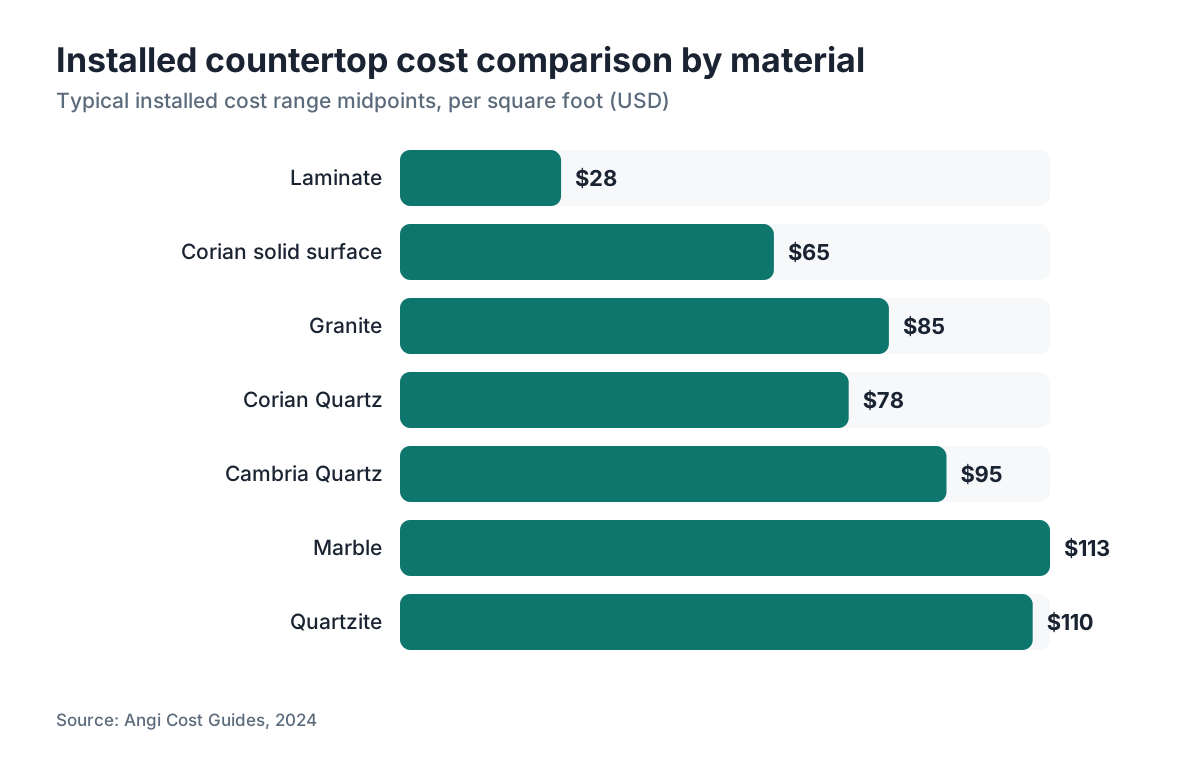
Here's where Corian Quartz falls against other common countertop materials, installed, per square foot:
| Material | Installed cost range ($/sq ft) |
|---|---|
| Laminate | $15, $40 |
| Corian solid surface | $45, $85 |
| Corian Quartz | $55, $100 |
| Cambria Quartz | $70, $120 |
| Granite | $45, $125 |
| Marble | $75, $150 |
| Quartzite | $80, $140 |
Those ranges come from aggregated contractor data and supplier pricing. Exact numbers shift by metro area and supply conditions, so treat them as ballpark figures, not quotes. [3][4]
Fabricators: on Corian Quartz jobs, slab yield and remnant usage matter more than most people expect. Software like SlabWise runs nesting layouts to tighten waste before you cut.
For countertop pricing across every material, the kitchen countertops guide covers the whole field.
Corian vs quartz countertops: how do the two materials actually compare?
This question usually pits Corian solid surface against engineered quartz (any brand, including Corian Quartz). Let's get specific.
Surface hardness. Quartz is harder. On the Mohs scale, quartz mineral rates a 7. Corian solid surface rates roughly 3 to 4, which means a stainless knife dragged across it leaves a mark. Engineered quartz shrugs off scratches far better. [5]
Repairability. Solid surface wins. Scratches sand out with fine-grit paper, and a skilled fabricator can refinish burns or deep marks back to new. Engineered quartz can't be refinished. A chip is basically permanent or needs a fill.
Heat resistance. Neither handles direct heat well. Corian solid surface can warp or scorch from a hot pan. Engineered quartz can crack from thermal shock because the resin binder expands at a different rate than the quartz aggregate. [6] Use a trivet. Always.
Appearance. Engineered quartz can mimic marble veining convincingly in some colors. Corian solid surface reads more uniform and matte, which some buyers call dated and others call clean.
Seaming. Corian solid surface seams nearly invisibly when done right. Quartz seams are always visible to some degree, worst in light colors.
Hygiene. Both are non-porous and never need sealing. Neither harbors bacteria more than any other clean surface. NSF has certified both material types for food-contact surfaces under NSF/ANSI 51. [7]
The short version: quartz is harder and easier day-to-day; solid surface is more repairable and seams better. Pick the failure mode you'd rather live with.
Corian countertops cost vs quartz: which one is cheaper over time?
Upfront, Corian solid surface usually costs a bit less than premium engineered quartz. Material plus installation for solid surface tends to run $45 to $85 per square foot. Corian Quartz and comparable engineered quartz run $55 to $120. [3]
Over 10 years, the math muddies. Quartz needs zero sealing and almost no maintenance spend. Solid surface occasionally needs professional buffing when it gets heavily scratched, which can run $150 to $400 for a kitchen depending on your market.
Both carry manufacturer warranties. DuPont's Corian solid surface has historically offered a 10-year limited warranty for residential use. [8] Confirm Corian Quartz warranty terms with the dealer, since engineered quartz warranty structures vary by line.
If you're deciding on cost alone, laminate is the honest answer for cheap, and laminate countertops have gotten genuinely good lately. If you want a mid-tier durable surface, solid surface and engineered quartz land close enough that the choice should come down to the look you want and how you treat your kitchen.
How durable is Corian Quartz in everyday use?
For daily kitchen use, engineered quartz is about as close to bulletproof as a countertop gets, within reason.
It won't absorb wine, oil, or bacteria because it's non-porous. It won't need the annual sealing granite does. Coffee, tomato sauce, and most kitchen spills wipe off without staining. [2]
The weak points are heat (covered above) and UV. Corian Quartz and most engineered quartz aren't rated for outdoor use. Prolonged sunlight breaks down the resin binders and causes yellowing or warping. Want outdoor countertops? Granite or quartzite are the better calls.
Chip resistance is decent, not perfect. Drop a cast-iron skillet on the edge of a quartz counter and you can chip it. Edges take damage more easily than the field of the slab.
For how natural stones compare in durability, the granite countertops guide gets into Mohs hardness and real-world scratch resistance.
Is Corian Quartz good for bathrooms?
Yes, and it's arguably a better fit for bathrooms than kitchens for one reason: bathrooms rarely bring the heat exposure that gives quartz trouble.
Vanity tops, tub decks, and some shower configurations all work well with engineered quartz. The non-porous surface means soap scum and water spots stay on top instead of soaking in, though hard water deposits still form and need periodic cleaning.
For shower walls, confirm with the fabricator that the specific product and install method are rated for wet applications. Not every engineered quartz product is built for constant water contact at seams over time.
Bathroom countertop areas usually run 10 to 20 square feet, so a single vanity top often installs for $550 to $2,000 depending on configuration and edge detail.
How does Corian Quartz compare to Cambria and other engineered quartz brands?
Engineered quartz is a commodity product with brand marketing layered on top. The core manufacturing is similar across Corian Quartz, Cambria, Silestone, Caesarstone, MSI Q Premium, and the rest.
Cambria is American-made (plants in Minnesota) and sits at the premium end, typically $70 to $120 installed. [9] Corian Quartz tends to come in a step below that.
Silestone (made by Cosentino, based in Spain) has pushed antibacterial surface treatments under its HybriQ line. Whether that premium is worth it for a kitchen you wipe down anyway is genuinely debatable.
The honest comparison: pick the brand whose colors match what you want. Performance differences between top-tier engineered quartz brands are small enough that looks should drive the decision, not brand loyalty.
One practical note. Warranty service is local. If Corian Quartz comes through a dealer with good support near you, that's worth real money compared to a brand with no local presence when something goes wrong.
What are the best colors and styles in the Corian Quartz line?
DuPont's Corian Quartz collection has shifted over the years, and the current lineup leans white and gray marble-look patterns, which is where the market has been for more than a decade.
The marble-mimicking colors (whites with soft gray veining) are the most popular and the most stocked at dealers. Want something with more character? The darker series with concrete-look or deep solid colors can look genuinely good in modern kitchens.
A few honest caveats. Engineered quartz marble-looks don't fool most people up close. The veining is printed or pressed and lacks the depth of real marble. If you want that organic variation, marble countertops or quartzite are worth a look even with the maintenance tradeoffs.
Color consistency in engineered quartz cuts both ways. Matching a second phase of a project or replacing a section is far easier with engineered quartz than natural stone. That matters for remodelers running staged renovations.
How do you clean and maintain Corian Quartz countertops?
Daily cleaning is simple. Warm water and mild dish soap on a soft cloth handles 95% of what lands on a kitchen counter. [6]
For dried food or sticky residue, a plastic scraper (not metal) lifts it without scratching. A non-abrasive cream cleanser like Bar Keepers Friend, used carefully, is fine for stubborn spots, but check with the manufacturer first because some abrasives void warranties.
Skip full-strength bleach. Diluted bleach (under 3%) is generally fine for disinfecting. Keep drain cleaner, oven cleaner, and anything strongly alkaline or acidic off the surface. They won't stain the quartz, but they can dull the resin over time.
No sealing. Ever. The non-porous surface never needs it, which is one of the main reasons people buy engineered quartz over granite.
For cleaning stone and quartz surfaces in general, the how to clean stone countertops guide applies many of the same principles.
What do fabricators need to know about cutting and installing Corian Quartz?
Engineered quartz is harder on tooling than most natural stones because the resin-quartz composite is dense and consistent with no natural cleavage planes. You'll burn through diamond blades faster than on granite. [10]
Water cooling during cutting is non-negotiable. Dry cutting throws silica dust, a serious occupational health hazard. OSHA set a permissible exposure limit of 50 micrograms per cubic meter as an 8-hour time-weighted average for respirable crystalline silica, effective June 23, 2018, for the construction sector. [11] Wet cutting plus proper respirators is the floor. Integrated dust controls on CNC machines are the real answer.
CNC routing for sink and cooktop cutouts works well with engineered quartz. Inside corners on cutouts always need a radius, never a sharp 90-degree corner, because stress piles up at sharp corners and cracks the slab.
Seam placement matters most in lighter colors. Seam filler can yellow slightly over years, and on a white countertop that shows. Match the filler to the specific color batch and set seam locations with the homeowner before you template.
For install basics that apply across materials, see the countertop installation guide.
Fabricators on Corian Quartz jobs: accurate quoting and nesting layouts before you touch a slab save real money on material. SlabWise is built for that workflow.
Is Corian Quartz a good choice for resale value and home buyers?
Engineered quartz has become one of the default safe countertop picks for real estate. Buyers recognize it, it photographs well in listings, and it reads as an upgrade from laminate without the maintenance nerves of marble.
Nobody has solid national data on the exact resale premium for quartz versus solid surface. Remodeling Magazine's annual Cost vs. Value report tracks kitchen remodel ROI broadly (mid-range kitchen remodels recoup roughly 49 to 85% of cost depending on year and metro) but doesn't break out countertop material specifically. [12]
Here's the practical reality. In competitive resale markets, buyers expect granite or quartz. Corian solid surface can read as dated in some markets because it was the premium product in the 1980s and 1990s. Corian Quartz doesn't carry that baggage.
If your kitchen has butcher block countertops or older laminate and you're renovating to sell, upgrading to engineered quartz is a defensible spend. Whether the brand is Corian Quartz or a competitor matters much less than the category.
What are the silica dust risks with quartz countertops, and should homeowners care?
This is a fabricator problem, not a homeowner problem. Once a quartz countertop is installed in your kitchen, normal use exposes you to no silica dust.
The risk is to the workers cutting and grinding slabs. Engineered quartz is 90%+ crystalline silica by weight, and cutting or grinding it without dust controls releases respirable particles that cause silicosis, a progressive and irreversible lung disease. [11]
Several countries have acted. Australia banned or severely restricted engineered stone products in recent years over silicosis rates among stone benchtop workers. Safe Work Australia's National Dust Disease Taskforce documented elevated silicosis rates in the engineered stone sector specifically. [13]
The U.S. response has been OSHA enforcement of the silica standard rather than a product ban. If you're hiring a fabricator, ask what dust controls they use. A shop with wet-cutting gear, integrated dust collection on CNC machines, and workers in powered air-purifying respirators is doing it right.
Your installed countertop is not the concern. The danger lives entirely in fabrication and installation.
Frequently asked questions
Is Corian the same as quartz?
No. Corian is a solid-surface material made from acrylic polymer and alumina trihydrate with no stone content. Quartz countertops are engineered from roughly 90 to 93% ground natural quartz bound with polymer resin. DuPont sells both: the original Corian solid surface and a separate Corian Quartz line, which is engineered quartz. They look different, feel different, and behave differently in use.
How much does Corian Quartz cost per square foot installed?
Corian Quartz runs roughly $55 to $100 per square foot installed in most U.S. markets. Material alone is typically $35 to $65 per square foot before fabrication labor. A standard 50-square-foot kitchen lands at $2,750 to $5,000. Large kitchens with premium edges or complex layouts can top $8,000. Get at least three local quotes because regional labor rates move these numbers a lot.
What is Corian Quartz made of?
Like all engineered quartz, Corian Quartz is about 90 to 93% ground natural quartz mineral combined with polymer resins and pigments. The mix gets pressed under high pressure and heat into slabs. The quartz content makes the surface very hard and non-porous. The resin binders hold it together and give it consistent color and pattern across the slab.
Can you put hot pots on Corian Quartz countertops?
No. The polymer resin in engineered quartz expands at a different rate than the quartz aggregate under sudden heat. A hot pan set directly on the surface can cause thermal shock, cracking or discoloring the top in ways that can't be repaired. Always use trivets or heat pads. Corian Quartz and every engineered quartz brand share this weakness.
Does Corian Quartz need to be sealed?
No. Engineered quartz is non-porous, so liquids and bacteria can't penetrate the surface. Sealing isn't needed and wouldn't help. This is a key advantage over granite and natural stone, which need periodic sealing to prevent staining. Clean Corian Quartz with soap and water for daily maintenance. No extra products required.
Which is better, Corian or quartz, for a kitchen?
It depends on your priorities. Engineered quartz (including Corian Quartz) is harder, more scratch-resistant, and needs less day-to-day care. Corian solid surface seams invisibly, refinishes if it gets scratched or burned, and often costs a bit less. For busy kitchens with kids, most fabricators lean quartz. For curved designs or integrated sinks with invisible seams, solid surface is hard to beat.
How does Corian Quartz compare to Cambria?
Both are engineered quartz with similar composition and performance. Cambria is American-made, typically priced higher at $70 to $120 installed per square foot, and carries a lifetime limited residential warranty. Corian Quartz tends to run a bit cheaper. The real differences are color selection and dealer availability. Pick whichever brand has the color you want backed by a local dealer with a good service reputation.
Is Corian Quartz good for outdoor kitchens?
No. Engineered quartz isn't rated for outdoor use. UV from sunlight breaks down the polymer resin binders over time, causing yellowing, fading, or warping. For outdoor countertops, granite, quartzite, or porcelain are better because they're entirely inorganic and UV-stable. Even if an installer says it's fine, most engineered quartz warranties specifically exclude outdoor applications.
Can Corian Quartz be repaired if it chips?
Chips in engineered quartz can be filled with color-matched epoxy or resin, but the repair is rarely invisible. Unlike Corian solid surface, which sands and refinishes back to a uniform look, quartz surfaces can't be resurfaced. Edge chips are the most common and the most visible. Prevention matters more with quartz: be careful dropping heavy objects near the edges.
How long does Corian Quartz last?
With normal care, engineered quartz countertops last 20 to 30 years or more. The material itself doesn't degrade; lifespan is limited by physical damage (chips, thermal shock cracks) or changing tastes. The resin surface can gradually dull over decades with harsh cleaners, but a well-maintained quartz countertop should look good well past the 15-year mark.
Is quartz countertop dust dangerous to homeowners?
No, once installed. The silica dust risk is entirely a fabrication and installation issue for workers cutting and grinding slabs. Installed quartz countertops present no silica hazard to homeowners in normal use. The risk to fabrication workers is serious, which is why OSHA enforces a permissible exposure limit of 50 micrograms per cubic meter for respirable crystalline silica.
What is the difference between quartzite and quartz countertops?
Quartzite is a natural metamorphic stone formed when sandstone meets heat and pressure underground. Quartz countertops are engineered in a factory. Quartzite is harder and UV-stable, so it works outdoors; it also needs sealing. Engineered quartz needs no sealing but can't take direct heat or outdoor UV. Up close they look different: quartzite has natural depth and variation; engineered quartz looks more consistent.
Where is Corian Quartz sold?
Corian Quartz sells through DuPont's authorized dealer and fabricator network. You can find dealers through DuPont's website locator. Home Depot has carried Corian products in some markets, but slab products generally sell through specialty countertop fabricators rather than big-box stores. Prices vary by dealer, so get multiple quotes from local fabricators before committing.
Sources
- DuPont Corian Design, Corian Solid Surface product page: Corian solid surface is an acrylic polymer solid-surface product introduced by DuPont in 1967.
- NSF International, NSF/ANSI 51 Food Equipment Materials: Engineered quartz is approximately 90 to 93% ground natural quartz bound with polymer resins and pigments; NSF certifies both solid surface and engineered quartz for food-contact use.
- HomeAdvisor (Angi), Quartz Countertop Cost Guide: Installed engineered quartz countertops cost approximately $55, $100 per square foot for most residential projects in U.S. markets.
- HomeAdvisor (Angi), Granite Countertop Cost Guide: Granite countertops install for approximately $45, $125 per square foot depending on slab grade and region.
- U.S. Geological Survey, Mohs Hardness Scale: Quartz mineral rates 7 on the Mohs hardness scale; acrylic-based solid surface materials rate approximately 3 to 4.
- Natural Stone Institute, Care and Maintenance of Engineered Stone: Engineered quartz can crack from thermal shock because the resin binder and quartz aggregate expand at different rates; daily cleaning with soap and water is recommended.
- NSF International, Certified Products Database: NSF has certified both engineered quartz and solid surface material types for food-contact surfaces under NSF/ANSI 51.
- DuPont Corian Design, Warranty Information: DuPont's Corian solid surface carries a 10-year limited warranty for residential use.
- Cambria, About Cambria / Made in America: Cambria engineered quartz is manufactured in plants in Minnesota and typically retails at the premium end of the engineered quartz market.
- Natural Stone Institute, Fabrication Technical Resources: Engineered quartz is dense and consistent without natural cleavage planes, which increases tooling wear compared to some natural stones.
- U.S. Occupational Safety and Health Administration, Crystalline Silica Rule: OSHA set a permissible exposure limit of 50 micrograms per cubic meter as an 8-hour TWA for respirable crystalline silica, effective June 23, 2018, for the construction sector.
- Remodeling Magazine, Cost vs. Value Report: Mid-range kitchen remodels recoup roughly 49 to 85% of their cost at resale depending on year and metro area.
Last updated 2026-07-09