TL;DR
- Corian countertops run $45 to $150 per square foot fully installed, with most kitchens landing between $2,000 and $6,500.
- Material grade, edge profiles, cutouts, and whether you need old tops torn out all move the number.
- Solid-surface is priced by the job, not the slab, so get itemized quotes.
What does Corian cost per square foot installed?
The honest range for Corian countertops, material plus fabrication plus installation, is $45 to $150 per square foot [1]. The low end gets you a builder-grade color in a straight run with a simple eased edge. The high end reflects premium colors, complex shapes, integrated sinks, and tight urban labor markets.
Most homeowners in mid-size cities land somewhere between $65 and $95 per square foot once everything is added up. That works out to roughly $2,500 to $4,500 for a typical 40-square-foot kitchen. Bathrooms and laundry rooms with smaller footprints can cost less in absolute dollars but often cost more per square foot, because setup time is nearly fixed no matter how small the piece.
Fabricators set their own prices. Corian is a DuPont-originated brand now owned by Corian Design, sold through authorized dealers and fabricators who set labor rates independently [2]. There is no published MSRP for installed countertops, so prices swing by region and shop. Get three quotes. That is not optional here.
What are the main factors that change the installed price?
Color and series tier matter more than most homeowners expect. Corian Design groups its 100-plus colors into tiers. Entry-level solids like Glacier White or Cameo White cost less than the deep veined or particulate patterns in the Botanical and Expressions series. Moving up one tier can add $10 to $20 per square foot before you touch fabrication [1].
Edge profiles are a real cost driver. A standard eased or beveled edge is usually included in the quote. Ogee, dupont, waterfall, or a thick laminated edge can add $15 to $40 per linear foot, because each one takes extra material and hand-finishing time [7].
Cutouts add up fast. Each sink cutout runs $75 to $200 depending on shape. Cooktop cutouts, outlet strips routed into the surface, and pop-up electrical boxes each carry their own labor charge. A kitchen with a farmhouse sink, a five-burner cooktop cutout, and two pop-ups can add $400 to $700 in cutout work alone.
Integrated sinks are one of the biggest reasons people pick solid-surface. Because Corian can be thermoformed and welded, a sink can be fabricated as one continuous piece with the counter. That looks great. It also costs $300 to $800 more than a drop-in or undermount sink install, depending on the basin shape [7].
Tearout and disposal of old countertops runs $150 to $400 for a typical kitchen depending on what is coming out. Tile tearout is harder work than lifting a laminate top, so confirm whether your quote includes it.
Labor rates track your region. A fabricator in rural Tennessee charges less per hour than one in Boston or San Francisco. The national median wage for tile and stone setters was around $22 per hour in the most recent Bureau of Labor Statistics data, but shop rates billed to customers run $60 to $120 per hour once overhead, insurance, and equipment get factored in [3].
How does Corian compare to granite, quartz, and laminate on price?
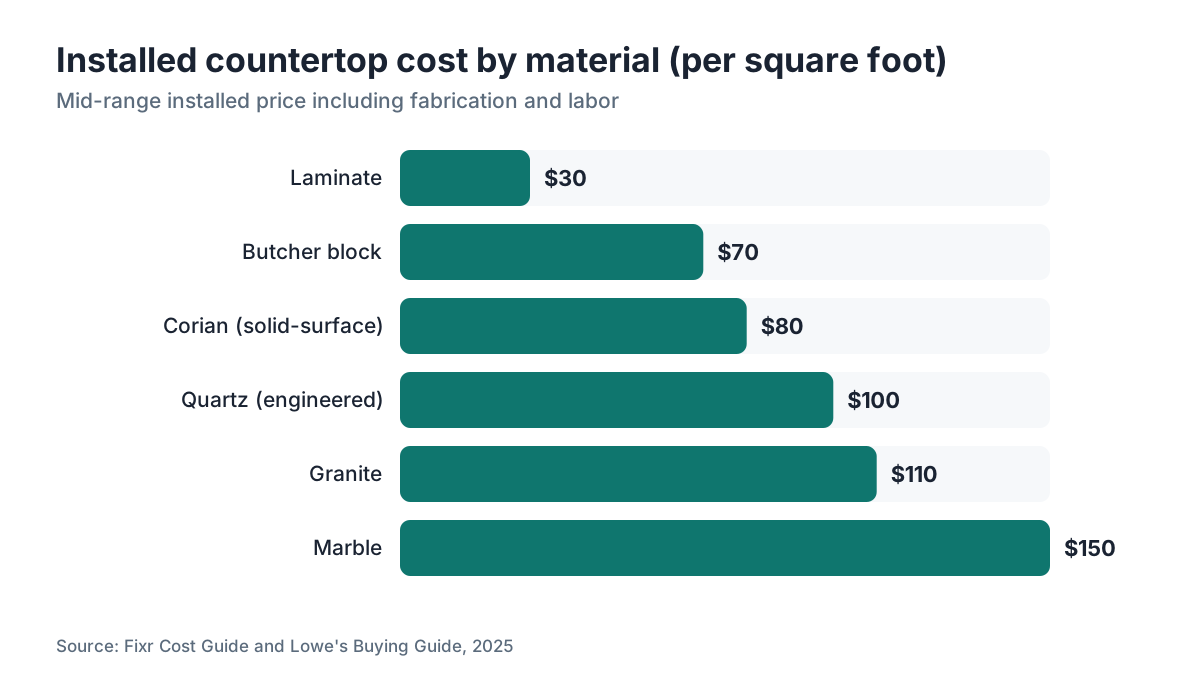
Here is a straight comparison of installed cost ranges for common countertop materials. These are market ranges, not hard ceilings, and your local quotes may land outside them depending on region and project complexity.
| Material | Installed cost per sq ft | Seam visibility | Integrated sinks | Repairability |
|---|---|---|---|---|
| Corian (solid-surface) | $45, $150 | Nearly invisible | Yes | Yes, sandable |
| Granite countertops | $50, $200 | Visible | No | Chips; needs pro repair |
| Quartz (engineered) | $60, $150 | Visible | No | Limited |
| Marble countertops | $75, $250 | Visible | No | Etches; needs sealing |
| Laminate countertops | $15, $45 | Visible at seams | No | No; replace section |
| Butcher block countertops | $40, $100 | Glue joints | No | Yes, sandable |
Corian sits in the mid-range, more than laminate and less than high-end natural stone [8]. It competes most directly with engineered quartz on price. The practical difference: solid-surface scratches more easily than quartz but sands back to new, while quartz shrugs off scratches but keeps any permanent damage forever [4].
For a full look at what goes into kitchen countertops cost across materials, the differences in fabrication complexity explain a lot of the pricing gap between stone and solid-surface.
How much does a typical kitchen Corian installation cost in total?
A 40-square-foot kitchen at a mid-range price of $75 per square foot installed comes to $3,000. That covers material, a basic edge profile, a standard undermount sink cutout, and installation. No tearout.
Add tearout of existing laminate tops ($200), an ogee edge upgrade ($300), and an integrated sink ($500), and the same kitchen runs $4,000. That is a real-world scenario, not a worst case.
Larger kitchens with islands push the square footage to 60 or 70 feet. At $80 per square foot, a 65-square-foot job is $5,200 before upgrades. The island adds seams, extra edge finishing, and sometimes a waterfall detail that piles on several hundred dollars more.
Bathrooms are smaller, 10 to 20 square feet, but minimum job charges at many shops run $500 to $1,200 regardless of size. A tiny vanity top can cost $600 even when the square footage math suggests $300, simply because the shop still has to schedule a visit, set up, and fabricate a single piece.
For context on what the full countertop installation process involves beyond the material cost, the tearout, template, and cure time all affect your timeline.
What does the installation process actually involve?
Solid-surface installation is different from stone. Corian sheets ship from the factory in 30-inch by 144-inch pieces, usually 1/2 inch thick for horizontal surfaces [2]. The fabricator cuts, shapes, and joins pieces in the shop, then delivers semi-finished sections to your home.
Seams get joined with a color-matched adhesive, clamped, then sanded flush. Done right, seams in Corian are nearly invisible to the eye and impermeable to water. This is one of the material's genuine wins over stone, where seam quality rides entirely on the fabricator's skill and the color often makes the joint obvious.
After delivery, installers set the pieces, secure them to the cabinets, connect plumbing if they handle that, and do a final surface sand if needed. A typical kitchen install takes three to six hours for the crew. Complex kitchens with an island and multiple cutouts can eat a full day.
You should never need to seal Corian. Unlike granite or quartzite, solid-surface is non-porous and needs no sealing at install or on an annual schedule [4]. That is real long-term savings compared to natural stone, where sealing runs $100 to $300 each time.
Can you save money with a DIY Corian installation?
Technically yes. Corian works with standard woodworking tools, a router, and sanders. DuPont, now Corian Design, publishes fabrication guidelines for the sheet goods. The problem is the seaming.
Invisible seams need a color-matched joint adhesive, precise machining of both edges, and clamping technique that takes experienced hands. A bad seam is worse than ugly. It is a spot where water eventually gets in and swells the substrate beneath. Most DIYers who take on Corian end up with a seam that looks fine at first and turns into a problem within a year.
If your layout is a single piece with no seams, say a small bathroom vanity top under 30 inches wide, DIY fabrication gets realistic. Prefabricated Corian vanity tops also sit on the shelf at home centers for $150 to $400, already shaped and finished. Those are a legitimate DIY option [5].
For full kitchen runs with seams, the money saved almost never covers the risk. Spend it on a qualified fabricator instead.
How do fabricators price a Corian job? What should your quote show?
A good Corian quote breaks out material cost by color tier, linear feet of edge profile, each cutout separately, tearout if it applies, and any special features like integrated sinks or backsplash. A quote that just says '$4,200 installed' is hard to compare and hard to dispute if something gets missed.
Fabricators who run modern estimating software, including platforms like SlabWise that handle quoting and job costing for solid-surface and stone shops, tend to itemize better because the software makes them enter each cost separately. Ask for an itemized breakdown no matter what tool they use.
Material markup varies. Most fabricators buy Corian sheet goods from authorized distributors and mark them up 30 to 60 percent before adding labor. That is a normal margin for a trade business, but it means the cheapest material quote is not always the cheapest final quote if labor rates differ.
Ask whether the quote includes the sink, faucet holes, and connection to plumbing. Many fabricators install the top and leave plumbing reconnection to a plumber, a separate $100 to $200 charge. Know this before your counters go in. The Consumer Product Safety Commission ties botched plumbing reconnection to water damage claims in home improvement projects [10].
What are the long-term costs of owning Corian countertops?
Corian's real edge over natural stone is repairability. Surface scratches, minor burns from a pan set too close to the edge, and even light gouges sand out with 120- to 220-grit sandpaper and buff back to a matte or satin finish [4]. A professional refinish runs $150 to $350 and can make a 15-year-old Corian surface look close to new.
You will not reseal. You will not sweat etching from lemon juice the way marble owners do. Corian needs no periodic treatment, which puts annual maintenance cost near zero for most homeowners.
The main long-term risk is heat damage. Corian handles intermittent temperatures up to about 212 degrees Fahrenheit, but sustained direct heat above that can discolor or distort the surface [2]. A trivet is non-negotiable. A repair to a heat-discolored spot is possible but not always invisible, and if the damage runs deep, a section replacement may run $400 to $800.
Warranty coverage matters here too. Corian Design offers a 10-year limited warranty on materials when the job is done by an authorized fabricator [2]. That warranty skips heat damage and misuse, but it covers manufacturing defects and delamination. Make sure your fabricator is authorized or you get no warranty at all.
Is Corian worth the cost compared to cheaper solid-surface alternatives?
Corian is the original solid-surface brand, introduced by DuPont in 1967, and it still commands a slight premium over generic solid-surface products [6]. Whether that premium earns its keep depends on what you are buying.
Brands like Wilsonart, Formica solid-surface, and LG Hi-Macs use similar acrylic and polyester formulations. They get fabricated and installed the same way. The color and pattern libraries differ, and quality consistency varies by manufacturer. Corian's color matching and sheet-to-sheet consistency are genuinely good thanks to tight manufacturing controls, which matters a lot when you have multiple seams that need to disappear.
If you like the Corian palette, the 10-year warranty and brand recognition from authorized dealers earn the small premium. If a generic solid-surface has the color you want and your fabricator has real experience with it, you can save $5 to $15 per square foot without much sacrifice.
Here is what I would not do. Buy the cheapest solid-surface from a fabricator who mostly works in stone and does one Corian job a month. Seaming technique is material-specific. A stone shop that rarely touches solid-surface is more likely to leave you a visible seam than a dedicated solid-surface shop.
For Cambria countertops or other premium engineered options, the price overlap with Corian is real. The choice comes down to look, repairability, and whether integrated sinks matter to you.
How do you get an accurate quote for Corian countertops?
Measure your countertop footprint in square feet. Length times depth in inches, divided by 144, gives you square feet per section. Add all sections, then add 10 percent for waste and cutout offsets. That is your working number for comparing quotes.
Call at least three authorized Corian fabricators near you. Corian Design runs a dealer locator on their website [2]. Authorized means the fabricator has been trained, carries the adhesive system, and can honor the manufacturer warranty. A non-authorized shop can still do good work, but you lose the warranty.
Bring your measurements, a photo of your kitchen layout, and a decision on sink type. If you already know you want an integrated sink and a specific edge profile, say so upfront. A fabricator forced to guess at your scope will pad the quote. One who gets the full picture can price it tight.
Anyone who fires off an instant number over the phone before seeing the space is guessing. A real quote needs a template. Some shops charge $75 to $150 for the template visit and credit it back on the job. That is fair. It filters out tire-kickers and makes sure the measurement is right.
Are there ways to get Corian countertops installed for less?
Go with an entry-level color. The Corian spectrum includes solid whites and neutrals that cost noticeably less than the premium veined patterns. Glacier White and Venaro White have been builder favorites for decades because they look clean and the price is right. If you like a simple look, you lose nothing going entry-level.
Stick with a simple edge. Eased or beveled edges work exactly like fancy profiles and cost a fraction as much. The ogee is beautiful. It is also $20 to $40 more per linear foot for something you mostly see from the side.
Skip the island waterfall if budget is tight. A waterfall edge, where the countertop material drops vertically to the floor on the end of the island, burns a lot of material and demands precision mitering. It can add $800 to $2,000 depending on size. It looks dramatic. It is also expensive and a pain to repair if the miter ever fails.
Handle your own tearout if you are comfortable with it. Renting a reciprocating saw, cutting the old laminate top into sections, and hauling it away yourself is a Saturday morning job. It can knock $150 to $300 off the quote.
Time the job for the off-season. Fabrication shops in most regions slow down in January and February. You may be able to talk a modest discount or at least dodge scheduling delays.
Frequently asked questions
How much does Corian cost per square foot installed in 2026?
Expect $45 to $150 per square foot fully installed, depending on color tier, edge profile, cutouts, and your local labor market. Most mid-range kitchen projects land between $65 and $95 per square foot. Integrated sinks, complex shapes, and tearout of existing tops push the number higher. Get at least three itemized quotes from authorized Corian fabricators before committing.
How much does an average kitchen Corian countertop installation cost in total?
A 40-square-foot kitchen with a standard color, eased edge, and one sink cutout runs roughly $2,500 to $3,800. Add an integrated sink, upgraded edge, and tearout and you are looking at $3,800 to $5,500. Larger kitchens with islands regularly reach $5,000 to $8,000. Bathroom vanities often carry minimum job charges that put small installs at $500 to $1,200 regardless of square footage.
Is Corian more expensive than quartz countertops?
They overlap heavily. Corian runs $45 to $150 per square foot installed; engineered quartz runs $60 to $150. At the mid-range, prices are nearly identical. Corian can be cheaper at the entry level and allows integrated sinks that quartz cannot match. Quartz is harder and more scratch-resistant. The choice is about the look and features you need, not a clear price winner.
Can I install Corian countertops myself to save money?
You can for very simple jobs, particularly prefabricated vanity tops available at home centers for $150 to $400. Full kitchen installs with seams are risky as DIY projects. Invisible seams require color-matched adhesive, precision machining, and clamping technique that is hard to replicate without experience. A bad seam is a water infiltration point. For any job with more than one piece, pay a qualified fabricator.
How long does Corian countertop installation take?
Fabrication in the shop takes three to seven business days after templating. On-site installation for a typical kitchen takes three to six hours for the crew. Complex kitchens with islands and multiple cutouts can take a full day. Add the template visit, fabrication period, and installation day, and plan for seven to fourteen days from first contact to finished counters. Rush jobs may be available for a fee.
Does Corian come with a warranty?
Yes. Corian Design offers a 10-year limited warranty on materials when the job is done by an authorized fabricator. The warranty covers manufacturing defects and delamination but excludes damage from heat, improper use, or abrasive cleaners. To get coverage, confirm your fabricator is authorized through the Corian Design dealer locator before signing a contract.
How do you repair Corian countertops if they get scratched or burned?
Light scratches sand out with 120- to 220-grit sandpaper followed by a Scotch-Brite pad to restore the matte finish. Minor burns can be sanded similarly in most cases. Deep gouges or heat discoloration may require professional refinishing at $150 to $350, or a section replacement at $400 to $800 for severe damage. This repairability is one of Corian's real advantages over stone and quartz.
What is the cost difference between Corian and laminate countertops?
Laminate installs for $15 to $45 per square foot, well below Corian's $45 to $150 range. A 40-square-foot kitchen in laminate might run $800 to $1,500 installed versus $2,500 to $5,000 in Corian. Laminate cannot be repaired once damaged and shows seams clearly. Corian costs more upfront but is sandable, hides its seams, and supports integrated sinks that laminate cannot.
Does Corian need to be sealed?
No. Corian and other solid-surface materials are non-porous, so they need no sealing at installation or on any maintenance schedule. This sets them apart from natural stone like granite, quartzite, and marble, all of which need resealing every one to three years. The absence of sealing costs is a genuine long-term savings and one less maintenance task.
What factors make a Corian quote go higher than expected?
The biggest surprises are integrated sinks ($300 to $800 extra), decorative edge profiles ($15 to $40 per linear foot above a basic eased edge), multiple cutouts beyond a standard single sink, tearout and disposal of old countertops ($150 to $400), and island waterfall details ($800 to $2,000). Premium color tiers also add $10 to $20 per square foot over entry-level colors. Ask for a fully itemized quote to see each charge clearly.
How do I find an authorized Corian fabricator near me?
Corian Design keeps a dealer and fabricator locator on their official website at corian.com. Authorized fabricators have completed training on seaming technique, carry the correct adhesive system, and can honor the 10-year manufacturer warranty. Non-authorized shops can still do solid-surface work but the warranty does not transfer. Always confirm authorization before signing a contract if the warranty matters to you.
Is Corian good for outdoor countertops or outdoor kitchens?
No. Corian is not rated for outdoor use. Sustained UV exposure causes color fading and surface degradation, and freeze-thaw cycles can cause delamination. The manufacturer warranty explicitly excludes outdoor applications. For outdoor kitchens, look at porcelain tile, concrete, or natural granite, all of which handle weather better. Using Corian outdoors voids the warranty and will likely look bad within a couple of seasons.
How does Corian hold up compared to granite long-term?
Granite is harder and more scratch-resistant than Corian but requires periodic sealing and cannot be repaired if chipped or cracked without visible patching. Corian scratches more easily but those scratches sand out. Granite seams are always visible; Corian seams can nearly disappear. For a low-maintenance kitchen you want to repair rather than replace, Corian holds up well over 15 to 20 years with basic care.
What is the cost of Corian countertops installed for a bathroom vanity?
A single bathroom vanity top in Corian, 25 to 36 inches wide, typically runs $400 to $1,000 installed. Many fabrication shops have minimum job charges of $500 to $1,200, so a small vanity can cost more per square foot than a full kitchen. Prefabricated Corian vanity tops at home centers run $150 to $400 and are a genuine DIY option for standard-size vanities without complex cutouts.
Sources
- HomeAdvisor (Angi), Corian Countertops Cost Guide: Installed Corian countertops cost $45 to $150 per square foot depending on color tier, edge profile, and regional labor rates
- Corian Design, Official Product and Warranty Information: Corian is sold through authorized dealers and fabricators; standard sheet dimensions are 30 by 144 inches; Corian Design offers a 10-year limited warranty when installed by authorized fabricators
- U.S. Bureau of Labor Statistics, Occupational Employment and Wage Statistics, Tile and Stone Setters and Related Workers: National median wage for tile and stone setters was approximately $22 per hour in the most recent Occupational Employment and Wage Statistics survey
- Corian Design, Care and Maintenance Guide: Corian is non-porous and does not require sealing; surface scratches and minor burns can be sanded out with 120- to 220-grit sandpaper; material is rated for intermittent heat up to 212 degrees Fahrenheit
- The Home Depot, Prefabricated Solid Surface Vanity Tops: Prefabricated solid-surface vanity tops, including Corian-branded options, are available at home improvement retailers for $150 to $400
- U.S. Patent and Trademark Office, Corian Trademark History: Corian solid-surface material was introduced by DuPont in 1967 and is among the longest-standing branded solid-surface products in the market
- Fixr, Countertop Installation Cost Guide: Integrated sink fabrication in solid-surface material adds $300 to $800 over a standard undermount sink cutout; edge profile upgrades add $15 to $40 per linear foot above a basic eased edge
- Lowe's, Countertop Materials Buying Guide: Laminate countertops install for $15 to $45 per square foot; granite and engineered quartz install for $50 to $200 per square foot depending on grade and region
- National Kitchen and Bath Association, Kitchen and Bath Market Index: Countertop replacement is among the most common kitchen remodeling purchases tracked in NKBA industry surveys
- U.S. Consumer Product Safety Commission, Home Improvement Safety: Improper installation of countertops and failure to reconnect plumbing correctly are cited causes of water damage claims in home improvement projects
Last updated 2026-07-09