TL;DR
- White marble countertops run $40 to $200 per square foot installed, depending on variety and edge work.
- They scratch, etch, and stain more easily than granite or quartz.
- Carrara is the most affordable Italian option.
- If you can live with patina and seal every 6 to 12 months, marble is genuinely beautiful.
- If you want zero maintenance, look elsewhere.
What do white marble countertops actually cost?
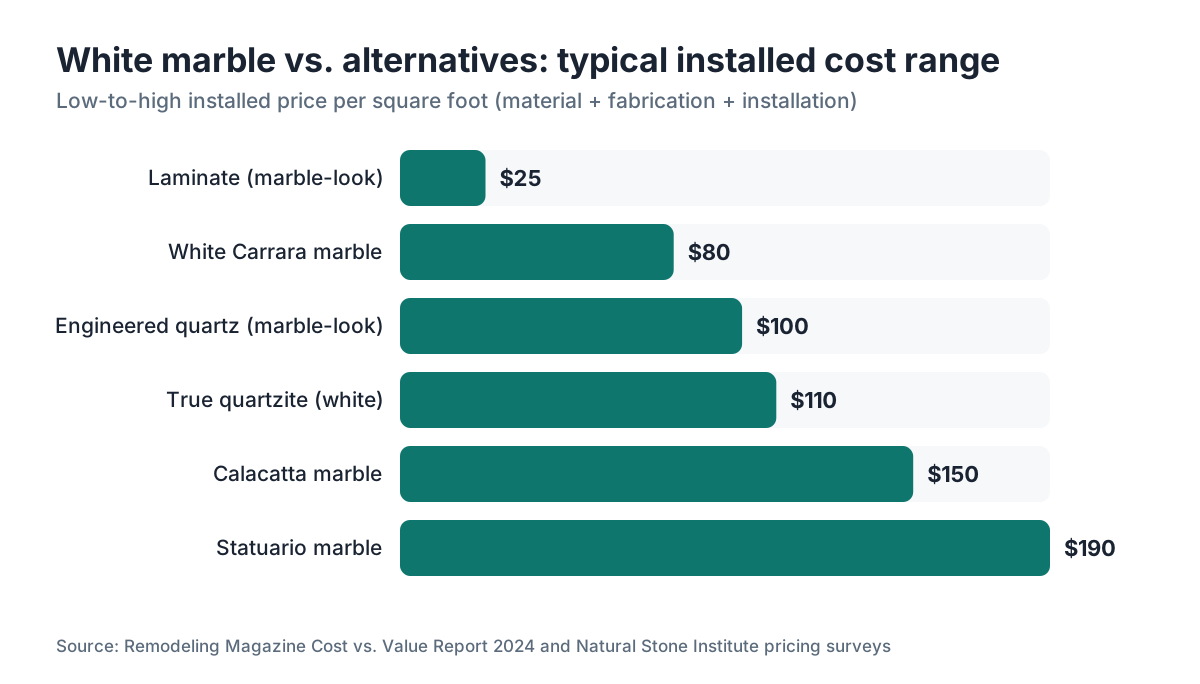
Installed prices for white marble countertops range from roughly $40 per square foot on the low end (basic Carrara with a straight edge) to $200 or more per square foot for premium Calacatta Gold with waterfall edges and complex cutouts [1]. The national median for marble countertop installation sits around $75 to $100 per square foot installed, according to contractor pricing surveys, though regional labor costs shift that number by 20 to 30 percent in either direction.
Material alone typically runs $20 to $60 per square foot for the slab, depending on origin, veining quality, and slab thickness (2 cm vs 3 cm). Fabrication, edge profiles, cutouts, and installation add another $30 to $80 per square foot. So when someone quotes you $50 per square foot for marble, make sure you know whether that includes fabrication and installation or just the raw stone.
A standard kitchen with 40 square feet of countertop runs $2,000 to $4,000 for Carrara and $6,000 to $8,000 or more for high-end Calacatta. Bathrooms are cheaper because the runs are shorter, but the per-foot price is the same.
For a full picture of how marble stacks up against other materials, see our guide to kitchen countertops and the marble countertops overview.
What is the difference between Carrara, Calacatta, and Statuario marble?
These three names get used interchangeably at showrooms, which is either ignorance or sales strategy. They are genuinely different stones with different prices and visual characters.
Carrara marble comes from the Apuan Alps near Carrara, Italy. It has a soft grey-white background with fine, feathery grey veining. It is the most widely quarried Italian marble and therefore the most affordable. A white Carrara marble countertop or a white and grey marble countertop effect is what most people picture when they imagine marble in a kitchen. Supply is relatively consistent, which keeps prices stable [2].
Calacatta marble also comes from the Carrara region but from a specific set of quarries that produce less material. The background is brighter white, and the veining is bolder, thicker, and often tinged with gold or grey. Because it is rarer, it costs more, typically 2 to 4 times what Carrara runs per square foot. Calacatta Borghini and Calacatta Gold are the prestige names that show up on design media.
Statuario marble is the rarest of the three. It has a very bright white ground with dramatic, sparse veining, historically prized for sculpture. Michelangelo used Statuario for the statue of David [2]. Supply is limited and price reflects that.
| Variety | Background | Veining style | Typical slab price ($/sq ft) | Relative supply |
|---|---|---|---|---|
| Carrara | Grey-white | Fine, feathery, grey | $20, $40 | High |
| Calacatta | Bright white | Bold, wide, gold/grey | $60, $150+ | Medium |
| Statuario | Bright white | Sparse, dramatic | $80, $200+ | Low |
| Arabescato | White | Busy grey/rust | $35, $80 | Medium |
Italian Carrara white marble countertops remain the default choice for anyone who wants the look without spending Calacatta money. If a fabricator shows you a slab labeled "Calacatta" at Carrara prices, ask for the quarry certificate.
Is white marble too high-maintenance for a kitchen?
Honest answer: it depends on who is cooking and what they expect the stone to look like in ten years.
Marble is calcium carbonate. Acids etch it. Lemon juice, vinegar, tomato sauce, wine, and most household cleaners will dull the polished surface on contact. That dull spot is not a stain you can wipe away. It is a chemical reaction that removes the polished surface layer and leaves a matte patch [3]. Repolishing requires professional equipment.
Marble also absorbs liquids. A polished marble surface has a natural porosity around 0.3 to 0.5 percent, lower than many people think, but enough that red wine or coffee sitting on an unsealed surface for 15 minutes can leave a permanent mark [4]. Regular sealing cuts the absorption rate hard.
Scratching is less of an issue than etching. Marble sits at 3 to 4 on the Mohs hardness scale, which means a knife dragged across it will scratch it, but normal kitchen use does not produce many scratches unless someone is cutting directly on the stone.
Plenty of people cook on marble for decades without drama. The habits that actually work: wipe spills right away, use cutting boards every time, never reach for acidic cleaners, and accept that a kitchen counter will pick up patina. That patina, the honed or "lived-in" look, is what you see in 200-year-old Italian kitchens. Some designers prefer it on purpose.
If you want absolutely zero risk, granite countertops have higher hardness and lower acid sensitivity. Quartz engineered stone has near-zero porosity. But neither looks like marble.
How often does white marble need to be sealed?
Seal a polished white marble countertop every 6 to 12 months in a kitchen, and every 12 to 24 months in a bathroom where acid exposure is lower [4]. Honed finishes are slightly more porous than polished and lean toward the frequent end of that range.
The water test tells you when resealing is due: pour a tablespoon of water on the surface and watch it for 10 minutes. If the water beads up, the sealer is intact. If it soaks in and darkens the stone, seal now.
Impregnating sealers (also called penetrating sealers) are the right product. They soak into the pores of the stone and repel liquids from within. Topical sealers sit on the surface, peel, and make the stone look plasticky. Look for a sealer rated for marble specifically, since granite sealers are formulated for lower porosity and may not penetrate marble adequately [4].
Application takes about 20 minutes for a standard kitchen. Apply the sealer, let it sit for the dwell time on the label (usually 5 to 10 minutes), wipe off the excess before it hazes, and let it cure for 24 hours before putting the kitchen back into full use. That is the whole job.
Sealing does not prevent etching. Etching is a chemical surface reaction, and no sealer stops acid from reacting with calcium carbonate. Sealing only slows liquid absorption.
What finishes are available for white marble countertops?
Polished is the default finish everyone pictures: a mirror-like surface that makes the veining pop and the white look almost luminous. It shows etching and fingerprints more visibly than other finishes, which is the trade-off.
Honed means the surface is ground flat but not buffed to a shine. It looks matte or satin. Etching is less visible on a honed surface because the stone is already matte to begin with. Most designers working with Carrara in kitchens recommend honed for this reason. The downside is slightly higher porosity, so sealing matters more.
Leathered (also called brushed) creates a slight texture by running diamond-tipped brushes across the stone. It hides fingerprints well and has a contemporary feel. Less common for marble than for granite because the process can muddy marble's veining.
Satin is a middle step between polished and honed. Some slabs are sold satin-finished as a compromise, though most fabricators consider it an intermediate step rather than a final option.
For white marble specifically, honed is the most practical for a high-use kitchen. Polished is the right choice for a bathroom vanity where acid exposure is minimal and you want the full visual impact.
How does white marble compare to quartz and quartzite in a kitchen?
Three genuinely different stones (or engineered products) that get compared constantly, so here are the real differences.
White marble is natural calcium carbonate. It etches with acid, absorbs liquids without sealing, costs $40 to $200 per square foot installed, and looks unlike anything else. It is soft enough (Mohs 3 to 4) to scratch with a knife.
Quartzite is a natural metamorphic stone made of sandstone compressed into silica. It looks similar to marble in many white-and-grey varieties, but it is dramatically harder (Mohs 7+) and resistant to acid etching. The catch: quartzite is often mislabeled at stone yards. Many slabs sold as "white quartzite" are actually dolomitic marble or soft quartzite that still etches. Ask for an acid test on any quartzite slab before you buy. For more on caring for true quartzite, see how to clean quartzite countertops.
Engineered quartz (brands like Cambria, Silestone, Caesarstone) is roughly 90 to 94 percent ground quartz bound with polymer resin [5]. It does not etch, does not need sealing, and resists most stains. White and grey versions closely mimic Carrara marble. Cost runs $50 to $150 per square foot installed. The trade-off is that it looks manufactured at close range, cannot be refinished if damaged, and can discolor from prolonged UV exposure or very high heat. See Cambria countertops for a deep look at one popular brand.
| Material | Acid resistance | Hardness (Mohs) | Needs sealing | Installed cost ($/sq ft) |
|---|---|---|---|---|
| White marble | Low (etches) | 3 to 4 | Yes, 6 to 12 mo | $40, $200 |
| True quartzite | High | 7+ | Yes, annually | $60, $150 |
| Engineered quartz | High | ~7 | No | $50, $150 |
| Granite | High | 6 to 7 | Yes, 1 to 3 yr | $40, $120 |
Choosing between marble and quartz for a busy family kitchen? Quartz is the lower-risk pick by a wide margin. If the look of real stone matters more than zero-maintenance performance, marble earns its extra attention.
What edge profiles work best with white marble?
Edge profile is a real decision for marble because it affects both looks and durability. Marble chips more easily than granite at thin exposed edges.
Eased edge (a simple 90-degree corner with a slight soften) is the most durable and contemporary option. It shows the full thickness of the slab and works well with modern and transitional kitchens.
Bevel and chamfer edges break the corner at 45 degrees. Less chip-prone than a sharp 90-degree edge. Good for high-traffic kitchens.
Bullnose (the entire edge rounded over into a half-circle profile) is a classic for marble and hides chips well because there is no sharp corner to damage. It can look dated in very modern designs.
Ogee and dupont profiles have more decorative curves and work in traditional and transitional kitchens. They require more fabrication time, which adds cost, and the thin sections of the profile are more vulnerable to chipping in marble.
For a 3 cm (1.25 inch) white marble slab, any profile works structurally. For 2 cm (0.75 inch) slabs, which are thinner, stick to eased or beveled edges and avoid profiles with thin exposed sections. The edge itself typically adds $10 to $30 per linear foot depending on complexity [1].
How do fabricators quote and template white marble jobs differently than other stone?
Marble templating demands more attention to veining direction than most other stone. On a white Carrara marble countertop, the veining runs in a consistent direction through the slab. A good fabricator orients pieces so veining flows continuously across a seam, which means more careful slab layout and sometimes more waste.
Vein-matching across seams is possible but adds cost. It requires the fabricator to buy more slab (sometimes 20 to 30 percent extra) to account for the material lost in matching, and it takes more layout time. On Calacatta with bold veining, the visual impact of a matched seam is significant. On Carrara with fine veining, matching is less critical and most homeowners cannot see a mismatch from normal viewing distance.
Slab inspection before cutting matters more with marble than granite. White marble amplifies any background cloudiness, natural fissures, or color variation. Visit the stone yard with your fabricator before the deposit is placed, and ask to see the specific slabs that will be used on your job.
For fabricators who quote multiple materials and want to track slab yield accurately, software like SlabWise automates the nesting calculations that tell you exactly how much of each slab you will consume on a marble job, which cuts expensive waste on high-cost material.
Seam placement is a bigger aesthetic issue with white stone than dark stone. Plan seam locations during templating, not after. Seams near sinks are structurally riskier; seams in open field areas of the counter are less visible but need proper support.
Can you use white marble in a bathroom vanity or other lower-traffic areas?
Bathroom vanities are where marble performs best in residential settings. Acid exposure is minimal (toothpaste is mildly abrasive but not acidic enough to etch quickly, and most hand soaps are neutral to slightly alkaline). The surface gets used less intensively than a kitchen counter.
Many of the iconic marble bathrooms you see in design publications are completely realistic for real homeowners. A bathroom vanity top in honed Carrara, sealed once a year, can look essentially new after 20 years of normal use.
Fireplace surrounds are another excellent use case. No acid exposure, no heat close enough to damage the stone, and marble's history as a fireplace material goes back centuries in European architecture [2].
Laundry room counters are lower risk than kitchens. Laundry detergents are alkaline, which does not etch marble. The risk is physical impact and iron staining from wet metal hardware.
Outdoor use is a different matter. Freeze-thaw cycles damage marble over time as water expands in the natural micro-fissures of the stone. Italian marble is not recommended for outdoor countertop applications in climates with freezing winters.
How do you clean and remove stains from white marble countertops?
Daily cleaning is simple: warm water and a few drops of pH-neutral dish soap on a soft cloth. Wipe, rinse, dry. Never use vinegar, lemon juice, citrus-based cleaners, bleach, or abrasive powders on marble. All of those either etch or scratch [3].
For organic stains (coffee, tea, wine, food), a poultice made of baking soda and water applied to the stain, covered with plastic wrap, and left overnight pulls the stain out of the stone as it dries. This works for fresh stains. Old stains that have been in the stone for weeks are much harder to remove.
Oil stains (cooking grease, butter) need a different poultice: acetone or mineral spirits mixed with an absorbent powder like talc. Same application method: apply, cover, let dry, remove.
Etch marks are not stains and cannot be removed with cleaning. A shallow etch can sometimes be polished out with marble polishing powder (tin oxide or aluminum oxide), working in small circles with a damp cloth. Deeper etching needs professional honing or repolishing.
For more detail on cleaning natural stone safely, see how to clean stone countertops and how to clean soapstone countertops for comparison with another natural stone that has its own maintenance quirks.
Never use a steam cleaner on marble. The heat and moisture drive water into the stone and can cause fissures to open.
What should homeowners know before buying white marble countertops?
Get the slab designation in writing. A receipt that says "white marble" is not enough. You want the variety name (Carrara, Calacatta, Arabescato, etc.), the country of origin, and ideally the quarry name. This matters if you ever need to match additional material for a repair or expansion.
Buy from the same lot. Marble color varies by block. If you need multiple slabs, buy them all from the same quarry run (same lot number) so the background color and veining character match.
Ask about fissures before you finalize. Natural fissures in marble are normal and structurally fine in most cases. But a fissure running through the area where a sink cutout will be placed is a fabrication risk. A good fabricator will show you the slab and point out any concerns before cutting.
Think through your seam plan early. Every kitchen layout has seams somewhere. Know where yours will be before installation day, not after.
Factor in the ongoing cost. Penetrating sealer for a kitchen countertop runs $20 to $50 per application if you do it yourself, once or twice a year. If you hire a stone care company, expect $150 to $300 per visit. Over 10 years, that is $1,500 to $6,000 in maintenance that granite or quartz does not require at the same frequency.
For homeowners who want a quicker path to understanding their total project cost before they ever visit a showroom, the SlabWise instant quote tool gives a real price range based on material, square footage, and edge profile, which is useful context before you negotiate with a fabricator.
What are the best alternatives to white marble countertops?
If you love the look but not the maintenance, engineered quartz is the most honest substitute. Brands like Cambria, Silestone, and MSI Calacatta Gold Quartz reproduce the white-and-grey marble appearance closely enough that most guests will not notice the difference. Zero sealing, high scratch resistance, acid-proof. See the Cambria countertops guide for specifics on one leading brand.
If you want natural stone but less fragility, true quartzite (verified with an acid test) gives a similar aesthetic with much better durability. Supply is inconsistent and the mislabeling problem is real, but when you get the real thing, it performs far better than marble in a kitchen.
Porcelain slabs are a newer category worth knowing about. Large-format porcelain panels (6 to 12 mm thick) in white marble patterns are now widely available, cost $30 to $80 per square foot installed, resist acid and heat, and look convincing at countertop distance. They cannot be routed for an undermount sink the same way stone can, and seams show more at thick-panel thickness, but the technology is improving.
For historical perspective on lower-cost white-look surfaces, laminate countertops and Formica countertops now come in marble-look patterns that fool most people from normal viewing distance. They scratch more easily and cannot be refinished, but at $10 to $40 per square foot installed they are a completely rational choice for a rental property or tight budget. Corian countertops offer another solid surface option with repairability that marble lacks.
For those who want something warm rather than cool, butcher block countertops pair beautifully with white marble islands as a contrasting perimeter material.
Frequently asked questions
Are white marble countertops hard to maintain in a busy kitchen?
Yes, compared to granite or quartz. Marble etches from acid (lemon juice, vinegar, tomato sauce) and absorbs liquids without sealing. A busy family kitchen that gets wiped down once a day but has kids spilling juice and adults cooking daily acidic food will show etching and staining within months. If that sounds like your house, engineered quartz is a more practical choice. If you can commit to wiping spills immediately and sealing twice a year, marble is workable.
How long does white marble last as a countertop?
Structurally, marble lasts indefinitely. Ancient marble surfaces are thousands of years old. The real question is cosmetic durability. In a kitchen, a polished white marble surface will develop etch marks and possibly staining within the first year of normal use. Whether that patina bothers you is a personal decision. Honed marble ages more gracefully in kitchens because the matte surface already absorbs the visual texture of the etch marks.
What is the difference between white Carrara marble and Calacatta marble?
Carrara has a grey-white background with fine, subtle veining and is widely quarried near Carrara, Italy, making it the more affordable option at $20 to $40 per square foot for slab material. Calacatta comes from rarer quarries in the same region, has a brighter white background with bolder, thicker veining often tinged with gold, and costs 2 to 4 times more. Both are Italian marble but they are visually and economically distinct.
Does sealing white marble prevent staining and etching?
Sealing slows liquid absorption and cuts staining risk hard, but it does not prevent etching. Etching is a chemical reaction between acid and calcium carbonate on the stone surface. No sealer stops that reaction. Sealing buys you more time before a liquid stains, which matters for red wine or coffee that sits for a few minutes, but it will not protect a marble surface from a vinaigrette left sitting for an hour.
Is Italian Carrara white marble countertop worth the price premium over domestic marble?
Italian Carrara has a consistent grey-white look and fine veining that has been prized for centuries. Domestic white marbles from Tennessee, Georgia, or Vermont are structurally comparable but look different, often with a creamier or more varied background. Whether the visual difference justifies a 20 to 50 percent cost premium is a style decision, not a performance one. For fabrication purposes, both cut and finish similarly.
Can white marble countertops be repaired if they chip or crack?
Small chips can be filled with color-matched epoxy and are often nearly invisible after a professional repair. Cracks that run fully through the stone are more serious and may require bonding with epoxy and adding support underneath. Etch marks can sometimes be polished out with marble polishing powder at home, or by a professional with a floor polisher. Deep scratches require professional honing and repolishing. No repair is perfect, but most damage is repairable to a cosmetically acceptable level.
What thickness of marble slab should I choose, 2 cm or 3 cm?
3 cm (about 1.25 inches) is the standard for kitchen countertops and is what most fabricators recommend. It is stronger, requires no plywood substrate for most installations, and gives a more substantial visual presence. 2 cm (about 0.75 inches) is lighter and slightly less expensive for the slab itself but typically needs a substrate for support and is more prone to cracking under impact. For bathrooms or furniture applications, 2 cm can work fine.
What backsplash works best with white marble countertops?
White marble slab backsplashes that extend from the countertop up to the cabinets create a continuous veining effect that looks expensive and is actually simpler to clean than tile grout. Subway tile in white or grey complements Carrara without competing. Bold patterned tile in navy, black, or terracotta makes a strong contrast against white countertops. The material to avoid is another heavily patterned stone, which usually creates visual conflict. Keep at least one surface (wall, cabinet, floor) quiet.
Is honed or polished marble better for a kitchen?
Honed is the more practical kitchen finish for marble. Etch marks are far less visible on a matte surface, because etching just removes polish that was not there to begin with on a honed stone. Polished marble shows every etch mark as a dull spot against the mirror surface. Both require the same sealing frequency. Most professional kitchen designers working with marble in active cooking kitchens specify honed for this reason.
How do I get an accurate quote for white marble countertop installation?
You need three things for an accurate quote: your square footage (measure and add 10 to 15 percent for waste and overages), your edge profile choice, and the specific marble variety you want. Get quotes from at least two fabricators using the same specifications so you are comparing the same scope. Ask each quote to break out material, fabrication, and installation separately. Online estimators can give a useful ballpark before you make appointments.
Do white marble countertops increase home resale value?
Real estate data on specific countertop materials is sparse and regionally inconsistent. Remodeling Magazine's Cost vs. Value report tracks kitchen remodel returns broadly but not marble specifically [1]. General industry consensus is that natural stone countertops, including marble, contribute positively to kitchen appraisal value compared to laminate, but the premium over granite or quartz is not reliably measurable in resale price. Marble's biggest value impact is on buyer perception and time-on-market in certain price brackets.
What pH cleaners are safe to use on white marble?
Use cleaners with a pH between 7 and 9. Neutral dish soap and water is the safest daily option. Stone-specific cleaners labeled safe for marble are the next best choice. Avoid anything below pH 7 (acidic): vinegar, citrus cleaners, bathroom lime-scale removers, and most grout cleaners. Also avoid strong alkalis above pH 10, which can damage some sealers. When in doubt, plain warm water is always safe.
Are there white marble look-alikes that are lower maintenance?
Several. Engineered quartz in Carrara or Calacatta patterns (from Cambria, Caesarstone, MSI, and others) is the closest in appearance with near-zero maintenance. True quartzite like White Macaubas or Super White is natural stone with much better acid resistance, though you must verify it with an acid test before buying. Large-format porcelain slabs in marble patterns are increasingly convincing and cost $30 to $80 per square foot installed.
Sources
- Remodeling Magazine, Cost vs. Value Report 2024: Kitchen remodel cost and value data; context for countertop cost ranges in installed kitchen projects
- Marble Institute of America (Natural Stone Institute), Stone Types: Descriptions of Carrara, Calacatta, and Statuario marble origins and historical use including Michelangelo's use of Statuario
- Natural Stone Institute, Care and Maintenance of Natural Stone: Acid etching on marble: acids react with calcium carbonate, dulling polished surfaces chemically rather than via abrasion
- Marble Institute of America / Natural Stone Institute, Sealing Natural Stone: Recommended sealing frequency of 6 to 12 months for polished marble in kitchen applications; penetrating vs topical sealers
- Marble Institute of America / Natural Stone Institute, Engineered Stone FAQ: Engineered quartz is approximately 90 to 94 percent ground quartz bound with polymer resin
- OSHA, Silica Standard for General Industry (29 CFR 1910.1053): Fabrication safety requirements for silica-containing stone; relevant to fabricators cutting marble and engineered quartz
- EPA, An Introduction to Indoor Air Quality: Formaldehyde and VOCs: VOC context for adhesives and resins used in countertop fabrication and installation environments
- University of Florida IFAS Extension, Cleaning and Maintaining Natural Stone: pH guidance for cleaners safe on natural stone; recommendation to avoid acidic cleaners on calcium carbonate stones
- ASTM International, Standard C503: Specification for Marble Dimension Stone: Technical classification of marble as metamorphic rock composed predominantly of calcite or dolomite; hardness and absorption standards
Last updated 2026-07-09